


Mauna Kea Observatory

Encyclopedia
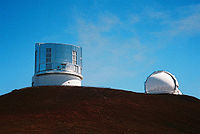
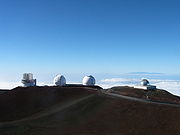
The Observatories at Mauna Kea, (MKO), are an independent collection of astronomical research facilities located on the summit of Mauna Kea
on the Big Island of Hawai'i
, USA
. The facilities are located in a 500 acres (2 km²) special land use zone known as the "Astronomy Precinct," which is located in the Mauna Kea Science Reserve. The Astronomy Precinct was established in 1967 and is located on land protected by the Historical Preservation Act
for its significance to Hawaiian culture.
The location is ideal because of its dark skies, good astronomical seeing
, low humidity and position above most of the water vapor in the atmosphere, clean air, good weather and almost equatorial location.
manages the site and leases land to several multi-national facilities which have invested more than $2 billion in science and technology.
makes Mauna Kea one of the best locations on earth for ground-based astronomy. It is an ideal location for submillimeter, infrared and optical observations. The seeing
statistics show that Mauna Kea is the best site in terms of optical and infrared image quality—for example the CFHT site has a median seeing of 0.43 arcseconds.
Accommodations for research astronomers are located at the Onizuka Center for International Astronomy
(often called Hale Pōhaku), 7 miles by unpaved steep road from the summit at 9300 feet (2835 m) above sea level.
An adjacent visitor information station is located at 9200 feet (2775 m). The summit of Mauna Kea is so high that tourists are advised to stop at the visitor station for at least 30 minutes to acclimate to atmospheric conditions before continuing to the summit, and scientists often stay at Hale Pōhaku for 8 hours or more before spending a full night at observatories on the summit, with some telescopes requiring observers to spend one full night at Hale Pōhaku before working at the summit.
and is a proposed site for Pan-STARRS
.
and aftershocks. Both CFHT and W. M. Keck Observatory were operational and back online by October 19.
Mauna Kea
Mauna Kea is a volcano on the island of Hawaii. Standing above sea level, its peak is the highest point in the state of Hawaii. However, much of the mountain is under water; when measured from its oceanic base, Mauna Kea is over tall—significantly taller than Mount Everest...
on the Big Island of Hawai'i
Hawaii (island)
The Island of Hawaii, also called the Big Island or Hawaii Island , is a volcanic island in the North Pacific Ocean...
, USA
United States
The United States of America is a federal constitutional republic comprising fifty states and a federal district...
. The facilities are located in a 500 acres (2 km²) special land use zone known as the "Astronomy Precinct," which is located in the Mauna Kea Science Reserve. The Astronomy Precinct was established in 1967 and is located on land protected by the Historical Preservation Act
National Historic Preservation Act of 1966
The National Historic Preservation Act is legislation intended to preserve historical and archaeological sites in the United States of America...
for its significance to Hawaiian culture.
The location is ideal because of its dark skies, good astronomical seeing
Astronomical seeing
Astronomical seeing refers to the blurring and twinkling of astronomical objects such as stars caused by turbulent mixing in the Earth's atmosphere varying the optical refractive index...
, low humidity and position above most of the water vapor in the atmosphere, clean air, good weather and almost equatorial location.
Ownership
The University of Hawai'iUniversity of Hawaii
The University of Hawaii System, formally the University of Hawaii and popularly known as UH, is a public, co-educational college and university system that confers associate, bachelor, master, and doctoral degrees through three university campuses, seven community college campuses, an employment...
manages the site and leases land to several multi-national facilities which have invested more than $2 billion in science and technology.
Location
The altitude and isolation in the middle of the Pacific OceanPacific Ocean
The Pacific Ocean is the largest of the Earth's oceanic divisions. It extends from the Arctic in the north to the Southern Ocean in the south, bounded by Asia and Australia in the west, and the Americas in the east.At 165.2 million square kilometres in area, this largest division of the World...
makes Mauna Kea one of the best locations on earth for ground-based astronomy. It is an ideal location for submillimeter, infrared and optical observations. The seeing
Astronomical seeing
Astronomical seeing refers to the blurring and twinkling of astronomical objects such as stars caused by turbulent mixing in the Earth's atmosphere varying the optical refractive index...
statistics show that Mauna Kea is the best site in terms of optical and infrared image quality—for example the CFHT site has a median seeing of 0.43 arcseconds.
Accommodations for research astronomers are located at the Onizuka Center for International Astronomy
Onizuka Center for International Astronomy
The Onizuka Center for International Astronomy, also known as Hale Pōhaku, is a complex of support facilities for the telescopes and other instruments that comprise the Mauna Kea Observatory atop Mauna Kea, on Hawaii island.-History:...
(often called Hale Pōhaku), 7 miles by unpaved steep road from the summit at 9300 feet (2835 m) above sea level.
An adjacent visitor information station is located at 9200 feet (2775 m). The summit of Mauna Kea is so high that tourists are advised to stop at the visitor station for at least 30 minutes to acclimate to atmospheric conditions before continuing to the summit, and scientists often stay at Hale Pōhaku for 8 hours or more before spending a full night at observatories on the summit, with some telescopes requiring observers to spend one full night at Hale Pōhaku before working at the summit.
Telescopes
Telescopes found at the summit of Mauna Kea are funded by government agencies of various nations. The University of Hawai'i itself directly administers two telescopes. In total there are 12 telescopes at or around the summit of Mauna Kea. It will also be the site of the Thirty Meter TelescopeThirty meter telescope
The Thirty Metre Telescope is a proposed ground-based large segmented mirror reflecting telescope to be built on Mauna Kea in Hawaii. The telescope is designed for observations from the near-ultraviolet to the mid-infrared . An adaptive optics system would correct for image blur caused by the...
and is a proposed site for Pan-STARRS
Pan-STARRS
The Panoramic Survey Telescope and Rapid Response System is a planned array of astronomical cameras and telescopes and computing facility that will survey the sky on a continual basis, including accurate astrometry and photometry of detected objects...
.
- Caltech Submillimeter ObservatoryCaltech Submillimeter ObservatoryThe Caltech Submillimeter Observatory is a diameter submillimeter wavelength telescope situated alongside the James Clerk Maxwell Telescope at Mauna Kea Observatory. It is engaged in submillimeter astronomy, of the terahertz radiation band.The CSO and JCMT were combined to form the first...
(CSO): Caltech - Canada France Hawai'i Telescope (CFHT): CanadaCanadaCanada is a North American country consisting of ten provinces and three territories. Located in the northern part of the continent, it extends from the Atlantic Ocean in the east to the Pacific Ocean in the west, and northward into the Arctic Ocean...
, FranceFranceThe French Republic , The French Republic , The French Republic , (commonly known as France , is a unitary semi-presidential republic in Western Europe with several overseas territories and islands located on other continents and in the Indian, Pacific, and Atlantic oceans. Metropolitan France...
, University of Hawai'iUniversity of HawaiiThe University of Hawaii System, formally the University of Hawaii and popularly known as UH, is a public, co-educational college and university system that confers associate, bachelor, master, and doctoral degrees through three university campuses, seven community college campuses, an employment... - Gemini North TelescopeGemini ObservatoryThe Gemini Observatory is an astronomical observatory consisting of two telescopes at sites in Hawai‘i and Chile. Together, the twin Gemini telescopes provide almost complete coverage of both the northern and southern skies...
: United StatesUnited StatesThe United States of America is a federal constitutional republic comprising fifty states and a federal district...
, United KingdomUnited KingdomThe United Kingdom of Great Britain and Northern IrelandIn the United Kingdom and Dependencies, other languages have been officially recognised as legitimate autochthonous languages under the European Charter for Regional or Minority Languages...
, CanadaCanadaCanada is a North American country consisting of ten provinces and three territories. Located in the northern part of the continent, it extends from the Atlantic Ocean in the east to the Pacific Ocean in the west, and northward into the Arctic Ocean...
, ChileChileChile ,officially the Republic of Chile , is a country in South America occupying a long, narrow coastal strip between the Andes mountains to the east and the Pacific Ocean to the west. It borders Peru to the north, Bolivia to the northeast, Argentina to the east, and the Drake Passage in the far...
, AustraliaAustraliaAustralia , officially the Commonwealth of Australia, is a country in the Southern Hemisphere comprising the mainland of the Australian continent, the island of Tasmania, and numerous smaller islands in the Indian and Pacific Oceans. It is the world's sixth-largest country by total area...
, ArgentinaArgentinaArgentina , officially the Argentine Republic , is the second largest country in South America by land area, after Brazil. It is constituted as a federation of 23 provinces and an autonomous city, Buenos Aires...
, BrazilBrazilBrazil , officially the Federative Republic of Brazil , is the largest country in South America. It is the world's fifth largest country, both by geographical area and by population with over 192 million people... - Infrared Telescope FacilityInfrared Telescope FacilityThe NASA Infrared Telescope Facility is a telescope optimized for use in infrared astronomy and located at the Mauna Kea Observatory in Hawai'i. It was first built to support the Voyager missions and is now the USA national facility for infrared astronomy, providing continued support to...
(IRTF): NASANASAThe National Aeronautics and Space Administration is the agency of the United States government that is responsible for the nation's civilian space program and for aeronautics and aerospace research... - James Clerk Maxwell TelescopeJames Clerk Maxwell TelescopeThe James Clerk Maxwell Telescope is a submillimetre-wavelength telescope at Mauna Kea Observatory in Hawaii. Its primary mirror is 15 metres across: it is the largest astronomical telescope that operates in submillimetre wavelengths of the electromagnetic spectrum...
(JCMT): United KingdomUnited KingdomThe United Kingdom of Great Britain and Northern IrelandIn the United Kingdom and Dependencies, other languages have been officially recognised as legitimate autochthonous languages under the European Charter for Regional or Minority Languages...
, CanadaCanadaCanada is a North American country consisting of ten provinces and three territories. Located in the northern part of the continent, it extends from the Atlantic Ocean in the east to the Pacific Ocean in the west, and northward into the Arctic Ocean...
, NetherlandsNetherlandsThe Netherlands is a constituent country of the Kingdom of the Netherlands, located mainly in North-West Europe and with several islands in the Caribbean. Mainland Netherlands borders the North Sea to the north and west, Belgium to the south, and Germany to the east, and shares maritime borders... - Subaru TelescopeSubaru (telescope)Subaru Telescope is the 8.2 metre flagship telescope of the National Astronomical Observatory of Japan, located at the Mauna Kea Observatory on Hawaii. It is named after the open star cluster known in English as the Pleiades...
: National Astronomical Observatory of JapanNational Astronomical Observatory of JapanThe is an astronomical research organisation comprising several facilities in Japan, as well as an observatory in Hawaii. It was established in 1988 as an amalgamation of three existing research organizations - the Tokyo Astronomical Observatory of the University of Tokyo, International Latitude... - Sub-Millimeter ArraySubmillimeter ArrayThe Submillimeter Array consists of eight diameter radio telescopes arranged as an interferometer for submillimeter wavelength observations. It is the first purpose-built submillimeter interferometer, constructed after successful interferometry experiments using the pre-existing James Clerk...
(SMA): TaiwanTaiwanTaiwan , also known, especially in the past, as Formosa , is the largest island of the same-named island group of East Asia in the western Pacific Ocean and located off the southeastern coast of mainland China. The island forms over 99% of the current territory of the Republic of China following...
, United StatesUnited StatesThe United States of America is a federal constitutional republic comprising fifty states and a federal district... - United Kingdom Infrared TelescopeUnited Kingdom Infrared TelescopeUKIRT, the United Kingdom Infra-Red Telescope, is a 3.8 metre infrared reflecting telescope, the largest dedicated infrared telescope in the world. It is operated by the Joint Astronomy Centre in Hilo and located on Mauna Kea, Hawai'i as part of Mauna Kea Observatory...
(UKIRT): United KingdomUnited KingdomThe United Kingdom of Great Britain and Northern IrelandIn the United Kingdom and Dependencies, other languages have been officially recognised as legitimate autochthonous languages under the European Charter for Regional or Minority Languages... - University of Hawai'i 88 inches (2.2 m) telescopeUH88The University of Hawai'i 88-inch telescope called UH88, UH2.2, or simply 88 by members of the local astronomical community is situated at the Mauna Kea Observatory and operated by the University's Institute for Astronomy...
(UH88): University of Hawai'i - University of Hawai'i 24 inches (609.6 mm) telescope (UH24): University of Hawaii at HiloUniversity of Hawaii at HiloThe University of Hawaii at Hilo, UHH, or UH Hilo is one of the ten branches of the University of Hawaii system anchored by the University of Hawaii at Mānoa in Honolulu, Hawaii...
- One receiver of the Very Long Baseline ArrayVery Long Baseline ArrayThe Very Long Baseline Array is a system of ten radio telescopes controlled remotely from the Array Operations Center in Socorro, New Mexico by the National Radio Astronomy Observatory. The array works together as the world's largest dedicated, full-time astronomical instrument using the...
(VLBA): United StatesUnited StatesThe United States of America is a federal constitutional republic comprising fifty states and a federal district... - W. M. Keck Observatory: California Association for Research in Astronomy
2006 Hawaii earthquake
A number of the telescopes sustained minor damage during the October 15, 2006 Hawaii earthquake2006 Hawaii earthquake
The 2006 Hawaii earthquake was an offshore earthquake occurring southwest from Puakō and north of Kailua-Kona, Hawaii, just offshore of the Kona Airport, on Sunday October 15, 2006 at 7:07:49 AM local time . It measured 6.7 on the moment magnitude scale, and was located at , at a depth of...
and aftershocks. Both CFHT and W. M. Keck Observatory were operational and back online by October 19.
See also
- Timeline of telescopes, observatories, and observing technologyTimeline of telescopes, observatories, and observing technology-3500s BC:*The earliest sundials known from the archaeological record are the obelisks ancient Egyptian astronomy and Babylonian astronomy-1900s BC:*Xiangfen Astronomical Observatory, Xiangfen County, Linfen City, Shanxi Province, China-600s BC:...
- Other major international observatories (under active development):
- Roque de los Muchachos ObservatoryRoque de los Muchachos ObservatoryRoque de los Muchachos Observatory is an astronomical observatory located in the municipality of Garafía on the island of La Palma in the Canary Islands...
- Paranal ObservatoryParanal ObservatoryParanal Observatory is an astronomical observatory located on Cerro Paranal at 2,635 m altitude and operated by the European Southern Observatory. The Very Large Telescope is the largest telescope on Paranal, actually composed of four separate 8.2 m telescopes...
- Cerro Tololo Inter-American ObservatoryCerro Tololo Inter-American ObservatoryThe Cerro Tololo Inter-American Observatory is a complex of astronomical telescopes and instruments located at 30.169 S, 70.804 W, approximately 80 km to the East of La Serena, Chile at an altitude of 2200 metres. The complex is part of the National Optical Astronomy Observatory along with Kitt...
- Llano de Chajnantor ObservatoryLlano de Chajnantor ObservatoryLlano de Chajnantor Observatory is an astronomical observatory located at an altitude of 5,104 m in the Chilean Atacama desert, 50 kilometers to the east of San Pedro de Atacama. It is a very dry site - inhospitable to humans - but an excellent site for submillimetre astronomy...
- Roque de los Muchachos Observatory
- Historically important observatories (not undergoing substantial development):
- Mount Wilson ObservatoryMount Wilson ObservatoryThe Mount Wilson Observatory is an astronomical observatory in Los Angeles County, California, United States. The MWO is located on Mount Wilson, a 5,715 foot peak in the San Gabriel Mountains near Pasadena, northeast of Los Angeles...
- Kitt Peak Observatory
- Palomar ObservatoryPalomar ObservatoryPalomar Observatory is a privately owned observatory located in San Diego County, California, southeast of Pasadena's Mount Wilson Observatory, in the Palomar Mountain Range. At approximately elevation, it is owned and operated by the California Institute of Technology...
- Mount Wilson Observatory
External links
- Mauna Kea Observatory web page
- Mauna Kea webcams
- Essay on visiting the Mauna Kea Observatories
- Weather forecast for Mauna Kea summit
- Photos of Mauna Kea from "A Gentle Rain of Starlight: The Story of Astronomy on Mauna Kea" by Michael J. West. ISBN 0-93154-899-3.
- Mauna Kea Visitor Information Station
- Office of Mauna Kea Management
- Thirty Meter Telescope Hawaii Environmental Impact Statement Process
- Mauna Kea Comprehensive Management Plan