
All Topics  
Semiconductor


Semiconductor


A
semiconductor is a solidSolid

A solid object is in the phase of matter characterized by resistance to deformation and changes of volume....
 material that has electrical conductivityElectrical conductivity

Electrical conductivity is a measure of a material's ability to conduct an electric current....
 in between that of a conductorElectrical conductor

In science and engineering, conductors are materials that contain movable charges of electricity....
 and that of an insulatorElectrical insulation

An insulator is a material or object which contains no movable electrical charges....
; it can vary over that wide range either permanently or dynamically.

Semiconductors are tremendously important in electronicElectronics

The field of electronics comprises the study and use of systems that operate by controlling the flow of electrons in device...
 technologyTechnology

Despite its cultural pervasiveness, technology is an elusive concept....
. Semiconductor deviceSemiconductor device

Semiconductor devices are electronic components that exploit the electronic properties of semiconductor materials, principal...
s, electronic components made of semiconductor materials, are essential in modern consumer electronicsConsumer electronics

Consumer electronics are electronic equipment intended for use by everyday people....
, including computers, mobile phoneMobile phone

A mobile or cell phone is a long-range, portable electronic device for personal telecommunications over long dis...
s, and digital audio playerDigital audio player

A digital audio player is a device that stores, organizes and plays digital music files....
s. SiliconSilicon

Silicon is the chemical element in the periodic table that has the symbol Si and atomic number 14....
 is used to create most semiconductors commercially, but dozens of other materials are used as well.

Overview

Semiconductors are very similar to insulatorsElectrical insulation

An insulator is a material or object which contains no movable electrical charges....
. The two categories of solids differ primarily in that insulators have larger band gapBand gap

In solid state physics and related applied fields, the band gap is the energy difference between the top of the valence band...
s—energiesEnergy

In general, the concept of energy refers to "the potential for causing changes." The word is used in several different conte...
 that electronElectron

The electron is a fundamental subatomic particle that carries an electric charge....
s must acquire to be free to move from atom to atom. In semiconductors at room temperature, just as in insulators, very few electrons gain enough thermal energy to leap the band gapBand gap

In solid state physics and related applied fields, the band gap is the energy difference between the top of the valence band...
 from the valence bandValence band

In solids, the valence band is the highest range of electron energies where electrons are normally present at absolute zero....
 to the conduction bandConduction band

In semiconductors and insulators, the conduction band is the range of electron energy, higher than that of the valence band,...
, which is necessary for electrons to be available for electric current conductionElectrical conduction

Electrical conduction is the movement of electrically charged particles through a transmission medium....
. For this reason, pure semiconductors and insulators in the absence of applied electric fields, have roughly similar resistance. The smaller bandgaps of semiconductors, however, allow for other means besides temperatureTemperature

In thermodynamics, temperature is a measure of the tendency of an object or system to spontaneously give up energy....
 to control their electrical properties.

Semiconductors' intrinsicIntrinsic semiconductor

An intrinsic semiconductor, also called an undoped semiconductor or i-type semiconductor, is a pure semiconducto...
 electrical properties are often permanently modified by introducing impurities by a process known as doping. Usually, it is sufficient to approximate that each impurity atom adds one electron or one "hole" (a concept to be discussed later) that may flow freely. Upon the addition of a sufficiently large proportion of impurity dopants, semiconductors will conduct electricityElectricity

Electricity is a general term for the variety of phenomena resulting from the presence and flow of electric charge....
 nearly as well as metals. Depending on the kind of impurity, a doped region of semiconductor can have more electrons or holes, and is named N-typeN-type semiconductor Overview

An N-type semiconductor is obtained by carrying out a process of doping, that is, by adding an impurity of valence-five elem...
 or P-type semiconductorP-type semiconductor

A P-type semiconductor is obtained by carrying out a process of doping, that is adding a certain type of atoms to the semico...
 material, respectively. Junctions between regions of N- and P-type semiconductorsP-n junction

A p-n junction is formed by combining N-type and P-type semiconductors together in very close contact....
 create electric fieldElectric field

In physics, the properties of space that surrounds an electric charge can be described using an electric field or E-field...
s, which cause electrons and holes to be available to move away from them, and this effect is critical to semiconductor device operation. Also, a density difference in the amount of impurities produces a small electric field in the region which is used to accelerate non-equilibrium electrons or holes.

In addition to permanent modification through doping, the resistance of semiconductors is normally modified dynamically by applying electric fields. The ability to control resistance/conductivity in regions of semiconductor material dynamically through the application of electric fields is the feature that makes semiconductors useful. It has led to the development of a broad range of semiconductor devices, like transistorTransistor

The transistor is a three terminal solid state semiconductor device that can be used for amplification, switching, voltage s...
s and diodeDiode

In electronics, a diode is a component that restricts the direction of movement of charge carriers....
s. Semiconductor devices that have dynamically controllable conductivity, such as transistors, are the building blocks of integrated circuits devices like the microprocessorMicroprocessor Overview

A microprocessor is a digital electronic component with transistors on a single semiconductor integrated circuit ....
. These "active" semiconductor devices (transistors) are combined with passive componentFacts About Passive component

A passive component is an electronic component that does not require a source of energy to perform its intended function....
s implemented from semiconductor material such as capacitorCapacitor

A capacitor is an electrical device that can store energy in the electric field between a pair of closely spaced conductors....
s and resistorResistor

|- align = "center"||width = "25"|| |- align = "center"...
s, to produce complete electronic circuits.

In most semiconductors, when electrons lose enough energy to fall from the conduction band to the valence band (the energy levels above and below the band gapElectronic band structure

In solid state physics, the electronic band structure of a solid describes ranges of energy that an electron is "forbidden" ...
), they often emit lightFacts About Light

Light is electromagnetic radiation with a wavelength that is visible to the eye or, in a technical or scientific context, e...
. This photoemissionPhotoemission

Photoemission may refer to:* Electron emission from matter after the absorption of energetic photons....
 process underlies the light-emitting diodeFacts About Light-emitting diode

A light-emitting diode is a semiconductor device that emits incoherent narrow-spectrum light when electrically biased in th...
 (LED) and the semiconductor laser, both of which are very important commercially. Conversely, semiconductor absorption of light in photodetectorPhotodetector

Photosensors or photodetectors are sensors of light or other electromagnetic energy....
s excites electrons to move from the valence band to the higher energy conduction band, thus facilitating detection of light and vary with its intensity. This is useful for fiber optic communications, and providing the basis for energyEnergy

In general, the concept of energy refers to "the potential for causing changes." The word is used in several different conte...
 from solar cellSolar cell

A solar cell is a semiconductor device that converts photons into electricity....
s.

Semiconductors may be elemental materials such as siliconSilicon

Silicon is the chemical element in the periodic table that has the symbol Si and atomic number 14....
 and germaniumGermanium

.Germanium is a chemical element in the periodic table that has the symbol Ge and atomic number 32....
, or compound semiconductorCompound semiconductor

A Compound Semiconductor is a semiconductor compound composed of elements from two or more different groups of the periodic ...
s such as gallium arsenideGallium Arsenide

Gallium Arsenide is an independent record label....
 and indium phosphide, or alloys such as silicon germanium or aluminium gallium arsenideAluminium gallium arsenide

Aluminium gallium arsenide is a semiconductor material with very nearly the same lattice constant as GaAs, but a larger band...
.

Band structure


Image:HAtomOrbitals.png| In a single H-atom an electron resides in well known orbits. Note that the orbits are called s,p,d in order of increasing circular current.
Image:CovalentBond.png| Putting two atoms together leads to delocalized orbits across two atoms, a so called covalent bondCovalent bond

Covalent bonding is an intramolecular form of chemical bonding characterized by the sharing of one or more pairs of electron...
. Due to Paulis principle in every state there is max one electron.
Image:Bändermodell-Potentialtöpfe.png| This can be continued with more atoms. Note: This picture unfortunately shows a metal.
Image:Benz4.png| Using 6 carbon atoms one can create molecular orbits which allow for circular current. Filling the states following Pauli's principle leads to zero net current. Current due to uneven filling needs an energy investment.
Image:Ressauts et terrasses.png| Proceeding in a regular fashion and create a crystal, which may after creation be cut into a tape and fused together at the ends allow for circular currents.
Image:Si-band-schematics.PNG| For this regular solid the band structure can be calculated or measured.
Image:Electronic_band_diagram.svg| Integrating over the k axis gives the bands of a semiconductor showing a full valence band and an empty conduction band. Generally stopping at the vacuum level is dumb, because some people want to calculate: photoemissionPhotoemission

Photoemission may refer to:* Electron emission from matter after the absorption of energetic photons....
, inverse photoemissionInverse photoemission

Inverse photoemission is a surface science technique used to study the unoccupied electronic structure of surfaces, thin fil...
, Semiconductor_detector#particle_detectorsSemiconductor detector Summary

A semiconductor detector is a device that uses a semiconductor to detect traversing charged particles or the absorption of p...

]]
Image:Wave packet (no dispersion).gif| After the band structure is determined states can be combined to generate wave packetWave packet Summary

In physics, a wave packet is an envelope or packet containing an arbitrary number of wave forms....
s. As this is analogous to wave packages in free space, the results are similar.
Image:Diffusion rayleigh et diffraction.png| An alternative descriptionBragg's law

In physics, Bragg's law is the result of experiments into the diffraction of X-rays or neutrons off crystal surfaces at cert...
, which does not really appreciate the strong Coulomb interaction, shoots free electrons into the crystal and looks at the scattering.
Image:Semiconduttore intrinseco.png| A third alternative descriptionLewis structure

Lewis structures, also called electron-dot structures or electron-dot diagrams, are diagrams that show the bonding between a...
 uses strongly localized unpaired electrons in chemical bonds, which looks almost like a Mott insulatorMott insulator

Mott Insulators are a class of materials that are expected to conduct electricity under conventional band theories, but whic...
.


There are three popular ways to describe the electronic structure of a crystal. The first starts from single atoms. An atom has discrete energy levels.
When two atoms come close each energy level splits into an upper and a lower level, whereby they delocalize across the two atoms.
With more atoms the number of levels increases, and groups of levels form bands.
Semiconductors contain many bands. If there is a large distance between the highest occupied state and the lowest unoccupied space, then a gap will likely remain between occupied and unoccupied bands even after band formation.

A second way starts with free electrons waveWave

A wave is a disturbance that propagates through space or spacetime, often transferring energy....
s. When fading in an electrostatic potential due to the cores,
due to Bragg reflection some waves are reflected and cannot penetrate the bulk, that is a band gap opens.
In this description it is not clear, while the number of electrons fills up exactly all states below the gap.

A third description starts with two atoms. The split states form a covalent bondCovalent bond Overview

Covalent bonding is an intramolecular form of chemical bonding characterized by the sharing of one or more pairs of electron...

where two electrons with spin up and spin down are mostly in between the two atoms.
Adding more atoms now is supposed not to lead to splitting, but to more bonds.
This is the way silicon is typically drawn. The band gap is now formed by lifting one electron from the lower electron level
into the upper level. This level is known to be anti-bonding, but bulk silicon has not been seen to lose atoms as easy as electrons are
wandering through it. Also this model is most unsuitable to explain how in graded hetero-junction the band gap can vary smoothly.

Like in other solids, the electrons in semiconductors can have energies only within certain bands (ie. ranges of levels of energy) between the energy of the ground state, corresponding to electrons tightly bound to the atomic nuclei of the material, and the free electron energy, which is the energy required for an electron to escape entirely from the material. The energy bands each correspond to a large number of discrete quantum stateQuantum state Overview

In quantum mechanics, the quantum state of a system completely describes all aspects of the system....
s of the electrons, and most of the states with low energy (closer to the nucleus) are full, up to a particular band called the valence bandValence band

In solids, the valence band is the highest range of electron energies where electrons are normally present at absolute zero....
. Semiconductors and insulators are distinguished from metals because the valence band in the semiconductor materials is very nearly full under usual operating conditions, thus causing more electrons to be available in the conduction band.

The ease with which electrons in a semiconductor can be excited from the valence band to the conduction band depends on the band gapBand gap

In solid state physics and related applied fields, the band gap is the energy difference between the top of the valence band...
 between the bands, and it is the size of this energy bandgap that serves as an arbitrary dividing line (roughly 4 eVElectronvolt

The electronvolt is a unit of energy....
) between semiconductors and insulatorElectrical insulation

An insulator is a material or object which contains no movable electrical charges....
s.

In the picture of covalent bonds, an electron moves by hopping to a neighboring bond. Because of the Pauli exclusion principlePauli exclusion principle

The Pauli exclusion principle is a quantum mechanical principle formulated by Wolfgang Pauli in 1925....
 it has to be lifted into the higher anti-bonding state of that bond. In the picture of delocalized states, for example in one dimension that is in a wire, for every energy there is a state with electrons flowing in one direction and one state for the electrons flowing in the other. For a net current to flow some more states for one direction then for the other direction have to be occupied and for this energy is needed. For a metal this can be a very small energy in the semiconductor the next higher states lie above the band gap. Often this is stated as: full bands do not contribute to the electrical conductivityElectrical conductivity

Electrical conductivity is a measure of a material's ability to conduct an electric current....
. However, as the temperature of a semiconductor rises above absolute zeroAbsolute zero

Absolute zero is the point on the thermodynamic temperature scale where the heat energy is at a minimum, that is, no more h...
, there is more energy in the semiconductor to spend on lattice vibration and — more importantly for us — on lifting some electrons into an energy states of the conduction band, which is the band immediately above the valence band. The current-carrying electrons in the conduction band are known as "free electrons", although they are often simply called "electrons" if context allows this usage to be clear.

Electrons excited to the conduction band also leave behind electron holeElectron hole

In solid state physics, an electron hole is the absence of an electron from the otherwise full valence band....
s, or unoccupied states in the valence band. Both the conduction band electrons and the valence band holes contribute to electrical conductivity. The holes themselves don't actually move, but a neighboring electron can move to fill the hole, leaving a hole at the place it has just come from, and in this way the holes appear to move, and the holes behave as if they were actual positively charged particles.

One covalent bondCovalent bond

Covalent bonding is an intramolecular form of chemical bonding characterized by the sharing of one or more pairs of electron...
 between neighboring atoms in the solid is ten times stronger than the binding of the single electron to the atom, so freeing the electron does not imply destruction of the crystal structure.

The notion of holesElectron hole

In solid state physics, an electron hole is the absence of an electron from the otherwise full valence band....
, which was introduced for semiconductors, can also be applied to metalMetal

In chemistry, a metal is an element that readily forms positive ions and has metallic bonds....
s, where the Fermi level lies within the conduction band. With most metals the Hall effectHall effect

The Hall effect refers to the potential difference on opposite sides of a thin sheet of conducting or semiconducting materi...
 reveals electrons to be the charge carriers, but some metals have a mostly filled conduction band, and the Hall effectHall effect

The Hall effect refers to the potential difference on opposite sides of a thin sheet of conducting or semiconducting materi...
 reveals positive charge carriers, which are not the ion-cores, but holes. Contrast this to some conductorsElectrical conductor

In science and engineering, conductors are materials that contain movable charges of electricity....
 like solutions of saltSalt

In chemistry, a salt is any ionic compound composed of cations and anions so that the product is neutral ....
s, or plasma. In the case of a metal, only a small amount of energy is needed for the electrons to find other unoccupied states to move into, and hence for current to flow. Sometimes even in this case it may be said that a hole was left behind, to explain why the electron does not fall back to lower energies: It cannot find a hole. In the end in both materials electron-phonon scattering and defects are the dominant causes for resistanceElectrical resistance

Electrical resistance is a measure of the degree to which an object opposes the passage of an electric current....
.

The energy distribution of the electrons determines which of the states are filled and which are empty. This distribution is described by Fermi-Dirac statisticsFermi-Dirac statistics

In statistical mechanics, Fermi-Dirac statistics is a particular case of particle statistics developed by Enrico Fermi and ...
. The distribution is characterized by the temperatureTemperature

In thermodynamics, temperature is a measure of the tendency of an object or system to spontaneously give up energy....
 of the electrons, and the Fermi energyFermi energy

In physics and Fermi-Dirac statistics, the Fermi energy of a system of non-interacting fermions is the smallest possible inc...
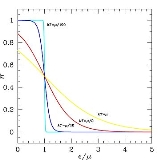
or Fermi level. Under absolute zero conditions the Fermi energy can be thought of as the energy up to which available electron states are occupied. At higher temperatures, the Fermi energy is the energy at which the probability of a state being occupied has fallen to 0.5.

The dependence of the electron energy distribution on temperature also explains why the conductivity of a semiconductor has a strong temperature dependency, as a semiconductor operating at lower temperatures will have fewer available free electrons and holes able to do the work.

Energy–momentum dispersion


In the preceding description an important fact is ignored for the sake of simplicity: the dispersion of the energy. The reason that the energies of the states are broadened into a band is that the energy depends on the value of the wave vectorWave vector

A wave vector is a vector representation of a wave....
, or k-vector, of the electron. The k-vector, in quantum mechanics, is the representation of the momentumMomentum

In classical mechanics, momentum is the product of the mass and velocity of an object....
 of a particle.

The dispersion relationship determines the effective massEffective mass

In solid state physics, a particle's effective mass is the mass it seems to carry in the semiclassical model of transpor...
, , of electrons or holes in the semiconductor, according to the formula:

The effective mass is important as it affects many of the electrical properties of the semiconductor, such as the electron or hole mobilityElectron mobility

In physics, electron mobility, is used to describe the relation between drift velocity of electrons or holes in a solid mate...
, which in turn influences the diffusivity of the charge carriers and the electrical conductivityFacts About Electrical conductivity

Electrical conductivity is a measure of a material's ability to conduct an electric current....
 of the semiconductor.

Typically the effective mass of electrons and holes are different. This affects the relative performance of p-channel and n-channel IGFETs, for example (Muller & Kamins 1986:427).

The top of the valence band and the bottom of the conduction band might not occur at that same value of k. Materials with this situation, such as siliconFacts About Silicon

Silicon is the chemical element in the periodic table that has the symbol Si and atomic number 14....
 and germaniumGermanium Overview

.Germanium is a chemical element in the periodic table that has the symbol Ge and atomic number 32....
, are known as indirect bandgapIndirect bandgap

In semiconductor physics, an indirect bandgap is a bandgap in which the minimum energy in the conduction band is shifted by ...
materials. Materials in which the band extrema are aligned in k, for example gallium arsenideGallium Arsenide

Gallium Arsenide is an independent record label....
, are called direct bandgapDirect bandgap

In semiconductor physics, a direct bandgap means that the minimum of the conduction band lies directly above the maximum of the va...
semiconductors. Direct gap semiconductors are particularly important in optoelectronicsOptoelectronics Summary

Optoelectronics is the study and application of electronic devices that interact with light, and thus is usually considered ...
 because they are much more efficient as light emitters than indirect gap materials.

Carrier generation and recombination


When ionizing radiationIonizing radiation

Ionizing radiation has many practical uses, but it is also dangerous to human health....
 strikes a semiconductor, it may excite an electron out of its energy level and consequently leave a hole. This process is known as electron–hole pair generationFacts About Carrier generation and recombination

In the solid state physics of semiconductors, carrier generation and recombination are processes by which mobile elect...
. Electron-hole pairs are constantly generated from thermal energyThermal energy

Thermal energy is the internal energy of a thermodynamic system at equilibrium....
 as well, in the absence of any external energy source.

Electron-hole pairs are also apt to recombine. Conservation of energyConservation of energy

Conservation of energy states that the total amount of energy in an isolated system remains constant....
 demands that these recombination events, in which an electron loses an amount of energyEnergy Overview

In general, the concept of energy refers to "the potential for causing changes." The word is used in several different conte...
 larger than the band gapBand gap

In solid state physics and related applied fields, the band gap is the energy difference between the top of the valence band...
, be accompanied by the emission of thermal energy (in the form of phonons) or radiation (in the form of photons).

In the steady state, the generation and recombination of electron–hole pairs are in equipoise. The number of electron-hole pairs in the steady stateSteady state

Steady state is a more general situation than dynamic equilibrium....
 at a given temperature is determined by quantum statistical mechanicsQuantum statistical mechanics

Quantum statistical mechanics is the study of statistical ensembles of quantum mechanical systems....
. The precise quantum mechanicalQuantum mechanics

Quantum mechanics is a first quantized quantum theory that supersedes classical mechanics at the atomic and subatomic levels...
 mechanisms of generation and recombination are governed by conservation of energyConservation of energy

Conservation of energy states that the total amount of energy in an isolated system remains constant....
 and conservation of momentum.

As the probability that electrons and holes meet together is proportional to the product of their amounts, the product is in steady state nearly constant at a given temperature, providing that there is no significant electric field (which might "flush" carriers of both types, or move them from neighbour regions containing more of them to meet together) or externally driven pair generation. The product is a function of the temperature, as the probability of getting enough thermal energy to produce a pair increases with temperature, being approximately 1/exp(band gap / kT), where k is Boltzmann's constant and T is absolute temperature.

The probability of meeting is increased by carrier traps – impurities or dislocations which can trap an electron or hole and hold it until a pair is completed. Such carrier traps are sometimes purposely added to reduce the time needed to reach the steady state.

Doping


The property of semiconductors that makes them most useful for constructing electronic devices is that their conductivity may easily be modified by introducing impurities into their crystal lattice. The process of adding controlled impurities to a semiconductor is known as doping. The amount of impurity, or dopant, added to an intrinsicIntrinsic semiconductor

An intrinsic semiconductor, also called an undoped semiconductor or i-type semiconductor, is a pure semiconducto...
(pure) semiconductor varies its level of conductivity. Doped semiconductors are often referred to as extrinsicExtrinsic semiconductor

An extrinsic semiconductor is a semiconductor that has been doped, that is, into which a doping agent has been introduce...
.

Dopants


The materials chosen as suitable dopants depend on the atomic properties of both the dopant and the material to be doped. In general, dopants that produce the desired controlled changes are classified as either electron acceptors or donors. A donor atom that activates (that is, becomes incorporated into the crystal lattice) donates weakly-bound valence electrons to the material, creating excess negative charge carrierCharge carrier

Charge carrier denotes in physics a free particle carrying an electric charge....
s. These weakly-bound electrons can move about in the crystal lattice relatively freely and can facilitate conduction in the presence of an electric field. (The donor atoms introduce some states under, but very close to the conduction band edge. Electrons at these states can be easily excited to conduction band, becoming free electrons, at room temperature.) Conversely, an activated acceptor produces a hole. Semiconductors doped with donor impurities are called n-type, while those doped with acceptor impurities are known as p-type. The n and p type designations indicate which charge carrier acts as the material's majority carrier. The opposite carrier is called the minority carrier, which exists due to thermal excitation at a much lower concentration compared to the majority carrier.

For example, the pure semiconductor siliconSilicon

Silicon is the chemical element in the periodic table that has the symbol Si and atomic number 14....
 has four valence electrons. In silicon, the most common dopants are IUPAC group 13Boron group

The Boron group is the series of elements in group 13 in the periodic table....
 (commonly known as group III) and group 15Nitrogen group

The Nitrogen group elements are also known as IUPAC Group 15 of the periodic table....
 (commonly known as group V) elements. Group 13 elements all contain three valence electrons, causing them to function as acceptors when used to dope silicon. Group 15 elements have five valence electrons, which allows them to act as a donor. Therefore, a silicon crystal doped with boronBoron

|-| colspan="6" align="center" | *Boron-10 content may be as low as 19.1% and ashigh as 20.3% in natural samples....
 creates a p-type semiconductor whereas one doped with phosphorusPhosphorus

|-| Critical temperature || 994 KPhosphorus, , is the chemical element in the periodic table that has the symbol P a...
 results in an n-type material.

Effect on band structure


Doping a semiconductor crystal introduces allowed energy states within the band gap but very close to the energy band that corresponds with the dopant type. In other words, donor impurities create states near the conduction band while acceptors create states near the valence band. The gap between these energy states and the nearest energy band is usually referred to as dopant-site bonding energy or and is relatively small. For example, the for boronBoron

|-| colspan="6" align="center" | *Boron-10 content may be as low as 19.1% and ashigh as 20.3% in natural samples....
 in silicon bulk is 0.045 eV, compared with silicon's band gap of about 1.12 eV. Because is so small, it takes little energy to ionize the dopant atoms and create free carriers in the conduction or valence bands. Usually the thermal energy available at room temperature is sufficient to ionize most of the dopant.

Dopants also have the important effect of shifting the material's Fermi level towards the energy band that corresponds with the dopant with the greatest concentration. Since the Fermi level must remain constant in a system in thermodynamic equilibriumThermodynamic equilibrium

In thermodynamics, a thermodynamic system is said to be in thermodynamic equilibrium when it is in thermal equilibrium, mech...
, stacking layers of materials with different properties leads to many useful electrical properties. For example, the p-n junctionP-n junction Overview

A p-n junction is formed by combining N-type and P-type semiconductors together in very close contact....
's properties are due to the energy band bending that happens as a result of lining up the Fermi levels in contacting regions of p-type and n-type material.

This effect is shown in a band diagramBand diagram Overview

In solid-state physics of semiconductors, a band diagram is a diagram showing the variation in the valence band and conducti...
. The band diagram typically indicates the variation in the valence band and conduction band edges versus some spatial dimension, often denoted x. The Fermi energy is also usually indicated in the diagram. Sometimes the intrinsic Fermi energy, Ei, which is the Fermi level in the absence of doping, is shown. These diagrams are useful in explaining the operation of many kinds of semiconductor deviceSemiconductor device

Semiconductor devices are electronic components that exploit the electronic properties of semiconductor materials, principal...
s.

Preparation of semiconductor materials

Semiconductors with predictable, reliable electronic properties are necessary for mass productionMass production

Mass production is the production of large amounts of standardized products on production lines....
. The level of chemical purity needed is extremely high because the presence of impurities even in very small proportions can have large effects on the properties of the material. A high degree of crystalline perfection is also required, since faults in crystal structure (such as dislocationDislocation

In materials science, a dislocation is a linear crystallographic defect, or irregularity, within a crystal structure....
s, twinsCrystal twinning

Crystal twinning occurs when two separate crystals share some of the same crystal lattice points in a symmetrical manner....
, and stacking faultsCrystallographic defect

Crystalline solids have a very regular atomic structure: that is, the local positions of atoms with respect to each other are repe...
) interfere with the semiconducting properties of the material. Crystalline faults are a major cause of defective semiconductor devices. The larger the crystal, the more difficult it is to achieve the necessary perfection. Current mass production processes use crystal ingots between four and twelve inches (300 mm) in diameter which are grown as cylinders and sliced into waferFacts About Wafer (electronics)

n microelectronics, a wafer is a thin slice of semiconducting material, such as a silicon crystal, upon which microcircuits ...
s.

Because of the required level of chemical purity and the perfection of the crystal structure which are needed to make semiconductor devices, special methods have been developed to produce the initial semiconductor material. A technique for achieving high purity includes growing the crystal using the Czochralski processCzochralski process

The Czochralski process is a method of crystal growth used to obtain single crystals of semiconductors, metals, salts and so...
. An additional step that can be used to further increase purity is known as zone refining. In zone refining, part of a solid crystal is melted. The impurities tend to concentrate in the melted region, while the desired material recrystalizes leaving the solid material more pure and with fewer crystalline faults.

In manufacturing semiconductor devices involving heterojunctionHeterojunction

A heterojunction is a semiconductor junction which is composed of layers of dissimilar semiconductor material, these materia...
s between different semiconductor materials, the lattice constantLattice constant

The Lattice constant refers to the constant distance between unit cells in a crystal lattice....
, which is the length of the repeating element of the crystal structure, is important for determining the compatibility of materials.

See also


External links

  • iLocus Report on Communications Chip Communications Chip Market
  • Semiconductor OneSource ,
  • by Bart Van Zeghbroeck, University of ColoradoUniversity of Colorado at Boulder

    The University of Colorado at Boulder is the flagship university of the University of Colorado system....
    . An online textbook
  • Physical Properties of Semiconductors
  • Semiconductor Community