See Also

Richard Feynman

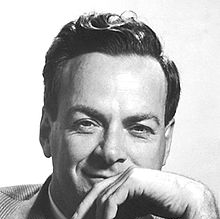
Richard Phillips Feynman was an influential American United States

The United States of America, also known as the United States, the U.S., the U.S.A., a... 

 physicist Physicist

A physicist is a scientist [i] who studies or practices physics [i]. ... 

 known for expanding greatly on the theory of quantum electrodynamics Quantum electrodynamics

Quantum electrodynamics is a relativistic quantum field theory [i] of electromagnetism [i]. ... 

, particle theory Particle physics

Particle physics is a branch of physics [i] that studies the elementary [i] constitu ... 

, and the physics of the superfluidity Superfluid

Superfluidity is a phase of matter [i] characterised by the complete absence of viscosity [i]. ... 

 of supercooled liquid helium. For his work on quantum electrodynamics, Feynman was one of the recipients of the Nobel Prize in Physics Nobel Prize in Physics

List of Nobel Prize [i] laureates in Physics [i] from 1901 [i] to the present day. 177 awards have been given ... 

 in 1965, along with Julian Schwinger Julian Schwinger

Julian Seymour Schwinger was an American [i] theoretical physicist [i]. ... 

 and Shin-Ichiro Tomonaga; in this work, he developed a way to understand the behavior of subatomic particles using pictorial tools now called Feynman diagram Feynman diagram

A Feynman diagram is a method for performing calculations in quantum field theory [i], invented by Ameri ... 

s. He helped in the development of the atomic bomb Nuclear weapon

A nuclear weapon derives its destructive force from nuclear reaction [i]s of fission [i] ... 

 and was later a member of the panel that investigated the Space Shuttle Challenger disaster Space Shuttle Challenger disaster

The Space Shuttle Challenger accident occurred on the morning of January 28 [i] 1986 [i], at 11:39 E ... 

.

Discussions

  Discussion Features

   Ask a question about 'Richard Feynman'

   Start a new discussion about 'Richard Feynman'

   Answer questions about 'Richard Feynman'

   'Richard Feynman' discussion forum

Timeline

1918   Born

1988   Died


Quotations

For those who want some proof that physicists are human, the proof is in the idiocy of all the different units which they use for measuring energy.

If I could explain it to the average person, I wouldn't have been worth the Nobel Prize.

People (22 July 1985)

When playing Russian roulette the fact that the first shot got off safely is little comfort for the next.

What I cannot create, I do not understand.

On his blackboard at time of death in 1988; as quoted in The Universe in a Nutshell by Stephen Hawking

I'll never make that mistake again, reading the experts' opinions. Of course, you only live one life, and you make all your mistakes, and learn what not to do, and that's the end of you.

Science is a way of trying not to fool yourself. The first principle is that you must not fool yourself, and you are the easiest person to fool.

From lecture "What is and What Should be the Role of Scientific Culture in Modern Society", given at the Galileo Symposium in Italy, 1964.

       More Quotes >>


Encyclopedia

Richard Phillips Feynman was an influential American United States

The United States of America, also known as the United States, the U.S., the U.S.A., a... 

 physicist Physicist

A physicist is a scientist [i] who studies or practices physics [i]. ... 

 known for expanding greatly on the theory of quantum electrodynamics Quantum electrodynamics

Quantum electrodynamics is a relativistic quantum field theory [i] of electromagnetism [i]. ... 

, particle theory Particle physics

Particle physics is a branch of physics [i] that studies the elementary [i] constitu ... 

, and the physics of the superfluidity Superfluid

Superfluidity is a phase of matter [i] characterised by the complete absence of viscosity [i]. ... 

 of supercooled liquid helium. For his work on quantum electrodynamics, Feynman was one of the recipients of the Nobel Prize in Physics Nobel Prize in Physics

List of Nobel Prize [i] laureates in Physics [i] from 1901 [i] to the present day. 177 awards have been given... 

 in 1965, along with Julian Schwinger Julian Schwinger

Julian Seymour Schwinger was an American [i] theoretical physicist [i]. ... 

 and Shin-Ichiro Tomonaga; in this work, he developed a way to understand the behavior of subatomic particles using pictorial tools now called Feynman diagram Feynman diagram

A Feynman diagram is a method for performing calculations in quantum field theory [i], invented by Ameri ... 

s.

He helped in the development of the atomic bomb Nuclear weapon

A nuclear weapon derives its destructive force from nuclear reaction [i]s of fission [i] ... 

 and was later a member of the panel that investigated the Space Shuttle Challenger disaster Space Shuttle Challenger disaster

The Space Shuttle Challenger accident occurred on the morning of January 28 [i] 1986 [i], at 11:39 E ... 

. For all his prolific contributions, Feynman wrote only 37 research papers in his career. Apart from pure physics, Feynman is also credited with the revolutionary concept and early exploration of quantum computing Quantum computer

A quantum computer is any device for computation [i] that makes direct use of distinctively quantum mechanical [i] ... 

, and publicly envisioning nanotechnology Nanotechnology

Nanotechnology is a field of applied science focused on the design, synthesis, characterization and appl... 

, the ability to create devices at the molecular scale. He held the Richard Chace Tolman professorship in theoretical physics at Caltech California Institute of Technology

The California Institute of Technology is a private [i], coeducation [i]al university lo ... 

.

Feynman was a keen and influential popularizer of physics in both his books and lectures, notably a seminal 1959 talk on top-down nanotechnology called There's Plenty of Room at the Bottom and The Feynman Lectures on Physics, a three-volume set which has become a classic text. In his lifetime as well as in the years after his death, he became one of the most publicly known scientists of the century. Known for his insatiable curiosity, gentle wit, brilliant mind and playful temperament , he is also famous for his many adventures, detailed in the books Surely You're Joking, Mr. Feynman! Surely You're Joking, Mr. Feynman!

Surely You're Joking, Mr.... 

, What Do You Care What Other People Think? and Tuva or Bust!. As well as being an inspiring lecturer, bongo Bongo drum

Bongo drums or bongos are a percussion instrument [i]. ... 

 player, notorious practical joker, and decipherer of Mayan hieroglyphics, Richard Feynman was, in many respects, an eccentric and a free spirit. He liked to pursue many independent paths, such as biology, art, percussion, and lockbreaking. Freeman Dyson Freeman Dyson

Freeman John Dyson is an English-born physicist [i] and mathematician [i], famous for his work in quantum mechanics [i] ... 

 once wrote that Feynman was "half-genius, half-buffoon", but later changed this to "all-genius, all-buffoon".

Biography

Feynman was born in Far Rockaway, Queens Far Rockaway, Queens

Far Rockaway is one of the four neighborhoods on the Rockaway Peninsula [i] in the New York City [i] ... 

, New York; his parents were Jewish Jew

Jews are followers of Judaism [i] or, more generally, members of the Jewish people , an ethno [i]... 

 and attended synagogue every Friday, although they were unritualistic in their practice of Judaism Judaism

Judaism is the religion [i] of the Jew [i]ish people. ... 

 as a religion. The young Feynman was heavily influenced by his father, Melville Feynman, who encouraged him to ask questions in order to challenge orthodox thinking. His mother instilled in him a powerful sense of humor which he kept all his life. As a child, he delighted in repairing radios and had a talent for engineering. At school he was bright, but his measured IQ Intelligence quotient

An intelligence quotient or IQ is a score derived from a set of standardized test [i]s of intelligence [i] ... 

 was merely above average at 124, which he would scoff at later. By age 15, he had mastered differential and integral calculus Integral

In calculus [i], the integral of a function [i] is an extension of the concept of a sum. ... 

. He kept experimenting on and re-creating mathematical topics, such as the half-derivative Fractional calculus

In mathematics [i], fractional calculus is a branch of mathematical analysis [i] that studies the possib ... 

, utilizing his own notation, before entering college. Thus, even while in high school, he was developing the mathematical intuition behind his Taylor series Taylor series

In mathematics [i], the Taylor series of an infinite [i]ly differentiable [i] real [i] ... 

 of mathematical operators. His habit of direct characterization would sometimes disconcert more conventional thinkers; for example, one of his questions when learning feline anatomy was: "Do you have a map of the cat?" . When he spoke, it was with clarity.

Education

This was Richard Feynman nearing the crest of his powers. At twenty-three ... there was no physicist on earth who could match his exuberant command over the native materials of theoretical science. It was not just a facility at mathematics . Feynman seemed to possess a frightening ease with the substance behind the equations, like Albert Einstein Albert Einstein

Albert Einstein was a German [i]-born theoretical physicist [i]. ... 

 at the same age, like the Soviet physicist Lev Landau Lev Landau

Lev Davidovich Landau was a prominent Soviet [i] physicist [i] who made fundamental contrib ... 

 - but few others.Genius : The Life and Science of Richard Feynman


In his last year at Far Rockaway High School, Feynman won the New York University Math Championship. He applied to Columbia College but was rejected because of its Jewish quota. Instead, he attended the Massachusetts Institute of Technology Massachusetts Institute of Technology

The Massachusetts Institute of Technology, or MIT, is a private world-leading research university [i] ... 

, where he received a bachelor's degree in 1939, and was named Putnam Fellow that same year. While there, Feynman had taken every physics course offered, and had taken a graduate course on theoretical physics while only in his second year. He obtained a perfect score on the entrance exams to Princeton University Princeton University

Princeton University is a coeducation [i]al private university [i] located in Princeton, New Jersey [i]. ... 

 in mathematics and physics — an unprecedented feat — but did rather poorly on the history and English portions. Attendees at Feynman's first seminar included the luminaries Albert Einstein, Wolfgang Pauli Wolfgang Pauli

Wolfgang Ernst Pauli was an Austria [i]n physicist [i] noted for his work on the theory of spin [i] ... 

, and John von Neumann John von Neumann

John von Neumann was an Austro-Hungarian [i] mathematician [i] and polymath [i] who ma ... 

. He received a Ph.D. from Princeton University in 1942; his thesis advisor was John Archibald Wheeler John Archibald Wheeler

John Archibald Wheeler is an eminent American [i] theoretical physicist [i]. ... 

. Feynman's thesis applied the principle of stationary action to problems of quantum mechanics, laying the ground work for the "path integral" approach and Feynman diagrams.

While researching his PhD, Feynman married his first wife, Arline Greenbaum. . Arline was diagnosed with tuberculosis Tuberculosis

Tuberculosis is an infectious disease [i] caused by the bacterium [i] Mycobacterium tuberculosis [i]'... 

, a terminal illness at that time, but she and Feynman were careful, and he never contracted the disease.

The Manhattan Project


At Princeton, the physicist Robert R. Wilson Robert R. Wilson

Robert Rathbun Wilson was an American physicist [i] who was a group leader of the Manhattan Project [i], ... 

 encouraged Feynman to participate in the Manhattan Project Manhattan Project

The Manhattan Project refers to the effort to develop the first nuclear weapon [i]s during World War II [i] ... 

—the wartime U.S. Army United States Army

The United States Army is the largest branch of the United States armed forces [i] ... 

 project at Los Alamos Los Alamos National Laboratory

Los Alamos National Laboratory is a United States Department of Energy [i] national laboratory [i] ... 

 developing the atomic bomb. Feynman said he was persuaded to join this effort to help make sure that Nazi Germany Nazi Germany

Nazi Germany, or the Third Reich, refers to Germany in the years 1933 to 1945, when it was governe... 

 did not build them first. On weekends, he visited his wife in a sanatorium in Albuquerque Albuquerque, New Mexico

Albuquerque is the largest city [i] in the state [i] of New Mexico [i] ... 

, right up until her death on June 16, 1945. He immersed himself in work on the project, and was present at the Trinity Trinity test

The "Trinity" test was the first test of a nuclear weapon [i], conducted by the United States [i] ... 

 bomb test. Feynman claimed to be the only person to see the explosion without the very dark glasses provided, reasoning that it was safe to ignore instructions and look through a truck windshield as it would screen out the harmful ultraviolet Ultraviolet

Ultraviolet light is electromagnetic radiation [i] with a wavelength [i] shorter than that of visible l ... 

 radiation.

As a junior physicist, his work on the project was relatively remote from the major action, consisting mostly of administering the computation group of human computers Human computer

Before mechanical and electronic computers, the term "computer", in use from the mid 17th century [i], meant a... 

 in the Theoretical division, and then, with Nicholas Metropolis, setting up the system for using IBM punch card Punch card

The punch card is an obsolescent [i] recording medium [i] for digital information for use by automated ... 

s for computation. John G. Kemeny, later president of Dartmouth College Dartmouth College

Dartmouth College is a private [i] academic institution in Hanover [i], New Hampshire [i] ... 

, worked for Feynman at this time. Feynman actually succeeded in solving one of the equations for the project which were posted on the blackboards. However, they did not "do the physics right" and Feynman's solution was not used in the project.

Feynman's other work at Los Alamos included calculating neutron Neutron

In physics [i], the neutron is a subatomic particle [i] with no net electric charge [i] and a mass [i] o ... 

 equations for the Los Alamos "Water Boiler", a small nuclear reactor Nuclear reactor

A nuclear reactor is a device in which nuclear chain reaction [i]s are initiated, controlled, and sustai ... 

 at the desert lab, in order to measure how close a particular assembly of fissile material was to becoming critical. After this work he was transferred to the Oak Ridge Oak Ridge National Laboratory

Oak Ridge National Laboratory is a multiprogram science and technology national laboratory [i] managed ... 

 facility, where he aided engineers in calculating safety procedures for material storage . He also did crucial theoretical and calculation work on the proposed uranium-hydride bomb, which was later proven to be infeasible.

Feynman was also sought out by the famous physicist Niels Bohr Niels Bohr

Niels Bohr was a Danish [i] physicist [i] who made fundamental contributions to understanding ... 

 for one-on-one discussions. He later found out why. Most physicists were too much in awe of Bohr to argue with him, but Feynman had no such inhibitions, vigorously pointing out anything he considered to be flawed in his thinking. Feynman said he felt just as much respect for Bohr's reputation as anyone else, but that once anyone got him talking about physics, he couldn't help but forget about anything else.


Due to the top secret nature of the work, Los Alamos was isolated; in his own words, "There wasn't anything to do there". Bored, Feynman claims he indulged his curiosity by learning to pick the combination locks on cabinets and desks used to secure papers. Feynman played many jokes on colleagues; in one case he found the combination to a locked filing cabinet by trying the numbers a physicist would use , and found that the three filing cabinets in which a colleague kept a comprehensive set of atomic bomb Nuclear weapon

A nuclear weapon derives its destructive force from nuclear reaction [i]s of fission [i] ... 

 research notes all had the same combination. He left a series of mischievous notes as a prank, which initially spooked his colleague into thinking a spy or saboteur had actually gained access to atomic bomb secrets. On another occasion, he noted that a captain in his building at Los Alamos had a massive safe, better than anything the bomb scientists had, installed with much ado in his office. Some time after the captain left Los Alamos, Feynman discovered that the captain with the massive safe had  never bothered to change the combination from the single generic factory setting, so that even an amateur safecracker could open it, and  there was nothing important being kept in the safe anyway, whereas all the secrets of the bomb scientists were mostly kept in relatively insecure locked cabinets. These anecdotes are related by him in the book Surely You're Joking, Mr. Feynman! Surely You're Joking, Mr. Feynman!

Surely You're Joking, Mr.... 


On occasion, Feynman would find an isolated section of the mesa Mesa

A mesa is an elevated area of land with a flat top and sides that are usually steep cliffs.... 

 to drum Indian-style; "and maybe I would dance and chant, a little". These antics did not go unnoticed, and rumors spread about a mysterious Indian drummer called "Injun Joe". He also became a friend of laboratory head J. Robert Oppenheimer Robert Oppenheimer

J. Robert Oppenheimer was an American [i] theoretical physicist [i], ... 

, who unsuccessfully tried to court him away from his other commitments to work at the University of California, Berkeley University of California, Berkeley

The University of California, Berkeley is the oldest and flagship campus of the ten-campus University of California [i] ... 

 after the war.

Early career: Cornell University

After the project, Feynman started working as a professor at Cornell University Cornell University

Cornell University is a private [i] research university [i] located in Ithaca, New York [i] ... 

, where Hans Bethe Hans Bethe

Hans Albrecht Bethe, was a German [i]-American [i] physicist [i] who won the Nobel Prize in Physics [i] ... 

  worked. However he felt uninspired there; despairing that he had burned out, he turned to less useful, but fun problems, such as analyzing the physics of a twirling, nutating Nutation

Nutation is a slight irregular motion in the axis [i] of rotation of a largely axially ... 

 dish, as it is being balanced by a juggler. He was therefore surprised to be offered professorships from competing universities, eventually choosing to work at the California Institute of Technology California Institute of Technology

The California Institute of Technology is a private [i], coeducation [i]al university lo ... 

 at Pasadena, California Pasadena, California

Pasadena is a city in Los Angeles County [i], California [i], United States [i] ... 

, despite being offered a position near Princeton Princeton University

Princeton University is a coeducation [i]al private university [i] located in Princeton, New Jersey [i]. ... 

, at the Institute for Advanced Study Institute for Advanced Study

The Institute for Advanced Study is a private institution in Princeton Township, New Jersey [i], U.S.A. [i] ... 

 .

Feynman rejected the Institute on the grounds that there were no teaching duties. Feynman found his students to be a source of inspiration and also, during uncreative times, comfort. He felt that if he could not be creative, at least he could teach. Another major factor in his decision was just a desire to live in a mild climate, a goal he seized on while having to put snow chains on his car's wheels in the middle of a snowstorm in Ithaca, New York Ithaca, New York

The City of Ithaca sits on the southern shore of Cayuga Lake [i], in Central [i] New York State [i] ... 

.


Feynman is sometimes called the "Great Explainer"; he took great care when explaining topics to his students, making it a moral point not to make a topic arcane, but accessible to others. His principle was that if a topic could not be explained in a freshman lecture, it was not fully understood yet. Feynman gained great pleasure from coming up with such a "freshman level" explanation of the connection between spin and statistics , a question he pondered in his own lectures and which he solved in the 1986 Dirac memorial lecture. He opposed rote learning and other teaching methods that emphasized form over function, everywhere from a conference on education in Brazil to a state commission on school textbook selection. Clear thinking and clear presentation were fundamental prerequisites for his attention. It could be perilous to even approach him when unprepared, and he did not forget who the fools or pretenders were.

On one sabbatical year, he returned to Newton's Isaac Newton

[i] [[[Old Style and New Style dates|OS]] [i]: [[25 December]] [i] [[1642]] [i]... 

 Principia Philosophiae Naturalis Principia Mathematica

The Philosophiae Naturalis Principia Mathematica is a three-volume work by Isaac Newton [i] publish ... 

to study it anew; what he learned from Newton, he also passed along to his students, such as Newton's attempted explanation of diffraction Diffraction

Diffraction refers to the various phenomena associated with wave propagation, such as the bending, sprea... 

.

The Caltech years

Feynman did much of his best work while at Caltech California Institute of Technology

The California Institute of Technology is a private [i], coeducation [i]al university lo ... 

, including research in:

  • Quantum electrodynamics Quantum electrodynamics

    Quantum electrodynamics is a relativistic quantum field theory [i] of electromagnetism [i]. ... 

    . The theory for which Feynman won his Nobel Prize Nobel Prize

    The Nobel Prizes are prize [i]s instituted by the will [i] of Alfred Nobel [i], awarded to people... 

     is known for its extremely accurate predictions,. He helped develop a functional integral formulation Path integral formulation

    The path integral formulation of quantum mechanics [i] is a description of quantum theory which generali ... 

     of quantum mechanics, in which every possible path from one state to the next is considered, the final path being a sum over the possibilities.


  • Physics of the superfluid Superfluid

    Superfluidity is a phase of matter [i] characterised by the complete absence of viscosity [i]. ... 

    ity of supercooled liquid helium Helium

    |-

| 3He || 0.000137%* || colspan="4" | He is stable [i] with 1 neutron [i]
... 

, where helium seems to display a lack of viscosity Viscosity

Viscosity is a measure of the resistance of a fluid [i] to deform under shear stress [i]. ... 

 when flowing. Applying the Schrödinger equation to the question showed that the superfluid was displaying quantum mechanical behavior observable on a macroscopic scale. This helped enormously with the problem of superconductivity Superconductivity

Superconductivity is a phenomenon occurring in certain material [i]s at extremely low temperature [i]s , ... 

.

  • A model of weak decay Weak interaction

    The weak interaction is one of the four fundamental interaction [i]s of nature. ... 

    , which showed that the current coupling in the process is a combination of vector and axial. Although E.C. George Sudharsan George Sudarshan

    Ennakkal Chandy George Sudarshan is a prominent India [i]n-American [i] physicist, author, ... 

     and Robert Marshak developed the theory nearly simultaneously, Feynman's collaboration with Murray Gell-Mann Murray Gell-Mann

    Murray Gell-Mann is an American [i] physicist [i] who received the 1969 [i] Nobel Prize in physics [i] ... 

     was seen as the seminal one, the theory was of massive importance, and the weak interaction Weak interaction

    The weak interaction is one of the four fundamental interaction [i]s of nature. ... 

     was neatly described.


He also developed Feynman diagrams, a bookkeeping device which helps in conceptualizing and calculating interactions between particles in spacetime, notably the interactions between electrons and their antimatter counterparts, positrons Positron

The positron is the antiparticle [i] or the antimatter [i] counterpart of the electron [i]. ... 

. This device allowed him, and now others, to work with concepts which would have been less approachable without it, such as time reversibility and other fundamental processes. Feynman famously painted Feynman diagrams on the exterior of his van.

Feynman diagrams are now fundamental for string theory String theory

String theory is a model [i] of fundamental physics [i] whose building blocks are on ... 

 and M-theory M-theory

In physics [i], M-theory is put forward as the master theory that unifies the five superstring theories [i] ... 

, and have even been extended topologically. Feynman's mental picture for these diagrams started with the hard sphere approximation, and the interactions could be thought of as collisions at first. It was not until decades later that physicists thought of analyzing the nodes of the Feynman diagrams more closely. The world-lines of the diagrams have become tubes to better model the more complicated objects such as strings and M-branes.

From his diagrams of a small number of particles interacting in spacetime, Feynman could then model all of physics in terms of those particles' spins and the range of coupling of the fundamental forces. Feynman attempted an explanation of the strong interactions governing nucleons scattering called the partonmodel. The parton model emerged as a rival to the quark Quark

In particle physics [i], quarks are one of the two basic constituents of matter [i] . ... 

 model developed by his Caltech colleague Murray Gell-Mann Murray Gell-Mann

Murray Gell-Mann is an American [i] physicist [i] who received the 1969 [i] Nobel Prize in physics [i] ... 

. The relationship between the two models was murky; Gell-Mann referred to Feynman's partons derisively as "put-ons". Feynman did not dispute the quark model; for example, when the 5th quark was discovered, Feynman immediately pointed out to his students that the discovery implied the existence of a 6th quark, which was duly discovered in the decade after his death.

After the success of quantum electrodynamics, Feynman turned to quantum gravity. By analogy with the photon, which has spin 1, he investigated the consequences of a free massless spin 2 field, and was able to derive the Einstein field equation of general relativity, but little more. However, a calculational technique that Feynman developed for gravity in 1962 — "ghosts" — later proved invaluable. In 1967 Fadeev and Popov quantized the particle behaviour of the spin 1 theories of Yang-Mills -Shaw -Pauli, that are now seen to describe the weak and strong interactions, using Feynman's path integral technique. A "ghost" is a field which is spin 0 and so should be a boson, but which is a fermion — disobeying the spin-statistics theorem. Because it does not propagate externally no effects of this are seen. Unfortunately, at this time he became exhausted by working on multiple major projects at the same time, including his Lectures in Physics.

While at Caltech, Feynman was asked to "spruce up" the teaching of undergraduates. After three years devoted to the task, a series of lectures was produced, eventually becoming the famous Feynman Lectures on Physics, which are a major reason that Feynman is still regarded by most physicists as one of the greatest teachers of physics ever. He wanted a picture of a drumhead sprinkled with powder to show the modes of vibration at the beginning of the book; the publishers misunderstood him, and the books carry a picture of him playing drums. Feynman later won the Oersted Medal for teaching, of which he seemed especially proud. His students competed keenly for his attention; once he was awakened when a student solved a problem and dropped it in his mailbox at home; glimpsing the student sneaking across his lawn, he could not go back to sleep, and he read the student's solution. That morning his breakfast was interrupted by another triumphant student, but Feynman informed this student that he was too late.

Partly as a way to bring publicity to progress in physics, Feynman offered $1000 prizes for two of his challenges in nanotechnology. He was also one of the first scientists to conceive the possibility of quantum computer Quantum computer

A quantum computer is any device for computation [i] that makes direct use of distinctively quantum mechanical [i] ... 

s. Many of his lectures and other miscellaneous talks were turned into books such as The Character of Physical Law and QED: The Strange Theory of Light and Matter. He gave lectures which his students annotated into books, such as Statistical Mechanics and Lectures on Gravity. The Feynman Lectures on Physics
required two physicists, Robert B. Leighton and Matthew Sands as full-time editors for several years. Even though they were not adopted by the universities as textbooks, the books continue to be bestsellers because they provide a deep understanding of physics. As of 2005, The Feynman Lectures on Physics have sold over 1.5 million copies in English, an estimated 1 million copies in Russian, and an estimated half million copies in other languages.

In 1974 Feynman delivered the Caltech commencement address on the topic of cargo cult science Cargo cult science

Cargo cult science is a term used by Richard Feynman [i] in his 1974 Caltech [i] commencement address to ... 

, which has the semblance of science but is only pseudoscience Pseudoscience

A pseudoscience is any body of alleged knowledge, methodology, belief, or practice that claims to be sci... 

 due to a lack of integrity on the part of the scientist. He instructed the graduating class that "The first principle is that you must not fool yourself—and you are the easiest person to fool. So you have to be very careful about that. After you've not fooled yourself, it's easy not to fool other scientists. You just have to be honest in a conventional way after that."

In the late 1970's, according to "Richard Feynman and the Connection Machine" , Richard Feynman played a critical role in developing the first parallel-processing computer and finding innovative uses for it in numerical computing and building neural networks Neural network

A neural network is a system [i] of interconnecting neuron [i]s in a network [i] working together to pro... 

 as well as physical simulation with cellular automata Cellular automaton

A cellular automaton is a discrete [i] model studied in computability theory [i] ... 

 , working with Stephen Wolfram at Caltech.

Shortly before his death, Feynman criticized string theory String theory

String theory is a model [i] of fundamental physics [i] whose building blocks are on ... 

 in an interview. These words have been much-quoted by opponents of the string-theoretic direction for particle physics ever since.

"I don't like that they're not calculating anything," he said. "I don't like that they don't check their ideas. I don't like that for anything that disagrees with an experiment, they cook up an explanation -- a fix-up to say, 'Well, it still might be true.'"

Personal life

Feynman's relationship with his first wife Arlene, who died during the Manhattan Project, is portrayed in the 1996 movie Infinity Infinity

he word infinity comes from the Latin [i] infinitas or "unboundedness." It refers to several distinc ... 

. He married a second time, to Mary Louise Bell of Neodesha, Kansas Neodesha, Kansas

Neodesha is a city in Wilson County [i], Kansas [i], United States [i].... 

 in June 1952; this marriage was brief and unsuccessful. He later married Gweneth Howarth from the United Kingdom, who shared his enthusiasm for life and spirited adventure. Besides their home in Altadena, California Altadena, California

Altadena is an unincorporated [i] census-designated place [i] in Los Angeles County [i] ... 

, they had a beach house in Baja California Baja California

Baja California is the northernmost state [i] of Mexico [i]. ... 

. They remained married for life, had a son, Carl, in 1962, and adopted a daughter, Michelle, in 1968.

Feynman had a great deal of success teaching Carl using discussions about ants and Martians as a device for gaining perspective on problems and issues; he was surprised to learn that the same teaching devices did not apply for Michelle. Mathematics was a common interest for father and son; they both entered the computer field as consultants and were involved in advancing a new method of using multiple computers to solve complex problems - later known as parallel computing. The Jet Propulsion Laboratory Jet Propulsion Laboratory

The NASA [i] Jet Propulsion Laboratory , in Pasadena [i] and La Caada Flintridge [i] ... 

 retained Feynman as a computational consultant during critical missions. One coworker characterized Feynman as akin to Don Quixote Don Quixote

or is a novel [i] by the Spanish [i] author Miguel de Cervantes Saavedra [i]. ... 

at his desk, rather than at a computer workstation, ready to do battle with the windmills.

According to his colleague, Professor Steven Frautschi, Feynman was the only person in the Altadena region to buy flood insurance after the massive 1978 fire, predicting correctly that the fire's destruction would lead to land erosion, causing mudslides and flooding. The flood occurred in 1979 after winter rains and destroyed multiple houses in the neighborhood.

Feynman traveled a great deal, notably to Brazil, and near the end of his life schemed to visit the Russian land of Tuva Tuva

The Tuva Republic is a federal subject [i] of Russia [i]. ... 

, a dream that, due to Cold War Cold War

The Cold War was the protracted geopolitical [i], ideological [i], and economic [i]... 

 bureaucratic problems, never succeeded. During this period he discovered that he had a form of cancer, but, thanks to surgery, he managed to hold it off. Out of his enthusiastic interest of reaching Tuva came the phrase "Tuva or Bust" , which was tossed about frequently amongst his circle of friends in hope that they, one day, could see it first-hand. The documentary movie Genghis Blues Genghis Blues

External links


[i]
... 

mentions some of his attempts to communicate with Tuva and chronicles the journey when some of his friends did make it there. His attempts to write and send a letter using an English-Russian and Russian-Tuvan dictionary demonstrate his usual zest for life.

Feynman did not work only on physics, and had a large circle of friends from all walks of life, including the arts. He took up painting Painting

Painting taken literally is the practice of applying pigment [i] suspended in a liquid vehicle to a surface [i] ... 

 at one time and enjoyed some success under the pseudonym "Ofey", culminating in an exhibition dedicated to his work. While at Los Alamos on the Top Secret Manhattan Project, he earned the notoriety of being a master safe-cracker. He learned to play drums Drum

A drum is a musical instrument [i] in the percussion [i] family, technically class... 

  in acceptable samba style in Brazil by persistence and practice, and participated in a samba school Samba school

The Samba schools are samba [i] clubs that started in the early half of the 20th century in Rio de Janeiro [i] ... 

. Feynman even translated Mayan hieroglyphics. Such actions earned him a reputation of eccentricity.

According to Genius, the James Gleick biography, Richard Feynman experimented with LSD LSD

Lysergic acid diethylamide, commonly called LSD, or LSD-25, is a semisynthetic [i] psychedelic drug [i] ... 

 during his professorship at Caltech California Institute of Technology

The California Institute of Technology is a private [i], coeducation [i]al university lo ... 

. Somewhat embarrassed by his actions, Feynman sidestepped the issue when dictating his anecdotes; consequently, the "Altered States" chapter in Surely You're Joking, Mr. Feynman! describes only marijuana Cannabis (drug)

The drug [i] cannabis, also called marijuana, is produced from parts of the cannabis [i]... 

 and ketamine Ketamine

Ketamine is a general dissociative [i] anaesthetic [i] for human and veterinary use. ... 

 experiences at John Lilly's famed sensory deprivation tanks, as a way of studying consciousness. Feynman gave up alcohol when he began to show early signs of alcoholism, as he did not want to do anything that could damage his brain.

Feynman also had very liberal views on sexuality and was not ashamed of admitting it. In Surely You're Joking, Mr. Feynman!, he gives advice on the best way to pick up a girl in a hostess bar. At Caltech, he used a nude/topless bar as an office away from his usual office, making sketches or writing physics equations on paper placemats. When the county officials tried to close the locale, all visitors except Feynman refused to testify in favor of the bar, fearing that their families would learn about their visiting this place. Only Feynman accepted, and in court, he affirmed that the bar was a public need, stating that craftsmen, technicians, engineers, common workers "and a physics professor" frequented the establishment. The bar was allowed to remain open.


In summary, Feynman's wives were: Arline Greenbaum, Mary Louise Bell, Gweneth Howarth. His children were Carl Richard , Michelle Catherine , with last wife Gweneth.

Feynman's later years

Feynman was requested to serve on the presidential Rogers Commission which investigated the Challenger Space Shuttle Challenger

Space Shuttle Challenger was NASA's second Space Shuttle [i] orbiter to be put into service, after ... 

 disaster of 1986. Drawing upon clues from a source with inside information, Feynman famously showed on television the crucial role in the disaster played by the booster's O-ring O-ring

An O-ring is a loop of elastomer [i] with a round cross-section used as a mechanical seal [i] or gasket [i] ... 

 flexible gas seals with a simple demonstration using a glass of ice water, a clamp, and a sample of o-ring material. His opinion of the cause of the accident differed from the official findings and was considerably more critical of the role of management in sidelining the concerns of engineers. After much petitioning, Feynman's minority report was included as an appendix to the official document. Feynman's book, What Do You Care What Other People Think?, includes a copy of that appendix and stories about his work on the commission. In the appendix, Feynman concluded that NASA management greatly over-estimated space shuttle reliability, offering a more realistic estimate of 98% reliability , in stark contrast against the NASA management estimate of one failure in 100,000 flights. Sadly, this estimate appears justified, with two failures in 115 flights as of July 4, 2006.

The cancer returned in 1987, with Feynman entering the hospital a year later. Complications with surgery worsened his condition, whereupon Feynman decided to die with dignity and not accept any more treatment. He died on February 15, 1988. According to his sister, Dr. Joan Feynman, Richard Feynman's last words were "I'd hate to die twice, it's so boring." He and his wife Gweneth, who died in 1989, are buried in Mountain View Cemetery, Altadena, California.

Commemorations


On May 4, 2005 the United States Postal Service United States Postal Service

The United States Postal Service is an "independent establishment of the executive branch" of the United States Government [i] ... 

 issued the American Scientists commemorative set of four 37-cent self-adhesive stamps in several configurations. The scientists depicted were Richard Feynman, John von Neumann John von Neumann

John von Neumann was an Austro-Hungarian [i] mathematician [i] and polymath [i] who ma ... 

, Barbara McClintock Barbara McClintock

Barbara McClintock was a pioneering American [i] scientist and one of the world's most d... 

 and Josiah Willard Gibbs Josiah Willard Gibbs

Josiah Willard Gibbs was an American [i] mathematical physicist [i] ... 

. Feynman's stamp, sepia-toned, features a photograph of a 30-something Feynman and eight small Feynman diagrams.

A shuttlecraft named after Feynman appeared in two episodes of the science fiction television show . An error in the art department, however, caused the shuttle name to be misspelled, "FEYMAN."

Feynman appears in the fiction book The Diamond Age The Diamond Age

The Diamond Age or, A Young Lady's Illustrated Primer is postcyberpunk [i] novel [i] by Neal Stephenson [i] ... 

as one of the heroes of the world where nanotechnology Nanotechnology

Nanotechnology is a field of applied science focused on the design, synthesis, characterization and appl... 

 is ubiquitous.

Apple's Apple Computer

Apple Computer, Inc. is an American [i] computer [i] technology [i] corporation [i] with ... 

 "Think Different" ad campaign featured photo portraits of Feynman that appeared in magazines and on posters and billboards.

Miscellany


  • Feynman has an Erdos number of three.
  • Feynman was lefthanded.
  • Oersted Medal .
  • Nobel Prize in Physics Nobel Prize in Physics

    List of Nobel Prize [i] laureates in Physics [i] from 1901 [i] to the present day. 177 awards have been given... 


References


  • The Character of Physical Law, The 1964 Messenger Lectures, MIT Press, 1967, ISBN 0-262-56003-8
  • The Feynman Lectures on Physics: The Definitive and Extended Edition . Originally published as separate volumes in 1964 and 1966, and as a set since 1970. 3 volumes, Addison Wesley, 2nd edition 2005, ISBN 0-8053-9045-6. Includes Feynman’s Tips on Physics, a set of four previously unreleased lectures on problem solving.
  • Quantum Electrodynamics, Addison Wesley, 1985, ISBN 0-8053-2501-8
  • Elementary Particles and the Laws of Physics: The 1986 Dirac Memorial Lectures, Cambridge University Press, 1987, ISBN 0-521-34000-4
  • Six Easy Pieces: Essentials of Physics Explained by Its Most Brilliant Teacher, Perseus Books, 1994, ISBN 0-201-40955-0
  • Six Not So Easy Pieces: Einstein’s Relativity, Symmetry and Space-Time, Addison Wesley, 1997, ISBN 0-201-15026-3
  • Feynman’s Tips On Physics: A Problem-Solving Supplement to the Feynman Lectures On Physics, Addison Wesley, 2005, ISBN 0-8053-9063-4

Further reading

The Feynman Lectures on Physics are perhaps his most accessible work for anyone with an interest in physics, compiled from lectures to Caltech California Institute of Technology

The California Institute of Technology is a private [i], coeducation [i]al university lo ... 

 undergraduates in 1962. As news of the lectures' lucidity grew, a large number of professional physicists began to drop in to listen. Physicist Robert B. Leighton edited them into book form. The work has endured, and is useful to this day. They were edited and supplemented in 2005 with "Feynman's Tips on Physics: A Problem-Solving Supplement to the Feynman Lectures on Physics" by Michael Gottlieb and Ralph Leighton , with support from Kip Thorne Kip Thorne

Kip Stephen Thorne, Ph.D. [i], is an American [i] theoretical physicist [i]... 

 and other physicists.

Popular works by and about Feynman

  • Disturbing the Universe, Freeman Dyson, Harper and Row, 1979, ISBN 0-06-011108-9. Dyson’s autobiography. The chapters “A Scientific Apprenticeship” and “A Ride to Albuquerque” describe his impressions of Feynman in the period 1947-48 when Dyson was a graduate student at Cornell.
  • Physics Today, American Institute of Physics magazine, February 1989 Issue. Special Feynman memorial issue containing non-technical articles on Feynman's life and work in physics.
  • Classic Feynman: All the Adventures of a Curious Character, edited by Ralph Leighton, W. W. Norton, 2005, ISBN 0-393-06132-9. Chronologically reordered omnibus volume of Surely You’re Joking, Mr. Feynman and What Do You Care What Other People Think?, with a bundled CD containing one of Feynman’s signature lectures.
  • Don't You Have Time to Think?, edited and with additional commentary by Michelle Feynman, Allen Lane, 2005, ISBN 0-7139-9847-4

Audio recordings

  • Safecracker Suite
  • Six Easy Pieces
  • Six Not So Easy Pieces
  • The Feynman Lectures on Physics: The Complete Audio Collection
    • Quantum Mechanics, Volume 1
    • Advanced Quantum Mechanics, Volume 2
    • From Crystal Structure to Magnetism, Volume 3
    • Electrical and Magnetic Behavior, Volume 4
    • Feynman on Fundamentals: Energy and Motion, Volume 5
    • Feynman on Fundamentals: Kinetics and Heat, Volume 6
    • Feynman on Science and Vision, Volume 7
    • Feynman on Gravity, Relativity and Electromagnetism, Volume 8
    • Basic Concepts in Classical Physics, Volume 9
    • Basic Concepts in Quantum Physics, Volume 10
    • Feynman on Science and Vision, Volume 11
    • Feynman on Sound, Volume 12
    • Feynman on Fields, Volume 13
    • Feynman on Electricity and Magnetism, Part 1, Volume 14
    • Feynman on Electricity and Magnetism, Part 2, Volume 15
    • Feynman on Electromagnetism, Volume 16
    • Feynman on Electrodynamics, Volume 17
    • Feynman on Flow, Volume 18
    • Masers and Light, Volume 19
    • The Very Best Lectures, Volume 20
  • Samples of Feynman's drumming, chanting and speech are included in the songs "Tuva Groove " and "Kargyraa Rap " on the album Back Tuva Future, The Adventure Continues by Kongar-ol Ondar Kongar-ool Ondar

    Kongar-ool Ondar is a master Tuva [i]n throatsinger [i] and a member of the Tuvan Parliam ... 

    . The hidden track on this album also includes excerpts from lectures without musical background.

Video recordings

  • The Messenger Lectures
    • The Law of Gravitation
    • The Relation of Mathematics to Physics
    • The Great Conservation Principles
    • Symmetry in Physical Law
    • The Distinction of Past and Future
    • Probability and Uncertainty - The Quantum Mechanical View of Nature
    • Seeking New Laws
  • Elementary Particles and the Laws of Physics

Quotations

  • "Dear Mrs. Chown, Ignore your son's attempts to teach you physics. Physics isn't the most important thing. Love is. Best wishes, Richard Feynman."
  • "Physics is to math what sex is to masturbation."
  • "Physics is like sex: sure, it may give some practical results, but that's not why we do it."
  • "Mathematics is not real, but it feels real. Where is this place?"
  • "The same equations have the same solutions."
  • "When you are solving a problem, don't worry. Now, after you have solved the problem, then that's the time to worry."
  • "The wonderful thing about science is that it's alive."
  • "All fundamental processes are reversible."
  • "What does it mean, to understand? ... I don't know."
  • "What I cannot create, I do not understand."
  • "Know how to solve every problem that has ever been solved."
  • "But I don't have to know an answer. I don't feel frightened by not knowing things, by being lost in the mysterious universe without having any purpose—which is the way it really is, as far as I can tell, possibly. It doesn't frighten me."
  • "To those who do not know mathematics it is difficult to get across a real feeling as to the beauty, the deepest beauty, of nature ... If you want to learn about nature, to appreciate nature, it is necessary to understand the language that she speaks in."
  • "I cannot define the real problem, therefore I suspect there's no real problem, but I'm not sure there's no real problem."
  • "When playing Russian roulette the fact that the first shot got off safely is little comfort for the next"
  • "I'd hate to die twice. It's so boring" .

Quotations about Feynman

  • The "Feynman Problem Solving Algorithm", as facetiously observed by a colleague, Murray Gell-Mann Murray Gell-Mann

    Murray Gell-Mann is an American [i] physicist [i] who received the 1969 [i] Nobel Prize in physics [i] ... 

     in the NY Times The New York Times

    The New York Times is a newspaper [i] published in New York City [i] by Arthur Ochs Sulzberger Jr. [i] ... 

    , was:
    1. write down the problem;
    2. think very hard;
    3. write down the answer.


  • The Nobel laureate Nobel Prize in Physics

    List of Nobel Prize [i] laureates in Physics [i] from 1901 [i] to the present day. 177 awards have been given... 

     physicist and mathematician E.P. Wigner E. P. Wigner

    Eugene Paul Wigner was a Hungarian [i] physicist [i] and mathematician [i] who received the Nobel Prize in Physics [i] ... 

     said about Feynman, "He is a second Dirac Paul Dirac

    Paul Adrien Maurice Dirac, OM [i], FRS [i] was a British [i]... 

    . Only this time human".


  • Jeff Coffin  says in the song "Ah shu Dekio" :

This verse is for Richard Feynman, He was not a simple simon.

See also

  • Physics Physics

    Physics , the most fundamental physical science [i], is concerned with the underlying principles of the ... 

  • Stückelberg-Feynman interpretation
  • QED
  • Infinity Infinity

    he word infinity comes from the Latin [i] infinitas or "unboundedness." It refers to several distinc ... 

  • Feynman point
  • Feynman sprinkler

External links

  • .
  • ***