

Palomar Observatory

Encyclopedia
Palomar Observatory is a privately owned observatory
located in San Diego County, California
, 90 miles (144.8 km) southeast of Pasadena
's Mount Wilson Observatory
, in the Palomar Mountain Range
. At approximately 5570 feet (1,697.7 m) elevation, it is owned and operated by the California Institute of Technology
. Research time is granted to Caltech and its research partners which includes the Jet Propulsion Laboratory
, and Cornell University
.
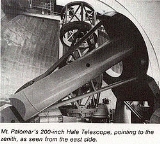
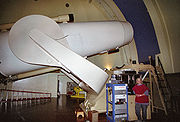
The observatory includes several telescopes: the 200 in (5.1 m) Hale telescope
, the 48 in (1.2 m) Samuel Oschin telescope
(called the 48 inch Schmidt before 1986), and a 60 in (1.5 m) reflecting telescope
. In addition, other instruments and projects have been hosted at the observatory, for example the Palomar Testbed Interferometer
was active at the observatory from 1995 to 2009. Retired historical instruments include the 18 in (457.2 mm) Schmidt telescope, Palomar Observatory's first telescope, dating from 1936.
, whose vision created the Palomar Observatory, built the world's largest telescope four times. He published an article in the April 1928 issue of Harper's Magazine
called "The Possibilities of Large Telescopes". This article contained Hale's vision for building of what was to become the 200-inch Palomar reflector; it was an invitation to the American public to learn about how large telescopes could help answer questions relating to the fundamental nature of the universe. Hale hoped that the American people would understand and support his project. In fact the 200-inch telescope was the most important telescope in the world from 1949 until 1992 when the Keck I telescope (at approximately 10 meters - 387 inches) on Mauna Kea in Hawaii became the world's largest.
Hale followed this article with a letter to the International Education Board (later absorbed into the General Education Board
) of the Rockefeller Foundation
dated April 28, 1928, in which he requested funding for this project. In his letter, Hale stated:
"No method of advancing science is so productive as the development of new and more powerful instruments and methods of research. A larger telescope would not only furnish the necessary gain in light space-penetration and photographic resolving power, but permit the application of ideas and devices derived chiefly from the recent fundamental advances in physics and chemistry."
, dating back from the time of Spanish California
, and means pigeon house (in the same sense as henhouse). The name may be in reference to the large shoals of pigeons that can be seen during the spring and autumn months atop Palomar Mountain or reminiscent of an old pigeon-raising facility built there by the Spaniards.
blank manufactured by Corning Glass Works. The telescope (the largest in the world at that time) saw first light January 26, 1949 targeting NGC 2261
. The American astronomer Edwin Powell Hubble, perhaps the most important observer of the 20th century, was given the honor of being the first astronomer to use the telescope.
Astronomers using the Hale Telescope have discovered distant objects at the edges of the known universe called quasar
s and have given us the first direct evidence of stars in distant galaxies. They have studied the structure and chemistry of intergalactic clouds leading to an understanding of the synthesis of elements in the universe and have discovered thousands of asteroid
s. A one-tenth-scale engineering model of the telescope at Corning Community College in Corning, New York
, home of the Corning Glass Works (now Corning Incorporated) was used to discover at least one minor planet, (34419) Corning
was primarily responsible for the striking Art Deco architecture of the Observatory's buildings, most notably the dome of the 200 inch Hale Telescope. Porter was also responsible for much of the technical design of the Hale Telescope and Schmidt Cameras, producing a series of remarkable cross-section engineering drawings that are considered among the finest examples of such work. Porter worked on the designs in collaboration with many engineers and Caltech committee members. The iconic, gleaming white building on Palomar Mountain that houses the 200 inch Hale Telescope is considered by many to be "The Cathedral of Astronomy".
 Major instruments at the Palomar Observatory include:
(POSS or POSS-I), sponsored by the National Geographic institute, was completed in 1958. The first plates were shot in November 1948 and the last in April 1958. This survey was performed using 14 inch2 or (6 degree
)2 blue-sensitive (Kodak 103a-O) and red-sensitive (Kodak 103a-E) photographic plates on the 48 inch (1.22 m) Samuel Oschin Schmidt reflecting
telescope. The survey covered the sky from a declination
of +90 degrees (celestial north pole
) to -27 degrees and all right ascension
s and had a sensitivity to +22 magnitude
s (about 1 million times fainter than the limit of human vision). A southern extension extending the sky coverage of the POSS to -33 degrees declination
was shot in 1957 - 1958. The final POSS I consisted of 937 plate pairs.
Fritz Zwicky was the first astronomer to observe on Mt. Palomar and was the father of the Sky Survey Technique.
Digitized Sky Survey (DSS) produced images which were based on the photographic data developed in the course of POSS-I.
J.B. Whiteoak, an Australian radio astronomer, used the same instrument to broaden this POSS-I data further. Whiteoaks observations extended south to about -45 degrees declination
, using the same field centers as the corresponding northern declination zones. Unlike POSS-I, the Whiteoak extension consisted only of red-sensitive (Kodak 103a-E) photographic plates.
(who discovered over 100 supernovae by comparing the POSS I and POSS II plates). Ms Mueller also discovered several comets during the course of POSS II and the bright Comet Wilson 1986 was discovered by then graduate student C. Wilson early in the survey.
Until the completion of the Two Micron All Sky Survey (2MASS
), POSS-II was the most extensive wide-field sky survey ever. When completed, the Sloan Digital Sky Survey
will surpass POSS-I and POSS-II in depth, although the POSS covers almost 2.5 times more area on the sky.
POSS-II also exists in digitized form (i.e., the photographic plates were scanned), both in photographic form as the Digitized Sky Survey
(DSS)
(QUEST) Variability survey. This survey yielded results that were used by several projects, including the Near-Earth Asteroid Tracking project. Another program that used the QUEST results discovered 90377 Sedna
on 14 November 2003, and around 40 Kuiper belt
objects. Other programs that share the camera are Shri Kulkarni's search for gamma-ray bursts (this takes advantage of the automated telescope's ability to react as soon as a burst is seen and take a series of snapshots of the fading burst), Richard Ellis
' search for supernova
e to test whether the universe's expansion is accelerating or not, and S. George Djorgovski's quasar
search.
The camera for the Palomar QUEST Survey was a mosaic of 112 Charge-coupled device
s (CCDs) covering the whole (4 degree by 4 degree) field of view of the Schmidt telescope, the largest CCD mosaic used in an astronomical camera when built. This instrument was used to produce The Big Picture, the largest astronomical photograph ever produced. The Big Picture is on display at Griffith Observatory
.
The 48-inch Samuel Oschin Schmidt Telescope is actively working on a new sky survey, the Palomar Transient Factory
(PTF).
The 60-inch telescope is used for a variety of projects including follow-up observations for the Palomar Transient Factory and is a rapid response telescope for gamma-ray bursts.
s from the United States
and Britain
released some of the clearest pictures ever taken of outer space
. The pictures were obtained through the use of a new hybrid "Lucky imaging
" and "adaptive optics
" system which sharpens pictures taken from the Palomar Observatory. The resolution attained exceeds that of the Hubble Space Telescope
by a factor of two.
in San Diego. The observatory is located off State Route 76
in northern San Diego County, California
, is two hours' drive from downtown San Diego, and three hours' drive from central Los Angeles
( UCLA, LAX airport ).
's 1997 debut album, Declaration of Conformity
, contains a track entitled "Palomar Observatory." It is the last track on the album and completely instrumental. It is likely the track title was chosen by singer/drummer Matt Cameron
, who grew up in San Diego near the observatory. Also, Canadian band The Rheostatics 11th track from their effort Whale Music is entitled Palomar. The song depicts a man named Palomar on the top of a mount, cleaning his lenses with saline waters. Palomar assembles his kaleidoscope in his lonely observatory. The song presents a visual characterization of a man on a mountain and his relationship with his best friend, a dog.
Palomar is mentioned in the first episode of season 2 of The X-Files
, "Little Green Men". Fox Mulder
refers to Hale's suggestion that an elf
crawled through his window and told him to build the observatory.
that would potentially affect the observatory.
Observatory
An observatory is a location used for observing terrestrial or celestial events. Astronomy, climatology/meteorology, geology, oceanography and volcanology are examples of disciplines for which observatories have been constructed...
located in San Diego County, California
San Diego County, California
San Diego County is a large county located in the southwestern corner of the US state of California. Hence, San Diego County is also located in the southwestern corner of the 48 contiguous United States. Its county seat and largest city is San Diego. Its population was about 2,813,835 in the 2000...
, 90 miles (144.8 km) southeast of Pasadena
Pasadena, California
Pasadena is a city in Los Angeles County, California, United States. Although famous for hosting the annual Rose Bowl football game and Tournament of Roses Parade, Pasadena is the home to many scientific and cultural institutions, including the California Institute of Technology , the Jet...
's Mount Wilson Observatory
Mount Wilson Observatory
The Mount Wilson Observatory is an astronomical observatory in Los Angeles County, California, United States. The MWO is located on Mount Wilson, a 5,715 foot peak in the San Gabriel Mountains near Pasadena, northeast of Los Angeles...
, in the Palomar Mountain Range
Palomar Mountain Range
The Palomar Mountain Range is a high Peninsular mountain range in northern San Diego County of Southern California. The name, which means pigeon roost in Spanish, was given to it due to the prevalence of Band-tailed Pigeons....
. At approximately 5570 feet (1,697.7 m) elevation, it is owned and operated by the California Institute of Technology
California Institute of Technology
The California Institute of Technology is a private research university located in Pasadena, California, United States. Caltech has six academic divisions with strong emphases on science and engineering...
. Research time is granted to Caltech and its research partners which includes the Jet Propulsion Laboratory
Jet Propulsion Laboratory
Jet Propulsion Laboratory is a federally funded research and development center and NASA field center located in the San Gabriel Valley area of Los Angeles County, California, United States. The facility is headquartered in the city of Pasadena on the border of La Cañada Flintridge and Pasadena...
, and Cornell University
Cornell University
Cornell University is an Ivy League university located in Ithaca, New York, United States. It is a private land-grant university, receiving annual funding from the State of New York for certain educational missions...
.
The observatory includes several telescopes: the 200 in (5.1 m) Hale telescope
Hale telescope
The Hale Telescope is a , 3.3 reflecting telescope at the Palomar Observatory in California, named after astronomer George Ellery Hale. With funding from the Rockefeller Foundation, he orchestrated the planning, design, and construction of the observatory, but did not live to see its commissioning...
, the 48 in (1.2 m) Samuel Oschin telescope
Samuel Oschin telescope
The Samuel Oschin telescope is a 48-inch aperture Schmidt camera at the Palomar Observatory in northern San Diego County, California. It consists of a 49.75-inch Schmidt corrector plate and a 72-inch mirror. The instrument is strictly a camera; there is no provision for an eyepiece to look...
(called the 48 inch Schmidt before 1986), and a 60 in (1.5 m) reflecting telescope
Reflecting telescope
A reflecting telescope is an optical telescope which uses a single or combination of curved mirrors that reflect light and form an image. The reflecting telescope was invented in the 17th century as an alternative to the refracting telescope which, at that time, was a design that suffered from...
. In addition, other instruments and projects have been hosted at the observatory, for example the Palomar Testbed Interferometer
Palomar Testbed Interferometer
The Palomar Testbed Interferometer was a near-IR, long-baseline stellar interferometer located at Palomar Observatory in north San Diego County. It was built by Caltech/JPL and was intended to serve as a testbed for developing interferometric techniques to be used at the Keck Interferometer...
was active at the observatory from 1995 to 2009. Retired historical instruments include the 18 in (457.2 mm) Schmidt telescope, Palomar Observatory's first telescope, dating from 1936.
Hale's vision for large telescopes and Palomar Observatory
Astronomer George Ellery HaleGeorge Ellery Hale
George Ellery Hale was an American solar astronomer.-Biography:Hale was born in Chicago, Illinois. He was educated at MIT, at the Observatory of Harvard College, , and at Berlin . As an undergraduate at MIT, he is known for inventing the spectroheliograph, with which he made his discovery of...
, whose vision created the Palomar Observatory, built the world's largest telescope four times. He published an article in the April 1928 issue of Harper's Magazine
Harper's Magazine
Harper's Magazine is a monthly magazine of literature, politics, culture, finance, and the arts, with a generally left-wing perspective. It is the second-oldest continuously published monthly magazine in the U.S. . The current editor is Ellen Rosenbush, who replaced Roger Hodge in January 2010...
called "The Possibilities of Large Telescopes". This article contained Hale's vision for building of what was to become the 200-inch Palomar reflector; it was an invitation to the American public to learn about how large telescopes could help answer questions relating to the fundamental nature of the universe. Hale hoped that the American people would understand and support his project. In fact the 200-inch telescope was the most important telescope in the world from 1949 until 1992 when the Keck I telescope (at approximately 10 meters - 387 inches) on Mauna Kea in Hawaii became the world's largest.
Hale followed this article with a letter to the International Education Board (later absorbed into the General Education Board
General Education Board
The General Education Board was a philanthropy created by John D. Rockefeller and Frederick T. Gates in 1902. Rockefeller gave it $180 million, which was used primarily to support higher education and medical schools in the United States, and to help rural white and black schools in the South, as...
) of the Rockefeller Foundation
Rockefeller Foundation
The Rockefeller Foundation is a prominent philanthropic organization and private foundation based at 420 Fifth Avenue, New York City. The preeminent institution established by the six-generation Rockefeller family, it was founded by John D. Rockefeller , along with his son John D. Rockefeller, Jr...
dated April 28, 1928, in which he requested funding for this project. In his letter, Hale stated:
"No method of advancing science is so productive as the development of new and more powerful instruments and methods of research. A larger telescope would not only furnish the necessary gain in light space-penetration and photographic resolving power, but permit the application of ideas and devices derived chiefly from the recent fundamental advances in physics and chemistry."
Etymology
The word palomar is from the Spanish languageSpanish language
Spanish , also known as Castilian , is a Romance language in the Ibero-Romance group that evolved from several languages and dialects in central-northern Iberia around the 9th century and gradually spread with the expansion of the Kingdom of Castile into central and southern Iberia during the...
, dating back from the time of Spanish California
Alta California
Alta California was a province and territory in the Viceroyalty of New Spain and later a territory and department in independent Mexico. The territory was created in 1769 out of the northern part of the former province of Las Californias, and consisted of the modern American states of California,...
, and means pigeon house (in the same sense as henhouse). The name may be in reference to the large shoals of pigeons that can be seen during the spring and autumn months atop Palomar Mountain or reminiscent of an old pigeon-raising facility built there by the Spaniards.
The Hale Telescope
The 200-inch (5.08 m) telescope is named after astronomer George Ellery Hale. It was built by Caltech with a 6 million dollar grant from the Rockefeller Foundation, using a PyrexPyrex
Pyrex is a brand name for glassware, introduced by Corning Incorporated in 1915.Originally, Pyrex was made from borosilicate glass. In the 1940s the composition was changed for some products to tempered soda-lime glass, which is the most common form of glass used in glass bakeware in the US and has...
blank manufactured by Corning Glass Works. The telescope (the largest in the world at that time) saw first light January 26, 1949 targeting NGC 2261
NGC 2261
NGC 2261 is a variable nebula located in the constellation Monoceros. It is illuminated by the star R Monocerotis , which is not directly visible itself....
. The American astronomer Edwin Powell Hubble, perhaps the most important observer of the 20th century, was given the honor of being the first astronomer to use the telescope.
Astronomers using the Hale Telescope have discovered distant objects at the edges of the known universe called quasar
Quasar
A quasi-stellar radio source is a very energetic and distant active galactic nucleus. Quasars are extremely luminous and were first identified as being high redshift sources of electromagnetic energy, including radio waves and visible light, that were point-like, similar to stars, rather than...
s and have given us the first direct evidence of stars in distant galaxies. They have studied the structure and chemistry of intergalactic clouds leading to an understanding of the synthesis of elements in the universe and have discovered thousands of asteroid
Asteroid
Asteroids are a class of small Solar System bodies in orbit around the Sun. They have also been called planetoids, especially the larger ones...
s. A one-tenth-scale engineering model of the telescope at Corning Community College in Corning, New York
Corning (city), New York
Corning is a city in Steuben County, New York, United States, on the Chemung River. The population was 10,842 at the 2000 census. It is named for Erastus Corning, an Albany financier and railroad executive who was an investor in the company that developed the community.- Overview :The city of...
, home of the Corning Glass Works (now Corning Incorporated) was used to discover at least one minor planet, (34419) Corning
Architecture and design
According to the Observatory's Public Affairs Office, Russell W. PorterRussell W. Porter
Russell Williams Porter was an American artist, engineer, amateur astronomer and explorer. He was a pioneer in the field of “cutaway illustration" and is sometimes referred to as the "founder" or one of the "founders" of amateur telescope making."-Biography:Russell W...
was primarily responsible for the striking Art Deco architecture of the Observatory's buildings, most notably the dome of the 200 inch Hale Telescope. Porter was also responsible for much of the technical design of the Hale Telescope and Schmidt Cameras, producing a series of remarkable cross-section engineering drawings that are considered among the finest examples of such work. Porter worked on the designs in collaboration with many engineers and Caltech committee members. The iconic, gleaming white building on Palomar Mountain that houses the 200 inch Hale Telescope is considered by many to be "The Cathedral of Astronomy".
Telescopes and instruments
- 200-inch Hale TelescopeHale telescopeThe Hale Telescope is a , 3.3 reflecting telescope at the Palomar Observatory in California, named after astronomer George Ellery Hale. With funding from the Rockefeller Foundation, he orchestrated the planning, design, and construction of the observatory, but did not live to see its commissioning...
(Project started in 1928, and active since first light in 1948) (see above) - A 60" (1.5 m) f/8.75 telescope in the Oscar Mayer Building. It was dedicated in 1970 to take some of the load off of the Hale Telescope. This telescope discovered the first brown dwarfBrown dwarfBrown dwarfs are sub-stellar objects which are too low in mass to sustain hydrogen-1 fusion reactions in their cores, which is characteristic of stars on the main sequence. Brown dwarfs have fully convective surfaces and interiors, with no chemical differentiation by depth...
star. - The 48" (1.22 m) Samuel Oschin Telescope (Schmidt Camera)Samuel Oschin telescopeThe Samuel Oschin telescope is a 48-inch aperture Schmidt camera at the Palomar Observatory in northern San Diego County, California. It consists of a 49.75-inch Schmidt corrector plate and a 72-inch mirror. The instrument is strictly a camera; there is no provision for an eyepiece to look...
. The dwarf planetDwarf planetA dwarf planet, as defined by the International Astronomical Union , is a celestial body orbiting the Sun that is massive enough to be spherical as a result of its own gravity but has not cleared its neighboring region of planetesimals and is not a satellite...
ErisEris (dwarf planet)Eris, formal designation 136199 Eris, is the most massive known dwarf planet in the Solar System and the ninth most massive body known to orbit the Sun directly...
was discovered by Caltech astronomer Mike Brown using this instrument. It was this object that triggered the discussions in the international astronomy community that led to Pluto being re-classified as a dwarf planet. It was formerly called the 48 inch Schmidt, and was named in 1986.http://www.astro.caltech.edu/palomar/SOTdisc.htm - A 24" robotic telescope completed in January 2006. It is used to monitor the weather on Saturn's largest moon, Titan, and to follow up on observations of moving objects in the solar system discovered with the Samuel Oschin telescope.
- An 18" (0.4 m) Schmidt cameraSchmidt cameraA Schmidt camera, also referred to as the Schmidt telescope, is a catadioptric astrophotographic telescope designed to provide wide fields of view with limited aberrations. Other similar designs are the Wright Camera and Lurie-Houghton telescope....
. Now retired, in 1936 this became the first operational telescope at the Observatory. Comet Shoemaker-Levy 9Comet Shoemaker-Levy 9Comet Shoemaker–Levy 9 was a comet that broke apart and collided with Jupiter in July 1994, providing the first direct observation of an extraterrestrial collision of solar system objects. This generated a large amount of coverage in the popular media, and the comet was closely observed by...
was discovered with this instrument in 1993. In the 1930s a Caltech astronomer named Fritz ZwickyFritz ZwickyFritz Zwicky was a Swiss astronomer. He worked most of his life at the California Institute of Technology in the United States of America, where he made many important contributions in theoretical and observational astronomy.- Biography :Fritz Zwicky was born in Varna, Bulgaria to a Swiss father....
discovered over 100 supernovae (exploding stars) in other galaxies with this telescope and gathered the first evidence for dark matter. - The Palomar Planet Search Telescope From 2003 - 2008 this small robotic telescope was dedicated to the search for planets around other stars using the transit method.
- The Palomar Testbed InterferometerPalomar Testbed InterferometerThe Palomar Testbed Interferometer was a near-IR, long-baseline stellar interferometer located at Palomar Observatory in north San Diego County. It was built by Caltech/JPL and was intended to serve as a testbed for developing interferometric techniques to be used at the Keck Interferometer...
a multi-telescope instrument that permits astronomers to make very high resolution measurements of the sizes and positions of objects in space. The shapes of some bright stars have been measured with the PTI.
Palomar Observatory sky surveys
The observatory has completed several observational survey series — the first in the 1950s, the second in the 1980s and 1990s, and a third in 2003.POSS-I
The initial Palomar Observatory Sky SurveyNational Geographic Society - Palomar Observatory Sky Survey
The National Geographic Society – Palomar Observatory Sky Survey is a major photographic survey of the night sky that was completed at Palomar Observatory in 1958.-Observations:...
(POSS or POSS-I), sponsored by the National Geographic institute, was completed in 1958. The first plates were shot in November 1948 and the last in April 1958. This survey was performed using 14 inch2 or (6 degree
Degree (angle)
A degree , usually denoted by ° , is a measurement of plane angle, representing 1⁄360 of a full rotation; one degree is equivalent to π/180 radians...
)2 blue-sensitive (Kodak 103a-O) and red-sensitive (Kodak 103a-E) photographic plates on the 48 inch (1.22 m) Samuel Oschin Schmidt reflecting
Reflecting telescope
A reflecting telescope is an optical telescope which uses a single or combination of curved mirrors that reflect light and form an image. The reflecting telescope was invented in the 17th century as an alternative to the refracting telescope which, at that time, was a design that suffered from...
telescope. The survey covered the sky from a declination
Declination
In astronomy, declination is one of the two coordinates of the equatorial coordinate system, the other being either right ascension or hour angle. Declination in astronomy is comparable to geographic latitude, but projected onto the celestial sphere. Declination is measured in degrees north and...
of +90 degrees (celestial north pole
Celestial pole
The north and south celestial poles are the two imaginary points in the sky where the Earth's axis of rotation, indefinitely extended, intersects the imaginary rotating sphere of stars called the celestial sphere...
) to -27 degrees and all right ascension
Right ascension
Right ascension is the astronomical term for one of the two coordinates of a point on the celestial sphere when using the equatorial coordinate system. The other coordinate is the declination.-Explanation:...
s and had a sensitivity to +22 magnitude
Apparent magnitude
The apparent magnitude of a celestial body is a measure of its brightness as seen by an observer on Earth, adjusted to the value it would have in the absence of the atmosphere...
s (about 1 million times fainter than the limit of human vision). A southern extension extending the sky coverage of the POSS to -33 degrees declination
Declination
In astronomy, declination is one of the two coordinates of the equatorial coordinate system, the other being either right ascension or hour angle. Declination in astronomy is comparable to geographic latitude, but projected onto the celestial sphere. Declination is measured in degrees north and...
was shot in 1957 - 1958. The final POSS I consisted of 937 plate pairs.
Fritz Zwicky was the first astronomer to observe on Mt. Palomar and was the father of the Sky Survey Technique.
Digitized Sky Survey (DSS) produced images which were based on the photographic data developed in the course of POSS-I.
J.B. Whiteoak, an Australian radio astronomer, used the same instrument to broaden this POSS-I data further. Whiteoaks observations extended south to about -45 degrees declination
Declination
In astronomy, declination is one of the two coordinates of the equatorial coordinate system, the other being either right ascension or hour angle. Declination in astronomy is comparable to geographic latitude, but projected onto the celestial sphere. Declination is measured in degrees north and...
, using the same field centers as the corresponding northern declination zones. Unlike POSS-I, the Whiteoak extension consisted only of red-sensitive (Kodak 103a-E) photographic plates.
POSS-II
The Second Palomar Observatory Sky Survey (POSS-II) was performed in the 1980s and 1990s that made use of better, faster films and an upgraded telescope. The Oschin Schmidt was given an achromatic corrector and provisions for autoguiding. Images were recorded in three wavelengths: blue (IIIaJ), red (IIIaF) and near infrared (IVN) plates, respectively. Observers on POSS II included C. Brewer, D. Griffiths, W. McKinley, D. Mendenhall, K. Rykoski, J. Phinney and Jean MuellerJean Mueller
Jean Mueller is an American astronomer.Working at Palomar Observatory, she has discovered a total of 15 comets, including 7 periodic comets 120P/Mueller, 131P/Mueller, 136P/Mueller, 149P/Mueller, 173P/Mueller, 188P/LINEAR-Mueller, 190P/Mueller, and 8 non-periodic comets.She has also discovered 10...
(who discovered over 100 supernovae by comparing the POSS I and POSS II plates). Ms Mueller also discovered several comets during the course of POSS II and the bright Comet Wilson 1986 was discovered by then graduate student C. Wilson early in the survey.
Until the completion of the Two Micron All Sky Survey (2MASS
2MASS
Observations for the Two Micron All-Sky Survey began in 1997 and were completed in 2001 at two telescopes located one each in the northern and southern hemispheres to ensure coverage of the entire sky...
), POSS-II was the most extensive wide-field sky survey ever. When completed, the Sloan Digital Sky Survey
Sloan Digital Sky Survey
The Sloan Digital Sky Survey or SDSS is a major multi-filter imaging and spectroscopic redshift survey using a dedicated 2.5-m wide-angle optical telescope at Apache Point Observatory in New Mexico, United States. The project was named after the Alfred P...
will surpass POSS-I and POSS-II in depth, although the POSS covers almost 2.5 times more area on the sky.
POSS-II also exists in digitized form (i.e., the photographic plates were scanned), both in photographic form as the Digitized Sky Survey
Digitized Sky Survey
The Digitized Sky Survey is a digital version of several photographic atlases of the night sky, and an ongoing project to produce more digital versions of photographic astronomical datasets.- Versions and source material :...
(DSS)
QUEST
The multi-year POSS projects were followed by the Palomar Quasar Equatorial Survey TeamQuasar Equatorial Survey Team
The Quasar Equatorial Survey Team is a joint venture between Yale University, Indiana University, and Centro de Investigaciones de Astronomia to photographically survey the sky. It uses the 48 inch The Quasar Equatorial Survey Team is a joint venture between Yale University, Indiana University,...
(QUEST) Variability survey. This survey yielded results that were used by several projects, including the Near-Earth Asteroid Tracking project. Another program that used the QUEST results discovered 90377 Sedna
90377 Sedna
90377 Sedna is a trans-Neptunian object discovered in 2003, which was about three times as far from the Sun as Neptune. For most of its orbit it is even further from the Sun, with its aphelion estimated at 960 astronomical units , making it one of the most distant known objects in the Solar System...
on 14 November 2003, and around 40 Kuiper belt
Kuiper belt
The Kuiper belt , sometimes called the Edgeworth–Kuiper belt, is a region of the Solar System beyond the planets extending from the orbit of Neptune to approximately 50 AU from the Sun. It is similar to the asteroid belt, although it is far larger—20 times as wide and 20 to 200 times as massive...
objects. Other programs that share the camera are Shri Kulkarni's search for gamma-ray bursts (this takes advantage of the automated telescope's ability to react as soon as a burst is seen and take a series of snapshots of the fading burst), Richard Ellis
Richard Ellis (astronomer)
Richard Salisbury Ellis CBE FRS is the Steele Professor of Astronomy at the California Institute of Technology ....
' search for supernova
Supernova
A supernova is a stellar explosion that is more energetic than a nova. It is pronounced with the plural supernovae or supernovas. Supernovae are extremely luminous and cause a burst of radiation that often briefly outshines an entire galaxy, before fading from view over several weeks or months...
e to test whether the universe's expansion is accelerating or not, and S. George Djorgovski's quasar
Quasar
A quasi-stellar radio source is a very energetic and distant active galactic nucleus. Quasars are extremely luminous and were first identified as being high redshift sources of electromagnetic energy, including radio waves and visible light, that were point-like, similar to stars, rather than...
search.
The camera for the Palomar QUEST Survey was a mosaic of 112 Charge-coupled device
Charge-coupled device
A charge-coupled device is a device for the movement of electrical charge, usually from within the device to an area where the charge can be manipulated, for example conversion into a digital value. This is achieved by "shifting" the signals between stages within the device one at a time...
s (CCDs) covering the whole (4 degree by 4 degree) field of view of the Schmidt telescope, the largest CCD mosaic used in an astronomical camera when built. This instrument was used to produce The Big Picture, the largest astronomical photograph ever produced. The Big Picture is on display at Griffith Observatory
Griffith Observatory
Griffith Observatory is in Los Angeles, California, United States. Sitting on the south-facing slope of Mount Hollywood in L.A.'s Griffith Park, it commands a view of the Los Angeles Basin, including downtown Los Angeles to the southeast, Hollywood to the south, and the Pacific Ocean to the southwest...
.
Current research
Current research programs on the 200-inch Hale Telescope cover the range of the observable universe including studies on near-Earth asteroids, outer solar system planets, Kuiper Belt Objects, star formation, exoplanets, gamma-ray bursts, black holes, quasars and much more.The 48-inch Samuel Oschin Schmidt Telescope is actively working on a new sky survey, the Palomar Transient Factory
Palomar Transient Factory
The Palomar Transient Factory is an astronomical wide-field survey designed to search for optical transient and variable sources. It is fully automated, including a wide-field survey camera, an automated realtime data reduction pipeline, a dedicated photometric follow up telescope, and a full...
(PTF).
The 60-inch telescope is used for a variety of projects including follow-up observations for the Palomar Transient Factory and is a rapid response telescope for gamma-ray bursts.
Clearest images
In September 2007, a team of astronomerAstronomer
An astronomer is a scientist who studies celestial bodies such as planets, stars and galaxies.Historically, astronomy was more concerned with the classification and description of phenomena in the sky, while astrophysics attempted to explain these phenomena and the differences between them using...
s from the United States
United States
The United States of America is a federal constitutional republic comprising fifty states and a federal district...
and Britain
United Kingdom
The United Kingdom of Great Britain and Northern IrelandIn the United Kingdom and Dependencies, other languages have been officially recognised as legitimate autochthonous languages under the European Charter for Regional or Minority Languages...
released some of the clearest pictures ever taken of outer space
Outer space
Outer space is the void that exists between celestial bodies, including the Earth. It is not completely empty, but consists of a hard vacuum containing a low density of particles: predominantly a plasma of hydrogen and helium, as well as electromagnetic radiation, magnetic fields, and neutrinos....
. The pictures were obtained through the use of a new hybrid "Lucky imaging
Lucky imaging
Lucky imaging is one form of speckle imaging used for astronomical photography. Speckle imaging techniques use a high-speed camera with exposure times short enough so that the changes in the Earth's atmosphere during the exposure are minimal.With lucky imaging, those optimum exposures least...
" and "adaptive optics
Adaptive optics
Adaptive optics is a technology used to improve the performance of optical systems by reducing the effect of wavefront distortions. It is used in astronomical telescopes and laser communication systems to remove the effects of atmospheric distortion, and in retinal imaging systems to reduce the...
" system which sharpens pictures taken from the Palomar Observatory. The resolution attained exceeds that of the Hubble Space Telescope
Hubble Space Telescope
The Hubble Space Telescope is a space telescope that was carried into orbit by a Space Shuttle in 1990 and remains in operation. A 2.4 meter aperture telescope in low Earth orbit, Hubble's four main instruments observe in the near ultraviolet, visible, and near infrared...
by a factor of two.
Directors
- Ira Sprague BowenIra Sprague BowenIra Sprague Bowen was an American astronomer. In 1927 he discovered that nebulium was not really a chemical element but instead doubly ionized oxygen.-Life and work:...
, 1948–1964 - Horace Welcome BabcockHorace W. BabcockHorace Welcome Babcock was an American astronomer. He was the son of Harold D. Babcock.He invented and built a number of astronomical instruments, and in 1953 was the first to propose the idea of adaptive optics. He specialized in spectroscopy and the study of magnetic fields of stars...
, 1964–1978 - Maarten SchmidtMaarten SchmidtMaarten Schmidt is a Dutch astronomer who measured the distances of quasars.Born in Groningen, The Netherlands, Schmidt studied with Jan Hendrik Oort. He earned his Ph.D. degree from Leiden Observatory in 1956....
, 1978–1980 - Gerry Neugebauer, 1980–1994
- James WestphalJames WestphalJames Adolf Westphal was an American academic, scientist, engineer, inventor and astronomer and Director of Caltech's Palomar Observatory from 1994 through 1997....
, 1994–1997 - Wallace Leslie William Sargent, 1997–2000
- Richard EllisRichard Ellis (astronomer)Richard Salisbury Ellis CBE FRS is the Steele Professor of Astronomy at the California Institute of Technology ....
, 2000–2006 - Shrinivas KulkarniShrinivas KulkarniShrinivas R. Kulkarni FRS is a professor of astrophysics and planetary science at California Institute of Technology. He is on the Space Interferometry Mission science team and is the director of optical observatories at California Institute of Technology, including Palomar and Keck.Kulkarni is...
, 2006–
Public access
The Palomar Observatory is an active research facility. However, parts of it are open to the public during the day. Visitors can take self-guided tours of the 200-inch (5.08 m) telescope daily from 9 a.m. to 3 p.m. Guided tours of the 200-inch Hale Telescope dome and observing area are available Saturdays and Sundays from April through October. Details are available at the Observatory's web site, http://palomar-observatory.org. There is a visitor's center and a gift shop on the grounds. Behind-the-scenes tours for the public are offered through the community support group, Friends of Palomar support group. Periodic tours are also organized by the Reuben H. Fleet Science CenterReuben H. Fleet Science Center
The Reuben H. Fleet Science Center is a science museum in Balboa Park in San Diego, California. Established in 1973, it was the first science museum to combine interactive science exhibits with a planetarium and an IMAX Dome theater, setting the standard that most major science museums follow today...
in San Diego. The observatory is located off State Route 76
California State Route 76
State Route 76 is a state highway in the U.S. state of California. It is an important east–west route in the North County region of San Diego County that begins in Oceanside near Interstate 5 and continues east past Interstate 15 to State Route 79...
in northern San Diego County, California
San Diego County, California
San Diego County is a large county located in the southwestern corner of the US state of California. Hence, San Diego County is also located in the southwestern corner of the 48 contiguous United States. Its county seat and largest city is San Diego. Its population was about 2,813,835 in the 2000...
, is two hours' drive from downtown San Diego, and three hours' drive from central Los Angeles
Los Ángeles
Los Ángeles is the capital of the province of Biobío, in the commune of the same name, in Region VIII , in the center-south of Chile. It is located between the Laja and Biobío rivers. The population is 123,445 inhabitants...
( UCLA, LAX airport ).
In pop culture
The band Wellwater ConspiracyWellwater Conspiracy
Wellwater Conspiracy was an American rock band that formed in Seattle, Washington in 1993. The band was created by members of the grunge-era side project Hater. Wellwater Conspiracy featured Soundgarden drummer Matt Cameron and ex-Monster Magnet guitarist John McBain. The band originally featured...
's 1997 debut album, Declaration of Conformity
Declaration of Conformity
Japanese bonus tracks-Personnel:Wellwater Conspiracy*Matt Cameron – drums, vocals, mini-moog, simulated rain, acoustic guitar, guitar solo on "Lucy Leave"*John McBain – guitars, bass guitar, drums on "Far Side of Your Moon" and "Palomar Observatory"...
, contains a track entitled "Palomar Observatory." It is the last track on the album and completely instrumental. It is likely the track title was chosen by singer/drummer Matt Cameron
Matt Cameron
Matthew David "Matt" Cameron is an American musician who serves as the drummer for the American rock bands Pearl Jam and Soundgarden...
, who grew up in San Diego near the observatory. Also, Canadian band The Rheostatics 11th track from their effort Whale Music is entitled Palomar. The song depicts a man named Palomar on the top of a mount, cleaning his lenses with saline waters. Palomar assembles his kaleidoscope in his lonely observatory. The song presents a visual characterization of a man on a mountain and his relationship with his best friend, a dog.
Palomar is mentioned in the first episode of season 2 of The X-Files
The X-Files
The X-Files is an American science fiction television series and a part of The X-Files franchise, created by screenwriter Chris Carter. The program originally aired from to . The show was a hit for the Fox network, and its characters and slogans became popular culture touchstones in the 1990s...
, "Little Green Men". Fox Mulder
Fox Mulder
FBI Special Agent Fox William Mulder is a fictional character and protagonist in the American Fox television shows The X-Files and The Lone Gunmen, two science fiction shows about a government conspiracy to hide or deny the truth of Alien existence. Mulder's peers consider his theories on...
refers to Hale's suggestion that an elf
Elf
An elf is a being of Germanic mythology. The elves were originally thought of as a race of divine beings endowed with magical powers, which they use both for the benefit and the injury of mankind...
crawled through his window and told him to build the observatory.
Selected works
- 1983 — Calvino, ItaloItalo CalvinoItalo Calvino was an Italian journalist and writer of short stories and novels. His best known works include the Our Ancestors trilogy , the Cosmicomics collection of short stories , and the novels Invisible Cities and If on a winter's night a traveler .Lionised in Britain and the United States,...
. PalomarMr. PalomarMr. Palomar is a 1983 novel by the Italian writer Italo Calvino. Its original Italian title is Palomar. In an interview with Gregory Lucente, Calvino stated that he began writing Mr. Palomar in 1975, making it a predecessor to earlier published works such as If on a winter's night a traveler. Mr...
. Torino: G. Einaudi. 10-ISBN 8806056794/13-ISBN 9788806056797; OCLC 461880054 - 1987 — Preston, RichardRichard PrestonRichard Preston, born August 5, 1954 in Cambridge, Massachusetts, U.S., is a New Yorker writer and bestselling author perhaps best-known for his books about infectious disease epidemics and bioterrorism, although he has written other non-fiction works...
. First LightFirst LightFirst Light may refer to:* First Light , 2007* First Light * First Light , 1971* First Light , a 1987 nonfiction book on astronomy by Richard Preston...
. New York: Atlantic Monthly Press. 10-ISBN 0871132001/13-ISBN 9780871132000; OCLC 16004290 - 1994 — Florence, Ronald. The Perfect MachineThe Perfect MachineThe Perfect Machine is a 2005 album by Vision Divine. It is a concept album dealing with a scientist who is able to put an end to death and disease for all mankind, and thus make the human race immortal...
. New York: HarperCollins. 10-ISBN 0060182059/13-ISBN 9780060182052; OCLC 611549937
Palomar Observatory and light pollution
Much of the surrounding region of Southern California has adopted shielded lighting to reduce the light pollutionLight pollution
Light pollution, also known as photopollution or luminous pollution, is excessive or obtrusive artificial light.The International Dark-Sky Association defines light pollution as:...
that would potentially affect the observatory.
See also
- National Geographic Society - Palomar Observatory Sky SurveyNational Geographic Society - Palomar Observatory Sky SurveyThe National Geographic Society – Palomar Observatory Sky Survey is a major photographic survey of the night sky that was completed at Palomar Observatory in 1958.-Observations:...
- Mount Laguna ObservatoryMount Laguna ObservatoryThe Mount Laguna Observatory or MLO is an astronomical observatory operated by the Astronomy Department of San Diego State University...
- Jet Propulsion LaboratoryJet Propulsion LaboratoryJet Propulsion Laboratory is a federally funded research and development center and NASA field center located in the San Gabriel Valley area of Los Angeles County, California, United States. The facility is headquartered in the city of Pasadena on the border of La Cañada Flintridge and Pasadena...
- California Institute of TechnologyCalifornia Institute of TechnologyThe California Institute of Technology is a private research university located in Pasadena, California, United States. Caltech has six academic divisions with strong emphases on science and engineering...
- Digitized Sky SurveyDigitized Sky SurveyThe Digitized Sky Survey is a digital version of several photographic atlases of the night sky, and an ongoing project to produce more digital versions of photographic astronomical datasets.- Versions and source material :...
External links
- Caltech Astronomy
- Palomar Skies, news and history written by Palomar public affairs coordinator Scott Kardel
- The SBO Palomar Sky Survey Prints
- Palomar Observatory Clear Sky Clock Forecast of observing conditions.