


Fields Medal

Encyclopedia
The Fields Medal, officially known as International Medal for Outstanding Discoveries in Mathematics, is a prize awarded to two, three, or four mathematician
s not over 40 years of age at each International Congress
of the International Mathematical Union
(IMU), a meeting that takes place every four years. The colloquial name is in honour of Canadian
mathematician John Charles Fields
. Fields was instrumental in establishing the award, designing the medal itself, and funding the monetary component. The Fields Medal is often viewed as the greatest honour a mathematician can receive. It comes with a monetary award, which since 2006 is C$15,000. The medal was first awarded in 1936 to Finnish mathematician Lars Ahlfors and American mathematician Jesse Douglas
, and it has been awarded every four years since 1950. Its purpose is to give recognition and support to younger mathematical researchers who have made major contributions.
is a more direct analogue. In contrast with the Nobel Prize, the Fields Medal is awarded only every four years. The Medal also has an age limit: a recipient's 40th birthday must not occur before January 1 of the year in which the Fields Medal is awarded. As a result some great mathematicians have missed it by having done their best work (or having had their work recognized) too late in life. The 40-year rule is based on Fields' desire that
The monetary award is much lower than the roughly US$1.5 million given with each Nobel prize. Other major awards in mathematics, such as the Abel Prize
and the Chern Medal, have a large monetary prize like a Nobel.
became the youngest winner of the Fields Medal, at 27. He still retains this distinction.
In 1966, Alexander Grothendieck
boycotted the ICM, held in Moscow, to protest Soviet military actions taking place in Eastern Europe.
In 1970, Sergei Novikov, due to restrictions placed on him by the Soviet government, was unable to travel to the congress in Nice
to receive his medal.
In 1978, Grigory Margulis
, due to restrictions placed on him by the Soviet government, was unable to travel to the congress in Helsinki
to receive his medal. The award was accepted on his behalf by Jacques Tits
, who said in his address: "I cannot but express my deep disappointment — no doubt shared by many people here — in the absence of Margulis from this ceremony. In view of the symbolic meaning of this city of Helsinki, I had indeed grounds to hope that I would have a chance at last to meet a mathematician whom I know only through his work and for whom I have the greatest respect and admiration."
In 1982, the congress was due to be held in Warsaw
but had to be rescheduled to the next year, due to martial law
introduced in Poland Dec. 13, 1981. The awards were announced at the ninth General Assembly of the IMU earlier in the year and awarded at the 1983 Warsaw congress.
In 1990, Edward Witten
became the first and so far only physicist
to win this award.
In 1998, at the ICM, Andrew Wiles
was presented by the chair of the Fields Medal Committee, Yuri I. Manin
, with the first-ever IMU silver plaque in recognition of his proof of Fermat's Last Theorem
. Don Zagier
referred to the plaque as a "quantized Fields Medal". Accounts of this award frequently make reference that at the time of the award Wiles was over the age limit for the Fields medal. Although Wiles was slightly over the age limit in 1994, he was thought to be a favorite to win the medal; however, a gap (later resolved by Taylor
and Wiles) in the proof was found in 1993.
In 2006, Grigori Perelman
, who proved the Poincaré conjecture
, refused his Fields Medal and did not attend the congress.
.
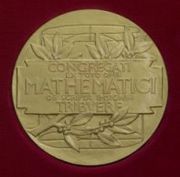
Translation: "Mathematicians gathered from the entire world awarded [understood "the winners"] for their outstanding writings."
In the background, there is the representation of Archimedes' tomb, with the carving illustrating his theorem on the sphere and the cylinder, behind a branch. (This is the mathematical result of which Archimedes was reportedly most proud: Given a sphere and a circumscribed cylinder of the same height and diameter, the ratio between their volumes is equal to 2/3.)
The rim bears the name of the prizewinner.
Mathematician
A mathematician is a person whose primary area of study is the field of mathematics. Mathematicians are concerned with quantity, structure, space, and change....
s not over 40 years of age at each International Congress
International Congress of Mathematicians
The International Congress of Mathematicians is the largest conference for the topic of mathematics. It meets once every four years, hosted by the International Mathematical Union ....
of the International Mathematical Union
International Mathematical Union
The International Mathematical Union is an international non-governmental organisation devoted to international cooperation in the field of mathematics across the world. It is a member of the International Council for Science and supports the International Congress of Mathematicians...
(IMU), a meeting that takes place every four years. The colloquial name is in honour of Canadian
Canada
Canada is a North American country consisting of ten provinces and three territories. Located in the northern part of the continent, it extends from the Atlantic Ocean in the east to the Pacific Ocean in the west, and northward into the Arctic Ocean...
mathematician John Charles Fields
John Charles Fields
John Charles Fields, FRS, FRSC was a Canadian mathematician and the founder of the Fields Medal for outstanding achievement in mathematics...
. Fields was instrumental in establishing the award, designing the medal itself, and funding the monetary component. The Fields Medal is often viewed as the greatest honour a mathematician can receive. It comes with a monetary award, which since 2006 is C$15,000. The medal was first awarded in 1936 to Finnish mathematician Lars Ahlfors and American mathematician Jesse Douglas
Jesse Douglas
Jesse Douglas was an American mathematician. He was born in New York and attended Columbia College of Columbia University from 1920–1924. Douglas was one of two winners of the first Fields Medals, awarded in 1936. He was honored for solving, in 1930, the problem of Plateau, which asks whether a...
, and it has been awarded every four years since 1950. Its purpose is to give recognition and support to younger mathematical researchers who have made major contributions.
Conditions of the award
The Fields Medal is often described as the "Nobel Prize of Mathematics" for the prestige it carries, though in most other ways the relatively new Abel PrizeAbel Prize
The Abel Prize is an international prize presented annually by the King of Norway to one or more outstanding mathematicians. The prize is named after Norwegian mathematician Niels Henrik Abel . It has often been described as the "mathematician's Nobel prize" and is among the most prestigious...
is a more direct analogue. In contrast with the Nobel Prize, the Fields Medal is awarded only every four years. The Medal also has an age limit: a recipient's 40th birthday must not occur before January 1 of the year in which the Fields Medal is awarded. As a result some great mathematicians have missed it by having done their best work (or having had their work recognized) too late in life. The 40-year rule is based on Fields' desire that
... while it was in recognition of work already done, it was at the same time intended to be an encouragement for further achievement on the part of the recipients and a stimulus to renewed effort on the part of others.
The monetary award is much lower than the roughly US$1.5 million given with each Nobel prize. Other major awards in mathematics, such as the Abel Prize
Abel Prize
The Abel Prize is an international prize presented annually by the King of Norway to one or more outstanding mathematicians. The prize is named after Norwegian mathematician Niels Henrik Abel . It has often been described as the "mathematician's Nobel prize" and is among the most prestigious...
and the Chern Medal, have a large monetary prize like a Nobel.
Fields Medalists
| Year | ICM location | Medalists | Institution | Nationality |
|---|---|---|---|---|
| 1936 |  Oslo OsloOslo Oslo is a municipality, as well as the capital and most populous city in Norway. As a municipality , it was established on 1 January 1838. Founded around 1048 by King Harald III of Norway, the city was largely destroyed by fire in 1624. The city was moved under the reign of Denmark–Norway's King... |
Lars Ahlfors Jesse Douglas Jesse Douglas Jesse Douglas was an American mathematician. He was born in New York and attended Columbia College of Columbia University from 1920–1924. Douglas was one of two winners of the first Fields Medals, awarded in 1936. He was honored for solving, in 1930, the problem of Plateau, which asks whether a... |
University of Helsinki University of Helsinki The University of Helsinki is a university located in Helsinki, Finland since 1829, but was founded in the city of Turku in 1640 as The Royal Academy of Turku, at that time part of the Swedish Empire. It is the oldest and largest university in Finland with the widest range of disciplines available... Massachusetts Institute of Technology Massachusetts Institute of Technology The Massachusetts Institute of Technology is a private research university located in Cambridge, Massachusetts. MIT has five schools and one college, containing a total of 32 academic departments, with a strong emphasis on scientific and technological education and research.Founded in 1861 in... |
  |
| 1950 | Cambridge Cambridge, Massachusetts Cambridge is a city in Middlesex County, Massachusetts, United States, in the Greater Boston area. It was named in honor of the University of Cambridge in England, an important center of the Puritan theology embraced by the town's founders. Cambridge is home to two of the world's most prominent... |
Laurent Schwartz Laurent Schwartz Laurent-Moïse Schwartz was a French mathematician. He pioneered the theory of distributions, which gives a well-defined meaning to objects such as the Dirac delta function. He was awarded the Fields medal in 1950 for his work... Atle Selberg Atle Selberg Atle Selberg was a Norwegian mathematician known for his work in analytic number theory, and in the theory of automorphic forms, in particular bringing them into relation with spectral theory... |
University of Nancy Institute for Advanced Study Institute for Advanced Study The Institute for Advanced Study, located in Princeton, New Jersey, United States, is an independent postgraduate center for theoretical research and intellectual inquiry. It was founded in 1930 by Abraham Flexner... |
 |
| 1954 |  Amsterdam AmsterdamAmsterdam Amsterdam is the largest city and the capital of the Netherlands. The current position of Amsterdam as capital city of the Kingdom of the Netherlands is governed by the constitution of August 24, 1815 and its successors. Amsterdam has a population of 783,364 within city limits, an urban population... |
Kunihiko Kodaira Jean-Pierre Serre Jean-Pierre Serre Jean-Pierre Serre is a French mathematician. He has made contributions in the fields of algebraic geometry, number theory, and topology.-Early years:... |
Institute for Advanced Study Institute for Advanced Study The Institute for Advanced Study, located in Princeton, New Jersey, United States, is an independent postgraduate center for theoretical research and intellectual inquiry. It was founded in 1930 by Abraham Flexner... Centre National de la Recherche Scientifique Centre national de la recherche scientifique The National Center of Scientific Research is the largest governmental research organization in France and the largest fundamental science agency in Europe.... |
 |
| 1958 | Edinburgh Edinburgh Edinburgh is the capital city of Scotland, the second largest city in Scotland, and the eighth most populous in the United Kingdom. The City of Edinburgh Council governs one of Scotland's 32 local government council areas. The council area includes urban Edinburgh and a rural area... |
Klaus Roth Klaus Roth Klaus Friedrich Roth is a British mathematician known for work on diophantine approximation, the large sieve, and irregularities of distribution. He was born in Breslau, Prussia, but raised and educated in the UK. He graduated from Peterhouse, Cambridge in 1945... René Thom René Thom René Frédéric Thom was a French mathematician. He made his reputation as a topologist, moving on to aspects of what would be called singularity theory; he became world-famous among the wider academic community and the educated general public for one aspect of this latter interest, his work as... |
Imperial College London Imperial College London Imperial College London is a public research university located in London, United Kingdom, specialising in science, engineering, business and medicine... University of Strasbourg University of Strasbourg The University of Strasbourg in Strasbourg, Alsace, France, is the largest university in France, with about 43,000 students and over 4,000 researchers.... |
|
| 1962 |  Stockholm StockholmStockholm Stockholm is the capital and the largest city of Sweden and constitutes the most populated urban area in Scandinavia. Stockholm is the most populous city in Sweden, with a population of 851,155 in the municipality , 1.37 million in the urban area , and around 2.1 million in the metropolitan area... |
Lars Hörmander Lars Hörmander Lars Valter Hörmander is a Swedish mathematician who has been called "the foremost contributor to the modern theory of linear partial differential equations". He was awarded the Fields Medal in 1962, and the Wolf Prize in 1988... John Milnor John Milnor John Willard Milnor is an American mathematician known for his work in differential topology, K-theory and dynamical systems. He won the Fields Medal in 1962, the Wolf Prize in 1989, and the Abel Prize in 2011. Milnor is a distinguished professor at Stony Brook University... |
University of Stockholm Princeton University Princeton University Princeton University is a private research university located in Princeton, New Jersey, United States. The school is one of the eight universities of the Ivy League, and is one of the nine Colonial Colleges founded before the American Revolution.... |
|
| 1966 |  Moscow MoscowMoscow Moscow is the capital, the most populous city, and the most populous federal subject of Russia. The city is a major political, economic, cultural, scientific, religious, financial, educational, and transportation centre of Russia and the continent... |
Michael Atiyah Michael Atiyah Sir Michael Francis Atiyah, OM, FRS, FRSE is a British mathematician working in geometry.Atiyah grew up in Sudan and Egypt but spent most of his academic life in the United Kingdom at Oxford and Cambridge, and in the United States at the Institute for Advanced Study... Paul Joseph Cohen Paul Cohen (mathematician) Paul Joseph Cohen was an American mathematician best known for his proof of the independence of the continuum hypothesis and the axiom of choice from Zermelo–Fraenkel set theory, the most widely accepted axiomatization of set theory.-Early years:Cohen was born in Long Branch, New Jersey, into a... Alexander Grothendieck Alexander Grothendieck Alexander Grothendieck is a mathematician and the central figure behind the creation of the modern theory of algebraic geometry. His research program vastly extended the scope of the field, incorporating major elements of commutative algebra, homological algebra, sheaf theory, and category theory... Stephen Smale Stephen Smale Steven Smale a.k.a. Steve Smale, Stephen Smale is an American mathematician from Flint, Michigan. He was awarded the Fields Medal in 1966, and spent more than three decades on the mathematics faculty of the University of California, Berkeley .-Education and career:He entered the University of... |
University of Oxford University of Oxford The University of Oxford is a university located in Oxford, United Kingdom. It is the second-oldest surviving university in the world and the oldest in the English-speaking world. Although its exact date of foundation is unclear, there is evidence of teaching as far back as 1096... Stanford University Stanford University The Leland Stanford Junior University, commonly referred to as Stanford University or Stanford, is a private research university on an campus located near Palo Alto, California. It is situated in the northwestern Santa Clara Valley on the San Francisco Peninsula, approximately northwest of San... Institut des Hautes Études Scientifiques Institut des Hautes Études Scientifiques The Institut des Hautes Études Scientifiques is a French institute supporting advanced research in mathematics and theoretical physics... University of California, Berkeley University of California, Berkeley The University of California, Berkeley , is a teaching and research university established in 1868 and located in Berkeley, California, USA... |
None |
| 1970 | Nice Nice Nice is the fifth most populous city in France, after Paris, Marseille, Lyon and Toulouse, with a population of 348,721 within its administrative limits on a land area of . The urban area of Nice extends beyond the administrative city limits with a population of more than 955,000 on an area of... |
Alan Baker Heisuke Hironaka Heisuke Hironaka is a Japanese mathematician. After completing his undergraduate studies at Kyoto University, he received his Ph.D. from Harvard while under the direction of Oscar Zariski. He won the Fields Medal in 1970.... Sergei Novikov John G. Thompson John G. Thompson John Griggs Thompson is a mathematician at the University of Florida noted for his work in the field of finite groups. He was awarded the Fields Medal in 1970, the Wolf Prize in 1992 and the 2008 Abel Prize.... |
University of Cambridge University of Cambridge The University of Cambridge is a public research university located in Cambridge, United Kingdom. It is the second-oldest university in both the United Kingdom and the English-speaking world , and the seventh-oldest globally... Harvard University Harvard University Harvard University is a private Ivy League university located in Cambridge, Massachusetts, United States, established in 1636 by the Massachusetts legislature. Harvard is the oldest institution of higher learning in the United States and the first corporation chartered in the country... Moscow State University Moscow State University Lomonosov Moscow State University , previously known as Lomonosov University or MSU , is the largest university in Russia. Founded in 1755, it also claims to be one of the oldest university in Russia and to have the tallest educational building in the world. Its current rector is Viktor Sadovnichiy... University of Cambridge University of Cambridge The University of Cambridge is a public research university located in Cambridge, United Kingdom. It is the second-oldest university in both the United Kingdom and the English-speaking world , and the seventh-oldest globally... |
|
| 1974 |  Vancouver VancouverVancouver Vancouver is a coastal seaport city on the mainland of British Columbia, Canada. It is the hub of Greater Vancouver, which, with over 2.3 million residents, is the third most populous metropolitan area in the country,... |
Enrico Bombieri Enrico Bombieri Enrico Bombieri is a mathematician who has been working at the Institute for Advanced Study in Princeton, New Jersey. Bombieri's research in number theory, algebraic geometry, and mathematical analysis have earned him many international prizes --- a Fields Medal in 1974 and the Balzan Prize in 1980... David Mumford David Mumford David Bryant Mumford is an American mathematician known for distinguished work in algebraic geometry, and then for research into vision and pattern theory. He won the Fields Medal and was a MacArthur Fellow. In 2010 he was awarded the National Medal of Science... |
University of Pisa University of Pisa The University of Pisa , located in Pisa, Tuscany, is one of the oldest universities in Italy. It was formally founded on September 3, 1343 by an edict of Pope Clement VI, although there had been lectures on law in Pisa since the 11th century... Harvard University Harvard University Harvard University is a private Ivy League university located in Cambridge, Massachusetts, United States, established in 1636 by the Massachusetts legislature. Harvard is the oldest institution of higher learning in the United States and the first corporation chartered in the country... |
 |
| 1978 | Helsinki Helsinki Helsinki is the capital and largest city in Finland. It is in the region of Uusimaa, located in southern Finland, on the shore of the Gulf of Finland, an arm of the Baltic Sea. The population of the city of Helsinki is , making it by far the most populous municipality in Finland. Helsinki is... |
Pierre Deligne Pierre Deligne - See also :* Deligne conjecture* Deligne–Mumford moduli space of curves* Deligne–Mumford stacks* Deligne cohomology* Fourier–Deligne transform* Langlands–Deligne local constant- External links :... Charles Fefferman Charles Fefferman Charles Louis Fefferman is an American mathematician at Princeton University. His primary field of research is mathematical analysis.... Grigory Margulis Grigory Margulis Gregori Aleksandrovich Margulis is a Russian mathematician known for his far-reaching work on lattices in Lie groups, and the introduction of methods from ergodic theory into diophantine approximation. He was awarded a Fields Medal in 1978 and a Wolf Prize in Mathematics in 2005, becoming the... Daniel Quillen |
Institut des Hautes Études Scientifiques Institut des Hautes Études Scientifiques The Institut des Hautes Études Scientifiques is a French institute supporting advanced research in mathematics and theoretical physics... Princeton University Princeton University Princeton University is a private research university located in Princeton, New Jersey, United States. The school is one of the eight universities of the Ivy League, and is one of the nine Colonial Colleges founded before the American Revolution.... Moscow State University Moscow State University Lomonosov Moscow State University , previously known as Lomonosov University or MSU , is the largest university in Russia. Founded in 1755, it also claims to be one of the oldest university in Russia and to have the tallest educational building in the world. Its current rector is Viktor Sadovnichiy... Massachusetts Institute of Technology Massachusetts Institute of Technology The Massachusetts Institute of Technology is a private research university located in Cambridge, Massachusetts. MIT has five schools and one college, containing a total of 32 academic departments, with a strong emphasis on scientific and technological education and research.Founded in 1861 in... |
 |
| 1982 |  Warsaw WarsawWarsaw Warsaw is the capital and largest city of Poland. It is located on the Vistula River, roughly from the Baltic Sea and from the Carpathian Mountains. Its population in 2010 was estimated at 1,716,855 residents with a greater metropolitan area of 2,631,902 residents, making Warsaw the 10th most... |
Alain Connes Alain Connes Alain Connes is a French mathematician, currently Professor at the Collège de France, IHÉS, The Ohio State University and Vanderbilt University.-Work:... William Thurston William Thurston William Paul Thurston is an American mathematician. He is a pioneer in the field of low-dimensional topology. In 1982, he was awarded the Fields Medal for his contributions to the study of 3-manifolds... Shing-Tung Yau Shing-Tung Yau Shing-Tung Yau is a Chinese American mathematician working in differential geometry. He was born in Shantou, Guangdong Province, China into a family of scholars from Jiaoling, Guangdong Province.... |
Institut des Hautes Études Scientifiques Institut des Hautes Études Scientifiques The Institut des Hautes Études Scientifiques is a French institute supporting advanced research in mathematics and theoretical physics... Princeton University Princeton University Princeton University is a private research university located in Princeton, New Jersey, United States. The school is one of the eight universities of the Ivy League, and is one of the nine Colonial Colleges founded before the American Revolution.... Institute for Advanced Study Institute for Advanced Study The Institute for Advanced Study, located in Princeton, New Jersey, United States, is an independent postgraduate center for theoretical research and intellectual inquiry. It was founded in 1930 by Abraham Flexner... |
|
| 1986 | Berkeley Berkeley, California Berkeley is a city on the east shore of the San Francisco Bay in Northern California, United States. Its neighbors to the south are the cities of Oakland and Emeryville. To the north is the city of Albany and the unincorporated community of Kensington... |
Simon Donaldson Simon Donaldson Simon Kirwan Donaldson FRS , is an English mathematician known for his work on the topology of smooth four-dimensional manifolds. He is now Royal Society research professor in Pure Mathematics and President of the Institute for Mathematical Science at Imperial College London... Gerd Faltings Gerd Faltings Gerd Faltings is a German mathematician known for his work in arithmetic algebraic geometry.From 1972 to 1978, he studied mathematics and physics at the University of Münster. In 1978 he received his PhD in mathematics and in 1981 he got the venia legendi in mathematics, both from the University... Michael Freedman Michael Freedman Michael Hartley Freedman is a mathematician at Microsoft Station Q, a research group at the University of California, Santa Barbara. In 1986, he was awarded a Fields Medal for his work on the Poincaré conjecture. Freedman and Robion Kirby showed that an exotic R4 manifold exists.Freedman was born... |
University of Oxford University of Oxford The University of Oxford is a university located in Oxford, United Kingdom. It is the second-oldest surviving university in the world and the oldest in the English-speaking world. Although its exact date of foundation is unclear, there is evidence of teaching as far back as 1096... Princeton University Princeton University Princeton University is a private research university located in Princeton, New Jersey, United States. The school is one of the eight universities of the Ivy League, and is one of the nine Colonial Colleges founded before the American Revolution.... University of California, San Diego University of California, San Diego The University of California, San Diego, commonly known as UCSD or UC San Diego, is a public research university located in the La Jolla neighborhood of San Diego, California, United States... |
 |
| 1990 | Kyoto Kyoto is a city in the central part of the island of Honshū, Japan. It has a population close to 1.5 million. Formerly the imperial capital of Japan, it is now the capital of Kyoto Prefecture, as well as a major part of the Osaka-Kobe-Kyoto metropolitan area.-History:... |
Vladimir Drinfel'd Vladimir Drinfel'd Vladimir Gershonovich Drinfel'd is a Ukrainian and Soviet mathematician at the University of Chicago.The work of Drinfeld related algebraic geometry over finite fields with number theory, especially the theory of automorphic forms, through the notions of elliptic module and the theory of the... Vaughan F. R. Jones Vaughan Jones Sir Vaughan Frederick Randal Jones, KNZM, FRS, FRSNZ is a New Zealand mathematician, known for his work on von Neumann algebras, knot polynomials and conformal field theory. He was awarded a Fields Medal in 1990, and famously wore a New Zealand rugby jersey when he accepted the prize... Shigefumi Mori Shigefumi Mori -References:*Heisuke Hironaka, Fields Medallists Lectures, Michael F. Atiyah , Daniel Iagolnitzer ; World Scientific Publishing, 2007. ISBN 9810231172... Edward Witten Edward Witten Edward Witten is an American theoretical physicist with a focus on mathematical physics who is currently a professor of Mathematical Physics at the Institute for Advanced Study.... |
Kharkov Institute of Physics and Technology Kharkov Institute of Physics and Technology The Kharkiv Institute of Physics and Technology is the oldest and largest physical science research centre in the Ukraine.This was where the UPTI Affair occurred in 1938.-External links:*... University of California, Berkeley University of California, Berkeley The University of California, Berkeley , is a teaching and research university established in 1868 and located in Berkeley, California, USA... University of Kyoto Institute for Advanced Study Institute for Advanced Study The Institute for Advanced Study, located in Princeton, New Jersey, United States, is an independent postgraduate center for theoretical research and intellectual inquiry. It was founded in 1930 by Abraham Flexner... |
 |
| 1994 |  Zürich ZürichZürich Zurich is the largest city in Switzerland and the capital of the canton of Zurich. It is located in central Switzerland at the northwestern tip of Lake Zurich... |
Jean Bourgain Jean Bourgain Jean Bourgain is a Belgian mathematician. He has been a faculty member at the University of Illinois, Urbana-Champaign and, from 1985 until 1995, professor at Institut des Hautes Études Scientifiques at Bures-sur-Yvette in France, and since 1994 at the Institute for Advanced Study in Princeton,... Pierre-Louis Lions Pierre-Louis Lions Pierre-Louis Lions is a French mathematician. His parents were Jacques-Louis Lions, a mathematician and at that time professor at the University of Nancy, who in particular became President of the International Mathematical Union, and Andrée Olivier, his wife... Jean-Christophe Yoccoz Jean-Christophe Yoccoz Jean-Christophe Yoccoz is a French mathematician. He was awarded a Fields Medal in 1994, for his work on dynamical systems.-Biography:... Efim Zelmanov Efim Zelmanov Efim Isaakovich Zelmanov is a Russian mathematician, known for his work on combinatorial problems in nonassociative algebra and group theory, including his solution of the restricted Burnside problem. He was awarded a Fields Medal at the International Congress of Mathematicians in Zürich in... |
Institute for Advanced Study Institute for Advanced Study The Institute for Advanced Study, located in Princeton, New Jersey, United States, is an independent postgraduate center for theoretical research and intellectual inquiry. It was founded in 1930 by Abraham Flexner... Paris Dauphine University Paris-Sud 11 University Paris-Sud 11 University University of Paris-Sud or University of Paris-Sud or University of Paris XI is a French university distributed among several campuses in the southern suburb of Paris... University of California, San Diego University of California, San Diego The University of California, San Diego, commonly known as UCSD or UC San Diego, is a public research university located in the La Jolla neighborhood of San Diego, California, United States... |
 |
| 1998 | Berlin Berlin Berlin is the capital city of Germany and is one of the 16 states of Germany. With a population of 3.45 million people, Berlin is Germany's largest city. It is the second most populous city proper and the seventh most populous urban area in the European Union... |
Richard Borcherds Richard Borcherds Richard Ewen Borcherds is a British mathematician specializing in lattices, number theory, group theory, and infinite-dimensional algebras. He was awarded the Fields Medal in 1998.- Personal life :... Timothy Gowers Maxim Kontsevich Maxim Kontsevich Maxim Lvovich Kontsevich is a Russian mathematician. He is a professor at the Institut des Hautes Études Scientifiques and a distinguished professor at the University of Miami... Curtis T. McMullen Curtis T. McMullen Curtis Tracy McMullen is Professor of Mathematics at Harvard University. He was awarded the Fields Medal in 1998 for his work in complex dynamics, hyperbolic geometry and Teichmüller theory.... |
University of California, Berkeley University of California, Berkeley The University of California, Berkeley , is a teaching and research university established in 1868 and located in Berkeley, California, USA... and University of Cambridge University of Cambridge The University of Cambridge is a public research university located in Cambridge, United Kingdom. It is the second-oldest university in both the United Kingdom and the English-speaking world , and the seventh-oldest globally... University of Cambridge University of Cambridge The University of Cambridge is a public research university located in Cambridge, United Kingdom. It is the second-oldest university in both the United Kingdom and the English-speaking world , and the seventh-oldest globally... Institut des Hautes Études Scientifiques Institut des Hautes Études Scientifiques The Institut des Hautes Études Scientifiques is a French institute supporting advanced research in mathematics and theoretical physics... and Rutgers University Rutgers University Rutgers, The State University of New Jersey , is the largest institution for higher education in New Jersey, United States. It was originally chartered as Queen's College in 1766. It is the eighth-oldest college in the United States and one of the nine Colonial colleges founded before the American... Harvard University Harvard University Harvard University is a private Ivy League university located in Cambridge, Massachusetts, United States, established in 1636 by the Massachusetts legislature. Harvard is the oldest institution of higher learning in the United States and the first corporation chartered in the country... |
|
| 2002 |  Beijing BeijingBeijing Beijing , also known as Peking , is the capital of the People's Republic of China and one of the most populous cities in the world, with a population of 19,612,368 as of 2010. The city is the country's political, cultural, and educational center, and home to the headquarters for most of China's... |
Laurent Lafforgue Laurent Lafforgue Laurent Lafforgue is a French mathematician.He won 2 silver medals at International Mathematical Olympiad in 1984 and 1985.... Vladimir Voevodsky Vladimir Voevodsky Vladimir Voevodsky is a Russian American mathematician. His work in developing a homotopy theory for algebraic varieties and formulating motivic cohomology led to the award of a Fields Medal in 2002.- Biography :... |
Institut des Hautes Études Scientifiques Institut des Hautes Études Scientifiques The Institut des Hautes Études Scientifiques is a French institute supporting advanced research in mathematics and theoretical physics... Institute for Advanced Study Institute for Advanced Study The Institute for Advanced Study, located in Princeton, New Jersey, United States, is an independent postgraduate center for theoretical research and intellectual inquiry. It was founded in 1930 by Abraham Flexner... |
|
| 2006 |  Madrid MadridMadrid Madrid is the capital and largest city of Spain. The population of the city is roughly 3.3 million and the entire population of the Madrid metropolitan area is calculated to be 6.271 million. It is the third largest city in the European Union, after London and Berlin, and its metropolitan... |
Andrei Okounkov Andrei Okounkov Andrei Yuryevich Okounkov is a Russian mathematician who works on representation theory and its applications to algebraic geometry, mathematical physics, probability theory and special functions. He is currently a professor at Columbia University.... Grigori Perelman Grigori Perelman Grigori Yakovlevich Perelman is a Russian mathematician who has made landmark contributions to Riemannian geometry and geometric topology.In 1992, Perelman proved the soul conjecture. In 2002, he proved Thurston's geometrization conjecture... (declined) Terence Tao Terence Tao Terence Chi-Shen Tao FRS is an Australian mathematician working primarily on harmonic analysis, partial differential equations, combinatorics, analytic number theory and representation theory... Wendelin Werner Wendelin Werner Wendelin Werner is a German-born French mathematician working in the area of self-avoiding random walks, Schramm-Loewner evolution, and related theories in probability theory and mathematical physics. In 2006, at the 25th International Congress of Mathematicians in Madrid, Spain he received the... |
Princeton University Princeton University Princeton University is a private research university located in Princeton, New Jersey, United States. The school is one of the eight universities of the Ivy League, and is one of the nine Colonial Colleges founded before the American Revolution.... None (St. Petersburg) University of California, Los Angeles University of California, Los Angeles The University of California, Los Angeles is a public research university located in the Westwood neighborhood of Los Angeles, California, USA. It was founded in 1919 as the "Southern Branch" of the University of California and is the second oldest of the ten campuses... Paris-Sud 11 University Paris-Sud 11 University University of Paris-Sud or University of Paris-Sud or University of Paris XI is a French university distributed among several campuses in the southern suburb of Paris... |
 |
| 2010 |  Hyderabad Hyderabad |
Elon Lindenstrauss Elon Lindenstrauss Elon Lindenstrauss is an Israeli mathematician, and a winner of the 2010 Fields Medal.Since 2004, he has been a professor at Princeton University... Ngô Bảo Châu Ngo Bao Chau Ngô Bảo Châu is a Vietnamese and French mathematician at the University of Chicago, best known for proving the fundamental lemma for automorphic forms proposed by Robert Langlands and Diana Shelstad. He is the first Vietnamese to receive the Fields Medal.- Biography :Chau was born in 1972, the... Stanislav Smirnov Stanislav Smirnov Stanislav Konstantinovich Smirnov is a Russian mathematician currently working at the University of Geneva, who was awarded the Fields Medal in 2010. His research focuses on the fields of complex analysis, dynamical systems and probability theory.-Career:... Cédric Villani Cédric Villani Cédric Villani is a French mathematician working primarily on partial differential equations and mathematical physics. He was awarded the Fields Medal in 2010.-Biography:... |
Hebrew University of Jerusalem Hebrew University of Jerusalem The Hebrew University of Jerusalem ; ; abbreviated HUJI) is Israel's second-oldest university, after the Technion – Israel Institute of Technology. The Hebrew University has three campuses in Jerusalem and one in Rehovot. The world's largest Jewish studies library is located on its Edmond J... University of Chicago University of Chicago The University of Chicago is a private research university in Chicago, Illinois, USA. It was founded by the American Baptist Education Society with a donation from oil magnate and philanthropist John D. Rockefeller and incorporated in 1890... and Paris-Sud 11 University Paris-Sud 11 University University of Paris-Sud or University of Paris-Sud or University of Paris XI is a French university distributed among several campuses in the southern suburb of Paris... and Institute for Advanced Study Institute for Advanced Study The Institute for Advanced Study, located in Princeton, New Jersey, United States, is an independent postgraduate center for theoretical research and intellectual inquiry. It was founded in 1930 by Abraham Flexner... University of Geneva University of Geneva The University of Geneva is a public research university located in Geneva, Switzerland.It was founded in 1559 by John Calvin, as a theological seminary and law school. It remained focused on theology until the 17th century, when it became a center for Enlightenment scholarship. In 1873, it... École Normale Supérieure de Lyon École Normale Supérieure de Lyon The École Normale Supérieure de Lyon is a highly selective grande école located in Lyon, France. As one of France's three Écoles normales supérieures, ENS Lyon is associated with a strong French tradition of excellence and public service... and Institut Henri Poincaré Institut Henri Poincaré The Institut Henri Poincaré is a mathematical institute in Paris which has established itself over its eighty year history as an important meeting place for French and international mathematicians and theoretical physicists... |
  - - |
| 2014 | Seoul Seoul Seoul , officially the Seoul Special City, is the capital and largest metropolis of South Korea. A megacity with a population of over 10 million, it is the largest city proper in the OECD developed world... |
TBD |
Landmarks
In 1954, Jean-Pierre SerreJean-Pierre Serre
Jean-Pierre Serre is a French mathematician. He has made contributions in the fields of algebraic geometry, number theory, and topology.-Early years:...
became the youngest winner of the Fields Medal, at 27. He still retains this distinction.
In 1966, Alexander Grothendieck
Alexander Grothendieck
Alexander Grothendieck is a mathematician and the central figure behind the creation of the modern theory of algebraic geometry. His research program vastly extended the scope of the field, incorporating major elements of commutative algebra, homological algebra, sheaf theory, and category theory...
boycotted the ICM, held in Moscow, to protest Soviet military actions taking place in Eastern Europe.
In 1970, Sergei Novikov, due to restrictions placed on him by the Soviet government, was unable to travel to the congress in Nice
Nice
Nice is the fifth most populous city in France, after Paris, Marseille, Lyon and Toulouse, with a population of 348,721 within its administrative limits on a land area of . The urban area of Nice extends beyond the administrative city limits with a population of more than 955,000 on an area of...
to receive his medal.
In 1978, Grigory Margulis
Grigory Margulis
Gregori Aleksandrovich Margulis is a Russian mathematician known for his far-reaching work on lattices in Lie groups, and the introduction of methods from ergodic theory into diophantine approximation. He was awarded a Fields Medal in 1978 and a Wolf Prize in Mathematics in 2005, becoming the...
, due to restrictions placed on him by the Soviet government, was unable to travel to the congress in Helsinki
Helsinki
Helsinki is the capital and largest city in Finland. It is in the region of Uusimaa, located in southern Finland, on the shore of the Gulf of Finland, an arm of the Baltic Sea. The population of the city of Helsinki is , making it by far the most populous municipality in Finland. Helsinki is...
to receive his medal. The award was accepted on his behalf by Jacques Tits
Jacques Tits
Jacques Tits is a Belgian and French mathematician who works on group theory and geometry and who introduced Tits buildings, the Tits alternative, and the Tits group.- Career :Tits received his doctorate in mathematics at the age of 20...
, who said in his address: "I cannot but express my deep disappointment — no doubt shared by many people here — in the absence of Margulis from this ceremony. In view of the symbolic meaning of this city of Helsinki, I had indeed grounds to hope that I would have a chance at last to meet a mathematician whom I know only through his work and for whom I have the greatest respect and admiration."
In 1982, the congress was due to be held in Warsaw
Warsaw
Warsaw is the capital and largest city of Poland. It is located on the Vistula River, roughly from the Baltic Sea and from the Carpathian Mountains. Its population in 2010 was estimated at 1,716,855 residents with a greater metropolitan area of 2,631,902 residents, making Warsaw the 10th most...
but had to be rescheduled to the next year, due to martial law
Martial law in Poland
Martial law in Poland refers to the period of time from December 13, 1981 to July 22, 1983, when the authoritarian government of the People's Republic of Poland drastically restricted normal life by introducing martial law in an attempt to crush political opposition to it. Thousands of opposition...
introduced in Poland Dec. 13, 1981. The awards were announced at the ninth General Assembly of the IMU earlier in the year and awarded at the 1983 Warsaw congress.
In 1990, Edward Witten
Edward Witten
Edward Witten is an American theoretical physicist with a focus on mathematical physics who is currently a professor of Mathematical Physics at the Institute for Advanced Study....
became the first and so far only physicist
Physicist
A physicist is a scientist who studies or practices physics. Physicists study a wide range of physical phenomena in many branches of physics spanning all length scales: from sub-atomic particles of which all ordinary matter is made to the behavior of the material Universe as a whole...
to win this award.
In 1998, at the ICM, Andrew Wiles
Andrew Wiles
Sir Andrew John Wiles KBE FRS is a British mathematician and a Royal Society Research Professor at Oxford University, specializing in number theory...
was presented by the chair of the Fields Medal Committee, Yuri I. Manin
Yuri I. Manin
Yuri Ivanovitch Manin is a Soviet/Russian/German mathematician, known for work in algebraic geometry and diophantine geometry, and many expository works ranging from mathematical logic to theoretical physics.-Biography:...
, with the first-ever IMU silver plaque in recognition of his proof of Fermat's Last Theorem
Fermat's Last Theorem
In number theory, Fermat's Last Theorem states that no three positive integers a, b, and c can satisfy the equation an + bn = cn for any integer value of n greater than two....
. Don Zagier
Don Zagier
Don Bernard Zagier is an American mathematician whose main area of work is number theory. He is currently one of the directors of the Max Planck Institute for Mathematics in Bonn, Germany, and a professor at the Collège de France in Paris, France.He was born in Heidelberg, Germany...
referred to the plaque as a "quantized Fields Medal". Accounts of this award frequently make reference that at the time of the award Wiles was over the age limit for the Fields medal. Although Wiles was slightly over the age limit in 1994, he was thought to be a favorite to win the medal; however, a gap (later resolved by Taylor
Richard Taylor (mathematician)
-External links:**...
and Wiles) in the proof was found in 1993.
In 2006, Grigori Perelman
Grigori Perelman
Grigori Yakovlevich Perelman is a Russian mathematician who has made landmark contributions to Riemannian geometry and geometric topology.In 1992, Perelman proved the soul conjecture. In 2002, he proved Thurston's geometrization conjecture...
, who proved the Poincaré conjecture
Poincaré conjecture
In mathematics, the Poincaré conjecture is a theorem about the characterization of the three-dimensional sphere , which is the hypersphere that bounds the unit ball in four-dimensional space...
, refused his Fields Medal and did not attend the congress.
The medal
The medal was designed by Canadian sculptor R. Tait McKenzieR. Tait McKenzie
Robert Tait McKenzie was an internationally renowned Canadian-born sculptor, doctor, soldier, physical educator, athlete and Scouter...
.
- On the obverse is ArchimedesArchimedesArchimedes of Syracuse was a Greek mathematician, physicist, engineer, inventor, and astronomer. Although few details of his life are known, he is regarded as one of the leading scientists in classical antiquity. Among his advances in physics are the foundations of hydrostatics, statics and an...
and a quote attributed to Marcus ManiliusMarcus ManiliusMarcus Manilius was a Roman poet, astrologer, and author of a poem in five books called Astronomica.-Criticism:The author of Astronomica is neither quoted nor mentioned by any ancient writer. Even his name is uncertain, but it was probably Marcus Manilius; in the earlier books the author is...
which reads in Latin: "Transire suum pectus mundoque potiri" (Rise above oneself and grasp the world).
- On the reverse is the inscription (in Latin):
Translation: "Mathematicians gathered from the entire world awarded [understood "the winners"] for their outstanding writings."
In the background, there is the representation of Archimedes' tomb, with the carving illustrating his theorem on the sphere and the cylinder, behind a branch. (This is the mathematical result of which Archimedes was reportedly most proud: Given a sphere and a circumscribed cylinder of the same height and diameter, the ratio between their volumes is equal to 2/3.)
The rim bears the name of the prizewinner.
See also
- List of prizes, medals, and awards in mathematics