
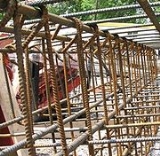
A
rebar also known as
reinforcing steel,
reinforcement steel,
rerod, or a
deformed bar, is a common
steelSteel is an alloy that consists mostly of iron and has a carbon content between 0.2% and 2.1% by weight, depending on the grade. Carbon is the most common alloying material for iron, but various other alloying elements are used, such as manganese, chromium, vanadium, and tungsten...
bar, and is commonly used as a tensioning device in
reinforced concreteReinforced concrete is concrete in which reinforcement bars , reinforcement grids, plates or fibers have been incorporated to strengthen the concrete in tension. It was invented by French gardener Joseph Monier in 1849 and patented in 1867. The term Ferro Concrete refers only to concrete that is...
and reinforced
masonryMasonry is the building of structures from individual units laid in and bound together by mortar; the term masonry can also refer to the units themselves. The common materials of masonry construction are brick, stone, marble, granite, travertine, limestone; concrete block, glass block, stucco, and...
structures holding the concrete in compression. It is usually formed from carbon steel, and is given ridges for better mechanical anchoring into the concrete. In
AustraliaAustralia , officially the Commonwealth of Australia, is a country in the Southern Hemisphere comprising the mainland of the Australian continent, the island of Tasmania, and numerous smaller islands in the Indian and Pacific Oceans. It is the world's sixth-largest country by total area...
, it is
colloquiallyA colloquialism is a word or phrase that is common in everyday, unconstrained conversation rather than in formal speech, academic writing, or paralinguistics. Dictionaries often display colloquial words and phrases with the abbreviation colloq. as an identifier...
known as
reo.
History
Rebars were known in construction well before the era of the modern reinforced concrete. Some 150 years before its invention rebars were used to form the carcass of the
Leaning Tower of NevyanskThe Leaning Tower of Nevyansk is a tower in the town of Nevyansk in Sverdlovsk Oblast, Russia, built in the 18th century. Its construction was funded by Peter the Great’s associate and a famous Russian manufacturer Akinfiy Demidov .The height of the tower is 57.5 m from the ground and the...
in
RussiaRussia or , officially known as both Russia and the Russian Federation , is a country in northern Eurasia. It is a federal semi-presidential republic, comprising 83 federal subjects...
, built on the orders of the industrialist
Akinfiy DemidovAkinfiy Nikitich Demidov was a Russian industrialist of the Demidov family.-Life:He was the eldest son of Nikita Demidov and increased the family fortune, raising it to one of Russia's most important industrial dynasties. He set up at least 9 steel foundries and munitions factories from 1717 to...
. The purpose of such construction is one of the many mysteries of the tower. The
cast ironCast iron is derived from pig iron, and while it usually refers to gray iron, it also identifies a large group of ferrous alloys which solidify with a eutectic. The color of a fractured surface can be used to identify an alloy. White cast iron is named after its white surface when fractured, due...
used for rebars was of very high quality, and there is no
corrosionCorrosion is the disintegration of an engineered material into its constituent atoms due to chemical reactions with its surroundings. In the most common use of the word, this means electrochemical oxidation of metals in reaction with an oxidant such as oxygen...
on them up to this day. The carcass of the tower was connected to its cast iron
tented roofA tented roof is a type of roof widely used in 16th and 17th century Russian architecture for churches. It is like a polygonal spire but differs in purpose in that it is typically used to roof the main internal space of a church, rather than an auxiliary structure...
, crowned with the first
lightning rodA lightning rod or lightning conductor is a metal rod or conductor mounted on top of a building and electrically connected to the ground through a wire, to protect the building in the event of lightning...
in the Western world. This lightning rod was
groundedIn electrical engineering, ground or earth may be the reference point in an electrical circuit from which other voltages are measured, or a common return path for electric current, or a direct physical connection to the Earth....
through the carcass, though it is not clear whether the effect was intentional.
Use in concrete and masonry
ConcreteConcrete is a composite construction material, composed of cement and other cementitious materials such as fly ash and slag cement, aggregate , water and chemical admixtures.The word concrete comes from the Latin word...
is a material that is very strong in compression, but relatively weak in
tensionIn physics, tension is the magnitude of the pulling force exerted by a string, cable, chain, or similar object on another object. It is the opposite of compression. As tension is the magnitude of a force, it is measured in newtons and is always measured parallel to the string on which it applies...
. To compensate for this imbalance in concrete's behavior, rebar is cast into it to carry the tensile
loadStructural loads or actions are forces, deformations or accelerations applied to a structure or its components.Loads cause stresses, deformations and displacements in structures. Assessment of their effects is carried out by the methods of structural analysis...
s.
Masonry structures and the
mortarMortar is a workable paste used to bind construction blocks together and fill the gaps between them. The blocks may be stone, brick, cinder blocks, etc. Mortar becomes hard when it sets, resulting in a rigid aggregate structure. Modern mortars are typically made from a mixture of sand, a binder...
holding them together have similar properties to concrete and also have a limited ability to carry tensile loads. Some standard masonry units like blocks and
brickA brick is a block of ceramic material used in masonry construction, usually laid using various kinds of mortar. It has been regarded as one of the longest lasting and strongest building materials used throughout history.-History:...
s are made with strategically placed voids to accommodate rebar, which is then secured in place with
groutGrout is a construction material used to embed rebars in masonry walls, connect sections of pre-cast concrete, fill voids, and seal joints . Grout is generally composed of a mixture of water, cement, sand, often color tint, and sometimes fine gravel...
. This combination is known as reinforced masonry.
While any material with sufficient tensile strength could conceivably be used to reinforce concrete, steel and concrete have similar coefficients of thermal expansion: a concrete structural member reinforced with steel will experience minimal
stressIn continuum mechanics, stress is a measure of the internal forces acting within a deformable body. Quantitatively, it is a measure of the average force per unit area of a surface within the body on which internal forces act. These internal forces are a reaction to external forces applied on the body...
as a result of differential expansions of the two interconnected materials caused by temperature changes.
Physical characteristics
Steel has an expansion coefficient nearly equal to that of modern concrete. If this were not so, it would cause problems through additional longitudinal and perpendicular stresses at temperatures different than the temperature of the setting. Although rebar has ribs that bind it mechanically to the concrete, it can still be pulled out of the concrete under high stresses, an occurrence that often precedes a larger-scale collapse of the structure. To prevent such a failure, rebar is either deeply embedded into adjacent structural members (40-60 times the diameter), or bent and hooked at the ends to lock it around the concrete and other rebar. This first approach increases the friction locking the bar into place, while the second makes use of the high compressive strength of concrete.
Common rebar is made of unfinished tempered steel, making it susceptible to
rustRust is a general term for a series of iron oxides. In colloquial usage, the term is applied to red oxides, formed by the reaction of iron and oxygen in the presence of water or air moisture...
ing. Normally the concrete cover is able to provide a pH value higher than 12 avoiding the corrosion reaction. Too little concrete cover can compromise this guard through carbonation from the surface. Too much concrete cover can cause bigger crack widths which also compromises the local guard. As rust takes up greater volume than the steel from which it was formed, it causes severe internal pressure on the surrounding concrete, leading to cracking, spalling, and ultimately,
structural failureStructural failure refers to loss of the load-carrying capacity of a component or member within a structure or of the structure itself. Structural failure is initiated when the material is stressed to its strength limit, thus causing fracture or excessive deformations...
. This is a particular problem where the concrete is exposed to salt water, as in bridges built in areas where salt is applied to roadways in winter, or in marine applications.
EpoxyEpoxy, also known as polyepoxide, is a thermosetting polymer formed from reaction of an epoxide "resin" with polyamine "hardener". Epoxy has a wide range of applications, including fiber-reinforced plastic materials and general purpose adhesives....
-coated, galvanized or
stainless steelIn metallurgy, stainless steel, also known as inox steel or inox from French "inoxydable", is defined as a steel alloy with a minimum of 10.5 or 11% chromium content by mass....
rebars may be employed in these situations at greater initial expense, but significantly lower expense over the service life of the project. Special care must be taken during the installation of epoxy-coated rebar, because even small cracks and failures in the coating can lead to intensified local chemical reactions not visible at the surface.
Fiber-reinforced polymer rebar is now also being used in high-corrosion environments. It is available in many forms, from spirals for reinforcing columns, to the common rod, to meshes and many other forms. Most commercially available rebars are made from unidirectional glassfibre reinforced thermoset resins.
U.S. sizes
Imperial bar designations represent the bar diameter in fractions of inch, such that #8 = inch = 1 inch diameter. Area = (bar size/9)
2 such that area of #8 = (8/9)
2 = 0.79 in
2. This applies to #8 bars and smaller. Larger bars have a slightly larger diameter than the one computed using the inch convention.
Imperial
Bar Size |
"Soft"
Metric Size |
|
Mass per unit length
(kg/m) |
Nominal Diameter
(in) |
Nominal Diameter
(mm) |
Nominal Area
(in²) |
Nominal Area
(mm²) |
| #3 |
#10 |
0.376 |
0.561 |
0.375 = |
9.525 |
0.11 |
71 |
| #4 |
#13 |
0.668 |
0.996 |
0.500 = |
12.7 |
0.20 |
129 |
| #5 |
#16 |
1.043 |
1.556 |
0.625 = |
15.875 |
0.31 |
200 |
| #6 |
#19 |
1.502 |
2.24 |
0.750 = |
19.05 |
0.44 |
284 |
| #7 |
#22 |
2.044 |
3.049 |
0.875 = |
22.225 |
0.60 |
387 |
| #8 |
#25 |
2.670 |
3.982 |
1.000 |
25.4 |
0.79 |
509 |
| #9 |
#29 |
3.400 |
5.071 |
1.128 |
28.65 |
1.00 |
645 |
| #10 |
#32 |
4.303 |
6.418 |
1.270 |
32.26 |
1.27 |
819 |
| #11 |
#36 |
5.313 |
7.924 |
1.410 |
35.81 |
1.56 |
1006 |
| #12 |
#40 |
6.424 |
9.619 |
1.50 |
38.1 |
1.76 |
1140 |
| #14 |
#43 |
7.650 |
11.41 |
1.693 |
43 |
2.25 |
1452 |
| #18 |
#57 |
13.60 |
20.284 |
2.257 |
57.33 |
4.00 |
2581 |
Canadian sizes
Metric bar designations represent the nominal bar diameter in millimeters, rounded to the nearest 5 mm.
Metric
Bar Size |
Mass per unit length
(kg/m) |
Nominal Diameter
(mm) |
Cross-Sectional
Area (mm²) |
| 10M |
0.785 |
11.3 |
100 |
| 15M |
1.570 |
16.0 |
200 |
| 20M |
2.355 |
19.5 |
300 |
| 25M |
3.925 |
25.2 |
500 |
| 30M |
5.495 |
29.9 |
700 |
| 35M |
7.850 |
35.7 |
1000 |
| 45M |
11.775 |
43.7 |
1500 |
| 55M |
19.625 |
56.4 |
2500 |
European sizes
Metric bar designations represent the nominal bar diameter in millimetres. Bars in Europe will be specified to comply with the standard
EN 10080The EN 10080: Steel for the reinforcement of concrete is an European Standard. This standard is referenced by EN 1992....
(awaiting introduction as of early 2007), although various national standards still remain in force (e.g. BS 4449 in the United Kingdom).
Metric
Bar Size |
Mass per unit length
(kg/m) |
Nominal Diameter
(mm) |
Cross-Sectional
Area (mm²) |
| 6,0 |
0.222 |
6 |
28.3 |
| 8,0 |
0.395 |
8 |
50.3 |
| 10,0 |
0.617 |
10 |
78.5 |
| 12,0 |
0.888 |
12 |
113 |
| 14,0 |
1.21 |
14 |
154 |
| 16,0 |
1.579 |
16 |
201 |
| 20,0 |
2.467 |
20 |
314 |
| 25,0 |
3.855 |
25 |
491 |
| 28,0 |
4.83 |
28 |
616 |
| 32,0 |
6.316 |
32 |
804 |
| 40,0 |
9.868 |
40 |
1257 |
| 50,0 |
15.413 |
50 |
1963 |
Grades
Rebar is available in different grades and specifications that vary in yield strength, ultimate tensile strength, chemical composition, and percentage of elongation.
The grade designation is equal to the minimum yield strength of the bar in ksi (1000 psi) for example grade 60 rebar has a minimum yield strength of 60 ksi. Rebar is typically manufactured in grades 40, 60, and 75.
Common ASTM specification are:
- ASTM A82: Specification for Plain Steel Wire for Concrete Reinforcement
- ASTM A184/A184M: Specification for Fabricated Deformed Steel Bar Mats for Concrete Reinforcement
- ASTM A185: Specification for Welded Plain Steel Wire Fabric for Concrete Reinforcement
- ASTM A496: Specification for Deformed Steel Wire for Concrete Reinforcement
- ASTM A497: Specification for Welded Deformed Steel Wire Fabric for Concrete Reinforcement
- ASTM A615/A615M: Deformed and plain carbon-steel bars for concrete reinforcement
- ASTM A616/A616M: Specification for Rail-Steel Deformed and Plain Bars for Concrete Reinforcement
- ASTM A617/A617M: Specification for Axle-Steel Deformed and Plain Bars for Concrete Reinforcement
- ASTM A706/A706M: Low-alloy steel deformed and plain bars for concrete reinforcement
- ASTM A767/A767M: Specification for Zinc-Coated(Galvanized) Steel Bars for Concrete Reinforcement
- ASTM A775/A775M: Specification for Epoxy-Coated Reinforcing Steel Bars
- ASTM A934/A934M: Specification for Epoxy-Coated Prefabricated Steel Reinforcing Bars
- ASTM A955: Deformed and plain stainless-steel bars for concrete reinforcement
- ASTM A996: Rail-steel and axle-steel deformed bars for concrete reinforcement
ASTM marking designations are:
- 'S' billet A615
- 'I' rail A616
- 'IR' Rail Meeting Supplementary Requirements S1 A616
- 'A' Axle A617
- 'W' Low-alloy — A706
Historically in Europe, rebar is composed of mild steel material with a yield strength of approximately 250 N/mm². Modern rebar is composed of high-yield steel, with a yield strength more typically 500 N/mm². Rebar can be supplied with various grades of
ductilityIn materials science, ductility is a solid material's ability to deform under tensile stress; this is often characterized by the material's ability to be stretched into a wire. Malleability, a similar property, is a material's ability to deform under compressive stress; this is often characterized...
, with the more ductile steel capable of absorbing considerably greater energy when deformed - this can be of use in design to resist the forces from
earthquakeAn earthquake is the result of a sudden release of energy in the Earth's crust that creates seismic waves. The seismicity, seismism or seismic activity of an area refers to the frequency, type and size of earthquakes experienced over a period of time...
s for example.
Placing rebar
Rebar cages are fabricated either on or off the project site commonly with the help of hydraulic benders and shears, however for small or custom work a tool known as a Hickey - or hand rebar bender, is sufficient. The rebars are placed by
rodbusters or concrete reinforcing ironworkers with bar supports separating the rebar from the concrete forms to establish concrete cover and ensure that proper embedment is achieved. The rebars in the cages are connected either by welding, tying steel wire, or with mechanical connections.
For epoxy coated or galvanised rebars only the latter is possible.
Welding
The American Welding Society (AWS) D 1.4 sets out the practices for welding rebar in the U.S. Without special consideration the only rebar that is ready to weld is
W grade (Low-alloy — A706). Rebar that is not produced to the ASTM A706 specification is generally not suitable for welding without calculating the "carbon-equivalent". Material with a carbon-equivalent of less than 0.55 can be welded. (AWS D1.4)
ASTM A 616 & ASTM A 617 reinforcing are re-rolled rail steel & re-rolled rail axle steel with uncontrolled chemistry, phosphorus & carbon content. These materials are not common.
Rebar cages are normally tied together with wire, although welding of cages has been the norm in Europe for many years, and is becoming more common in the US. High strength steels for
prestressed concretePrestressed concrete is a method for overcoming concrete's natural weakness in tension. It can be used to produce beams, floors or bridges with a longer span than is practical with ordinary reinforced concrete...
may absolutely not be welded.
Mechanical Connections
Also known as "mechanical couplers" or "mechanical splices", mechanical connections are used to connect reinforcing bars together. Mechanical couplers are an effective means to reduce rebar congestion in highly reinforced areas for cast-in-place concrete construction. These couplers are also used in precast concrete construction at the joints between members.
The structural performance criteria for mechanical connections varies considerably between different countries, codes, and industries. As a minimum requirement, codes typically specify that the rebar to splice connection meets or exceeds 125% of the specified tensile strength of the rebar. More stringent criteria also requires the development of the specified ultimate strength of the rebar. As an example, ACI 318 specifies either Type 1 (125% F
y) or Type 2 (125% F
y and 100% F
u) performance criteria.
For concrete structures designed with ductility in mind, it is recommended that the mechanical connections are also capable of failing in a ductile manner, typically known in the reinforcing steel industry as achieving "bar-break". As an example, Caltrans specifies a required mode of failure (i.e., "necking of the bar").
Safety
To prevent workers and / or pedestrians from accidentally impaling themselves, the protruding ends of steel rebar are often bent over or covered with special steel-reinforced plastic "plate" caps. "Mushroom" caps may provide protection from scratches and other minor injuries, but provide little to no protection from impalement.
Designations
For clarity, reinforcement is usually tabulated in a "reinforcement schedule" on construction drawings. This eliminates ambiguity in the various notations used in different parts of the world. The following list provides examples of the different notations used in the architectural, engineering, and construction industry.
New Zealand
| Designation |
Explanation |
| HD-16-300, T&B, EW |
High strength (500 MPa) 16 mm diameter rebars spaced at 300 mm centers (center-to-center distance) on both the top and bottom face and in each way as well (i.e., longitudinal and transverse). |
| 3-D12 |
Three mild strength (300 MPa) 12 mm diameter rebars |
| R8 Stirrups @ 225 MAX |
D grade (300 MPa) smooth bar stirrups, spaced at 225 mm centres. By default in New Zealand practice all stirrups are normally interpreted as being full, closed, loops. This is a detailing requirement for concrete ductility in seismic zones; If a single strand of stirrup with a hook at each end was required, this would typically be both specified and illustrated. |
United States
| Designation |
Explanation |
| #4 @ 12 OC, T&B, EW |
Number 4 rebars spaced 12 inches on center (center-to-center distance) on both the top and bottom faces and in each way as well, i.e. longitudinal and transverse. |
| (3) #4 |
Three number 4 rebars (usually used when the rebar perpendicular to the detail) |
| #3 ties @ 9 OC, (2) per set |
Number 3 rebars used as stirrups, spaced at 9 inches on center. Each set consists of two ties, which is usually illustrated. |
| #7 @ 12" EW, EF |
Number 7 rebar spaced 12 inches apart, placed in each direction (each way) and on each face. |
See also
- Carbon grid
Carbon Grid FRP Structures for use in reinforcing concreteTechnology:Carbon fiber FRP Grids are structural reinforcement materials that improve the performance of concrete structures such as insulated wall panels, architectural panels, double tee parking garage tee beams, concrete countertops and...
- Concrete cover
Concrete cover, in reinforced concrete, is the least distance between the surface of embedded reinforcement and the outer surface of the concrete...
- Cover Meter
A cover meter is an instrument to locate rebars and measure the exact concrete cover. Rebar detectors are less sophisticated devices that can only locate metallic objects below the surface...
- Formwork
Formwork is the term given to either temporary or permanent molds into which concrete or similar materials are poured. In the context of concrete construction, the falsework supports the shuttering moulds.-Formwork and concrete form types:...
- Fusion bonded epoxy coating
Fusion bonded epoxy coating, also known as fusion-bond epoxy powder coating and commonly referred to as FBE coating, is an epoxy based powder coating that is widely used to protect steel pipe used in pipeline construction, concrete reinforcing bars and on a wide variety of piping connections,...
for coated rebars
- Steel fixer
A steel fixer is a tradesman who positions and secures steel reinforcing bars, also known as rebar, and steel mesh used in reinforced concrete on construction projects. The work involves following engineering drawings that detail the type of bar and the spacing used and setting out the work. The...
External links