

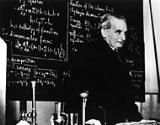
Theodore von Karman

Encyclopedia
Theodore von Kármán (May 11, 1881 – May 7, 1963) was a Hungarian-American
mathematician
, aerospace engineer and physicist
who was active primarily in the fields of aeronautics
and astronautics
. He is responsible for many key advances in aerodynamics
, notably his work on supersonic
and hypersonic
airflow characterization. He is regarded as the outstanding aerodynamic theoretician of the 20th century.
, Austria-Hungary
as Kármán Tódor. One of his ancestor
s was Rabbi
Judah Loew ben Bezalel
. He studied engineering at the city's Royal Joseph Technical University, known today as Budapest University of Technology and Economics
. After graduating in 1902 he moved to Germany
and joined Ludwig Prandtl at the University of Göttingen, and received his doctorate in 1908. He taught at Göttingen for four years. In 1912 accepted a position as director of the Aeronautical Institute at RWTH Aachen
, one of the country's leading universities. His time at RWTH Aachen was interrupted by service in the Austro-Hungarian Army
1915–1918, where he designed an early helicopter
. He is believed to have founded the International Union of Theoretical and Applied Mechanics
in September 1922 by organizing its first conference in Innsbruck
. He left RWTH Aachen in 1930.
at the California Institute of Technology
(GALCIT) and emigrated to the United States. In 1936, along with Frank Malina
and Jack Parsons, he founded a company Aerojet
to manufacture JATO
rocket motors. He later became a naturalized citizen
of the United States.
He later became an important figure in supersonic motion. Noting in a seminal paper that aeronautical engineers were “pounding hard on the closed door leading into the field of supersonic motion.”
German activity during World War II
increased U.S. military interest in rocket research. During the early part of 1943, the Experimental Engineering Division of the United States Army Air Forces
Material Command forwarded to von Kármán reports from British
intelligence sources describing German
rockets capable of reaching more than 100 miles (160 km). In a letter dated 2 August 1943 von Kármán provided the Army with his analysis of and comments on the German program.
In 1944 he and others affiliated with GALCIT founded the Jet Propulsion Laboratory
, which is now a Federally funded research and development center
managed and operated by Caltech under a contract from NASA
. In 1946 he became the first chairman of the Scientific Advisory Group
which studied aeronautical technologies for the United States Army Air Forces. He also helped found AGARD
, the NATO aerodynamics research oversight group (1951), the International Council of the Aeronautical Sciences (1956), the International Academy of Astronautics
(1960), and the Von Karman Institute for Fluid Dynamics
in Brussels
(1956).
, stability of laminar flow
, turbulence
, airfoil
s in steady and unsteady flow, boundary layer
s, and supersonic aerodynamics. He made additional contributions in other fields, including elasticity, vibration, heat transfer, and crystallography
. His name also appears in a number of concepts, for example:
in New York City
. The surgery caused two hernia
s, and von Kármán's recovery was slow. Early in September, while still in New York, he met with U.S. Army Air Forces Commanding General Henry H. Arnold
on a runway at LaGuardia Airport
. Hap Arnold then proposed that von Kármán move to Washington, D.C.
to lead the Scientific Advisory Group and become a long-range planning consultant to the military. He returned to Pasadena
around mid-September. Von Kármán was appointed to the position on October 23, 1944, and left Caltech in December 1944.
At age 81 von Kármán was the recipient of the first National Medal of Science
, bestowed in a White House
ceremony by President John F. Kennedy
. He was recognized, "For his leadership in the science and engineering basic to aeronautics; for his effective teaching and related contributions in many fields of mechanics, for his distinguished counsel to the Armed Services, and for his promoting international cooperation in science and engineering."
While on a trip to Aachen (Germany) in 1963, von Kármán died. He was buried in Pasadena, California. He never married.
Von Kármán's fame was in the use of mathematical tools to study fluid flow
, and the interpretation of those results to guide practical designs. He was instrumental in recognizing the importance of the swept-back wings
that are ubiquitous in modern jet aircraft
.
United States
The United States of America is a federal constitutional republic comprising fifty states and a federal district...
mathematician
Mathematician
A mathematician is a person whose primary area of study is the field of mathematics. Mathematicians are concerned with quantity, structure, space, and change....
, aerospace engineer and physicist
Physicist
A physicist is a scientist who studies or practices physics. Physicists study a wide range of physical phenomena in many branches of physics spanning all length scales: from sub-atomic particles of which all ordinary matter is made to the behavior of the material Universe as a whole...
who was active primarily in the fields of aeronautics
Aeronautics
Aeronautics is the science involved with the study, design, and manufacturing of airflight-capable machines, or the techniques of operating aircraft and rocketry within the atmosphere...
and astronautics
Astronautics
Astronautics, and related astronautical engineering, is the theory and practice of navigation beyond the Earth's atmosphere. In other words, it is the science and technology of space flight....
. He is responsible for many key advances in aerodynamics
Aerodynamics
Aerodynamics is a branch of dynamics concerned with studying the motion of air, particularly when it interacts with a moving object. Aerodynamics is a subfield of fluid dynamics and gas dynamics, with much theory shared between them. Aerodynamics is often used synonymously with gas dynamics, with...
, notably his work on supersonic
Supersonic
Supersonic speed is a rate of travel of an object that exceeds the speed of sound . For objects traveling in dry air of a temperature of 20 °C this speed is approximately 343 m/s, 1,125 ft/s, 768 mph or 1,235 km/h. Speeds greater than five times the speed of sound are often...
and hypersonic
Hypersonic
In aerodynamics, a hypersonic speed is one that is highly supersonic. Since the 1970s, the term has generally been assumed to refer to speeds of Mach 5 and above...
airflow characterization. He is regarded as the outstanding aerodynamic theoretician of the 20th century.
Early life
Von Kármán was born into a Jewish family at BudapestBudapest
Budapest is the capital of Hungary. As the largest city of Hungary, it is the country's principal political, cultural, commercial, industrial, and transportation centre. In 2011, Budapest had 1,733,685 inhabitants, down from its 1989 peak of 2,113,645 due to suburbanization. The Budapest Commuter...
, Austria-Hungary
Austria-Hungary
Austria-Hungary , more formally known as the Kingdoms and Lands Represented in the Imperial Council and the Lands of the Holy Hungarian Crown of Saint Stephen, was a constitutional monarchic union between the crowns of the Austrian Empire and the Kingdom of Hungary in...
as Kármán Tódor. One of his ancestor
Ancestor
An ancestor is a parent or the parent of an ancestor ....
s was Rabbi
Rabbi
In Judaism, a rabbi is a teacher of Torah. This title derives from the Hebrew word רבי , meaning "My Master" , which is the way a student would address a master of Torah...
Judah Loew ben Bezalel
Judah Loew ben Bezalel
Judah Loew ben Bezalel, alt. Loewe, Löwe, or Levai, widely known to scholars of Judaism as the Maharal of Prague, or simply The MaHaRaL, the Hebrew acronym of "Moreinu ha-Rav Loew," was an important Talmudic scholar, Jewish mystic, and philosopher who served as a leading rabbi in the city of...
. He studied engineering at the city's Royal Joseph Technical University, known today as Budapest University of Technology and Economics
Budapest University of Technology and Economics
The Budapest University of Technology and Economics , in hungarian abbreviated as BME, English official abbreviation BUTE, is the most significant University of Technology in Hungary and is also one of the oldest Institutes of Technology in the world, having been founded in 1782.-History:BME is...
. After graduating in 1902 he moved to Germany
Germany
Germany , officially the Federal Republic of Germany , is a federal parliamentary republic in Europe. The country consists of 16 states while the capital and largest city is Berlin. Germany covers an area of 357,021 km2 and has a largely temperate seasonal climate...
and joined Ludwig Prandtl at the University of Göttingen, and received his doctorate in 1908. He taught at Göttingen for four years. In 1912 accepted a position as director of the Aeronautical Institute at RWTH Aachen
RWTH Aachen
RWTH Aachen University is a research university located in Aachen, North Rhine-Westphalia, Germany with roughly 33,000 students enrolled in 101 study programs....
, one of the country's leading universities. His time at RWTH Aachen was interrupted by service in the Austro-Hungarian Army
Austro-Hungarian Army
The Austro-Hungarian Army was the ground force of the Austro-Hungarian Dual Monarchy from 1867 to 1918. It was composed of three parts: the joint army , the Austrian Landwehr , and the Hungarian Honvédség .In the wake of fighting between the...
1915–1918, where he designed an early helicopter
Helicopter
A helicopter is a type of rotorcraft in which lift and thrust are supplied by one or more engine-driven rotors. This allows the helicopter to take off and land vertically, to hover, and to fly forwards, backwards, and laterally...
. He is believed to have founded the International Union of Theoretical and Applied Mechanics
International Union of Theoretical and Applied Mechanics
The International Union of Theoretical and Applied Mechanics is believed to have been founded when Aachen professor Theodore von Kármán held a conference in Innsbruck in September of 1922. The purpose of the 1922 conference was to discuss questions of hydrodynamics and aerodynamics. The...
in September 1922 by organizing its first conference in Innsbruck
Innsbruck
- Main sights :- Buildings :*Golden Roof*Kaiserliche Hofburg *Hofkirche with the cenotaph of Maximilian I, Holy Roman Emperor*Altes Landhaus...
. He left RWTH Aachen in 1930.
Emigration and JPL
Apprehensive about developments in Europe, in 1930 he accepted the directorship of the Guggenheim Aeronautical LaboratoryGuggenheim Aeronautical Laboratory
The Guggenheim Aeronautical Laboratory at the California Institute of Technology , was a research institute created in 1926, at first specializing in aeronautics research. In 1930, Hungarian scientist Theodore von Kármán accepted the directorship of the lab and emigrated to the United States. Under...
at the California Institute of Technology
California Institute of Technology
The California Institute of Technology is a private research university located in Pasadena, California, United States. Caltech has six academic divisions with strong emphases on science and engineering...
(GALCIT) and emigrated to the United States. In 1936, along with Frank Malina
Frank Malina
Frank Joseph Malina was an American aeronautical engineer and painter, especially known for becoming both a pioneer in the art world and the realm of scientific engineering.-Early life:...
and Jack Parsons, he founded a company Aerojet
Aerojet
Aerojet is an American rocket and missile propulsion manufacturer based primarily in Rancho Cordova, California with divisions in Redmond, Washington, Orange, Gainesville and Camden, Arkansas. Aerojet is owned by GenCorp. They are the only US propulsion company that provides both solid rocket...
to manufacture JATO
JATO
JATO is an acronym for jet-fuel assisted take off. It is a system for helping overloaded aircraft into the air by providing additional thrust in the form of small rockets....
rocket motors. He later became a naturalized citizen
Naturalization
Naturalization is the acquisition of citizenship and nationality by somebody who was not a citizen of that country at the time of birth....
of the United States.
He later became an important figure in supersonic motion. Noting in a seminal paper that aeronautical engineers were “pounding hard on the closed door leading into the field of supersonic motion.”
German activity during World War II
World War II
World War II, or the Second World War , was a global conflict lasting from 1939 to 1945, involving most of the world's nations—including all of the great powers—eventually forming two opposing military alliances: the Allies and the Axis...
increased U.S. military interest in rocket research. During the early part of 1943, the Experimental Engineering Division of the United States Army Air Forces
United States Army Air Forces
The United States Army Air Forces was the military aviation arm of the United States of America during and immediately after World War II, and the direct predecessor of the United States Air Force....
Material Command forwarded to von Kármán reports from British
United Kingdom
The United Kingdom of Great Britain and Northern IrelandIn the United Kingdom and Dependencies, other languages have been officially recognised as legitimate autochthonous languages under the European Charter for Regional or Minority Languages...
intelligence sources describing German
Germany
Germany , officially the Federal Republic of Germany , is a federal parliamentary republic in Europe. The country consists of 16 states while the capital and largest city is Berlin. Germany covers an area of 357,021 km2 and has a largely temperate seasonal climate...
rockets capable of reaching more than 100 miles (160 km). In a letter dated 2 August 1943 von Kármán provided the Army with his analysis of and comments on the German program.
In 1944 he and others affiliated with GALCIT founded the Jet Propulsion Laboratory
Jet Propulsion Laboratory
Jet Propulsion Laboratory is a federally funded research and development center and NASA field center located in the San Gabriel Valley area of Los Angeles County, California, United States. The facility is headquartered in the city of Pasadena on the border of La Cañada Flintridge and Pasadena...
, which is now a Federally funded research and development center
Federally funded research and development center
Federally Funded Research and Development Centers conduct research for the United States Government. They are administered in accordance with U.S Code of Federal Regulations, Title 48, Part 35, Section 35.017 by universities and corporations....
managed and operated by Caltech under a contract from NASA
NASA
The National Aeronautics and Space Administration is the agency of the United States government that is responsible for the nation's civilian space program and for aeronautics and aerospace research...
. In 1946 he became the first chairman of the Scientific Advisory Group
Scientific Advisory Group
The Scientific Advisory Group of the United States Air Force, later renamed the Scientific Advisory Board, was established in 1944, when General Henry H. Arnold asked Dr. Theodore von Kármán to establish a group of scientists to review the techniques and research trends in aeronautics...
which studied aeronautical technologies for the United States Army Air Forces. He also helped found AGARD
AGARD
The acronym AGARD stands for Advisory Group for Aerospace Research and Development, and was an agency of NATO that existed from 1952 to 1996....
, the NATO aerodynamics research oversight group (1951), the International Council of the Aeronautical Sciences (1956), the International Academy of Astronautics
International Academy of Astronautics
The International Academy of Astronautics is an international community of experts committed to expanding the frontiers of space. It is a non-governmental organisation established in Stockholm on August 16, 1960....
(1960), and the Von Karman Institute for Fluid Dynamics
Von Karman Institute for Fluid Dynamics
The von Karman Institute for Fluid Dynamics is a non-profit educational and scientific organization which specializes in three specific fields: aeronautics and aerospace, environment and applied fluid dynamics, turbomachinery and propulsion...
in Brussels
Brussels
Brussels , officially the Brussels Region or Brussels-Capital Region , is the capital of Belgium and the de facto capital of the European Union...
(1956).
Selected Contributions
Specific contributions include theories of non-elastic buckling, unsteady wakes in circum-cylinder flowVon Kármán vortex street
A Kármán vortex street is a term in fluid dynamics for a repeating pattern of swirling vortices caused by the unsteady separation of flow of a fluid over bluff bodies...
, stability of laminar flow
Laminar flow
Laminar flow, sometimes known as streamline flow, occurs when a fluid flows in parallel layers, with no disruption between the layers. At low velocities the fluid tends to flow without lateral mixing, and adjacent layers slide past one another like playing cards. There are no cross currents...
, turbulence
Turbulence
In fluid dynamics, turbulence or turbulent flow is a flow regime characterized by chaotic and stochastic property changes. This includes low momentum diffusion, high momentum convection, and rapid variation of pressure and velocity in space and time...
, airfoil
Airfoil
An airfoil or aerofoil is the shape of a wing or blade or sail as seen in cross-section....
s in steady and unsteady flow, boundary layer
Boundary layer
In physics and fluid mechanics, a boundary layer is that layer of fluid in the immediate vicinity of a bounding surface where effects of viscosity of the fluid are considered in detail. In the Earth's atmosphere, the planetary boundary layer is the air layer near the ground affected by diurnal...
s, and supersonic aerodynamics. He made additional contributions in other fields, including elasticity, vibration, heat transfer, and crystallography
Crystallography
Crystallography is the experimental science of the arrangement of atoms in solids. The word "crystallography" derives from the Greek words crystallon = cold drop / frozen drop, with its meaning extending to all solids with some degree of transparency, and grapho = write.Before the development of...
. His name also appears in a number of concepts, for example:
- Föppl–von Kármán equationsFöppl–von Kármán equationsThe Föppl–von Kármán equations, named after August Föppl and Theodore von Kármán, are a set of nonlinear partial differential equations describing the large deflections of thin flat plates...
(large deflection of elastic plates) - Born-von Kármán lattice modelBorn-von Karman boundary conditionThe Born–von Karman boundary condition is a set of boundary conditions which impose the restriction that a wave function must be periodic on a certain Bravais lattice....
(crystallography) - Chaplygin-Kármán-Tsien approximation (potential flow)
- Falkowich-Kármán equation (transonic flow)
- von Kármán constantVon Kármán constantIn fluid dynamics, the Von Kármán constant , named for Theodore von Kármán, is a dimensionless constant describing the logarithmic velocity profile of a turbulent fluid flow near a boundary with a no-slip condition...
(wall turbulence) - Kármán lineKarman lineThe Kármán line lies at an altitude of above the Earth's sea level, and is commonly used to define the boundary between the Earth's atmosphere and outer space...
(aerodynamics/astronautics) - von Kármán–Gabrielli diagramVon Kármán–Gabrielli diagramThe von Kármán–Gabrielli diagram is a diagram which compares the efficiency of transportation methods by plotting specific tractive force, or specific resistance against velocity...
(transportation) - Kármán-Howarth equationKármán-Howarth equationIn isotropic turbulence the Kármán-Howarth equation , which is derived from the Navier-Stokes equations, is used to describe the evolution of non-dimensional longitudinal autocorrelation.-See also:...
(turbulence) - Kármán-Nikuradse correlation (viscous flow; coauthored by Johann NikuradseJohann NikuradseJohann Nikuradse was a Georgia-born German engineer and physicist. His brother, Alexander Nikuradse, was also a Germany-based physicist and geopolitician known for his ties with Alfred Rosenberg and for his role in saving many Georgians during World War II.He was born in Samtredia, Georgia and...
) - Kármán-Pohlhausen parameter (boundary layers)
- Kármán-Treffz transformation (airfoil theory)
- Prandtl-von Kármán law (velocity in open channel flow)
- von Kármán integral equation (boundary layers)
- von Kármán ogive (supersonic aerodynamics)
- von Kármán vortex streetVon Kármán vortex streetA Kármán vortex street is a term in fluid dynamics for a repeating pattern of swirling vortices caused by the unsteady separation of flow of a fluid over bluff bodies...
(flow past cylinder) - von Kármán-Tsien compressibility correction.
- Vortex sheddingVortex sheddingVortex shedding is an unsteady flow that takes place in special flow velocities . In this flow, vortices are created at the back of the body and detach periodically from either side of the body. See Von Kármán vortex street.Vortex shedding is caused when a fluid flows past a blunt object...
Last years
In June 1944, von Kármán underwent surgery for intestinal cancerColorectal cancer
Colorectal cancer, commonly known as bowel cancer, is a cancer caused by uncontrolled cell growth , in the colon, rectum, or vermiform appendix. Colorectal cancer is clinically distinct from anal cancer, which affects the anus....
in New York City
New York City
New York is the most populous city in the United States and the center of the New York Metropolitan Area, one of the most populous metropolitan areas in the world. New York exerts a significant impact upon global commerce, finance, media, art, fashion, research, technology, education, and...
. The surgery caused two hernia
Hernia
A hernia is the protrusion of an organ or the fascia of an organ through the wall of the cavity that normally contains it. A hiatal hernia occurs when the stomach protrudes into the mediastinum through the esophageal opening in the diaphragm....
s, and von Kármán's recovery was slow. Early in September, while still in New York, he met with U.S. Army Air Forces Commanding General Henry H. Arnold
Henry H. Arnold
Henry Harley "Hap" Arnold was an American general officer holding the grades of General of the Army and later General of the Air Force. Arnold was an aviation pioneer, Chief of the Air Corps , Commanding General of the U.S...
on a runway at LaGuardia Airport
LaGuardia Airport
LaGuardia Airport is an airport located in the northern part of Queens County on Long Island in the City of New York. The airport is located on the waterfront of Flushing Bay and Bowery Bay, and borders the neighborhoods of Astoria, Jackson Heights and East Elmhurst. The airport was originally...
. Hap Arnold then proposed that von Kármán move to Washington, D.C.
Washington, D.C.
Washington, D.C., formally the District of Columbia and commonly referred to as Washington, "the District", or simply D.C., is the capital of the United States. On July 16, 1790, the United States Congress approved the creation of a permanent national capital as permitted by the U.S. Constitution....
to lead the Scientific Advisory Group and become a long-range planning consultant to the military. He returned to Pasadena
Pasadena, California
Pasadena is a city in Los Angeles County, California, United States. Although famous for hosting the annual Rose Bowl football game and Tournament of Roses Parade, Pasadena is the home to many scientific and cultural institutions, including the California Institute of Technology , the Jet...
around mid-September. Von Kármán was appointed to the position on October 23, 1944, and left Caltech in December 1944.
At age 81 von Kármán was the recipient of the first National Medal of Science
National Medal of Science
The National Medal of Science is an honor bestowed by the President of the United States to individuals in science and engineering who have made important contributions to the advancement of knowledge in the fields of behavioral and social sciences, biology, chemistry, engineering, mathematics and...
, bestowed in a White House
White House
The White House is the official residence and principal workplace of the president of the United States. Located at 1600 Pennsylvania Avenue NW in Washington, D.C., the house was designed by Irish-born James Hoban, and built between 1792 and 1800 of white-painted Aquia sandstone in the Neoclassical...
ceremony by President John F. Kennedy
John F. Kennedy
John Fitzgerald "Jack" Kennedy , often referred to by his initials JFK, was the 35th President of the United States, serving from 1961 until his assassination in 1963....
. He was recognized, "For his leadership in the science and engineering basic to aeronautics; for his effective teaching and related contributions in many fields of mechanics, for his distinguished counsel to the Armed Services, and for his promoting international cooperation in science and engineering."
While on a trip to Aachen (Germany) in 1963, von Kármán died. He was buried in Pasadena, California. He never married.
Von Kármán's fame was in the use of mathematical tools to study fluid flow
Fluid dynamics
In physics, fluid dynamics is a sub-discipline of fluid mechanics that deals with fluid flow—the natural science of fluids in motion. It has several subdisciplines itself, including aerodynamics and hydrodynamics...
, and the interpretation of those results to guide practical designs. He was instrumental in recognizing the importance of the swept-back wings
Swept wing
A swept wing is a wing planform favored for high subsonic jet speeds first investigated by Germany during the Second World War. Since the introduction of the MiG-15 and North American F-86 which demonstrated a decisive superiority over the slower first generation of straight-wing jet fighters...
that are ubiquitous in modern jet aircraft
Jet aircraft
A jet aircraft is an aircraft propelled by jet engines. Jet aircraft generally fly much faster than propeller-powered aircraft and at higher altitudes – as high as . At these altitudes, jet engines achieve maximum efficiency over long distances. The engines in propeller-powered aircraft...
.
Selected writings
- Aerodynamics - Selected Topics in the Light of their Historical Development, Cornell University Press, Ithaca, 1954
- Collected Works, (4 Volumes), Von Karman Institute, Rhode St. Genese, 1975 (limited edition book); also Butterworth Scientific Publ., London 1956. Many papers from volumes 1 and 2 are in German.
- From Low Speed Aerodynamics to Astronautics, Pergamon Press, London, 1961
- The Wind and Beyond - Theodore von Kármán Pioneer in Aviation and Pathfinder in Space, Little Brown, 1967 (with L. Edson)
- Mathematical Methods in Engineering, McGraw Hill, 1940 (with M. A. BiotMaurice Anthony BiotMaurice Anthony Biot was a Belgian-American physicist and the founder of the theory of poroelasticity.Born in Antwerp, Belgium, Biot studied at Catholic University of Leuven in Belgium where he received a bachelor's degrees in philosophy , mining engineering and electrical engineering , and...
)
Honors and legacy
- Each year since 1960 the American Society of Civil EngineersAmerican Society of Civil EngineersThe American Society of Civil Engineers is a professional body founded in 1852 to represent members of the civil engineering profession worldwide. It is the oldest national engineering society in the United States. ASCE's vision is to have engineers positioned as global leaders who strive toward...
has awarded to an individual the Theodore von Karman MedalTheodore von Karman MedalThe Theodore von Karman Medal in Engineering Mechanics is awarded annually to an individual in recognition of his distinguished achievement in engineering mechanics, applicable to any branch of civil engineering...
, "in recognition of distinguished achievement in engineering mechanics." - In 2005 von Kármán was named an Honorary Fellow of the Arnold Engineering Development CenterArnold Engineering Development CenterArnold Engineering Development Center is a ground-based flight test facility operated by the US Air Force Materiel Command.-Mission statement:The AEDC mission is to:...
(AEDC). Fellows of the AEDC are recognized as, "People who have made exceptionally distinguished contributions to the center's flight testing mission." - CraterImpact craterIn the broadest sense, the term impact crater can be applied to any depression, natural or manmade, resulting from the high velocity impact of a projectile with a larger body...
s on MarsMarsMars is the fourth planet from the Sun in the Solar System. The planet is named after the Roman god of war, Mars. It is often described as the "Red Planet", as the iron oxide prevalent on its surface gives it a reddish appearance...
and the MoonMoonThe Moon is Earth's only known natural satellite,There are a number of near-Earth asteroids including 3753 Cruithne that are co-orbital with Earth: their orbits bring them close to Earth for periods of time but then alter in the long term . These are quasi-satellites and not true moons. For more...
are named in his honor. - The boundary between the atmosphere and space is named the Kármán LineKarman lineThe Kármán line lies at an altitude of above the Earth's sea level, and is commonly used to define the boundary between the Earth's atmosphere and outer space...
- In Irvine, CA there is a 5-mile street that runs through the heart of Irvine's business center named after him.
- In 1977, RWTH Aachen University named its newly constructed lecture hall complex "Kármán-Auditorium" in memory of von Kármán's outstanding research contributions at the university's Aeronautical Institute.
- University of Southern CaliforniaUniversity of Southern CaliforniaThe University of Southern California is a private, not-for-profit, nonsectarian, research university located in Los Angeles, California, United States. USC was founded in 1880, making it California's oldest private research university...
Professor Shirley ThomasShirley Thomas (USC professor)Shirley Thomas Ph.D. , was a radio/television actress/writer/producer, author, and professor in the Master of Professional Writing Program at the University of Southern California.-Background:...
(after nearly two decades of petitioning) was able to create a postage stampPostage stampA postage stamp is a small piece of paper that is purchased and displayed on an item of mail as evidence of payment of postage. Typically, stamps are made from special paper, with a national designation and denomination on the face, and a gum adhesive on the reverse side...
in his honor. It was first issued in 1992 with his image as an "Aerospace Scientist". - In 1956 von Kármán founded a research institute in Sint-Genesius-RodeSint-Genesius-RodeSint-Genesius-Rode is a municipality located in Flanders, one of three regions of Belgium, in the province of Flemish Brabant. The municipality comprises the town of Sint-Genesius-Rode only. On January 1, 2008, the town had a total population of 18,021...
, BelgiumBelgiumBelgium , officially the Kingdom of Belgium, is a federal state in Western Europe. It is a founding member of the European Union and hosts the EU's headquarters, and those of several other major international organisations such as NATO.Belgium is also a member of, or affiliated to, many...
, which is now named after him: the von Karman Institute for Fluid DynamicsVon Karman Institute for Fluid DynamicsThe von Karman Institute for Fluid Dynamics is a non-profit educational and scientific organization which specializes in three specific fields: aeronautics and aerospace, environment and applied fluid dynamics, turbomachinery and propulsion...
. - In 1948 von Kármán was awarded the Franklin MedalFranklin MedalThe Franklin Medal was a science and engineering award presented by the Franklin Institute, of Philadelphia, PA, USA.-Laureates:*1915 - Thomas Alva Edison *1915 - Heike Kamerlingh Onnes *1916 - John J...
.
Further reading
- I. ChangIris ChangIris Shun-Ru Chang was an American historian and journalist. She is best known for her best-selling 1997 account of the Nanking Massacre, The Rape of Nanking. She committed suicide on November 9, 2004...
, Thread of the Silkworm. Perseus Books Group (1995). ISBN 0-465-08716-7. - S. Goldstein, "Theodore von Kármán, 1881-1963," Biographical Memoirs of Fellows of the Royal Society of London 12 (1966), 335-365.
- D. S. Halacy, Jr., Father of Supersonic Flight: Theodor von Kármán (1965).
- M. H. Gorn, The Universal Man: Theodore von Kármán's Life in Aeronautics (Smithsonian Institution Press, Washington, 1992).
- G. Gabrielli, "Theodore von Kármán", Atti Accad. Sci. Torino Cl. Sci. Fis. Mat. Natur. 98 (1963/1964), 471-485.
- J. L. Greenberg and J. R. Goodstein, "Theodore von Kármán and applied mathematics in America," Science 222 (4630) (1983), 1300-1304.
- J. L. Greenberg and J. R. Goodstein, "Theodore von Kármán and applied mathematics in America," A century of mathematics in America II (Providence, R.I., 1989), 467-477.
- R. C. Hall, "Shaping the course of aeronautics, rocketry, and astronautics: Theodore von Kármán, 1881-1963," J. Astronaut. Sci. 26 (4) (1978), 369-386.
- J. Polásek, "Theodore von Kármán and applied mathematics" (Czech), Pokroky Mat. Fyz. Astronom. 28 (6) (1983), 301-310.
- W. R. Sears, "Some recollections of Theodore von Kármán," J. Soc. Indust. Appl. Math. 13 (1965), 175-183.
- W. R. Sears, "Von Kármán: fluid dynamics and other things," Physics today 39 (1986), 34-39.
- F. L. Wattendorf, "Theodore von Kármán, international scientist," Z. Flugwiss. 4 (1956), 163-165.
- F. L. Wattendorf and F. J. Malina, "Theodore von Kármán, 1881-1963," Astronautica Acta 10 (1964), 81.
External links
- Theodore von Kármán - School of Mathematics and Statistics, University of St. Andrews, Scotland
- Profile of von Kármán - NASA's Jet Propulsion Laboratory
- Research institute founded by and later named for von Kármán
- Brief biography
- Gravesite of von Kármán