

Trans-Neptunian object

Encyclopedia
A trans-Neptunian object (TNO; also written transneptunian object) is any minor planet
in the Solar System
that orbit
s the Sun
at a greater distance on average than Neptune
.
The first trans-Neptunian object to be discovered was Pluto
in 1930. It took more than 60 years to discover, in 1992, a second trans-Neptunian object, (15760) 1992 QB1
, with only the discovery of Pluto's moon Charon
in 1978 before that. Now over 1200 trans-Neptunian objects appear on the Minor Planet Center's List Of Transneptunian Objects. As of November 2009, two hundred of these have their orbits well-enough determined that they have been given a permanent minor planet designation.
The largest known trans-Neptunian objects are Pluto
and , followed by and . The Kuiper belt
, scattered disk, and Oort cloud
are three conventional divisions of this volume of space, though treatments vary and a few objects such as do not fit easily into any division.
. The search for these led to the discovery of Pluto
in 1930. However, Pluto was too small to explain the discrepancies, and revised estimates of Neptune's mass showed that the problem was spurious.
Pluto was easiest to find because it has the highest apparent magnitude
of all known trans-Neptunian objects. It also has a lower inclination to the ecliptic than most other large TNOs.
. Only after the discovery of a second TNO, (15760) 1992 QB1
, in 1992, systematic searches for further such objects began. A broad strip of the sky around the ecliptic
was photographed and digitally evaluated for slowly-moving objects. Hundreds of TNOs were found, with diameters in the range of 50 to 2500 kilometers.
Eris, at the time thought to be the largest TNO, was discovered in 2005, revisiting a long-running dispute within the scientific community over the classification of large TNOs, and whether objects like Pluto can be considered planets. Pluto and Eris were eventually classified as dwarf planets by the International Astronomical Union
.
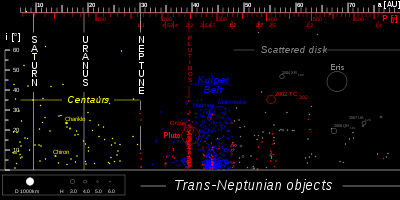
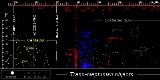
The diagram to the right illustrates the distribution of known trans-Neptunian objects (up to 70 AU) in relation to the orbits of the planets and the centaurs
for reference. Different classes are represented in different colours. Resonant objects
(including Neptune trojan
s) are plotted in red, cubewano
s in blue.
The scattered disk extends to the right, far beyond the diagram, with known objects at mean distances beyond 500 AU (Sedna) and aphelia beyond 1000 AU .
A fuller list of objects is being compiled in the List of trans-Neptunian objects.
Studying colours and spectra provides insight into the objects' origin and a potential correlation with other classes of objects, namely centaurs
and some satellites of giant planets (Triton
, Phoebe
), suspected to originate in the Kuiper belt
. However, the interpretations are typically ambiguous as the spectra can fit more than one model of the surface composition and depend on the unknown particle size. More significantly, the optical surfaces of small bodies are subject to modification by intense radiation, solar wind
and micrometeorites. Consequently, the thin optical surface layer could be quite different from the regolith
underneath, and not representative of the bulk composition of the body.
Small TNOs are thought to be low-density mixtures of rock and ice with some organic
(carbon
-containing) surface material such as tholin
, detected in their spectra. On the other hand, the high density of , 2.6-3.3 g/cm3, suggests a very high non-ice content (compare with Pluto
's density: 2.0 g/cm3).
The composition of some small TNOs could be similar to that of comet
s. Indeed, some centaurs
undergo seasonal changes when they approach the Sun, making the boundary blurred (see 2060 Chiron
and 133P/Elst-Pizarro
). However, population comparisons between centaurs and TNOs are still controversial.
 Like Centaurs
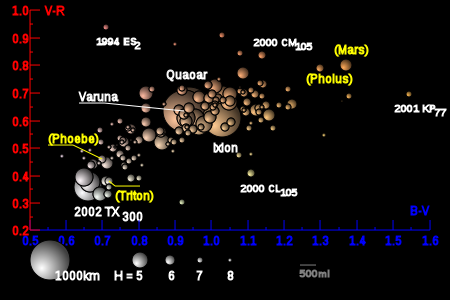
, TNOs display a wide range of colours from blue-grey to very red, but unlike the centaurs, clearly re-grouped into two classes, the distribution appears to be uniform.
Colour indices are simple measures of the differences in the apparent magnitude
of an object seen through blue (B), visible (V), i.e. green-yellow, and red (R) filters.
The diagram illustrates known colour indices for all but the biggest objects (in slightly enhanced colour).
For reference, two moons: Triton
and Phoebe
, the centaur
Pholus
and planet Mars
are plotted (yellow labels, size not to scale).
Correlations between the colors and the orbital characteristics have been studied, to confirm theories of different origin of the different dynamic classes.
seem to be composed of two different colour populations: the so-called cold (inclination <5°) population, displaying only red colours, and the so-called hot (higher inclination) population displaying the whole range of colours from blue to very red.
A recent analysis based on the data from Deep Ecliptic Survey
confirms this difference in colour between low-inclination (named Core) and high-inclination (named Halo) objects. Red colours of the Core objects together with their unperturbed orbits suggest that these objects could be a relic of the original population of the belt.
 Characteristically, big (bright) objects are typically on inclined orbits, while the invariable plane
re-groups mostly small and dim objects.
With the exception of Sedna
, all big TNOs (Eris
, , , Charon
, and Orcus
) display neutral colour (infrared index V-I < 0.2), while the relatively dimmer bodies (50000 Quaoar
, Ixion
, , and Varuna
), as well as the population as the whole, are reddish (V-I in 0.3 to 0.6 range).
This distinction leads to suggestion that the surface of the largest bodies is covered with ices, hiding the redder, darker areas underneath.
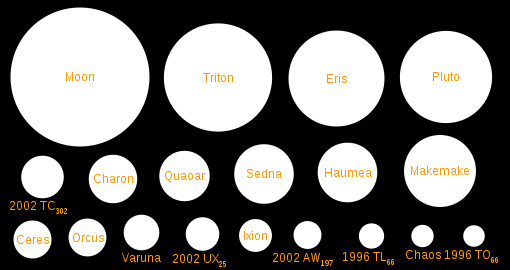
The diagram illustrates the relative sizes, albedos and colours of the biggest TNOs. Also shown, are the known satellites and the exceptional shape of resulting from its rapid rotation.
The arc around represents uncertainty given its unknown albedo.
The size of Eris follows Michael Brown’s
measure (2400 km) based on HST
point spread model
. The arc around it represents the thermal measure (3000 km) by Bertoldi (see the related section of the article for the references).
Very red objects present a steep slope, reflecting much more in red and infrared.
A recent attempt at classification (common with Centaurs) uses the total of four classes from BB (blue, average B-V=0.70, V-R=0.39 e.g. Orcus
) to RR (very red, B-V=1.08, V-R=0.71, e.g. Sedna
) with BR and IR as intermediate classes. BR and IR differ mostly in the infrared bands I, J and H.
Typical models of the surface include water ice, amorphous carbon
, silicate
s and organic macromolecules, named tholin
s, created by intense radiation. Four major tholins are used to fit the reddening slope:
As an illustration of the two extreme classes BB and RR, the following compositions have been suggested
of TNOs. For very large objects, with very well known orbital elements (namely, Pluto and Charon), diameters can be precisely measured by occultation
of stars.
For other large TNOs, diameters can be estimated by thermal
measurements. The intensity of light illuminating the object is known (from its distance to the Sun), and one assumes that most of its surface is in thermal equilibrium (usually not a bad assumption for an airless body).
For a known albedo
, it is possible to estimate the surface temperature, and correspondingly the intensity of heat radiation. Further, if the size of the object is known, it is possible to predict both the amount of visible light and emitted heat radiation reaching the Earth. A simplifying factor is that the Sun emits almost all of its energy in visible light and at nearby frequencies, while at the cold temperatures of TNOs, the heat radiation is emitted at completely different wavelengths (the far infrared).
Thus there are two unknowns (albedo and size), which can be determined by two independent measurements (of the amount of reflected light and emitted infrared heat radiation).
Unfortunately, TNOs are so far from the Sun that they are very cold, hence produce black-body radiation around 60 micrometre
s in wavelength
. This wavelength of light is impossible to observe on the Earth's surface, but only from space using, e.g., the Spitzer Space Telescope
. For ground-based observations, astronomers observe the tail of the black-body radiation in the far infrared. This far infrared radiation is so dim that the thermal method is only applicable to the largest KBOs.
For the majority of (small) objects, the diameter is estimated by assuming an albedo. However, the albedos found range from 0.50 down to 0.05 resulting, as example for magnitude
of 1.0, in uncertainty from 1200 – 3700 km!.
Minor planet
An asteroid group or minor-planet group is a population of minor planets that have a share broadly similar orbits. Members are generally unrelated to each other, unlike in an asteroid family, which often results from the break-up of a single asteroid...
in the Solar System
Solar System
The Solar System consists of the Sun and the astronomical objects gravitationally bound in orbit around it, all of which formed from the collapse of a giant molecular cloud approximately 4.6 billion years ago. The vast majority of the system's mass is in the Sun...
that orbit
Orbit
In physics, an orbit is the gravitationally curved path of an object around a point in space, for example the orbit of a planet around the center of a star system, such as the Solar System...
s the Sun
Sun
The Sun is the star at the center of the Solar System. It is almost perfectly spherical and consists of hot plasma interwoven with magnetic fields...
at a greater distance on average than Neptune
Neptune
Neptune is the eighth and farthest planet from the Sun in the Solar System. Named for the Roman god of the sea, it is the fourth-largest planet by diameter and the third largest by mass. Neptune is 17 times the mass of Earth and is slightly more massive than its near-twin Uranus, which is 15 times...
.
The first trans-Neptunian object to be discovered was Pluto
Pluto
Pluto, formal designation 134340 Pluto, is the second-most-massive known dwarf planet in the Solar System and the tenth-most-massive body observed directly orbiting the Sun...
in 1930. It took more than 60 years to discover, in 1992, a second trans-Neptunian object, (15760) 1992 QB1
(15760) 1992 QB1
', also written 1992 QB1, was the first trans-Neptunian object to be discovered after Pluto and Charon. It was discovered 1992 by David C. Jewitt and Jane X. Luu at the Mauna Kea Observatory, Hawaii. It is now classed as a classical Kuiper belt object, and gave rise to the name cubewano for this...
, with only the discovery of Pluto's moon Charon
Charon (moon)
Charon is the largest satellite of the dwarf planet Pluto. It was discovered in 1978 at the United States Naval Observatory Flagstaff Station. Following the 2005 discovery of two other natural satellites of Pluto , Charon may also be referred to as Pluto I...
in 1978 before that. Now over 1200 trans-Neptunian objects appear on the Minor Planet Center's List Of Transneptunian Objects. As of November 2009, two hundred of these have their orbits well-enough determined that they have been given a permanent minor planet designation.
The largest known trans-Neptunian objects are Pluto
Pluto
Pluto, formal designation 134340 Pluto, is the second-most-massive known dwarf planet in the Solar System and the tenth-most-massive body observed directly orbiting the Sun...
and , followed by and . The Kuiper belt
Kuiper belt
The Kuiper belt , sometimes called the Edgeworth–Kuiper belt, is a region of the Solar System beyond the planets extending from the orbit of Neptune to approximately 50 AU from the Sun. It is similar to the asteroid belt, although it is far larger—20 times as wide and 20 to 200 times as massive...
, scattered disk, and Oort cloud
Oort cloud
The Oort cloud , or the Öpik–Oort cloud , is a hypothesized spherical cloud of comets which may lie roughly 50,000 AU, or nearly a light-year, from the Sun. This places the cloud at nearly a quarter of the distance to Proxima Centauri, the nearest star to the Sun...
are three conventional divisions of this volume of space, though treatments vary and a few objects such as do not fit easily into any division.
Discovery of Pluto
The orbit of each of the planets is slightly affected by the gravitational influences of the other planets. Discrepancies in the early 1900s between the observed and expected orbits of Uranus and Neptune suggested that there were one or more additional planets beyond NeptunePlanets beyond Neptune
Following the discovery of the planet Neptune in 1846, there was considerable speculation that another planet might exist beyond its orbit. The search began in the mid-19th century but culminated at the start of the 20th with Percival Lowell's quest for Planet X...
. The search for these led to the discovery of Pluto
Pluto
Pluto, formal designation 134340 Pluto, is the second-most-massive known dwarf planet in the Solar System and the tenth-most-massive body observed directly orbiting the Sun...
in 1930. However, Pluto was too small to explain the discrepancies, and revised estimates of Neptune's mass showed that the problem was spurious.
Pluto was easiest to find because it has the highest apparent magnitude
Apparent magnitude
The apparent magnitude of a celestial body is a measure of its brightness as seen by an observer on Earth, adjusted to the value it would have in the absence of the atmosphere...
of all known trans-Neptunian objects. It also has a lower inclination to the ecliptic than most other large TNOs.
Discovery of other trans-Neptunian objects
After Pluto's discovery, American astronomer Clyde Tombaugh continued searching for some years for similar objects, but found none. For a long time, no one searched for other TNOs as it was generally believed that Pluto was the only major object of the Kuiper beltKuiper belt
The Kuiper belt , sometimes called the Edgeworth–Kuiper belt, is a region of the Solar System beyond the planets extending from the orbit of Neptune to approximately 50 AU from the Sun. It is similar to the asteroid belt, although it is far larger—20 times as wide and 20 to 200 times as massive...
. Only after the discovery of a second TNO, (15760) 1992 QB1
(15760) 1992 QB1
', also written 1992 QB1, was the first trans-Neptunian object to be discovered after Pluto and Charon. It was discovered 1992 by David C. Jewitt and Jane X. Luu at the Mauna Kea Observatory, Hawaii. It is now classed as a classical Kuiper belt object, and gave rise to the name cubewano for this...
, in 1992, systematic searches for further such objects began. A broad strip of the sky around the ecliptic
Ecliptic
The ecliptic is the plane of the earth's orbit around the sun. In more accurate terms, it is the intersection of the celestial sphere with the ecliptic plane, which is the geometric plane containing the mean orbit of the Earth around the Sun...
was photographed and digitally evaluated for slowly-moving objects. Hundreds of TNOs were found, with diameters in the range of 50 to 2500 kilometers.
Eris, at the time thought to be the largest TNO, was discovered in 2005, revisiting a long-running dispute within the scientific community over the classification of large TNOs, and whether objects like Pluto can be considered planets. Pluto and Eris were eventually classified as dwarf planets by the International Astronomical Union
International Astronomical Union
The International Astronomical Union IAU is a collection of professional astronomers, at the Ph.D. level and beyond, active in professional research and education in astronomy...
.
Distribution and classification
According to their distance from the Sun and their orbit parameters, TNOs are classified in two large groups:- The (classical) Kuiper beltKuiper beltThe Kuiper belt , sometimes called the Edgeworth–Kuiper belt, is a region of the Solar System beyond the planets extending from the orbit of Neptune to approximately 50 AU from the Sun. It is similar to the asteroid belt, although it is far larger—20 times as wide and 20 to 200 times as massive...
contains objects with an average distance to the Sun of 30 to about 55 AU, usually having close-to-circular orbits with a small inclination from the eclipticEclipticThe ecliptic is the plane of the earth's orbit around the sun. In more accurate terms, it is the intersection of the celestial sphere with the ecliptic plane, which is the geometric plane containing the mean orbit of the Earth around the Sun...
. Kuiper belt objects are further classified into the following two groups:- Resonant objectsResonant trans-Neptunian objectIn astronomy, a resonant trans-Neptunian object is a trans-Neptunian object in mean motion orbital resonance with Neptune. The orbital periods of the resonant objects are in a simple integer relations with the period of Neptune e.g. 1:2, 2:3 etc...
are locked in an orbital resonance with NeptuneNeptuneNeptune is the eighth and farthest planet from the Sun in the Solar System. Named for the Roman god of the sea, it is the fourth-largest planet by diameter and the third largest by mass. Neptune is 17 times the mass of Earth and is slightly more massive than its near-twin Uranus, which is 15 times...
. Objects with a 1:2 resonance are also called twotinos, and objects with a 2:3 resonance are called plutinoPlutinoIn astronomy, a plutino is a trans-Neptunian object in 2:3 mean motion resonance with Neptune. For every 2 orbits that a plutino makes, Neptune orbits 3 times. Plutinos are named after Pluto, which follows an orbit trapped in the same resonance, with the Italian diminutive suffix -ino...
s, after their most prominent member, PlutoPlutoPluto, formal designation 134340 Pluto, is the second-most-massive known dwarf planet in the Solar System and the tenth-most-massive body observed directly orbiting the Sun...
. - Classical Kuiper belt objects (also called cubewanos) have no such resonance, moving on almost circular orbits, unperturbed by Neptune. Examples are 1992 QB1, 50000 Quaoar50000 Quaoar50000 Quaoar is a rocky trans-Neptunian object in the Kuiper belt with one known moon. Discovered on June 4, 2002 by astronomers Chad Trujillo and Michael Brown at the California Institute of Technology from images acquired at the Samuel Oschin Telescope at Palomar Observatory, it is thought by...
and Makemake.
- Resonant objects
- The scattered disk contains objects further from the Sun, usually with very irregular orbits (i.e. very elliptical and having a strong inclination from the ecliptic). A typical example is the most massive known TNO, ErisEris (dwarf planet)Eris, formal designation 136199 Eris, is the most massive known dwarf planet in the Solar System and the ninth most massive body known to orbit the Sun directly...
.
The diagram to the right illustrates the distribution of known trans-Neptunian objects (up to 70 AU) in relation to the orbits of the planets and the centaurs
Centaur (planetoid)
Centaurs are an unstable orbital class of minor planets that behave with characteristics of both asteroids and comets. They are named after the mythological race of beings, centaurs, which were a mixture of horse and human...
for reference. Different classes are represented in different colours. Resonant objects
Resonant trans-Neptunian object
In astronomy, a resonant trans-Neptunian object is a trans-Neptunian object in mean motion orbital resonance with Neptune. The orbital periods of the resonant objects are in a simple integer relations with the period of Neptune e.g. 1:2, 2:3 etc...
(including Neptune trojan
Neptune Trojan
Neptune trojans are Kuiper belt object-like bodies in solar orbit that have the same orbital period as Neptune and follow roughly the same orbital path...
s) are plotted in red, cubewano
Cubewano
A classical Kuiper belt object, also called a cubewano is a low-eccentricity Kuiper belt object that orbits beyond Neptune and is not controlled by an orbital resonance with Neptune. Cubewanos have orbits with semi-major axes in the 40–50 AU range and, unlike Pluto, do not cross Neptune’s orbit...
s in blue.
The scattered disk extends to the right, far beyond the diagram, with known objects at mean distances beyond 500 AU (Sedna) and aphelia beyond 1000 AU .
Notable trans-Neptunian objects
- PlutoPlutoPluto, formal designation 134340 Pluto, is the second-most-massive known dwarf planet in the Solar System and the tenth-most-massive body observed directly orbiting the Sun...
, a dwarf planet.- CharonCharon (moon)Charon is the largest satellite of the dwarf planet Pluto. It was discovered in 1978 at the United States Naval Observatory Flagstaff Station. Following the 2005 discovery of two other natural satellites of Pluto , Charon may also be referred to as Pluto I...
, the largest of Pluto's moons., the prototype cubewano, the first Kuiper belt object discovered after Pluto and Charon., the first binary Kuiper belt object discovered after Pluto and Charon., the first object to be categorized as a scattered disc object. has a very large satellite and is the earliest discovered scattered disc object.
- Charon
- 1993 RO1993 RO1993 RO is a trans-Neptunian object of the plutino class.It was the first plutino discovered after Pluto itself, with 1993 RP and 1993 SB a day and two days behind. The discovery was made in 1993 at the Mauna Kea Observatory with a 2.2m telescope....
, the next plutinoPlutinoIn astronomy, a plutino is a trans-Neptunian object in 2:3 mean motion resonance with Neptune. For every 2 orbits that a plutino makes, Neptune orbits 3 times. Plutinos are named after Pluto, which follows an orbit trapped in the same resonance, with the Italian diminutive suffix -ino...
discovered after Pluto. - 20000 Varuna20000 Varuna20000 Varuna is a large classical Kuiper belt object and a probable dwarf planet. It previously had the provisional designation ' and has been precovered in plates dating back to 1953.-Name:Varuna is named after the Hindu deity,...
and 50000 Quaoar50000 Quaoar50000 Quaoar is a rocky trans-Neptunian object in the Kuiper belt with one known moon. Discovered on June 4, 2002 by astronomers Chad Trujillo and Michael Brown at the California Institute of Technology from images acquired at the Samuel Oschin Telescope at Palomar Observatory, it is thought by...
, large cubewanos. - 90482 Orcus90482 Orcus90482 Orcus is a trans-Neptunian object in the Kuiper belt with a large moon. It was discovered on February 17, 2004 by Michael Brown of Caltech, Chad Trujillo of the Gemini Observatory, and David Rabinowitz of Yale University. Precovery images as early as November 8, 1951 were later identified...
and 28978 Ixion28978 Ixion28978 Ixion is a Kuiper belt object discovered on May 22, 2001. Ixion is a plutino and a very likely dwarf planet; its diameter of 650 km estimated by Spitzer makes it about the fifth largest plutino. It is named after Ixion, a figure from Greek mythology...
, large plutinos. - 90377 Sedna90377 Sedna90377 Sedna is a trans-Neptunian object discovered in 2003, which was about three times as far from the Sun as Neptune. For most of its orbit it is even further from the Sun, with its aphelion estimated at 960 astronomical units , making it one of the most distant known objects in the Solar System...
, a distant object, proposed for a new category named Extended scattered disc (E-SDO), detached objects, Distant Detached Objects (DDO) or Scattered-Extended in the formal classification by DESDeep Ecliptic SurveyThe Deep Ecliptic Survey is a project to find Kuiper belt objects , using the facilities of the National Optical Astronomy Observatory .The principal investigator is Bob Millis....
. - Haumea, a dwarf planet, the fourth largest known trans-Neptunian object. Notable for its two known satellites and unusually short rotation period (3.9 h).
- ErisEris (dwarf planet)Eris, formal designation 136199 Eris, is the most massive known dwarf planet in the Solar System and the ninth most massive body known to orbit the Sun directly...
, dwarf planet, a scattered disc object, and currently the most massive known trans-Neptunian object. One known satellite, DysnomiaDysnomia (moon)- References :...
. - Makemake, dwarf planet, a cubewano, the third largest known trans-Neptunian object., a scattered disk object following a highly inclined but nearly circular orbit. and , remarkable for their eccentric orbits and large aphelia.
- IAU Minor Planet Center provisional designation 2008 KV422008 KV42', nicknamed Drac , is a trans-Neptunian object orbiting the Sun in retrograde motion and almost perpendicular to the ecliptic: it has a 104-degree inclination. This odd orbit suggests that may have been perturbed inwards from the Oort cloud...
and temporary nickname "Drac". The first retrograde TNO. Orbital inclination i = 104°, semimajor axis is a sime 42 AU, the perihelion distance is q~21 AU. Discovered 31st May, 2008.
A fuller list of objects is being compiled in the List of trans-Neptunian objects.
Physical characteristics
Given the apparent magnitude (>20) of all but the biggest trans-Neptunian objects, the physical studies are limited to the following:- thermal emissions for the largest objects (see size determination)
- colour indicesColor indexIn astronomy, the color index is a simple numerical expression that determines the color of an object, which in the case of a star gives its temperature...
i.e. comparisons of the apparent magnitudeApparent magnitudeThe apparent magnitude of a celestial body is a measure of its brightness as seen by an observer on Earth, adjusted to the value it would have in the absence of the atmosphere...
s using different filters - analysis of spectra, visual and infraredInfraredInfrared light is electromagnetic radiation with a wavelength longer than that of visible light, measured from the nominal edge of visible red light at 0.74 micrometres , and extending conventionally to 300 µm...
Studying colours and spectra provides insight into the objects' origin and a potential correlation with other classes of objects, namely centaurs
Centaur (planetoid)
Centaurs are an unstable orbital class of minor planets that behave with characteristics of both asteroids and comets. They are named after the mythological race of beings, centaurs, which were a mixture of horse and human...
and some satellites of giant planets (Triton
Triton (moon)
Triton is the largest moon of the planet Neptune, discovered on October 10, 1846, by English astronomer William Lassell. It is the only large moon in the Solar System with a retrograde orbit, which is an orbit in the opposite direction to its planet's rotation. At 2,700 km in diameter, it is...
, Phoebe
Phoebe (moon)
Phoebe is an irregular satellite of Saturn. It was discovered by William Henry Pickering on 17 March 1899 from photographic plates that had been taken starting on 16 August 1898 at the Boyden Observatory near Arequipa, Peru, by DeLisle Stewart...
), suspected to originate in the Kuiper belt
Kuiper belt
The Kuiper belt , sometimes called the Edgeworth–Kuiper belt, is a region of the Solar System beyond the planets extending from the orbit of Neptune to approximately 50 AU from the Sun. It is similar to the asteroid belt, although it is far larger—20 times as wide and 20 to 200 times as massive...
. However, the interpretations are typically ambiguous as the spectra can fit more than one model of the surface composition and depend on the unknown particle size. More significantly, the optical surfaces of small bodies are subject to modification by intense radiation, solar wind
Solar wind
The solar wind is a stream of charged particles ejected from the upper atmosphere of the Sun. It mostly consists of electrons and protons with energies usually between 1.5 and 10 keV. The stream of particles varies in temperature and speed over time...
and micrometeorites. Consequently, the thin optical surface layer could be quite different from the regolith
Regolith
Regolith is a layer of loose, heterogeneous material covering solid rock. It includes dust, soil, broken rock, and other related materials and is present on Earth, the Moon, some asteroids, and other terrestrial planets and moons.-Etymology:...
underneath, and not representative of the bulk composition of the body.
Small TNOs are thought to be low-density mixtures of rock and ice with some organic
Organic compound
An organic compound is any member of a large class of gaseous, liquid, or solid chemical compounds whose molecules contain carbon. For historical reasons discussed below, a few types of carbon-containing compounds such as carbides, carbonates, simple oxides of carbon, and cyanides, as well as the...
(carbon
Carbon
Carbon is the chemical element with symbol C and atomic number 6. As a member of group 14 on the periodic table, it is nonmetallic and tetravalent—making four electrons available to form covalent chemical bonds...
-containing) surface material such as tholin
Tholin
Tholin [after the ancient Greek word meaning "not clear"] is a heteropolymer molecule formed by solar ultraviolet irradiation of simple organic compounds such as methane or ethane. Tholins do not form naturally on modern-day Earth, but are found in great abundance on the surface of icy bodies in...
, detected in their spectra. On the other hand, the high density of , 2.6-3.3 g/cm3, suggests a very high non-ice content (compare with Pluto
Pluto
Pluto, formal designation 134340 Pluto, is the second-most-massive known dwarf planet in the Solar System and the tenth-most-massive body observed directly orbiting the Sun...
's density: 2.0 g/cm3).
The composition of some small TNOs could be similar to that of comet
Comet
A comet is an icy small Solar System body that, when close enough to the Sun, displays a visible coma and sometimes also a tail. These phenomena are both due to the effects of solar radiation and the solar wind upon the nucleus of the comet...
s. Indeed, some centaurs
Centaur (planetoid)
Centaurs are an unstable orbital class of minor planets that behave with characteristics of both asteroids and comets. They are named after the mythological race of beings, centaurs, which were a mixture of horse and human...
undergo seasonal changes when they approach the Sun, making the boundary blurred (see 2060 Chiron
2060 Chiron
2060 Chiron is a minor planet in the outer Solar System. Discovered in 1977 by Charles T. Kowal , it was the first-known member of a new class of objects now known as centaurs, with an orbit between Saturn and Uranus.Although it was initially classified as an asteroid, it was later found to...
and 133P/Elst-Pizarro
133P/Elst-Pizarro
Comet Elst–Pizarro is a body that displays characteristics of both asteroids and comets, and is the prototype of main-belt comets. Its orbit keeps it within the asteroid belt, yet it displayed a dust tail like a comet while near perihelion in 1996, 2001, and 2007.* As a comet it is formally...
). However, population comparisons between centaurs and TNOs are still controversial.
Colours
Centaur (planetoid)
Centaurs are an unstable orbital class of minor planets that behave with characteristics of both asteroids and comets. They are named after the mythological race of beings, centaurs, which were a mixture of horse and human...
, TNOs display a wide range of colours from blue-grey to very red, but unlike the centaurs, clearly re-grouped into two classes, the distribution appears to be uniform.
Colour indices are simple measures of the differences in the apparent magnitude
Apparent magnitude
The apparent magnitude of a celestial body is a measure of its brightness as seen by an observer on Earth, adjusted to the value it would have in the absence of the atmosphere...
of an object seen through blue (B), visible (V), i.e. green-yellow, and red (R) filters.
The diagram illustrates known colour indices for all but the biggest objects (in slightly enhanced colour).
For reference, two moons: Triton
Triton (moon)
Triton is the largest moon of the planet Neptune, discovered on October 10, 1846, by English astronomer William Lassell. It is the only large moon in the Solar System with a retrograde orbit, which is an orbit in the opposite direction to its planet's rotation. At 2,700 km in diameter, it is...
and Phoebe
Phoebe (moon)
Phoebe is an irregular satellite of Saturn. It was discovered by William Henry Pickering on 17 March 1899 from photographic plates that had been taken starting on 16 August 1898 at the Boyden Observatory near Arequipa, Peru, by DeLisle Stewart...
, the centaur
Centaur (planetoid)
Centaurs are an unstable orbital class of minor planets that behave with characteristics of both asteroids and comets. They are named after the mythological race of beings, centaurs, which were a mixture of horse and human...
Pholus
5145 Pholus
5145 Pholus is a centaur in an eccentric orbit, with a perihelion less than Saturn's and aphelion greater than Neptune's. Pholus has not come within one astronomical unit of a planet since 764 BC, and will not until 5290. It is believed that Pholus originated as a Kuiper belt object.It was...
and planet Mars
Mars
Mars is the fourth planet from the Sun in the Solar System. The planet is named after the Roman god of war, Mars. It is often described as the "Red Planet", as the iron oxide prevalent on its surface gives it a reddish appearance...
are plotted (yellow labels, size not to scale).
Correlations between the colors and the orbital characteristics have been studied, to confirm theories of different origin of the different dynamic classes.
Classical objects
Classical objectsCubewano
A classical Kuiper belt object, also called a cubewano is a low-eccentricity Kuiper belt object that orbits beyond Neptune and is not controlled by an orbital resonance with Neptune. Cubewanos have orbits with semi-major axes in the 40–50 AU range and, unlike Pluto, do not cross Neptune’s orbit...
seem to be composed of two different colour populations: the so-called cold (inclination <5°) population, displaying only red colours, and the so-called hot (higher inclination) population displaying the whole range of colours from blue to very red.
A recent analysis based on the data from Deep Ecliptic Survey
Deep Ecliptic Survey
The Deep Ecliptic Survey is a project to find Kuiper belt objects , using the facilities of the National Optical Astronomy Observatory .The principal investigator is Bob Millis....
confirms this difference in colour between low-inclination (named Core) and high-inclination (named Halo) objects. Red colours of the Core objects together with their unperturbed orbits suggest that these objects could be a relic of the original population of the belt.
Scattered disk objects
Scattered disk objects show colour resemblances with hot classical objects pointing to a common origin.The largest objects
Invariable plane
The invariable plane of a planetary system, also called Laplace's invariable plane, is the plane passing through its barycenter perpendicular to its angular momentum vector. In the Solar System, about 98% of this effect is contributed by the orbital angular momenta of the four jovian planets...
re-groups mostly small and dim objects.
With the exception of Sedna
90377 Sedna
90377 Sedna is a trans-Neptunian object discovered in 2003, which was about three times as far from the Sun as Neptune. For most of its orbit it is even further from the Sun, with its aphelion estimated at 960 astronomical units , making it one of the most distant known objects in the Solar System...
, all big TNOs (Eris
Eris (dwarf planet)
Eris, formal designation 136199 Eris, is the most massive known dwarf planet in the Solar System and the ninth most massive body known to orbit the Sun directly...
, , , Charon
Charon (moon)
Charon is the largest satellite of the dwarf planet Pluto. It was discovered in 1978 at the United States Naval Observatory Flagstaff Station. Following the 2005 discovery of two other natural satellites of Pluto , Charon may also be referred to as Pluto I...
, and Orcus
90482 Orcus
90482 Orcus is a trans-Neptunian object in the Kuiper belt with a large moon. It was discovered on February 17, 2004 by Michael Brown of Caltech, Chad Trujillo of the Gemini Observatory, and David Rabinowitz of Yale University. Precovery images as early as November 8, 1951 were later identified...
) display neutral colour (infrared index V-I < 0.2), while the relatively dimmer bodies (50000 Quaoar
50000 Quaoar
50000 Quaoar is a rocky trans-Neptunian object in the Kuiper belt with one known moon. Discovered on June 4, 2002 by astronomers Chad Trujillo and Michael Brown at the California Institute of Technology from images acquired at the Samuel Oschin Telescope at Palomar Observatory, it is thought by...
, Ixion
28978 Ixion
28978 Ixion is a Kuiper belt object discovered on May 22, 2001. Ixion is a plutino and a very likely dwarf planet; its diameter of 650 km estimated by Spitzer makes it about the fifth largest plutino. It is named after Ixion, a figure from Greek mythology...
, , and Varuna
20000 Varuna
20000 Varuna is a large classical Kuiper belt object and a probable dwarf planet. It previously had the provisional designation ' and has been precovered in plates dating back to 1953.-Name:Varuna is named after the Hindu deity,...
), as well as the population as the whole, are reddish (V-I in 0.3 to 0.6 range).
This distinction leads to suggestion that the surface of the largest bodies is covered with ices, hiding the redder, darker areas underneath.
The diagram illustrates the relative sizes, albedos and colours of the biggest TNOs. Also shown, are the known satellites and the exceptional shape of resulting from its rapid rotation.
The arc around represents uncertainty given its unknown albedo.
The size of Eris follows Michael Brown’s
Michael E. Brown
Michael E. Brown has been a professor of planetary astronomy at the California Institute of Technology since 2003....
measure (2400 km) based on HST
Hubble Space Telescope
The Hubble Space Telescope is a space telescope that was carried into orbit by a Space Shuttle in 1990 and remains in operation. A 2.4 meter aperture telescope in low Earth orbit, Hubble's four main instruments observe in the near ultraviolet, visible, and near infrared...
point spread model
Point spread function
The point spread function describes the response of an imaging system to a point source or point object. A more general term for the PSF is a system's impulse response, the PSF being the impulse response of a focused optical system. The PSF in many contexts can be thought of as the extended blob...
. The arc around it represents the thermal measure (3000 km) by Bertoldi (see the related section of the article for the references).
Spectra
The objects present wide range of spectra, differing in reflectivity in visible red and near infrared. Neutral objects present a flat spectrum, reflecting as much red and infrared as visible spectrum.Very red objects present a steep slope, reflecting much more in red and infrared.
A recent attempt at classification (common with Centaurs) uses the total of four classes from BB (blue, average B-V=0.70, V-R=0.39 e.g. Orcus
90482 Orcus
90482 Orcus is a trans-Neptunian object in the Kuiper belt with a large moon. It was discovered on February 17, 2004 by Michael Brown of Caltech, Chad Trujillo of the Gemini Observatory, and David Rabinowitz of Yale University. Precovery images as early as November 8, 1951 were later identified...
) to RR (very red, B-V=1.08, V-R=0.71, e.g. Sedna
90377 Sedna
90377 Sedna is a trans-Neptunian object discovered in 2003, which was about three times as far from the Sun as Neptune. For most of its orbit it is even further from the Sun, with its aphelion estimated at 960 astronomical units , making it one of the most distant known objects in the Solar System...
) with BR and IR as intermediate classes. BR and IR differ mostly in the infrared bands I, J and H.
Typical models of the surface include water ice, amorphous carbon
Amorphous carbon
Amorphous carbon or free, reactive carbon, is an allotrope of carbon that does not have any crystalline structure. As with all glassy materials, some short-range order can be observed...
, silicate
Silicate
A silicate is a compound containing a silicon bearing anion. The great majority of silicates are oxides, but hexafluorosilicate and other anions are also included. This article focuses mainly on the Si-O anions. Silicates comprise the majority of the earth's crust, as well as the other...
s and organic macromolecules, named tholin
Tholin
Tholin [after the ancient Greek word meaning "not clear"] is a heteropolymer molecule formed by solar ultraviolet irradiation of simple organic compounds such as methane or ethane. Tholins do not form naturally on modern-day Earth, but are found in great abundance on the surface of icy bodies in...
s, created by intense radiation. Four major tholins are used to fit the reddening slope:
- Titan tholin, believed to be produced from a mixture of 90% N2 and 10% CH4 (gaseous methaneMethaneMethane is a chemical compound with the chemical formula . It is the simplest alkane, the principal component of natural gas, and probably the most abundant organic compound on earth. The relative abundance of methane makes it an attractive fuel...
) - Triton tholin, as above but with very low (0.1%) methane content
- (ethane) Ice tholin I, believed to be produced from a mixture of 86% H2O and 14% C2H6 (ethaneEthaneEthane is a chemical compound with chemical formula C2H6. It is the only two-carbon alkane that is an aliphatic hydrocarbon. At standard temperature and pressure, ethane is a colorless, odorless gas....
) - (methanol) Ice tholin II, 80% H2O, 16% CH3OH (methanolMethanolMethanol, also known as methyl alcohol, wood alcohol, wood naphtha or wood spirits, is a chemical with the formula CH3OH . It is the simplest alcohol, and is a light, volatile, colorless, flammable liquid with a distinctive odor very similar to, but slightly sweeter than, ethanol...
) and 3% CO2
As an illustration of the two extreme classes BB and RR, the following compositions have been suggested
- for Sedna (RR very red): 24% Triton tholin, 7% carbon, 10% N2, 26% methanol, and 33% methane
- for Orcus (BB, grey/blue): 85% amorphous carbon, +4% titan tholin, and 11% H20 ice
Size determination
It is difficult to estimate the diameterDiameter
In geometry, a diameter of a circle is any straight line segment that passes through the center of the circle and whose endpoints are on the circle. The diameters are the longest chords of the circle...
of TNOs. For very large objects, with very well known orbital elements (namely, Pluto and Charon), diameters can be precisely measured by occultation
Occultation
An occultation is an event that occurs when one object is hidden by another object that passes between it and the observer. The word is used in astronomy . It can also refer to any situation wherein an object in the foreground blocks from view an object in the background...
of stars.
For other large TNOs, diameters can be estimated by thermal
Infrared
Infrared light is electromagnetic radiation with a wavelength longer than that of visible light, measured from the nominal edge of visible red light at 0.74 micrometres , and extending conventionally to 300 µm...
measurements. The intensity of light illuminating the object is known (from its distance to the Sun), and one assumes that most of its surface is in thermal equilibrium (usually not a bad assumption for an airless body).
For a known albedo
Albedo
Albedo , or reflection coefficient, is the diffuse reflectivity or reflecting power of a surface. It is defined as the ratio of reflected radiation from the surface to incident radiation upon it...
, it is possible to estimate the surface temperature, and correspondingly the intensity of heat radiation. Further, if the size of the object is known, it is possible to predict both the amount of visible light and emitted heat radiation reaching the Earth. A simplifying factor is that the Sun emits almost all of its energy in visible light and at nearby frequencies, while at the cold temperatures of TNOs, the heat radiation is emitted at completely different wavelengths (the far infrared).
Thus there are two unknowns (albedo and size), which can be determined by two independent measurements (of the amount of reflected light and emitted infrared heat radiation).
Unfortunately, TNOs are so far from the Sun that they are very cold, hence produce black-body radiation around 60 micrometre
Micrometre
A micrometer , is by definition 1×10⁻⁶ of a meter .In plain English, it means one-millionth of a meter . Its unit symbol in the International System of Units is μm...
s in wavelength
Wavelength
In physics, the wavelength of a sinusoidal wave is the spatial period of the wave—the distance over which the wave's shape repeats.It is usually determined by considering the distance between consecutive corresponding points of the same phase, such as crests, troughs, or zero crossings, and is a...
. This wavelength of light is impossible to observe on the Earth's surface, but only from space using, e.g., the Spitzer Space Telescope
Spitzer Space Telescope
The Spitzer Space Telescope , formerly the Space Infrared Telescope Facility is an infrared space observatory launched in 2003...
. For ground-based observations, astronomers observe the tail of the black-body radiation in the far infrared. This far infrared radiation is so dim that the thermal method is only applicable to the largest KBOs.
For the majority of (small) objects, the diameter is estimated by assuming an albedo. However, the albedos found range from 0.50 down to 0.05 resulting, as example for magnitude
Apparent magnitude
The apparent magnitude of a celestial body is a measure of its brightness as seen by an observer on Earth, adjusted to the value it would have in the absence of the atmosphere...
of 1.0, in uncertainty from 1200 – 3700 km!.
External links
- Nine planets, University of Arizona
- David Jewitt's Kuiper Belt site
- A list of the estimates of the diameters from johnstonarchive with references to the original papers
See also
- List of trans-Neptunian objects
- TritonTriton (moon)Triton is the largest moon of the planet Neptune, discovered on October 10, 1846, by English astronomer William Lassell. It is the only large moon in the Solar System with a retrograde orbit, which is an orbit in the opposite direction to its planet's rotation. At 2,700 km in diameter, it is...
- NemesisNemesis (star)Nemesis is a hypothetical hard-to-detect red dwarf star, white dwarf star or brown dwarf, originally postulated in 1984 to be orbiting the Sun at a distance of about 95,000 AU , somewhat beyond the Oort cloud, to explain a perceived cycle of mass extinctions in the geological record, which seem to...
- Tyche (hypothetical planet)Tyche (hypothetical planet)Tyche is the nickname given to a hypothetical gas giant planet located in the Solar System's Oort cloud, first proposed in 1999 by astronomer John Matese of the University of Louisiana at Lafayette. Matese and his colleague Daniel Whitmire argue that evidence of Tyche's existence can be seen in a...
- Dwarf planetDwarf planetA dwarf planet, as defined by the International Astronomical Union , is a celestial body orbiting the Sun that is massive enough to be spherical as a result of its own gravity but has not cleared its neighboring region of planetesimals and is not a satellite...
- MesoplanetMesoplanetMesoplanet is a term coined by Isaac Asimov to refer to planetary bodies with sizes smaller than Mercury but larger than Ceres. Assuming "size" is defined by linear dimension , mesoplanets should be approximately 1,000 km to 5,000 km in diameter...
- Small Solar System BodySmall solar system bodyA small Solar System body is an object in the Solar System that is neither a planet nor a dwarf planet, nor a satellite of a planet or dwarf planet:...