


SAT

Encyclopedia
The SAT Reasoning Test is a standardized test for college admissions in the United States
. The SAT is owned, published, and developed by the College Board
, a nonprofit organization
in the United States. It was formerly developed, published, and scored by the Educational Testing Service
which still administers the exam. The test is intended to assess a student's readiness for college. It was first introduced in 1926, and its name and scoring have changed several times. It was first called the Scholastic Aptitude Test, then the Scholastic Assessment Test, but now SAT does not stand for anything, hence is an empty acronym.
The current SAT Reasoning Test, introduced in 2005, takes three hours and forty-five minutes to finish, and costs $49 ($75 International), excluding late fees.
Possible scores range from 600 to 2400, combining test results from three 800-point sections (Mathematics, Critical Reading, and Writing).
Taking the SAT or its competitor, the ACT, is required for freshman entry to many, but not all, universities in the United States.
. They state that the SAT assesses how well the test takers analyze and solve problems—skills they learned in school that they will need in college. The SAT is typically taken by high school
sophomores
, juniors
and seniors
.
Specifically, the College Board states that use of the SAT in combination with high school grade point average (GPA) provides a better indicator of success in college than high school grades alone, as measured by college freshman GPA
. Various studies conducted over the lifetime of the SAT show a statistically significant increase in correlation
of high school grades and freshman grades when the SAT is factored in.
There are substantial differences in funding, curricula, grading, and difficulty among U.S. secondary schools due to American federalism
, local control, and the prevalence of private, distance, and home schooled
students. SAT (and ACT) scores are intended to supplement the secondary school record and help admission officers put local data—such as course work, grades, and class rank—in a national perspective.
Historically, the SAT has been more popular among colleges on the coasts and the ACT more popular in the Midwest and South. There are some colleges that require the ACT to be taken for college course placement, and a few schools that formerly did not accept the SAT at all. Nearly all colleges accept the test.
Certain high IQ
societies, like Mensa
, the Prometheus Society
and the Triple Nine Society
, use scores from certain years as one of their admission tests. For instance, the Triple Nine Society
accepts scores of 1450 on tests taken before April 1995, and scores of at least 1520 on tests taken between April 1995 and February 2005.
The SAT is sometimes given to students younger than 13 by organizations such as the Study of Mathematically Precocious Youth
, who use the results to select, study and mentor students of exceptional ability.
While the exact manner in which SAT scores will help to determine admission of a student at American institutions of higher learning is generally a matter decided by the individual institution, some foreign countries have made SAT (and ACT) scores a legal criterion in deciding whether holders of American high school diplomas will be admitted at their public universities.
, Mathematics
, and Writing
. Each section receives a score on the scale of 200–800. All scores are multiples of 10. Total scores are calculated by adding up scores of the three sections. Each major section is divided into three parts. There are 10 sub-sections, including an additional 25-minute experimental or "equating" section that may be in any of the three major sections. The experimental section is used to normalize
questions for future administrations of the SAT and does not count toward the final score. The test contains 3 hours and 45 minutes of actual timed sections, although most administrations, including orientation, distribution of materials, completion of biographical sections, and eleven minutes of timed breaks, run about four and a half hours long. The questions range from easy, medium, and hard depending on the scoring from the experimental sections. Easier questions typically appear closer to the beginning of the section while harder questions are towards the end in certain sections. This is not true for every section but it is the rule of thumb mainly for math and sentence completions and vocabulary.
and understanding of sentence structure and organization by requiring the student to select one or two words that best complete a given sentence. The bulk of the Critical Reading section is made up of questions regarding reading passages, in which students read short excerpts on social sciences, humanities, physical sciences, or personal narratives and answer questions based on the passage. Certain sections contain passages asking the student to compare two related passages; generally, these consist of shorter reading passages. The number of questions about each passage is proportional to the length of the passage. Unlike in the Mathematics section, where questions go in the order of difficulty, questions in the Critical Reading section go in the order of the passage. Overall, question sets towards the beginning of the section are easier, and question sets towards the end of the section are harder.
section of the SAT is widely known as the Quantitative Section or Calculation Section. The mathematics section consists of three scored sections. There are two 25-minute sections and one 20-minute section, as follows:
Notably, the SAT has done away with quantitative comparison questions on the math section, leaving only questions with symbol
ic or numerical
answers.
during the test. These programs allow students to complete problems faster than would normally be possible when making calculations manually.
The use of a graphing calculator is sometimes preferred, especially for geometry problems and questions involving multiple calculations. According to research conducted by the CollegeBoard, performance on the math sections of the exam is associated with the extent of calculator use, with those using calculators on about a third to a half of the items averaging higher scores than those using calculators less frequently. The use of a graphing calculator in mathematics courses, and also becoming familiar with the calculator outside of the classroom, is known to have a positive effect on the performance of students using a graphing calculator during the exam.
The multiple choice questions include error identification questions, sentence improvement questions, and paragraph improvement questions. Error identification and sentence improvement questions test the student's knowledge of grammar, presenting an awkward or grammatically incorrect sentence; in the error identification section, the student must locate the word producing the source of the error or indicate that the sentence has no error, while the sentence improvement section requires the student to select an acceptable fix to the awkward sentence. The paragraph improvement questions test the student's understanding of logical organization of ideas, presenting a poorly written student essay and asking a series of questions as to what changes might be made to best improve it.
The essay section, which is always administered as the first section of the test, is 25 minutes long. All essays must be in response to a given prompt. The prompts are broad and often philosophical and are designed to be accessible to students regardless of their educational and social backgrounds. For instance, test takers may be asked to expand on such ideas as their opinion on the value of work in human life or whether technological change also carries negative consequences to those who benefit from it. No particular essay structure is required, and the College Board accepts examples "taken from [the student's] reading, studies, experience, or observations." Two trained readers assign each essay a score between 1 and 6, where a score of 0 is reserved for essays that are blank, off-topic, non-English, not written with a Number 2 pencil, or considered illegible after several attempts at reading. The scores are summed to produce a final score from 2 to 12 (or 0). If the two readers' scores differ by more than one point, then a senior third reader decides. The average time each reader/grader spends on each essay is less than 3 minutes.
In March 2004, Dr. Les Perelman analyzed 15 scored sample essays contained in the College Board's ScoreWrite book along with 30 other training samples and found that in over 90% of cases, the essay's score could be predicted from simply counting the number of words in the essay. Two years later, Dr. Perelman trained high school seniors to write essays that made little sense but contained infrequently used words such as "plethora" and "myriad." All of the students received scores of "10" or better, which placed the essays in the 92nd percentile or higher.
; all multiple-choice questions have five answer choices, one of which is correct. The questions of each section of the same type are generally ordered by difficulty. However, an important exception exists: Questions that follow the long and short reading passages are organized chronologically, rather than by difficulty. Ten of the questions in one of the math sub-sections are not multiple choice. They instead require the test taker to bubble in a number in a four-column grid.
The questions are weighted equally. For each correct answer, one raw point is added. For each incorrect answer one-fourth of a point is deducted. No points are deducted for incorrect math grid-in questions. This ensures that a student's mathematically expected gain
from guessing is zero. The final score is derived from the raw score; the precise conversion chart varies between test administrations.
The SAT therefore recommends only making educated guesses, that is, when the test taker can eliminate at least one answer he or she thinks is wrong. Without eliminating any answers one's probability of answering correctly is 20%. Eliminating one wrong answer increases this probability to 25% (and the expected gain to 1/16 of a point); two, a 33.3% probability (1/6 of a point); and three, a 50% probability (3/8 of a point).
! Section !! Average Score !! Time (Minutes)!!Content
|-
| Writing >493
60
Grammar
, usage
, and diction
.
>-
| Mathematics
515
70
Number
and operations
; algebra
and functions
; geometry
; statistics
, probability
, and data analysis
>-
| Critical Reading
501
70
Candidates may take either the SAT Reasoning Test or up to three SAT Subject Tests
on any given test date, except the first spring test date, when only the SAT Reasoning Test is offered. Candidates wishing to take the test may register online at the College Board's website, by mail, or by telephone, at least three weeks before the test date.
The SAT Subject Tests are all given in one large book on test day. Therefore, it is actually immaterial which tests, and how many, the student signs up for; with the possible exception of the language tests with listening, the student may change his or her mind and take any tests, regardless of his or her initial sign-ups. Students who choose to take more subject tests than they signed up for will later be billed by College Board for the additional tests and their scores will be withheld until the bill is paid. Students who choose to take fewer subject tests than they signed up for are not eligible for a refund.
The SAT Reasoning Test costs $49 ($78 International, $99 for India and Pakistan). For the Subject tests, students pay a $21 ($49 International, $73 for India and Pakistan) Basic Registration Fee and $10 per test (except for language tests with listening, which cost $21 each). The College Board makes fee waivers available for low income students. Additional fees apply for late registration, standby testing, registration changes, scores by telephone, and extra score reports (beyond the four provided for free).
Candidates whose religious beliefs prevent them from taking the test on a Saturday may request to take the test on the following day, except for the October test date in which the Sunday test date is eight days after the main test offering. Such requests must be made at the time of registration and are subject to denial.
Students with verifiable disabilities, including physical and learning disabilities, are eligible to take the SAT with accommodations. The standard time increase for students requiring additional time due to learning disabilities is time + 50%; time + 100% is also offered.
(the percentage of other test takers with lower scores). The raw score, or the number of points gained from correct answers and lost from incorrect answers (ranges from just under 50 to just under 60, depending upon the test), is also included. Students may also receive, for an additional fee, the Question and Answer Service, which provides the student's answer, the correct answer to each question, and online resources explaining each question.
The corresponding percentile of each scaled score varies from test to test—for example, in 2003, a scaled score of 800 in both sections of the SAT Reasoning Test corresponded to a percentile of 99.9, while a scaled score of 800 in the SAT Physics Test corresponded to the 94th percentile. The differences in what scores mean with regard to percentiles are because of the content of the exam and the caliber of students choosing to take each exam. Subject Tests are subject to intensive study (often in the form of an AP
, which is relatively more difficult), and only those who know they will perform well tend to take these tests, creating a skewed distribution of scores.
The percentiles that various SAT scores for college-bound seniors correspond to are summarized in the following chart:
{| class="wikitable"
! Percentile !! Score, 1600 Scale
(official, 2006) !! Score, 2400 Scale
(official, 2006)
|-
| 99.93/99.98* || 1600 || 2400
|-
| 99+ ** || ≥1540 || ≥2280
|-
| 99 || ≥1480 || ≥2200
|-
| 98 || ≥1450 || ≥2140
|-
| 97 || ≥1420 || ≥2100
|-
| 93 || ≥1340 || ≥1990
|-
| 88 || ≥1280 || ≥1900
|-
| 81 || ≥1220 || ≥1800
|-
| 72 || ≥1150 || ≥1700
|-
| 61 || ≥1090 || ≥1600
|-
| 48 || ≥1010 || ≥1500
|-
| 36 || ≥950 || ≥1400
|-
| 24 || ≥870 || ≥1300
|-
| 15 || ≥810 || ≥1200
|-
| 8 || ≥730 || ≥1090
|-
| 4 || ≥650 || ≥990
|-
| 2 || ≥590 || ≥890
|-
|colspan="3"|* The percentile
of the perfect score was 99.98 on the 2400 scale and 99.93 on the 1600 scale.
|-
|colspan="3"|** 99+ means better than 99.5 percent of test takers.
|}
The older SAT (before 1995) had a very high ceiling. In any given year, only seven of the million test-takers scored above 1580. A score above 1580 was equivalent to the 99.9995 percentile.
 Although there is no official conversion chart between the SAT and its biggest rival, the ACT, the College Board released an unofficial chart based on results from 103,525 test takers who took both tests between October 1994 and December 1996; however, both tests have changed since then. Several colleges have also issued their own charts. The following is based on the University of California's conversion chart.
{| class="wikitable" style="text-align:center"
! SAT (Prior to Writing Test Addition) !! SAT (With Writing Test Addition) !! ACT Composite Score
|-
| 1600 || 2400 || 36
|-
| 1560–1590 || 2340–2390 || 35
|-
| 1520–1550 || 2280–2330 || 34
|-
| 1480–1510 || 2220–2270 || 33
|-
| 1440–1470 || 2160–2210 || 32
|-
| 1400–1430 || 2100–2150 || 31
|-
| 1360–1390 || 2040–2090 || 30
|-
| 1320–1350 || 1980–2030 || 29
|-
| 1280–1310 || 1920–1970 || 28
|-
| 1240–1270 || 1860–1910 || 27
|-
| 1200–1230 || 1800–1850 || 26
|-
| 1160–1190 || 1740–1790 || 25
|-
| 1120–1150 || 1680–1730 || 24
|-
| 1080–1110 || 1620–1670 || 23
|-
| 1040–1070 || 1560–1610 || 22
|-
| 1000–1030 || 1500–1550 || 21
|-
| 960–990 || 1440–1490 || 20
|-
| 920–950 || 1380–1430 || 19
|-
| 880–910 || 1320–1370 || 18
|-
| 840–870 || 1260–1310 || 17
|-
| 800–830 || 1200–1250 || 16
|-
| 760–790 || 1140–1190 || 15
|-
| 720–750 || 1080–1130 || 14
|-
| 680–710 || 1020–1070 || 13
|-
| 640–670 || 960–1010 || 12
|-
| 600–630 || 900–950 || 11
|}
, or g (r=.82 in their sample). The correlation between SAT scores and scores on the Raven's Advanced Progressive Matrices was .483 (.72 corrected for restricted range). They concluded that the SAT is primarily a test of g. Beaujean and colleagues (2006) have reached similar conclusions.
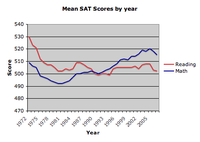 Originally used mainly by colleges and universities in the northeastern United States, and developed by Carl Brigham
, one of the psychologists who worked on the Army Alpha and Beta tests, the SAT was originally developed as a way to eliminate test bias between people from different socio-economic backgrounds.
, New Jersey
, or Pennsylvania
. The majority of those taking the test were from private schools, academies, or endowed schools. About 60% of those taking the test applied to Columbia University
. The test contained sections on English, French, German, Latin
, Greek, history, mathematics, chemistry
, and physics
. The test was not multiple choice, but instead was evaluated based on essay responses as "excellent", "good", "doubtful", "poor" or "very poor".
s, arithmetic
, classification, artificial language, antonym
s, number series, analogies, logical inference, and paragraph reading. It was administered to over 8,000 students at over 300 test centers. Men composed 60% of the test-takers. Slightly over a quarter of males and females applied to Yale University
and Smith College
. The test was paced rather quickly, test-takers being given only a little over 90 minutes to answer 315 questions.
The original "Strivers" project, which was in the research phase from 1980–1994, awarded special "Striver" status to test-takers who scored 200 points higher than expected for their race, gender and income level. The belief was that this would give minorities a better chance at being accepted in to a college of higher standard, i.e. an Ivy League school. In 1992, the Strivers Project was leaked to the public; as a result the Strivers Project was terminated in 1993. After Federal Courts heard arguments from the ACLU, NAACP and the Educational Testing Service, the courts ordered the study to alter its data collection process, stating that only the age, race and zip code could be used to determine the test-takers eligibility for "Strivers" points.
These changes were introduced to the SAT effective in 1994.
questions, and an increased focus on passage reading. The mathematics section also saw a dramatic change in 1994, thanks in part to pressure from the National Council of Teachers of Mathematics
. For the first time since 1935, the SAT asked some non-multiple choice questions, instead requiring students to supply the answers. 1994 also saw the introduction of calculators into the mathematics section for the first time in the test's history. The mathematics section introduced concepts of probability, slope, elementary statistics, counting problems, median and mode.
The average score on the 1994 modification of the SAT I was usually around 1000 (500 on the verbal, 500 on the math). The most selective schools in the United States (for example, those in the Ivy League
) typically had SAT averages exceeding 1400 on the old test.
of 100. As the test grew more popular and more students from less rigorous schools began taking the test, the average dropped to about 428 Verbal and 478 Math. The SAT was "recentered" in 1995, and the average "new" score became again close to 500. Scores awarded after 1994 and before October 2001 are officially reported with an "R" (e.g. 1260R) to reflect this change. Old scores may be recentered to compare to 1995 to present scores by using official College Board tables,
which in the middle ranges add about 70 points to Verbal and 20 or 30 points to Math. In other words, current students have a 100 (70 plus 30) point advantage over their parents.
, the University of Pennsylvania
, and Stanford, have announced they will require applicants to submit all scores. Stanford, however, only prohibits Score Choice for the traditional SAT. Others, such as MIT and Harvard
, have fully embraced Score Choice.
, certain types of questions were eliminated (the analogies from the verbal and quantitative comparisons from the Math section). The test was made marginally harder, as a corrective to the rising number of perfect scores. A new writing section, with an essay, based on the former SAT II Writing Subject Test, was added, in part to increase the chances of closing the opening gap between the highest and midrange scores. Other factors included the desire to test the writing ability of each student; hence the essay. The New SAT (known as the SAT Reasoning Test) was first offered on March 12, 2005, after the last administration of the "old" SAT in January 2005. The Mathematics section was expanded to cover three years of high school mathematics. The Verbal section's name was changed to the Critical Reading section.
, the name was changed to Scholastic Assessment Test. In 1993 the name was changed to SAT I: Reasoning Test (with the letters not standing for anything) to distinguish it from the SAT II: Subject Tests. This change was instituted because of sharp criticism and longitudinal studies showing that the original meaning was no longer accurate; the SAT did not accurately measure what it said it was measuring. In 2004, the roman numerals on both tests were dropped, and the SAT I was renamed the SAT Reasoning Test. The scoring categories are now the following: Critical Reading (comparable to some of the Verbal portions of the old SAT I), Mathematics, and Writing. The writing section now includes an essay, whose score is involved in computing the overall score for the Writing section, as well as grammar sections (also comparable to some Verbal portions of the previous SAT).
The test scoring was initially scaled to make 500 the mean score on each section with a standard deviation
of 100. As the test grew more popular and more students from less rigorous schools began taking the test, the average dropped to about 428 Verbal and 478 Math. The SAT was "recentered" in 1995, and the average "new" score became again close to 500. Scores awarded after 1994 and before October 2001 are officially reported with an "R" (e.g. 1260R) to reflect this change. Old scores may be recentered to compare to 1995 to present scores by using official College Board tables,
which in the middle ranges add about 70 points to Verbal and 20 or 30 points to Math. In other words, current students have a 100 (70 plus 30) point advantage over their parents.
) announced after the admission process was over that an error had been made in the scoring of the tests of 7010 (17%) of the students who had taken the Independent School Entrance Examination
for admission to private secondary schools for 2011. Commenting on the effect of the error on students' school applications in the New York Times, David Clune, President of the ERB stated "It is a lesson we all learn at some point — that life isn’t fair."
analogy question. The object of the question was to find the pair of terms that have the relationship most similar to the relationship between "runner" and "marathon". The correct answer was "oarsman" and "regatta". The choice of the correct answer presupposed students' familiarity with crew, a sport popular with the wealthy, and so upon their knowledge of its structure and terminology. Fifty-three percent (53%) of white students correctly answered the question, while only 22% of black students also scored correctly. However, according to Murray and Herrnstein, the black-white gap is smaller in culture-loaded questions like this one than in questions that appear to be culturally neutral. Analogy questions have since been replaced by short reading passages.
In a 2001 speech to the American Council on Education
, Richard C. Atkinson
, the president of the University of California
, urged dropping the SAT Reasoning Test as a college admissions requirement:
In response to threats by the University of California to drop the SAT as an admission requirement, the College Entrance Examination Board announced the restructuring of the SAT, to take effect in March 2005, as detailed above.
Perelman, along with the National Council of Teachers of English also criticized the 25-minute writing section of the test for damaging standards of writing teaching in the classroom. They say that writing teachers training their students for the SAT will not focus on revision, depth, accuracy, but will instead produce long, formulaic, and wordy pieces. "You're getting teachers to train students to be bad writers", concluded Perelman.
is a highly lucrative field. Many companies and organizations offer test preparation in the form of books, classes, online courses, and tutoring.
College Board
maintains that the SAT is essentially uncoachable, with tutoring courses resulting in the average increase of only about 20 points on the math section and 10 points on the verbal section.
Education in the United States
Education in the United States is mainly provided by the public sector, with control and funding coming from three levels: federal, state, and local. Child education is compulsory.Public education is universally available...
. The SAT is owned, published, and developed by the College Board
College Board
The College Board is a membership association in the United States that was formed in 1900 as the College Entrance Examination Board . It is composed of more than 5,900 schools, colleges, universities and other educational organizations. It sells standardized tests used by academically oriented...
, a nonprofit organization
Nonprofit organization
Nonprofit organization is neither a legal nor technical definition but generally refers to an organization that uses surplus revenues to achieve its goals, rather than distributing them as profit or dividends...
in the United States. It was formerly developed, published, and scored by the Educational Testing Service
Educational Testing Service
Educational Testing Service , founded in 1947, is the world's largest private nonprofit educational testing and assessment organization...
which still administers the exam. The test is intended to assess a student's readiness for college. It was first introduced in 1926, and its name and scoring have changed several times. It was first called the Scholastic Aptitude Test, then the Scholastic Assessment Test, but now SAT does not stand for anything, hence is an empty acronym.
The current SAT Reasoning Test, introduced in 2005, takes three hours and forty-five minutes to finish, and costs $49 ($75 International), excluding late fees.
Possible scores range from 600 to 2400, combining test results from three 800-point sections (Mathematics, Critical Reading, and Writing).
Taking the SAT or its competitor, the ACT, is required for freshman entry to many, but not all, universities in the United States.
Function
The College Board states that the SAT measures literacy and writing skills that are needed for academic success in collegeCollege
A college is an educational institution or a constituent part of an educational institution. Usage varies in English-speaking nations...
. They state that the SAT assesses how well the test takers analyze and solve problems—skills they learned in school that they will need in college. The SAT is typically taken by high school
High school
High school is a term used in parts of the English speaking world to describe institutions which provide all or part of secondary education. The term is often incorporated into the name of such institutions....
sophomores
Tenth grade
In majority of the world,Tenth grade is the tenth year of school post-kindergarten. The variants of "10th grade" in various nations is described below.-Australia:...
, juniors
Eleventh grade
Eleventh Grade is the eleventh, and for some countries final, grade of secondary schools. Students are typically 16 or 17 years of age, depending on the country and the students' birthdays.-Brazil:...
and seniors
Twelfth grade
Twelfth grade or Senior year, or Grade Twelve, are the North American names for the final year of secondary school. In most countries students then graduate at age 17 or 18. In some countries, there is a thirteenth grade, while other countries do not have a 12th grade/year at all...
.
Specifically, the College Board states that use of the SAT in combination with high school grade point average (GPA) provides a better indicator of success in college than high school grades alone, as measured by college freshman GPA
Grade (education)
Grades are standardized measurements of varying levels of comprehension within a subject area. Grades can be assigned in letters , as a range , as a number out of a possible total , as descriptors , in percentages, or, as is common in some post-secondary...
. Various studies conducted over the lifetime of the SAT show a statistically significant increase in correlation
Correlation
In statistics, dependence refers to any statistical relationship between two random variables or two sets of data. Correlation refers to any of a broad class of statistical relationships involving dependence....
of high school grades and freshman grades when the SAT is factored in.
There are substantial differences in funding, curricula, grading, and difficulty among U.S. secondary schools due to American federalism
Federalism
Federalism is a political concept in which a group of members are bound together by covenant with a governing representative head. The term "federalism" is also used to describe a system of the government in which sovereignty is constitutionally divided between a central governing authority and...
, local control, and the prevalence of private, distance, and home schooled
Homeschooling
Homeschooling or homeschool is the education of children at home, typically by parents but sometimes by tutors, rather than in other formal settings of public or private school...
students. SAT (and ACT) scores are intended to supplement the secondary school record and help admission officers put local data—such as course work, grades, and class rank—in a national perspective.
Historically, the SAT has been more popular among colleges on the coasts and the ACT more popular in the Midwest and South. There are some colleges that require the ACT to be taken for college course placement, and a few schools that formerly did not accept the SAT at all. Nearly all colleges accept the test.
Certain high IQ
Intelligence quotient
An intelligence quotient, or IQ, is a score derived from one of several different standardized tests designed to assess intelligence. When modern IQ tests are constructed, the mean score within an age group is set to 100 and the standard deviation to 15...
societies, like Mensa
Mensa International
Mensa is the largest and oldest high-IQ society in the world. It is a non-profit organization open to people who score at the 98th percentile or higher on a standardised, supervised IQ or other approved intelligence test...
, the Prometheus Society
Prometheus Society
The Prometheus Society is a high IQ society, similar to Mensa International, but much more restrictive. The entry test is designed to be passable by 1 in 30,000 of the population; Mensa entry is achievable by 1 in 50...
and the Triple Nine Society
Triple Nine Society
The Triple Nine Society , founded in 1978, is a voluntary association of individuals who have scored at or above the 99.9th percentile on specific IQ tests under supervised conditions, which generally correlates to an IQ of 149 or greater...
, use scores from certain years as one of their admission tests. For instance, the Triple Nine Society
Triple Nine Society
The Triple Nine Society , founded in 1978, is a voluntary association of individuals who have scored at or above the 99.9th percentile on specific IQ tests under supervised conditions, which generally correlates to an IQ of 149 or greater...
accepts scores of 1450 on tests taken before April 1995, and scores of at least 1520 on tests taken between April 1995 and February 2005.
The SAT is sometimes given to students younger than 13 by organizations such as the Study of Mathematically Precocious Youth
Study of Mathematically Precocious Youth
The Study of Mathematically Precocious Youth is a study project and was founded by Dr Julian Stanley in 1971 at the Johns Hopkins University. In 1986, it moved to Iowa State University, where it was headed by Dr Camilla Benbow until 1990, and from then on by Dr Benbow and Dr David Lubinski...
, who use the results to select, study and mentor students of exceptional ability.
While the exact manner in which SAT scores will help to determine admission of a student at American institutions of higher learning is generally a matter decided by the individual institution, some foreign countries have made SAT (and ACT) scores a legal criterion in deciding whether holders of American high school diplomas will be admitted at their public universities.
Structure
SAT consists of three major sections: Critical ReadingReading (process)
Reading is a complex cognitive process of decoding symbols for the intention of constructing or deriving meaning . It is a means of language acquisition, of communication, and of sharing information and ideas...
, Mathematics
Mathematics
Mathematics is the study of quantity, space, structure, and change. Mathematicians seek out patterns and formulate new conjectures. Mathematicians resolve the truth or falsity of conjectures by mathematical proofs, which are arguments sufficient to convince other mathematicians of their validity...
, and Writing
Writing
Writing is the representation of language in a textual medium through the use of a set of signs or symbols . It is distinguished from illustration, such as cave drawing and painting, and non-symbolic preservation of language via non-textual media, such as magnetic tape audio.Writing most likely...
. Each section receives a score on the scale of 200–800. All scores are multiples of 10. Total scores are calculated by adding up scores of the three sections. Each major section is divided into three parts. There are 10 sub-sections, including an additional 25-minute experimental or "equating" section that may be in any of the three major sections. The experimental section is used to normalize
Norm-referenced test
A norm-referenced test is a type of test, assessment, or evaluation which yields an estimate of the position of the tested individual in a predefined population, with respect to the trait being measured. This estimate is derived from the analysis of test scores and possibly other relevant data...
questions for future administrations of the SAT and does not count toward the final score. The test contains 3 hours and 45 minutes of actual timed sections, although most administrations, including orientation, distribution of materials, completion of biographical sections, and eleven minutes of timed breaks, run about four and a half hours long. The questions range from easy, medium, and hard depending on the scoring from the experimental sections. Easier questions typically appear closer to the beginning of the section while harder questions are towards the end in certain sections. This is not true for every section but it is the rule of thumb mainly for math and sentence completions and vocabulary.
Critical Reading
The Critical Reading (formerly Verbal) section of the SAT is made up of three scored sections: two 25-minute sections and one 20-minute section, with varying types of questions, including sentence completions and questions about short and long reading passages. Critical Reading sections normally begin with 5 to 8 sentence completion questions; the remainder of the questions are focused on the reading passages. Sentence completions generally test the student's vocabularyVocabulary
A person's vocabulary is the set of words within a language that are familiar to that person. A vocabulary usually develops with age, and serves as a useful and fundamental tool for communication and acquiring knowledge...
and understanding of sentence structure and organization by requiring the student to select one or two words that best complete a given sentence. The bulk of the Critical Reading section is made up of questions regarding reading passages, in which students read short excerpts on social sciences, humanities, physical sciences, or personal narratives and answer questions based on the passage. Certain sections contain passages asking the student to compare two related passages; generally, these consist of shorter reading passages. The number of questions about each passage is proportional to the length of the passage. Unlike in the Mathematics section, where questions go in the order of difficulty, questions in the Critical Reading section go in the order of the passage. Overall, question sets towards the beginning of the section are easier, and question sets towards the end of the section are harder.
Mathematics
The MathematicsMathematics
Mathematics is the study of quantity, space, structure, and change. Mathematicians seek out patterns and formulate new conjectures. Mathematicians resolve the truth or falsity of conjectures by mathematical proofs, which are arguments sufficient to convince other mathematicians of their validity...
section of the SAT is widely known as the Quantitative Section or Calculation Section. The mathematics section consists of three scored sections. There are two 25-minute sections and one 20-minute section, as follows:
- One of the 25-minute sections is entirely multiple choice, with 20 questions.
- The other 25-minute section contains 8 multiple choice questions and 10 grid-in questions. The 10 grid-in questions have no penalty for incorrect answers because the student guessing isn't limited.
- The 20-minute section is all multiple choice, with 16 questions.
Notably, the SAT has done away with quantitative comparison questions on the math section, leaving only questions with symbol
Symbol
A symbol is something which represents an idea, a physical entity or a process but is distinct from it. The purpose of a symbol is to communicate meaning. For example, a red octagon may be a symbol for "STOP". On a map, a picture of a tent might represent a campsite. Numerals are symbols for...
ic or numerical
Number
A number is a mathematical object used to count and measure. In mathematics, the definition of number has been extended over the years to include such numbers as zero, negative numbers, rational numbers, irrational numbers, and complex numbers....
answers.
- New topics include Algebra II and scatter plots. These recent changes have resulted in a shorter, more quantitative exam requiring higher level mathematics courses relative to the previous exam.
Calculator use
With the recent changes to the content of the SAT math section, the need to save time while maintaining accuracy of calculations has led some to use calculator programsSAT calculator program
An SAT calculator program is a software application that resides on a calculator which is used in helping to answer SAT questions. The programs themselves are different from SAT preparation books and classes in that they are actually used during the SAT test, and contain programs to answer...
during the test. These programs allow students to complete problems faster than would normally be possible when making calculations manually.
The use of a graphing calculator is sometimes preferred, especially for geometry problems and questions involving multiple calculations. According to research conducted by the CollegeBoard, performance on the math sections of the exam is associated with the extent of calculator use, with those using calculators on about a third to a half of the items averaging higher scores than those using calculators less frequently. The use of a graphing calculator in mathematics courses, and also becoming familiar with the calculator outside of the classroom, is known to have a positive effect on the performance of students using a graphing calculator during the exam.
Writing
The writing section of the SAT, based on but not directly comparable to the old SAT II subject test in writing (which in turn was developed from the old TSWE), includes multiple choice questions and a brief essay. The essay subscore contributes about 28% towards the total writing score, with the multiple choice questions contributing 70%. This section was implemented in March 2005 following complaints from colleges about the lack of uniform examples of a student's writing ability and critical thinking.The multiple choice questions include error identification questions, sentence improvement questions, and paragraph improvement questions. Error identification and sentence improvement questions test the student's knowledge of grammar, presenting an awkward or grammatically incorrect sentence; in the error identification section, the student must locate the word producing the source of the error or indicate that the sentence has no error, while the sentence improvement section requires the student to select an acceptable fix to the awkward sentence. The paragraph improvement questions test the student's understanding of logical organization of ideas, presenting a poorly written student essay and asking a series of questions as to what changes might be made to best improve it.
The essay section, which is always administered as the first section of the test, is 25 minutes long. All essays must be in response to a given prompt. The prompts are broad and often philosophical and are designed to be accessible to students regardless of their educational and social backgrounds. For instance, test takers may be asked to expand on such ideas as their opinion on the value of work in human life or whether technological change also carries negative consequences to those who benefit from it. No particular essay structure is required, and the College Board accepts examples "taken from [the student's] reading, studies, experience, or observations." Two trained readers assign each essay a score between 1 and 6, where a score of 0 is reserved for essays that are blank, off-topic, non-English, not written with a Number 2 pencil, or considered illegible after several attempts at reading. The scores are summed to produce a final score from 2 to 12 (or 0). If the two readers' scores differ by more than one point, then a senior third reader decides. The average time each reader/grader spends on each essay is less than 3 minutes.
In March 2004, Dr. Les Perelman analyzed 15 scored sample essays contained in the College Board's ScoreWrite book along with 30 other training samples and found that in over 90% of cases, the essay's score could be predicted from simply counting the number of words in the essay. Two years later, Dr. Perelman trained high school seniors to write essays that made little sense but contained infrequently used words such as "plethora" and "myriad." All of the students received scores of "10" or better, which placed the essays in the 92nd percentile or higher.
Style of questions
Most of the questions on the SAT, except for the essay and the grid-in math responses, are multiple choiceMultiple choice
Multiple choice is a form of assessment in which respondents are asked to select the best possible answer out of the choices from a list. The multiple choice format is most frequently used in educational testing, in market research, and in elections-- when a person chooses between multiple...
; all multiple-choice questions have five answer choices, one of which is correct. The questions of each section of the same type are generally ordered by difficulty. However, an important exception exists: Questions that follow the long and short reading passages are organized chronologically, rather than by difficulty. Ten of the questions in one of the math sub-sections are not multiple choice. They instead require the test taker to bubble in a number in a four-column grid.
The questions are weighted equally. For each correct answer, one raw point is added. For each incorrect answer one-fourth of a point is deducted. No points are deducted for incorrect math grid-in questions. This ensures that a student's mathematically expected gain
Expected value
In probability theory, the expected value of a random variable is the weighted average of all possible values that this random variable can take on...
from guessing is zero. The final score is derived from the raw score; the precise conversion chart varies between test administrations.
The SAT therefore recommends only making educated guesses, that is, when the test taker can eliminate at least one answer he or she thinks is wrong. Without eliminating any answers one's probability of answering correctly is 20%. Eliminating one wrong answer increases this probability to 25% (and the expected gain to 1/16 of a point); two, a 33.3% probability (1/6 of a point); and three, a 50% probability (3/8 of a point).
|-
| Writing >
Grammar
In linguistics, grammar is the set of structural rules that govern the composition of clauses, phrases, and words in any given natural language. The term refers also to the study of such rules, and this field includes morphology, syntax, and phonology, often complemented by phonetics, semantics,...
, usage
Usage
Usage is the manner in which written and spoken language is used. H. W. Fowler's Dictionary of Modern English Usage "defines usage as 'points of grammar, syntax, style, and the choice of words'". The Oxford Dictionary of English defines usage as "the way in which a word or phrase is normally and...
, and diction
Diction
Diction , in its original, primary meaning, refers to the writer's or the speaker's distinctive vocabulary choices and style of expression in a poem or story...
.
>-
| Mathematics
Number
A number is a mathematical object used to count and measure. In mathematics, the definition of number has been extended over the years to include such numbers as zero, negative numbers, rational numbers, irrational numbers, and complex numbers....
and operations
Operation (mathematics)
The general operation as explained on this page should not be confused with the more specific operators on vector spaces. For a notion in elementary mathematics, see arithmetic operation....
; algebra
Algebra
Algebra is the branch of mathematics concerning the study of the rules of operations and relations, and the constructions and concepts arising from them, including terms, polynomials, equations and algebraic structures...
and functions
Function (mathematics)
In mathematics, a function associates one quantity, the argument of the function, also known as the input, with another quantity, the value of the function, also known as the output. A function assigns exactly one output to each input. The argument and the value may be real numbers, but they can...
; geometry
Geometry
Geometry arose as the field of knowledge dealing with spatial relationships. Geometry was one of the two fields of pre-modern mathematics, the other being the study of numbers ....
; statistics
Statistics
Statistics is the study of the collection, organization, analysis, and interpretation of data. It deals with all aspects of this, including the planning of data collection in terms of the design of surveys and experiments....
, probability
Probability
Probability is ordinarily used to describe an attitude of mind towards some proposition of whose truth we arenot certain. The proposition of interest is usually of the form "Will a specific event occur?" The attitude of mind is of the form "How certain are we that the event will occur?" The...
, and data analysis
Data analysis
Analysis of data is a process of inspecting, cleaning, transforming, and modeling data with the goal of highlighting useful information, suggesting conclusions, and supporting decision making...
>-
| Critical Reading
Taking the test
The SAT is offered seven times a year in the United States; in October, November, December, January, March (or April, alternating), May, and June. The test is typically offered on the first Saturday of the month for the November, December, May, and June administrations. In other countries, the SAT is offered on the same dates as in the United States except for the first spring test date (i.e., March or April), which is not offered. In 2006, the test was taken 1,465,744 times.Candidates may take either the SAT Reasoning Test or up to three SAT Subject Tests
SAT Subject Tests
SAT Subject Tests is the name for 20 multiple-choice standardized tests given on individual subjects, usually taken to improve a student's credentials for admission to colleges in the United States. Students typically choose which tests to take depending upon college entrance requirements for the...
on any given test date, except the first spring test date, when only the SAT Reasoning Test is offered. Candidates wishing to take the test may register online at the College Board's website, by mail, or by telephone, at least three weeks before the test date.
The SAT Subject Tests are all given in one large book on test day. Therefore, it is actually immaterial which tests, and how many, the student signs up for; with the possible exception of the language tests with listening, the student may change his or her mind and take any tests, regardless of his or her initial sign-ups. Students who choose to take more subject tests than they signed up for will later be billed by College Board for the additional tests and their scores will be withheld until the bill is paid. Students who choose to take fewer subject tests than they signed up for are not eligible for a refund.
The SAT Reasoning Test costs $49 ($78 International, $99 for India and Pakistan). For the Subject tests, students pay a $21 ($49 International, $73 for India and Pakistan) Basic Registration Fee and $10 per test (except for language tests with listening, which cost $21 each). The College Board makes fee waivers available for low income students. Additional fees apply for late registration, standby testing, registration changes, scores by telephone, and extra score reports (beyond the four provided for free).
Candidates whose religious beliefs prevent them from taking the test on a Saturday may request to take the test on the following day, except for the October test date in which the Sunday test date is eight days after the main test offering. Such requests must be made at the time of registration and are subject to denial.
Students with verifiable disabilities, including physical and learning disabilities, are eligible to take the SAT with accommodations. The standard time increase for students requiring additional time due to learning disabilities is time + 50%; time + 100% is also offered.
Raw scores, scaled scores, and percentiles
Students receive their online score reports approximately three weeks after test administration (six weeks for mailed, paper scores), with each section graded on a scale of 200–800 and two sub scores for the writing section: the essay score and the multiple choice sub score. In addition to their score, students receive their percentilePercentile
In statistics, a percentile is the value of a variable below which a certain percent of observations fall. For example, the 20th percentile is the value below which 20 percent of the observations may be found...
(the percentage of other test takers with lower scores). The raw score, or the number of points gained from correct answers and lost from incorrect answers (ranges from just under 50 to just under 60, depending upon the test), is also included. Students may also receive, for an additional fee, the Question and Answer Service, which provides the student's answer, the correct answer to each question, and online resources explaining each question.
The corresponding percentile of each scaled score varies from test to test—for example, in 2003, a scaled score of 800 in both sections of the SAT Reasoning Test corresponded to a percentile of 99.9, while a scaled score of 800 in the SAT Physics Test corresponded to the 94th percentile. The differences in what scores mean with regard to percentiles are because of the content of the exam and the caliber of students choosing to take each exam. Subject Tests are subject to intensive study (often in the form of an AP
Advanced Placement Program
The Advanced Placement program is a curriculum in the United States and Canada sponsored by the College Board which offers standardized courses to high school students that are generally recognized to be equivalent to undergraduate courses in college...
, which is relatively more difficult), and only those who know they will perform well tend to take these tests, creating a skewed distribution of scores.
The percentiles that various SAT scores for college-bound seniors correspond to are summarized in the following chart:
{| class="wikitable"
! Percentile !! Score, 1600 Scale
(official, 2006) !! Score, 2400 Scale
(official, 2006)
|-
| 99.93/99.98* || 1600 || 2400
|-
| 99+ ** || ≥1540 || ≥2280
|-
| 99 || ≥1480 || ≥2200
|-
| 98 || ≥1450 || ≥2140
|-
| 97 || ≥1420 || ≥2100
|-
| 93 || ≥1340 || ≥1990
|-
| 88 || ≥1280 || ≥1900
|-
| 81 || ≥1220 || ≥1800
|-
| 72 || ≥1150 || ≥1700
|-
| 61 || ≥1090 || ≥1600
|-
| 48 || ≥1010 || ≥1500
|-
| 36 || ≥950 || ≥1400
|-
| 24 || ≥870 || ≥1300
|-
| 15 || ≥810 || ≥1200
|-
| 8 || ≥730 || ≥1090
|-
| 4 || ≥650 || ≥990
|-
| 2 || ≥590 || ≥890
|-
|colspan="3"|* The percentile
Percentile
In statistics, a percentile is the value of a variable below which a certain percent of observations fall. For example, the 20th percentile is the value below which 20 percent of the observations may be found...
of the perfect score was 99.98 on the 2400 scale and 99.93 on the 1600 scale.
|-
|colspan="3"|** 99+ means better than 99.5 percent of test takers.
|}
The older SAT (before 1995) had a very high ceiling. In any given year, only seven of the million test-takers scored above 1580. A score above 1580 was equivalent to the 99.9995 percentile.
SAT-ACT score comparisons
{| class="wikitable" style="text-align:center"
! SAT (Prior to Writing Test Addition) !! SAT (With Writing Test Addition) !! ACT Composite Score
|-
| 1600 || 2400 || 36
|-
| 1560–1590 || 2340–2390 || 35
|-
| 1520–1550 || 2280–2330 || 34
|-
| 1480–1510 || 2220–2270 || 33
|-
| 1440–1470 || 2160–2210 || 32
|-
| 1400–1430 || 2100–2150 || 31
|-
| 1360–1390 || 2040–2090 || 30
|-
| 1320–1350 || 1980–2030 || 29
|-
| 1280–1310 || 1920–1970 || 28
|-
| 1240–1270 || 1860–1910 || 27
|-
| 1200–1230 || 1800–1850 || 26
|-
| 1160–1190 || 1740–1790 || 25
|-
| 1120–1150 || 1680–1730 || 24
|-
| 1080–1110 || 1620–1670 || 23
|-
| 1040–1070 || 1560–1610 || 22
|-
| 1000–1030 || 1500–1550 || 21
|-
| 960–990 || 1440–1490 || 20
|-
| 920–950 || 1380–1430 || 19
|-
| 880–910 || 1320–1370 || 18
|-
| 840–870 || 1260–1310 || 17
|-
| 800–830 || 1200–1250 || 16
|-
| 760–790 || 1140–1190 || 15
|-
| 720–750 || 1080–1130 || 14
|-
| 680–710 || 1020–1070 || 13
|-
| 640–670 || 960–1010 || 12
|-
| 600–630 || 900–950 || 11
|}
Correlations with IQ
Frey and Detterman (2003) analyzed the correlation of SAT scores with intelligence test scores. They found SAT scores to be highly correlated with general mental abilityGeneral intelligence factor
The g factor, where g stands for general intelligence, is a statistic used in psychometrics to model the mental ability underlying results of various tests of cognitive ability...
, or g (r=.82 in their sample). The correlation between SAT scores and scores on the Raven's Advanced Progressive Matrices was .483 (.72 corrected for restricted range). They concluded that the SAT is primarily a test of g. Beaujean and colleagues (2006) have reached similar conclusions.
History
| Year of exam |
Reading /Verbal Score |
Math Score |
| 1972 | 530 | 509 |
| 1973 | 523 | 400 |
| 1974 | 521 | 505 |
| 1975 | 512 | 498 |
| 1976 | 509 | 497 |
| 1977 | 507 | 496 |
| 1978 | 507 | 494 |
| 1979 | 505 | 493 |
| 1980 | 502 | 492 |
| 1981 | 502 | 492 |
| 1982 | 504 | 493 |
| 1983 | 503 | 494 |
| 1984 | 504 | 497 |
| 1985 | 509 | 500 |
| 1986 | 509 | 500 |
| 1987 | 507 | 501 |
| 1988 | 505 | 501 |
| 1989 | 504 | 502 |
| 1990 | 500 | 501 |
| 1991 | 499 | 500 |
| 1992 | 500 | 501 |
| 1993 | 500 | 503 |
| 1994 | 499 | 504 |
| 1995 | 504 | 506 |
| 1996 | 505 | 508 |
| 1997 | 505 | 511 |
| 1998 | 505 | 512 |
| 1999 | 505 | 511 |
| 2000 | 505 | 514 |
| 2001 | 506 | 514 |
| 2002 | 504 | 516 |
| 2003 | 507 | 519 |
| 2004 | 508 | 518 |
| 2005 | 508 | 520 |
| 2006 | 503 | 518 |
| 2007 | 502 | 515 |
| 2008 | 502 | 515 |
| 2009 | 501 | 515 |
| 2010 | 501 | 516 |
Carl Brigham
Carl Campbell Brigham was a professor of psychology at Princeton University's Department of Psychology and pioneer in the field of psychometrics. His early writings influenced the eugenics movement and anti-immigration legislation in the United States, but he later disowned these views...
, one of the psychologists who worked on the Army Alpha and Beta tests, the SAT was originally developed as a way to eliminate test bias between people from different socio-economic backgrounds.
1901 test
The College Board began on June 17, 1901, when 973 students took its first test, across 67 locations in the United States, and two in Europe. Although those taking the test came from a variety of backgrounds, approximately one third were from New YorkNew York
New York is a state in the Northeastern region of the United States. It is the nation's third most populous state. New York is bordered by New Jersey and Pennsylvania to the south, and by Connecticut, Massachusetts and Vermont to the east...
, New Jersey
New Jersey
New Jersey is a state in the Northeastern and Middle Atlantic regions of the United States. , its population was 8,791,894. It is bordered on the north and east by the state of New York, on the southeast and south by the Atlantic Ocean, on the west by Pennsylvania and on the southwest by Delaware...
, or Pennsylvania
Pennsylvania
The Commonwealth of Pennsylvania is a U.S. state that is located in the Northeastern and Mid-Atlantic regions of the United States. The state borders Delaware and Maryland to the south, West Virginia to the southwest, Ohio to the west, New York and Ontario, Canada, to the north, and New Jersey to...
. The majority of those taking the test were from private schools, academies, or endowed schools. About 60% of those taking the test applied to Columbia University
Columbia University
Columbia University in the City of New York is a private, Ivy League university in Manhattan, New York City. Columbia is the oldest institution of higher learning in the state of New York, the fifth oldest in the United States, and one of the country's nine Colonial Colleges founded before the...
. The test contained sections on English, French, German, Latin
Latin
Latin is an Italic language originally spoken in Latium and Ancient Rome. It, along with most European languages, is a descendant of the ancient Proto-Indo-European language. Although it is considered a dead language, a number of scholars and members of the Christian clergy speak it fluently, and...
, Greek, history, mathematics, chemistry
Chemistry
Chemistry is the science of matter, especially its chemical reactions, but also its composition, structure and properties. Chemistry is concerned with atoms and their interactions with other atoms, and particularly with the properties of chemical bonds....
, and physics
Physics
Physics is a natural science that involves the study of matter and its motion through spacetime, along with related concepts such as energy and force. More broadly, it is the general analysis of nature, conducted in order to understand how the universe behaves.Physics is one of the oldest academic...
. The test was not multiple choice, but instead was evaluated based on essay responses as "excellent", "good", "doubtful", "poor" or "very poor".
1926 test
The first administration of the SAT occurred on June 23, 1926, when it was known as the Scholastic Aptitude Test. This test, prepared by a committee headed by Princeton psychologist Carl Campbell Brigham, had sections of definitionDefinition
A definition is a passage that explains the meaning of a term , or a type of thing. The term to be defined is the definiendum. A term may have many different senses or meanings...
s, arithmetic
Arithmetic
Arithmetic or arithmetics is the oldest and most elementary branch of mathematics, used by almost everyone, for tasks ranging from simple day-to-day counting to advanced science and business calculations. It involves the study of quantity, especially as the result of combining numbers...
, classification, artificial language, antonym
Antonym
In lexical semantics, opposites are words that lie in an inherently incompatible binary relationship as in the opposite pairs male : female, long : short, up : down, and precede : follow. The notion of incompatibility here refers to the fact that one word in an opposite pair entails that it is not...
s, number series, analogies, logical inference, and paragraph reading. It was administered to over 8,000 students at over 300 test centers. Men composed 60% of the test-takers. Slightly over a quarter of males and females applied to Yale University
Yale University
Yale University is a private, Ivy League university located in New Haven, Connecticut, United States. Founded in 1701 in the Colony of Connecticut, the university is the third-oldest institution of higher education in the United States...
and Smith College
Smith College
Smith College is a private, independent women's liberal arts college located in Northampton, Massachusetts. It is the largest member of the Seven Sisters...
. The test was paced rather quickly, test-takers being given only a little over 90 minutes to answer 315 questions.
1928 and 1929 tests
In 1928 the number of verbal sections was reduced to 7, and the time limit was increased to slightly under two hours. In 1929 the number of sections was again reduced, this time to 6. These changes in part loosened time constraints on test-takers. Math was eliminated entirely for these tests, instead focusing only on verbal ability.1930 test and 1936 changes
In 1930 the SAT was first split into the verbal and math sections, a structure that would continue through 2004. The verbal section of the 1930 test covered a more narrow range of content than its predecessors, examining only antonyms, double definitions (somewhat similar to sentence completions), and paragraph reading. In 1936, analogies were re-added. Between 1936 and 1946, students had between 80 and 115 minutes to answer 250 verbal questions (over a third of which were on antonyms). The mathematics test introduced in 1930 contained 100 free response questions to be answered in 80 minutes, and focused primarily on speed. From 1936 to 1941, like the 1928 and 1929 tests, the mathematics section was eliminated entirely. When the mathematics portion of the test was re-added in 1942, it consisted of multiple choice questions.1946 test and associated changes
Paragraph reading was eliminated from the verbal portion of the SAT in 1946, and replaced with reading comprehension, and "double definition" questions were replaced with sentence completions. Between 1946 and 1957 students were given 90 to 100 minutes to complete 107 to 170 verbal questions. Starting in 1958 time limits became more stable, and for 17 years, until 1975, students had 75 minutes to answer 90 questions. In 1959 questions on data sufficiency were introduced to the mathematics section, and then replaced with quantitative comparisons in 1974. In 1974 both verbal and math sections were reduced from 75 minutes to 60 minutes each, with changes in test composition compensating for the decreased time.1980 test and associated changes
The inclusion of the "Strivers" Score study was implemented. This study was introduced by The Educational Testing Service, which administers the SAT, and has been conducting research on how to make it easier for minorities and individuals who suffer from social and economic barriers.The original "Strivers" project, which was in the research phase from 1980–1994, awarded special "Striver" status to test-takers who scored 200 points higher than expected for their race, gender and income level. The belief was that this would give minorities a better chance at being accepted in to a college of higher standard, i.e. an Ivy League school. In 1992, the Strivers Project was leaked to the public; as a result the Strivers Project was terminated in 1993. After Federal Courts heard arguments from the ACLU, NAACP and the Educational Testing Service, the courts ordered the study to alter its data collection process, stating that only the age, race and zip code could be used to determine the test-takers eligibility for "Strivers" points.
These changes were introduced to the SAT effective in 1994.
1994 changes
In 1994 the verbal section received a dramatic change in focus. Among these changes were the removal of antonymAntonym
In lexical semantics, opposites are words that lie in an inherently incompatible binary relationship as in the opposite pairs male : female, long : short, up : down, and precede : follow. The notion of incompatibility here refers to the fact that one word in an opposite pair entails that it is not...
questions, and an increased focus on passage reading. The mathematics section also saw a dramatic change in 1994, thanks in part to pressure from the National Council of Teachers of Mathematics
National Council of Teachers of Mathematics
The National Council of Teachers of Mathematics was founded in 1920. It has grown to be the world's largest organization concerned with mathematics education, having close to 100,000 members across the USA and Canada, and internationally....
. For the first time since 1935, the SAT asked some non-multiple choice questions, instead requiring students to supply the answers. 1994 also saw the introduction of calculators into the mathematics section for the first time in the test's history. The mathematics section introduced concepts of probability, slope, elementary statistics, counting problems, median and mode.
The average score on the 1994 modification of the SAT I was usually around 1000 (500 on the verbal, 500 on the math). The most selective schools in the United States (for example, those in the Ivy League
Ivy League
The Ivy League is an athletic conference comprising eight private institutions of higher education in the Northeastern United States. The conference name is also commonly used to refer to those eight schools as a group...
) typically had SAT averages exceeding 1400 on the old test.
1995 re-centering (raising median score back to 500)
The test scoring was initially scaled to make 500 the mean score on each section with a standard deviationStandard deviation
Standard deviation is a widely used measure of variability or diversity used in statistics and probability theory. It shows how much variation or "dispersion" there is from the average...
of 100. As the test grew more popular and more students from less rigorous schools began taking the test, the average dropped to about 428 Verbal and 478 Math. The SAT was "recentered" in 1995, and the average "new" score became again close to 500. Scores awarded after 1994 and before October 2001 are officially reported with an "R" (e.g. 1260R) to reflect this change. Old scores may be recentered to compare to 1995 to present scores by using official College Board tables,
which in the middle ranges add about 70 points to Verbal and 20 or 30 points to Math. In other words, current students have a 100 (70 plus 30) point advantage over their parents.
1995 re-centering controversy
Certain educational organizations viewed the SAT re-centering initiative as an attempt to stave off international embarrassment in regards to continuously declining test scores, even among top students. As evidence, it was presented that the number of pupils who scored above 600 on the verbal portion of the test had degenerated from a peak of 112,530 in 1972 to 73,080 in 1993, a 36% backslide, despite the fact that the total number of test-takers had risen over 500,000.2002 changes – Score Choice
In October 2002, the College Board dropped the Score Choice Option for SAT-II exams. Under this option, scores were not released to colleges until the student saw and approved of the score. The College Board has since decided to re-implement Score Choice in the spring of 2009. It is described as optional, and it is not clear if the reports sent will indicate whether or not this student has opted-in or not. A number of highly selective colleges and universities, including YaleYALE
RapidMiner, formerly YALE , is an environment for machine learning, data mining, text mining, predictive analytics, and business analytics. It is used for research, education, training, rapid prototyping, application development, and industrial applications...
, the University of Pennsylvania
University of Pennsylvania
The University of Pennsylvania is a private, Ivy League university located in Philadelphia, Pennsylvania, United States. Penn is the fourth-oldest institution of higher education in the United States,Penn is the fourth-oldest using the founding dates claimed by each institution...
, and Stanford, have announced they will require applicants to submit all scores. Stanford, however, only prohibits Score Choice for the traditional SAT. Others, such as MIT and Harvard
Harvard University
Harvard University is a private Ivy League university located in Cambridge, Massachusetts, United States, established in 1636 by the Massachusetts legislature. Harvard is the oldest institution of higher learning in the United States and the first corporation chartered in the country...
, have fully embraced Score Choice.
2005 changes
In 2005, the test was changed again, largely in response to criticism by the University of California system. Because of issues concerning ambiguous questions, especially analogiesAnalogy
Analogy is a cognitive process of transferring information or meaning from a particular subject to another particular subject , and a linguistic expression corresponding to such a process...
, certain types of questions were eliminated (the analogies from the verbal and quantitative comparisons from the Math section). The test was made marginally harder, as a corrective to the rising number of perfect scores. A new writing section, with an essay, based on the former SAT II Writing Subject Test, was added, in part to increase the chances of closing the opening gap between the highest and midrange scores. Other factors included the desire to test the writing ability of each student; hence the essay. The New SAT (known as the SAT Reasoning Test) was first offered on March 12, 2005, after the last administration of the "old" SAT in January 2005. The Mathematics section was expanded to cover three years of high school mathematics. The Verbal section's name was changed to the Critical Reading section.
2008 changes
In late 2008, a new variable came into play. Previously, applicants to most colleges were required to submit all scores, with some colleges that embraced Score Choice retaining the option of allowing their applicants not to have to submit all scores. However, in 2008, an initiative to make Score Choice universal had begun, with some opposition from colleges desiring to maintain score report practices. While students theoretically now have the choice to submit their best score (in theory one could send any score one wishes to send) to the college of their choice, some popular colleges and universities, such as Cornell, ask that students send all test scores. This had led the College Board to display on their web site which colleges agree with or dislike Score Choice, with continued claims that students will still never have scores submitted against their will. Regardless of whether a given college permits applicants to exercise Score Choice options, most colleges do not penalize students who report poor scores along with high ones; many universities, such as Columbia and Cornell, expressly promise to overlook those scores that may be undesirable to the student and/or to focus more on those scores that are most representative of the student's achievement and academic potential.Name changes and recentered scores
The name originally stood for "Scholastic Aptitude Test". But in 1990, because of uncertainty about the SAT's ability to function as an intelligence testIntelligence quotient
An intelligence quotient, or IQ, is a score derived from one of several different standardized tests designed to assess intelligence. When modern IQ tests are constructed, the mean score within an age group is set to 100 and the standard deviation to 15...
, the name was changed to Scholastic Assessment Test. In 1993 the name was changed to SAT I: Reasoning Test (with the letters not standing for anything) to distinguish it from the SAT II: Subject Tests. This change was instituted because of sharp criticism and longitudinal studies showing that the original meaning was no longer accurate; the SAT did not accurately measure what it said it was measuring. In 2004, the roman numerals on both tests were dropped, and the SAT I was renamed the SAT Reasoning Test. The scoring categories are now the following: Critical Reading (comparable to some of the Verbal portions of the old SAT I), Mathematics, and Writing. The writing section now includes an essay, whose score is involved in computing the overall score for the Writing section, as well as grammar sections (also comparable to some Verbal portions of the previous SAT).
The test scoring was initially scaled to make 500 the mean score on each section with a standard deviation
Standard deviation
Standard deviation is a widely used measure of variability or diversity used in statistics and probability theory. It shows how much variation or "dispersion" there is from the average...
of 100. As the test grew more popular and more students from less rigorous schools began taking the test, the average dropped to about 428 Verbal and 478 Math. The SAT was "recentered" in 1995, and the average "new" score became again close to 500. Scores awarded after 1994 and before October 2001 are officially reported with an "R" (e.g. 1260R) to reflect this change. Old scores may be recentered to compare to 1995 to present scores by using official College Board tables,
which in the middle ranges add about 70 points to Verbal and 20 or 30 points to Math. In other words, current students have a 100 (70 plus 30) point advantage over their parents.
Scoring problems of October 2005 tests
In March 2006, it was announced that a small percentage of the SATs taken in October 2005 had been scored incorrectly due to the test papers being moist and not scanning properly, and that some students had received erroneous scores. The College Board announced they would change the scores for the students who were given a lower score than they earned, but at this point many of those students had already applied to colleges using their original scores. The College Board decided not to change the scores for the students who were given a higher score than they earned. A lawsuit was filed in 2005 by about 4,400 students who received an incorrect low score on the SAT. The class-action suit was settled in August 2007 when The College Board and another company that administers the college-admissions test announced they would pay $2.85 million to over 4,000 students. Under the agreement each student can either elect to receive $275 or submit a claim for more money if he or she feels the damage was even greater. A similar scoring error occurred on a secondary school admission test in 2010-2011 when the ERB (Educational Records BureauEducational Records Bureau
Educational Records Bureau is the only not-for-profit educational services organization offering assessments for both admission and achievement for independent and selective public schools for Pre K-grade 12....
) announced after the admission process was over that an error had been made in the scoring of the tests of 7010 (17%) of the students who had taken the Independent School Entrance Examination
Independent School Entrance Examination
The Independent School Entrance Examination, or ISEE, is an entrance exam used by many independent schools and magnet schools in the United States. Developed and administered by the Educational Records Bureau, the ISEE has three levels: the Lower level, for entrance in grades 5-6; Middle level,...
for admission to private secondary schools for 2011. Commenting on the effect of the error on students' school applications in the New York Times, David Clune, President of the ERB stated "It is a lesson we all learn at some point — that life isn’t fair."
The math-verbal achievement gap
In 2002 Richard Rothstein (education scholar and columnist) wrote in the New York Times that the U.S. math averages on the SAT & ACT continued its decade-long rise over national verbal averages on the tests. To date there is one, singular academic analysis of this achievement gap.Cultural bias
For decades many critics have accused designers of the verbal SAT of cultural bias toward the white and wealthy. A famous example of this bias in the SAT I was the oarsman–regattaRegatta
A regatta is a series of boat races. The term typically describes racing events of rowed or sailed water craft, although some powerboat race series are also called regattas...
analogy question. The object of the question was to find the pair of terms that have the relationship most similar to the relationship between "runner" and "marathon". The correct answer was "oarsman" and "regatta". The choice of the correct answer presupposed students' familiarity with crew, a sport popular with the wealthy, and so upon their knowledge of its structure and terminology. Fifty-three percent (53%) of white students correctly answered the question, while only 22% of black students also scored correctly. However, according to Murray and Herrnstein, the black-white gap is smaller in culture-loaded questions like this one than in questions that appear to be culturally neutral. Analogy questions have since been replaced by short reading passages.
Test score disparity by income
Recent research has linked high family incomes to higher mean scores. Test score data from California has shown that test-takers with family incomes of less than $20,000 a year had a mean score of 1310 while test-takers with family incomes of over $200,000 had a mean score of 1715, a difference of 405 points. The estimates of correlation of SAT scores and household income range from 0.23 to 0.4 (explaining about 5-16% of the variation). One calculation has shown a 40-point average score increase for every additional $20,000 in income. There are conflicting opinions on the source of this correlation. Some think it is evidence of superior education and tutoring that is accessible to the more affluent adolescents. Others consider it evidence of the heritability of intelligence and positive correlation between intelligence and income. Still others propose it relates to wealthier families being exposed to a broader range of cultural ideas and experiences, because of travel and other means of wider exposure, and that "Cultural Literacy" can lead to enhancement of aptitude.Dropping SAT
A growing number of colleges have responded to this criticism by joining the SAT optional movement. These colleges do not require the SAT for admission.In a 2001 speech to the American Council on Education
American Council on Education
The American Council on Education is a United States organization, established in 1918, comprising over 1,800 accredited, degree-granting colleges and universities and higher education-related associations, organizations, and corporations....
, Richard C. Atkinson
Richard C. Atkinson
Richard Chatham Atkinson is an American professor of psychology and academic administrator. He is the former president and regent of the University of California system, and former chancellor of U.C...
, the president of the University of California
University of California
The University of California is a public university system in the U.S. state of California. Under the California Master Plan for Higher Education, the University of California is a part of the state's three-tier public higher education system, which also includes the California State University...
, urged dropping the SAT Reasoning Test as a college admissions requirement:
- "Anyone involved in education should be concerned about how overemphasis on the SAT is distorting educational priorities and practices, how the test is perceived by many as unfair, and how it can have a devastating impact on the self-esteem and aspirations of young students. There is widespread agreement that overemphasis on the SAT harms American education."
In response to threats by the University of California to drop the SAT as an admission requirement, the College Entrance Examination Board announced the restructuring of the SAT, to take effect in March 2005, as detailed above.
MIT study
In 2005, MIT Writing Director Les Perelman plotted essay length versus essay score on the new SAT from released essays and found a high correlation between them. After studying over 50 graded essays, he found that longer essays consistently produced higher scores. In fact, he argues that by simply gauging the length of an essay without reading it, the given score of an essay could likely be determined correctly over 90% of the time. He also discovered that several of these essays were full of factual errors, although the College Board does not claim to grade for factual accuracy.Perelman, along with the National Council of Teachers of English also criticized the 25-minute writing section of the test for damaging standards of writing teaching in the classroom. They say that writing teachers training their students for the SAT will not focus on revision, depth, accuracy, but will instead produce long, formulaic, and wordy pieces. "You're getting teachers to train students to be bad writers", concluded Perelman.
Test preparation
SAT preparationTest preparation
Test preparation or exam preparation primarily refers to educational courses, tutoring services, and educational materials/learning tools designed to increase students' performance on standardized tests, particularly entrance examinations used for admissions to institutions of higher education,...
is a highly lucrative field. Many companies and organizations offer test preparation in the form of books, classes, online courses, and tutoring.
College Board
College Board
The College Board is a membership association in the United States that was formed in 1900 as the College Entrance Examination Board . It is composed of more than 5,900 schools, colleges, universities and other educational organizations. It sells standardized tests used by academically oriented...
maintains that the SAT is essentially uncoachable, with tutoring courses resulting in the average increase of only about 20 points on the math section and 10 points on the verbal section.
See also
- SAT Subject TestsSAT Subject TestsSAT Subject Tests is the name for 20 multiple-choice standardized tests given on individual subjects, usually taken to improve a student's credentials for admission to colleges in the United States. Students typically choose which tests to take depending upon college entrance requirements for the...
- List of admissions tests
- PSAT/NMSQTPSAT/NMSQTThe Preliminary SAT/National Merit Scholarship Qualifying Test is a standardized test administered by the College Board and National Merit Scholarship Corporation in the United States.This test is offered by the College Board....
- ACT (test), a college entrance exam, competitor to the SAT
- SAT calculator programSAT calculator programAn SAT calculator program is a software application that resides on a calculator which is used in helping to answer SAT questions. The programs themselves are different from SAT preparation books and classes in that they are actually used during the SAT test, and contain programs to answer...