

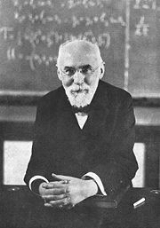
Hendrik Lorentz

Encyclopedia
Hendrik Antoon Lorentz was a Dutch
physicist
who shared the 1902 Nobel Prize in Physics
with Pieter Zeeman
for the discovery and theoretical explanation of the Zeeman effect
. He also derived the transformation equations
subsequently used by Albert Einstein
to describe space and time.
, Gelderland
(The Netherlands), the son of Gerrit Frederik Lorentz (1822 – 1893), a well-off nurseryman, and Geertruida van Ginkel (1826 – 1861). In 1862, after his mother's death, his father married Luberta Hupkes. From 1866-1869 he attended the newly established high school in Arnhem, and in 1870 he passed the exams in classical languages which were then required for admission to University.
Lorentz studied physics
and mathematics
at the University of Leiden, where he was strongly influenced by the teaching of astronomy professor Frederik Kaiser
; it was his influence that led him to become a physicist. After earning a bachelor's degree
, he returned to Arnhem in 1872 to teach high school classes in mathematics, but he continued his studies in Leiden in addition to his teaching position. In 1875 Lorentz earned a doctoral degree under Pieter Rijke
on a thesis entitled "" (On the theory of reflection and refraction of light), in which he refined the electromagnetic theory of James Clerk Maxwell
.
In 1881 Hendrik married Aletta Catharina Kaiser, niece of Frederik Kaiser. She was the daughter of Johann Wilhelm Kaiser, director of the Amsterdam
's Engraving School and professor of Fine Arts, and designer of the first Dutch postage stamp
s (1852). Later Kaiser was the Director of the National Gallery
of Amsterdam. Hendrik and Aletta's eldest daughter Geertruida Luberta Lorentz
was to become a physicist as well.
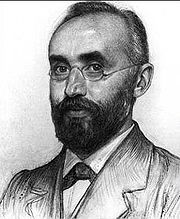
During the first twenty years in Leiden, Lorentz was primarily interested in the theory of electromagnetism to explain the relationship of electricity, magnetism, and light. After that, he extended his research to a much wider area while still focusing on theoretical physics. From his publications, it appears that Lorentz made contributions to mechanics, thermodynamics, hydrodynamics, kinetic theories, solid state theory, light, and propagation. His most important contributions were in the area of electromagnetism, the electron theory, and relativity.
Lorentz theorized that the atom
s might consist of charged particles and suggested that the oscillations of these charged particles were the source of light. When a colleague and former student of Lorentz, Pieter Zeeman
, discovered the Zeeman effect
in 1896, Lorentz supplied its theoretical interpretation. The experimental and theoretical work was honored with the Nobel prize in physics in 1902. Lorentz' name is now associated with the Lorentz-Lorenz
formula, the Lorentz force
, the Lorentzian
distribution, and the Lorentz transformation
.
, Lorentz proposed that moving bodies contract in the direction of motion (see length contraction
; George FitzGerald
had already arrived at this conclusion, see FitzGerald-Lorentz Contraction). Lorentz worked on describing electromagnetic phenomena (the propagation of light) in reference frames that moved relative to each other. He discovered that the transition from one to another reference frame could be simplified by using a new time variable which he called local time. The local time depended on the universal time and the location under consideration. Lorentz's publications (of 1895 and 1899) made use of the term local time without giving a detailed interpretation of its physical relevance. In 1900, Henri Poincaré
called Lorentz's local time a "wonderful invention" and illustrated it by showing that clocks in moving frames are synchronized by exchanging light signals that are assumed to travel at the same speed against and with the motion of the frame.
In 1899, and again in his paper "Electromagnetic phenomena in a system moving with any velocity smaller than that of light" (1904), Lorentz added time dilation
to his transformations and published what Poincaré in 1905 named Lorentz transformations. It was apparently unknown to Lorentz that Joseph Larmor
had used identical transformations to describe orbiting electrons in 1897. Larmor's and Lorentz's equations look somewhat unfamiliar, but they are algebraically equivalent to those presented by Poincaré and Einstein in 1905. Lorentz's 1904 paper includes the covariant formulation of electrodynamics, in which electrodynamic phenomena in different reference frames are described by identical equations with well defined transformation properties. The paper clearly recognizes the significance of this formulation, namely that the outcomes of electrodynamic experiments do not depend on the relative motion of the reference frame. The 1904 paper includes a
detailed discussion of the increase of the inertial mass of rapidly moving objects. In 1905, Einstein would use many of the concepts, mathematical tools and results discussed to write his paper entitled "On the Electrodynamics of Moving Bodies", known today as the theory of special relativity
. Because Lorentz laid the fundamentals for the work by Einstein, this theory was called the Lorentz-Einstein theory originally.
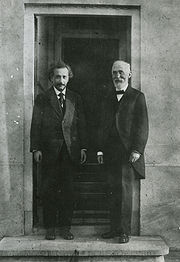 The increase of mass was the first prediction of special relativity to be tested, but the early (1901–1903) experiments by Kaufmann
appeared to show a slightly different mass increase; this led Lorentz to the famous remark that he was "at the end of his Latin." The confirmation
of his prediction had to wait until 1908. In 1909, Lorentz published "Theory of Electrons" based
on a series of lectures in Mathematical Physics he gave at Columbia University
.
Paul Langevin
(1911) said of Lorentz:
Lorentz and Emil Wiechert (Göttingen) had an interesting correspondence on the topics of electromagnetism and the theory of relativity, and Lorentz explained his ideas in letters to Wiechert. The correspondence between Lorentz and Wiechert has been published by Wilfried Schröder (Arch. ex. hist. Sci, 1984).
Lorentz was chairman of the first Solvay Conference
held in Brussels in the autumn of 1911. Shortly after the conference, Poincaré
wrote an essay on quantum physics which gives an indication of Lorentz's status at the time:
Albert Einstein
(1953) wrote of Lorentz:
While Lorentz is mostly known for fundamental theoretical work, he also had an interest in practical applications. In the years 1918-1926, at the request of the Dutch government, Lorentz headed a committee to calculate some of the effects of the proposed Afsluitdijk
(Closure Dike) flood control dam on other seaworks in the Netherlands. Hydraulic engineering
was mainly an empirical science at that time, but the disturbance of the tidal flow caused by the Afsluitdijk was so unprecedented that the empirical rules could not be trusted. Lorentz proposed to start from the basic hydrodynamic equations of motion and solve the problem numerically. This was feasible for a "human computer
", because of the quasi-one-dimensional nature of the water flow in the Waddenzee. The Afsluitdijk was completed in 1933 and the predictions of Lorentz and his committee turned out to be remarkably accurate. One of the two sets of locks in the Afsluitdijk was named after him.
in Haarlem
, although he remained external professor at Leiden and gave weekly lectures there. Paul Ehrenfest
succeeded him in his chair at the University of Leiden, founding the Institute for Theoretical Physics which would become known as the Lorentz Institute
. In addition to the Nobel prize
, Lorentz received a great many honours for his outstanding work. He was elected a Fellow of the Royal Society
in 1905. The Society awarded him their Rumford Medal
in 1908 and their Copley Medal
in 1918.
Lorentz died in Haarlem
, Netherlands. The respect in which he was held in the Netherlands is apparent from O. W. Richardson
's description of his funeral:
Unique 1928 film footage of the funeral procession with a lead carriage followed by ten mourners, followed by a carriage with the coffin, followed in turn by at least four more carriages, passing by a crowd at the Grote Markt, Haarlem
from the Zijlstraat to the Smedesstraat, and then back again through the Grote Houtstraat towards the Barteljorisstraat, on the way to the "Algemene Begraafplaats" at the Kleverlaan (northern Haarlem cemetery) has been digitized on Youtube
.
M. J. Klein (1967) wrote of Lorentz's reputation in the 1920s:
Netherlands
The Netherlands is a constituent country of the Kingdom of the Netherlands, located mainly in North-West Europe and with several islands in the Caribbean. Mainland Netherlands borders the North Sea to the north and west, Belgium to the south, and Germany to the east, and shares maritime borders...
physicist
Physicist
A physicist is a scientist who studies or practices physics. Physicists study a wide range of physical phenomena in many branches of physics spanning all length scales: from sub-atomic particles of which all ordinary matter is made to the behavior of the material Universe as a whole...
who shared the 1902 Nobel Prize in Physics
Nobel Prize in Physics
The Nobel Prize in Physics is awarded once a year by the Royal Swedish Academy of Sciences. It is one of the five Nobel Prizes established by the will of Alfred Nobel in 1895 and awarded since 1901; the others are the Nobel Prize in Chemistry, Nobel Prize in Literature, Nobel Peace Prize, and...
with Pieter Zeeman
Pieter Zeeman
Pieter Zeeman was a Dutch physicist who shared the 1902 Nobel Prize in Physics with Hendrik Lorentz for his discovery of the Zeeman effect.-Childhood and youth:...
for the discovery and theoretical explanation of the Zeeman effect
Zeeman effect
The Zeeman effect is the splitting of a spectral line into several components in the presence of a static magnetic field. It is analogous to the Stark effect, the splitting of a spectral line into several components in the presence of an electric field...
. He also derived the transformation equations
Lorentz transformation
In physics, the Lorentz transformation or Lorentz-Fitzgerald transformation describes how, according to the theory of special relativity, two observers' varying measurements of space and time can be converted into each other's frames of reference. It is named after the Dutch physicist Hendrik...
subsequently used by Albert Einstein
Albert Einstein
Albert Einstein was a German-born theoretical physicist who developed the theory of general relativity, effecting a revolution in physics. For this achievement, Einstein is often regarded as the father of modern physics and one of the most prolific intellects in human history...
to describe space and time.
Early life
Hendrik Lorentz was born in ArnhemArnhem
Arnhem is a city and municipality, situated in the eastern part of the Netherlands. It is the capital of the province of Gelderland and located near the river Nederrijn as well as near the St. Jansbeek, which was the source of the city's development. Arnhem has 146,095 residents as one of the...
, Gelderland
Gelderland
Gelderland is the largest province of the Netherlands, located in the central eastern part of the country. The capital city is Arnhem. The two other major cities, Nijmegen and Apeldoorn have more inhabitants. Other major regional centers in Gelderland are Ede, Doetinchem, Zutphen, Tiel, Wijchen,...
(The Netherlands), the son of Gerrit Frederik Lorentz (1822 – 1893), a well-off nurseryman, and Geertruida van Ginkel (1826 – 1861). In 1862, after his mother's death, his father married Luberta Hupkes. From 1866-1869 he attended the newly established high school in Arnhem, and in 1870 he passed the exams in classical languages which were then required for admission to University.
Lorentz studied physics
Physics
Physics is a natural science that involves the study of matter and its motion through spacetime, along with related concepts such as energy and force. More broadly, it is the general analysis of nature, conducted in order to understand how the universe behaves.Physics is one of the oldest academic...
and mathematics
Mathematics
Mathematics is the study of quantity, space, structure, and change. Mathematicians seek out patterns and formulate new conjectures. Mathematicians resolve the truth or falsity of conjectures by mathematical proofs, which are arguments sufficient to convince other mathematicians of their validity...
at the University of Leiden, where he was strongly influenced by the teaching of astronomy professor Frederik Kaiser
Frederik Kaiser
Frederik Kaiser was a Dutch astronomer.He was director of the Leiden Observatory from 1838 until his death....
; it was his influence that led him to become a physicist. After earning a bachelor's degree
Bachelor's degree
A bachelor's degree is usually an academic degree awarded for an undergraduate course or major that generally lasts for three or four years, but can range anywhere from two to six years depending on the region of the world...
, he returned to Arnhem in 1872 to teach high school classes in mathematics, but he continued his studies in Leiden in addition to his teaching position. In 1875 Lorentz earned a doctoral degree under Pieter Rijke
Pieter Rijke
Petrus Leonardus Rijke was a Dutch physicist, and a professor in experimental physics at the University of Leiden. Rijke spent his scientific career exploring the physics of electricity, and is known for the Rijke tube.On July 1, 1852 he was married to Johanna Hamaker...
on a thesis entitled "" (On the theory of reflection and refraction of light), in which he refined the electromagnetic theory of James Clerk Maxwell
James Clerk Maxwell
James Clerk Maxwell of Glenlair was a Scottish physicist and mathematician. His most prominent achievement was formulating classical electromagnetic theory. This united all previously unrelated observations, experiments and equations of electricity, magnetism and optics into a consistent theory...
.
In 1881 Hendrik married Aletta Catharina Kaiser, niece of Frederik Kaiser. She was the daughter of Johann Wilhelm Kaiser, director of the Amsterdam
Amsterdam
Amsterdam is the largest city and the capital of the Netherlands. The current position of Amsterdam as capital city of the Kingdom of the Netherlands is governed by the constitution of August 24, 1815 and its successors. Amsterdam has a population of 783,364 within city limits, an urban population...
's Engraving School and professor of Fine Arts, and designer of the first Dutch postage stamp
Postage stamp
A postage stamp is a small piece of paper that is purchased and displayed on an item of mail as evidence of payment of postage. Typically, stamps are made from special paper, with a national designation and denomination on the face, and a gum adhesive on the reverse side...
s (1852). Later Kaiser was the Director of the National Gallery
Rijksmuseum
The Rijksmuseum Amsterdam or simply Rijksmuseum is a Dutch national museum in Amsterdam, located on the Museumplein. The museum is dedicated to arts, crafts, and history. It has a large collection of paintings from the Dutch Golden Age and a substantial collection of Asian art...
of Amsterdam. Hendrik and Aletta's eldest daughter Geertruida Luberta Lorentz
Geertruida de Haas-Lorentz
Geertruida Luberta de Haas-Lorentz was a female Dutch physicist and the first to perform fluctuational analysis of electrons as Brownian particles. Consequently she is considered to be the first female in electrical noise theory. She was the eldest daughter of the physicist H. A. Lorentz and...
was to become a physicist as well.
Professor in Leiden
In 1878, only 24 years of age, Hendrik Antoon Lorentz was appointed to the newly established chair in theoretical physics at the University of Leiden. On January 25, 1878, he delivered his inaugural lecture on "" (The molecular theories in physics).During the first twenty years in Leiden, Lorentz was primarily interested in the theory of electromagnetism to explain the relationship of electricity, magnetism, and light. After that, he extended his research to a much wider area while still focusing on theoretical physics. From his publications, it appears that Lorentz made contributions to mechanics, thermodynamics, hydrodynamics, kinetic theories, solid state theory, light, and propagation. His most important contributions were in the area of electromagnetism, the electron theory, and relativity.
Lorentz theorized that the atom
Atom
The atom is a basic unit of matter that consists of a dense central nucleus surrounded by a cloud of negatively charged electrons. The atomic nucleus contains a mix of positively charged protons and electrically neutral neutrons...
s might consist of charged particles and suggested that the oscillations of these charged particles were the source of light. When a colleague and former student of Lorentz, Pieter Zeeman
Pieter Zeeman
Pieter Zeeman was a Dutch physicist who shared the 1902 Nobel Prize in Physics with Hendrik Lorentz for his discovery of the Zeeman effect.-Childhood and youth:...
, discovered the Zeeman effect
Zeeman effect
The Zeeman effect is the splitting of a spectral line into several components in the presence of a static magnetic field. It is analogous to the Stark effect, the splitting of a spectral line into several components in the presence of an electric field...
in 1896, Lorentz supplied its theoretical interpretation. The experimental and theoretical work was honored with the Nobel prize in physics in 1902. Lorentz' name is now associated with the Lorentz-Lorenz
Lorentz-Lorenz
The Lorentz–Lorenz equation, also known as the Clausius–Mossotti relation and Maxwell's formula, relates the refractive index of a substance to its polarizability....
formula, the Lorentz force
Lorentz force
In physics, the Lorentz force is the force on a point charge due to electromagnetic fields. It is given by the following equation in terms of the electric and magnetic fields:...
, the Lorentzian
Lorentzian
Lorentzian may refer to* Cauchy–Lorentz distribution, also known as the Lorentz distribution, Lorentzian function, or Cauchy distribution* Lorentz transformation* Lorentzian inner product* Lorentzian manifoldThe name Lorentz may refer to*Hendrik Lorentz...
distribution, and the Lorentz transformation
Lorentz transformation
In physics, the Lorentz transformation or Lorentz-Fitzgerald transformation describes how, according to the theory of special relativity, two observers' varying measurements of space and time can be converted into each other's frames of reference. It is named after the Dutch physicist Hendrik...
.
Electrodynamics and relativity
In 1895, with the attempt to explain the Michelson-Morley experimentMichelson-Morley experiment
The Michelson–Morley experiment was performed in 1887 by Albert Michelson and Edward Morley at what is now Case Western Reserve University in Cleveland, Ohio. Its results are generally considered to be the first strong evidence against the theory of a luminiferous ether and in favor of special...
, Lorentz proposed that moving bodies contract in the direction of motion (see length contraction
Length contraction
In physics, length contraction – according to Hendrik Lorentz – is the physical phenomenon of a decrease in length detected by an observer of objects that travel at any non-zero velocity relative to that observer...
; George FitzGerald
George FitzGerald
George Francis FitzGerald was an Irish professor of "natural and experimental philosophy" at Trinity College in Dublin, Ireland, during the last quarter of the 19th century....
had already arrived at this conclusion, see FitzGerald-Lorentz Contraction). Lorentz worked on describing electromagnetic phenomena (the propagation of light) in reference frames that moved relative to each other. He discovered that the transition from one to another reference frame could be simplified by using a new time variable which he called local time. The local time depended on the universal time and the location under consideration. Lorentz's publications (of 1895 and 1899) made use of the term local time without giving a detailed interpretation of its physical relevance. In 1900, Henri Poincaré
Henri Poincaré
Jules Henri Poincaré was a French mathematician, theoretical physicist, engineer, and a philosopher of science...
called Lorentz's local time a "wonderful invention" and illustrated it by showing that clocks in moving frames are synchronized by exchanging light signals that are assumed to travel at the same speed against and with the motion of the frame.
In 1899, and again in his paper "Electromagnetic phenomena in a system moving with any velocity smaller than that of light" (1904), Lorentz added time dilation
Time dilation
In the theory of relativity, time dilation is an observed difference of elapsed time between two events as measured by observers either moving relative to each other or differently situated from gravitational masses. An accurate clock at rest with respect to one observer may be measured to tick at...
to his transformations and published what Poincaré in 1905 named Lorentz transformations. It was apparently unknown to Lorentz that Joseph Larmor
Joseph Larmor
Sir Joseph Larmor , a physicist and mathematician who made innovations in the understanding of electricity, dynamics, thermodynamics, and the electron theory of matter...
had used identical transformations to describe orbiting electrons in 1897. Larmor's and Lorentz's equations look somewhat unfamiliar, but they are algebraically equivalent to those presented by Poincaré and Einstein in 1905. Lorentz's 1904 paper includes the covariant formulation of electrodynamics, in which electrodynamic phenomena in different reference frames are described by identical equations with well defined transformation properties. The paper clearly recognizes the significance of this formulation, namely that the outcomes of electrodynamic experiments do not depend on the relative motion of the reference frame. The 1904 paper includes a
detailed discussion of the increase of the inertial mass of rapidly moving objects. In 1905, Einstein would use many of the concepts, mathematical tools and results discussed to write his paper entitled "On the Electrodynamics of Moving Bodies", known today as the theory of special relativity
Special relativity
Special relativity is the physical theory of measurement in an inertial frame of reference proposed in 1905 by Albert Einstein in the paper "On the Electrodynamics of Moving Bodies".It generalizes Galileo's...
. Because Lorentz laid the fundamentals for the work by Einstein, this theory was called the Lorentz-Einstein theory originally.
Walter Kaufmann (physicist)
Walter Kaufmann was a German physicist. He is most well known for his first experimental proof of the velocity dependence of mass, which was an important contribution to the development of modern physics, including special relativity.-Life:In 1890/91 he studied mechanical engineering at the...
appeared to show a slightly different mass increase; this led Lorentz to the famous remark that he was "at the end of his Latin." The confirmation
of his prediction had to wait until 1908. In 1909, Lorentz published "Theory of Electrons" based
on a series of lectures in Mathematical Physics he gave at Columbia University
Columbia University
Columbia University in the City of New York is a private, Ivy League university in Manhattan, New York City. Columbia is the oldest institution of higher learning in the state of New York, the fifth oldest in the United States, and one of the country's nine Colonial Colleges founded before the...
.
Assessments
Poincaré (1902) said of Lorentz's theory of electrodynamics:- The most satisfactory theory is that of Lorentz; it is unquestionably the theory that best explains the known facts, the one that throws into relief the greatest number of known relations ... it is due to Lorentz that the results of Fizeau on the optics of moving bodies, the laws of normal and abnormal dispersion and of absorption are connected with each other ... Look at the ease with which the new Zeeman phenomenonZeeman effectThe Zeeman effect is the splitting of a spectral line into several components in the presence of a static magnetic field. It is analogous to the Stark effect, the splitting of a spectral line into several components in the presence of an electric field...
found its place, and even aided the classification of Faraday's magnetic rotation, which had defied all Maxwell'sJames Clerk MaxwellJames Clerk Maxwell of Glenlair was a Scottish physicist and mathematician. His most prominent achievement was formulating classical electromagnetic theory. This united all previously unrelated observations, experiments and equations of electricity, magnetism and optics into a consistent theory...
efforts.
Paul Langevin
Paul Langevin
Paul Langevin was a prominent French physicist who developed Langevin dynamics and the Langevin equation. He was one of the founders of the Comité de vigilance des intellectuels antifascistes, an antifascist organization created in the wake of the 6 February 1934 far right riots...
(1911) said of Lorentz:
- It is the great merit of H. A. Lorentz to have seen that the fundamental equations of electromagnetism admit a group of transformations which enables them to have the same form when one passes from one frame of reference to another; this new transformation has the most profound implications for the transformations of space and time
Lorentz and Emil Wiechert (Göttingen) had an interesting correspondence on the topics of electromagnetism and the theory of relativity, and Lorentz explained his ideas in letters to Wiechert. The correspondence between Lorentz and Wiechert has been published by Wilfried Schröder (Arch. ex. hist. Sci, 1984).
Lorentz was chairman of the first Solvay Conference
Solvay Conference
The International Solvay Institutes for Physics and Chemistry, located in Brussels, were founded by the Belgian industrialist Ernest Solvay in 1912, following the historic invitation-only 1911 Conseil Solvay, the turning point in world physics...
held in Brussels in the autumn of 1911. Shortly after the conference, Poincaré
Henri Poincaré
Jules Henri Poincaré was a French mathematician, theoretical physicist, engineer, and a philosopher of science...
wrote an essay on quantum physics which gives an indication of Lorentz's status at the time:
- ... at every moment [the twenty physicists from different countries] could be heard talking of the [quantum mechanics] which they contrasted with the old mechanics. Now what was the old mechanics? Was it that of Newton, the one which still reigned uncontested at the close of the nineteenth century? No, it was the mechanics of Lorentz, the one dealing with the principle of relativity; the one which, hardly five years ago, seemed to be the height of boldness.
Albert Einstein
Albert Einstein
Albert Einstein was a German-born theoretical physicist who developed the theory of general relativity, effecting a revolution in physics. For this achievement, Einstein is often regarded as the father of modern physics and one of the most prolific intellects in human history...
(1953) wrote of Lorentz:
- For me personally he meant more than all the others I have met on my life's journey.
While Lorentz is mostly known for fundamental theoretical work, he also had an interest in practical applications. In the years 1918-1926, at the request of the Dutch government, Lorentz headed a committee to calculate some of the effects of the proposed Afsluitdijk
Afsluitdijk
The Afsluitdijk is a major causeway in the Netherlands, constructed between 1927 and 1933 and running from Den Oever on Wieringen in North Holland province, to the village of Zurich in Friesland province, over a length of and a width of 90 m, at an initial height of 7.25 m above sea-level.It is...
(Closure Dike) flood control dam on other seaworks in the Netherlands. Hydraulic engineering
Hydraulic engineering
This article is about civil engineering. For the mechanical engineering discipline see Hydraulic machineryHydraulic engineering as a sub-discipline of civil engineering is concerned with the flow and conveyance of fluids, principally water and sewage. One feature of these systems is the extensive...
was mainly an empirical science at that time, but the disturbance of the tidal flow caused by the Afsluitdijk was so unprecedented that the empirical rules could not be trusted. Lorentz proposed to start from the basic hydrodynamic equations of motion and solve the problem numerically. This was feasible for a "human computer
Human computer
The term "computer", in use from the mid 17th century, meant "one who computes": a person performing mathematical calculations, before electronic computers became commercially available....
", because of the quasi-one-dimensional nature of the water flow in the Waddenzee. The Afsluitdijk was completed in 1933 and the predictions of Lorentz and his committee turned out to be remarkably accurate. One of the two sets of locks in the Afsluitdijk was named after him.
Personal life
In 1912, Lorentz retired early to become director of research at Teylers MuseumTeylers Museum
Teyler's Museum , located in Haarlem, is the oldest museum in the Netherlands. The museum is in the former home of Pieter Teyler van der Hulst . He was a wealthy cloth merchant and Amsterdam banker of Scottish descent, who bequeathed his fortune for the advancement of religion, art and science...
in Haarlem
Haarlem
Haarlem is a municipality and a city in the Netherlands. It is the capital of the province of North Holland, the northern half of Holland, which at one time was the most powerful of the seven provinces of the Dutch Republic...
, although he remained external professor at Leiden and gave weekly lectures there. Paul Ehrenfest
Paul Ehrenfest
Paul Ehrenfest was an Austrian and Dutch physicist, who made major contributions to the field of statistical mechanics and its relations with quantum mechanics, including the theory of phase transition and the Ehrenfest theorem.- Biography :Paul Ehrenfest was born and grew up in Vienna in a Jewish...
succeeded him in his chair at the University of Leiden, founding the Institute for Theoretical Physics which would become known as the Lorentz Institute
Lorentz Institute
The Lorentz Institute, or Instituut-Lorentz in Dutch, was established in 1921 and is the oldest institute for theoretical physics in The Netherlands. Together with the experimental physics groups in the Kamerlingh Onnes Laboratory and the Huygens Laboratory, it makes up the Leiden Institute of...
. In addition to the Nobel prize
Nobel Prize
The Nobel Prizes are annual international awards bestowed by Scandinavian committees in recognition of cultural and scientific advances. The will of the Swedish chemist Alfred Nobel, the inventor of dynamite, established the prizes in 1895...
, Lorentz received a great many honours for his outstanding work. He was elected a Fellow of the Royal Society
Royal Society
The Royal Society of London for Improving Natural Knowledge, known simply as the Royal Society, is a learned society for science, and is possibly the oldest such society in existence. Founded in November 1660, it was granted a Royal Charter by King Charles II as the "Royal Society of London"...
in 1905. The Society awarded him their Rumford Medal
Rumford Medal
The Rumford Medal is awarded by the Royal Society every alternating year for "an outstandingly important recent discovery in the field of thermal or optical properties of matter made by a scientist working in Europe". First awarded in 1800, it was created after a 1796 donation of $5000 by the...
in 1908 and their Copley Medal
Copley Medal
The Copley Medal is an award given by the Royal Society of London for "outstanding achievements in research in any branch of science, and alternates between the physical sciences and the biological sciences"...
in 1918.
Lorentz died in Haarlem
Haarlem
Haarlem is a municipality and a city in the Netherlands. It is the capital of the province of North Holland, the northern half of Holland, which at one time was the most powerful of the seven provinces of the Dutch Republic...
, Netherlands. The respect in which he was held in the Netherlands is apparent from O. W. Richardson
Owen Willans Richardson
Sir Owen Willans Richardson, FRS was a British physicist who won the Nobel Prize in Physics in 1928 for his work on thermionic emission, which led to Richardson's Law.-Biography:...
's description of his funeral:
- The funeral took place at Haarlem at noon on Friday, February 10. At the stroke of twelve the State telegraph and telephone services of Holland were suspended for three minutes as a revered tribute to the greatest man Holland has produced in our time. It was attended by many colleagues and distinguished physicists from foreign countries. The President, Sir Ernest RutherfordErnest RutherfordErnest Rutherford, 1st Baron Rutherford of Nelson OM, FRS was a New Zealand-born British chemist and physicist who became known as the father of nuclear physics...
, represented the Royal Society and made an appreciative oration by the graveside.
Unique 1928 film footage of the funeral procession with a lead carriage followed by ten mourners, followed by a carriage with the coffin, followed in turn by at least four more carriages, passing by a crowd at the Grote Markt, Haarlem
Grote Markt, Haarlem
The Grote Markt is the central market square of Haarlem, the Netherlands.According to the 1911 Encyclopædia Britannica;...
from the Zijlstraat to the Smedesstraat, and then back again through the Grote Houtstraat towards the Barteljorisstraat, on the way to the "Algemene Begraafplaats" at the Kleverlaan (northern Haarlem cemetery) has been digitized on Youtube
YouTube
YouTube is a video-sharing website, created by three former PayPal employees in February 2005, on which users can upload, view and share videos....
.
Legacy
Richardson describes Lorentz as:- [A] man of remarkable intellectual powers ... . Although steeped in his own investigation of the moment, he always seemed to have in his immediate grasp its ramifications into every corner of the universe. ... The singular clearness of his writings provides a striking reflection of his wonderful powers in this respect. .... He possessed and successfully employed the mental vivacity which is necessary to follow the interplay of discussion, the insight which is required to extract those statements which illuminate the real difficulties, and the wisdom to lead the discussion among fruitful channels, and he did this so skillfully that the process was hardly perceptible.
M. J. Klein (1967) wrote of Lorentz's reputation in the 1920s:
- For many years physicists had always been eager "to hear what Lorentz will say about it" when a new theory was advanced, and, even at seventy-two, he did not disappoint them.
- Nobel Prize for Physics (1902)
- Rumford MedalRumford MedalThe Rumford Medal is awarded by the Royal Society every alternating year for "an outstandingly important recent discovery in the field of thermal or optical properties of matter made by a scientist working in Europe". First awarded in 1800, it was created after a 1796 donation of $5000 by the...
(1908) - Copley MedalCopley MedalThe Copley Medal is an award given by the Royal Society of London for "outstanding achievements in research in any branch of science, and alternates between the physical sciences and the biological sciences"...
(1918)
See also
- Lorentz forceLorentz forceIn physics, the Lorentz force is the force on a point charge due to electromagnetic fields. It is given by the following equation in terms of the electric and magnetic fields:...
- Lorentz transformationLorentz transformationIn physics, the Lorentz transformation or Lorentz-Fitzgerald transformation describes how, according to the theory of special relativity, two observers' varying measurements of space and time can be converted into each other's frames of reference. It is named after the Dutch physicist Hendrik...
- Relativity of simultaneityRelativity of simultaneityIn physics, the relativity of simultaneity is the concept that simultaneity–whether two events occur at the same time–is not absolute, but depends on the observer's reference frame. According to the special theory of relativity, it is impossible to say in an absolute sense whether two events occur...
- Lorentz-FitzGerald contraction hypothesis
- Lorentz MedalLorentz MedalLorentz Medal is a prize awarded every four years by the Royal Netherlands Academy of Arts and Sciences. It was established in 1925 on the occasion of the 50th anniversary of the doctorate of Hendrik Lorentz. This solid gold medal is given for important contributions to theoretical physics, though...
- Lorentz (crater)Lorentz (crater)Lorentz is a huge lunar crater that lies just beyond the northwest limb of the Moon, in a region that is brought into sight of the Earth during favorable librations. This formation is nearly as large as the Mare Nectaris on the near side of the Moon, although it has not been submerged by lava as...
- Lorentz factorLorentz factorThe Lorentz factor or Lorentz term appears in several equations in special relativity, including time dilation, length contraction, and the relativistic mass formula. Because of its ubiquity, physicists generally represent it with the shorthand symbol γ . It gets its name from its earlier...
- Geertruida de Haas-LorentzGeertruida de Haas-LorentzGeertruida Luberta de Haas-Lorentz was a female Dutch physicist and the first to perform fluctuational analysis of electrons as Brownian particles. Consequently she is considered to be the first female in electrical noise theory. She was the eldest daughter of the physicist H. A. Lorentz and...