


Lawrence Berkeley National Laboratory

Encyclopedia
The Lawrence Berkeley National Laboratory (Berkeley Lab), is a U.S. Department of Energy
(DOE) national laboratory conducting unclassified scientific research. It is located on the grounds of the University of California, Berkeley
, in the Berkeley Hills
above the central campus. It is managed and operated by the University of California for the DOE.
(a type of particle accelerator
for which he won the Nobel Prize in Physics
in 1939). Throughout the 1930s, Lawrence pushed to create larger and larger machines for physics research, courting private philanthropists
for funding. After the laboratory was scooped on a number of fundamental discoveries that they felt they ought to have made, the "cyclotroneers" began to collaborate more closely with the theoretical physicists
in the Berkeley Department of Physics, led by Robert Oppenheimer
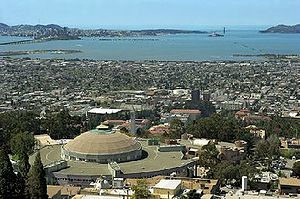
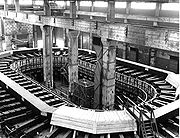
. The lab moved to its site on the hill above campus in 1940 as its machines (specifically, the 184 inches (4.7 m) cyclotron) became too big to house on the university grounds.
 Lawrence courted government as his sponsor in the early years of the Manhattan Project
, the American effort to produce the first atomic bomb during World War II
, and along with Applied Physics Laboratory at Johns Hopkins (which helped develop the proximity fuse), and the MIT Radiation Laboratory (which helped to develop radar
) ushered in the era of "Big Science
". Lawrence's lab helped contribute to what has been judged to be the three most valuable technology developments of the war (the atomic bomb, proximity fuse, and radar). Using the newly created 184 inches (4,673.6 mm) cyclotron as a mass spectrometer, Lawrence and his colleagues developed the principle behind the electromagnetic enrichment of uranium
, which was put to use in the calutron
s (named after the university) at the massive Y-12
facility in Oak Ridge, Tennessee
. The 184 inches (4,673.6 mm) cyclotron was finished in November 1946; the Manhattan Project shut down two months later.
After the war, Lawrence sought to maintain strong government and military ties at his lab, which became incorporated into the new system of Atomic Energy Commission
(AEC) (now Department of Energy (DOE)) National Laboratories, but in the early 1950s set out that the lab's purpose would be primarily non-classified research. Classified weapon research would take place at Los Alamos National Laboratory
(LANL) (established during the war) and the new Lawrence Livermore National Laboratory
(LLNL), established by Lawrence and Edward Teller
from what was originally a splinter from the original Radiation Laboratory. Some weapons-related and collaborative research continued at Berkeley Lab until the 1970s, however.
After the death of Ernest Lawrence in 1959, the Radiation Laboratory was re-named the Ernest O. Lawrence Berkeley Laboratory, although many continued to call it the "Rad Lab." Gradually, another shortened form came into common usage, "LBL" (Lawrence Berkeley Laboratory). Its formal name was amended to Ernest Orlando Lawrence Berkeley National Laboratory in 1995, when "National" was added to the names of all DOE labs. "Ernest Orlando" was later dropped to shorten the name. Today, the lab is commonly referred to as "Berkeley Lab".
(2004–2008): Steven Chu
(1989–2004): Charles Shank
(1980–1989): David Shirley
(1973–1980): Andrew Sessler
(1958–1972): Edwin McMillan
(1931–1958): Ernest Orlando Lawrence
s of the large group of physicists, engineers, computer programmers and technicians led by Luis W. Alvarez from the early 1950s until his death in 1988. Over 1700 memos are available on-line, hosted by the Laboratory.
, life sciences
, chemical sciences, environmental energy technologies, materials science
, physical biosciences, computational research, accelerator and fusion research, engineering
, nuclear science, and physics
.
Berkeley Lab has six main science thrusts: soft x-ray science for discovery, climate change and environmental sciences, matter and force in the universe, energy efficiency and sustainable energy, computational science and networking, and biological science for energy research. It was Lawrence’s belief that scientific research is best done through teams of individuals with different fields of expertise, working together. His teamwork concept is a Berkeley Lab tradition that continues today.
Additionally Berkeley Lab is host to six major National User Facilities: the Advanced Light Source
, the National Center for Electron Microscopy
, National Energy Research Scientific Computing Center
, the Energy Sciences Network
, the Molecular Foundry
, and the Joint Genome Institute
(JGI).
The Joint Genome Institute, located in Walnut Creek, California
, was founded in 1997 to unite the expertise and resources in genome mapping, DNA sequencing
, technology development, and information sciences pioneered at the three genome centers at Berkeley Lab, Lawrence Livermore National Laboratory, and the Los Alamos National Laboratory. Today the JGI's partner laboratories include Berkeley Lab, LLNL, LANL, as well as Oak Ridge (ORNL), Pacific Northwest National Laboratory (PNNL), and the HudsonAlpha Institute for Biotechnology (formerly associated with the Stanford Human Genome Center). The JGI workforce draws most heavily from Berkeley Lab and LLNL.
The laboratory also manages the Department of Energy's high speed research network, ESnet.
Berkeley Lab is the lead partner in the Joint BioEnergy Institute
(JBEI), located in Emeryville, California
. Other partners are the Sandia National Laboratories
, the University of California (UC) campuses of Berkeley and Davis, the Carnegie Institution for Science
, and the Lawrence Livermore National Laboratory (LLNL). JBEI’s primary scientific mission is to advance the development of the next generation of biofuels – liquid fuels derived from the solar energy stored in plant biomass. JBEI is one of three new U.S. Department of Energy (DOE) Bioenergy Research Centers (BRCs).
in the Berkeley Hills. Altogether, it has some 4,000 University of California employees, of whom about 800 are students. Each year, the Lab also hosts more than 3,000 participating guests. There are approximately two dozen DOE employees stationed at the laboratory to provide federal oversight of Berkeley Lab's work for the DOE.
The Laboratory Director is appointed by the Regents of the University of California
and reports to the President of the University of California. On January 21, 2009 Paul Alivisatos was appointed interim director to replace former laboratory Director, Steven Chu, who was sworn in as U.S. Energy Secretary. Alivisatos was officially named Berkeley Lab's seventh director by the University of California Board of Regents on November 19, 2009. Although Berkeley Lab is governed by UC independently of the Berkeley campus, the two entities are closely interconnected: more than 200 Berkeley Lab researchers hold joint appointments as UC Berkeley faculty and more than 500 UC Berkeley graduate students conduct research at Berkeley Lab.
The Lab's budget for fiscal year 2010 is $652 million, plus $122 million from the American Recovery and Reinvestment Act.
, the discovery of several transuranic elements
, and the discovery of the accelerating universe
.
Since its inception, 12 researchers associated with Berkeley Lab (Ernest Lawrence
, Glenn T. Seaborg
, Edwin M. McMillan, Owen Chamberlain
, Emilio G. Segrè
, Donald A. Glaser
, Melvin Calvin
, Luis W. Alvarez
, Yuan T. Lee
, Steven Chu
, George F. Smoot and Saul Perlmutter
) have been awarded the Nobel Prize
.
Fifty-seven Berkeley Lab scientists are members of the U.S. National Academy of Sciences (NAS), one of the highest honors for a scientist in the United States. Thirteen Berkeley Lab scientists have won the National Medal of Science
, the nation's highest award for lifetime achievement in fields of scientific research. Eighteen Berkeley Lab engineers have been elected to the National Academy of Engineering
, and three Berkeley Lab scientists have been elected into the Institute of Medicine
.
Elements discovered by Berkeley Lab physicists include astatine
, neptunium
, plutonium
, curium
, americium
, berkelium
*, californium
*, einsteinium
, fermium
, mendelevium
, nobelium
, lawrencium
*, dubnium
, and seaborgium
*. Those elements listed with asterisks (*) are named after the University and Professor Seaborg - principal scientist involved in their discovery. The element technetium
was discovered after Ernest Lawrence gave Emilio Segrè a molybdenum
strip from the Berkeley Lab cyclotron.
Some inventions and discoveries to come out of Berkeley Lab include: "smart" windows with embedded electrodes that enable window glass to respond to changes in sunlight, synthetic genes for antimalaria and anti-AIDS superdrugs based on breakthroughs in synthetic biology
, electronic ballasts for more efficient lighting, Home Energy Saver
, the web's first do-it-yourself home energy audit tool, a pocket-sized DNA sampler called the PhyloChip, and the Berkeley Darfur Stove, which uses one-quarter as much firewood as traditional cook stoves. One of Berkeley Lab's most notable breakthroughs is the discovery of dark energy
. During the 1980s and 1990s Berkeley Lab physicists and astronomers formed the Supernova Cosmology Project
(SCP), using Type Ia supernovae as “standard candles” to measure the expansion rate of the universe. Their successful methods inspired competition, with the result that early in 1998 both the SCP and the High-Z Supernova Search Team
announced the surprising discovery that expansion is accelerating; the cause was soon named dark energy.
Networking tools libpcap, tcpdump
, and traceroute
were developed by the Network Engineering Group staff at the Laboratory.
and ununhexium
by Victor Ninov
, a researcher employed at Berkeley Lab, led to the retraction of two articles and was one of the big scandals in physics in 2002.
United States Department of Energy
The United States Department of Energy is a Cabinet-level department of the United States government concerned with the United States' policies regarding energy and safety in handling nuclear material...
(DOE) national laboratory conducting unclassified scientific research. It is located on the grounds of the University of California, Berkeley
University of California, Berkeley
The University of California, Berkeley , is a teaching and research university established in 1868 and located in Berkeley, California, USA...
, in the Berkeley Hills
Berkeley Hills
The Berkeley Hills are a range of the Pacific Coast Ranges that overlook the northeast side of the valley that surrounds San Francisco Bay. They were previously called the "Contra Costa Range/Hills" , but with the establishment of Berkeley and the University of California, the current usage was...
above the central campus. It is managed and operated by the University of California for the DOE.
History
The laboratory was founded as the Radiation Laboratory of the University of California, associated with the Physics Department, on August 26, 1931 by Ernest Orlando Lawrence as a site for centering physics research around his new instrument, the cyclotronCyclotron
In technology, a cyclotron is a type of particle accelerator. In physics, the cyclotron frequency or gyrofrequency is the frequency of a charged particle moving perpendicularly to the direction of a uniform magnetic field, i.e. a magnetic field of constant magnitude and direction...
(a type of particle accelerator
Particle accelerator
A particle accelerator is a device that uses electromagnetic fields to propel charged particles to high speeds and to contain them in well-defined beams. An ordinary CRT television set is a simple form of accelerator. There are two basic types: electrostatic and oscillating field accelerators.In...
for which he won the Nobel Prize in Physics
Nobel Prize in Physics
The Nobel Prize in Physics is awarded once a year by the Royal Swedish Academy of Sciences. It is one of the five Nobel Prizes established by the will of Alfred Nobel in 1895 and awarded since 1901; the others are the Nobel Prize in Chemistry, Nobel Prize in Literature, Nobel Peace Prize, and...
in 1939). Throughout the 1930s, Lawrence pushed to create larger and larger machines for physics research, courting private philanthropists
Philanthropy
Philanthropy etymologically means "the love of humanity"—love in the sense of caring for, nourishing, developing, or enhancing; humanity in the sense of "what it is to be human," or "human potential." In modern practical terms, it is "private initiatives for public good, focusing on quality of...
for funding. After the laboratory was scooped on a number of fundamental discoveries that they felt they ought to have made, the "cyclotroneers" began to collaborate more closely with the theoretical physicists
Theoretical physics
Theoretical physics is a branch of physics which employs mathematical models and abstractions of physics to rationalize, explain and predict natural phenomena...
in the Berkeley Department of Physics, led by Robert Oppenheimer
Robert Oppenheimer
Julius Robert Oppenheimer was an American theoretical physicist and professor of physics at the University of California, Berkeley. Along with Enrico Fermi, he is often called the "father of the atomic bomb" for his role in the Manhattan Project, the World War II project that developed the first...
. The lab moved to its site on the hill above campus in 1940 as its machines (specifically, the 184 inches (4.7 m) cyclotron) became too big to house on the university grounds.
Manhattan Project
The Manhattan Project was a research and development program, led by the United States with participation from the United Kingdom and Canada, that produced the first atomic bomb during World War II. From 1942 to 1946, the project was under the direction of Major General Leslie Groves of the US Army...
, the American effort to produce the first atomic bomb during World War II
World War II
World War II, or the Second World War , was a global conflict lasting from 1939 to 1945, involving most of the world's nations—including all of the great powers—eventually forming two opposing military alliances: the Allies and the Axis...
, and along with Applied Physics Laboratory at Johns Hopkins (which helped develop the proximity fuse), and the MIT Radiation Laboratory (which helped to develop radar
Radar
Radar is an object-detection system which uses radio waves to determine the range, altitude, direction, or speed of objects. It can be used to detect aircraft, ships, spacecraft, guided missiles, motor vehicles, weather formations, and terrain. The radar dish or antenna transmits pulses of radio...
) ushered in the era of "Big Science
Big Science
Big Science is a term used by scientists and historians of science to describe a series of changes in science which occurred in industrial nations during and after World War II, as scientific progress increasingly came to rely on large-scale projects usually funded by national governments or groups...
". Lawrence's lab helped contribute to what has been judged to be the three most valuable technology developments of the war (the atomic bomb, proximity fuse, and radar). Using the newly created 184 inches (4,673.6 mm) cyclotron as a mass spectrometer, Lawrence and his colleagues developed the principle behind the electromagnetic enrichment of uranium
Uranium
Uranium is a silvery-white metallic chemical element in the actinide series of the periodic table, with atomic number 92. It is assigned the chemical symbol U. A uranium atom has 92 protons and 92 electrons, of which 6 are valence electrons...
, which was put to use in the calutron
Calutron
A calutron is a mass spectrometer used for separating the isotopes of uranium. It was developed by Ernest O. Lawrence during the Manhattan Project and was similar to the cyclotron invented by Lawrence. Its name is a concatenation of Cal. U.-tron, in tribute to the University of California,...
s (named after the university) at the massive Y-12
Y-12 National Security Complex
The Y-12 National Security Complex is a United States Department of Energy National Nuclear Security Administration facility located in Oak Ridge, Tennessee, near the Oak Ridge National Laboratory...
facility in Oak Ridge, Tennessee
Oak Ridge, Tennessee
Oak Ridge is a city in Anderson and Roane counties in the eastern part of the U.S. state of Tennessee, about west of Knoxville. Oak Ridge's population was 27,387 at the 2000 census...
. The 184 inches (4,673.6 mm) cyclotron was finished in November 1946; the Manhattan Project shut down two months later.
After the war, Lawrence sought to maintain strong government and military ties at his lab, which became incorporated into the new system of Atomic Energy Commission
United States Atomic Energy Commission
The United States Atomic Energy Commission was an agency of the United States government established after World War II by Congress to foster and control the peace time development of atomic science and technology. President Harry S...
(AEC) (now Department of Energy (DOE)) National Laboratories, but in the early 1950s set out that the lab's purpose would be primarily non-classified research. Classified weapon research would take place at Los Alamos National Laboratory
Los Alamos National Laboratory
Los Alamos National Laboratory is a United States Department of Energy national laboratory, managed and operated by Los Alamos National Security , located in Los Alamos, New Mexico...
(LANL) (established during the war) and the new Lawrence Livermore National Laboratory
Lawrence Livermore National Laboratory
The Lawrence Livermore National Laboratory , just outside Livermore, California, is a Federally Funded Research and Development Center founded by the University of California in 1952...
(LLNL), established by Lawrence and Edward Teller
Edward Teller
Edward Teller was a Hungarian-American theoretical physicist, known colloquially as "the father of the hydrogen bomb," even though he did not care for the title. Teller made numerous contributions to nuclear and molecular physics, spectroscopy , and surface physics...
from what was originally a splinter from the original Radiation Laboratory. Some weapons-related and collaborative research continued at Berkeley Lab until the 1970s, however.
After the death of Ernest Lawrence in 1959, the Radiation Laboratory was re-named the Ernest O. Lawrence Berkeley Laboratory, although many continued to call it the "Rad Lab." Gradually, another shortened form came into common usage, "LBL" (Lawrence Berkeley Laboratory). Its formal name was amended to Ernest Orlando Lawrence Berkeley National Laboratory in 1995, when "National" was added to the names of all DOE labs. "Ernest Orlando" was later dropped to shorten the name. Today, the lab is commonly referred to as "Berkeley Lab".
Previous Lab Directors
(2009–present): A. Paul Alivisatos(2004–2008): Steven Chu
Steven Chu
Steven Chu is an American physicist and the 12th United States Secretary of Energy. Chu is known for his research at Bell Labs in cooling and trapping of atoms with laser light, which won him the Nobel Prize in Physics in 1997, along with his scientific colleagues Claude Cohen-Tannoudji and...
(1989–2004): Charles Shank
(1980–1989): David Shirley
(1973–1980): Andrew Sessler
(1958–1972): Edwin McMillan
Edwin McMillan
Edwin Mattison McMillan was an American physicist and Nobel laureate credited with being the first ever to produce a transuranium element. He shared the Nobel Prize in Chemistry with Glenn Seaborg in 1951....
(1931–1958): Ernest Orlando Lawrence
Alvarez Physics Memos
The Alvarez Physics Memos are a set of informal working paperWorking paper
A working paper or work paper or workpaper may refer to:*A preliminary scientific or technical paper. Often, authors will release working papers to share ideas about a topic or to elicit feedback before submitting to a peer reviewed conference or academic journal.* Sometimes the term working paper...
s of the large group of physicists, engineers, computer programmers and technicians led by Luis W. Alvarez from the early 1950s until his death in 1988. Over 1700 memos are available on-line, hosted by the Laboratory.
Science mission
From the 1950s through the present, Berkeley Lab has maintained its status as a major international center for physics research, and has also diversified its research program into almost every realm of scientific investigation. The Laboratory's 14 scientific divisions are organized within the areas of Computing Sciences, General Sciences, Energy and Environmental Sciences, Life Sciences, and Photon Sciences. Many research projects are staffed and supported by multiple divisions, with computational and engineering integrated across the biosciences, general sciences, and energy sciences. The scientific divisions include: earth sciences, genomicsGenomics
Genomics is a discipline in genetics concerning the study of the genomes of organisms. The field includes intensive efforts to determine the entire DNA sequence of organisms and fine-scale genetic mapping efforts. The field also includes studies of intragenomic phenomena such as heterosis,...
, life sciences
Life sciences
The life sciences comprise the fields of science that involve the scientific study of living organisms, like plants, animals, and human beings. While biology remains the centerpiece of the life sciences, technological advances in molecular biology and biotechnology have led to a burgeoning of...
, chemical sciences, environmental energy technologies, materials science
Materials science
Materials science is an interdisciplinary field applying the properties of matter to various areas of science and engineering. This scientific field investigates the relationship between the structure of materials at atomic or molecular scales and their macroscopic properties. It incorporates...
, physical biosciences, computational research, accelerator and fusion research, engineering
Engineering
Engineering is the discipline, art, skill and profession of acquiring and applying scientific, mathematical, economic, social, and practical knowledge, in order to design and build structures, machines, devices, systems, materials and processes that safely realize improvements to the lives of...
, nuclear science, and physics
Physics
Physics is a natural science that involves the study of matter and its motion through spacetime, along with related concepts such as energy and force. More broadly, it is the general analysis of nature, conducted in order to understand how the universe behaves.Physics is one of the oldest academic...
.
Berkeley Lab has six main science thrusts: soft x-ray science for discovery, climate change and environmental sciences, matter and force in the universe, energy efficiency and sustainable energy, computational science and networking, and biological science for energy research. It was Lawrence’s belief that scientific research is best done through teams of individuals with different fields of expertise, working together. His teamwork concept is a Berkeley Lab tradition that continues today.
Additionally Berkeley Lab is host to six major National User Facilities: the Advanced Light Source
Advanced Light Source
The Advanced Light Source at Lawrence Berkeley National Laboratory in Berkeley, California is a synchrotron light source. Built from 1987 to 1993, it currently employs 210 scientists and staff. Part of the building in which it is housed was completed in 1942 for a 4.67 m cyclotron, designed by...
, the National Center for Electron Microscopy
National Center for Electron Microscopy
The National Center for Electron Microscopy is a U.S. Department of Energy national user facility at Lawrence Berkeley National Laboratory in Berkeley, California, for unclassified scientific research using advanced electron microscopy. It is managed and owned by the University of California....
, National Energy Research Scientific Computing Center
National Energy Research Scientific Computing Center
The ', or NERSC for short, is a designated user facility operated by Lawrence Berkeley National Laboratory and the Department of Energy. It contains several cluster supercomputers, the largest of which is...
, the Energy Sciences Network
Energy Sciences Network
The Energy Sciences Network is a high-speed computer network serving United States Department of Energy scientists and their collaborators worldwide. It is managed by staff at the Lawrence Berkeley National Laboratory....
, the Molecular Foundry
Molecular Foundry
- The Molecular Foundry : is a nanoscience user facility located at the Lawrence Berkeley National Laboratory in Berkeley, California, and is one of five nanoscale science research centers sponsored by the United States Department of Energy...
, and the Joint Genome Institute
Joint Genome Institute
The U.S. Department of Energy Joint Genome Institute was created in 1997 to unite the expertise and resources in genome mapping, DNA sequencing, technology development, and information sciences pioneered at the DOE genome centers at Lawrence Berkeley National Laboratory , Lawrence Livermore...
(JGI).
The Joint Genome Institute, located in Walnut Creek, California
Walnut Creek, California
Walnut Creek is an incorporated city located east of the city of Oakland. It lies in the East Bay region of the San Francisco Bay Area. While not as large as neighboring Concord, Walnut Creek serves as the business and entertainment hub for the neighboring cities within central Contra Costa...
, was founded in 1997 to unite the expertise and resources in genome mapping, DNA sequencing
DNA sequencing
DNA sequencing includes several methods and technologies that are used for determining the order of the nucleotide bases—adenine, guanine, cytosine, and thymine—in a molecule of DNA....
, technology development, and information sciences pioneered at the three genome centers at Berkeley Lab, Lawrence Livermore National Laboratory, and the Los Alamos National Laboratory. Today the JGI's partner laboratories include Berkeley Lab, LLNL, LANL, as well as Oak Ridge (ORNL), Pacific Northwest National Laboratory (PNNL), and the HudsonAlpha Institute for Biotechnology (formerly associated with the Stanford Human Genome Center). The JGI workforce draws most heavily from Berkeley Lab and LLNL.
The laboratory also manages the Department of Energy's high speed research network, ESnet.
Berkeley Lab is the lead partner in the Joint BioEnergy Institute
Joint BioEnergy Institute
The Joint BioEnergy Institute is a research institute funded by the Department of Energy of the United States. It is led by the Lawrence Berkeley National Laboratory, and includes participation from the Sandia National Laboratory, Lawrence Livermore National Laboratory, as well as UC Berkeley, UC...
(JBEI), located in Emeryville, California
Emeryville, California
Emeryville is a small city located in Alameda County, California, in the United States. It is located in a corridor between the cities of Berkeley and Oakland, extending to the shore of San Francisco Bay. Its proximity to San Francisco, the Bay Bridge, the University of California, Berkeley, and...
. Other partners are the Sandia National Laboratories
Sandia National Laboratories
The Sandia National Laboratories, managed and operated by the Sandia Corporation , are two major United States Department of Energy research and development national laboratories....
, the University of California (UC) campuses of Berkeley and Davis, the Carnegie Institution for Science
Carnegie Institution for Science
The Carnegie Institution for Science is an organization in the United States established to support scientific research....
, and the Lawrence Livermore National Laboratory (LLNL). JBEI’s primary scientific mission is to advance the development of the next generation of biofuels – liquid fuels derived from the solar energy stored in plant biomass. JBEI is one of three new U.S. Department of Energy (DOE) Bioenergy Research Centers (BRCs).
Operations and governance
The site consists of 76 buildings (owned by the U.S. Department of Energy) located on 200 acre (0.809372 km²) owned by the University of CaliforniaUniversity of California
The University of California is a public university system in the U.S. state of California. Under the California Master Plan for Higher Education, the University of California is a part of the state's three-tier public higher education system, which also includes the California State University...
in the Berkeley Hills. Altogether, it has some 4,000 University of California employees, of whom about 800 are students. Each year, the Lab also hosts more than 3,000 participating guests. There are approximately two dozen DOE employees stationed at the laboratory to provide federal oversight of Berkeley Lab's work for the DOE.
The Laboratory Director is appointed by the Regents of the University of California
Regents of the University of California
The Regents of the University of California make up the governing board of the University of California. The Board has 26 full members:* The majority are appointed by the Governor of California for 12-year terms....
and reports to the President of the University of California. On January 21, 2009 Paul Alivisatos was appointed interim director to replace former laboratory Director, Steven Chu, who was sworn in as U.S. Energy Secretary. Alivisatos was officially named Berkeley Lab's seventh director by the University of California Board of Regents on November 19, 2009. Although Berkeley Lab is governed by UC independently of the Berkeley campus, the two entities are closely interconnected: more than 200 Berkeley Lab researchers hold joint appointments as UC Berkeley faculty and more than 500 UC Berkeley graduate students conduct research at Berkeley Lab.
The Lab's budget for fiscal year 2010 is $652 million, plus $122 million from the American Recovery and Reinvestment Act.
Scientific achievements, inventions, and discoveries
Notable scientific accomplishments at the Lab since World War II include the observation of the antiprotonAntiproton
The antiproton is the antiparticle of the proton. Antiprotons are stable, but they are typically short-lived since any collision with a proton will cause both particles to be annihilated in a burst of energy....
, the discovery of several transuranic elements
Chemical element
A chemical element is a pure chemical substance consisting of one type of atom distinguished by its atomic number, which is the number of protons in its nucleus. Familiar examples of elements include carbon, oxygen, aluminum, iron, copper, gold, mercury, and lead.As of November 2011, 118 elements...
, and the discovery of the accelerating universe
Accelerating universe
The accelerating universe is the observation that the universe appears to be expanding at an increasing rate, which in formal terms means that the cosmic scale factor a has a positive second derivative, implying that the velocity at which a given galaxy is receding from us should be continually...
.
Since its inception, 12 researchers associated with Berkeley Lab (Ernest Lawrence
Ernest Lawrence
Ernest Orlando Lawrence was an American physicist and Nobel Laureate, known for his invention, utilization, and improvement of the cyclotron atom-smasher beginning in 1929, based on his studies of the works of Rolf Widerøe, and his later work in uranium-isotope separation for the Manhattan Project...
, Glenn T. Seaborg
Glenn T. Seaborg
Glenn Theodore Seaborg was an American scientist who won the 1951 Nobel Prize in Chemistry for "discoveries in the chemistry of the transuranium elements", contributed to the discovery and isolation of ten elements, and developed the actinide concept, which led to the current arrangement of the...
, Edwin M. McMillan, Owen Chamberlain
Owen Chamberlain
Owen Chamberlain was an American physicist, and Nobel laureate in physics for his discovery, with collaborator Emilio Segrè, of antiprotons, a sub-atomic antiparticle.-Biography:...
, Emilio G. Segrè
Emilio G. Segrè
Emilio Gino Segrè was an Italian-born, naturalized American, physicist and Nobel laureate in physics, who with Owen Chamberlain, discovered antiprotons, a sub-atomic antiparticle.-Biography:...
, Donald A. Glaser
Donald A. Glaser
Donald Arthur Glaser , is an American physicist, neurobiologist, and Nobel Prize in Physics laureate for his invention of the Bubble chamber used in subatomic particle physics....
, Melvin Calvin
Melvin Calvin
Melvin Ellis Calvin was an American chemist most famed for discovering the Calvin cycle along with Andrew Benson and James Bassham, for which he was awarded the 1961 Nobel Prize in Chemistry. He spent most of his five-decade career at the University of California, Berkeley.- Life :Calvin was born...
, Luis W. Alvarez
Luis Alvarez
Luis W. Alvarez was an American experimental physicist and inventor, who spent nearly all of his long professional career on the faculty of the University of California, Berkeley...
, Yuan T. Lee
Yuan T. Lee
Yuan Tseh Lee, Ph.D. is a chemist. He was the first Taiwanese Nobel Prize laureate, who, along with the Hungarian-Canadian John C. Polanyi and American Dudley R. Herschbach won the Nobel Prize in Chemistry in 1986 "for their contributions to the dynamics of chemical elementary processes"...
, Steven Chu
Steven Chu
Steven Chu is an American physicist and the 12th United States Secretary of Energy. Chu is known for his research at Bell Labs in cooling and trapping of atoms with laser light, which won him the Nobel Prize in Physics in 1997, along with his scientific colleagues Claude Cohen-Tannoudji and...
, George F. Smoot and Saul Perlmutter
Saul Perlmutter
Saul Perlmutter is an American astrophysicist at the Lawrence Berkeley National Laboratory and a professor of physics at the University of California, Berkeley. He is a member of the American Academy of Arts & Sciences, and was elected a Fellow of the American Association for the Advancement of...
) have been awarded the Nobel Prize
Nobel Prize
The Nobel Prizes are annual international awards bestowed by Scandinavian committees in recognition of cultural and scientific advances. The will of the Swedish chemist Alfred Nobel, the inventor of dynamite, established the prizes in 1895...
.
Fifty-seven Berkeley Lab scientists are members of the U.S. National Academy of Sciences (NAS), one of the highest honors for a scientist in the United States. Thirteen Berkeley Lab scientists have won the National Medal of Science
National Medal of Science
The National Medal of Science is an honor bestowed by the President of the United States to individuals in science and engineering who have made important contributions to the advancement of knowledge in the fields of behavioral and social sciences, biology, chemistry, engineering, mathematics and...
, the nation's highest award for lifetime achievement in fields of scientific research. Eighteen Berkeley Lab engineers have been elected to the National Academy of Engineering
National Academy of Engineering
The National Academy of Engineering is a government-created non-profit institution in the United States, that was founded in 1964 under the same congressional act that led to the founding of the National Academy of Sciences...
, and three Berkeley Lab scientists have been elected into the Institute of Medicine
Institute of Medicine
The Institute of Medicine is a not-for-profit, non-governmental American organization founded in 1970, under the congressional charter of the National Academy of Sciences...
.
Elements discovered by Berkeley Lab physicists include astatine
Astatine
Astatine is a radioactive chemical element with the symbol At and atomic number 85. It occurs on the Earth only as the result of decay of heavier elements, and decays away rapidly, so much less is known about this element than its upper neighbors in the periodic table...
, neptunium
Neptunium
Neptunium is a chemical element with the symbol Np and atomic number 93. A radioactive metal, neptunium is the first transuranic element and belongs to the actinide series. Its most stable isotope, 237Np, is a by-product of nuclear reactors and plutonium production and it can be used as a...
, plutonium
Plutonium
Plutonium is a transuranic radioactive chemical element with the chemical symbol Pu and atomic number 94. It is an actinide metal of silvery-gray appearance that tarnishes when exposed to air, forming a dull coating when oxidized. The element normally exhibits six allotropes and four oxidation...
, curium
Curium
Curium is a synthetic chemical element with the symbol Cm and atomic number 96. This radioactive transuranic element of the actinide series was named after Marie Skłodowska-Curie and her husband Pierre Curie. Curium was first intentionally produced and identified in summer 1944 by the group of...
, americium
Americium
Americium is a synthetic element that has the symbol Am and atomic number 95. This transuranic element of the actinide series is located in the periodic table below the lanthanide element europium, and thus by analogy was named after another continent, America.Americium was first produced in 1944...
, berkelium
Berkelium
Berkelium , is a synthetic element with the symbol Bk and atomic number 97, a member of the actinide and transuranium element series. It is named after the city of Berkeley, California, the location of the University of California Radiation Laboratory where it was discovered in December 1949...
*, californium
Californium
Californium is a radioactive metallic chemical element with the symbol Cf and atomic number 98. The element was first made in the laboratory in 1950 by bombarding curium with alpha particles at the University of California, Berkeley. It is the ninth member of the actinide series and was the...
*, einsteinium
Einsteinium
Einsteinium is a synthetic element with the symbol Es and atomic number 99. It is the seventh transuranic element, and an actinide.Einsteinium was discovered in the debris of the first hydrogen bomb explosion in 1952, and named after Albert Einstein...
, fermium
Fermium
Fermium is a synthetic element with the symbol Fm. It is the 100th element in the periodic table and a member of the actinide series. It is the heaviest element that can be formed by neutron bombardment of lighter elements, and hence the last element that can be prepared in macroscopic quantities,...
, mendelevium
Mendelevium
Mendelevium is a synthetic element with the symbol Md and the atomic number 101. A metallic radioactive transuranic element in the actinide series, mendelevium is usually synthesized by bombarding einsteinium with alpha particles. It was named after Dmitri Ivanovich Mendeleev, who created the...
, nobelium
Nobelium
Nobelium is a synthetic element with the symbol No and atomic number 102. It was first correctly identified in 1966 by scientists at the Flerov Laboratory of Nuclear Reactions in Dubna, Soviet Union...
, lawrencium
Lawrencium
Lawrencium is a radioactive synthetic chemical element with the symbol Lr and atomic number 103. In the periodic table of the elements, it is a period 7 d-block element and the last element of actinide series...
*, dubnium
Dubnium
The Soviet team proposed the name nielsbohrium in honor of the Danish nuclear physicist Niels Bohr. The American team proposed that the new element should be named hahnium , in honor of the late German chemist Otto Hahn...
, and seaborgium
Seaborgium
Seaborgium is a synthetic chemical element with the symbol Sg and atomic number 106.Seaborgium is a synthetic element whose most stable isotope 271Sg has a half-life of 1.9 minutes. A new isotope 269Sg has a potentially slightly longer half-life based on the observation of a single decay...
*. Those elements listed with asterisks (*) are named after the University and Professor Seaborg - principal scientist involved in their discovery. The element technetium
Technetium
Technetium is the chemical element with atomic number 43 and symbol Tc. It is the lowest atomic number element without any stable isotopes; every form of it is radioactive. Nearly all technetium is produced synthetically and only minute amounts are found in nature...
was discovered after Ernest Lawrence gave Emilio Segrè a molybdenum
Molybdenum
Molybdenum , is a Group 6 chemical element with the symbol Mo and atomic number 42. The name is from Neo-Latin Molybdaenum, from Ancient Greek , meaning lead, itself proposed as a loanword from Anatolian Luvian and Lydian languages, since its ores were confused with lead ores...
strip from the Berkeley Lab cyclotron.
Some inventions and discoveries to come out of Berkeley Lab include: "smart" windows with embedded electrodes that enable window glass to respond to changes in sunlight, synthetic genes for antimalaria and anti-AIDS superdrugs based on breakthroughs in synthetic biology
Synthetic biology
Synthetic biology is a new area of biological research that combines science and engineering. It encompasses a variety of different approaches, methodologies, and disciplines with a variety of definitions...
, electronic ballasts for more efficient lighting, Home Energy Saver
Home Energy Saver
Home Energy Saver is a set of on–line resources developed by the U.S. Department of Energy at the Lawrence Berkeley National Laboratory intended to help consumers and professional energy analysts, analyze, reduce, and manage home energy use....
, the web's first do-it-yourself home energy audit tool, a pocket-sized DNA sampler called the PhyloChip, and the Berkeley Darfur Stove, which uses one-quarter as much firewood as traditional cook stoves. One of Berkeley Lab's most notable breakthroughs is the discovery of dark energy
Dark energy
In physical cosmology, astronomy and celestial mechanics, dark energy is a hypothetical form of energy that permeates all of space and tends to accelerate the expansion of the universe. Dark energy is the most accepted theory to explain recent observations that the universe appears to be expanding...
. During the 1980s and 1990s Berkeley Lab physicists and astronomers formed the Supernova Cosmology Project
Supernova Cosmology Project
The Supernova Cosmology Project is one of two research teams that determined the likelihood of an accelerating universe and therefore a positive Cosmological constant, using data from the redshift of Type Ia supernovae...
(SCP), using Type Ia supernovae as “standard candles” to measure the expansion rate of the universe. Their successful methods inspired competition, with the result that early in 1998 both the SCP and the High-Z Supernova Search Team
High-z Supernova Search Team
The High-z Supernova Search Team was an international cosmology collaboration which used Type Ia Supernovae to chart the expansion of the Universe. The team was formed in 1994 by Brian P. Schmidt, then a post-doctoral research associate at Harvard University, and Nicholas B. Suntzeff, a staff...
announced the surprising discovery that expansion is accelerating; the cause was soon named dark energy.
Networking tools libpcap, tcpdump
Tcpdump
tcpdump is a common packet analyzer that runs under the command line. It allows the user to intercept and display TCP/IP and other packets being transmitted or received over a network to which the computer is attached...
, and traceroute
Traceroute
traceroute is a computer network diagnostic tool for displaying the route and measuring transit delays of packets across an Internet Protocol network. Traceroute is available on most operating systems....
were developed by the Network Engineering Group staff at the Laboratory.
Scandal
The fabricated evidence used to claim the creation of ununoctiumUnunoctium
Ununoctium is the temporary IUPAC name for the transactinide element having the atomic number 118 and temporary element symbol Uuo. It is also known as eka-radon or element 118, and on the periodic table of the elements it is a p-block element and the last one of the 7th period. Ununoctium is...
and ununhexium
Ununhexium
Ununhexium is the temporary name of a synthetic superheavy element with the temporary symbol Uuh and atomic number 116. There is no proposed name yet although moscovium has been discussed in the media.It is placed as the heaviest member of group 16 although a sufficiently stable isotope is...
by Victor Ninov
Victor Ninov
Victor Ninov is a former researcher in the nuclear chemistry group at Lawrence Berkeley National Laboratory who was alleged to have fabricated the evidence used to claim the creation of ununoctium and ununhexium....
, a researcher employed at Berkeley Lab, led to the retraction of two articles and was one of the big scandals in physics in 2002.
External links
- LBNL official website, YouTube channel
- University of California Office of Laboratory Management
- The Rad Lab - Ernest Lawrence and the Cyclotron: American Institute of Physics web exhibit
- Lawrence and His Laboratory: A Historian's View of the Lawrence Years by J. L. Heilbron, Robert W. Seidel, and Bruce R. Wheaton.
- A Century of Physics at Berkeley: Seedtime for "Big Science", 1930-1950