
Home      Discussion      Topics      Dictionary      Almanac
Signup       Login
Seven churches of Asia

Seven churches of Asia

Overview
The Seven Churches of Revelation, also known as The Seven Churches of the Apocalypse and The Seven Churches of Asia (referring to the Roman province of Asia, not the entire continent), are seven major churches
Christian Church
The Christian Church is the assembly or association of followers of Jesus Christ. The Greek term ἐκκλησία that in its appearances in the New Testament is usually translated as "church" basically means "assembly"...

 of Early Christianity, as mentioned in the New Testament
New Testament
The New Testament is the second major division of the Christian biblical canon, the first such division being the much longer Old Testament....

 Book of Revelation
Book of Revelation
The Book of Revelation is the final book of the New Testament. The title came into usage from the first word of the book in Koine Greek: apokalupsis, meaning "unveiling" or "revelation"...

 and written to by Ignatius of Antioch
Ignatius of Antioch
Ignatius of Antioch was among the Apostolic Fathers, was the third Bishop of Antioch, and was a student of John the Apostle. En route to his martyrdom in Rome, Ignatius wrote a series of letters which have been preserved as an example of very early Christian theology...

. All seven sites are in modern-day Turkey
Turkey
Turkey , known officially as the Republic of Turkey , is a Eurasian country located in Western Asia and in East Thrace in Southeastern Europe...

 and no longer have significant Christian populations since they were emptied of Christians under the Treaty of Lausanne
Treaty of Lausanne
The Treaty of Lausanne was a peace treaty signed in Lausanne, Switzerland on 24 July 1923, that settled the Anatolian and East Thracian parts of the partitioning of the Ottoman Empire. The treaty of Lausanne was ratified by the Greek government on 11 February 1924, by the Turkish government on 31...

. In Revelation, on the Greek island of Patmos
Patmos
Patmos is a small Greek island in the Aegean Sea. One of the northernmost islands of the Dodecanese complex, it has a population of 2,984 and an area of . The highest point is Profitis Ilias, 269 meters above sea level. The Municipality of Patmos, which includes the offshore islands of Arkoi ,...

, Jesus Christ instructs his servant John
John of Patmos
John of Patmos is the name given, in the Book of Revelation, as the author of the apocalyptic text that is traditionally cannonized in the New Testament...

 to: "Write on a scroll what you see and send it to the seven churches: to Ephesus, and to Smyrna, and to Pergamos, and to Thyatira, and to Sardis, and to Philadelphia, and to Laodicea."
Discussion
Ask a question about 'Seven churches of Asia'
Start a new discussion about 'Seven churches of Asia'
Answer questions from other users
Full Discussion Forum
 
Recent Discussions
Encyclopedia
The Seven Churches of Revelation, also known as The Seven Churches of the Apocalypse and The Seven Churches of Asia (referring to the Roman province of Asia, not the entire continent), are seven major churches
Christian Church
The Christian Church is the assembly or association of followers of Jesus Christ. The Greek term ἐκκλησία that in its appearances in the New Testament is usually translated as "church" basically means "assembly"...

 of Early Christianity, as mentioned in the New Testament
New Testament
The New Testament is the second major division of the Christian biblical canon, the first such division being the much longer Old Testament....

 Book of Revelation
Book of Revelation
The Book of Revelation is the final book of the New Testament. The title came into usage from the first word of the book in Koine Greek: apokalupsis, meaning "unveiling" or "revelation"...

 and written to by Ignatius of Antioch
Ignatius of Antioch
Ignatius of Antioch was among the Apostolic Fathers, was the third Bishop of Antioch, and was a student of John the Apostle. En route to his martyrdom in Rome, Ignatius wrote a series of letters which have been preserved as an example of very early Christian theology...

. All seven sites are in modern-day Turkey
Turkey
Turkey , known officially as the Republic of Turkey , is a Eurasian country located in Western Asia and in East Thrace in Southeastern Europe...

 and no longer have significant Christian populations since they were emptied of Christians under the Treaty of Lausanne
Treaty of Lausanne
The Treaty of Lausanne was a peace treaty signed in Lausanne, Switzerland on 24 July 1923, that settled the Anatolian and East Thracian parts of the partitioning of the Ottoman Empire. The treaty of Lausanne was ratified by the Greek government on 11 February 1924, by the Turkish government on 31...

. In Revelation, on the Greek island of Patmos
Patmos
Patmos is a small Greek island in the Aegean Sea. One of the northernmost islands of the Dodecanese complex, it has a population of 2,984 and an area of . The highest point is Profitis Ilias, 269 meters above sea level. The Municipality of Patmos, which includes the offshore islands of Arkoi ,...

, Jesus Christ instructs his servant John
John of Patmos
John of Patmos is the name given, in the Book of Revelation, as the author of the apocalyptic text that is traditionally cannonized in the New Testament...

 to: "Write on a scroll what you see and send it to the seven churches: to Ephesus, and to Smyrna, and to Pergamos, and to Thyatira, and to Sardis, and to Philadelphia, and to Laodicea."

"Churches" in this context refers to the community of Christians living in each city, and not merely to the building or buildings in which they gathered for worship.

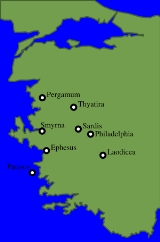
The seven churches are located in:
  • Ephesus
    Ephesus
    Ephesus was an ancient Greek city, and later a major Roman city, on the west coast of Asia Minor, near present-day Selçuk, Izmir Province, Turkey. It was one of the twelve cities of the Ionian League during the Classical Greek era...

     (also see Church of Mary
    Church of Mary
    The Church of Mary is an ancient Christian cathedral dedicated to the Theotokos , located in Ephesus, Turkey. It is also known as the Church of the Councils because two councils of importance to the history of Early Christianity are assumed to have been held within...

    )
  • Smyrna
    Smyrna
    Smyrna was an ancient city located at a central and strategic point on the Aegean coast of Anatolia. Thanks to its advantageous port conditions, its ease of defence and its good inland connections, Smyrna rose to prominence. The ancient city is located at two sites within modern İzmir, Turkey...

  • Pergamon
    Pergamon
    Pergamon , or Pergamum, was an ancient Greek city in modern-day Turkey, in Mysia, today located from the Aegean Sea on a promontory on the north side of the river Caicus , that became the capital of the Kingdom of Pergamon during the Hellenistic period, under the Attalid dynasty, 281–133 BC...

  • Thyatira
    Thyatira
    Thyateira is the name of the modern Turkish city of Akhisar . The name comes from Koine Greek "Θυάτειρα" . The Turkish equivalent of Thyateira is Tepe Mezarligi. It lies in the far west of Turkey, south of Istanbul and almost due east of Athens...

  • Sardis
    Sardis
    Sardis or Sardes was an ancient city at the location of modern Sart in Turkey's Manisa Province...

     (the See of Sardis
    See of Sardis
    The See of Sardis was an episcopal see in Sardis. It was one of the Seven Churches of the Apocalypse, held by metropolitan bishops since the middle to late 1st century, with jurisdiction over the province of Lydia...

    )
  • Philadelphia
    Alasehir
    Alaşehir, in Antiquity and the Middle Ages known as Philadelphia , i.e. " brotherly love" is a town and district of Manisa Province in the Aegean region of Turkey. It is situated in the valley of the Kuzuçay , at the foot of the Bozdağ...

  • and Laodicea
    Laodicea on the Lycus
    Laodicea on the Lycus was the ancient metropolis of Phrygia Pacatiana , built on the river Lycus , in Anatolia near the modern village of Eskihisar , Denizli Province,...

    , near Denizli
    Denizli
    Denizli is a growing industrial city in the Southwestern part of Turkey and the eastern end of the alluvial valley formed by the river Büyük Menderes, where the plain reaches an elevation of about a hundred meters. Denizli is located in southwestern Turkey, in the country's Aegean Region.The city...

     (see Laodicean Church
    Laodicean Church
    The Laodicean Church was a Christian community established in the ancient city of Laodicea . The church was established in the earliest period of Christianity, and is probably best known for being one of the seven churches addressed by name in the Book of Revelation The Laodicean Church was a...

    )

Character of the churches

  1. Ephesus (Revelation 2:1-7) - the church that had forsaken its first love (2:4).
  2. Smyrna (Revelation 2:8-11) - the church that would suffer persecution (2:10).
  3. Pergamum (Revelation 2:12-17) - the church that needed to repent (2:16).
  4. Thyatira (Revelation 2:18-29) - the church that had a false prophetess (2:20).
  5. Sardis (Revelation 3:1-6) - the church that had fallen asleep (3:2).
  6. Philadelphia (Revelation 3:7-13) - the church that had endured patiently (3:10).
  7. Laodicea (Revelation 3:14-22) - the church with the lukewarm faith (3:16).

Seven messages


The letters follow a common pattern: the Lord of hosts first addresses each church and identifies himself, then defines things that he knows about the church in question. After this a challenge or reproach is given, followed by a promise. In all seven cases the admonition is included, "He who has an ear, let him hear what the Spirit says to the churches", although sometimes this comes before the promise and sometimes after.

Although the letters differ in length in accord with the needs of each community, all conclude with an appeal to hold fast and to listen to what the Spirit is saying to the churches. Each church is promised that everyone who conquers will be rewarded by Christ.

Historicists
Historicism (Christian eschatology)
Historicism is a method of interpretation, in Christian eschatology, by associating biblical prophecies with actual historical events as well as identifying symbolic beings with historical persons or societies. In prophetic theology, the main texts of interest are apocalyptic literature such as the...

 typically interpret the seven churches as representing seven different periods in the history of the Church from the time of Paul until the return of Jesus Christ. Scofield states that "these messages by their very terms go beyond the local asemblies mentioned." He is of the opinion that the letters have a prophetic purpose disclosing the seven phases of the spiritual history of the Church.

Angels of the churches


Chapters 2-3 of the Revelation has specific messages for each of the seven churches. The message of each of the seven letters is directed to the angel of the particular church that is mentioned.

Origen
Origen
Origen , or Origen Adamantius, 184/5–253/4, was an early Christian Alexandrian scholar and theologian, and one of the most distinguished writers of the early Church. As early as the fourth century, his orthodoxy was suspect, in part because he believed in the pre-existence of souls...

 explains that these "angels" are the guardian angel
Guardian angel
A guardian angel is an angel assigned to protect and guide a particular person or group. Belief in guardian angels can be traced throughout all antiquity...

s of the churches, a view upheld by Henry Alford
Henry Alford
Henry Alford was an English churchman, theologian, textual critic, scholar, poet, hymnodist, and writer.-Life:...

. But Epiphanius
Epiphanius of Salamis
Epiphanius of Salamis was bishop of Salamis at the end of the 4th century. He is considered a saint and a Church Father by both the Eastern Orthodox and Catholic Churches. He gained a reputation as a strong defender of orthodoxy...

 explicitly rejects this view, and, in accordance with the imagery of the passage, explains it of the bishops.

John sees a vision
John's vision of the Son of Man
John's vision of the Son of Man is described in the scriptural Revelation . John sees a vision of the risen, ascended and glorified Jesus Christ, whom he describes as one "like the Son of Man" . Jesus is portrayed in this vision as having a robe with a golden sash, white hair, eyes like blazing...

 of the Son of Man
Son of man
The phrase son of man is a primarily Semitic idiom that originated in Ancient Mesopotamia, used to denote humanity or self. The phrase is also used in Judaism and Christianity. The phrase used in the Greek, translated as Son of man is ὁ υἱὸς τοὺ ἀνθρώπου...

, who walks among seven lampstands and has seven stars in his right hand. states that "The seven stars are the angels of the seven churches, and the seven lampstands are the seven churches." The comparison of a teacher to a star is scriptural.

Augustine of Hippo
Augustine of Hippo
Augustine of Hippo , also known as Augustine, St. Augustine, St. Austin, St. Augoustinos, Blessed Augustine, or St. Augustine the Blessed, was Bishop of Hippo Regius . He was a Latin-speaking philosopher and theologian who lived in the Roman Africa Province...

's reason for interpreting angels of the churches as the prelates of the church is that St. John speaks of them as falling from their first charity which is not true of the angels. Others would say that the falling away relates to the churches, not to the messengers, as each of the seven letters conclude with the words "He who has an ear, let him hear what the Spirit says to the churches." (NKJV)

Scofield has noted that The natural explanation of the "messengers" is that they were men sent by the seven churches to ascertain the state of the aged apostle ... but they figure any who bear God's messages to a church.

In the New Testament, the Greek word for angels (aggelos) is also used for human messengers (Matthew 11:10, Mark 1:2, Luke 7:27, Luke 9:52, James 2:25, Revelation 22:8,9).

See also


  • Events of Revelation (Chapter 1)
  • Eastern Christianity
    Eastern Christianity
    Eastern Christianity comprises the Christian traditions and churches that developed in the Balkans, Eastern Europe, Asia Minor, the Middle East, Northeastern Africa, India and parts of the Far East over several centuries of religious antiquity. The term is generally used in Western Christianity to...

  • Summary of Christian eschatological differences
  • Christianity in Anatolia during Roman times
  • Early centers of Christianity
    Early centers of Christianity
    Early Christianity spread from Western Asia, throughout the Roman Empire, and beyond into East Africa and South Asia, reaching as far as India. At first, this development was closely connected to centers of Hebrew faith, in the Holy Land and the Jewish diaspora...

  • Seven Spirits of God
    Seven Spirits of God
    The seven Spirits of God are referenced several times in the Bible, primarily in the Book of Revelation. The meaning of this term has been interpreted in multiple ways.-The Seven Spirits of God:...


Further reading

  • Halley, H. H., Halley's Bible Handbook (Grand Rapids, MI: Zondervan, 1978), p684
  • Scofield, C. I., The Scofield Reference Bible (Oxford: Oxford University Press, 1967), p1332

External links