


Obadiah

Encyclopedia
- This article is about the prophet attributed to being the author of the Book of ObadiahBook of ObadiahThe canonical Book of Obadiah is an oracle concerning the divine judgment of Edom and the restoration of Israel. The text consists of a single chapter, divided into 21 verses, making it the shortest book in the Hebrew Bible....
.
Obadiah is a Biblical
Bible
The Bible refers to any one of the collections of the primary religious texts of Judaism and Christianity. There is no common version of the Bible, as the individual books , their contents and their order vary among denominations...
theophorical
Theophory in the Bible
Theophory refers to the practice of embedding the name of a god or a deity in, usually, a proper name. Much Hebrew theophory occurs in the Bible, particularly in the Old Testament...
name, meaning "servant of Yahweh
Yahweh
Yahweh is the name of God in the Bible, the God of Abraham, Isaac, Jacob, Jews and Christians.The word Yahweh is a modern scholarly convention for the Hebrew , transcribed into Roman letters as YHWH and known as the Tetragrammaton, for which the original pronunciation is unknown...
" or "worshipper of Yahweh." It is related to "Abdeel", "servant of God", which is also cognate
Cognate
In linguistics, cognates are words that have a common etymological origin. This learned term derives from the Latin cognatus . Cognates within the same language are called doublets. Strictly speaking, loanwords from another language are usually not meant by the term, e.g...
to the Arabic
Arabic language
Arabic is a name applied to the descendants of the Classical Arabic language of the 6th century AD, used most prominently in the Quran, the Islamic Holy Book...
name "Abdullah
Abdullah (name)
Abdullah or Abdallah is the primary transliteration of the Arabic given name, , built from the Arabic words Abd and Allah . The first letter a in al-Ilah in its native pronunciation is often unstressed and commonly transliterated by u, a stressed a is often used as well, although any vowel can also...
". Turkish name Abdil
Abdil
Abdil is Turkish name.The famous family in Kailar in Rumelia Abdil Ağalar.Abdil is related to "Abdeel", "servant of God", which is also cognate to the Arabic name "Abdullah". Turkish name Abdil or Abdi. The form of Obadiah's name used in the Septuagint is Obdios; in Latin it is Abdias. The...
or Abdi
Abdi
Abdi is an Arabic male name or compound word, that is related to Abdul.Abdi is often used as part of a Muslim name meaning servant. Abdi is then followed by one of the Names of God in Islam, signifying servant of God. Each of the names of Allah are adjectives describing Him. For example, Abdi-Fatah...
. The form of Obadiah's name used in the Septuagint is Obdios; in Latin it is Abdias. The Bishops' Bible
Bishops' Bible
The Bishops' Bible is an English translation of the Bible which was produced under the authority of the established Church of England in 1568. It was substantially revised in 1572, and this revised edition was to be prescribed as the base text for the Authorized King James Version of...
has it as Abdi.
Rabbinic tradition
According to the TalmudTalmud
The Talmud is a central text of mainstream Judaism. It takes the form of a record of rabbinic discussions pertaining to Jewish law, ethics, philosophy, customs and history....
, Obadiah is said to have been a convert to Judaism from Edom
Edom
Edom or Idumea was a historical region of the Southern Levant located south of Judea and the Dead Sea. It is mentioned in biblical records as a 1st millennium BC Iron Age kingdom of Edom, and in classical antiquity the cognate name Idumea was used to refer to a smaller area in the same region...
, a descendant of Eliphaz
Eliphaz
Eliphaz was the first-born son of Esau by his wife Adah. He had six sons, one of whom was Amalek, born to his concubine Timna, who was the ancestral enemy of the Israelite people ....
, the friend of Job. He is identified with the Obadiah who was the servant of Ahab, and it is said that he was chosen to prophesy against Edom because he was himself an Edomite. Moreover, having lived with two such godless persons as Ahab
Ahab
Ahab or Ach'av or Achab in Douay-Rheims was king of Israel and the son and successor of Omri according to the Hebrew Bible. His wife was Jezebel....
and Jezebel
Jezebel
Jezebel may refer to:* Jezebel, wife of King Ahab*Jezebel, in the Book of Revelation 2:20 a prophetess in the church of Thyatira* Jezebel , starring Bette Davis and Henry Fonda* Jezebel , a blog aimed at women...
without learning to act as they did, he seemed the most suitable person to prophesy against Esau
Esau
Esau , in the Hebrew Bible, is the oldest son of Isaac. He is mentioned in the Book of Genesis, and by the minor prophets, Obadiah and Malachi. The New Testament later references him in the Book of Romans and the Book of Hebrews....
(Edom), who, having been brought up by two pious persons, Isaac
Isaac
Isaac as described in the Hebrew Bible, was the only son Abraham had with his wife Sarah, and was the father of Jacob and Esau. Isaac was one of the three patriarchs of the Israelites...
and Rebekah, had not learned to imitate their good deeds.
Obadiah is supposed to have received the gift of prophecy for having hidden the hundred prophets from the persecution of Jezebel. He hid the prophets in two caves, so that if those in one cave should be discovered those in the other might yet escape (1 Kings ).
Talmud Sanhedrin 39b
R. Isaac said: Why did Obadiah attain29 the gift of prophecy? — Because he hid a hundred prophets in caves, as it is written, For it was so when Jezebel cut off the prophets of the Lord that Obadiah took a hundred prophets and hid them, fifty in a cave.30 Why just fifty? — R. Eleazar said: He learnt this lesson from Jacob,31 as it is written, 'Then the camp which is left shall escape.32 R. Abbahu said: It was because the one cave could not hold more than fifty.
Obadiah was very rich, but all his wealth was expended in feeding the poor prophets, until, in order to be able to continue to support them, finally he had to borrow money at interest from Ahab's son Jehoram
Jehoram of Israel
Jehoram was a king of the northern Kingdom of Israel. He was the son of Ahab and Jezebel.According to , in the fifth year of Joram of Israel, Jehoram became king of Judah, when his father Jehoshaphat was king of Judah, indicating a co-regency...
. Obadiah's fear of God was one degree higher than that of Abraham
Abraham
Abraham , whose birth name was Abram, is the eponym of the Abrahamic religions, among which are Judaism, Christianity and Islam...
; and if the house of Ahab had been capable of being blessed, it would have been blessed for Obadiah's sake.
Christian Tradition
In some Christian traditions he is said to have been born in "Sychem" (ShechemShechem
Shechem was a Canaanite city mentioned in the Amarna letters, and is mentioned in the Hebrew Bible as an Israelite city of the tribe of Manasseh and the first capital of the Kingdom of Israel...
), and to have been the third centurion sent out by Ahaziah
Ahaziah of Israel
Ahaziah or Ochozias was king of Israel and the son of Ahab and Jezebel.William F. Albright has dated his reign to 850-849 BC, while E. R. Thiele offers the dates 853-852 BC...
against Elijah. The date of his ministry is unclear due to certain historical ambiguities in the book bearing his name, but is believed to be around 586 B.C.
Catholicism
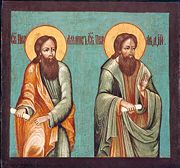
Saint
A saint is a holy person. In various religions, saints are people who are believed to have exceptional holiness.In Christian usage, "saint" refers to any believer who is "in Christ", and in whom Christ dwells, whether in heaven or in earth...
by several Catholic churches. His feast day is celebrated on January 10 in the Coptic Church. The Eastern Orthodox Church
Eastern Orthodox Church
The Orthodox Church, officially called the Orthodox Catholic Church and commonly referred to as the Eastern Orthodox Church, is the second largest Christian denomination in the world, with an estimated 300 million adherents mainly in the countries of Belarus, Bulgaria, Cyprus, Georgia, Greece,...
and those Eastern Catholic Churches which follow the Byzantine Rite
Byzantine Rite
The Byzantine Rite, sometimes called the Rite of Constantinople or Constantinopolitan Rite is the liturgical rite used currently by all the Eastern Orthodox Churches, by the Greek Catholic Churches , and by the Protestant Ukrainian Lutheran Church...
celebrate his memory on November 19 (for those churches which follow the traditional Julian Calendar
Julian calendar
The Julian calendar began in 45 BC as a reform of the Roman calendar by Julius Caesar. It was chosen after consultation with the astronomer Sosigenes of Alexandria and was probably designed to approximate the tropical year .The Julian calendar has a regular year of 365 days divided into 12 months...
, November 19 currently falls on December 2 of the modern Gregorian Calendar
Gregorian calendar
The Gregorian calendar, also known as the Western calendar, or Christian calendar, is the internationally accepted civil calendar. It was introduced by Pope Gregory XIII, after whom the calendar was named, by a decree signed on 24 February 1582, a papal bull known by its opening words Inter...
). He is celebrated on February 28 in the Syriac and Malankara Church
Malankara Church
The Malankara Church is the church of the Saint Thomas Christians of Kerala, India, with particular emphasis on the part of the community that joined Archdeacon Mar Thoma in swearing to resist the authority of the Portuguese Padroado in 1653...
es, and with the other Minor prophet
Minor prophet
Minor prophets is a book of the Hebrew Bible, so named because it contains twelve shorter prophetic works. In Christian Bibles the twelve are presented as individual books...
s in the Calendar of saints
Calendar of Saints (Armenian Apostolic Church)
-January:* 1 Third Day of the Fast of the Nativity* 2 Fourth Day of the Fast of the Nativity* 3 Fifth Day of the Fast of the Nativity* 4 Sixth Day of the Fast of the Nativity* 5 Eve of the Nativity and Theophany of our Lord Jesus Christ...
of the Armenian Apostolic Church
Armenian Apostolic Church
The Armenian Apostolic Church is the world's oldest National Church, is part of Oriental Orthodoxy, and is one of the most ancient Christian communities. Armenia was the first country to adopt Christianity as its official religion in 301 AD, in establishing this church...
on July 31.
According to an old tradition, Obadiah is buried in Samaria
Samaria
Samaria, or the Shomron is a term used for a mountainous region roughly corresponding to the northern part of the West Bank.- Etymology :...
.
Miscellaneous Obadiahs in the Old Testament
Other individuals named Obadiah in the Old Testament are listed as:- the servant of king AhabAhabAhab or Ach'av or Achab in Douay-Rheims was king of Israel and the son and successor of Omri according to the Hebrew Bible. His wife was Jezebel....
of Israel . According to both rabbinic tradition and the traditionSacred TraditionSacred Tradition or Holy Tradition is a theological term used in some Christian traditions, primarily in the Roman Catholic, Anglican, Eastern Orthodox and Oriental Orthodox traditions, to refer to the fundamental basis of church authority....
of the Orthodox Church, this is the same individual as the prophet. - the son of Hananiah, a descendant of king DavidDavidDavid was the second king of the united Kingdom of Israel according to the Hebrew Bible and, according to the Gospels of Matthew and Luke, an ancestor of Jesus Christ through both Saint Joseph and Mary...
of Israel through SolomonSolomonSolomon , according to the Book of Kings and the Book of Chronicles, a King of Israel and according to the Talmud one of the 48 prophets, is identified as the son of David, also called Jedidiah in 2 Samuel 12:25, and is described as the third king of the United Monarchy, and the final king before...
(1 Chronicles ) - the son of Uzzi, a descendant of the HebrewHebrewsHebrews is an ethnonym used in the Hebrew Bible...
patriarch IssacharIssacharIssachar/Yissachar was, according to the Book of Genesis, a son of Jacob and Leah , and the founder of the Israelite Tribe of Issachar; however some Biblical scholars view this as postdiction, an eponymous metaphor providing an aetiology of the connectedness of the tribe to others in the Israelite...
- the son of Azel, a descendant of king SaulSaul the KingAccording to the Bible, Saul was the first king of the united Kingdom of Israel. He was anointed by the prophet Samuel and reigned from Gibeah. He commited suicide to avoid arrest in the battle against the Philistines at Mount Gilboa, during which three of his sons were also killed...
of Israel through JonathanDavid and JonathanDavid and Jonathan were heroic figures of the Kingdom of Israel, whose covenant was recorded favourably in the books of Samuel. Jonathan was the son of Saul, king of Israel, of the tribe of Benjamin, and David was the son of Jesse of Bethlehem and Jonathan's presumed rival for the crown...
- the son of Shemaiah, a descendant of the Hebrew patriarch LeviLeviLevi/Levy was, according to the Book of Genesis, the third son of Jacob and Leah, and the founder of the Israelite Tribe of Levi ; however Peake's commentary suggests this as postdiction, an eponymous metaphor providing an aetiology of the connectedness of the tribe to others in the Israelite...
- a warrior of the Tribe of GadTribe of GadAccording to the Hebrew Bible, the Tribe of Gad was one of the Tribes of Israel.From after the conquest of the land by Joshua until the formation of the first Kingdom of Israel in c. 1050 BC, the Tribe of Gad was a part of a loose confederation of Israelite tribes. No central government existed,...
who served King DavidDavidDavid was the second king of the united Kingdom of Israel according to the Hebrew Bible and, according to the Gospels of Matthew and Luke, an ancestor of Jesus Christ through both Saint Joseph and Mary...
- the father of Ishmaiah, governor of the tribe of ZebulunZebulunZebulun was, according to the Books of Genesis and Numbers, the sixth son of Jacob and Leah, and the founder of the Israelite Tribe of Zebulun...
during the reign of king David - a prince of the southern kingdom of JudahKingdom of JudahThe Kingdom of Judah was a Jewish state established in the Southern Levant during the Iron Age. It is often referred to as the "Southern Kingdom" to distinguish it from the northern Kingdom of Israel....
during the reign of king JehoshaphatJehoshaphatJehoshaphat was the fourth king of the The Kingdom of Judah, and successor of his father Asa. His children included Jehoram, who succeeded him as king...
(2 Chronicles ) - a LeviteLeviteIn Jewish tradition, a Levite is a member of the Hebrew tribe of Levi. When Joshua led the Israelites into the land of Canaan, the Levites were the only Israelite tribe that received cities but were not allowed to be landowners "because the Lord the God of Israel himself is their inheritance"...
, overseer of the reconstruction efforts during the reforms of king JosiahJosiahJosiah or Yoshiyahu or Joshua was a king of Judah who instituted major reforms. Josiah is credited by most historians with having established or compiled important Jewish scriptures during the Deuteronomic reform that occurred during his rule.Josiah became king of Judah at the age of eight, after...
of Judah - the son of Joab, one of the individuals who returned from the Babylonian captivityBabylonian captivityThe Babylonian captivity was the period in Jewish history during which the Jews of the ancient Kingdom of Judah were captives in Babylon—conventionally 587–538 BCE....
with the priestly scribe EzraEzraEzra , also called Ezra the Scribe and Ezra the Priest in the Book of Ezra. According to the Hebrew Bible he returned from the Babylonian exile and reintroduced the Torah in Jerusalem...
, and possibly the Levite mentioned in (NehemiahBook of NehemiahThe Book of Nehemiah is a book of the Hebrew Bible. Told largely in the form of a first-person memoir, it concerns the rebuilding of the walls of Jerusalem by Nehemiah, a Jew who is a high official at the Persian court, and the dedication of the city and its people to God's laws...
) as a porter of Jerusalem's gates after the city's reconstruction under NehemiahNehemiahNehemiah ]]," Standard Hebrew Nəḥemya, Tiberian Hebrew Nəḥemyāh) is the central figure of the Book of Nehemiah, which describes his work rebuilding Jerusalem and purifying the Jewish community. He was the son of Hachaliah, Nehemiah ]]," Standard Hebrew Nəḥemya, Tiberian Hebrew Nəḥemyāh) is the...
(EzraBook of EzraThe Book of Ezra is a book of the Hebrew Bible. Originally combined with the Book of Nehemiah in a single book of Ezra-Nehemiah, the two became separated in the early centuries of the Christian era...
)
Notations
- Holweck, F. G.Frederick George HolweckFrederick George Holweck was a German-American Roman Catholic priest and scholar, hagiographer and church historian.-Life:...
, A Biographical Dictionary of the Saints. St. Louis, MO: B. Herder Book Co., 1924.
External links
- Prophet Obadiah (Abdias) Orthodox iconIconAn icon is a religious work of art, most commonly a painting, from Eastern Christianity and in certain Eastern Catholic churches...
and synaxarion