
Home      Discussion      Topics      Dictionary      Almanac
Signup       Login
Amasis II

Amasis II

Overview
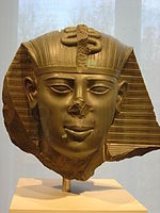
Amasis II (also Ahmose II) was a pharaoh
Pharaoh
Pharaoh is a title used in many modern discussions of the ancient Egyptian rulers of all periods. In antiquity this title began to be used for the ruler who was the religious and political leader of united ancient Egypt. This was true only during the New Kingdom, specifically during the middle of...

 (570 BC - 526 BC) of the Twenty-sixth dynasty of Egypt
Twenty-sixth dynasty of Egypt
The Twenty-sixth Dynasty of Egypt was the last native dynasty to rule Egypt before the Persian conquest in 525 BC . The Dynasty's reign The Twenty-sixth Dynasty of Egypt (also written Dynasty XXVI or Dynasty 26) was the last native dynasty to rule Egypt before the Persian conquest...

, the successor of Apries
Apries
Apries is the name by which Herodotus and Diodorus designate Wahibre Haibre, Ουαφρης , a pharaoh of Egypt , the fourth king of the Twenty-sixth dynasty of Egypt. He was equated with the Waphres of Manetho, who correctly records that he reigned for 19 years...

 at Sais
Sais, Egypt
Sais or Sa el-Hagar was an ancient Egyptian town in the Western Nile Delta on the Canopic branch of the Nile. It was the provincial capital of the fifth nome of Lower Egypt and became the seat of power during the Twenty-fourth dynasty of Egypt and the Saite Twenty-sixth dynasty of Egypt during...

. He was the last great ruler of Egypt
Ancient Egypt
Ancient Egypt was an ancient civilization of eastern North Africa, concentrated along the lower reaches of the Nile River in what is now the modern country of Egypt. The civilization coalesced around 3150 BC with the political unification of Upper and Lower Egypt under the first pharaoh, and...

 before the Persian
Achaemenid Empire
The Achaemenid Empire or Persian Empire was the successor state of the Median Empire, ruling over significant portions of what would become Greater Iran. The Persian and the Median Empire taken together are also known as the Medo-Persian Empire, succeeding the Neo-Assyrian Empire...

 conquest.

Most of our information about him is derived from Herodotus
Herodotus
Herodotus of Halicarnassus was a Greek historian who lived in the 5th century BC and is regarded as the "Father of History" in Western culture. He was the first historian known to collect his materials systematically, test their accuracy to a certain extent and arrange them in a...

 (2.161ff) and can only be imperfectly verified by monumental evidence. According to the Greek historian, he was of common origins. A revolt which broke out among native Egyptian soldiers gave him his opportunity to seize the throne.
Discussion
Ask a question about 'Amasis II'
Start a new discussion about 'Amasis II'
Answer questions from other users
Full Discussion Forum
 
Encyclopedia
Amasis II (also Ahmose II) was a pharaoh
Pharaoh
Pharaoh is a title used in many modern discussions of the ancient Egyptian rulers of all periods. In antiquity this title began to be used for the ruler who was the religious and political leader of united ancient Egypt. This was true only during the New Kingdom, specifically during the middle of...

 (570 BC - 526 BC) of the Twenty-sixth dynasty of Egypt
Twenty-sixth dynasty of Egypt
The Twenty-sixth Dynasty of Egypt was the last native dynasty to rule Egypt before the Persian conquest in 525 BC . The Dynasty's reign The Twenty-sixth Dynasty of Egypt (also written Dynasty XXVI or Dynasty 26) was the last native dynasty to rule Egypt before the Persian conquest...

, the successor of Apries
Apries
Apries is the name by which Herodotus and Diodorus designate Wahibre Haibre, Ουαφρης , a pharaoh of Egypt , the fourth king of the Twenty-sixth dynasty of Egypt. He was equated with the Waphres of Manetho, who correctly records that he reigned for 19 years...

 at Sais
Sais, Egypt
Sais or Sa el-Hagar was an ancient Egyptian town in the Western Nile Delta on the Canopic branch of the Nile. It was the provincial capital of the fifth nome of Lower Egypt and became the seat of power during the Twenty-fourth dynasty of Egypt and the Saite Twenty-sixth dynasty of Egypt during...

. He was the last great ruler of Egypt
Ancient Egypt
Ancient Egypt was an ancient civilization of eastern North Africa, concentrated along the lower reaches of the Nile River in what is now the modern country of Egypt. The civilization coalesced around 3150 BC with the political unification of Upper and Lower Egypt under the first pharaoh, and...

 before the Persian
Achaemenid Empire
The Achaemenid Empire or Persian Empire was the successor state of the Median Empire, ruling over significant portions of what would become Greater Iran. The Persian and the Median Empire taken together are also known as the Medo-Persian Empire, succeeding the Neo-Assyrian Empire...

 conquest.

Most of our information about him is derived from Herodotus
Herodotus
Herodotus of Halicarnassus was a Greek historian who lived in the 5th century BC and is regarded as the "Father of History" in Western culture. He was the first historian known to collect his materials systematically, test their accuracy to a certain extent and arrange them in a...

 (2.161ff) and can only be imperfectly verified by monumental evidence. According to the Greek historian, he was of common origins. A revolt which broke out among native Egyptian soldiers gave him his opportunity to seize the throne. These troops, returning home from a disastrous military expedition to Cyrene in Libya, suspected that they had been betrayed in order that Apries
Apries
Apries is the name by which Herodotus and Diodorus designate Wahibre Haibre, Ουαφρης , a pharaoh of Egypt , the fourth king of the Twenty-sixth dynasty of Egypt. He was equated with the Waphres of Manetho, who correctly records that he reigned for 19 years...

, the reigning king, might rule more absolutely by means of his Greek mercenaries; many Egyptians fully sympathized with them. General Amasis, sent to meet them and quell the revolt, was proclaimed king by the rebels instead, and Apries, who had now to rely entirely on his mercenaries, was defeated. Apries was either taken prisoner in the ensuing conflict at Memphis
Memphis, Egypt
Memphis was the ancient capital of the first nome of Lower Egypt, and of the Old Kingdom of Egypt from its foundation until around 2200 BC and later for shorter periods during the New Kingdom, and an administrative centre throughout ancient history....

 before being eventually strangled and buried in his ancestral tomb at Sais, or fled to the Babylonians and was killed mounting an invasion of his native homeland in 567 BC with the aid of a Babylonian army. An inscription confirms the struggle between the native Egyptian and the foreign soldiery, and proves that Apries was killed and honourably buried in the third year of Amasis (c.567 BC). Amasis then married Chedebnitjerbone II, one of the daughters of his predecessor Apries
Apries
Apries is the name by which Herodotus and Diodorus designate Wahibre Haibre, Ουαφρης , a pharaoh of Egypt , the fourth king of the Twenty-sixth dynasty of Egypt. He was equated with the Waphres of Manetho, who correctly records that he reigned for 19 years...

, in order to better legitimise his kingship.

Some information is known about the family origins of Amasis: his mother was a certain Tashereniset as a bust statue of this lady, which is today located in the British Museum, shows. A stone block from Mehallet el-Kubra also establishes that his maternal grandmother—Tashereniset's mother—was a certain Tjenmutetj.

Egypt's wealth


Although Amasis thus appears first as champion of the disparaged native, he had the good sense to cultivate the friendship of the Greek world
Ancient Greece
Ancient Greece is the civilisation belonging to the period of Greek history lasting from the Greek Dark Ages ca. 1100 BC and the Dorian invasion, to 146 BC and the Roman conquest of Greece after the Battle of Corinth. It is generally considered to be the seminal culture which provided the...

, and brought Egypt into closer touch with it than ever before. Herodotus relates that under his prudent administration, Egypt reached a new level of wealth; Amasis adorned the temples of Lower Egypt
Lower Egypt
Lower Egypt is the northern-most section of Egypt. It refers to the fertile Nile Delta region, which stretches from the area between El-Aiyat and Zawyet Dahshur, south of modern-day Cairo, and the Mediterranean Sea....

 especially with splendid monolith
Monolith
A monolith is a geological feature such as a mountain, consisting of a single massive stone or rock, or a single piece of rock placed as, or within, a monument...

ic shrine
Shrine
A shrine is a holy or sacred place, which is dedicated to a specific deity, ancestor, hero, martyr, saint or similar figure of awe and respect, at which they are venerated or worshipped. Shrines often contain idols, relics, or other such objects associated with the figure being venerated...

s and other monuments (his activity here is proved by existing remains). Amasis assigned the commercial colony of Naucratis
Naucratis
Naucratis or Naukratis, , loosely translated as " power over ships" , was a city of Ancient Egypt, on the Canopic branch of the Nile river, 45 mi SE of the open sea and the later capital of Ptolemaic Egypt, Alexandria...

 on the Canopic
Canopus, Egypt
Canopus was an Ancient Egyptian coastal town, located in the Nile Delta. Its site is in the eastern outskirts of modern-day Alexandria, around 25 kilometres from the centre of that city....

 branch of the Nile
Nile
The Nile is a major north-flowing river in Africa, generally regarded as the longest river in the world....

 to the Greeks, and when the temple of Delphi was burnt, he contributed 1,000 talents
Talent (weight)
The talent is one of several ancient units of mass, as well as corresponding units of value equivalent to these masses of a precious metal. It was approximately the mass of water required to fill an amphora...

 to the rebuilding. He also married a Greek princess named Ladice
Ladice (Cyrenaean Princess)
This article is about Ladice, the Libyan Greek Cyrenaean Princess who married the Egyptian Pharaoh Amasis II. For the village in Slovakia, go to Ladice....

 daughter of King Battus III
Battus III of Cyrene
Battus III of Cyrene or Battus III, surnamed The Lame was the fifth Greek Cyrenaean king and a member of The Battiads Dynasty....

 (see Battus) and made alliances with Polycrates
Polycrates
Polycrates , son of Aeaces, was the tyrant of Samos from c. 538 BC to 522 BC.He took power during a festival of Hera with his brothers Pantagnotus and Syloson, but soon had Pantagnotus killed and exiled Syloson to take full control for himself. He then allied with Amasis II, pharaoh of Egypt, as...

 of Samos and Croesus
Croesus
Croesus was the king of Lydia from 560 to 546 BC until his defeat by the Persians in about 547 BC. The fall of Croesus made a profound impact on the Hellenes, providing a fixed point in their calendar. "By the fifth century at least," J.A.S...

 of Lydia.

Under Amasis or Ahmose II, Egypt's agricultural based economy reached its zenith. Herodotus who visited Egypt less than a century after Amasis II's death writes that:
His kingdom consisted probably of Egypt only, as far as the First Cataract, but to this he added Cyprus
Cyprus
Cyprus , officially the Republic of Cyprus , is a Eurasian island country situated in the eastern Mediterranean, south of Turkey and west of Syria and Lebanon....

, and his influence was great in Cyrene. In his fourth year (c.567 BC), Amasis was able to defeat a Babylonian invasion of Egypt Nebuchadrezzar II
Nebuchadrezzar II
Nebuchadnezzar II was a ruler of Babylon in the Chaldean Dynasty, who reigned c. 605 BC – 562 BC. According to the Bible, he conquered Judah and Jerusalem, and sent the Jews into exile. He is credited with the construction of the Hanging Gardens of Babylon. He is featured in the Book of...

; henceforth, the Babylonians experienced sufficient difficulties controlling their empire that they were forced to abandon future attacks against Amasis. However, Amasis was later faced with a more formidable enemy with the rise of Persia under Cyrus who ascended to the throne in 559 BC; his final years were preoccupied by the threat of the impending Persian onslaught against Egypt. With great strategic skill, Cyrus had destroyed Lydia in 546 BC and finally defeated the Babylonians in 538 BC which left Amasis with no major Near Eastern allies to counter Persia's increasing military might. Amasis reacted by cultivating closer ties with the Greek states to counter the future Persian invasion into Egypt but was fortunate to have died in 526 BC shortly before the Persians attacked. The final assault instead fell upon his son Psamtik III, whom the Persians defeated in 525 BC after a reign of only six months.

Tomb and desecration


Amasis II died in 526 BC. He was buried at the royal necropolis of Sais, and while his tomb was never discovered, Herodotus describes it for us:
Herodotus also relates the desecration of Ahmose II/Amasis' mummy when the Persian king Cambyses conquered Egypt and thus ended the 26th Saite dynasty: