


Ishmael

Encyclopedia
Ishmael is a figure in the Hebrew Bible
and the Qur'an
, and was Abraham
's first born child according to Jews
, Christians
and Muslims
. Ishmael was born of Abraham's marriage to Sarah
's handmaiden Hagar
. According to the Genesis account, he died at the age of 137 .
cultures, including early Babylonian and Minæan. It is translated literally as "God
has hearkened", suggesting that "a child so named was regarded as the fulfillment of a divine promise".
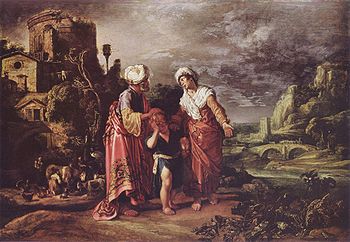 This is the account of Ishmael from
’s first wife, who at that time was known as Sarai
. She and her husband Abram (Abraham), sought a way to have children in order to fulfill the Abrahamic covenant that was established in . Since Sarai had yet to bear Abram a child, her idea was to offer her Egyptian handmaiden Hagar to Abram, so that they could have a child by her. Abram consented to a marital arrangement taking Hagar as his second wife when he was in his late 85th year of age. Customs of that time dictated that, although Hagar was the birth mother, any child conceived would belong to Sarai and Abram (Sarah and Abraham).
describes the naming of Ishmael, and Yahweh
's promise to Hagar concerning Ishmael and his descendants. This occurred at the well of Beer-lahai-roi, located in the desert region between Abram’s settlement and Shur
. Hagar fled here after Sarai dealt harshly with her for showing contempt for her mistress following her having become pregnant. Here, Hagar encountered an angel of Yahweh who instructed her to return and be submissive to Sarai so that she could have her child there. The blessing that this child's father was promised was that Abram's descendants would be as numerous as the dust of the earth. The promise would be extended to this child, who would be named Ishmael. The angel continued that "he shall be a wild ass of a man: his hand shall be against every man, and every man's hand against him; and he shall dwell in the face of all his brethren." When Ishmael was born, Abram was 86 years old.
in a mass circumcision. This occurred because his father Abram was inaugurated as Abraham at the age of 99 and then initiated into the covenant by having himself and his entire household circumcised.
At the time of the covenant, Yahweh informed Abraham that his wife Sarah would give birth to a son, which he was instructed to name Isaac. Yahweh told Abraham that He would establish his covenant through Isaac, and when Abraham inquired as to Ishmael’s role, Yahweh answers that Ishmael has been blessed and that He “will make him fruitful, and will multiply him exceedingly; twelve princes shall he beget, and I will make him a great nation.”
A year later, Ishmael's half-brother Isaac
was born by Abraham to his first wife Sarah.
On the day of feasting during which Abraham celebrated the weaning of Isaac, Ishmael was, “mocking” or "playing with" Isaac (the Hebrew word is ambiguous) and Sarah asked Abraham to expel Ishmael and his mother, saying: "Get rid of that slave woman and her son, for that slave woman's son will never share in the inheritance with my son Isaac." This proposition was grievous to Abraham due to his great love for his son Ishmael. Abraham only agreed when God told him that it was through Isaac that Abraham's offspring would "be reckoned", and that He would "make Ishmael into a nation" too, since he was a descendant of Abraham.
At the age of 14, Ishmael became a free man along with his mother. Under Mesopotamian law, their freedom enjoined them from laying claim to any inheritance that Abraham and Sarah had. The Lord’s covenant also made clear Ishmael was not to inherit Abraham’s house and that Isaac would be the instrument of the covenant. Ishmael's father gave him and his mother a supply of bread and water and sent them away. Hagar strayed in the wilderness of Beer-sheba where the two soon ran out of water and Hagar, not wanting to witness the death of her son, set the boy some distance away from herself, and wept. "And God heard the voice of the lad" and sent his angel to tell Hagar, "Arise, lift up the lad, and hold him in thine hand; for I will make him a great nation." And God "opened her eyes, and she saw a well of water", from which she drew to save Ishmael's life and her own. "And God was with the lad; and he grew, and dwelt in the wilderness, and became an archer."
, where he became an expert in archery
. Eventually, his mother found him a wife from the land of Egypt
. They had 12 sons who became 12 tribal chiefs throughout the regions from Havilah
to Shur
(from Assyria
to the border of Egypt
). His children are listed as follows:
Daughter:
Ishmael also appeared with Isaac at the burial of Abraham. Ishmael died at the age of 137.
places the location and identity of the Ishmaelites as the Arab peoples residing in Arab territories. This is the current view for the majority of the Christian, Islamic and Jewish faiths, though according to Biblical accounts the Arab people traditionally have had long-standing alliances with the descendants of the Assyrians and the Medes. Furthermore, the Arab populations in modernity represent many nations rather than one nation as specified biblically; genetic and historical evidence indicates that (for instance) the Arabs of Lebanon
are the descendants of the Phoenicians (the Biblical Canaanites) and that the Arabs of Palestine, Syria, and Jordan are descended from Canaanites, Aramaeans, and even Hebrews.
s and academics in the fields of linguistics
and source criticism
believe that the stories of Ishmael belong to the three strata of J, or Yahwist source
, the P, or Priestly source
, and the E, or Elohist source (See Documentary hypothesis
). For example, The narration in is of J type and the narration in is of E type.
Islamic traditions consider Ishmael to be the ancestor of Arab
people, excluding Arabs who are descendants of Ya'rub. Arabs who are from Ishmael-descendant tribes are occasionally referred to as "Arabized-Arabs" to highlight their ancestry. The Prophet Muhammad was of these Arabs. However, many modern Arabs also believe their tribes and houses to be of Isaac
's blood line, in particular in Southern Palestine.
Jewish traditions are split between those, like Josephus
, who consider Ishmael the ancestor of the Arabs, and those, like Maimonides
, who believe that the northern Arabs are descended from the sons of Keturah
, whom Abraham married after Sarah's death.
has generally viewed Ishmael as wicked though repentant (Whereas Christianity omits any reference to repentance which is sourced in the Talmud
ic explanation of the Bible
). Judaism maintains that Isaac
rather than Ishmael was the true heir of Abraham.
In some Rabbinic traditions Ishmael is said to have had two wives; one of them named Aisha. This name corresponds to the Muslim tradition for the name of Muhammad's wife. This is understood as a metaphoric representation of the Muslim world (first Arabs and then Turks) with Ishmael.
The name of an important 2nd Century CE sage—Ishmael ben Elisha
, known as "Rabbi Ishmael" (רבי ישמעאל), one of the Tannaim
—indicates that the Bibilical Ishmael enjoyed a positive image among Jews of the time.
Rabbinical commentators in the Midrash
Genesis Rabbah also say that Ishmael's mother Hagar was the Pharaoh's daughter, thereby making Ishmael the grandson of the Pharaoh. This could be why Genesis 17:20 refers to Ishmael as the father of 12 mighty princes. According to Genesis 21:21, Hagar married Ishmael to an Egyptian woman, and if Rabbinical commentators are correct about Hagar being the daughter of the Pharaoh, his marriage to a woman selected by the Pharaoh's daughter could explain how and why his sons became princes.
However, according to other Jewish commentators, Ishmael's mother Hagar is identified with Keturah
, the woman Abraham married after the death of Sarah, stating that Abraham sought her out after Sarah's death. It is suggested that Keturah was Hagar's personal name, and that "Hagar" was a descriptive label meaning "stranger". This interpretation is discussed in the Midrash
and is supported by Rashi
, Gur Aryeh
, Keli Yakar, and Obadiah of Bertinoro. Rashi (Rabbi Shlomo Itzhaki) argues that "Keturah" was a name given to Hagar because her deeds were as beautiful as incense (hence: ketores), and/or that she remained chaste from the time she was separated from Abraham—keturah [ קְטוּרָה Q'turah ] derives from the Aramaic word for restrained.
It is also said that Sarah was motivated by Ishmael's sexually frivolous ways because of the reference to his "making merry" (Gen. 21:9), a translation of the Hebrew word "Mitzachek". This was developed into a reference to idolatry, sexual immorality or even murder; some rabbinic sources claim that Sarah worried that Ishmael would negatively influence Isaac, or that he would demand Isaac's inheritance on the grounds of being the firstborn. Others take a more positive view, emphasizing Hagar's piety, noting that she was "the one who had sat by the well and besought him who is the life of the worlds, saying 'look upon my misery'".
and patriarch
of Islam
. Muslim
s believe that Ishmael was the firstborn of Abraham
, born to him from his second wife Hagar
. Ishmael is recognized by Muslims as the ancestor of several prominent Arab
tribes
and being the forefather of Muhammad
. Muslims also believe that Muhammad was the descendant of Ishmael that would establish a great nation, as promised by God in the Old Testament
.
, often alongside other patriarch
s and prophet
s of ancient times. In XIX: 54, the Qur'an says: "And make mention in the Scripture of Ishmael. He was a keeper of his promise, and he was a messenger, a prophet. He enjoined upon his people worship and almsgiving, and was most acceptable in the sight of his Lord." Later on, in XXXVIII: 48, Ishmael is mentioned together with Elisha
and Dhul-Kifl
as one of "the patiently enduring and righteous, whom God caused to enter into his mercy." It is also said of Lot, Elisha, Jonah
and Ishmael, that God gave each one "preference above the worlds" (VI: 86). These reference to Ishmael are, in each case, part of a larger context in which other holy prophets are mentioned. In other chapters of the Qur'an, however, which date from the Medina period, Ishmael is mentioned closely with his father Abraham
: Ishmael stands alongside Abraham in their attempt to set up the Kaaba
in Mecca
as a place of monotheistic pilgrimage (II: 127-129) and Abraham thanks God
for granting him Ishmael and Isaac
in his old age (XIV: 35-41). Ishmael is further mentioned alongside the patriarchs who had been given revelations (II: 136) and Jacob
's sons promise to follow the faith of their forefathers, "Abraham, Ishmael and Isaac", when testifying their faith (II: 133). In the narrative of the near-sacrifice of Abraham's son (XXXVII: 100-107), the son is not named and, although the general interpretation is that it was Ishmael, Tabari maintained that it was Isaac. Most modern commentators, however, regard the son's identification as least important in a narrative which is given for its moral lesson.
and the numerous collections of Stories of the Prophets
flesh out the Islamic perspective of Ishmael and detail his integral part in setting up the Kaaba
. According to Muslim
tradition
, Ishmael was buried in Al-Hijr
, inside the Sacred Mosque.
In Islamic belief
, Abraham had prayed to God
for a son and God heard his prayer. Muslim
exegesis
states that Sarah
asked Abraham to marry her Egypt
ian handmaiden
Hagar
because she herself was barren. Hagar soon bore Ishmael, who was the first son of Abraham. After Sarah gave birth to her own son, Isaac
, tension arose between the two women. According to exegesis
, God
told Abraham to listen to Sarah, who said that both Hagar and Ishmael should be taken out of their household and into the desert. In Islamic tradition
, Abraham took Hagar and Ishmael to the desert himself, where he left them and returned to his household. In the desert, the young Ishmael cried with thirst. His mother searched for water, which resulted in her running seven times between the Safa and Marwah
hills, before God helped them by making spring water gush forth from the Zamzam well
, so both mother and son could rejuvenate themselves. To commemorate the bravery of Hagar and Ishmael, Muslims run between the Safa and Marwah
hills during Hajj
.
On one of his visits to Mecca
, Abraham
is said to have asked his son to help him build the requested Kaaba
. Islamic traditions hold that the Kaaba was first built by Adam and that Abraham and Ishmael rebuilt the Kaaba on the old foundations. As Ishmael grew up in Arabia, he is said to have become fluent in Arabic. In the genealogical trees that the early scholars drew, Ishmael was considered the ancestor of the Northern Arab
s and Muhammad was linked to him through the lineage of the patriarch
Adnan
.
According to the Genesis account, Ishmael and his mother were expelled at the instigation of Sarah, in order to make sure that Isaac would be Abraham's heir. In the book of Galatians
(4:21–31), Paul
uses the incident "to symbolize the relationship between Judaism, the older but now rejected tradition, and Christianity". In Galatians 4:28–31, Hagar is associated with the Sinai covenant
, while Sarah is associated with the covenant of grace
into which her son Isaac enters.
writings state that it was Ishmael, and not Isaac, who was the son that Abraham almost sacrificed. However, the Bahá'í writings also state that the name is unimportant as either could be used: the importance is that both were symbols of sacrifice. According to Shoghi Effendi
, there has also been another Ishmael, a prophet of Israel
, commonly known as Samuel
.
Hebrew Bible
The Hebrew Bible is a term used by biblical scholars outside of Judaism to refer to the Tanakh , a canonical collection of Jewish texts, and the common textual antecedent of the several canonical editions of the Christian Old Testament...
and the Qur'an
Qur'an
The Quran , also transliterated Qur'an, Koran, Alcoran, Qur’ān, Coran, Kuran, and al-Qur’ān, is the central religious text of Islam, which Muslims consider the verbatim word of God . It is regarded widely as the finest piece of literature in the Arabic language...
, and was Abraham
Abraham
Abraham , whose birth name was Abram, is the eponym of the Abrahamic religions, among which are Judaism, Christianity and Islam...
's first born child according to Jews
Judaism
Judaism ) is the "religion, philosophy, and way of life" of the Jewish people...
, Christians
Christianity
Christianity is a monotheistic religion based on the life and teachings of Jesus as presented in canonical gospels and other New Testament writings...
and Muslims
Islam
Islam . The most common are and . : Arabic pronunciation varies regionally. The first vowel ranges from ~~. The second vowel ranges from ~~~...
. Ishmael was born of Abraham's marriage to Sarah
Sarah
Sarah or Sara was the wife of Abraham and the mother of Isaac as described in the Hebrew Bible and the Quran. Her name was originally Sarai...
's handmaiden Hagar
Hagar (Bible)
Hagar , according to the Abrahamic faiths, was the second wife of Abraham, and the mother of his first son, Ishmael. Her story is recorded in the Book of Genesis, mentioned in Hadith, and alluded to in the Qur'an...
. According to the Genesis account, he died at the age of 137 .
Etymology
Cognates of Hebrew Yishma'el existed in various ancient SemiticSemitic
In linguistics and ethnology, Semitic was first used to refer to a language family of largely Middle Eastern origin, now called the Semitic languages...
cultures, including early Babylonian and Minæan. It is translated literally as "God
El (god)
is a Northwest Semitic word meaning "deity", cognate to Akkadian and then to Hebrew : Eli and Arabic )....
has hearkened", suggesting that "a child so named was regarded as the fulfillment of a divine promise".
Ishmael in Genesis
Birth of Ishmael
In , the birth of Ishmael was planned by the Patriarch AbrahamAbraham
Abraham , whose birth name was Abram, is the eponym of the Abrahamic religions, among which are Judaism, Christianity and Islam...
’s first wife, who at that time was known as Sarai
Sarah
Sarah or Sara was the wife of Abraham and the mother of Isaac as described in the Hebrew Bible and the Quran. Her name was originally Sarai...
. She and her husband Abram (Abraham), sought a way to have children in order to fulfill the Abrahamic covenant that was established in . Since Sarai had yet to bear Abram a child, her idea was to offer her Egyptian handmaiden Hagar to Abram, so that they could have a child by her. Abram consented to a marital arrangement taking Hagar as his second wife when he was in his late 85th year of age. Customs of that time dictated that, although Hagar was the birth mother, any child conceived would belong to Sarai and Abram (Sarah and Abraham).
describes the naming of Ishmael, and Yahweh
Yahweh
Yahweh is the name of God in the Bible, the God of Abraham, Isaac, Jacob, Jews and Christians.The word Yahweh is a modern scholarly convention for the Hebrew , transcribed into Roman letters as YHWH and known as the Tetragrammaton, for which the original pronunciation is unknown...
's promise to Hagar concerning Ishmael and his descendants. This occurred at the well of Beer-lahai-roi, located in the desert region between Abram’s settlement and Shur
Shur (Bible)
Shur is a location mentioned several times in the Hebrew Bible. When Hagar flees from Abraham, the Angel of the Lord find her by a "spring on the way to Shur." .According to Exodus 15:22, Marah is located in the "wilderness of Shur."...
. Hagar fled here after Sarai dealt harshly with her for showing contempt for her mistress following her having become pregnant. Here, Hagar encountered an angel of Yahweh who instructed her to return and be submissive to Sarai so that she could have her child there. The blessing that this child's father was promised was that Abram's descendants would be as numerous as the dust of the earth. The promise would be extended to this child, who would be named Ishmael. The angel continued that "he shall be a wild ass of a man: his hand shall be against every man, and every man's hand against him; and he shall dwell in the face of all his brethren." When Ishmael was born, Abram was 86 years old.
Inheritance rights
When he was 13 years old, Ishmael was circumcised at the same time as all other males in Abraham’s house becoming a part of the covenantBrit milah
The brit milah is a Jewish religious circumcision ceremony performed on 8-day old male infants by a mohel. The brit milah is followed by a celebratory meal .-Biblical references:...
in a mass circumcision. This occurred because his father Abram was inaugurated as Abraham at the age of 99 and then initiated into the covenant by having himself and his entire household circumcised.
At the time of the covenant, Yahweh informed Abraham that his wife Sarah would give birth to a son, which he was instructed to name Isaac. Yahweh told Abraham that He would establish his covenant through Isaac, and when Abraham inquired as to Ishmael’s role, Yahweh answers that Ishmael has been blessed and that He “will make him fruitful, and will multiply him exceedingly; twelve princes shall he beget, and I will make him a great nation.”
A year later, Ishmael's half-brother Isaac
Isaac
Isaac as described in the Hebrew Bible, was the only son Abraham had with his wife Sarah, and was the father of Jacob and Esau. Isaac was one of the three patriarchs of the Israelites...
was born by Abraham to his first wife Sarah.
On the day of feasting during which Abraham celebrated the weaning of Isaac, Ishmael was, “mocking” or "playing with" Isaac (the Hebrew word is ambiguous) and Sarah asked Abraham to expel Ishmael and his mother, saying: "Get rid of that slave woman and her son, for that slave woman's son will never share in the inheritance with my son Isaac." This proposition was grievous to Abraham due to his great love for his son Ishmael. Abraham only agreed when God told him that it was through Isaac that Abraham's offspring would "be reckoned", and that He would "make Ishmael into a nation" too, since he was a descendant of Abraham.
At the age of 14, Ishmael became a free man along with his mother. Under Mesopotamian law, their freedom enjoined them from laying claim to any inheritance that Abraham and Sarah had. The Lord’s covenant also made clear Ishmael was not to inherit Abraham’s house and that Isaac would be the instrument of the covenant. Ishmael's father gave him and his mother a supply of bread and water and sent them away. Hagar strayed in the wilderness of Beer-sheba where the two soon ran out of water and Hagar, not wanting to witness the death of her son, set the boy some distance away from herself, and wept. "And God heard the voice of the lad" and sent his angel to tell Hagar, "Arise, lift up the lad, and hold him in thine hand; for I will make him a great nation." And God "opened her eyes, and she saw a well of water", from which she drew to save Ishmael's life and her own. "And God was with the lad; and he grew, and dwelt in the wilderness, and became an archer."
Descendants
After roaming the wilderness for some time, Ishmael and his mother settled in the Desert of ParanDesert of Paran
The Desert of Paran or Wilderness of Paran , is the place in which the Hebrew Bible says the Israelites spent part of their 40 years of wandering: Then the Israelites set out from the Desert of Sinai and traveled from place to place until the cloud came to rest in the Desert of Paran...
, where he became an expert in archery
Archery
Archery is the art, practice, or skill of propelling arrows with the use of a bow, from Latin arcus. Archery has historically been used for hunting and combat; in modern times, however, its main use is that of a recreational activity...
. Eventually, his mother found him a wife from the land of Egypt
Ancient Egypt
Ancient Egypt was an ancient civilization of Northeastern Africa, concentrated along the lower reaches of the Nile River in what is now the modern country of Egypt. Egyptian civilization coalesced around 3150 BC with the political unification of Upper and Lower Egypt under the first pharaoh...
. They had 12 sons who became 12 tribal chiefs throughout the regions from Havilah
Havilah
Havilah is in several books of the Bible referring to both land and people.The story of the Garden of Eden in Genesis 2:11: "And a river went out of Eden to water the garden; and from thence it was parted, and became into four heads...
to Shur
Shur (Bible)
Shur is a location mentioned several times in the Hebrew Bible. When Hagar flees from Abraham, the Angel of the Lord find her by a "spring on the way to Shur." .According to Exodus 15:22, Marah is located in the "wilderness of Shur."...
(from Assyria
Assyria
Assyria was a Semitic Akkadian kingdom, extant as a nation state from the mid–23rd century BC to 608 BC centred on the Upper Tigris river, in northern Mesopotamia , that came to rule regional empires a number of times through history. It was named for its original capital, the ancient city of Assur...
to the border of Egypt
Egypt
Egypt , officially the Arab Republic of Egypt, Arabic: , is a country mainly in North Africa, with the Sinai Peninsula forming a land bridge in Southwest Asia. Egypt is thus a transcontinental country, and a major power in Africa, the Mediterranean Basin, the Middle East and the Muslim world...
). His children are listed as follows:
- NebaiothNebaiothNebaioth is mentioned at least five times in the Hebrew Bible according to which he was the firstborn son of Ishmael, and the name appears as the name of one of the wilderness tribes mentioned in the Book of Genesis 25:13, and in the Book of Isaiah 60:7.-Biblical occurrences:In the Book of...
- Kedar, father of the QedariteQedariteThe Qedarites were a largely nomadic, ancient Arab tribal confederation...
s, (A northern Arab tribe that controlled the region between the Persian Gulf and the Sinai Peninsula). According to tradition, ancestor of MuhammadMuhammadMuhammad |ligature]] at U+FDF4 ;Arabic pronunciation varies regionally; the first vowel ranges from ~~; the second and the last vowel: ~~~. There are dialects which have no stress. In Egypt, it is pronounced not in religious contexts...
and the Quraysh tribe. - Adbeel, established a tribe in northwest Arabia.
- Mibsam
- Mishma
- DumahDumah (son of Ishmael)Dumah was the sixth son of Ishmael, the son of biblical Abraham and Hagar.-Biblical references:The generations of Ishamel are the ninth recorded in the Book of Genesis...
, associated with Adummatu described as "a fortress of Arabia" in Saudi ArabiaSaudi ArabiaThe Kingdom of Saudi Arabia , commonly known in British English as Saudi Arabia and in Arabic as as-Sa‘ūdiyyah , is the largest state in Western Asia by land area, constituting the bulk of the Arabian Peninsula, and the second-largest in the Arab World...
. - Massa, father of a nomadic tribe that inhabited the Arabian desert toward BabyloniaBabyloniaBabylonia was an ancient cultural region in central-southern Mesopotamia , with Babylon as its capital. Babylonia emerged as a major power when Hammurabi Babylonia was an ancient cultural region in central-southern Mesopotamia (present-day Iraq), with Babylon as its capital. Babylonia emerged as...
. - HadadHadad (Bible)Multiple Biblical characters with the names Hadad or Hadar existed. Ishmael had a son that is referred to by both names; the last king of Edom also has both alternative names. One Hadad ben Bedad was an earlier king of Edom....
- Tema
- Jetur
- Naphish
- Kedemah
Daughter:
- MahalathMahalathMahalath was the third mentioned wife of Esau, a daughter of Ishmael and sister of Nebajoth. Esau took Mahalath from the house of Ishmael to be his wife, after seeing that his Canaanite wives displeased his father, Isaac...
or Basemath, the third wife of EsauEsauEsau , in the Hebrew Bible, is the oldest son of Isaac. He is mentioned in the Book of Genesis, and by the minor prophets, Obadiah and Malachi. The New Testament later references him in the Book of Romans and the Book of Hebrews....
.
Ishmael also appeared with Isaac at the burial of Abraham. Ishmael died at the age of 137.
Deuterocanonical references
The book of JubileesJubilees
The Book of Jubilees , sometimes called Lesser Genesis , is an ancient Jewish religious work, considered one of the pseudepigrapha by Protestant, Roman Catholic, and Eastern Orthodox Churches...
places the location and identity of the Ishmaelites as the Arab peoples residing in Arab territories. This is the current view for the majority of the Christian, Islamic and Jewish faiths, though according to Biblical accounts the Arab people traditionally have had long-standing alliances with the descendants of the Assyrians and the Medes. Furthermore, the Arab populations in modernity represent many nations rather than one nation as specified biblically; genetic and historical evidence indicates that (for instance) the Arabs of Lebanon
Lebanon
Lebanon , officially the Republic of LebanonRepublic of Lebanon is the most common term used by Lebanese government agencies. The term Lebanese Republic, a literal translation of the official Arabic and French names that is not used in today's world. Arabic is the most common language spoken among...
are the descendants of the Phoenicians (the Biblical Canaanites) and that the Arabs of Palestine, Syria, and Jordan are descended from Canaanites, Aramaeans, and even Hebrews.
World views
HistorianHistorian
A historian is a person who studies and writes about the past and is regarded as an authority on it. Historians are concerned with the continuous, methodical narrative and research of past events as relating to the human race; as well as the study of all history in time. If the individual is...
s and academics in the fields of linguistics
Linguistics
Linguistics is the scientific study of human language. Linguistics can be broadly broken into three categories or subfields of study: language form, language meaning, and language in context....
and source criticism
Source criticism
A source criticism is a published source evaluation . An information source may be a document, a person, a speech, a fingerprint, a photo, an observation or anything used in order to obtain knowledge. In relation to a given purpose, a given information source may be more or less valid, reliable or...
believe that the stories of Ishmael belong to the three strata of J, or Yahwist source
Jahwist
The Jahwist, also referred to as the Jehovist, Yahwist, or simply as J, is one of the sources of the Torah. It gets its name from the fact that it characteristically uses the term Yahweh for God in the book of Genesis...
, the P, or Priestly source
Priestly source
The Priestly Source is one of the sources of the Torah/Pentateuch in the bible. Primarily a product of the post-Exilic period when Judah was a province of the Persian empire , P was written to show that even when all seemed lost, God remained present with Israel...
, and the E, or Elohist source (See Documentary hypothesis
Documentary hypothesis
The documentary hypothesis , holds that the Pentateuch was derived from originally independent, parallel and complete narratives, which were subsequently combined into the current form by a series of redactors...
). For example, The narration in is of J type and the narration in is of E type.
Islamic traditions consider Ishmael to be the ancestor of Arab
Arab
Arab people, also known as Arabs , are a panethnicity primarily living in the Arab world, which is located in Western Asia and North Africa. They are identified as such on one or more of genealogical, linguistic, or cultural grounds, with tribal affiliations, and intra-tribal relationships playing...
people, excluding Arabs who are descendants of Ya'rub. Arabs who are from Ishmael-descendant tribes are occasionally referred to as "Arabized-Arabs" to highlight their ancestry. The Prophet Muhammad was of these Arabs. However, many modern Arabs also believe their tribes and houses to be of Isaac
Isaac
Isaac as described in the Hebrew Bible, was the only son Abraham had with his wife Sarah, and was the father of Jacob and Esau. Isaac was one of the three patriarchs of the Israelites...
's blood line, in particular in Southern Palestine.
Jewish traditions are split between those, like Josephus
Josephus
Titus Flavius Josephus , also called Joseph ben Matityahu , was a 1st-century Romano-Jewish historian and hagiographer of priestly and royal ancestry who recorded Jewish history, with special emphasis on the 1st century AD and the First Jewish–Roman War, which resulted in the Destruction of...
, who consider Ishmael the ancestor of the Arabs, and those, like Maimonides
Maimonides
Moses ben-Maimon, called Maimonides and also known as Mūsā ibn Maymūn in Arabic, or Rambam , was a preeminent medieval Jewish philosopher and one of the greatest Torah scholars and physicians of the Middle Ages...
, who believe that the northern Arabs are descended from the sons of Keturah
Keturah
According to the Hebrew Bible, Keturah or Ketura was the woman whom Abraham, the patriarch of the Israelites, married after the death of his wife, Sarah. Keturah bore Abraham six sons, Zimran, Jokshan, Medan, Midian, Ishbak, and Shuah....
, whom Abraham married after Sarah's death.
Jewish views
JudaismJudaism
Judaism ) is the "religion, philosophy, and way of life" of the Jewish people...
has generally viewed Ishmael as wicked though repentant (Whereas Christianity omits any reference to repentance which is sourced in the Talmud
Talmud
The Talmud is a central text of mainstream Judaism. It takes the form of a record of rabbinic discussions pertaining to Jewish law, ethics, philosophy, customs and history....
ic explanation of the Bible
Bible
The Bible refers to any one of the collections of the primary religious texts of Judaism and Christianity. There is no common version of the Bible, as the individual books , their contents and their order vary among denominations...
). Judaism maintains that Isaac
Isaac
Isaac as described in the Hebrew Bible, was the only son Abraham had with his wife Sarah, and was the father of Jacob and Esau. Isaac was one of the three patriarchs of the Israelites...
rather than Ishmael was the true heir of Abraham.
In some Rabbinic traditions Ishmael is said to have had two wives; one of them named Aisha. This name corresponds to the Muslim tradition for the name of Muhammad's wife. This is understood as a metaphoric representation of the Muslim world (first Arabs and then Turks) with Ishmael.
The name of an important 2nd Century CE sage—Ishmael ben Elisha
Ishmael ben Elisha
Rabbi Ishmael or Ishmael ben Elisha was a Tanna of the 1st and 2nd centuries . A Tanna is a rabbinic sage whose views are recorded in the Mishnah.-Disposition:...
, known as "Rabbi Ishmael" (רבי ישמעאל), one of the Tannaim
Tannaim
The Tannaim were the Rabbinic sages whose views are recorded in the Mishnah, from approximately 70-200 CE. The period of the Tannaim, also referred to as the Mishnaic period, lasted about 130 years...
—indicates that the Bibilical Ishmael enjoyed a positive image among Jews of the time.
Rabbinical commentators in the Midrash
Midrash
The Hebrew term Midrash is a homiletic method of biblical exegesis. The term also refers to the whole compilation of homiletic teachings on the Bible....
Genesis Rabbah also say that Ishmael's mother Hagar was the Pharaoh's daughter, thereby making Ishmael the grandson of the Pharaoh. This could be why Genesis 17:20 refers to Ishmael as the father of 12 mighty princes. According to Genesis 21:21, Hagar married Ishmael to an Egyptian woman, and if Rabbinical commentators are correct about Hagar being the daughter of the Pharaoh, his marriage to a woman selected by the Pharaoh's daughter could explain how and why his sons became princes.
However, according to other Jewish commentators, Ishmael's mother Hagar is identified with Keturah
Keturah
According to the Hebrew Bible, Keturah or Ketura was the woman whom Abraham, the patriarch of the Israelites, married after the death of his wife, Sarah. Keturah bore Abraham six sons, Zimran, Jokshan, Medan, Midian, Ishbak, and Shuah....
, the woman Abraham married after the death of Sarah, stating that Abraham sought her out after Sarah's death. It is suggested that Keturah was Hagar's personal name, and that "Hagar" was a descriptive label meaning "stranger". This interpretation is discussed in the Midrash
Midrash
The Hebrew term Midrash is a homiletic method of biblical exegesis. The term also refers to the whole compilation of homiletic teachings on the Bible....
and is supported by Rashi
Rashi
Shlomo Yitzhaki , or in Latin Salomon Isaacides, and today generally known by the acronym Rashi , was a medieval French rabbi famed as the author of a comprehensive commentary on the Talmud, as well as a comprehensive commentary on the Tanakh...
, Gur Aryeh
Judah Loew ben Bezalel
Judah Loew ben Bezalel, alt. Loewe, Löwe, or Levai, widely known to scholars of Judaism as the Maharal of Prague, or simply The MaHaRaL, the Hebrew acronym of "Moreinu ha-Rav Loew," was an important Talmudic scholar, Jewish mystic, and philosopher who served as a leading rabbi in the city of...
, Keli Yakar, and Obadiah of Bertinoro. Rashi (Rabbi Shlomo Itzhaki) argues that "Keturah" was a name given to Hagar because her deeds were as beautiful as incense (hence: ketores), and/or that she remained chaste from the time she was separated from Abraham—keturah [ קְטוּרָה Q'turah ] derives from the Aramaic word for restrained.
It is also said that Sarah was motivated by Ishmael's sexually frivolous ways because of the reference to his "making merry" (Gen. 21:9), a translation of the Hebrew word "Mitzachek". This was developed into a reference to idolatry, sexual immorality or even murder; some rabbinic sources claim that Sarah worried that Ishmael would negatively influence Isaac, or that he would demand Isaac's inheritance on the grounds of being the firstborn. Others take a more positive view, emphasizing Hagar's piety, noting that she was "the one who had sat by the well and besought him who is the life of the worlds, saying 'look upon my misery'".
Islamic view
Ishmael ( Ismā'īl) is recognized as an important prophetProphets of Islam
Muslims identify the Prophets of Islam as those humans chosen by God and given revelation to deliver to mankind. Muslims believe that every prophet was given a belief to worship God and their respective followers believed it as well...
and patriarch
Patriarch
Originally a patriarch was a man who exercised autocratic authority as a pater familias over an extended family. The system of such rule of families by senior males is called patriarchy. This is a Greek word, a compound of πατριά , "lineage, descent", esp...
of Islam
Islam
Islam . The most common are and . : Arabic pronunciation varies regionally. The first vowel ranges from ~~. The second vowel ranges from ~~~...
. Muslim
Muslim
A Muslim, also spelled Moslem, is an adherent of Islam, a monotheistic, Abrahamic religion based on the Quran, which Muslims consider the verbatim word of God as revealed to prophet Muhammad. "Muslim" is the Arabic term for "submitter" .Muslims believe that God is one and incomparable...
s believe that Ishmael was the firstborn of Abraham
Abraham
Abraham , whose birth name was Abram, is the eponym of the Abrahamic religions, among which are Judaism, Christianity and Islam...
, born to him from his second wife Hagar
Hagar
-People:* Hagar , handmaid of Sarah and mother of Abraham's son Ishmael* Hagar Finer, Israeli WIBF bantamweight champion* Albert Hagar, Canadian politician* Mandy Hagar, New Zealand children's author...
. Ishmael is recognized by Muslims as the ancestor of several prominent Arab
Arab
Arab people, also known as Arabs , are a panethnicity primarily living in the Arab world, which is located in Western Asia and North Africa. They are identified as such on one or more of genealogical, linguistic, or cultural grounds, with tribal affiliations, and intra-tribal relationships playing...
tribes
Tribes of Arabia
Tribes of Arabia refers to Arab clans hailing from the Arabian Peninsula.Much of the lineage provided before Ma'ad relies on biblical genealogy and therefore questions persist concerning the accuracy of this segment of Arab genealogy...
and being the forefather of Muhammad
Muhammad
Muhammad |ligature]] at U+FDF4 ;Arabic pronunciation varies regionally; the first vowel ranges from ~~; the second and the last vowel: ~~~. There are dialects which have no stress. In Egypt, it is pronounced not in religious contexts...
. Muslims also believe that Muhammad was the descendant of Ishmael that would establish a great nation, as promised by God in the Old Testament
Old Testament
The Old Testament, of which Christians hold different views, is a Christian term for the religious writings of ancient Israel held sacred and inspired by Christians which overlaps with the 24-book canon of the Masoretic Text of Judaism...
.
Ishmael in the Qur'an
Ishmael is mentioned over ten times in the Qur'anQur'an
The Quran , also transliterated Qur'an, Koran, Alcoran, Qur’ān, Coran, Kuran, and al-Qur’ān, is the central religious text of Islam, which Muslims consider the verbatim word of God . It is regarded widely as the finest piece of literature in the Arabic language...
, often alongside other patriarch
Patriarch
Originally a patriarch was a man who exercised autocratic authority as a pater familias over an extended family. The system of such rule of families by senior males is called patriarchy. This is a Greek word, a compound of πατριά , "lineage, descent", esp...
s and prophet
Prophet
In religion, a prophet, from the Greek word προφήτης profitis meaning "foreteller", is an individual who is claimed to have been contacted by the supernatural or the divine, and serves as an intermediary with humanity, delivering this newfound knowledge from the supernatural entity to other people...
s of ancient times. In XIX: 54, the Qur'an says: "And make mention in the Scripture of Ishmael. He was a keeper of his promise, and he was a messenger, a prophet. He enjoined upon his people worship and almsgiving, and was most acceptable in the sight of his Lord." Later on, in XXXVIII: 48, Ishmael is mentioned together with Elisha
Elisha
Elisha is a prophet mentioned in the Hebrew Bible and the Qur'an. His name is commonly transliterated into English as Elisha via Hebrew, Eliseus via Greek and Latin, or Alyasa via Arabic.-Biblical biography:...
and Dhul-Kifl
Dhul-Kifl
Dhul-Kifl, or Zul-Kifl, , is an Islamic prophet who has been identified with various Hebrew Bible prophets, most commonly Ezekiel. It is believed that he lived for roughly 75 years and that he preached in what is modern day Iraq...
as one of "the patiently enduring and righteous, whom God caused to enter into his mercy." It is also said of Lot, Elisha, Jonah
Jonah
Jonah is the name given in the Hebrew Bible to a prophet of the northern kingdom of Israel in about the 8th century BC, the eponymous central character in the Book of Jonah, famous for being swallowed by a fish or a whale, depending on translation...
and Ishmael, that God gave each one "preference above the worlds" (VI: 86). These reference to Ishmael are, in each case, part of a larger context in which other holy prophets are mentioned. In other chapters of the Qur'an, however, which date from the Medina period, Ishmael is mentioned closely with his father Abraham
Abraham
Abraham , whose birth name was Abram, is the eponym of the Abrahamic religions, among which are Judaism, Christianity and Islam...
: Ishmael stands alongside Abraham in their attempt to set up the Kaaba
Kaaba
The Kaaba is a cuboid-shaped building in Mecca, Saudi Arabia, and is the most sacred site in Islam. The Qur'an states that the Kaaba was constructed by Abraham, or Ibraheem, in Arabic, and his son Ishmael, or Ismaeel, as said in Arabic, after he had settled in Arabia. The building has a mosque...
in Mecca
Mecca
Mecca is a city in the Hijaz and the capital of Makkah province in Saudi Arabia. The city is located inland from Jeddah in a narrow valley at a height of above sea level...
as a place of monotheistic pilgrimage (II: 127-129) and Abraham thanks God
God
God is the English name given to a singular being in theistic and deistic religions who is either the sole deity in monotheism, or a single deity in polytheism....
for granting him Ishmael and Isaac
Isaac
Isaac as described in the Hebrew Bible, was the only son Abraham had with his wife Sarah, and was the father of Jacob and Esau. Isaac was one of the three patriarchs of the Israelites...
in his old age (XIV: 35-41). Ishmael is further mentioned alongside the patriarchs who had been given revelations (II: 136) and Jacob
Jacob
Jacob "heel" or "leg-puller"), also later known as Israel , as described in the Hebrew Bible, the Talmud, the New Testament and the Qur'an was the third patriarch of the Hebrew people with whom God made a covenant, and ancestor of the tribes of Israel, which were named after his descendants.In the...
's sons promise to follow the faith of their forefathers, "Abraham, Ishmael and Isaac", when testifying their faith (II: 133). In the narrative of the near-sacrifice of Abraham's son (XXXVII: 100-107), the son is not named and, although the general interpretation is that it was Ishmael, Tabari maintained that it was Isaac. Most modern commentators, however, regard the son's identification as least important in a narrative which is given for its moral lesson.
Ishmael in Muslim literature
The commentaries on the Qur'anQur'an
The Quran , also transliterated Qur'an, Koran, Alcoran, Qur’ān, Coran, Kuran, and al-Qur’ān, is the central religious text of Islam, which Muslims consider the verbatim word of God . It is regarded widely as the finest piece of literature in the Arabic language...
and the numerous collections of Stories of the Prophets
Stories of The Prophets
Stories of The Prophets or Qasas al-anbiya is a famous work of Islamic literature, written by the Muslim scholar Ibn Kathir. In the book, Kathir has compiled all accounts of information regarding various prophets and messengers through Islamic history...
flesh out the Islamic perspective of Ishmael and detail his integral part in setting up the Kaaba
Kaaba
The Kaaba is a cuboid-shaped building in Mecca, Saudi Arabia, and is the most sacred site in Islam. The Qur'an states that the Kaaba was constructed by Abraham, or Ibraheem, in Arabic, and his son Ishmael, or Ismaeel, as said in Arabic, after he had settled in Arabia. The building has a mosque...
. According to Muslim
Muslim
A Muslim, also spelled Moslem, is an adherent of Islam, a monotheistic, Abrahamic religion based on the Quran, which Muslims consider the verbatim word of God as revealed to prophet Muhammad. "Muslim" is the Arabic term for "submitter" .Muslims believe that God is one and incomparable...
tradition
Tradition
A tradition is a ritual, belief or object passed down within a society, still maintained in the present, with origins in the past. Common examples include holidays or impractical but socially meaningful clothes , but the idea has also been applied to social norms such as greetings...
, Ishmael was buried in Al-Hijr
Al-Hijr
Sura Al-Hijr is the 15th sura of the Qur'an. It has 99 ayat. It is a Makkan sura believed to have been received by Muhammad shortly after the 12th sura , Muhammad's last year in Mecca. Like the other sura of this period it praises God....
, inside the Sacred Mosque.
In Islamic belief
Islamic theology
Islamic theology is a branch of Islamic studies regarding the beliefs associated with the Islamic faith. Any religious belief system, or creed, can be considered an example of aqidah. However, this term has taken a significant technical usage in Islamic history and theology, denoting those...
, Abraham had prayed to God
God
God is the English name given to a singular being in theistic and deistic religions who is either the sole deity in monotheism, or a single deity in polytheism....
for a son and God heard his prayer. Muslim
Muslim
A Muslim, also spelled Moslem, is an adherent of Islam, a monotheistic, Abrahamic religion based on the Quran, which Muslims consider the verbatim word of God as revealed to prophet Muhammad. "Muslim" is the Arabic term for "submitter" .Muslims believe that God is one and incomparable...
exegesis
Exegesis
Exegesis is a critical explanation or interpretation of a text, especially a religious text. Traditionally the term was used primarily for exegesis of the Bible; however, in contemporary usage it has broadened to mean a critical explanation of any text, and the term "Biblical exegesis" is used...
states that Sarah
Sarah
Sarah or Sara was the wife of Abraham and the mother of Isaac as described in the Hebrew Bible and the Quran. Her name was originally Sarai...
asked Abraham to marry her Egypt
Egypt
Egypt , officially the Arab Republic of Egypt, Arabic: , is a country mainly in North Africa, with the Sinai Peninsula forming a land bridge in Southwest Asia. Egypt is thus a transcontinental country, and a major power in Africa, the Mediterranean Basin, the Middle East and the Muslim world...
ian handmaiden
Handmaiden
A handmaiden is a female attendant, assistant, domestic worker , or slave.-Religion:Norse goddesses had handmaidens, . The biblical Mary referred to herself as "the handmaid of the Lord" in acceptance of becoming pregnant by the Holy Ghost.A man might use a handmaiden as a concubine to bear his...
Hagar
Hagar
-People:* Hagar , handmaid of Sarah and mother of Abraham's son Ishmael* Hagar Finer, Israeli WIBF bantamweight champion* Albert Hagar, Canadian politician* Mandy Hagar, New Zealand children's author...
because she herself was barren. Hagar soon bore Ishmael, who was the first son of Abraham. After Sarah gave birth to her own son, Isaac
Isaac
Isaac as described in the Hebrew Bible, was the only son Abraham had with his wife Sarah, and was the father of Jacob and Esau. Isaac was one of the three patriarchs of the Israelites...
, tension arose between the two women. According to exegesis
Exegesis
Exegesis is a critical explanation or interpretation of a text, especially a religious text. Traditionally the term was used primarily for exegesis of the Bible; however, in contemporary usage it has broadened to mean a critical explanation of any text, and the term "Biblical exegesis" is used...
, God
God
God is the English name given to a singular being in theistic and deistic religions who is either the sole deity in monotheism, or a single deity in polytheism....
told Abraham to listen to Sarah, who said that both Hagar and Ishmael should be taken out of their household and into the desert. In Islamic tradition
Tradition
A tradition is a ritual, belief or object passed down within a society, still maintained in the present, with origins in the past. Common examples include holidays or impractical but socially meaningful clothes , but the idea has also been applied to social norms such as greetings...
, Abraham took Hagar and Ishmael to the desert himself, where he left them and returned to his household. In the desert, the young Ishmael cried with thirst. His mother searched for water, which resulted in her running seven times between the Safa and Marwah
Al-Safa and Al-Marwah
Al-Safa and Al-Marwah are two small mountains now located in the Masjid al-Haram in Mecca, Saudi Arabia between which Muslims travel back and forth seven times during the ritual pilgrimages of Hajj and Umrah.-History:...
hills, before God helped them by making spring water gush forth from the Zamzam well
Zamzam Well
The Well of Zamzam is a well located within the Masjid al-Haram in Mecca, Saudi Arabia, east of the Kaaba, the holiest place in Islam...
, so both mother and son could rejuvenate themselves. To commemorate the bravery of Hagar and Ishmael, Muslims run between the Safa and Marwah
Al-Safa and Al-Marwah
Al-Safa and Al-Marwah are two small mountains now located in the Masjid al-Haram in Mecca, Saudi Arabia between which Muslims travel back and forth seven times during the ritual pilgrimages of Hajj and Umrah.-History:...
hills during Hajj
Hajj
The Hajj is the pilgrimage to Mecca, Saudi Arabia. It is one of the largest pilgrimages in the world, and is the fifth pillar of Islam, a religious duty that must be carried out at least once in their lifetime by every able-bodied Muslim who can afford to do so...
.
On one of his visits to Mecca
Mecca
Mecca is a city in the Hijaz and the capital of Makkah province in Saudi Arabia. The city is located inland from Jeddah in a narrow valley at a height of above sea level...
, Abraham
Abraham
Abraham , whose birth name was Abram, is the eponym of the Abrahamic religions, among which are Judaism, Christianity and Islam...
is said to have asked his son to help him build the requested Kaaba
Kaaba
The Kaaba is a cuboid-shaped building in Mecca, Saudi Arabia, and is the most sacred site in Islam. The Qur'an states that the Kaaba was constructed by Abraham, or Ibraheem, in Arabic, and his son Ishmael, or Ismaeel, as said in Arabic, after he had settled in Arabia. The building has a mosque...
. Islamic traditions hold that the Kaaba was first built by Adam and that Abraham and Ishmael rebuilt the Kaaba on the old foundations. As Ishmael grew up in Arabia, he is said to have become fluent in Arabic. In the genealogical trees that the early scholars drew, Ishmael was considered the ancestor of the Northern Arab
Arab
Arab people, also known as Arabs , are a panethnicity primarily living in the Arab world, which is located in Western Asia and North Africa. They are identified as such on one or more of genealogical, linguistic, or cultural grounds, with tribal affiliations, and intra-tribal relationships playing...
s and Muhammad was linked to him through the lineage of the patriarch
Patriarch
Originally a patriarch was a man who exercised autocratic authority as a pater familias over an extended family. The system of such rule of families by senior males is called patriarchy. This is a Greek word, a compound of πατριά , "lineage, descent", esp...
Adnan
Adnan
Adnan is the traditional ancestor of the Adnani Arabs of northern, central and western Arabia, as opposed to the Qahtani of Southern and south eastern Arabia who descend from Qahtan.-Origin:...
.
Christian view
In some Christian biblical interpretations, Ishmael is used to symbolize the older—now rejected—Judaic tradition; Isaac symbolizes the new tradition of Christianity.According to the Genesis account, Ishmael and his mother were expelled at the instigation of Sarah, in order to make sure that Isaac would be Abraham's heir. In the book of Galatians
Epistle to the Galatians
The Epistle of Paul to the Galatians, often shortened to Galatians, is the ninth book of the New Testament. It is a letter from Paul of Tarsus to a number of Early Christian communities in the Roman province of Galatia in central Anatolia...
(4:21–31), Paul
Paul of Tarsus
Paul the Apostle , also known as Saul of Tarsus, is described in the Christian New Testament as one of the most influential early Christian missionaries, with the writings ascribed to him by the church forming a considerable portion of the New Testament...
uses the incident "to symbolize the relationship between Judaism, the older but now rejected tradition, and Christianity". In Galatians 4:28–31, Hagar is associated with the Sinai covenant
Mosaic Covenant
The Mosaic Covenant or Sinaitic Covenant are terms used for the biblical covenant between God and the Israelites...
, while Sarah is associated with the covenant of grace
Covenant Theology
Covenant theology is a conceptual overview and interpretive framework for understanding the overall flow of the Bible...
into which her son Isaac enters.
Bahá'í faith
The Bahá'íBahá'í Faith
The Bahá'í Faith is a monotheistic religion founded by Bahá'u'lláh in 19th-century Persia, emphasizing the spiritual unity of all humankind. There are an estimated five to six million Bahá'ís around the world in more than 200 countries and territories....
writings state that it was Ishmael, and not Isaac, who was the son that Abraham almost sacrificed. However, the Bahá'í writings also state that the name is unimportant as either could be used: the importance is that both were symbols of sacrifice. According to Shoghi Effendi
Shoghi Effendi
Shoghí Effendí Rabbání , better known as Shoghi Effendi, was the Guardian and appointed head of the Bahá'í Faith from 1921 until his death in 1957...
, there has also been another Ishmael, a prophet of Israel
Israel
The State of Israel is a parliamentary republic located in the Middle East, along the eastern shore of the Mediterranean Sea...
, commonly known as Samuel
Samuel
Samuel is a leader of ancient Israel in the Books of Samuel in the Hebrew Bible. He is also known as a prophet and is mentioned in the Qur'an....
.
External links
- Genealogy from Adam to the Twelve Tribes
- Ishmael in Islam
- The Jewish Encyclopedia: Ishmael.
- Biographical Study on Ishmael
- Ishmael in Bahá'í Faith
See also
- AbrahamAbrahamAbraham , whose birth name was Abram, is the eponym of the Abrahamic religions, among which are Judaism, Christianity and Islam...
- Biblical narratives and the Qur'anBiblical narratives and the Qur'anThe Qur'an, the central religious text of Islam, contains references to over fifty people and events also found in the Bible. While the stories told in each book are generally comparable in most respects, important differences sometimes emerge....
- IsaacIsaacIsaac as described in the Hebrew Bible, was the only son Abraham had with his wife Sarah, and was the father of Jacob and Esau. Isaac was one of the three patriarchs of the Israelites...
- Legends and the Qur'anLegends and the Qur'anThis article considers the relation of the Qur'an, the central religious text of Islam, and pre-Islamic mythology and legends.Early in Islamic history, debates over the role of Jewish mythology, as well as Christian Biblical apocrypha references in the Qur'an, the sacred text of Islam, existed...
- List of names referring to El
- Prophets of IslamProphets of IslamMuslims identify the Prophets of Islam as those humans chosen by God and given revelation to deliver to mankind. Muslims believe that every prophet was given a belief to worship God and their respective followers believed it as well...
- Stories of The ProphetsStories of The ProphetsStories of The Prophets or Qasas al-anbiya is a famous work of Islamic literature, written by the Muslim scholar Ibn Kathir. In the book, Kathir has compiled all accounts of information regarding various prophets and messengers through Islamic history...