
In Depth
See Also

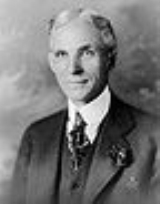
Henry Ford

Henry Ford was the founder of the Ford Motor Company Ford Motor Company

Ford Motor Company is an American [i] multinational corporation [i] and one of the largest ... 

 and father of the modern assembly line Assembly line

... 

 used in mass production. His introduction of the Model T Ford Model T

The Ford Model T was an automobile [i] produced by Henry Ford [i]'s Ford Motor Company [i] from 1908 thr ... 

 automobile revolutionized transportation and American industry. As sole owner of the Ford Company he became one of the richest and best-known people in the world. He is credited with "Fordism", that is, the mass production of large numbers of inexpensive automobiles using the assembly line, coupled with high wages for his workers--notably the $5 a day pay scale adopted in 1914. Ford, though poorly educated, had a global vision, with consumerism as the key to peace.

Discussions

  Discussion Features

   Ask a question about 'Henry Ford'

   Start a new discussion about 'Henry Ford'

   Answer questions about 'Henry Ford'

   'Henry Ford' discussion forum

Timeline

1863   Born

1908   Henry Ford produces his first Model T Ford Model T

The Ford Model T was an automobile [i] produced by Henry Ford [i]'s Ford Motor Company [i] from 1908 thr ... 

 automobile.

1947   Died


Quotations

An idealist is a person who helps other people to be prosperous.

Remarks, July 1919, to a court in Mount Clemens, Michigan.

History is more or less bunk. It's tradition. We don't want tradition. We want to live in the present and the only history that is worth a tinker's damn is the history we make today.

Interview in Chicago Tribune (May 25, 1916)

       More Quotes >>


Encyclopedia


Henry Ford was the founder of the Ford Motor Company Ford Motor Company

Ford Motor Company is an American [i] multinational corporation [i] and one of the largest ... 

 and father of the modern assembly line Assembly line

... 

 used in mass production. His introduction of the Model T Ford Model T

The Ford Model T was an automobile [i] produced by Henry Ford [i]'s Ford Motor Company [i] from 1908 thr ... 

 automobile revolutionized transportation and American industry. As sole owner of the Ford Company he became one of the richest and best-known people in the world. He is credited with "Fordism", that is, the mass production of large numbers of inexpensive automobiles using the assembly line, coupled with high wages for his workers--notably the $5 a day pay scale adopted in 1914. Ford, though poorly educated, had a global vision, with consumerism as the key to peace. He was a leading pacifist in World War I World War I

World War I, also known as the First World War, the Great War and "The War to End All War... 

, but turned his company into a major producer of war materials in both world wars. His intense commitment to lowering costs resulted in numerous experiments and innovations, as well as the franchise system that put a dealership in every city in North America, and in major cities on six continents. However arch-rival General Motors General Motors

General Motors Corporation, also known as GM, is the world's largest automaker [i] ... 

 jumped ahead in the 1920s by offering far more options to consumers in terms of power, prestige, styling, and convenient financing plans. Ford left most of his vast wealth to the Ford Foundation, but arranged for his family to control the company permanently.

Early life


Ford was born on a prosperous farm in Springwells Township owned by his parents, William Ford and Mary Litogot , immigrants from County Cork County Cork

County Cork is the most southwesterly and the largest of the modern counties of Republic of Ireland [i] ... 

, Ireland Ireland

Ireland is the third largest [i] island [i] in Europe [i]. ... 

. The Ford family has its origins in western England - the family was evicted from their land in Somerset Somerset

Somerset is a county [i] in the south-west of England [i]. ... 

 and 'planted' in Ireland. His siblings include: Margaret Ford ; Jane Ford ; William Ford and Robert Ford .

During the summer of 1873, Henry saw his first self-propelled road machine, a stationary steam engine that could be used for threshing or to power a saw mill. The operator, Fred Reden, had mounted it on wheels connected with a drive chain. Henry was fascinated with the machine and Reden over the next year taught Henry how to fire and operate the engine. Ford later said, it was this experience "that showed me that I was by instinct an engineer."

Henry took this passion about mechanics into his home. His father had given him a pocket watch in his early teens. By fifteen, he had a reputation as a watch repairman, having dismantled and reassembled timepieces of friends and neighbors dozens of times.

His mother died in 1876. It was a blow that devastated little Henry. His father expected Henry to eventually take over the family farm, but Henry despised farm work. And with his mother dead, little remained to keep him on the farm. He later said, "I never had any particular love for the farm. It was the mother on the farm I loved."

In 1879, he left home for the nearby city of Detroit Detroit, Michigan

Detroit is the largest city in the U.S. state [i] of Michigan [i] and the seat [i] of Wayne County [i] ... 

 to work as an apprentice machinist, first with James F. Flower & Bros., and later with the Detroit Dry Dock Co. In 1882, he returned to Dearborn to work on the family farm and became adept at operating the Westinghouse portable steam engine. This led to his being hired by Westinghouse Westinghouse Electric (1886)

----
The Westinghouse Electric Corporation was an organization founded by George Westinghouse [i] in 1886 [i]... 

 company to service their steam engines.

Upon his marriage to Clara Bryant in 1888, Ford supported himself by farming and running a sawmill. They had a single child: Edsel Bryant Ford .

In 1891, Ford became an engineer with the Edison Illuminating Company, and after his promotion to Chief Engineer in 1893, he had enough time and money to devote attention to his personal experiments on gasoline engines. These experiments culminated in 1896 with the completion of his own self-propelled vehicle named the Quadricycle Quadricycle

Quadricycle is a four-wheeled vehicle [i]. ... 

, which he test-drove on June 4 of that year. After various test-drives, Henry Ford brainstormed ways to improve the Quadricycle.

In 1894, Ford also became a Freemason Freemasonry

Freemasonry is a fraternal organization [i] whose membership is held together by shared moral [i] ... 

, joining Palestine Lodge #357 in Detroit.

Detroit Automobile Company and The Henry Ford Company


After this initial success, Ford came to Edison Illuminating in 1899 with other investors, and they formed the Detroit Automobile Company. The Company soon went bankrupt because Ford continued to improve the design, instead of selling cars. He raced his car against those of other manufacturers to show the superiority of his designs. With his interest in race cars, he formed the Henry Ford Company.

During this period, he personally drove one of his cars to victory in a race against Alexander Winton Winton Motor Carriage Company

The Winton Motor Carriage Company of Cleveland, Ohio [i] was a pioneer United States [i] automobile [i] ... 

 on October 10, 1901. In 1902, Ford continued to work on his race car to the dismay of the investors. They wanted a high-end production model and brought in Henry M. Leland Henry M. Leland

Henry M. Leland was a machinist, inventor, engineer and automotive entrepreneur.
... 

 to do it. Ford resigned over this usurpation of his authority. He said later that "I resigned, determined never again to put myself under orders." The company was reorganized as Cadillac.

Ford Motor Company

At age 40, Ford, with 11 other investors and $28,000 in capital, incorporated the Ford Motor Company Ford Motor Company

Ford Motor Company is an American [i] multinational corporation [i] and one of the largest ... 

 in 1903. In a newly-designed car, Ford drove an exhibition in which the car covered the distance of a mile on the ice of Lake St. Clair in 39.4 seconds, which was a new land speed record Land speed record

The land speed record is the fastest speed achieved by a vehicle on land, as opposed to one on water or ... 

. Convinced by this success, the famous race driver Barney Oldfield Barney Oldfield

Bern "Barney" Eli Oldfield was an automobile [i] racer and pioneer. ... 

, who named this new Ford model "999" in honor of a racing locomotive of the day, took the car around the country and thereby made the Ford brand known throughout the United States. Ford was also one of the early backers of the Indianapolis 500 Indianapolis 500

The Indianapolis 500-Mile Race, often shortened to Indianapolis 500 or Indy 500, is an American [i] ... 

.

Ford astonished the world in 1914 by offering a $5 a day wage that more than doubled the rate of most of his workers. The move proved hugely profitable. Instead of constant turnover of employees, the best mechanics in Detroit flocked to Ford, bringing in their human capital and expertise, raising productivity, and lowering training costs. Ford called it 'wage motive.' The company's use of vertical integration also proved successful, as Ford built a gigantic factory that shipped in raw materials and shipped out finished automobiles.

The Model T

The Model T Ford Model T

The Ford Model T was an automobile [i] produced by Henry Ford [i]'s Ford Motor Company [i] from 1908 thr ... 

 was introduced on October 1, 1908. It had many important innovations--such as the steering wheel on the left, which every other company soon copied. The entire engine and transmission were enclosed; the 4 cylinders were cast in a solid block; the suspension used two semi-elliptic springs. The car was very simple to drive, and--more important--easy and cheap to repair. It was so cheap at $825 in 1908 that by the 1920s a majority of American drivers learned to drive on the Model T, leaving fond memories for millions. Ford created a massive publicity machine in Detroit to ensure every newspaper carried stories and ads about the new product. Ford's network of local dealers made the car ubiquitous in virtually every city in North America. As independent dealers the franchises grew rich and publicized not just the Ford but the very concept of automobiling; local motor clubs sprang up to help new drivers and to explore the countryside. Ford was always eager to sell to farmers, who looked on the vehicle as a commercial device to help their business. Sales skyrocketed--several years posted 100+% gains on the previous year. Always on the hunt for more efficiency and lower costs, in 1913 Ford introduced the moving assembly belts into his plants, which enabled an enormous increase in production. Sales passed 250,000 in 1914. Although Henry Ford is often credited with the idea, contemporary sources indicate that the concept and its development came from employees Clarence Avery, Peter E. Martin, Charles E. Sorensen, and C.H. Wills. By 1916, as the price dropped to $360 for the basic touring car, sales reached 472,000.


By 1918, half of all cars in America were Model T's. As Ford wrote in his autobiography, "Any customer can have a car painted any colour that he wants so long as it is black". Until the development of the assembly line which mandated black because of its quicker drying time, Model Ts were available in other colors including red. The design was fervently promoted and defended by Henry Ford, and production continued as late as 1927; the final total production was exactly 15,000,000. This was a record which stood for the next 45 years.

In 1918 President Woodrow Wilson Woodrow Wilson

Thomas Woodrow Wilson was the 28th President of the United States [i] . ... 

 personally asked Ford to run for the Senate from Michigan as a Democrat. Although the nation was at war Ford ran as a peace candidate and a strong supporter of the proposed League of Nations League of Nations

The League of Nations was an international organization [i] founded after the Paris Peace Conference of 1919 [i] ... 

. Ford lost by 1%. . In December 1918 Henry Ford turned the presidency of Ford Motor Company over to his son Edsel Ford. Henry, however, retained final decision authority and sometimes reversed his son. Henry and Edsel purchased all remaining stock from other investors, thus giving the family sole ownership of the company.

By the mid-1920s, sales of the Model T began to decline due to rising competition. Other auto makers offered payment plans through which consumers could buy their cars, which usually included more modern mechanical features and styling not available with the Model T. Despite urgings from Edsel, Henry steadfastly refused to incorporate new features into the Model T or to form a customer credit plan.

The "Model A" and Ford's Later Career


Death of Edsel Ford

In May 1943, Edsel Ford died, leaving a vacancy in the company presidency. Henry Ford advocated long-time associate Harry Bennett to take the spot. Edsel's widow Eleanor, who had inherited Edsel's voting stock, wanted her son Henry Ford II Henry Ford II

Henry Ford II, commonly known as "Hank the Deuce," was the son of Edsel Ford [i] and grandson of Henry Ford [i] ... 

 to take over the position. The issue was settled for a period when Henry himself, at age 79, took over the presidency personally. Henry Ford II was released from the Navy and became an executive vice president, while Harry Bennett had a seat on the board and was responsible for personnel, labor relations, and public relations.

The company saw hard times during the next two years, losing $10 million a month. By 1945, Henry Ford's senility was quite evident, and his wife and daughter-in-law forced his resignation in favor of his grandson, Henry Ford II.

Ford's labor philosophy

Henry Ford was a pioneer of "welfare capitalism" designed to improve the lot of his workers and especially to reduce the heavy turnover that had many departments hiring 300 men a year to fill 100 slots. Efficiency meant hiring and keeping the best workers. On January 5, 1914, Ford announced his five-dollar a day program. The revolutionary program called for a reduction in length of the workday from 9 to 8 hours, a 5 day work week, and a raise in minimum daily pay from $2.34 to $5 for qualifying workers.

Ford had been criticized by Wall Street for starting the 40 hour work week and a minimum wage. He proved, however, that paying people more would enable Ford workers to afford the cars they were producing, and therefore be good for the economy. Ford labeled the increased compensation as profit-sharing rather than wages. The wage was offered to men over age 22, who had worked at the company for 6 months or more, and, importantly, conducted their lives in a manner of which Ford's "Sociological Department" approved. They frowned on heavy drinking and gambling. The Sociological Department used 150 investigators and support staff to maintain employee standards; a large percentage of workers were able to qualify for the profit-sharing.

Ford was adamantly against labor unions Trade union

"A Trade Union , ... is a continuous association of wage-earners for the purpose of maintaining or imp... 

 in his plants. To forestall union activity, he promoted Harry Bennett, a former Navy boxer, to be the head of the Service Department. Bennett employed various intimidation tactics to squash union organizing. The most famous incident, in 1937, was a bloody brawl between company security men and organizers that became known as The Battle of the Overpass.

Ford was the last Detroit automaker to recognize the United Auto Workers United Auto Workers

The United Auto Workers, officially the United Automobile, Aerospace & Agricultural Implement Worker... 

 union . A sit-down strike by the UAW union in April 1941 closed the River Rouge Plant River Rouge Plant

The River Rouge Plant is a Ford Motor Company [i] automobile [i] factory complex located in Dearborn, Michigan [i] ... 

. Under pressure from Edsel and his wife, Clara, Henry Ford finally agreed to collective bargaining at Ford plants, and the first contract with the UAW was signed in June 1941.

Ford Airplane Company

Ford, like other automobile companies, entered the aviation business during World War I World War I

World War I, also known as the First World War, the Great War and "The War to End All War... 

, building Liberty engines. After the war, it returned to auto manufacturing until 1925, when Henry Ford acquired the Stout Metal Airplane Company.


Ford's most successful aircraft was the Ford 4AT Trimotor—called the “Tin Goose” because of its corrugated metal construction. It used a new alloy called Alclad that combined the corrosion resistance of aluminum with the strength of duralumin. The plane was similar to Fokker Fokker

Fokker was a Dutch [i] aircraft manufacturer [i] named after its founder, Anthony Fokker [i] ... 

's V.VII-3m, and some say that Ford's engineers surreptitiously measured the Fokker plane and then copied it. The Trimotor first flew on June 11, 1926, and was the first successful U.S. passenger airliner, accommodating about 12 passengers in a rather uncomfortable fashion. Several variants were also used by the U.S. Army. About 200 Trimotors were built before it was discontinued in 1933, when the Ford Airplane Division shut down because of poor sales due to the Depression.

Peace ship

In 1915, he funded a trip to Europe, where World War I was raging, for himself and about 170 other prominent peace leaders. He talked to President Wilson about the trip but had no government support. His group went to neutral Sweden and the Netherlands to meet with peace activists there. Ford, the target of much ridicule, left the ship as soon as it reached Sweden.

An article G. K. Chesterton G. K. Chesterton

Gilbert Keith Chesterton was an influential English [i] writer of the early 20th century. ... 

 wrote for the December 11, 1915 issue of Illustrated London News, shows why Ford's effort was ridiculed. Referring to Ford as "the celebrated American comedian," Chesterton noted that Ford had been quoted claiming, "I believe that the sinking of the Lusitania RMS Lusitania

The RMS [i] Lusitania was a British [i] ocean liner [i] owned by th ... 

was deliberately planned to get this country America United States

The United States of America, also known as the United States, the U.S., the U.S.A., a... 

 into war. It was planned by the financiers of war." Chesterton expressed "difficulty in believing that bankers swim under the sea to cut holes in the bottoms of ships," and asked why, if what Ford said was true, Germany took responsibility for the sinking and "defended what it did not do." Mr. Ford's efforts, he concluded, "queer the pitch" of "more plausible and presentable" pacifists.

Allegations of anti-Semitism and The Dearborn Independent


In 1918, Ford's closest aide and private secretary Ernest G. Liebold purchased an obscure weekly newspaper, The Dearborn Independent The Dearborn Independent

The Dearborn Independent was a newspaper published by Henry Ford [i] from 1919 [i] through 1927 [i]. ... 

, so that Ford could spread his views. By 1920 Ford had become virulently anti-Semitic and in March of that year began an anti-Jewish crusade in the pages of his newspaper. The Independent ran for eight years, from 1920 until 1927, during which Liebold was editor. The newspaper published "Protocols of the Learned Elders of Zion The Protocols of the Elders of Zion

The Protocols of the Elders of Zion is a text published in the Russian Empire [i] in the early 20th century [i] ... 

," which was discredited as a forgery during the Independents publishing run by The Times The Times

The Times is a national newspaper [i] published daily in the United Kingdom [i] since 1785, and unde ... 

 of London. The American Jewish Historical Society American Jewish Historical Society

... 

 describes the ideas presented in the magazine as "anti-immigrant, anti-labor, anti-liquor, and anti-Semitic". In February 1921, the New York World New York World

The New York World was a newspaper [i] published in New York [i] from 1860 [i] until 1931 [i]. ... 

 published an interview with Ford, in which he said "The only statement I care to make about the Protocols is that they fit in with what is going on". During this period Ford emerged as "a respected spokesman for right-wing extremism and religious prejudice," reaching around 700,000 readers through his newspaper.

Along with the Protocols, anti-Jewish articles published by The Dearborn Independent were also released, in the early 1920s, as a set of four bound volumes, cumulatively titled The International Jew, the World's Foremost Problem. Vincent Curcio writes of these publications that "they were widely distributed and had great influence, particularly in Nazi Germany, where no less a personage than Adolph Hitler read and admired them. Hitler hung Ford's picture on the wall, and based several sections of Mein Kampf on his writings: indeed, Ford is the only American mentioned in Hitler's book. It can probably be said, as Lacey does, that no American contributed as much to the evils of Nazism as Henry Ford." Steven Watts writes that Hitler "revered" Ford, proclaiming that "I shall do my best to put his theories into practice in Germany," and modelling the Volkswagen Volkswagen

Volkswagen AG [i] or VW is an automobile [i] manufacturer based in Wolfsburg [i] ... 

, the people's car, on the model T." In Mein Kampf Hitler expressed the opinion that, "It is Jews who govern the stock exchange forces of the American Union. Every year makes them more and more the controlling masters of the producers in a nation of one hundred and twenty millions; only a single great man, Ford, to their fury, still maintains full independence."

Denounced by the Anti-Defamation League Anti-Defamation League

The Anti-Defamation League is an organization founded by B'nai B'rith [i] in the United States whose st ... 

 , the articles nevertheless explicitly condemned pogroms and violence against Jews , preferring to blame incidents of mass violence on the Jews themselves. None of this work was actually written by Ford, who wrote almost nothing according to trial testimony. Friends and business associates say they warned Ford about the contents of the Independent, and that Ford probably never read them. However, court testimony in a libel suit, brought by one of the targets of the newspaper, stated that Ford did indeed know about the contents of the Independent in advance of publication.

A libel lawsuit brought by San Francisco lawyer and Jewish farm cooperative organizer Aaron Sapiro in response to anti-Semitic remarks led Ford to close the Independent in December 1927. News reports at the time quoted him as being shocked by the content and having been unaware of its nature. During the trial, the editor of Ford's "Own Page", William Cameron, testified that Ford had nothing to do with the editorials even though they were under his byline. Cameron testified at the libel trial that he never discussed the content of the pages or sent them to Ford for his approval. Investigative journalist Max Wallace noted that "whatever credibility this absurd claim may have had was soon undermined when James M. Miller, a former Dearborn Independent employee, swore under oath that Ford had told him he intended to expose Sapiro.

Michael Barkun observed, 'That Cameron would have continued to publish such controversial material without Ford's explicit instructions seemed unthinkable to those who knew both men. Mrs. Stanley Ruddiman, a Ford family intimate, remarked that "I don't think Mr. Cameron ever wrote anything for publication without Mr. Ford's approval"'. According to Spencer Blakeslee,

The ADL mobilized prominent Jews and non-Jews to publicly oppose Ford's message. They formed a coalition of Jewish groups for the same purpose, and raised constant objections in the Detroit press. Before leaving his presidency early in 1921, Woodrow Wilson joined other leading Americans in a statement that rebuked Ford and others for their antisemitic campaign. A boycott against Ford products by Jews and liberal Christians also had an impact, and Ford shut down the paper in 1927, recanting his views in a public letter to Sigmund Livingston, ADL.


Ford subsequently became associated with the notorious anti-Semite Gerald L.K. Smith Gerald L. K. Smith

Gerald Lyman Kenneth Smith was a leader of the Share Our Wealth [i] movement and founder of the America First Party [i] ... 

, who commented upon meeting Ford in the 1930s that he "was less anti-Semitic than Ford." Smith also remarked that, in 1940, Ford showed "no regret" for the Independents anti-Semitic views, and "hoped to publish The International Jew again some time." In the same year Ford told The Manchester Guardian The Guardian

The Guardian is a British [i] newspaper [i] owned by the Guardian Media Group [i]. ... 

 that "international Jewish bankers" were responsible for World War II.

In 1938, the German consul at Cleveland gave Ford the award of the Grand Cross of the German Eagle, the highest medal that Nazi Germany could bestow on a foreigner, while James D. Mooney, vice-president of overseas operations for General Motors General Motors

General Motors Corporation, also known as GM, is the world's largest automaker [i] ... 

, received a similar medal, the Merit Cross of the German Eagle, First Class.

Distribution of International Jew was halted in 1942, but extremist groups often recycle the material; it still appears on anti-Semitic Anti-Semitism

Anti-Semitism is hostility toward or prejudice [i] against Jew [i]s as a religious, ethnic, or racial g ... 

 and neo-Nazi Neo-Nazism

The term Neo-Nazism is used to refer to any social or political movement seeking to revive National Socialism [i] ... 

 websites.

Ford does business with the world

Ford's philosophy was one of economic independence for the United States. Ford's River Rouge Plant River Rouge Plant

The River Rouge Plant is a Ford Motor Company [i] automobile [i] factory complex located in Dearborn, Michigan [i] ... 

 would become the world's largest industrial complex even able to produce its own steel. Ford's goal was to produce a vehicle from scratch without reliance on foreign trade. Ford believed in the global expansion of his company. He believed that international trade and cooperation led to international peace, and used the assembly line process and production of the Model T to demonstrate it [Watts 236-40]. He opened Ford assembly plants in Britain and Canada in 1911, and soon became the biggest automotive producer in those countries. In 1912 Ford cooperated with Agnelli of Fiat to launch the first Italian automotive assembly plants. The first plants in Germany were built in the 1920s with the encouragement of Herbert Hoover Herbert Hoover

[i] , was a successful [[mining engineer]... 

 and the Commerce department, which agreed with Ford's theory that international trade was essential to world peace [Wilkins]. In the 1920s Ford also opened plants in Australia, India, and France, and by 1929 he had successful dealerships on six continents. Ford experimented with a commercial rubber plantation in the Amazon jungle called Fordlândia; it was one of the few failures. In 1929 Ford accepted Stalin's invitation to build a model plant at Gorky, a city later renamed to Nizhny Novgorod Nizhny Novgorod

Nizhny Novgorod , colloquially shortened as Nizhny and also transliterated [i] ... 

, and he sent American engineers and technicians to help set it up, including future labor leader Walter Reuther Walter Reuther

Walter Philip Reuther was an American labor union [i] leader, who made ... 

.
The technical assistance agreement between Ford Motor Company, VSNH and Amtorg was concluded for nine years and signed on May 31, 1929, by Ford, FMC vice-president Peter E. Martin, V. I. Mezhlauk, and the president of Amtorg, Saul G. Bron. Any nation where the United States had peaceful diplomatic relations, Ford Motor Company worked to conduct business. By 1932, Ford was manufacturing one third of all the world’s automobiles.

Ford's image transfixed Europeans, especially the Germans, arousing the "fear of some, the infatuation of others, and the fascination among all" [Nolan p 31]. Germans who discussed "Fordism" often believed that it represented something quintessentially American. They saw the size, tempo, standardization, and philosophy of production demonstrated at the Ford Works as a national service - an "American thing" that represented the culture of United States. Both supporters and critics insisted that Fordism epitomized American capitalist development, and that the auto industry was the key to understanding economic and social relations in the United States. As one German explained, "Automobiles have so completely changed the American's mode of life that today one can hardly imagine being without a car. It is difficult to remember what life was like before Mr. Ford began preaching his doctrine of salvation" For many Germans Henry Ford himself embodied the essence of successful Americanism.

Racing


Ford began his career as a racing car driver and maintained his interest. From 1909 to 1913, Ford entered stripped-down Model Ts in races, finishing first in an "ocean-to-ocean" race in 1909, and setting a one-mile oval speed record at Detroit Fairgrounds in 1911 with driver Frank Kulick. In 1913, Ford attempted to enter a reworked Model T in the Indianapolis 500 Indianapolis 500

The Indianapolis 500-Mile Race, often shortened to Indianapolis 500 or Indy 500, is an American [i] ... 

, but was told rules required the addition of another 1,000 pounds to the car before it could qualify. Ford dropped out of the race, and soon thereafter dropped out of racing permanently, citing dissatisfaction with the sport's rules and the demands on his time by the now-booming production of the Model Ts.

He was inducted in the Motorsports Hall of Fame of America in 1996.

The Ford Foundation

Henry Ford, with his son Edsel, founded the Ford Foundation in 1936 with a broad charter to promote human welfare. Ford split his stock into a small number of voting shares, which he gave his family, and a large number of nonvoting shares he gave the Foundation. The Foundation grew immensely and, by 1950, had become international in scope. It gradually sold all its shares on the stock market from 1955 through 1974, and dropped all connections with the Ford Motor Company Ford Motor Company

Ford Motor Company is an American [i] multinational corporation [i] and one of the largest ... 

 and the Ford family.

Death

Ford suffered an initial stroke in 1938, after which he turned over the running of his company to Edsel. Edsel's 1943 death brought Henry Ford out of retirement. In ill health, he ceded the presidency to his grandson Henry Ford II Henry Ford II

Henry Ford II, commonly known as "Hank the Deuce," was the son of Edsel Ford [i] and grandson of Henry Ford [i] ... 

 in September 1945, and went into retirement. He died in 1947 of a cerebral hemorrhage at the age of 83 in Fair Lane, his Dearborn estate, and is buried in the Ford Cemetery in Detroit. On the night of his death the River Rouge had flooded the local power station and had left Ford's house without electricity. Before going to sleep Henry and his wife lit candles and oil lamps to light the house. Later that evening, just before dawn, Henry Ford, father of mass production and creator of the modern era, died in the same atmosphere as he had been born 83 years earlier, surrounded by candlelight.

Henry Ford's - Family tree

The following is the family tree of Henry Ford, Founder of Ford Motor Company. It includes those family members that work, or have worked for Ford.

Quotations


The only history worth a thinker's damn is the history we make today
-Henry Ford
hes the only

Sidelights

Henry Ford long had an interest in plastics developed from agricultural products, especially soybean Soybean

The soybean or soya bean is a species of legume [i] native to eastern Asia [i].... 

s. He cultivated a relationship with George Washington Carver George Washington Carver

sources need to be cited within this article
... 

 for this purpose. Soybean-based plastics were used in Ford automobiles throughout the 1930s in plastic parts such as car horns, in paint, etc. This project culminated in 1942, when Ford patented an automobile made almost entirely of plastic, attached to a tubular welded frame. It weighed 30% less than a steel car, and was said to be able to withstand blows ten times greater than could steel. Furthermore, it ran on grain alcohol instead of gasoline. The design never caught on. [Lewis 1995]

Ford was instrumental in developing charcoal briquets, under the brand name "Kingsford". Along with his brother in law, E.G. Kingsford used wood scraps from the Ford factory to make the briquets, adding backyard grilling as a pastime.

Ford maintained a vacation residence in Richmond Hill, Georgia Richmond Hill, Georgia

[i], [[United States]... 

. He contributed substantially to the community, building a chapel and schoolhouse and employing a large number of local residents.

Ford had an interest in "Americana Americana

Americana refers to artifacts of the culture of the United States [i]. ... 

". In the 1920s, Ford began work to turn Sudbury, Massachusetts Sudbury, Massachusetts

Sudbury is a town in Middlesex County [i], Massachusetts [i], United States [i] ... 

 into a themed historical village. He moved the schoolhouse referred to in the nursery rhyme, Mary had a little lamb Mary had a little lamb

Mary had a little lamb is a popular nursery rhyme [i]. ... 

 from Sterling, Massachusetts Sterling, Massachusetts

Sterling is a town in Worcester County [i], Massachusetts [i], USA [i]... 

 and purchased the historical Wayside Inn Wayside Inn

The Wayside Inn is an historic landmark inn located in Sudbury, Massachusetts [i] in the USA [i]. ... 

. This plan never saw fruition, but Ford repeated it with the creation of Greenfield Village The Henry Ford

The Henry Ford, in the Metro Detroit [i] suburb of Dearborn [i], Michigan [i], USA [i] ... 

 in Dearborn, Michigan. It may have inspired the creation of Old Sturbridge Village Old Sturbridge Village

Old Sturbridge Village is a living museum [i] located in Sturbridge [i], Massachusetts [i], USA [i], whi ... 

 as well. About the same time, he began collecting materials for his museum, which had a theme of practical technology. It was opened in 1929 as the Edison Institute and, although greatly modernized, remains open today.

Henry Ford is sometimes credited with the invention of the automobile, generally attributed to Karl Benz Karl Benz

Karl Friedrich Benz was a German [i] engine designer and automobile engineer [i], generally reg ... 

, and the assembly line, invented by Ransom E. Olds Ransom E. Olds

Ransom Eli Olds was a pioneer of the American automobile industry [i], for whom both the Oldsmobile [i] ... 

. Ford's employees did develop the first moving assembly line based on conveyor belts.

Ford was the winner of the award of Car Entrepreneur of the Century Car Entrepreneur of the Century

The Car Entrepreneur of the Century was an international award given to the most influential car designe... 

 in 1999.

Ford in culture

  • In Aldous Huxley's Aldous Huxley

    Aldous Leonard Huxley was an English [i] writer [i] who emigrated to the United States [i]. ... 

     Brave New World Brave New World

    Brave New World, published in 1932 [i], was first intended as a dystopian novel [i]... 

    , society is organized on 'Fordist' lines and the years are dated A.F. .

See also

  • Detroit, Toledo and Ironton Railroad
  • Edison and Ford Winter Estates Edison and Ford Winter Estates

    The Edison and Ford Winter Estates contain a historical museum [i] and 17 acre botanical garden [i] on t ... 

  • Fair Lane Fair Lane

    Fair Lane was the name of Henry Ford [i]'s estate in Dearborn, Michigan [i]. ... 

  • Fordlândia
  • William B. Mayo
  • Dodge v. Ford Motor Company
  • Philip Roth Philip Roth

    Philip Milton Roth is an American [i] novelist. ... 

     a novelist who imagined Ford as Secretary of Interior in an imaginary Lindbergh administration in the 2005 novel The Plot Against America The Plot Against America

    The Plot Against America: A Novel is a novel by Philip Roth [i] published in 2004. ... 

    .

Notes


National Geographic

References


Primary sources

  • Ford, Henry and Crowther, Samuel; , 1922
  • Ford, Henry and Crowther, Samuel; Today and Tomorrow, 1926
  • Ford, Henry and Crowther, Samuel; Moving Forward, 1930
  • Bennett, Harry, as told to Paul Marcus. Ford: We Never Called Him Henry, 1951
  • Sorensen, Charles E., with Samuel T. Williamson. My Forty Years with Ford, 1956; ISBN 0-915299-36-4

Biographies

  • Bak, Richard. Henry and Edsel: The Creation of the Ford Empire
  • Brinkley, Douglas G. Wheels for the World: Henry Ford, His Company, and a Century of Progress
  • Halberstam, David. "Citizen Ford" American Heritage 1986 37: 49-64. interpretive essay
  • Jardim, Anne. The First Henry Ford: A Study in Personality and Business Leadership Massachusetts Inst. of Technology Press 1970.
  • Lacey, Robert. Ford: The Men and the Machine Little, Brown, 1986. popular biography
  • Lewis, David I. The Public Image of Henry Ford: An American Folk Hero and His Company Wayne State U Press ,
  • Nye, David E. Henry Ford: "Ignorant Idealist." Kennikat, 1979.
  • Watts, Steven. The People's Tycoon: Henry Ford and the American Century

Specialized studies

  • Batchelor, Ray. Henry Ford: Mass Production, Modernism and Design Manchester U. Press, 1994.
  • Bonin, Huber et al. Ford, 1902-2003: The European History 2 vol Paris 2003. ISBN 2-914369-06-9 scholarly essays in English; reviewed in * Holden, Len. "Fording the Atlantic: Ford and Fordism in Europe" in Business History Volume 47, #1 Jan 2005 pp 122-127
  • Brinkley, Douglas. "Prime Mover". American Heritage 2003 54: 44-53. on Model T
  • Bryan, Ford R. Henry's Lieutenants, 1993; ISBN 0-8143-2428-2
  • Bryan, Ford R. Beyond the Model T: The Other Ventures of Henry Ford Wayne State Press 1990.
  • Dempsey, Mary A. "Fordlandia," Michigan History 1994 78: 24-33. Ford's rubber plantation in Brazil
  • Jacobson, D. S. "The Political Economy of Industrial Location: the Ford Motor Company at Cork 1912-26." Irish Economic and Social History 1977 4: 36-55. Ford and Irish politics
  • Kraft, Barbara S. The Peace Ship: Henry Ford's Pacifist Adventure in the First World War Macmillan, 1978
  • Levinson, William A. Henry Ford's Lean Vision: Enduring Principles from the First Ford Motor Plant, 2002; ISBN 1-56327-260-1
  • Lewis, David L. "Ford and Kahn" Michigan History 1980 64: 17-28. Ford commissioned architect Albert Kahn to design factories
  • Lewis, David L. "Henry Ford and His Magic Beanstalk" . Michigan History 1995 79: 10-17. Ford's interest in soybeans and plastics
  • Lewis, David L. "Working Side by Side" Michigan History 1993 77: 24-30. Why Ford hired large numbers of black workers
  • McIntyre, Stephen L. "The Failure of Fordism: Reform of the Automobile Repair Industry, 1913-1940: Technology and Culture 2000 41: 269-299. repair shops rejected flat rates
  • Meyer, Stephen. The Five Dollar Day: Labor Management and Social Control in the Ford Motor Company, 1908-1921
  • Nolan; Mary. Visions of Modernity: American Business and the Modernization of Germany
  • Pietrykowski, Bruce. "Fordism at Ford: Spatial Decentralization and Labor Segmentation at the Ford Motor Company, 1920-1950" Economic Geography 1995 71: 383-401.
  • Roediger, David, ed "Americanism and Fordism - American Style: Kate Richards O'hare's 'Has Henry Ford Made Good?'" Labor History 1988 29: 241-252. Socialist praise for Ford in 1916
  • Segal, Howard P. "'Little Plants in the Country': Henry Ford's Village Industries and the Beginning of Decentralized Technology in Modern America" Prospects 1988 13: 181-223. Ford created 19 rural workplaces as pastoral retreats
  • Tedlow, Richard S. "The Struggle for Dominance in the Automobile Market: the Early Years of Ford and General Motors" Business and Economic History 1988 17: 49-62. Ford stressed low price based on efficient factories but GM did better in oligopolistic competition by including investment in manufacturing, marketing, and management.
  • Thomas, Robert Paul. "The Automobile Industry and its Tycoon" Explorations in Entrepreneurial History 1969 6: 139-157. argues Ford did NOT have much influence on US industry,
  • Valdés, Dennis Nodin. "Perspiring Capitalists: Latinos and the Henry Ford Service School, 1918-1928" Aztlán 1981 12: 227-239. Ford brought hundreds of Mexicans in for training as managers
  • Wilkins, Mira and Frank Ernest Hill, American Business Abroad: Ford on Six Continents Wayne State University Press, 1964
  • Williams, Karel, Colin Haslam and John Williams, "Ford versus `Fordism': The Beginning of Mass Production?" Work, Employment & Society, Vol. 6, No. 4, 517-555 , stress on Ford's flexibility and commitment to continuous improvements

Jews, anti-semitism and Nazis

  • Baldwin, Neil; Henry Ford and the Jews: The Mass Production of Hate; PublicAffairs, 2000; ISBN 1-58648-163-0
  • Foust, James C. "Mass-produced Reform: Henry Ford's Dearborn Independent" American Journalism 1997 14: 411-424.
  • Higham, Charles, Trading With The Enemy 1983
  • Kandel, Alan D. "Ford and Israel" Michigan Jewish History 1999 39: 13-17. covers business and philanthropy
  • Lee, Albert; Henry Ford and the Jews; Rowman & Littlefield Publishers, Inc., 1980; ISBN 0-8128-2701-5
  • Lewis, David L. "Henry Ford's Anti-semitism and its Repercussions" Michigan Jewish History 1984 24: 3-10.
  • Reich, Simon "The Ford Motor Company and the Third Reich" Dimensions, 13: 15 - 17
  • Ribuffo, Leo P. "Henry Ford and the International Jew" American Jewish History 1980 69: 437-477.
  • Sapiro, Aaron L. "A Retrospective View of the Aaron Sapiro-Henry Ford Case" Western States Jewish Historical Quarterly 1982 15: 79-84.
  • Silverstein, K. "Ford and the Fuhrer" The Nation 270: 11 - 16
  • Wallace, Max The American Axis: Henry Ford, Charles Lindbergh, and the Rise of the Third Reich; ISBN 0-312-33531-8
  • Woeste, Victoria Saker. "Insecure Equality: Louis Marshall, Henry Ford, and the Problem of Defamatory Antisemitism, 1920-1929" Journal of American History 2004 91: 877-905.

External links

  • Full text of from Project Gutenberg Project Gutenberg

    Project Gutenberg is a volunteer effort to digitize, archive, and distribute cultural works.... 

    • , adapted from the Gutenberg Project version, with contextual links to Wikipedia.
  • Henry Ford and the Jews