

Anti-submarine warfare

Encyclopedia
Naval warfare
Naval warfare is combat in and on seas, oceans, or any other major bodies of water such as large lakes and wide rivers.-History:Mankind has fought battles on the sea for more than 3,000 years. Land warfare would seem, initially, to be irrelevant and entirely removed from warfare on the open ocean,...
that uses surface warship
Warship
A warship is a ship that is built and primarily intended for combat. Warships are usually built in a completely different way from merchant ships. As well as being armed, warships are designed to withstand damage and are usually faster and more maneuvrable than merchant ships...
s, aircraft
Aircraft
An aircraft is a vehicle that is able to fly by gaining support from the air, or, in general, the atmosphere of a planet. An aircraft counters the force of gravity by using either static lift or by using the dynamic lift of an airfoil, or in a few cases the downward thrust from jet engines.Although...
, or other submarine
Submarine
A submarine is a watercraft capable of independent operation below the surface of the water. It differs from a submersible, which has more limited underwater capability...
s to find, track and deter, damage or destroy enemy submarines.
Like many forms of warfare, successful anti-submarine warfare depends on a mix of sensor and weapon technology, training, experience and luck. Sophisticated sonar
Sonar
Sonar is a technique that uses sound propagation to navigate, communicate with or detect other vessels...
equipment for first detecting, then classifying, locating and tracking the target submarine is a key element of ASW. To destroy submarines both the torpedo
Torpedo
The modern torpedo is a self-propelled missile weapon with an explosive warhead, launched above or below the water surface, propelled underwater towards a target, and designed to detonate either on contact with it or in proximity to it.The term torpedo was originally employed for...
and mine
Naval mine
A naval mine is a self-contained explosive device placed in water to destroy surface ships or submarines. Unlike depth charges, mines are deposited and left to wait until they are triggered by the approach of, or contact with, an enemy vessel...
are used, launched from air, surface and underwater platforms. Other means of destruction have been used in the past but are now obsolete. ASW also involves protecting friendly ships.
History
The first attacks on a ship by an underwater vehicle are generally believed to have been during the American Revolutionary WarAmerican Revolutionary War
The American Revolutionary War , the American War of Independence, or simply the Revolutionary War, began as a war between the Kingdom of Great Britain and thirteen British colonies in North America, and ended in a global war between several European great powers.The war was the result of the...
of 1776 using what would now be called a naval mine
Naval mine
A naval mine is a self-contained explosive device placed in water to destroy surface ships or submarines. Unlike depth charges, mines are deposited and left to wait until they are triggered by the approach of, or contact with, an enemy vessel...
but what then was called a torpedo, though various attempts to build submarines had been made before this. The first self-propelled torpedo was invented in 1863 and launched from surface craft. The first submarine with a torpedo was Nordenfeld II built in 1886, though it had been proposed earlier. In the Russo-Japanese War
Russo-Japanese War
The Russo-Japanese War was "the first great war of the 20th century." It grew out of rival imperial ambitions of the Russian Empire and Japanese Empire over Manchuria and Korea...
of 1904-5, the submarine was a significant threat. By the start of the First World War nearly 300 submarines were in service. Some warships were fitted with an armoured belt as protection against torpedoes.
There were, however, no means to detect submerged U-boats, and attacks on them were limited at first to efforts to damage their periscopes with hammers. The Royal Navy torpedo establishment, HMS Vernon
HMS Vernon
Two ships and a training establishment of the Royal Navy have borne the name HMS Vernon, possibly after Admiral Edward Vernon:*HMS Vernon was a 14-gun armed ship listed between 1781 and 1782....
, studied explosive grapnel sweeps; these sank four or five U-boats in the First World War
World War I
World War I , which was predominantly called the World War or the Great War from its occurrence until 1939, and the First World War or World War I thereafter, was a major war centred in Europe that began on 28 July 1914 and lasted until 11 November 1918...
. A similar approach featured a string of 70 lb (31.8 kg) charges on a floating cable, fired electrically; an unimpressed Louis Mountbatten
Louis Mountbatten, 1st Earl Mountbatten of Burma
Admiral of the Fleet Louis Francis Albert Victor Nicholas George Mountbatten, 1st Earl Mountbatten of Burma, KG, GCB, OM, GCSI, GCIE, GCVO, DSO, PC, FRS , was a British statesman and naval officer, and an uncle of Prince Philip, Duke of Edinburgh...
considered any U-boat sunk by it deserved to be.
Also tried were dropping 18.5 lb (8.4 kg) hand-thrown guncotton bombs. The Lance Bomb was developed, also; this featured a 35–40 lb (15.9–18.1 kg) cone-shaped steel drum on a 5 ft (1.5 m) shaft, intended to be thrown at a submarine. Firing Lyddite shells, or using trench mortars, was tried. Use of nets to ensnare U-boats was also examined, as was a destroyer, HMS Starfish
HMS Starfish
Three ships of the Royal Navy have borne the name HMS Starfish, after the Starfish, a marine creature:*HMS Starfish was an A class destroyer of the Sturgeon subgroup. She was launched in 1894 and sold in 1911....
, fitted with a spar torpedo
Spar torpedo
A spar torpedo is a weapon consisting of a bomb placed at the end of a long pole, or spar, and attached to a boat. The weapon is used by running the end of the spar into the enemy ship. Spar torpedoes were often equipped with a barbed spear at the end, so it would stick to wooden hulls...
. To attack at set depths, aircraft bombs were attached to lanyards which would trigger their charges; a similar idea was a 16 lb (7.3 kg) guncotton charge in a lanyarded can; two of these lashed together became known as the Depth Charge
Depth charge
A depth charge is an anti-submarine warfare weapon intended to destroy or cripple a target submarine by the shock of exploding near it. Most use explosives and a fuze set to go off at a preselected depth in the ocean. Depth charges can be dropped by either surface ships, patrol aircraft, or from...
Type A. Problems with the lanyards tangling and failing to function led to the development of a chemical pellet trigger as the Type B. These were effective at a distance of around 20 ft (6.1 m).
The best concept arose in a 1913 RN Torpedo School report, describing a device intended for countermining
Demining
Demining or mine clearance is the process of removing either land mines, or naval mines, from an area, while minesweeping describes the act of detecting of mines. There are two distinct types of mine detection and removal: military and humanitarian.Minesweepers use many tools in order to accomplish...
, a "dropping mine". At Admiral John Jellicoe's request, the standard Mark II mine was fitted with a hydrostatic pistol (developed in 1914 by Thomas Firth and Sons of Sheffield) preset for 45 ft (13.7 m) firing, to be launched from a stern platform. Weighing 1150 lb (521.6 kg), and effective at 100 ft (30.5 m), the "cruiser mine" was a potential hazard to the dropping ship, but was also on the right track.
World War I
During the First World War, submarines were a major menace. They operated in the Baltic, North Sea, Black Sea and Mediterranean as well as the North Atlantic. Previously they had been limited to relatively calm and protected waters. The vessels used to combat them were a range of small, fast surface ships using gunGun
A gun is a muzzle or breech-loaded projectile-firing weapon. There are various definitions depending on the nation and branch of service. A "gun" may be distinguished from other firearms in being a crew-served weapon such as a howitzer or mortar, as opposed to a small arm like a rifle or pistol,...
s and good luck. They mainly relied on the fact a submarine of the day was often on the surface for a range of reasons, such as charging batteries
Battery (electricity)
An electrical battery is one or more electrochemical cells that convert stored chemical energy into electrical energy. Since the invention of the first battery in 1800 by Alessandro Volta and especially since the technically improved Daniell cell in 1836, batteries have become a common power...
or crossing long distances. The first approach to protect warships was chainlink nets strung from the sides of battleship
Battleship
A battleship is a large armored warship with a main battery consisting of heavy caliber guns. Battleships were larger, better armed and armored than cruisers and destroyers. As the largest armed ships in a fleet, battleships were used to attain command of the sea and represented the apex of a...
s, as defense against torpedo
Torpedo
The modern torpedo is a self-propelled missile weapon with an explosive warhead, launched above or below the water surface, propelled underwater towards a target, and designed to detonate either on contact with it or in proximity to it.The term torpedo was originally employed for...
es. Nets were also deployed across the mouth of a harbour or naval base to stop submarines entering or to stop torpedoes fired against ships. British warships were fitted with a ram with which to sink submarines, and U-15 was sunk in August 1914.
RN in June 1915 began operational trials of the Type D depth charge, with a 300 lb (136.1 kg) charge of TNT (amatol
Amatol
Amatol is a highly explosive material made from a mixture of TNT and ammonium nitrate. Its name originates from the words ammonium and toluene...
, as TNT supplies became critical) and a hydrostatic pistol, firing at either 40 or, and believed to be effective at a distance of 140 ft (42.7 m); the Type D*, with a 120 lb (54.4 kg) charge, was offered for smaller ships.
In July 1915, the British set up the civilian Board of Invention and Research to evaluate suggestions from the public as well as carrying out their own investigations. Some 14000 suggestions were received about combating submarines. In December 1916, the RN set up its own Anti-Submarine Division (from which came the term "Asdics") but relations with the BIR were poor. After 1917 most ASW work was carried out by ASD. In the U.S., a Naval Consulting Board was set up in 1915 to evaluate ideas. After American entry into the war in 1917, they encouraged work on submarine detection. The U.S. National Research Council, a civilian organization, brought in British and French experts on underwater sound to a meeting with their American counterparts in June 1917. In October 1918, there was a meeting in Paris on "supersonics", a term used for echo-ranging, but the technique was still in research by the end of the war.
The first recorded sinking of a submarine by depth charge was U-68, sunk by Q-ship
Q-ship
Q-ships, also known as Q-boats, Decoy Vessels, Special Service Ships, or Mystery Ships, were heavily armed merchant ships with concealed weaponry, designed to lure submarines into making surface attacks. This gave Q-ships the chance to open fire and sink them...
HMS Farnborough
HMS Farnborough
HMS Farnborough, also known as , was a Q-ship of the British Royal Navy that saw service in the First World War. Farnborough was a heavily armed merchant ship with concealed weaponry that was designed to lure submarines into making surface attacks. Farnborough sank two submarines in her service in...
off Kerry
County Kerry
Kerry means the "people of Ciar" which was the name of the pre-Gaelic tribe who lived in part of the present county. The legendary founder of the tribe was Ciar, son of Fergus mac Róich. In Old Irish "Ciar" meant black or dark brown, and the word continues in use in modern Irish as an adjective...
, Ireland 22 March 1916. By early 1917, the Royal Navy
Royal Navy
The Royal Navy is the naval warfare service branch of the British Armed Forces. Founded in the 16th century, it is the oldest service branch and is known as the Senior Service...
had also developed indicator loop
Anti-submarine indicator loop
An anti-submarine indicator loop was a submerged cable laid on the sea bed and used to detect the passage of enemy submarines. Developed by the Royal Navy during World War I, they were extensively used by the Allies during World War II to protect harbours against submarine attack.They worked as...
s which consisted of long lengths of cables lain on the seabed to detect the magnetic field of submarines as they passed overhead. At this stage they were used in conjunction with controlled mine
Naval mine
A naval mine is a self-contained explosive device placed in water to destroy surface ships or submarines. Unlike depth charges, mines are deposited and left to wait until they are triggered by the approach of, or contact with, an enemy vessel...
s which could be detonated from a shore station once a 'swing' had been detected on the indicator loop galvanometer. Indicator loops used with controlled mining were known as 'guard loops'. By July 1917, depth charges had developed to the point settings of between 50–200 ft (15.2–61 m) were possible. This design would remain mainly unchanged through the end of World War II
World War II
World War II, or the Second World War , was a global conflict lasting from 1939 to 1945, involving most of the world's nations—including all of the great powers—eventually forming two opposing military alliances: the Allies and the Axis...
. While dipping hydrophones
Sonar
Sonar is a technique that uses sound propagation to navigate, communicate with or detect other vessels...
appeared before war's end, the trials were abandoned.
Seaplane
Seaplane
A seaplane is a fixed-wing aircraft capable of taking off and landing on water. Seaplanes that can also take off and land on airfields are a subclass called amphibian aircraft...
s and airship
Airship
An airship or dirigible is a type of aerostat or "lighter-than-air aircraft" that can be steered and propelled through the air using rudders and propellers or other thrust mechanisms...
s were also used to patrol
Patrol
A patrol is commonly a group of personnel, such as police officers or soldiers, that are assigned to monitor a specific geographic area.- Military :...
for submarines. A number of successful attacks were made
,
but the main value of air patrols was in driving the U-boat to submerge, rendering it virtually blind and immobile.
However, the most effective anti-submarine measure was the introduction of escorted convoys, which reduced the loss of ships entering the German's War Zone around the British Isles from 25% to less than 1%.
To attack submerged boats a number of anti-submarine weapons were derived, including the sweep with a contact-fused explosive. Bombs were dropped by aircraft and depth charge attacks were made by ships. Initially these were simply dropped off the back of a ship but then depth charge throwers were introduced. The Q-ship
Q-ship
Q-ships, also known as Q-boats, Decoy Vessels, Special Service Ships, or Mystery Ships, were heavily armed merchant ships with concealed weaponry, designed to lure submarines into making surface attacks. This gave Q-ships the chance to open fire and sink them...
, a warship disguised as a merchantman, was used to attack surfaced U-boats while the R1
British R class submarine
The R-class submarines were a class of 12 small British diesel-electric submarines built for the Royal Navy during World War I, and were forerunners of the modern hunter-killer submarines, in that they were designed specifically to attack and sink enemy submarines, their battery capacity and hull...
was the first ASW submarine. A major contribution was the interception of German submarine radio signals and breaking of their code by "Room 40" of the Admiralty
Admiralty
The Admiralty was formerly the authority in the Kingdom of England, and later in the United Kingdom, responsible for the command of the Royal Navy...
.
178 of the 360 U-boats were sunk during the war, from a variety of ASW methods:
- Mines 58
- Depth charges 30
- Submarine torpedoes 20
- Gunfire 20
- Ramming 19
- Unknown 19
- Accidents 7
- Sweeps 3
- Other (including bombs) 2
Inter-war period
This period saw the development of active sonar (ASDIC) and its integration into a complete weapons system by the British, as well as the introduction of radar. During the period there was a great advance due to the introduction of electronics for amplifying, processing and display of signals. In particular the "range recorder" was a major step that provided a memory of target position. New materials for sound projectors were developed. Both the Royal Navy and the US Navy fitted their destroyers with ASDIC. In 1928 a small escort ship was designed and plans made to arm trawlers and to mass produce ASDIC sets. Depth soundersEcho sounding
Echo sounding is the technique of using sound pulses directed from the surface or from a submarine vertically down to measure the distance to the bottom by means of sound waves. This information is then typically used for navigation purposes or in order to obtain depths for charting purposes...
were developed that allowed measurement by moving ships and an appreciation obtained of the properties of the ocean affecting sound propagation. The bathythermograph
Bathythermograph
The bathythermograph, or BT, is a small torpedo-shaped device that holds a temperature sensor and a transducer to detect changes in water temperature versus depth. Lowered into the water from an underway ship, the BT records pressure and temperature changes as it is dropped through the water...
was invented in 1937, which was soon fitted to ASW ships.
There were few major advances in weapons. However, the performance of torpedoes continued to improve.
Battle of the Atlantic
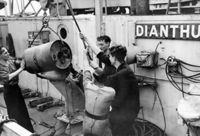

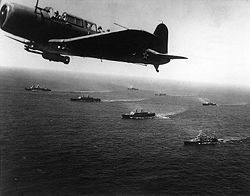
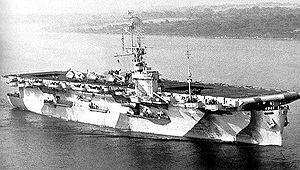
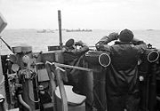
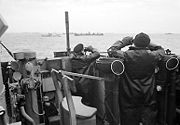
World War II
World War II, or the Second World War , was a global conflict lasting from 1939 to 1945, involving most of the world's nations—including all of the great powers—eventually forming two opposing military alliances: the Allies and the Axis...
, the submarine menace revived, threatening the survival of island nations like Britain and Japan which were particularly vulnerable because of their dependence on imports of food, oil, and other vital war materials. Despite this vulnerability, little had been done to prepare sufficient anti-submarine forces or develop suitable new weapons. Other navies were similarly unprepared, even though every major navy had a large, modern submarine fleet, because all had fallen in the grip of Mahan
Alfred Thayer Mahan
Alfred Thayer Mahan was a United States Navy flag officer, geostrategist, and historian, who has been called "the most important American strategist of the nineteenth century." His concept of "sea power" was based on the idea that countries with greater naval power will have greater worldwide...
ian doctrine
Doctrine
Doctrine is a codification of beliefs or a body of teachings or instructions, taught principles or positions, as the body of teachings in a branch of knowledge or belief system...
which held guerre de course could not win a war.
At the beginning of the war, most navies had few ideas how to combat submarines beyond locating them with sonar and then dropping depth charge
Depth charge
A depth charge is an anti-submarine warfare weapon intended to destroy or cripple a target submarine by the shock of exploding near it. Most use explosives and a fuze set to go off at a preselected depth in the ocean. Depth charges can be dropped by either surface ships, patrol aircraft, or from...
s on them. Sonar proved much less effective than expected, and was no use at all against submarines operating on the surface, as U-boats routinely did at night. The Royal Navy had continued to develop indicator loops between the wars but this was a passive form of harbour defense that depended on detecting the magnetic field of submarines by the use of long lengths of cable lain on the floor of the harbour. Indicator loop technology was quickly developed further and deployed by the US Navy in 1942. By then there were dozens of loop stations around the world. Sonar was far more effective and loop technology died straight after the war.
The use and improvement of radar technology was one of the most important proponents in the fight against submarines. Locating submarines was the first step in being able to defend against and destroy them. Throughout the war, Allied radar technology was much better than their German counterparts. German U-Boats never had the proper radar detection capabilities and the Allies took advantage of this by equipping aircraft with micro and macro radar technology. Allied planes were also eventually fitted with the proper weaponry to sink submarines and from 1943-1945 they would account for the bulk of Allied kills against U-Boats. Allied anti-submarine tactics
Naval tactics in the Age of Steam
The development of the steam ironclad firing explosive shells in the mid 19th century rendered sailing tactics obsolete. New tactics were developed for the big-gun Dreadnought battleships. The mine, torpedo, submarine and aircraft posed new threats, each of which had to be countered, leading to...
developed to defend convoy
Convoy
A convoy is a group of vehicles, typically motor vehicles or ships, traveling together for mutual support and protection. Often, a convoy is organized with armed defensive support, though it may also be used in a non-military sense, for example when driving through remote areas.-Age of Sail:Naval...
s (the Royal Navy
Royal Navy
The Royal Navy is the naval warfare service branch of the British Armed Forces. Founded in the 16th century, it is the oldest service branch and is known as the Senior Service...
's preferred method), aggressively hunt down U-boat
U-boat
U-boat is the anglicized version of the German word U-Boot , itself an abbreviation of Unterseeboot , and refers to military submarines operated by Germany, particularly in World War I and World War II...
s (the U.S. Navy approach), and to divert vulnerable or valuable ships away from known U-boat concentrations.
During the Second World War, the Allies developed a huge range of new technologies, weapons and tactics to counter the submarine danger. These included:
Vessels
- Allocating ships to convoyConvoyA convoy is a group of vehicles, typically motor vehicles or ships, traveling together for mutual support and protection. Often, a convoy is organized with armed defensive support, though it may also be used in a non-military sense, for example when driving through remote areas.-Age of Sail:Naval...
s according to speed, so faster ships were less exposed. - Adjusting the convoy cycle. Analysis of convoy lossesOperations researchOperations research is an interdisciplinary mathematical science that focuses on the effective use of technology by organizations...
over the first three years of the war showed that the overall size of a convoy was less important than the size of its escorting force. Therefore, escorts could better protect a few large convoys than many small ones. - Huge construction programmes to mass-produce the small warships needed for convoy defense, such as corvetteCorvetteA corvette is a small, maneuverable, lightly armed warship, originally smaller than a frigate and larger than a coastal patrol craft or fast attack craft , although many recent designs resemble frigates in size and role...
s, frigateFrigateA frigate is any of several types of warship, the term having been used for ships of various sizes and roles over the last few centuries.In the 17th century, the term was used for any warship built for speed and maneuverability, the description often used being "frigate-built"...
s, and destroyer escortDestroyer escortA destroyer escort is the classification for a smaller, lightly armed warship designed to be used to escort convoys of merchant marine ships, primarily of the United States Merchant Marine in World War II. It is employed primarily for anti-submarine warfare, but also provides some protection...
s. These were more economical than using destroyerDestroyerIn naval terminology, a destroyer is a fast and maneuverable yet long-endurance warship intended to escort larger vessels in a fleet, convoy or battle group and defend them against smaller, powerful, short-range attackers. Destroyers, originally called torpedo-boat destroyers in 1892, evolved from...
s, which were needed for fleet duties. - Ships that could carry aircraft, such as the CAM shipCAM shipCAM ships were World War II-era British merchant ships used in convoys as an emergency stop-gap until sufficient escort carriers became available. CAM is an acronym for catapult aircraft merchantman. A CAM ship was equipped with a rocket-propelled catapult launching a single Hawker Sea Hurricane,...
s, the merchant aircraft carrierMerchant aircraft carrierMerchant aircraft carriers were bulk cargo ships with minimal aircraft handling facilities, used during World War II by Britain and the Netherlands as an interim measure to supplement British and United States-built escort carriers in providing an anti-submarine function for convoys...
, and eventually the purpose-built escort carriersEscort aircraft carrierThe escort aircraft carrier or escort carrier, also called a "jeep carrier" or "baby flattop" in the USN or "Woolworth Carrier" by the Royal Navy, was a small and slow type of aircraft carrier used by the British Royal Navy , the Imperial Japanese Navy and Imperial Japanese Army Air Force, and the...
. - Support groups of escort ships that could be sent to reinforce the defense of convoys under attack. Free from the obligation to remain with the convoys, support groups could continue hunting a submerged submarine until its batteries and air supplies were exhausted and it was forced to surface.
- Hunter-killer groups, whose job was to actively seek out enemy submarines, as opposed to waiting for the convoy to come under attack. Later hunter-killer groups were centered around escort carriers.
- Huge construction programmes to mass-produce the transports and replace their losses. Once shipbuilding had ramped up to full efficiency, transports could be built faster than U-boats could sink them, playing a crucial role in the Allies winning the "Tonnage warTonnage warA tonnage war is a military strategy aimed at merchant shipping. The premise is that an enemy has only a finite number of ships, and a finite capacity to build replacements for them. The concept was made famous by U-boat commander Karl Dönitz, who wrote: The shipping of the enemy powers is one...
".
Aircraft
- Air raids on the German U-boat penSubmarine penA submarine pen is a bunker which is designed to protect submarines from air attack.The term is generally applied to submarine bases constructed during World War II, particularly in Germany and the occupied countries which were also known as U-boat pens .-Background:Amongst the first...
s at BrestBrest, FranceBrest is a city in the Finistère department in Brittany in northwestern France. Located in a sheltered position not far from the western tip of the Breton peninsula, and the western extremity of metropolitan France, Brest is an important harbour and the second French military port after Toulon...
and La RochelleLa RochelleLa Rochelle is a city in western France and a seaport on the Bay of Biscay, a part of the Atlantic Ocean. It is the capital of the Charente-Maritime department.The city is connected to the Île de Ré by a bridge completed on 19 May 1988...
. - Long-range aircraft patrols to close the Mid-Atlantic gapMid-Atlantic gapThe Mid-Atlantic Gap was the gap in coverage by land-based Coastal Command antisubmarine aircraft during the Battle of the Atlantic in the Second World War. It is frequently known as The Black Pit, as well as the Atlantic Gap, Air Gap, Greenland Gap, or just "the Gap". This resulted in heavy...
. - Escort carriers to provide the convoy with air cover, as well as close the mid-Atlantic gap.
- High frequency direction finding (HF/DF), including shipborne sets, to pinpoint the location of an enemy submarine from its radio transmissions.
- The introduction of seaborne radarRadarRadar is an object-detection system which uses radio waves to determine the range, altitude, direction, or speed of objects. It can be used to detect aircraft, ships, spacecraft, guided missiles, motor vehicles, weather formations, and terrain. The radar dish or antenna transmits pulses of radio...
which could enable the detection of surfaced U-boats. - Airborne radar.
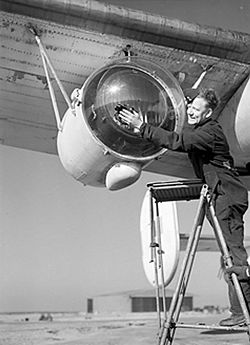
- The Leigh lightLeigh lightThe Leigh Light was a British World War II era anti-submarine device used in the Second Battle of the Atlantic.It was a powerful carbon arc searchlight of 24 inches diameter fitted to a number of the British Royal Air Force's Coastal Command patrol bombers to help them spot surfaced...
airborne searchlight, in conjunction with airborne radar to surprise and attack enemy submarines on the surface at night. - Magnetic anomaly detectionMagnetic anomaly detectorA magnetic anomaly detector is an instrument used to detect minute variations in the Earth's magnetic field. The term refers specifically to magnetometers used by military forces to detect submarines ; the military MAD gear is a descendent of geomagnetic survey instruments used to search for...
- Diesel exhaust sniffers
- Sonobuoys
Weaponry
- Torpedo countermeasures such as the FoxerFoxerFoxer, was the codename for a British built acoustic decoy, used to confuse German acoustic homing torpedoes like the G7es torpedo during the Second World War. A US version codenamed FXR was deployed in 1943. A Canadian version was also built called the CAT...
acoustic decoy. - The development of forward-throwing anti-submarine weapons such as HedgehogHedgehog (weapon)The Hedgehog was an anti-submarine weapon developed by the Royal Navy during World War II, that was deployed on convoy escort warships such as destroyers to supplement the depth charge. The weapon worked by firing a number of small spigot mortar bombs from spiked fittings...
and the SquidSquid (weapon)Squid was a British World War II ship-mounted anti-submarine weapon. It consisted of a three-barrelled mortar which launched depth charges. It replaced the Hedgehog system, and was in turn replaced by the Limbo system....
. - The FIDOMark 24 FIDO TorpedoThe Mark 24 Mine was a US air-dropped passive acoustic homing anti-submarine torpedo used during the Second World War against German and Japanese submarines. It entered service in March 1943 and continued in service with the US Navy until 1948...
(Mk 24 'mine') homing torpedo. - Pattern running torpedoes
Intelligence
- One of the best kept Allied secrets was the breaking of enemy codes including some of the German Naval Enigma codes (information gathered this way was dubbed Ultra) at Bletchley ParkBletchley ParkBletchley Park is an estate located in the town of Bletchley, in Buckinghamshire, England, which currently houses the National Museum of Computing...
in England. This enabled the tracking of U-boat packs to allow convoy re-routings; whenever the Germans changed their codes (and when they added a fourth rotor to the Enigma machines in 1943), convoy losses rose significantly. By the end of the war, the Allies were regularly breaking and reading German naval codes. - To prevent the Germans from guessing that Enigma had been cracked, the British planted a false story about a special infrared camera being used to locate U-boats. The British were subsequently delighted to learn that the Germans responded by developing a special paint for submarines that exactly duplicated the optical properties of seawater.
Tactics
Many different aircraft from airships to four-engined sea- and land-planes were used. Some of the more successful were the Lockheed Ventura
Lockheed Ventura
The Lockheed Ventura was a bomber and patrol aircraft of World War II, used by United States and British Commonwealth forces in several guises...
, PBY (Catalina or Canso, in British service), Consolidated B-24 Liberator (VLR Liberator, in British service), Short Sunderland
Short Sunderland
The Short S.25 Sunderland was a British flying boat patrol bomber developed for the Royal Air Force by Short Brothers. It took its service name from the town and port of Sunderland in northeast England....
, and Vickers Wellington
Vickers Wellington
The Vickers Wellington was a British twin-engine, long range medium bomber designed in the mid-1930s at Brooklands in Weybridge, Surrey, by Vickers-Armstrongs' Chief Designer, R. K. Pierson. It was widely used as a night bomber in the early years of the Second World War, before being displaced as a...
. U-boats were not defenseless, since their deck guns were a very good anti-aircraft weapon. They claimed 212 Allied aircraft shot down for the loss of 168 U-boats to air attack. At one point in the war, there was even a 'shoot back order' requiring U-boats to stay on the surface and fight back, in the absence of any other option.
The provision of air cover was essential. The Germans at the time had been using their Focke-Wulf Fw 200
Focke-Wulf Fw 200
The Focke-Wulf Fw 200 Condor, also known as Kurier to the Allies was a German all-metal four-engine monoplane originally developed by Focke-Wulf as a long-range airliner...
"Condor" long range aircraft to attack shipping and provide reconnaissance for U-boats, and most of their sorties occurred outside the reach of existing land-based aircraft that the Allies had; this was dubbed the Mid-Atlantic gap. At first, the British developed temporary solutions such as CAM ship
CAM ship
CAM ships were World War II-era British merchant ships used in convoys as an emergency stop-gap until sufficient escort carriers became available. CAM is an acronym for catapult aircraft merchantman. A CAM ship was equipped with a rocket-propelled catapult launching a single Hawker Sea Hurricane,...
s and merchant aircraft carrier
Merchant aircraft carrier
Merchant aircraft carriers were bulk cargo ships with minimal aircraft handling facilities, used during World War II by Britain and the Netherlands as an interim measure to supplement British and United States-built escort carriers in providing an anti-submarine function for convoys...
s. These were superseded by mass-produced, relatively cheap escort carriers built by the United States and operated by the US Navy and Royal Navy. There was also the introduction of long-ranged patrol aircraft. Many U-boats feared aircraft, as the mere presence would often force them to dive, disrupting their patrols and attack runs.
There was a significant difference in the tactics of the two navies. The Americans favored aggressive hunter-killer tactics using escort carriers on search and destroy patrols, whereas the British preferred to use their escort carriers to defend the convoys directly. The American view was that defending convoys did little to reduce or contain U-boat numbers, while the British were constrained by having to fight the battle of the Atlantic alone for the early part of the war with very limited resources. There were no spare escorts for extensive hunts, and it was only important to neutralize the U-boats which were found in the vicinity of convoys. The survival of convoys was critical, and if a hunt missed its target a convoy of strategic importance could be lost. The British also reasoned that since submarines sought convoys, convoys would be a good place to find submarines.
Once America joined the war, the different tactics were complementary, both suppressing the effectiveness of and destroying U-boats. The increase in Allied naval strength allowed both convoy defense and hunter-killer groups to be deployed, and this was reflected in the massive increase in U-Boat sinking in the latter part of the war. The British developments of ASDIC, Centimetric Radar
Radar
Radar is an object-detection system which uses radio waves to determine the range, altitude, direction, or speed of objects. It can be used to detect aircraft, ships, spacecraft, guided missiles, motor vehicles, weather formations, and terrain. The radar dish or antenna transmits pulses of radio...
and the Leigh Light
Leigh light
The Leigh Light was a British World War II era anti-submarine device used in the Second Battle of the Atlantic.It was a powerful carbon arc searchlight of 24 inches diameter fitted to a number of the British Royal Air Force's Coastal Command patrol bombers to help them spot surfaced...
also reached the point of being able to support U-Boat hunting towards the end of the war, while at the beginning technology was definitely on the side of the submarine. Commanders such as F. J. "Johnnie" Walker
Frederic John Walker
Captain Frederic John Walker, CB, DSO and three Bars, RN was a British Royal Navy officer noted for his exploits during World War II...
of the Royal Navy were able to develop integrated tactics which made the deployment of hunter-killer groups a practical proposition.
The earliest recorded sinking of one submarine by another while both were submerged occurred in 1945 when HMS Venturer
HMS Venturer (P68)
HMS Venturer was a Second World War British submarine.-Construction:Venturer was the lead boat of the British V class submarine, a development of the successful U-class...
torpedoed U-864
Unterseeboot 864
German submarine U-864 was a German Type IX U-boat of World War II. It departed from Kiel on 5 December 1944 on its last mission, to transport to Japan a large quantity of mercury and parts and engineering drawings for German jet fighters...
off the coast of Norway
Norway
Norway , officially the Kingdom of Norway, is a Nordic unitary constitutional monarchy whose territory comprises the western portion of the Scandinavian Peninsula, Jan Mayen, and the Arctic archipelago of Svalbard and Bouvet Island. Norway has a total area of and a population of about 4.9 million...
. The captain of Venturer tracked U-864 on hydrophones for several hours and manually calculated a three-dimensional firing solution before launching four torpedoes.
Mediterranean
Italian and German submarines operated in the Mediterranean on the Axis side while French and British submarines operated on the side of the Allies. Similar ASW methods were used as in the Atlantic but an additional menace was the use by Italians of midget submarines.Pacific Theatre
Japanese submarines pioneered many innovations, being some of the largest and longest range vessels of their type. However, they ended up playing little impact, especially in the latter half of the war. Instead of commerce raiding like their U-boat counterparts, they followed the Mahanian doctrine, serving in offensive roles against warships, which were fast, maneuverable and well-defended compared to merchant ships. In the early part of the Pacific War, Japanese subs scored several tactical victories, including two successful torpedo strikes on the US fleet carriers SaratogaUSS Saratoga (CV-3)
USS Saratoga was the second aircraft carrier of the United States Navy and the fifth ship to bear her name. She was commissioned one month earlier than her sister and class leader, , which is the third actually commissioned after and Saratoga...
and Wasp
USS Wasp (CV-7)
USS Wasp was a United States Navy aircraft carrier. The eighth Navy ship of that name, she was the sole ship of her class. Built to use up the remaining tonnage allowed to the U.S. for aircraft carriers under the treaties of the time, she was built on a reduced-size version of the Yorktown-class...
, the latter of which was sunk abandoned and scuttled as a result of the attack. However, these are mostly considered incidental successes, due to limited resources in the US Navy at the time.
Once the US was able to ramp up construction of destroyers and destroyer escort
Destroyer escort
A destroyer escort is the classification for a smaller, lightly armed warship designed to be used to escort convoys of merchant marine ships, primarily of the United States Merchant Marine in World War II. It is employed primarily for anti-submarine warfare, but also provides some protection...
s, as well as bringing over highly effective anti-submarine techniques learned from the British from experiences in the Battle of the Atlantic, they would take a significant toll on Japanese submarines, which tended to be slower and could not dive as deep as their German counterparts. Japanese submarines, in particular, never menaced the Allied merchant convoys and strategic shipping lanes to any degree that German U-boats did. One major advantages the Allies had was the breaking of the Japanese "Purple" code by the US, so allowing friendly ships to be diverted from Japanese submarines and allowing Allied submarines to intercept Japanese forces.
In 1942 and early 1943, US submarines posed little threat to Japanese ships, whether warships or merchant ships. They were initially hampered by poor torpedoes, which often failed to detonate on impact, ran too deep, or even ran wild. As the US submarine menace was slight in the beginning, Japanese commanders became complacent and as a result did not invest heavily into ASW measures or upgrade their convoy protection to any degree to what the Allies in the Atlantic did. Often encouraged by the Japanese not placing a high priority on the Allied submarine threat, US skippers were relatively complacent and docile compared to their German counterparts, who understood the "life and death" urgency in the Atlantic.
However, US Vice Admiral Charles A. Lockwood
Charles A. Lockwood
Charles Andrews Lockwood was an admiral of the United States Navy. He is known in submarine history as the legendary commander of Submarine Force Pacific Fleet during World War II...
pressured the ordnance department to replace the faulty torpedoes; famously when they initially ignored his complaints, he ran his own tests to prove the torpedoes' unreliability. He also cleaned out the "deadwood", replacing many cautious or unproductive submarine skippers with younger (somewhat) and more aggressive commanders. As a result, in the latter half of 1943, US subs were suddenly sinking Japanese ships at a dramatically higher rate, scoring their share of key warship kills and accounting for almost half of the Japanese merchant fleet. Japanese naval command was caught off guard, as they had not the anti-submarine technology or doctrine, nor did the production capability to withstand a tonnage war of attrition
Attrition warfare
Attrition warfare is a military strategy in which a belligerent side attempts to win a war by wearing down its enemy to the point of collapse through continuous losses in personnel and matériel....
, nor did they develop the organizations needed (unlike the Allies in the Atlantic).
Japanese antisubmarine forces consisted mainly of their destroyers, with sonar and depth charges. However, Japanese destroyer design, tactics, training, and doctrine emphasized surface nightfighting and torpedo delivery (necessary for fleet operations) over anti-submarine duties. By the time Japan finally developed a destroyer escort
Destroyer escort
A destroyer escort is the classification for a smaller, lightly armed warship designed to be used to escort convoys of merchant marine ships, primarily of the United States Merchant Marine in World War II. It is employed primarily for anti-submarine warfare, but also provides some protection...
which was more economical and better suited to convoy protection, it was too late; coupled to incompetent doctrine and organization, it could have had little effect in any case. Late in the war, the Japanese Army and Navy used Magnetic Anomaly Detector
Magnetic anomaly detector
A magnetic anomaly detector is an instrument used to detect minute variations in the Earth's magnetic field. The term refers specifically to magnetometers used by military forces to detect submarines ; the military MAD gear is a descendent of geomagnetic survey instruments used to search for...
MAD) gear in aircraft to locate shallow submerged submarines. The Japanese Army also developed two small aircraft carriers and Ka-1
Kayaba Ka-1
|-References:NotesBibliography* Francillon, Ph.D., René J. Japanese Aircraft of the Pacific War. London: Putnam & Company Ltd., 1970. ISBN 0-370-00033-1 .-External links:*...
autogyro
Autogyro
An autogyro , also known as gyroplane, gyrocopter, or rotaplane, is a type of rotorcraft which uses an unpowered rotor in autorotation to develop lift, and an engine-powered propeller, similar to that of a fixed-wing aircraft, to provide thrust...
aircraft for use in an antisubmarine warfare role.
The Japanese depth charge attacks by its surface forces initially proved fairly unsuccessful against U.S. fleet submarines. Unless caught in shallow water, a U.S. submarine commander could normally escape destruction, sometimes using temperature gradient
Gradient
In vector calculus, the gradient of a scalar field is a vector field that points in the direction of the greatest rate of increase of the scalar field, and whose magnitude is the greatest rate of change....
s (thermocline
Thermocline
A thermocline is a thin but distinct layer in a large body of fluid , in which temperature changes more rapidly with depth than it does in the layers above or below...
s). Additionally, IJN
Imperial Japanese Navy
The Imperial Japanese Navy was the navy of the Empire of Japan from 1869 until 1947, when it was dissolved following Japan's constitutional renunciation of the use of force as a means of settling international disputes...
doctrine
Doctrine
Doctrine is a codification of beliefs or a body of teachings or instructions, taught principles or positions, as the body of teachings in a branch of knowledge or belief system...
emphasized fleet action, not convoy protection, so the best ships and crews went elsewhere. Moreover, during the first part of the war, the Japanese tended to set their depth charges too shallow, unaware U.S. submarines could dive below 150 feet (45m). Unfortunately, this deficiency was revealed in a June 1943 press conference held by U.S. Congressman Andrew J. May
Andrew J. May
Andrew Jackson May was a Kentucky attorney and influential New Deal-era politician, best known for his chairmanship of the House Military Affairs Committee during World War II, and his subsequent conviction for bribery...
, and soon enemy depth charges were set to explode as deep as 250 feet (76m). Vice Admiral Charles A. Lockwood
Charles A. Lockwood
Charles Andrews Lockwood was an admiral of the United States Navy. He is known in submarine history as the legendary commander of Submarine Force Pacific Fleet during World War II...
, COMSUBPAC, later estimated May's revelation cost the navy as many as ten submarines and 800 crewmen.
Much later in the war, active and passive sonobuoy
Sonobuoy
A sonobuoy is a relatively small expendable sonar system that is dropped/ejected from aircraft or ships conducting anti-submarine warfare or underwater acoustic research....
s were developed for aircraft use, together with MAD devices. Toward the end of the war, the Allies developed much better ATWs, such as Squid
Squid (weapon)
Squid was a British World War II ship-mounted anti-submarine weapon. It consisted of a three-barrelled mortar which launched depth charges. It replaced the Hedgehog system, and was in turn replaced by the Limbo system....
, Limbo
Limbo (weapon)
Limbo, or Anti Submarine Mortar Mark 10 , was the final British development of a forward-throwing anti-submarine weapon originally designed during the Second World War. Limbo, a three-barreled mortar similar to the earlier Squid that it superseded, was developed by the Admiralty Underwater Weapons...
and Mousetrap
Mousetrap (weapon)
Mousetrap was an anti-submarine rocket used mainly during the Second World War by the U.S. Navy and the U.S. Coast Guard. Its development was begun in 1941 as a replacement for Hedgehog, a British-made projector, which was the first ahead-throwing ASW weapon...
, in the face of new, much better German submarines, such as the Type XVII
German Type XVIIB submarine
The Type XVII U-boats were small coastal submarines which used Hellmuth Walter's high test peroxide propulsion system, which offered a combination of air-independent propulsion and high submerged speeds.-Background:...
and Type XXI
German Type XXI submarine
Type XXI U-boats, also known as "Elektroboote", were the first submarines designed to operate primarily submerged, rather than as surface ships that could submerge as a means to escape detection or launch an attack.-Description:...
.
British and Dutch submarines also operated in the Pacific, mainly against coastal shipping.
Post-war
In the immediate postwar period, faced with the prospect of large numbers of Soviet submarines as capable as the Type XVIIs and XXIs, or better, new ASW weapons were essential. This led to the introduction of longer-ranged ATWs, such as IkaraIkara (missile)
The Ikara missile was an Australian ship-launched anti-submarine missile, named after an Australian Aboriginal word for "throwing stick". It launched an acoustic torpedo to a range of , allowing fast-reaction attacks against submarines at ranges that would otherwise require the launching ship to...
, Weapon Alpha
Weapon Alpha
The RUR-4 "Weapon Alpha" was an American naval ahead-throwing ASW rocket launcher.Similar to the earlier American Mousetrap, 375mm Swedish Bofors, and 250mm and 300mm Soviet systems, all of which use multiple rockets, Weapon Alpha was developed toward the end of World War II, in response to the...
and ASROC
ASROC
ASROC is an all-weather, all sea-conditions anti-submarine missile system. Developed by the United States Navy in the 1950s, it was deployed in the 1960s, updated in the 1990s, and eventually installed on over 200 USN surface ships, specifically cruisers, destroyers, and frigates...
. Nuclear submarine
Nuclear submarine
A nuclear submarine is a submarine powered by a nuclear reactor . The performance advantages of nuclear submarines over "conventional" submarines are considerable: nuclear propulsion, being completely independent of air, frees the submarine from the need to surface frequently, as is necessary for...
s, even faster still, posed an even greater threat; in particular, shipborne helicopter
Helicopter
A helicopter is a type of rotorcraft in which lift and thrust are supplied by one or more engine-driven rotors. This allows the helicopter to take off and land vertically, to hover, and to fly forwards, backwards, and laterally...
s (recalling the blimp
Blimp
A blimp, or non-rigid airship, is a floating airship without an internal supporting framework or keel. A non-rigid airship differs from a semi-rigid airship and a rigid airship in that it does not have any rigid structure, neither a complete framework nor a partial keel, to help the airbag...
s of World War I) have emerged as essential anti-submarine platforms. A number of torpedo carrying missiles were developed, combining ahead-throwing capability (or longer-range delivery) with torpedo homing.
Since the introduction of submarines capable of carrying ballistic missile
Ballistic missile
A ballistic missile is a missile that follows a sub-orbital ballistic flightpath with the objective of delivering one or more warheads to a predetermined target. The missile is only guided during the relatively brief initial powered phase of flight and its course is subsequently governed by the...
s, great efforts have been made to counter the threat they pose; here, maritime patrol aircraft (as in World War II) and helicopters have had a large role. The use of nuclear propulsion and streamlined hulls has resulted in submarines with high speed capability and increased maneuverability, as well as low "indiscretion rates" when a submarine is exposed on the surface. This has required changes both to the sensors and weapons used for ASW. Because nuclear submarines were noisy, there was an emphasis on passive sonar detection. The torpedo became the main weapon (though nuclear depth charges were developed). The mine continued to be an important ASW weapon.
In some areas of the ocean, where land forms natural barriers, long strings of sonobuoys, deployed from surface ships or dropped from aircraft, can monitor maritime passages for extended periods. Bottom mounted hydrophones can also be used, with land based processing. A system like this SOSUS
SOSUS
SOSUS, an acronym for Sound Surveillance System, is a chain of underwater listening posts across the northern Atlantic Ocean near Greenland, Iceland and the United Kingdom — the GIUK gap. It was originally operated by the United States Navy for tracking Soviet submarines, which had to pass...
was deployed by the USA in the GIUK gap
GIUK gap
The GIUK gap is an area in the northern Atlantic Ocean that forms a naval warfare chokepoint. Its name is an acronym for Greenland, Iceland, and the United Kingdom, the gap being the open ocean between these three landmasses...
and other strategically important places.
Airborne ASW forces developed better bomb
Bomb
A bomb is any of a range of explosive weapons that only rely on the exothermic reaction of an explosive material to provide an extremely sudden and violent release of energy...
s and depth charge
Depth charge
A depth charge is an anti-submarine warfare weapon intended to destroy or cripple a target submarine by the shock of exploding near it. Most use explosives and a fuze set to go off at a preselected depth in the ocean. Depth charges can be dropped by either surface ships, patrol aircraft, or from...
s, while for ships and submarines a range of towed sonar devices were developed to overcome the problem of ship-mounting. Helicopters can fly courses offset from the ships and transmit sonar information to their combat information centre
Combat Information Center
The Operations Room is the tactical center of a warship or AWAC aircraft providing processed information for command and control of the near battle space or 'area of operations'...
s. They can also drop sonobuoys and launch homing torpedoes to positions many miles away from the ships actually monitoring the enemy submarine. Submerged submarines are generally blind to the actions of a patrolling aircraft until it uses active sonar or fires a weapon, and the aircraft's speed allows it to maintain a fast search pattern around the suspected contact.
Increasingly anti-submarine submarines, called attack submarines or hunter-killers, became capable of destroying, particularly, ballistic missile submarines. Initially these were very quiet diesel-electric propelled vessels but they are more likely to be nuclear-powered these days. The development of these was strongly influenced by the duel between Venturer
HMS Venturer (P68)
HMS Venturer was a Second World War British submarine.-Construction:Venturer was the lead boat of the British V class submarine, a development of the successful U-class...
and U-864
Unterseeboot 864
German submarine U-864 was a German Type IX U-boat of World War II. It departed from Kiel on 5 December 1944 on its last mission, to transport to Japan a large quantity of mercury and parts and engineering drawings for German jet fighters...
.
A significant detection aid that has continued in service is the Magnetic Anomaly Detector
Magnetic anomaly detector
A magnetic anomaly detector is an instrument used to detect minute variations in the Earth's magnetic field. The term refers specifically to magnetometers used by military forces to detect submarines ; the military MAD gear is a descendent of geomagnetic survey instruments used to search for...
(MAD), a passive device. First used in World War II, MAD uses the Earth's magnetosphere as a standard, detecting anomalies caused by large metallic vessels, such as submarines. Modern MAD arrays are usually contained in a long tail boom (fixed-wing aircraft) or an aerodynamic housing carried on a deployable tow line (helicopters). Keeping the sensor away from the plane's engines and avionics helps eliminate interference from the carrying platform.
At one time, reliance was placed on electronic warfare
Electronic warfare
Electronic warfare refers to any action involving the use of the electromagnetic spectrum or directed energy to control the spectrum, attack an enemy, or impede enemy assaults via the spectrum. The purpose of electronic warfare is to deny the opponent the advantage of, and ensure friendly...
detection devices exploiting the submarine's need to perform radar sweeps and transmit responses to radio messages from home port. As frequency surveillance and direction finding became more sophisticated, these devices enjoyed some success. However, submariners soon learned not to rely on such transmitters in dangerous waters. Home bases can then use extremely low frequency
Extremely low frequency
Extremely low frequency is a term used to describe radiation frequencies from 3 to 300 Hz. In atmosphere science, an alternative definition is usually given, from 3 Hz to 3 kHz...
radio signals, able to penetrate the ocean's surface, to reach submarines wherever they might be.
Modern warfare
.jpg)
Littoral (military)
Littoral combat is a term in military and naval warfare. It refers to operations in and around the littoral zone, within a certain distance of shore, including surveillance, mine-clearing and support for landing operations and other types of combat shifting from water to ground, and back.The...
operation where ASW is generally more difficult.
Current technologies
There are a large number of technologies used in modern anti-submarine warfare:Sensors
- AcousticsUnderwater acousticsUnderwater acoustics is the study of the propagation of sound in water and the interaction of the mechanical waves that constitute sound with the water and its boundaries. The water may be in the ocean, a lake or a tank. Typical frequencies associated with underwater acoustics are between 10 Hz and...
particularly in active and passive sonarSonarSonar is a technique that uses sound propagation to navigate, communicate with or detect other vessels...
, sonobuoySonobuoyA sonobuoy is a relatively small expendable sonar system that is dropped/ejected from aircraft or ships conducting anti-submarine warfare or underwater acoustic research....
s and fixed hydrophoneHydrophoneA hydrophone is a microphone designed to be used underwater for recording or listening to underwater sound. Most hydrophones are based on a piezoelectric transducer that generates electricity when subjected to a pressure change...
s and in the reduction of radiated noise. - PyrotechnicsPyrotechnicsPyrotechnics is the science of using materials capable of undergoing self-contained and self-sustained exothermic chemical reactions for the production of heat, light, gas, smoke and/or sound...
in the use of markersBuoyA buoy is a floating device that can have many different purposes. It can be anchored or allowed to drift. The word, of Old French or Middle Dutch origin, is now most commonly in UK English, although some orthoepists have traditionally prescribed the pronunciation...
, flares and explosive devices - SearchlightSearchlightA searchlight is an apparatus that combines a bright light source with some form of curved reflector or other optics to project a powerful beam of light of approximately parallel rays in a particular direction, usually constructed so that it can be swiveled about.-Military use:The Royal Navy used...
s - RadarRadarRadar is an object-detection system which uses radio waves to determine the range, altitude, direction, or speed of objects. It can be used to detect aircraft, ships, spacecraft, guided missiles, motor vehicles, weather formations, and terrain. The radar dish or antenna transmits pulses of radio...
- Low frequency spread-spectrum electromagnetic surface wave devices
- Active spread-spectrum magnetic techniques
- Hydrodynamic pressure wave detection
- Blue-green laser airborne and satellite LIDARLIDARLIDAR is an optical remote sensing technology that can measure the distance to, or other properties of a target by illuminating the target with light, often using pulses from a laser...
- Electronic countermeasuresElectronic countermeasuresAn electronic countermeasure is an electrical or electronic device designed to trick or deceive radar, sonar or other detection systems, like infrared or lasers. It may be used both offensively and defensively to deny targeting information to an enemy...
and Acoustic Countermeasures such as noisemakers - Passive acoustic countermeasures such as concealment and design of sound-absorbing materials to coat reflecting underwater surfaces
- Magnetic anomaly detection (MAD)
- Active and (more commonly) passive infra-red detectionForward looking infraredForward looking infrared cameras, typically used on military aircraft, use an imaging technology that senses infrared radiation.The sensors installed in forward looking infrared cameras, as well as those of other thermal imaging cameras, use detection of infrared radiation, typically emitted from a...
Forward looking infrared
Forward looking infrared cameras, typically used on military aircraft, use an imaging technology that senses infrared radiation.The sensors installed in forward looking infrared cameras, as well as those of other thermal imaging cameras, use detection of infrared radiation, typically emitted from a...
(FLIR) detectors have been used to track the large plumes of heat that fast nuclear-powered submarines leave while rising to the surface. FLIR devices are also used to see periscope
Periscope
A periscope is an instrument for observation from a concealed position. In its simplest form it consists of a tube with mirrors at each end set parallel to each other at a 45-degree angle....
s or snorkels
Submarine snorkel
A submarine snorkel is a device which allows a submarine to operate submerged while still taking in air from above the surface. Navy personnel often refer to it as the snort.-History:...
at night whenever a submariner might be incautious enough to probe the surface.
The active sonar used in such operations is often of "mid-frequency", approximately 3.5 kHz. Because of the quietening of submarines, resulting in shorter passive detection ranges, there has been interest in low frequency active for ocean surveillance. However, there have been protests about the use of medium and low frequency high-powered active sonar because of its effects on whales. Others argue the high power level of some LFA (Low Frequency Active) sonars is actually detrimental to sonar performance in that such sonars are reverberation limited.
Weapons
- MinesNaval mineA naval mine is a self-contained explosive device placed in water to destroy surface ships or submarines. Unlike depth charges, mines are deposited and left to wait until they are triggered by the approach of, or contact with, an enemy vessel...
, - TorpedoTorpedoThe modern torpedo is a self-propelled missile weapon with an explosive warhead, launched above or below the water surface, propelled underwater towards a target, and designed to detonate either on contact with it or in proximity to it.The term torpedo was originally employed for...
es, acoustic, wire-guided, and wake homing. - Depth charges
- RocketsRocket (weapon)A rocket is a self propelled, unguided weapon system powered by a rocket motor.- Categorisation :In military parlance, powered munitions are broadly categorised as follows:* A powered, unguided munition is known as a rocket....
- MissileMissileThough a missile may be any thrown or launched object, it colloquially almost always refers to a self-propelled guided weapon system.-Etymology:The word missile comes from the Latin verb mittere, meaning "to send"...
s - Anti-submarine netAnti-submarine netAn anti-submarine net is a device placed across the mouth of a harbour or a strait for protection against submarines.-Examples of anti-submarine nets:*Lake Macquarie anti-submarine boom*Indicator net*Naval operations in the Dardanelles Campaign...
- RammingRammingIn warfare, ramming is a technique that was used in air, sea and land combat. The term originated from battering ram, a siege weapon used to bring down fortifications by hitting it with the force of the ram's momentum...
Platforms
Satellites have been used to image the sea surface using optical and radar techniques, and it is claimed these might be used for indirect detection of submarines, as could thermal imaging. Fixed-wing aircraft, such as the P-3 OrionP-3 Orion
The Lockheed P-3 Orion is a four-engine turboprop anti-submarine and maritime surveillance aircraft developed for the United States Navy and introduced in the 1960s. Lockheed based it on the L-188 Electra commercial airliner. The aircraft is easily recognizable by its distinctive tail stinger or...
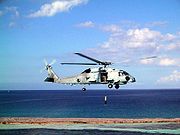
provide both a sensor and weapons platform as do some helicopters like the SH-60 Seahawk
SH-60 Seahawk
The Sikorsky SH-60/MH-60 Seahawk is a twin turboshaft engine, multi-mission United States Navy helicopter based on the United States Army UH-60 Black Hawk and a member of the Sikorsky S-70 family. The most significant airframe modification is a hinged tail to reduce its footprint aboard ships.The...
, with sonobuoys and/or dipping sonars as well as aerial torpedo
Aerial torpedo
The aerial torpedo, airborne torpedo or air-dropped torpedo is a naval weapon, the torpedo, designed to be dropped into water from an aircraft after which it propels itself to the target. First used in World War I, air-dropped torpedoes were used extensively in World War II, and remain in limited...
es. In other cases the helicopter has been used solely for sensing and rocket delivered torpedoes used as the weapon. Surface ships continue to be a main ASW platform because of their endurance, now having towed array sonars. Submarines are the main ASW platform because of their ability to change depth and their quietness, which aids detection. In the future unmanned vehicles
Unmanned surface vehicle
The term unmanned surface vehicle or autonomous surface vehicle refers to any vehicle that operates on the surface of the water without a crew. USVs have been tested since World War II but have been largely overshadowed. This is due to the fact the USVs, such as the OWL Mk II surveillance drone,...
may be used in the ASW role. In early 2010 DARPA began funding the ACTUV
ACTUV
The ASW Continuous Trail Unmanned Vessel is a DARPA funded project launched in early 2010 to develop an unmanned ship for Anti-submarine warfare .- Overview :...
programme to develop a semi-autonomous ocean going unmanned naval vessel.
Today some nations have seabed listening devices capable of tracking submarines. It is known to be possible to detect man-made marine noises across the southern Indian Ocean
Indian Ocean
The Indian Ocean is the third largest of the world's oceanic divisions, covering approximately 20% of the water on the Earth's surface. It is bounded on the north by the Indian Subcontinent and Arabian Peninsula ; on the west by eastern Africa; on the east by Indochina, the Sunda Islands, and...
from South Africa
South Africa
The Republic of South Africa is a country in southern Africa. Located at the southern tip of Africa, it is divided into nine provinces, with of coastline on the Atlantic and Indian oceans...
to New Zealand
New Zealand
New Zealand is an island country in the south-western Pacific Ocean comprising two main landmasses and numerous smaller islands. The country is situated some east of Australia across the Tasman Sea, and roughly south of the Pacific island nations of New Caledonia, Fiji, and Tonga...
. Some of the SOSUS
SOSUS
SOSUS, an acronym for Sound Surveillance System, is a chain of underwater listening posts across the northern Atlantic Ocean near Greenland, Iceland and the United Kingdom — the GIUK gap. It was originally operated by the United States Navy for tracking Soviet submarines, which had to pass...
arrays have been turned over to civilian use and are now used for marine research.
See also
- Modern Naval tacticsModern naval tacticsThe term modern naval tactics refers to tactical doctrines developed after World War II, following the final obsolescence of the battleship and the development of long-range missiles. Since there has been no major naval conflict since World War II, with the exception of the Falklands War, many of...
- Naval tactics in the Age of SteamNaval tactics in the Age of SteamThe development of the steam ironclad firing explosive shells in the mid 19th century rendered sailing tactics obsolete. New tactics were developed for the big-gun Dreadnought battleships. The mine, torpedo, submarine and aircraft posed new threats, each of which had to be countered, leading to...
- Anti-submarine weaponAnti-submarine weaponAn anti-submarine weapon is any one of a range of devices that are intended to act against a submarine, and its crew, to destroy the vessel or to destroy or reduce its capability as a weapon of war...