

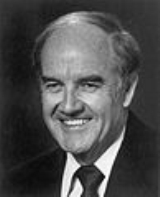
George McGovern

Encyclopedia
George Stanley McGovern (born July 19, 1922) is an historian, author, and former U.S. Representative
, U.S. Senator
, and the Democratic Party
nominee in the 1972 presidential election
.
McGovern grew up in Mitchell, South Dakota
, where he was a renowned debater. He volunteered for the U.S. Army Air Forces
upon the country's entry into World War II
and as a B-24 Liberator
pilot flew 35 missions over German-occupied Europe. Among the medals awarded him was a Distinguished Flying Cross
for making a hazardous emergency landing of his damaged plane and saving his crew. After the war he gained degrees from Dakota Wesleyan University
and Northwestern University
, culminating in a Ph.D
, and was a history professor. He was elected to the U.S. House of Representatives in 1956 and re-elected in 1958. After a failed bid for the U.S. Senate in 1960, he was elected to there in 1962.
As a senator, McGovern was an exemplar of modern American liberalism
. He became most known for his outspoken opposition to the growing U.S. involvement in the Vietnam War
. He staged a brief nomination run in the 1968 presidential election
as a stand-in for the assassinated Robert F. Kennedy
. The subsequent McGovern–Fraser Commission fundamentally altered the Democratic presidential nominating process, by greatly increasing the number of caucus
es and primaries
and reducing the influence of party insiders. The McGovern–Hatfield Amendment sought to end the Vietnam War by legislative means but was defeated in 1970 and 1971. McGovern's long-shot, grassroots-based 1972 presidential campaign
found triumph in gaining the Democratic nomination but left the party badly split ideologically, and the failed vice-presidential pick of Thomas Eagleton
undermined McGovern's credibility. In the general election McGovern lost to incumbent Richard Nixon
in one of the biggest landslides in American history. Re-elected Senator in 1968 and 1974, McGovern was defeated in a bid for a fourth term in 1980.
Throughout his career, McGovern has been involved in issues related to agriculture, food, nutrition, and hunger. As the first director of the Food for Peace
program in 1961, McGovern oversaw the distribution of U.S. surpluses to the needy abroad and was instrumental in the creation of the United Nations
-based World Food Programme
. As sole chair of the Senate Select Committee on Nutrition and Human Needs
from 1968–1977, McGovern publicized the problem of hunger within the United States and issued the "McGovern Report" that led to a new set of nutritional guidelines for Americans. McGovern later served as U.S. Ambassador to the United Nations Agencies for Food and Agriculture
from 1998–2001 and was appointed the first UN Global Ambassador on World Hunger by the World Food Programme in 2001. The McGovern-Dole International Food for Education and Child Nutrition Program
has provided school meals for millions of children in dozens of countries since 2000 and resulted in McGovern being named World Food Prize
co-laureate in 2008.
. His father, Reverend Joseph C. McGovern (born 1868), was pastor of the local Wesleyan Methodist Church there. Joseph had once worked in mines and then been a professional baseball player in the minor leagues
, but had given the latter up due to the heavy drinking, gambling, and womanizing of his teammates, and entered the seminary instead. George's mother was the former Frances McLean (born c. 1890), who had been born in Toronto
, Canada; her family had later moved to Calgary
and then she came to South Dakota looking for work as a secretary. George was the second oldest of four children. Joseph McGovern's salary never reached $100 per month, and he often received compensation in the form of potatoes, cabbages, or other food items. Joseph and Frances McGovern were both firm Republican
s, but were not politically active or doctrinaire.
 When George was about three years old, the family moved to Calgary for a while to be near Frances' ailing mother, and he formed memories of events such as the Calgary Stampede
. While living there, Charles Lindbergh
's solo transatlantic flight in 1927 made a great impression upon George, as it did upon many members of his generation. When George was six, the family returned to the U.S. and moved to Mitchell, South Dakota
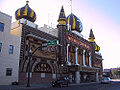
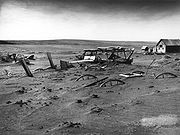
, a community of 12,000. McGovern attended public schools there and was an average student whose only wild behavior was going to the movies (forbidden to good Wesleyans). He was painfully shy as a child and was afraid to speak in class during first grade. Otherwise he had a normal childhood marked by visits to the renowned Mitchell Corn Palace
and "a sense of belonging to a particular place and knowing your part in it." He would, however, long remember the Dust Bowl
storms and grasshopper plagues
that swept the prairie states
during the Great Depression
. The McGovern family lived on the edge of the poverty line for much of the 1920s and 1930s. Growing up amid that lack of affluence gave young George a lifelong sympathy for underpaid workers and struggling farmers. He was influenced by the currents of populism and agrarian unrest and by the "practical divinity" teachings of cleric John Wesley
that sought to fight poverty, injustice, and ignorance.
In seventh grade, a gym teacher called him a "physical coward" for being afraid to dive headfirst and somersault over a gymnastics vaulting horse; the incident troubled him psychologically. George attended Mitchell High School, where he was a solid but unspectacular member of the track team. A turning point came when his tenth grade English teacher recruited him for the debate team, where he became quite active. His high school debate coach proved to be a great influence in his life, and McGovern spent many hours honing his meticulous, if colorless, forensic style. McGovern and his debating partner won events in his area and gained renown in a state where debating was passionately followed by the general public. Debate changed McGovern's life, giving him a chance to explore ideas to their logical end, broadening his perspective, and instilling a sense of personal and social confidence. He graduated in 1940 in the top ten percent of his class.
McGovern enrolled at small Dakota Wesleyan University
in Mitchell and became a star student there. He supplemented a forensic scholarship by working a variety of odd jobs. With World War II underway overseas, McGovern still felt insecure about his own courage. To prove himself, McGovern took flying lessons in an Aeronca aircraft
and received a pilot's license through the government's Civilian Pilot Training Program
. McGovern recalled: "Frankly, I was scared to death on that first solo flight. But when I walked away from it, I had an enormous feeling of satisfaction that I had taken the thing off the ground and landed it without tearing the wings off." In April 1941, McGovern began dating fellow student Eleanor Stegeberg
, who had grown up in Woonsocket, South Dakota
. (They had first encountered each other during a high school debate in which Eleanor and her twin sister Ila defeated McGovern and his partner.)
McGovern was listening to a radio broadcast of the New York Philharmonic Orchestra for a sophomore year music appreciation class when he heard the news of the December 7, 1941, attack on Pearl Harbor
. Within days he drove to Omaha, Nebraska
, and volunteered to join the United States Army Air Forces
. The military accepted him, but they did not yet have enough airfields, aircraft, or instructors to start training all the volunteers, so McGovern stayed at Dakota Wesleyan. George and Eleanor became engaged, but initially decided not to marry until the war was over. During his sophomore year, McGovern won the statewide intercollegiate South Dakota Peace Oratory Contest with a speech called "My Brother's Keeper", which was later selected by the National Council of Churches
as one of the nation's twelve best orations of 1942. McGovern was also elected president of his sophomore and junior classes. In February 1943, during his junior year, he and a partner won a national debate tournament at North Dakota State University
that featured competitors from over one hundred schools; upon his return to campus he discovered that the Army had finally called him up.
at Fort Snelling in Minnesota
. He spent a month at Jefferson Barracks Military Post
in Missouri
and then five months at Southern Illinois Normal University in Carbondale, Illinois
for ground school training; both the academic work and physical training would be the toughest he would ever experience. He spent two months at a base in San Antonio, Texas
and then went to Hatbox Field in Muskogee, Oklahoma
for basic flying school in a single-engined PT-19. Lonely and in love, McGovern married Eleanor Stegeberg on October 31, 1943, while on three-day leave in a ceremony at the small Methodist church in Woonsocket with his father presiding, as the couple decided not to wait any further. After three months in Muskogee, McGovern went to Coffeyville Army Airfield
in Kansas
for three months of training on the BT-13. Around April 1944, McGovern went on to advanced flying school at Pampa Army Airfield
in Texas
for twin-engine training on the AT-17
and AT-9
. Throughout, Air Cadet McGovern showed skill as a pilot, with his exceptionally good depth perception
aiding him. Eleanor McGovern followed him to these different stops and was there when he got his wings and was commissioned a Second Lieutenant.
McGovern was assigned to Liberal Army Airfield in Kansas to transition school to learn to fly the B-24 Liberator
, an assignment he was pleased with. McGovern recalled later: "Learning how to fly the B-24 was the toughest part of the training. It was a difficult airplane to fly, physically, because in the early part of the war, they didn't have hydraulic controls. If you can imagine driving a Mack truck without any power steering or power brakes, that's about what it was like at the controls. It was the biggest bomber we had at the time." Eleanor was constantly afraid of her husband suffering an accident while training, which claimed a huge toll of airmen during the entire war. This was followed by a stint at Lincoln Army Airfield in Nebraska
, where McGovern met his B-24 crew. The traveling around the country and mixing with people from different backgrounds was a broadening experience for McGovern and others of his generation. The USAAF sped up training times for McGovern and others due to the heavy losses that bombing missions were suffering over Europe. Despite, and partly because of, the risk that McGovern might not come back from combat, the McGoverns decided to have a child and Eleanor became pregnant. In June 1944, McGovern's crew received final training at Mountain Home Army Air Field in Idaho
. They then shipped out via Camp Patrick Henry
in Virginia
, where McGovern found history books to fill downtime, and overseas on a slow troopship.
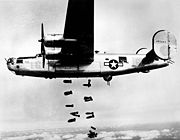 In September 1944, McGovern joined the 741st Squadron of the 455th Bombardment Group of the Fifteenth Air Force
, stationed at San Giovanni Airfield nearby Cerignola
in the Apulia
region of Italy. There he and his crew found a starving, disease-ridden local population wracked by the ill fortunes of war and far worse off than anything they had seen back home during the Depression. (The sights would be part of his later motivation to fight hunger.) Starting on November 11, 1944, McGovern flew 35 missions over enemy territory from there, the first five as co-pilot for an experienced crew and the rest as pilot for his own plane, known as the Dakota Queen
after his wife Eleanor. His targets were in Austria, Czechoslovakia
, Germany, Hungary, Poland, and northern, German-controlled Italy, and were often either oil refinery
complexes or rail marshalling yards, all as part of the U.S. strategic bombing campaign in Europe. The eight- or nine-hour missions were grueling tests of endurance for pilots, and while German fighter aircraft were a diminished threat by then, his missions often faced heavy anti-aircraft artillery fire that filled the sky with flak bursts.
On McGovern's December 15 mission over Linz
, his second as pilot, a piece of shrapnel from flak came through the windshield and missed killing him by only a few inches. The following day on a mission to Brüx
he nearly collided with another bomber during close-formation flying in complete cloud cover. The day after that he was recommended for a medal after surviving a blown wheel on the always-dangerous B-24 take-off, completing a mission over Germany, and then landing without further damage to the plane. On a December 20 mission against the Škoda Works
at Pilsen, McGovern's plane had one engine out and another in flames after being hit by flak. Unable to return to Italy, McGovern was able to land his plane on a British airfield on Vis
, a small island off the Yugoslav coast controlled by Josip Broz Tito
's Partisans
. The short field, normally used by small fighter planes, killed many of the bomber crews who tried to make emergency landings there, but McGovern successfully landed, saving his crew and earning him the Distinguished Flying Cross.
In January 1945, McGovern used R&R
time to see every sight he could in Rome and participate in an audience with the Pope. Bad weather prevented many missions from happening during the winter, and during downtime McGovern spent much time reading and discussing how the war had come about. He resolved that if he survived it, he would become a history professor. In February, McGovern was promoted to First Lieutenant
. On March 14, McGovern had an incident over Austria in which he accidentally bombed a family farm when a jammed bomb accidentally released above it and destroyed it, which McGovern felt guilty about. (Decades later, after a public appearance in that country, the owner of that farm came to the media to let the Senator know that he was the victim of that incident, but no one was hurt and felt it was worth the price if that event helped achieve the defeat of Nazi Germany
in some small way.) On return from the flight, McGovern was told his first child Ann had been born four days earlier. April 25 saw McGovern's 35th mission, to fulfill the USAAF limit for combat, against heavily defended Linz. The sky turned black and red with flak – McGovern later said "Hell can't be any worse than that" – the Dakota Queen was hit multiple times (producing 110 holes in its fuselage and wings) and the hydraulic system was knocked out. McGovern's waist gunner was injured and his flight engineer so terrified that he would be hospitalized with battle fatigue, but McGovern managed to bring back the plane safely with the assistance of an improvised landing technique.
In May and June 1945, following the end of the European war, McGovern flew food relief flights to northern Italy, then flew back to the United States with his crew. McGovern was discharged from the Army Air Forces in July 1945, with the rank of First Lieutenant. He was also awarded the Air Medal
with three oak leaf cluster
s, one instance of which was for the safe landing on his final mission.
degree magna cum laude. For a while he suffered from nightmares about flying through flak barrages or his plane being on fire. He continued with debate, again winning the state Peace Oratory Contest with a speech entitled "From Cave to Cave" that presented a Christian-influenced Wilsonian
outlook. The couple's second daughter, Susan, was born in March 1946.
McGovern switched from Wesleyan Methodism to less fundamental regular Methodism. Influenced by Walter Rauschenbusch
and the Social Gospel
movement, McGovern began divinity studies at Garrett Theological Seminary
in Evanston, Illinois
, near Chicago
. He preached as a United Methodist student supply minister at Diamond Lake Church in Mundelein, Illinois
during 1946 and 1947, but became dissatisfied by the minutiae of his pastoral duties. In late 1947, McGovern left the ministry and enrolled in graduate studies at Northwestern University
in Evanston, where he also worked as a teaching assistant. He received an M.A.
in history in 1949.
McGovern then returned to his alma mater, Dakota Wesleyan, and became a professor of history and political science. With the assistance of a Hearst fellowship for 1949–1950, he continued pursuing graduate studies during summers and other free time. The couple's third daughter, Teresa
, was born in June 1949. Eleanor McGovern began to suffer from bouts of depression, but continued to assume the large share of household and child-rearing duties. McGovern earned a Ph.D
in history from Northwestern University
in 1953. His 450-page dissertation, The Colorado Coal Strike, 1913–1914, was a sympathetic account of the miners' revolt against Rockefeller
interests in the Colorado Coalfield War. His thesis advisor, noted historian Arthur S. Link
, later said he had not seen a better student than McGovern in 26 years of teaching.
Nominally a Republican growing up, McGovern began to admire Democratic President Franklin Delano Roosevelt during World War II. At Northwestern, his exposure to the work of China scholars John King Fairbank and Owen Lattimore
had convinced him that unrest in Southeast Asia
was homegrown and that U.S. foreign policy towards Asia was counterproductive. Discouraged by the onset of the Cold War
, McGovern was attracted to the 1948 presidential campaign of former Vice President and Secretary of Agriculture Henry A. Wallace
. He volunteered for Wallace in South Dakota and attended the Wallace Progressive Party
's first national convention as a delegate
. After deciding there that Wallace was in the control of "fanatics", Communist and otherwise, he did not vote in the general election, although he supported the re-election of President Harry Truman.
Four years later, in 1952, he heard a radio broadcast of Governor Adlai Stevenson's speech accepting the presidential nomination of the Democratic Party
. He immediately dedicated himself towards Stevenson's campaign, publishing seven articles in Mitchell's Daily Republic newspaper outlining the historical issues that separated the Democratic Party from the Republicans. The McGoverns named their only son Steven, born immediately after the 1952 Democratic National Convention
, after his new hero. Although Stevenson lost the election, McGovern remained active in politics, believing that "the engine of progress in our time in America is the Democratic Party." In early 1953, McGovern left teaching to become executive secretary of the South Dakota Democratic Party
(the state chair having recruited him after reading his articles). Democrats in the state were at a low, holding no statewide offices and only 2 of the 110 seats in the state legislature. Friends and political figures had counseled McGovern against making the move, but despite his mild, unassuming manner, McGovern had an ambitious nature and was intent upon starting a political career of his own.
McGovern spent the following years rebuilding and revitalizing the party, building up a large list of voter contacts via frequent travel around the state. Democrats showed improvement in the 1954 elections, winning 25 seats in the state legislature. From 1954 to 1956 he also was on a political organization advisory group for the Democratic National Committee
. The McGoverns' fifth and final child, Mary, was born in 1955.
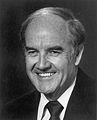 In 1956, McGovern sought elective office himself, and ran for the House of Representatives from South Dakota's 1st congressional district
, which consisted of the counties east of the Missouri River
. He faced four-term incumbent Republican Party Representative Harold O. Lovre. Aided by the voter lists he had earlier accumulated, he ran a low budget campaign, spending $12,000 while borrowing $5,000. McGovern's quiet personality appealed to voters he met, while Lovre suffered from a general unhappiness over Eisenhower administration farm policy. When polls showed McGovern gaining, Lovre's campaign implied that McGovern's support for admitting People's Republic of China
to the United Nations
and his past support for Henry Wallace meant that McGovern was a Communist appeaser or sympathizer. In his closing speech, McGovern responded: "I have always despised communism and every other ruthless tyranny over the mind and spirit of man." McGovern staged an upset victory, gaining 116,516 votes to his opponent's 105,835, and became the first Democrat elected to Congress from South Dakota in 22 years. The McGoverns established a home in Chevy Chase, Maryland
.
Entering the 85th United States Congress
, McGovern became a member of the House Committee on Education and Labor. As a representative, McGovern was attentive to his district. He became a staunch supporter of higher commodity prices, farm price supports, grain storage programs, and beef import controls, believing that such stored commodities programs guarded against drought and similar emergencies. He favored rural development, federal aid to small business and to education, and medical coverage for the aged under Social Security. In 1957, he traveled and studied conditions in the Middle East under a fellowship from the American Christian Palestine Committee. McGovern first allied with the Kennedy family
by supporting a House version of Senator John F. Kennedy's eventually unsuccessful labor reform bill.
In his 1958 reelection campaign, McGovern faced a strong challenge from South Dakota's two-term Republican Governor and World War II Medal of Honor
winner Joe Foss
, who was initially considered the favorite to win. But McGovern ran an effective campaign and was the
superior politician, possessing an acute sense of his political beliefs and the talent to articulate them. He prevailed with a slightly larger margin than two years before.
In the 86th United States Congress
, McGovern was assigned to the House Committee on Agriculture
. The longtime chair of the committee, Harold D. Cooley
, would subsequently say, "I cannot recall a single member of Congress who has fought more vigorously or intelligently for American farmers than Congressman McGovern." He helped pass a new food stamp law. He was one of nine representations from Congress to the NATO Parliamentary Assembly
conferences of 1958 and 1959. Along with Senator Hubert H. Humphrey, McGovern strongly advocated a reconstruction of the Agricultural Trade Development Assistance Act that had started under Eisenhower, with a greater emphasis on feeding the hungry around the world and the establishment of an executive office to run it. During his time in the House, McGovern was regarded as a liberal overall, and voted in accordance with the rated positions of Americans for Democratic Action
(ADA) 34 times and against 3 times. Two of the themes of his House career, improvements for rural America and the war on hunger, would be defining ones of his legislative career and public life.
In 1960, McGovern decided to run for the U.S. Senate and challenge the Republican incumbent Karl Mundt, a formidable figure in South Dakota politics whom McGovern loathed as an old-style McCarthyite. The race centered mostly around rural issues, but John F. Kennedy's Catholicism was a drawback at the top of the ticket in the Protestant state. McGovern made careless charges during the campaign and the press turned against him; he would say eleven years later, "It was my worst campaign. I hated [Mundt] so much I lost my sense of balance." McGovern was defeated in the November 1960 election, gaining 145,217 votes to Mundt's 160,579, but the margin was three times smaller than Kennedy's larger loss to Vice President Richard M. Nixon in the state's presidential contest.
program, which realized what McGovern had been advocating in the House. McGovern assumed the post on January 21, 1961.
As director, McGovern urged the greater use of food to enable foreign economic development, saying "We should thank God that we have a food abundance and use the over-supply among the under-privileged at home and abroad." He found space for the program in the Executive Office Building
rather than be subservient to either the State Department or Department of Agriculture. McGovern worked with deputy director James W. Symington
and Kennedy advisor Arthur M. Schlesinger, Jr. in visiting South America to discuss surplus grain distribution, and attended meetings of the United Nations
' Food and Agriculture Organization
. In June 1961, McGovern became seriously ill with hepatitis
, contracted from an infected White House dispensary needle used to give him inoculations for his South American trip; he was hospitalized and out of action for two months.
By the close of 1961, the Food for Peace program was operating in a dozen countries and 10 million more people had been fed with American surplus than the year before. In February 1962, McGovern visited India and oversaw a greatly expanded school lunch program thanks to Food for Peace; subsequently one of five Indian schoolchildren would be fed from it. Pope John XXIII
praised McGovern's work during an audience in Rome, and the distribution program was also popular among South Dakota's wheat farmers. In addition, McGovern was instrumental in the creation of the United Nations
-based World Food Programme
in December 1961; it started distributing food to stricken regions of the world the following year and would go on to become the largest humanitarian agency fighting hunger worldwide.
Administration was never McGovern's strength, however, and he was restless for another try at the Senate. With the approval of President Kennedy, McGovern resigned his post on July 18, 1962. Kennedy said that under McGovern the program had "become a vital force in the world", improving living conditions and economies of allies and creating "a powerful barrier to the spread of Communism". Schlesinger would later write that Food for Peace had been "the greatest unseen weapon of Kennedy's third-world policy."
. Case died in June, however, and McGovern instead faced an appointed senator, former Lieutenant Governor Joseph H. Bottum
. Much of the campaign revolved around policies of the Kennedy administration and its New Frontier
; Bottum accused the Kennedy family of trying to buy the Senate seat. McGovern appealed to those worried about the outflux of young people from the state, and had the strong support of the Farmers Union. Polls showed Bottum slightly ahead throughout the race and McGovern was hampered by a recurrence of his hepatitis problem in the final weeks of the campaign. (During this hospitalization, McGovern read Theodore H. White
's classic The Making of the President, 1960
and for the first time began thinking about running for the office someday.) Eleanor McGovern campaigned for her ailing husband and may well have saved his chances. The November 1962 election result was very close and required a recount, but McGovern's 127,458 votes prevailed by a margin of 597, making him the first Democratic senator from the state in 26 years and only the third since statehood in 1889.
When he joined the Senate in January 1963 for the 88th Congress, McGovern was seated on the Senate Agriculture and Forestry Committee
and Senate Interior and Insular Affairs Committee
. On the Agriculture Committee, McGovern supported high farm prices, full parity, and controls on beef importation, as well as the administration's Feed Grains Acreage Diversion Program. McGovern had a fractious relationship with Secretary of Agriculture Orville Freeman
, who was less sympathetic to farmers; McGovern's 1966 resolution to informally scold Freeman made the senator popular back in his home state. Fellow new senator Edward M. Kennedy saw McGovern as a serious voice on farm policy and often sought McGovern's guidance on agriculture-related votes. McGovern was largely inactive on the Interior Committee until 1967, when he was given chair of the Subcommittee on Indian Affairs. However, Interior chair Henry M. Jackson
, who did not get along with McGovern personally or politically, refused to allow McGovern his own staff, greatly limiting his effectiveness. McGovern regretted not accomplishing more for South Dakota's 30,000 Sioux Indians, although after a McGovern-introduced resolution on Indian self-determination passed in 1969, the Oglala Sioux named McGovern "Great White Eagle".
In his first speech on the Senate floor in March 1963, McGovern praised Kennedy's Alliance for Progress
initiative, but spoke out against U.S. policy towards Cuba, saying that it suffered from "our Castro fixation". In August 1963, McGovern advocated reducing the $53 billion defense budget
by $5 billion; influenced by advisor Seymour Melman
, he held a special antipathy towards the doctrine of nuclear "overkill". McGovern would try to reduce defense appropriations or limit military expenditures in almost every year during the 1960s. He also voted against many weapons programs, especially missile and anti-missile systems, and also opposed military assistance to foreign nations. In 1964, McGovern published his first book, War Against Want: America's Food for Peace Program. In it he argued for expanding his old program, and a Senate measure he introduced was eventually passed, adding $700 million to the effort's funding.
Preferring to focus on broad policy matters and speeches, McGovern was not a master of Senate legislative tactics, and developed a reputation among some other senators for "not doing his homework". Described as "a very private, unchummy guy", he was not a member of the Senate "club" nor did he want to be, turning down in 1969 a chance to join the powerful Senate Rules Committee. Relatively few pieces of legislation would bear his name and his legislative accomplishments were generally viewed as modest, although he would try to influence the contents of others' bills. In terms of ideology, McGovern fit squarely within modern American liberalism
; through 1967 his ADA senate score was 92, and when unbriefed on a particular matter, he would ask his staff, "What are the liberals doing?"
and other recent developments, and with concerns influenced by Vietnam historian Bernard Fall, McGovern said:
However, the speech was little noticed, and McGovern backed away from saying anything publicly for over a year afterward, partly because of the November 1963 assassination of President Kennedy and partly to not appear strident. Though more skeptical about it than most senators, McGovern voted in favor of the August 1964 Gulf of Tonkin Resolution
, which turned out to be an essentially unbounded authorization for President Lyndon B. Johnson
to escalate U.S. involvement in the war. McGovern thought the commander-in-chief should be given limited authority to retaliate against an attack; subsequently he said his instinct had been to vote no, but that he had voted yes based on Senator J. William Fulbright
's urging to stand behind Johnson politically. Indeed, the day after the resolution vote, McGovern spoke concerning his fears that the vote would lead to greater involvement in the war; Wayne Morse
, one of only two senators to oppose the resolution, sardonically noted that this fell into the category of "very interesting, but very belated". This would become the vote that McGovern most bitterly regretted.
In January 1965, McGovern made his first major address on Vietnam, saying that "We are not winning in South Vietnam. ... I am very much opposed to the policy, now gaining support in Washington, of extending the war to the north." McGovern instead proposed a five-point plan advocating a negotiated settlement involving a federated Vietnam with local autonomy and a UN presence to guarantee security and fair treatment. The speech gave McGovern national visibility as one of the "doves" in the debate over Vietnam. However, McGovern made moderate-to-hawkish statements at times too, flatly rejecting unconditional withdrawal of U.S. forces and criticizing anti-war draft-card burning
s as "immature, impractical, and illegal". In November 1965, McGovern travelled to South Vietnam for three weeks. The human carnage he saw in hospital wards deeply upset him, and he became increasingly outspoken about the war upon his return, more convinced than ever that Vietnam was a political not military problem. Now he was ready, as he later said, "not merely to dissent, but to crusade" against the war.
McGovern voted in favor of Vietnam military appropriations in 1966 through 1968, not wanting to deprive U.S. forces of necessary equipment. Nevertheless, his anti-war rhetoric increased throughout 1967. Over the years, Johnson had invited McGovern and other Senate doves to the White House
for attempts to explain the rationale for his actions in Vietnam; McGovern came away from the final such visit, in August 1967, shaken by the sight of a president "tortured and confused ... by the mess he has gotten into in Vietnam."
founded the Dump Johnson movement
, and soon they were seeking a Democratic Party figure to make a primaries campaign challenge against Johnson in the 1968 presidential election
. Their first choice was Senator Robert Kennedy, who declined, as did another, and by late September 1967 they approached McGovern. After much deliberation McGovern declined, largely because he feared such a run would significantly damage his own chances for reelection to his Senate seat in 1968. A month later the anti-Johnson forces were able to convince Senator Eugene McCarthy
to run, who was one of the few "dove" senators not up for reelection that year.
The 1968 Democratic primaries unfolded with McCarthy staging a strong showing and Robert Kennedy entering, followed by Johnson withdrawing and Vice President Humphrey running instead. While McGovern favored Kennedy privately, McCarthy and Humphrey were from a neighboring state and publicly McGovern remained neutral throughout. McGovern hosted all three as they campaigned for the June 4 South Dakota Democratic primary, which resulted in a strong win by Kennedy to go along with his win in the crucial California primary that night. McGovern spoke with Kennedy by phone minutes before Kennedy was assassinated in Los Angeles
. The death of Bobby Kennedy left McGovern the most emotionally distraught he had ever been to this point in his life.
Within days, some of Kennedy's aides were urging McGovern to run in his place; their antipathy towards McCarthy and ideological opposition to Humphrey made them unwilling to support either candidate. McGovern delayed making a decision, making sure that Ted Kennedy did not want to enter, and with his staff still concerned about the senator's own reelection prospects. Indeed McGovern's voting had changed during 1968, with his ADA rating falling to 43 as he sought more middle-of-the-road stances. In late July, McGovern's decision became more complicated when his daughter Teresa was arrested in Rapid City, South Dakota
on marijuana possession
charges. She had led a troubled life since her teenage years, developing problems with alcohol and depression and suffering the consequences of a relationship with an unstable neighborhood boy. Based on a recently enacted strict state drugs law, Terry now faced a minimum five-year prison sentence if found guilty. McGovern was also convinced that the socially conservative voters of South Dakota would reject him due to his daughter's arrest. Charges against her were subsequently dropped due to a technically invalid search warrant.
McGovern formally announced his candidacy on August 10, 1968 in Washington, two weeks in advance of the 1968 Democratic National Convention
, committing himself to "the goals for which Robert Kennedy gave his life." Asked why he was a better choice than McCarthy, he said, "Well – Gene really doesn't want to be President, and I do." At the convention in Chicago, Humphrey was the near-certain choice while McGovern became the initial rallying point for around 300 leaderless Kennedy delegates. The chaotic circumstances of the convention found McGovern denouncing as "police brutality" the Chicago police tactics against demonstrators. It was very difficult for McGovern to gain in delegate strength given the internal politics of the party, and black protest candidate Channing E. Phillips
drew off some of his support. In the actual roll call, McGovern came in third with 146½ delegates, far behind Humphrey's 1760¼ and McCarthy's 601.
McGovern endorsed Humphrey at the convention, to the dismay of some anti-war figures who considered it a betrayal. Humphrey went on to lose the general election to Richard Nixon. McGovern returned to his Senate reelection race, facing Republican former Governor Archie M. Gubbrud
. While South Dakota voters sympathized with McGovern over his daughter's arrest, he initially suffered a substantial drop in popularity over the events in Chicago. However, McGovern conducted an energetic campaign that focused on his service to the state, while Gubbrud ran a lackluster effort. In November, McGovern won 57 percent of the vote in what he would consider the easiest and most decisive victory of his career.
; due to the influence of former McCarthy and Kennedy supporters on the staff, the commission significantly reduced the role of party officials and insiders in the nomination process, increased the role of caucus
es and primaries
, and mandated quotas for proportional black, female, and youth delegate representation. A somewhat unintended consequence of the McGovern Commission's reforms was a massive increase in the number of presidential primaries; this became true for the Republican Party as well. The U.S. presidential nominating process has been different ever since, with scholars debating whether all the changes are for the better.
In the wake of several high-profile reports about hunger and malnutrition
in the United States, the Senate Select Committee on Nutrition and Human Needs
had been created in July 1968, with McGovern as its chair. Seeking to dramatize the problem, in March 1969 McGovern took the committee to Immokalee, Florida
, the base for 20,000 mostly black or Hispanic migrant farm workers. They saw graphic examples of hunger and malnutrition firsthand, but also encountered resistance and complaints about bad publicity from local and state officials. McGovern battled the Nixon administration and Southerners in Congress during much of the next year over an expanded food stamp program; he had to compromise on a number of points, but legislation signed in 1970 established the principles of free food stamps and a nationwide standard for eligibility.
McGovern generally lacked both interest and expertise in economics
, but was outspoken in reaction to Nixon's imposition of wage and price controls in 1971. McGovern declared: "This administration, which pledged to slow inflation and reduce unemployment, has instead given us the highest rate of inflation and the highest rate of unemployment in a decade."
A 1971 60 Minutes
detailed his support of desegregation busing while Washington, D.C. resident McGovern simultaneously paid tuition for his own daughter to attend Bethesda, Maryland
public schools, which were only 3 percent black.
But most of all, McGovern was known for his continued opposition to the Vietnam War. In March 1969, he became the first senator to explicitly criticize the new president's policy there, an action that was seen as a breach of customary protocol by other Senate doves. By the end of 1969, McGovern was calling for an immediate cease-fire and a total withdrawal of all American troops within a year. In October 1969, McGovern was a featured speaker before 100,000 demonstrators in Boston at the Moratorium to End the War in Vietnam
, and in November he spoke before 350,000 at Moratorium/Mobilization
's anti-war march to the Washington Monument
. Afterward, he decided that radicalized peace demonstrations were counterproductive and criticized anti-war figures such as Rennie Davis
, Tom Hayden
, Huey Newton, Abby Hoffman, and Jerry Rubin
as "reckless" and "irresponsible".
Instead, McGovern focused on legislative means to bring the war to an end. The McGovern–Hatfield Amendment to the annual military procurement bill, co-sponsored by Republican Mark Hatfield
of Oregon, required via funding cutoff a complete withdrawal of all American forces from Indochina by the end of 1970. It underwent months of public discussion and alterations to make it acceptable to more senators, including pushing the deadline out to the end of 1971. In May 1970, McGovern obtained a second mortgage
on his Washington home in order to fund a half-hour televised panel discussion on the amendment on NBC
. The broadcast brought in over $500,000 in donations that furthered work on passage, and eventually the amendment gained the support of the majority of the public in polls. The effort was denounced by opposition groups organized by White House aide Charles Colson
, which called McGovern and Hatfield "apostles of retreat and defeat" and "salesmen of surrender" and maintained that only the president could conduct foreign policy. The amendment was defeated in September 1970 by a 55–39 vote, just short of what McGovern had hoped would constitute at least a moral victory
. During the floor debate McGovern criticized his colleagues opposing the measure:
The Senate reacted in startled, stunned silence, and some faces showed anger and fury; when one member told McGovern he had been personally offended by the speech, McGovern said, "That's what I meant to do." McGovern believed Vietnam an immoral war that was destroying much of what was pure, hopeful, and different about America's character as a nation.
The defeat of the amendment left McGovern embittered and somewhat more radicalized. He accused Vice President of South Vietnam Nguyen Cao Ky
of running a heroin trafficking operation that was addicting American soldiers. In a retort to the powerful Senate Armed Services Committee
chairman John Stennis' suggestion that U.S. troops might have to return to Cambodia, McGovern declared, "I'm tired of old men dreaming up wars for young men to fight. If he wants to use American ground troops in Cambodia, let him lead the charge himself." He denounced Nixon's policy of Vietnamization
as "subsidiz[ing] the continued killing of the people of Indochina by technology and mercenaries." In a Playboy
interview, he said that Ho Chi Minh
was the North Vietnamese George Washington
.
McGovern–Hatfield was put up for a vote again in 1971, with somewhat weaker provisions designed to gain more support. In polls, a large majority of the public now favored its intent, and McGovern took his name off a final form of it, as some senators were just objecting to him. Nevertheless, in June 1971 it failed to pass again, gaining only a few more votes than the year before. McGovern was now certain that the only way the war would come to a quick end was if there was a new president.
Edmund Muskie
did worse than expected in the New Hampshire primary
and McGovern came in a close second. While Muskie's campaign funding and support dried up, McGovern picked up valuable momentum in the following months. Gary Hart
, who became a presidential contender 12 years later, was McGovern's campaign manager and future president Bill Clinton
(with assistance from his future wife Hillary Rodham) managed the McGovern campaign's operations in Texas. Despite losing several primaries, including Florida to George Wallace
, McGovern secured enough delegates to the 1972 Democratic National Convention
to win the party's nomination.
McGovern ran on a platform that advocated withdrawal from the Vietnam War in exchange for the return of American prisoners of war and amnesty for draft evaders who had left the country.
McGovern's platform also included an across-the-board, 37% reduction in defense spending over three years; and a "demogrant" program (later dropped from the platform) that would replace the personal income tax exemption with a $1,000 tax credit as a minimum-income floor for every citizen in America, to replace the welfare bureaucracy and complicated maze of existing public-assistance programs. Its concept (a conservative one) was similar to the negative income tax
long advocated by economist Milton Friedman, and by the Nixon Administration in the form of the Family Assistance Program, which called for a minimum family grant of $1,600 per year, later raised to $2,400. The personal income tax exemption later became $1,000 under President Reagan. (As Senator, McGovern had previously sponsored a bill, submitted by the National Welfare Rights Organization, for $6,500 guaranteed minimum income
per year to families, based on need.) In addition, McGovern supported ratification of the Equal Rights Amendment
.
McGovern became tagged with the label "amnesty, abortion and acid", supposedly reflecting his positions.
Just over two weeks after the 1972 Democratic Convention, it was revealed that McGovern's running mate, Thomas Eagleton
, had received electroshock therapy for clinical depression
during the 1960s. McGovern initially supported Eagleton, in part because he saw parallels with his daughter Terry's battles with mental illness. Though many people still supported Eagleton's candidacy, an increasing number of influential politicians and columnists questioned his ability to handle the office of Vice President. The resulting negative attention, combined with McGovern's consultation with preeminent psychiatrists including Eagleton's own doctors, prompted McGovern to accept Eagleton's offer to withdraw from the ticket. Five prominent Democrats publicly turned down McGovern's offer of the VP slot. Finally he was able to name United States Ambassador to France
Sargent Shriver
, a brother-in-law of John F. Kennedy. This occurred after McGovern had stated publicly he was still "... behind Eagleton 1000 percent
"; reneging on that statement a few days later made McGovern look indecisive. The Eagleton controversy also put the McGovern campaign off message and was speculated at the time to perhaps be a harbinger of what would become McGovern's subsequent landslide loss. McGovern himself would long view the Eagleton affair as having been "catastrophic" for his campaign.
The McGovern Commission changes to the convention rules marginalized the influence of establishment Democratic figures (some of whom had lost the nomination to McGovern). Many refused to support him, with some switching their support to the incumbent President Nixon through a campaign effort called "Democrats for Nixon
". In addition, McGovern was repeatedly attacked by associates of Nixon, including the infamous Watergate break-in, which eventually led to Nixon's resignation in 1974.
An infamous incident took place late in the campaign. McGovern was giving a speech and a Nixon admirer kept heckling him. McGovern called the young man over and whispered in his ear, "Listen, you son-of-a-bitch, why don't you kiss my ass?" The heckler confirmed the exchange when asked by a journalist, and the remark was widely reported. By the following night, "KMA" buttons were being worn by people in the crowds at McGovern rallies. Several years later, McGovern observed Mississippi
Senator James Eastland
looking at him from across the Senate floor and chuckling to himself. He subsequently approached McGovern and asked, "Did you really tell that guy in '72 to kiss your ass?" When McGovern smiled and nodded, Eastland replied, "That was the best line in the campaign." McGovern later wrote, "I don't know whether the incident won or lost me votes. It probably did both... Some staff members frantically insisted that I issue a denial or retraction immediately. I did no such thing. I went to bed and slept soundly."
In the general election, the McGovern/Shriver ticket suffered a 61%-37% defeat to Nixon– at the time, the second biggest landslide in American history, with Electoral College totals of 520 to 17. McGovern's two electoral vote victories came in Massachusetts
and Washington, D.C.; McGovern failed to win his home state of South Dakota, a state that had delivered for the Democrats in only three of the previous 18 presidential elections in the twentieth century.
One of the most memorable of the failings of McGovern's campaign was that, at the Democratic Convention, McGovern delivered his speech ("Come home America!") at 3 in the morning, reaching an audience of probably less than one million. This was supposedly the result of McGovern either repaying favors or yielding to pressure to give more than a dozen interest groups what were supposed to be two or three minutes of face time on network TV. Most of these special-interest speakers ignored time limits, with the result that McGovern spoke to a more-than-half-empty auditorium.
McGovern would later say of not emphasizing his war record more during the campaign: "I think it was a political error, but I always felt kind of foolish talking about my war record—what a hero I was. How do you do that? ... [I]t was not in my nature to turn the campaign into a constant exercise in self-congratulatory autobiography."
that talked about the abuses of Nixon's presidency; it brought criticism, including from some Democrats, for being ill-mannered. In order to get past the "bitterness and self-pity" he felt, McGovern forced himself to deal with the defeat humorously before audiences; starting at the March 1973 Gridiron Dinner, he frequently related his campaign misadventures in a self-deprecating fashion, such as saying, "For many years, I wanted to run for the Presidency in the worst possible way – and last year I sure did." (Nevertheless, emotions surrounding the loss would remain with McGovern for decades, as it did with some other defeated presidential nominees.) Nixon resigned in August 1974 due to the Watergate scandal
. McGovern said President Gerald R. Ford's subsequent September 1974 pardon of Nixon was difficult to understand given that Nixon's subordinates were going to prison.
McGovern displayed the political resiliency he had shown in the past. In the 1974 U.S. Senate elections, McGovern was initially in trouble for having neglected the state during his long presidential campaign, and by May 1973 had already begun campaigning for re-election. An Air Force pilot and Medal of Honor
winner, Leo K. Thorsness
, had just been repatriated after six years as a prisoner of war
in North Vietnam; he publicly accused McGovern of having given aid and comfort to the enemy and of having prolonged his time as a POW. McGovern replied that if there had been no war there would have been no POWs, and that everything he had done had been towards the goal of ending the war sooner. Thorsness became the Republican nominee against McGovern, but despite the two men's different roles in it, the war did not become a significant issue. Instead, the campaign was dominated by farm policy differences and economic concerns over the 1973–75 recession
. Thorsness charged McGovern with being a "part-time senator" more concerned with national office and with spending over $2 million on his re-election bid, while McGovern labelled Thorsness a carpetbagger
due to his having grown up in Minnesota. In a year in which Democrats were advantaged by the aftereffects of the Watergate scandal, McGovern won re-election in November 1974 with 53 percent of the vote.
Following the victory, McGovern harbored thoughts of running in the 1976 presidential election
, but given the magnitude of his presidential defeat, the Democratic Party wanted nothing to do with him then or later. Unfamiliar and uncomfortable with Democratic nominee Jimmy Carter
, McGovern secretly voted for Ford instead.
McGovern's Select Committee on Nutrition and Human Needs
expanded its scope to include national nutrition policy. In 1977, it issued a new set of nutritional guidelines for Americans that sought to combat leading killer health conditions. Titled Dietary Goals for the United States, but also known as the "McGovern Report", it suggested that Americans eat less fat, less cholesterol, less refined and processed sugars, and more complex carbohydrates and fiber. While many public health officials had said all of this for some time, the committee's issuance of the guidelines gave it higher public profile. The recommendations proved controversial with the cattle, dairy, egg, and sugar industries, including from McGovern's home state. The McGovern committee guidelines led to reorganization of some federal executive functions and became the predecessor to the more detailed Dietary Guidelines for Americans later issued twice a decade by the Center for Nutrition Policy and Promotion
.
In the 1980 Senate election in South Dakota
, McGovern was one of several liberal Democratic senators targeted for defeat by the National Conservative Political Action Committee
(NCPAC), which put out a year's worth of negative portrayals of McGovern. They and other pro-life
groups especially focused on McGovern's support for pro-choice
abortion laws. McGovern faced a Democratic primary challenge for the first time, from a pro-life candidate. McGovern's Republican opponent was James Abdnor
, a four-term incumbent congressman who held identical positions to McGovern on farm issues, was solidly conservative on national issues, and was well liked within the state. Abdnor's campaign focused on both McGovern's liberal voting record and what it said was McGovern's lack of involvement in South Dakota affairs. McGovern made an issue of NCPAC's outside involvement, and that group eventually withdrew from the campaign after Abdnor denounced a letter they had sent out. Far behind in the polls earlier, McGovern outspent Abdnor 2-to-1, hammered away at Abdnor's refusal to debate him (drawing attention to a slight speech defect Abdnor had), and, showing the comeback pattern of some of his past races in the state, closed the gap for a while. However, in November 1980 McGovern was solidly defeated for re-election, getting only 39 percent of the vote to Abdnor's 58 percent. McGovern became one of many Democratic casualties of that year's Republican sweep, which became known as the "Reagan Revolution".
and other new Christian right
forces. In 1982, he turned the group into a political action committee
, which raised $1.2 million for liberal candidates in the 1982 U.S. Congressional elections. McGovern shut the committee down when he decided to run for president again.
McGovern also began teaching and lecturing at a number of universities in the U.S. and Europe, accepting one-year contracts or less. From 1981 to 1982, McGovern replaced historian Stephen Ambrose
as a professor at the University of New Orleans
. McGovern also began making frequent speeches, earning several hundred thousand dollars a year.
McGovern attempted another presidential run in the 1984 Democratic Presidential nomination primaries
. Friends and political admirers of McGovern initially feared the effort would prove an embarrassment, and McGovern knew himself that his chances of winning were remote, but he felt compelled to try to influence the intraparty debate in a liberal direction. Freed from the practical concerns of trying to win, McGovern outlined a ten-point program of sweeping domestic and foreign policy changes; not seen as a threat, fellow competitors did not attack his positions and media commentators praised him as the "conscience" of the Democratic Party.
While having name recognition, McGovern had little funding or staff (although he did garner critical funding from some prominent celebrities and statesmen
). He won a surprise third-place showing in the Iowa caucuses amidst a crowded field of candidates, but finished fifth in the New Hampshire primary
. He announced he would drop out unless he finished first or second in the Massachusetts primary, and when he came in third behind his former campaign manager Gary Hart
and former Vice President Walter Mondale
, he made good on his promise. He later endorsed Mondale, the eventual Democratic nominee. To help pay off his campaign debt, McGovern hosted Saturday Night Live
on April 14, 1984.
McGovern addressed the party's platform committee and his name was placed in nomination at the 1984 Democratic National Convention
, where he delivered a speech that strongly criticized President Reagan and praised Democratic unity. He received the votes of four delegates. He went on to actively support the Mondale-Geraldine Ferraro
ticket, whose eventual landslide defeat bore some similarities to his own in 1972.
During the 1980s, McGovern was a fellow at the Institute for Policy Studies
think tank in Washington.
McGovern had made several real estate investments in the D.C. area and became interested in hotel operations. In 1988, using the money he had earned from his speeches, the McGoverns bought, renovated, and began running a 150-room inn in Stratford, Connecticut
, with the goal of providing a hotel, restaurant and public conference facility. It went into bankruptcy in 1990 and closed the following year. In 1992, McGovern's published reflections on the experience appeared in The Wall Street Journal
and the Nation's Restaurant News
. He attributed part of the failure to the early 1990s recession, but also part to the cost of dealing with federal, state and local regulations that were passed with good intentions but made life difficult for small businesses, and to the cost of dealing with frivolous lawsuits. McGovern wrote, "I ... wish that during the years I was in public office I had had this firsthand experience about the difficulties business people face every day. That knowledge would have made me a better U.S. senator and a more understanding presidential contender."
After briefly exploring in early 1991 another presidential run in the 1992 contest
,
instead in July 1991 McGovern became president of the Middle East Policy Council
(having previously served on its board since 1986), a non-profit organization that seeks to educate American citizens and policy makers about the political, economic and security issues impacting U.S. national interests in the Middle East. He held this position from until 1997 when he was replaced by Charles W. Freeman, Jr.
On the night of December 12–13, 1994, McGovern's daughter Teresa
fell into a snowbank in Madison, Wisconsin
while heavily intoxicated and died of hypothermia
. Heavy press attention followed, and McGovern revealed his daughter had battled her alcoholism
for years and had been in and out of many treatment programs while having one extended period of sobriety. He authored an account of her life, Terry: My Daughter's Life-and-Death Struggle with Alcoholism, published in 1996; it presented a harrowing, unsparing view of the depths to which she had descended, the torment that he and the rest of his family had experienced in trying unsuccessfully to help her, and his ongoing thoughts and guilt about whether the demands of his political career and the time he had spent away from the family had made things worse for her. The book was a modest best seller, and with the proceeds he founded the Teresa McGovern Center in Madison to help others suffering from the combination of alcoholism and mental health problems. He would later say that Terry's death was by far the most painful event in his life: "You never get over it, I'm sure of that. You get so you can live with it, that's all."
, serving in Rome, Italy, after having been named to the post by President Bill Clinton
. In an effort to meet the UN's goal of reducing the number of hungry people in the world by half, he urged delivery of more surplus food to foreign school-lunch programs and the establishment of specific targets such as had been done in old American programs. He began working again with fellow former Senator Bob Dole
to convince the Senate to support this effort, as well as expanded school lunch, food stamps, and nutritional help for pregnant women and poor children in the U.S.
The George McGovern–Robert Dole International Food for Education and Nutrition Program that was created in 2000, and funded largely through the Congress, would go on to provide more than 22 million meals to children in 41 countries over the next eight years. It was also credited with improving school attendance, especially among girls, who were more likely to be allowed to go to school if a meal was being provided. In August 2000, President Clinton presented McGovern with the Presidential Medal of Freedom
, the nation's highest civilian honor, in recognition of McGovern's humanitarian service in the effort to eradicate world hunger. McGovern's book The Third Freedom: Ending Hunger In Our Time was published in January 2001; with its title making reference to Roosevelt's Four Freedoms speech, it proposed a plan whereby chronic world hunger could be eliminated within thirty years. In January 2001, McGovern was asked to stay on at the UN post for a while by the incoming George W. Bush administration
, then concluded his stint in September 2001.
In October 2001, McGovern was appointed as the first UN Global Ambassador on World Hunger by the World Food Programme
, the agency he had helped found forty years earlier. He remains in this Goodwill Ambassador
position as of 2011. McGovern is an honorary life member of the board of Friends of the World Food Program. McGovern also currently serves as a Senior Policy Advisor at Olsson Frank Weeda
, a food and drug regulatory counseling law and lobbying firm in Washington, D.C., where he specializes on issues of food, nutrition, and agriculture.
McGovern's wartime story was at the center of Ambrose's 2001 best-selling profile of the men who flew B-24s over Germany in World War II, The Wild Blue
. It was the first time much of the public became familiar with that part of his life; throughout his political career, McGovern had rarely mentioned his war service or the medals he had won.
McGovern continued to lecture and make public appearances, sometimes appearing with Dole on college campuses. McGovern and Dole contributed essays to the 2005 volume Ending Hunger Now: A Challenge to Persons of Faith. From around 2003 to 2005, McGovern owned a bookstore in his summer home of Stevensville
in Montana
's Bitterroot Valley
, until deciding to sell it due to lack of sufficient market. In 2003, the McGoverns became part-time residents of Marco Island, Florida
; by then, Eleanor was struggling with heart disease
.
In October 2006, the $8.5 million George and Eleanor McGovern Library and Center for Leadership and Public Service was dedicated at Dakota Wesleyan University
. It seeks to prepare the college's best students for future careers in public service through classes, seminars, research, and internships, and also to raise the visibility of the university. The dignitaries in attendance were led by former President Clinton.
McGovern's wife Eleanor was too ill to attend the ceremony, and she died of heart disease on January 25, 2007, at their home in Mitchell, South Dakota.
Later in 2007, several events were held at Dakota Wesleyan and in Washington, D.C., to celebrate McGovern's 85th birthday and the 35th anniversary of his nomination for president. Hundreds of former staff, volunteers, supporters and friends attended, along with public officials.
McGovern still sought to have his voice heard in the American political scene.
He became a vocal opponent of the Iraq War, likening U.S. involvement in that country to that of the failed Vietnam effort, and in 2006 co-wrote the book Out of Iraq: A Practical Plan for Withdrawal Now.
In January 2008, McGovern wrote an op-ed in The Washington Post
calling for the impeachment of President George W. Bush
and Vice-President Dick Cheney
, saying they had violated the U.S. Constitution, transgressed national and international law, and repeatedly lied to the American people. The subtitle of the article read "Nixon Was Bad. These Guys Are Worse."
In the tumultuous 2008 Democratic Party presidential nomination campaign
, he first endorsed U.S. Senator Hillary Rodham Clinton
, then later switched to Senator Barack Obama
after concluding Clinton could no longer win.
On October 16, 2008, McGovern and Dole were made World Food Prize
laureates, for their for their efforts to curb hunger in the world and in particular for their joint program for school feeding and enhanced school attendance.
By 2009, McGovern had moved to St. Augustine Beach, Florida
, as a new seasonal resident, citing the history and beauty of the area.
By now a prolific writer, McGovern's seventh book (as author, co-author, or contributing editor) in the decade of the 2000s, Abraham Lincoln, was published by Times Books
and released at the close of 2008. Throughout 2009, McGovern embarked on a book tour, including a prominent visit to the Nixon Presidential Library and Museum in August 2009.
columnist Bob Greene
wrote, "Once again politicians– mostly Republicans, but some Democrats, too– are using his name as a synonym for presidential campaigns that are laughable and out of touch with the American people." According to Daniel McCarthy of The American Conservative
, the Republican Party began to act after 1972 as if "every Democratic leader, no matter how Southern, how pro-war, how middle-of-the-road, is really a McGovernite. Indeed, for nearly 40 years the conservative movement has defined itself in opposition to the Democratic standard-bearer of 1972. Anti-McGovernism has come to play for the Right the unifying role that anticommunism once played, much to the detriment of older principles such as limited government, fiscal continence, and prudence in foreign policy." McGovern later said in 2001 that his image had been exaggerated: "I am a liberal and always have been – just not the wild-eyed character the Republicans made me out to be." He continues to feel that he was marginalized with his views miscast; in 2006 he said, "How the hell do you get elected in South Dakota for twenty years if you're a wild-eyed radical?" Despite his reputation as a dovish liberal, McGovern has publicly stated he is not a pacifist
.
As Chairman of the Democratic Party's Commission on Party Structure and Delegate Selection in 1969-1970, McGovern helped institute major changes in Democratic party rules that continue to this day and, to a large degree, were ultimately adopted by the Republican Party as well.
He remains a symbol, or standard-bearer, of the political left, particularly in relation to the turbulent 1960s and early 1970s when the country was torn by U.S. involvement in the Vietnam War
and the corruption and abuse of power of the Nixon administration. McGovern recognized the mixed results of his 1972 candidacy, saying, "I opened the doors of the Democratic Party and 20 million people walked out." McGovern has also become more forceful in recent years in drawing historical parallels between the Nixon and Bush administrations and the Vietnam and Iraq wars. McGovern's post-political career has generally enhanced his reputation; Tom Brokaw
wrote in 1998 that "He remains one of the country's most decent and thoughtful public servants."
McGovern's legacy also includes his commitment to combating hunger both in the United States and around the globe. He has said, "After I'm gone, I want people to say about me: He did the best he could to end hunger in this country and the world." Overall, when confronted with the Serenity Prayer
's desire to "grant me the serenity to accept the things I cannot change," McGovern has said simply that he rejects that notion: "I keep trying to change them."
Print
Multimedia
United States House of Representatives
The United States House of Representatives is one of the two Houses of the United States Congress, the bicameral legislature which also includes the Senate.The composition and powers of the House are established in Article One of the Constitution...
, U.S. Senator
United States Senate
The United States Senate is the upper house of the bicameral legislature of the United States, and together with the United States House of Representatives comprises the United States Congress. The composition and powers of the Senate are established in Article One of the U.S. Constitution. Each...
, and the Democratic Party
Democratic Party (United States)
The Democratic Party is one of two major contemporary political parties in the United States, along with the Republican Party. The party's socially liberal and progressive platform is largely considered center-left in the U.S. political spectrum. The party has the lengthiest record of continuous...
nominee in the 1972 presidential election
United States presidential election, 1972
The United States presidential election of 1972 was the 47th quadrennial United States presidential election. It was held on November 7, 1972. The Democratic Party's nomination was eventually won by Senator George McGovern, who ran an anti-war campaign against incumbent Republican President Richard...
.
McGovern grew up in Mitchell, South Dakota
Mitchell, South Dakota
-Demographics:As of the census of 2000, there were 14,558 people, 6,121 households, and 3,599 families residing in the city. The population density was 1,475.7 people per square mile . There were 6,555 housing units at an average density of 664.4 per square mile...
, where he was a renowned debater. He volunteered for the U.S. Army Air Forces
United States Army Air Forces
The United States Army Air Forces was the military aviation arm of the United States of America during and immediately after World War II, and the direct predecessor of the United States Air Force....
upon the country's entry into World War II
World War II
World War II, or the Second World War , was a global conflict lasting from 1939 to 1945, involving most of the world's nations—including all of the great powers—eventually forming two opposing military alliances: the Allies and the Axis...
and as a B-24 Liberator
B-24 Liberator
The Consolidated B-24 Liberator was an American heavy bomber, designed by Consolidated Aircraft of San Diego, California. It was known within the company as the Model 32, and a small number of early models were sold under the name LB-30, for Land Bomber...
pilot flew 35 missions over German-occupied Europe. Among the medals awarded him was a Distinguished Flying Cross
Distinguished Flying Cross (United States)
The Distinguished Flying Cross is a medal awarded to any officer or enlisted member of the United States armed forces who distinguishes himself or herself in support of operations by "heroism or extraordinary achievement while participating in an aerial flight, subsequent to November 11, 1918." The...
for making a hazardous emergency landing of his damaged plane and saving his crew. After the war he gained degrees from Dakota Wesleyan University
Dakota Wesleyan University
Dakota Wesleyan University is a four-year university located in Mitchell, South Dakota, founded in 1885, that is affiliated with the United Methodist Church. The student body averages slightly less than 800 students...
and Northwestern University
Northwestern University
Northwestern University is a private research university in Evanston and Chicago, Illinois, USA. Northwestern has eleven undergraduate, graduate, and professional schools offering 124 undergraduate degrees and 145 graduate and professional degrees....
, culminating in a Ph.D
Doctor of Philosophy
Doctor of Philosophy, abbreviated as Ph.D., PhD, D.Phil., or DPhil , in English-speaking countries, is a postgraduate academic degree awarded by universities...
, and was a history professor. He was elected to the U.S. House of Representatives in 1956 and re-elected in 1958. After a failed bid for the U.S. Senate in 1960, he was elected to there in 1962.
As a senator, McGovern was an exemplar of modern American liberalism
Modern American liberalism
Modern American liberalism is a form of liberalism developed from progressive ideals such as Theodore Roosevelt's New Nationalism, Woodrow Wilson's New Freedom, Franklin D. Roosevelt's New Deal, John F. Kennedy's New Frontier, and Lyndon Johnson's Great Society. It combines social liberalism and...
. He became most known for his outspoken opposition to the growing U.S. involvement in the Vietnam War
Vietnam War
The Vietnam War was a Cold War-era military conflict that occurred in Vietnam, Laos, and Cambodia from 1 November 1955 to the fall of Saigon on 30 April 1975. This war followed the First Indochina War and was fought between North Vietnam, supported by its communist allies, and the government of...
. He staged a brief nomination run in the 1968 presidential election
United States presidential election, 1968
The United States presidential election of 1968 was the 46th quadrennial United States presidential election. Coming four years after Democrat Lyndon B. Johnson won in a historic landslide, it saw Johnson forced out of the race and Republican Richard Nixon elected...
as a stand-in for the assassinated Robert F. Kennedy
Robert F. Kennedy
Robert Francis "Bobby" Kennedy , also referred to by his initials RFK, was an American politician, a Democratic senator from New York, and a noted civil rights activist. An icon of modern American liberalism and member of the Kennedy family, he was a younger brother of President John F...
. The subsequent McGovern–Fraser Commission fundamentally altered the Democratic presidential nominating process, by greatly increasing the number of caucus
Caucus
A caucus is a meeting of supporters or members of a political party or movement, especially in the United States and Canada. As the use of the term has been expanded the exact definition has come to vary among political cultures.-Origin of the term:...
es and primaries
Primary election
A primary election is an election in which party members or voters select candidates for a subsequent election. Primary elections are one means by which a political party nominates candidates for the next general election....
and reducing the influence of party insiders. The McGovern–Hatfield Amendment sought to end the Vietnam War by legislative means but was defeated in 1970 and 1971. McGovern's long-shot, grassroots-based 1972 presidential campaign
George McGovern presidential campaign, 1972
George McGovern, a United States Senator from South Dakota, launched his second candidacy for the presidency of the United States in an ultimately unsuccessful bid for the 1972 presidential election.-Leading up to the announcement:...
found triumph in gaining the Democratic nomination but left the party badly split ideologically, and the failed vice-presidential pick of Thomas Eagleton
Thomas Eagleton
Thomas Francis Eagleton was a United States Senator from Missouri, serving from 1968–1987. He is best remembered for briefly being the Democratic vice presidential nominee under George McGovern in 1972...
undermined McGovern's credibility. In the general election McGovern lost to incumbent Richard Nixon
Richard Nixon
Richard Milhous Nixon was the 37th President of the United States, serving from 1969 to 1974. The only president to resign the office, Nixon had previously served as a US representative and senator from California and as the 36th Vice President of the United States from 1953 to 1961 under...
in one of the biggest landslides in American history. Re-elected Senator in 1968 and 1974, McGovern was defeated in a bid for a fourth term in 1980.
Throughout his career, McGovern has been involved in issues related to agriculture, food, nutrition, and hunger. As the first director of the Food for Peace
Food for Peace
Public Law 480 also known as Food for Peace is a funding avenue by which U.S. food can be used for overseas aid....
program in 1961, McGovern oversaw the distribution of U.S. surpluses to the needy abroad and was instrumental in the creation of the United Nations
United Nations
The United Nations is an international organization whose stated aims are facilitating cooperation in international law, international security, economic development, social progress, human rights, and achievement of world peace...
-based World Food Programme
World Food Programme
The World Food Programme is the food aid branch of the United Nations, and the world's largest humanitarian organization addressing hunger worldwide. WFP provides food, on average, to 90 million people per year, 58 million of whom are children...
. As sole chair of the Senate Select Committee on Nutrition and Human Needs
United States Senate Select Committee on Nutrition and Human Needs
The United States Senate Select Committee on Nutrition and Human Needs was a select committee of the United States Senate between 1968 and 1977. It was sometimes referred to as the McGovern committee, after its only chairperson, Senator George McGovern of South Dakota.-Formation and members:The...
from 1968–1977, McGovern publicized the problem of hunger within the United States and issued the "McGovern Report" that led to a new set of nutritional guidelines for Americans. McGovern later served as U.S. Ambassador to the United Nations Agencies for Food and Agriculture
United States Ambassador to the United Nations Agencies for Food and Agriculture
The United States Ambassador to the United Nations Agencies for Food and Agriculture is the head of the United States Mission to the UN Agencies in Rome and thus is the United States ambassador to the three United Nations agencies for food and agriculture located in Rome, Italy: the Food and...
from 1998–2001 and was appointed the first UN Global Ambassador on World Hunger by the World Food Programme in 2001. The McGovern-Dole International Food for Education and Child Nutrition Program
McGovern-Dole International Food for Education and Child Nutrition Program
The McGovern-Dole International Food for Education and Child Nutrition Program is a food aid program authorized in the 2002 farm bill which provides for the donation of U.S. agricultural commodities and associated financial and technical assistance to carry out preschool and school feeding...
has provided school meals for millions of children in dozens of countries since 2000 and resulted in McGovern being named World Food Prize
World Food Prize
The World Food Prize is an international award recognizing the achievements of individuals who have advanced human development by improving the quality, quantity or availability of food in the world.-The Prize:...
co-laureate in 2008.
Early life and early education
McGovern was born in the 600-person farming community of Avon, South DakotaAvon, South Dakota
Avon is a city in Bon Homme County, South Dakota, United States. The population was 590 at the 2010 census.-Geography:Avon is located at .According to the United States Census Bureau, the city has a total area of , all of it land....
. His father, Reverend Joseph C. McGovern (born 1868), was pastor of the local Wesleyan Methodist Church there. Joseph had once worked in mines and then been a professional baseball player in the minor leagues
Minor league baseball
Minor league baseball is a hierarchy of professional baseball leagues in the Americas that compete at levels below Major League Baseball and provide opportunities for player development. All of the minor leagues are operated as independent businesses...
, but had given the latter up due to the heavy drinking, gambling, and womanizing of his teammates, and entered the seminary instead. George's mother was the former Frances McLean (born c. 1890), who had been born in Toronto
Toronto
Toronto is the provincial capital of Ontario and the largest city in Canada. It is located in Southern Ontario on the northwestern shore of Lake Ontario. A relatively modern city, Toronto's history dates back to the late-18th century, when its land was first purchased by the British monarchy from...
, Canada; her family had later moved to Calgary
Calgary
Calgary is a city in the Province of Alberta, Canada. It is located in the south of the province, in an area of foothills and prairie, approximately east of the front ranges of the Canadian Rockies...
and then she came to South Dakota looking for work as a secretary. George was the second oldest of four children. Joseph McGovern's salary never reached $100 per month, and he often received compensation in the form of potatoes, cabbages, or other food items. Joseph and Frances McGovern were both firm Republican
Republican Party (United States)
The Republican Party is one of the two major contemporary political parties in the United States, along with the Democratic Party. Founded by anti-slavery expansion activists in 1854, it is often called the GOP . The party's platform generally reflects American conservatism in the U.S...
s, but were not politically active or doctrinaire.
Calgary Stampede
The Calgary Stampede is an annual rodeo, exhibition and festival held every July in Calgary, Alberta, Canada. The ten-day event, which bills itself as "The Greatest Outdoor Show on Earth", attracts over one million visitors per year and features one of the world's largest rodeos, a parade, midway,...
. While living there, Charles Lindbergh
Charles Lindbergh
Charles Augustus Lindbergh was an American aviator, author, inventor, explorer, and social activist.Lindbergh, a 25-year-old U.S...
's solo transatlantic flight in 1927 made a great impression upon George, as it did upon many members of his generation. When George was six, the family returned to the U.S. and moved to Mitchell, South Dakota
Mitchell, South Dakota
-Demographics:As of the census of 2000, there were 14,558 people, 6,121 households, and 3,599 families residing in the city. The population density was 1,475.7 people per square mile . There were 6,555 housing units at an average density of 664.4 per square mile...
, a community of 12,000. McGovern attended public schools there and was an average student whose only wild behavior was going to the movies (forbidden to good Wesleyans). He was painfully shy as a child and was afraid to speak in class during first grade. Otherwise he had a normal childhood marked by visits to the renowned Mitchell Corn Palace
Corn Palace
The Corn Palace is a multi-purpose arena/facility located in Mitchell, South Dakota. It is a popular tourist destination, visited by more than 500,000 people each year. The Moorish Revival building is decorated with Crop art; the murals and designs covering the building are made from corn and...
and "a sense of belonging to a particular place and knowing your part in it." He would, however, long remember the Dust Bowl
Dust Bowl
The Dust Bowl, or the Dirty Thirties, was a period of severe dust storms causing major ecological and agricultural damage to American and Canadian prairie lands from 1930 to 1936...
storms and grasshopper plagues
Locust
Locusts are the swarming phase of short-horned grasshoppers of the family Acrididae. These are species that can breed rapidly under suitable conditions and subsequently become gregarious and migratory...
that swept the prairie states
Great Plains
The Great Plains are a broad expanse of flat land, much of it covered in prairie, steppe and grassland, which lies west of the Mississippi River and east of the Rocky Mountains in the United States and Canada. This area covers parts of the U.S...
during the Great Depression
Great Depression
The Great Depression was a severe worldwide economic depression in the decade preceding World War II. The timing of the Great Depression varied across nations, but in most countries it started in about 1929 and lasted until the late 1930s or early 1940s...
. The McGovern family lived on the edge of the poverty line for much of the 1920s and 1930s. Growing up amid that lack of affluence gave young George a lifelong sympathy for underpaid workers and struggling farmers. He was influenced by the currents of populism and agrarian unrest and by the "practical divinity" teachings of cleric John Wesley
John Wesley
John Wesley was a Church of England cleric and Christian theologian. Wesley is largely credited, along with his brother Charles Wesley, as founding the Methodist movement which began when he took to open-air preaching in a similar manner to George Whitefield...
that sought to fight poverty, injustice, and ignorance.
In seventh grade, a gym teacher called him a "physical coward" for being afraid to dive headfirst and somersault over a gymnastics vaulting horse; the incident troubled him psychologically. George attended Mitchell High School, where he was a solid but unspectacular member of the track team. A turning point came when his tenth grade English teacher recruited him for the debate team, where he became quite active. His high school debate coach proved to be a great influence in his life, and McGovern spent many hours honing his meticulous, if colorless, forensic style. McGovern and his debating partner won events in his area and gained renown in a state where debating was passionately followed by the general public. Debate changed McGovern's life, giving him a chance to explore ideas to their logical end, broadening his perspective, and instilling a sense of personal and social confidence. He graduated in 1940 in the top ten percent of his class.
McGovern enrolled at small Dakota Wesleyan University
Dakota Wesleyan University
Dakota Wesleyan University is a four-year university located in Mitchell, South Dakota, founded in 1885, that is affiliated with the United Methodist Church. The student body averages slightly less than 800 students...
in Mitchell and became a star student there. He supplemented a forensic scholarship by working a variety of odd jobs. With World War II underway overseas, McGovern still felt insecure about his own courage. To prove himself, McGovern took flying lessons in an Aeronca aircraft
Aeronca Aircraft
Aeronca, contracted from Aeronautical Corporation of America, located in Middletown, Ohio, is a US manufacturer of engine components and airframe structures for commercial aviation and the defense industry...
and received a pilot's license through the government's Civilian Pilot Training Program
Civilian Pilot Training Program
The Civilian Pilot Training Program was a flight training program sponsored by the United States government with the stated purpose of increasing the number of civilian pilots, though having a clear impact on military preparedness....
. McGovern recalled: "Frankly, I was scared to death on that first solo flight. But when I walked away from it, I had an enormous feeling of satisfaction that I had taken the thing off the ground and landed it without tearing the wings off." In April 1941, McGovern began dating fellow student Eleanor Stegeberg
Eleanor McGovern
Eleanor Stegeberg McGovern, born Eleanor Fay Stegeberg , was the wife of George McGovern, a prominent United States politician, who served as a U.S. Senator from South Dakota and as the defeated Democratic presidential nominee in 1972.Born in Woonsocket, South Dakota, she grew up on her family's...
, who had grown up in Woonsocket, South Dakota
Woonsocket, South Dakota
Woonsocket is a city in Sanborn County, South Dakota, United States. The population was 655 at the 2010 census. It is the county seat of Sanborn County...
. (They had first encountered each other during a high school debate in which Eleanor and her twin sister Ila defeated McGovern and his partner.)
McGovern was listening to a radio broadcast of the New York Philharmonic Orchestra for a sophomore year music appreciation class when he heard the news of the December 7, 1941, attack on Pearl Harbor
Attack on Pearl Harbor
The attack on Pearl Harbor was a surprise military strike conducted by the Imperial Japanese Navy against the United States naval base at Pearl Harbor, Hawaii, on the morning of December 7, 1941...
. Within days he drove to Omaha, Nebraska
Omaha, Nebraska
Omaha is the largest city in the state of Nebraska, United States, and is the county seat of Douglas County. It is located in the Midwestern United States on the Missouri River, about 20 miles north of the mouth of the Platte River...
, and volunteered to join the United States Army Air Forces
United States Army Air Forces
The United States Army Air Forces was the military aviation arm of the United States of America during and immediately after World War II, and the direct predecessor of the United States Air Force....
. The military accepted him, but they did not yet have enough airfields, aircraft, or instructors to start training all the volunteers, so McGovern stayed at Dakota Wesleyan. George and Eleanor became engaged, but initially decided not to marry until the war was over. During his sophomore year, McGovern won the statewide intercollegiate South Dakota Peace Oratory Contest with a speech called "My Brother's Keeper", which was later selected by the National Council of Churches
National Council of Churches
The National Council of the Churches of Christ in the USA is an ecumenical partnership of 37 Christian faith groups in the United States. Its member denominations, churches, conventions, and archdioceses include Mainline Protestant, Orthodox, African American, Evangelical, and historic peace...
as one of the nation's twelve best orations of 1942. McGovern was also elected president of his sophomore and junior classes. In February 1943, during his junior year, he and a partner won a national debate tournament at North Dakota State University
North Dakota State University
North Dakota State University of Agriculture and Applied Sciences, more commonly known as North Dakota State University , is a public university in Fargo, North Dakota. NDSU has about 14,000 students and it is the largest university in North Dakota based on full time students and land size...
that featured competitors from over one hundred schools; upon his return to campus he discovered that the Army had finally called him up.
Military service
Soon thereafter McGovern was sworn in as a privatePrivate (rank)
A Private is a soldier of the lowest military rank .In modern military parlance, 'Private' is shortened to 'Pte' in the United Kingdom and other Commonwealth countries and to 'Pvt.' in the United States.Notably both Sir Fitzroy MacLean and Enoch Powell are examples of, rare, rapid career...
at Fort Snelling in Minnesota
Minnesota
Minnesota is a U.S. state located in the Midwestern United States. The twelfth largest state of the U.S., it is the twenty-first most populous, with 5.3 million residents. Minnesota was carved out of the eastern half of the Minnesota Territory and admitted to the Union as the thirty-second state...
. He spent a month at Jefferson Barracks Military Post
Jefferson Barracks Military Post
The Jefferson Barracks Military Post, located on the Mississippi River at Lemay, Missouri, which is just south of St. Louis, Missouri,was, at first owned land by the DeGamache's then borrowed by military leaders, but after war, the land was not returned. It was an important and highly active U.S....
in Missouri
Missouri
Missouri is a US state located in the Midwestern United States, bordered by Iowa, Illinois, Kentucky, Tennessee, Arkansas, Oklahoma, Kansas and Nebraska. With a 2010 population of 5,988,927, Missouri is the 18th most populous state in the nation and the fifth most populous in the Midwest. It...
and then five months at Southern Illinois Normal University in Carbondale, Illinois
Carbondale, Illinois
Carbondale is a city in Jackson County, in the state of Illinois, within the Southern Illinois region. It is located at the junction of Illinois Route 13 and U.S. Route 51, southeast of St. Louis, Missouri, on the northern edge of the Shawnee National Forest...
for ground school training; both the academic work and physical training would be the toughest he would ever experience. He spent two months at a base in San Antonio, Texas
San Antonio, Texas
San Antonio is the seventh-largest city in the United States of America and the second-largest city within the state of Texas, with a population of 1.33 million. Located in the American Southwest and the south–central part of Texas, the city serves as the seat of Bexar County. In 2011,...
and then went to Hatbox Field in Muskogee, Oklahoma
Muskogee, Oklahoma
Muskogee is a city in Muskogee County, Oklahoma, United States. It is the county seat of Muskogee County, and home to Bacone College. The population was 38,310 at the 2000 census, making it the eleventh-largest city in Oklahoma....
for basic flying school in a single-engined PT-19. Lonely and in love, McGovern married Eleanor Stegeberg on October 31, 1943, while on three-day leave in a ceremony at the small Methodist church in Woonsocket with his father presiding, as the couple decided not to wait any further. After three months in Muskogee, McGovern went to Coffeyville Army Airfield
Coffeyville Army Airfield
Coffeyville Army Airfield was a World War II training base of the United States Army Air Forces Central Flying Training Command . It is currently the city-owned Coffeyville Municipal Airport.-History:...
in Kansas
Kansas
Kansas is a US state located in the Midwestern United States. It is named after the Kansas River which flows through it, which in turn was named after the Kansa Native American tribe, which inhabited the area. The tribe's name is often said to mean "people of the wind" or "people of the south...
for three months of training on the BT-13. Around April 1944, McGovern went on to advanced flying school at Pampa Army Airfield
Pampa Army Airfield
Pampa Army Airfield is an abandoned airfield located about 11 miles east of Pampa in Gray County, Texas. During World War II, the United States Army Air Forces used Pampa Airfield as a training airfield by the Army Air Forces Flying Training Command, Gulf Coast Training Center.- History...
in Texas
Texas
Texas is the second largest U.S. state by both area and population, and the largest state by area in the contiguous United States.The name, based on the Caddo word "Tejas" meaning "friends" or "allies", was applied by the Spanish to the Caddo themselves and to the region of their settlement in...
for twin-engine training on the AT-17
Cessna AT-17
-References:NotesBibliography* Mondey, David. American Aircraft of World War II . London: Bounty Books, 2006. ISBN 978-0-7537-1461-4....
and AT-9
Curtiss AT-9
-Related content:Related development:Comparable aircraft:Beech C-45 Expeditor-Bibliography:* Bowers, Peter M. Curtiss Aircraft, 1907-1947. London: Putnam & Company Ltd., 1979. ISBN 0-370-10029-8....
. Throughout, Air Cadet McGovern showed skill as a pilot, with his exceptionally good depth perception
Depth perception
Depth perception is the visual ability to perceive the world in three dimensions and the distance of an object. Depth sensation is the ability to move accurately, or to respond consistently, based on the distances of objects in an environment....
aiding him. Eleanor McGovern followed him to these different stops and was there when he got his wings and was commissioned a Second Lieutenant.
McGovern was assigned to Liberal Army Airfield in Kansas to transition school to learn to fly the B-24 Liberator
B-24 Liberator
The Consolidated B-24 Liberator was an American heavy bomber, designed by Consolidated Aircraft of San Diego, California. It was known within the company as the Model 32, and a small number of early models were sold under the name LB-30, for Land Bomber...
, an assignment he was pleased with. McGovern recalled later: "Learning how to fly the B-24 was the toughest part of the training. It was a difficult airplane to fly, physically, because in the early part of the war, they didn't have hydraulic controls. If you can imagine driving a Mack truck without any power steering or power brakes, that's about what it was like at the controls. It was the biggest bomber we had at the time." Eleanor was constantly afraid of her husband suffering an accident while training, which claimed a huge toll of airmen during the entire war. This was followed by a stint at Lincoln Army Airfield in Nebraska
Nebraska
Nebraska is a state on the Great Plains of the Midwestern United States. The state's capital is Lincoln and its largest city is Omaha, on the Missouri River....
, where McGovern met his B-24 crew. The traveling around the country and mixing with people from different backgrounds was a broadening experience for McGovern and others of his generation. The USAAF sped up training times for McGovern and others due to the heavy losses that bombing missions were suffering over Europe. Despite, and partly because of, the risk that McGovern might not come back from combat, the McGoverns decided to have a child and Eleanor became pregnant. In June 1944, McGovern's crew received final training at Mountain Home Army Air Field in Idaho
Idaho
Idaho is a state in the Rocky Mountain area of the United States. The state's largest city and capital is Boise. Residents are called "Idahoans". Idaho was admitted to the Union on July 3, 1890, as the 43rd state....
. They then shipped out via Camp Patrick Henry
Camp Patrick Henry
Camp Patrick Henry is a decommissioned United States Army base which was located in Warwick County, Virginia. After World War II, the site was redeveloped as a commercial airport, and became part of City of Newport News in 1958 when the former City of Warwick and Newport News were politically...
in Virginia
Virginia
The Commonwealth of Virginia , is a U.S. state on the Atlantic Coast of the Southern United States. Virginia is nicknamed the "Old Dominion" and sometimes the "Mother of Presidents" after the eight U.S. presidents born there...
, where McGovern found history books to fill downtime, and overseas on a slow troopship.
Fifteenth Air Force
The Fifteenth Expeditionary Mobility Task Force is one of two EMTFs assigned to the United States Air Force Air Mobility Command . It is headquartered at Travis Air Force Base, California....
, stationed at San Giovanni Airfield nearby Cerignola
Cerignola
Cerignola is a town and comune of Apulia, Italy, in the province of Foggia, 40 km southeast from the town of Foggia. It has the third-largest land area of any comune in Italy, at 593.71 km², after Rome and Ravenna.-History:...
in the Apulia
Apulia
Apulia is a region in Southern Italy bordering the Adriatic Sea in the east, the Ionian Sea to the southeast, and the Strait of Òtranto and Gulf of Taranto in the south. Its most southern portion, known as Salento peninsula, forms a high heel on the "boot" of Italy. The region comprises , and...
region of Italy. There he and his crew found a starving, disease-ridden local population wracked by the ill fortunes of war and far worse off than anything they had seen back home during the Depression. (The sights would be part of his later motivation to fight hunger.) Starting on November 11, 1944, McGovern flew 35 missions over enemy territory from there, the first five as co-pilot for an experienced crew and the rest as pilot for his own plane, known as the Dakota Queen
Dakota queen
The Dakota Queen was an aircraft based in Italy that conducted strategic bombing during World War II in the European Theater of Operations, particularly missions of the Oil Campaign...
after his wife Eleanor. His targets were in Austria, Czechoslovakia
Czechoslovakia
Czechoslovakia or Czecho-Slovakia was a sovereign state in Central Europe which existed from October 1918, when it declared its independence from the Austro-Hungarian Empire, until 1992...
, Germany, Hungary, Poland, and northern, German-controlled Italy, and were often either oil refinery
Oil refinery
An oil refinery or petroleum refinery is an industrial process plant where crude oil is processed and refined into more useful petroleum products, such as gasoline, diesel fuel, asphalt base, heating oil, kerosene, and liquefied petroleum gas...
complexes or rail marshalling yards, all as part of the U.S. strategic bombing campaign in Europe. The eight- or nine-hour missions were grueling tests of endurance for pilots, and while German fighter aircraft were a diminished threat by then, his missions often faced heavy anti-aircraft artillery fire that filled the sky with flak bursts.
On McGovern's December 15 mission over Linz
Linz
Linz is the third-largest city of Austria and capital of the state of Upper Austria . It is located in the north centre of Austria, approximately south of the Czech border, on both sides of the river Danube. The population of the city is , and that of the Greater Linz conurbation is about...
, his second as pilot, a piece of shrapnel from flak came through the windshield and missed killing him by only a few inches. The following day on a mission to Brüx
Brux
Brux is a commune in the Vienne department in the Poitou-Charentes region in western France.-External links:*...
he nearly collided with another bomber during close-formation flying in complete cloud cover. The day after that he was recommended for a medal after surviving a blown wheel on the always-dangerous B-24 take-off, completing a mission over Germany, and then landing without further damage to the plane. On a December 20 mission against the Škoda Works
Škoda Works
Škoda Works was the largest industrial enterprise in Austro-Hungary and later in Czechoslovakia, one of its successor states. It was also one of the largest industrial conglomerates in Europe in the 20th century...
at Pilsen, McGovern's plane had one engine out and another in flames after being hit by flak. Unable to return to Italy, McGovern was able to land his plane on a British airfield on Vis
Vis (island)
Vis is the most outerly lying larger Croatian island in the Adriatic Sea, and is part of the Central Dalmatian group of islands, with an area of 90.26 km² and a population of 3,617 . Of all the inhabited Croatian islands, it is the farthest from the coast...
, a small island off the Yugoslav coast controlled by Josip Broz Tito
Josip Broz Tito
Marshal Josip Broz Tito – 4 May 1980) was a Yugoslav revolutionary and statesman. While his presidency has been criticized as authoritarian, Tito was a popular public figure both in Yugoslavia and abroad, viewed as a unifying symbol for the nations of the Yugoslav federation...
's Partisans
Partisan (military)
A partisan is a member of an irregular military force formed to oppose control of an area by a foreign power or by an army of occupation by some kind of insurgent activity...
. The short field, normally used by small fighter planes, killed many of the bomber crews who tried to make emergency landings there, but McGovern successfully landed, saving his crew and earning him the Distinguished Flying Cross.
In January 1945, McGovern used R&R
R&R (military)
R&R, military slang for rest and recuperation , is a term used for the free time of a soldier in the US military or International UN staff serving in non-family duty stations. R&R includes various forms, including mail, sports, film screenings, using the services of prostitutes and leave time...
time to see every sight he could in Rome and participate in an audience with the Pope. Bad weather prevented many missions from happening during the winter, and during downtime McGovern spent much time reading and discussing how the war had come about. He resolved that if he survived it, he would become a history professor. In February, McGovern was promoted to First Lieutenant
First Lieutenant
First lieutenant is a military rank and, in some forces, an appointment.The rank of lieutenant has different meanings in different military formations , but the majority of cases it is common for it to be sub-divided into a senior and junior rank...
. On March 14, McGovern had an incident over Austria in which he accidentally bombed a family farm when a jammed bomb accidentally released above it and destroyed it, which McGovern felt guilty about. (Decades later, after a public appearance in that country, the owner of that farm came to the media to let the Senator know that he was the victim of that incident, but no one was hurt and felt it was worth the price if that event helped achieve the defeat of Nazi Germany
Nazi Germany
Nazi Germany , also known as the Third Reich , but officially called German Reich from 1933 to 1943 and Greater German Reich from 26 June 1943 onward, is the name commonly used to refer to the state of Germany from 1933 to 1945, when it was a totalitarian dictatorship ruled by...
in some small way.) On return from the flight, McGovern was told his first child Ann had been born four days earlier. April 25 saw McGovern's 35th mission, to fulfill the USAAF limit for combat, against heavily defended Linz. The sky turned black and red with flak – McGovern later said "Hell can't be any worse than that" – the Dakota Queen was hit multiple times (producing 110 holes in its fuselage and wings) and the hydraulic system was knocked out. McGovern's waist gunner was injured and his flight engineer so terrified that he would be hospitalized with battle fatigue, but McGovern managed to bring back the plane safely with the assistance of an improvised landing technique.
In May and June 1945, following the end of the European war, McGovern flew food relief flights to northern Italy, then flew back to the United States with his crew. McGovern was discharged from the Army Air Forces in July 1945, with the rank of First Lieutenant. He was also awarded the Air Medal
Air Medal
The Air Medal is a military decoration of the United States. The award was created in 1942, and is awarded for meritorious achievement while participating in aerial flight.-Criteria:...
with three oak leaf cluster
Oak leaf cluster
An oak leaf cluster is a common device which is placed on U.S. Army and Air Force awards and decorations to denote those who have received more than one bestowal of a particular decoration. The number of oak leaf clusters typically indicates the number of subsequent awards of the decoration...
s, one instance of which was for the safe landing on his final mission.
Later education and early career
Upon coming home, McGovern returned to Dakota Wesleyan University, aided by the G.I. Bill, and graduated from there in June 1946 with a B.A.Bachelor of Arts
A Bachelor of Arts , from the Latin artium baccalaureus, is a bachelor's degree awarded for an undergraduate course or program in either the liberal arts, the sciences, or both...
degree magna cum laude. For a while he suffered from nightmares about flying through flak barrages or his plane being on fire. He continued with debate, again winning the state Peace Oratory Contest with a speech entitled "From Cave to Cave" that presented a Christian-influenced Wilsonian
Wilsonian
Wilsonianism or Wilsonian are words used to describe a certain type of ideological perspectives on foreign policy. The term comes from the ideology of United States President Woodrow Wilson and his famous Fourteen Points that he believed would help create world peace if implemented.Common...
outlook. The couple's second daughter, Susan, was born in March 1946.
McGovern switched from Wesleyan Methodism to less fundamental regular Methodism. Influenced by Walter Rauschenbusch
Walter Rauschenbusch
Walter Rauschenbusch was a Christian theologian and Baptist minister. He was a key figure in the Social Gospel movement in the United States of America.-Evolution of Thought:...
and the Social Gospel
Social Gospel
The Social Gospel movement is a Protestant Christian intellectual movement that was most prominent in the early 20th century United States and Canada...
movement, McGovern began divinity studies at Garrett Theological Seminary
Garrett-Evangelical Theological Seminary
Garrett–Evangelical Theological Seminary is a graduate school of theology of the United Methodist Church located in Evanston, Illinois. Founded in 1853, Garrett-Evangelical is on the campus of Northwestern University and continues many associations with the university...
in Evanston, Illinois
Evanston, Illinois
Evanston is a suburban municipality in Cook County, Illinois 12 miles north of downtown Chicago, bordering Chicago to the south, Skokie to the west, and Wilmette to the north, with an estimated population of 74,360 as of 2003. It is one of the North Shore communities that adjoin Lake Michigan...
, near Chicago
Chicago
Chicago is the largest city in the US state of Illinois. With nearly 2.7 million residents, it is the most populous city in the Midwestern United States and the third most populous in the US, after New York City and Los Angeles...
. He preached as a United Methodist student supply minister at Diamond Lake Church in Mundelein, Illinois
Mundelein, Illinois
Mundelein is a village in Lake County, Illinois, in the United States. As of the 2010 census, the village population was 31,064.-History:The community now known as Mundelein has been inhabited since at least 1650, when the Potowatami Indians were known to have been trading with French fur traders....
during 1946 and 1947, but became dissatisfied by the minutiae of his pastoral duties. In late 1947, McGovern left the ministry and enrolled in graduate studies at Northwestern University
Northwestern University
Northwestern University is a private research university in Evanston and Chicago, Illinois, USA. Northwestern has eleven undergraduate, graduate, and professional schools offering 124 undergraduate degrees and 145 graduate and professional degrees....
in Evanston, where he also worked as a teaching assistant. He received an M.A.
Master of Arts (postgraduate)
A Master of Arts from the Latin Magister Artium, is a type of Master's degree awarded by universities in many countries. The M.A. is usually contrasted with the M.S. or M.Sc. degrees...
in history in 1949.
McGovern then returned to his alma mater, Dakota Wesleyan, and became a professor of history and political science. With the assistance of a Hearst fellowship for 1949–1950, he continued pursuing graduate studies during summers and other free time. The couple's third daughter, Teresa
Teresa McGovern
Teresa "Terry" McGovern was the daughter of United States Senator and 1972 presidential candidate George McGovern.McGovern had resided in Madison, Wisconsin and died there at age 45 of exposure on December 13, 1994. She had suffered from alcoholism for three decades and had been in and out of...
, was born in June 1949. Eleanor McGovern began to suffer from bouts of depression, but continued to assume the large share of household and child-rearing duties. McGovern earned a Ph.D
Doctor of Philosophy
Doctor of Philosophy, abbreviated as Ph.D., PhD, D.Phil., or DPhil , in English-speaking countries, is a postgraduate academic degree awarded by universities...
in history from Northwestern University
Northwestern University
Northwestern University is a private research university in Evanston and Chicago, Illinois, USA. Northwestern has eleven undergraduate, graduate, and professional schools offering 124 undergraduate degrees and 145 graduate and professional degrees....
in 1953. His 450-page dissertation, The Colorado Coal Strike, 1913–1914, was a sympathetic account of the miners' revolt against Rockefeller
Rockefeller family
The Rockefeller family , the Cleveland family of John D. Rockefeller and his brother William Rockefeller , is an American industrial, banking, and political family of German origin that made one of the world's largest private fortunes in the oil business during the late 19th and early 20th...
interests in the Colorado Coalfield War. His thesis advisor, noted historian Arthur S. Link
Arthur S. Link
Arthur S. Link was a leading American historian and a scholarly authority on Woodrow Wilson.-Biography:Born in New Market, Virginia, to a German Lutheran family, he graduated from the University of North Carolina at Chapel Hill, where he received a B.A. in 1941 and a Ph.D. in 1945...
, later said he had not seen a better student than McGovern in 26 years of teaching.
Nominally a Republican growing up, McGovern began to admire Democratic President Franklin Delano Roosevelt during World War II. At Northwestern, his exposure to the work of China scholars John King Fairbank and Owen Lattimore
Owen Lattimore
Owen Lattimore was an American author, educator, and influential scholar of Central Asia, especially Mongolia. In the 1930s he was editor of Pacific Affairs, a journal published by the Institute of Pacific Relations, and then taught at Johns Hopkins University from 1938 to 1963...
had convinced him that unrest in Southeast Asia
Southeast Asia
Southeast Asia, South-East Asia, South East Asia or Southeastern Asia is a subregion of Asia, consisting of the countries that are geographically south of China, east of India, west of New Guinea and north of Australia. The region lies on the intersection of geological plates, with heavy seismic...
was homegrown and that U.S. foreign policy towards Asia was counterproductive. Discouraged by the onset of the Cold War
Origins of the Cold War
The Origins of the Cold War are widely regarded to lie most directly in the relations between the Soviet Union and its allies the United States, Britain and France in the years 1945–1947...
, McGovern was attracted to the 1948 presidential campaign of former Vice President and Secretary of Agriculture Henry A. Wallace
Henry A. Wallace
Henry Agard Wallace was the 33rd Vice President of the United States , the Secretary of Agriculture , and the Secretary of Commerce . In the 1948 presidential election, Wallace was the nominee of the Progressive Party.-Early life:Henry A...
. He volunteered for Wallace in South Dakota and attended the Wallace Progressive Party
Progressive Party (United States, 1948)
The United States Progressive Party of 1948 was a left-wing political party that ran former Vice President Henry A. Wallace of Iowa for president and U.S. Senator Glen H. Taylor of Idaho for vice president in 1948.-Foundation:...
's first national convention as a delegate
Delegate
A delegate is a person who speaks or acts on behalf of an organization at a meeting or conference between organizations of the same level A delegate is a person who speaks or acts on behalf of an organization (e.g., a government, a charity, an NGO, or a trade union) at a meeting or conference...
. After deciding there that Wallace was in the control of "fanatics", Communist and otherwise, he did not vote in the general election, although he supported the re-election of President Harry Truman.
Four years later, in 1952, he heard a radio broadcast of Governor Adlai Stevenson's speech accepting the presidential nomination of the Democratic Party
Democratic Party (United States)
The Democratic Party is one of two major contemporary political parties in the United States, along with the Republican Party. The party's socially liberal and progressive platform is largely considered center-left in the U.S. political spectrum. The party has the lengthiest record of continuous...
. He immediately dedicated himself towards Stevenson's campaign, publishing seven articles in Mitchell's Daily Republic newspaper outlining the historical issues that separated the Democratic Party from the Republicans. The McGoverns named their only son Steven, born immediately after the 1952 Democratic National Convention
1952 Democratic National Convention
The 1952 Democratic National Convention was held at the International Amphitheatre in Chicago, Illinois from July 21 to July 26, 1952, which was the same arena the Republicans had gathered in a few weeks earlier for their national convention...
, after his new hero. Although Stevenson lost the election, McGovern remained active in politics, believing that "the engine of progress in our time in America is the Democratic Party." In early 1953, McGovern left teaching to become executive secretary of the South Dakota Democratic Party
South Dakota Democratic Party
The South Dakota Democratic Party is the local branch of the Democratic Party in the state of South Dakota. Jack Billion recently resigned as party chair. Cheryl Chapman is currently serving as interim chair and will be running for the position in April...
(the state chair having recruited him after reading his articles). Democrats in the state were at a low, holding no statewide offices and only 2 of the 110 seats in the state legislature. Friends and political figures had counseled McGovern against making the move, but despite his mild, unassuming manner, McGovern had an ambitious nature and was intent upon starting a political career of his own.
McGovern spent the following years rebuilding and revitalizing the party, building up a large list of voter contacts via frequent travel around the state. Democrats showed improvement in the 1954 elections, winning 25 seats in the state legislature. From 1954 to 1956 he also was on a political organization advisory group for the Democratic National Committee
Democratic National Committee
The Democratic National Committee is the principal organization governing the United States Democratic Party on a day to day basis. While it is responsible for overseeing the process of writing a platform every four years, the DNC's central focus is on campaign and political activity in support...
. The McGoverns' fifth and final child, Mary, was born in 1955.
U.S. House of Representatives
South Dakota's 1st congressional district
South Dakota's 1st congressional district is now obsolete. It existed from 1913 to 1983.When South Dakota was admitted into the Union in 1889, it was allocated two congressional seats, both of which were elected state-wide at-large...
, which consisted of the counties east of the Missouri River
Missouri River
The Missouri River flows through the central United States, and is a tributary of the Mississippi River. It is the longest river in North America and drains the third largest area, though only the thirteenth largest by discharge. The Missouri's watershed encompasses most of the American Great...
. He faced four-term incumbent Republican Party Representative Harold O. Lovre. Aided by the voter lists he had earlier accumulated, he ran a low budget campaign, spending $12,000 while borrowing $5,000. McGovern's quiet personality appealed to voters he met, while Lovre suffered from a general unhappiness over Eisenhower administration farm policy. When polls showed McGovern gaining, Lovre's campaign implied that McGovern's support for admitting People's Republic of China
People's Republic of China
China , officially the People's Republic of China , is the most populous country in the world, with over 1.3 billion citizens. Located in East Asia, the country covers approximately 9.6 million square kilometres...
to the United Nations
United Nations
The United Nations is an international organization whose stated aims are facilitating cooperation in international law, international security, economic development, social progress, human rights, and achievement of world peace...
and his past support for Henry Wallace meant that McGovern was a Communist appeaser or sympathizer. In his closing speech, McGovern responded: "I have always despised communism and every other ruthless tyranny over the mind and spirit of man." McGovern staged an upset victory, gaining 116,516 votes to his opponent's 105,835, and became the first Democrat elected to Congress from South Dakota in 22 years. The McGoverns established a home in Chevy Chase, Maryland
Chevy Chase, Maryland
Chevy Chase is the name of both a town and an unincorporated census-designated place in Montgomery County, Maryland. In addition, a number of villages in the same area of Montgomery County include "Chevy Chase" in their names...
.
Entering the 85th United States Congress
85th United States Congress
The Eighty-fifth United States Congress was a meeting of the legislative branch of the United States federal government, composed of the United States Senate and the United States House of Representatives. It met in Washington, DC from January 3, 1957 to January 3, 1959, during the fifth and sixth...
, McGovern became a member of the House Committee on Education and Labor. As a representative, McGovern was attentive to his district. He became a staunch supporter of higher commodity prices, farm price supports, grain storage programs, and beef import controls, believing that such stored commodities programs guarded against drought and similar emergencies. He favored rural development, federal aid to small business and to education, and medical coverage for the aged under Social Security. In 1957, he traveled and studied conditions in the Middle East under a fellowship from the American Christian Palestine Committee. McGovern first allied with the Kennedy family
Kennedy family
In the United States, the phrase Kennedy family commonly refers to the family descending from the marriage of the Irish-Americans Joseph P. Kennedy, Sr. and Rose Elizabeth Fitzgerald that was prominent in American politics and government. Their political involvement has revolved around the...
by supporting a House version of Senator John F. Kennedy's eventually unsuccessful labor reform bill.
In his 1958 reelection campaign, McGovern faced a strong challenge from South Dakota's two-term Republican Governor and World War II Medal of Honor
Medal of Honor
The Medal of Honor is the highest military decoration awarded by the United States government. It is bestowed by the President, in the name of Congress, upon members of the United States Armed Forces who distinguish themselves through "conspicuous gallantry and intrepidity at the risk of his or her...
winner Joe Foss
Joe Foss
Joseph Jacob "Joe" Foss was the leading fighter ace of the United States Marine Corps during World War II and a 1943 recipient of the Medal of Honor, recognizing his role in the air combat during the Guadalcanal Campaign...
, who was initially considered the favorite to win. But McGovern ran an effective campaign and was the
superior politician, possessing an acute sense of his political beliefs and the talent to articulate them. He prevailed with a slightly larger margin than two years before.
In the 86th United States Congress
86th United States Congress
The Eighty-sixth United States Congress was a meeting of the legislative branch of the United States federal government, composed of the United States Senate and the United States House of Representatives. It met in Washington, DC from January 3, 1959 to January 3, 1961, during the last two years...
, McGovern was assigned to the House Committee on Agriculture
United States House Committee on Agriculture
The U.S. House Committee on Agriculture, or Agriculture Committee is a standing committee of the United States House of Representatives. The House Committee on Agriculture has general jurisdiction over federal agriculture policy and oversight of some federal agencies, and it can recommend funding...
. The longtime chair of the committee, Harold D. Cooley
Harold D. Cooley
Harold Dunbar Cooley was an American politician of the Democratic Party. He represented the Fourth Congressional district of North Carolina from 1934 - 1967...
, would subsequently say, "I cannot recall a single member of Congress who has fought more vigorously or intelligently for American farmers than Congressman McGovern." He helped pass a new food stamp law. He was one of nine representations from Congress to the NATO Parliamentary Assembly
NATO Parliamentary Assembly
Founded in 1955, the NATO Parliamentary Assembly serves as the consultative interparliamentary organisation for the North Atlantic Alliance. Its current President is Karl A...
conferences of 1958 and 1959. Along with Senator Hubert H. Humphrey, McGovern strongly advocated a reconstruction of the Agricultural Trade Development Assistance Act that had started under Eisenhower, with a greater emphasis on feeding the hungry around the world and the establishment of an executive office to run it. During his time in the House, McGovern was regarded as a liberal overall, and voted in accordance with the rated positions of Americans for Democratic Action
Americans for Democratic Action
Americans for Democratic Action is an American political organization advocating progressive policies. ADA works for social and economic justice through lobbying, grassroots organizing, research and supporting progressive candidates.-History:...
(ADA) 34 times and against 3 times. Two of the themes of his House career, improvements for rural America and the war on hunger, would be defining ones of his legislative career and public life.
In 1960, McGovern decided to run for the U.S. Senate and challenge the Republican incumbent Karl Mundt, a formidable figure in South Dakota politics whom McGovern loathed as an old-style McCarthyite. The race centered mostly around rural issues, but John F. Kennedy's Catholicism was a drawback at the top of the ticket in the Protestant state. McGovern made careless charges during the campaign and the press turned against him; he would say eleven years later, "It was my worst campaign. I hated [Mundt] so much I lost my sense of balance." McGovern was defeated in the November 1960 election, gaining 145,217 votes to Mundt's 160,579, but the margin was three times smaller than Kennedy's larger loss to Vice President Richard M. Nixon in the state's presidential contest.
Food for Peace director
Having relinquished his House seat to run for the Senate, McGovern was available for a position in the new Kennedy administration. McGovern was picked to become a Special Assistant to the President and first director of Kennedy's high-priority Food for PeaceFood for Peace
Public Law 480 also known as Food for Peace is a funding avenue by which U.S. food can be used for overseas aid....
program, which realized what McGovern had been advocating in the House. McGovern assumed the post on January 21, 1961.
As director, McGovern urged the greater use of food to enable foreign economic development, saying "We should thank God that we have a food abundance and use the over-supply among the under-privileged at home and abroad." He found space for the program in the Executive Office Building
Old Executive Office Building
The Eisenhower Executive Office Building , formerly known as the Old Executive Office Building and as the State, War, and Navy Building, is an office building in Washington, D.C., just west of the White House...
rather than be subservient to either the State Department or Department of Agriculture. McGovern worked with deputy director James W. Symington
James W. Symington
James Wadsworth Symington is a United States attorney and politician who served as four-term U.S. representative representing Missouri.-Youth, family, and education:...
and Kennedy advisor Arthur M. Schlesinger, Jr. in visiting South America to discuss surplus grain distribution, and attended meetings of the United Nations
United Nations
The United Nations is an international organization whose stated aims are facilitating cooperation in international law, international security, economic development, social progress, human rights, and achievement of world peace...
' Food and Agriculture Organization
Food and Agriculture Organization
The Food and Agriculture Organization of the United Nations is a specialised agency of the United Nations that leads international efforts to defeat hunger. Serving both developed and developing countries, FAO acts as a neutral forum where all nations meet as equals to negotiate agreements and...
. In June 1961, McGovern became seriously ill with hepatitis
Hepatitis
Hepatitis is a medical condition defined by the inflammation of the liver and characterized by the presence of inflammatory cells in the tissue of the organ. The name is from the Greek hepar , the root being hepat- , meaning liver, and suffix -itis, meaning "inflammation"...
, contracted from an infected White House dispensary needle used to give him inoculations for his South American trip; he was hospitalized and out of action for two months.
By the close of 1961, the Food for Peace program was operating in a dozen countries and 10 million more people had been fed with American surplus than the year before. In February 1962, McGovern visited India and oversaw a greatly expanded school lunch program thanks to Food for Peace; subsequently one of five Indian schoolchildren would be fed from it. Pope John XXIII
Pope John XXIII
-Papal election:Following the death of Pope Pius XII in 1958, Roncalli was elected Pope, to his great surprise. He had even arrived in the Vatican with a return train ticket to Venice. Many had considered Giovanni Battista Montini, Archbishop of Milan, a possible candidate, but, although archbishop...
praised McGovern's work during an audience in Rome, and the distribution program was also popular among South Dakota's wheat farmers. In addition, McGovern was instrumental in the creation of the United Nations
United Nations
The United Nations is an international organization whose stated aims are facilitating cooperation in international law, international security, economic development, social progress, human rights, and achievement of world peace...
-based World Food Programme
World Food Programme
The World Food Programme is the food aid branch of the United Nations, and the world's largest humanitarian organization addressing hunger worldwide. WFP provides food, on average, to 90 million people per year, 58 million of whom are children...
in December 1961; it started distributing food to stricken regions of the world the following year and would go on to become the largest humanitarian agency fighting hunger worldwide.
Administration was never McGovern's strength, however, and he was restless for another try at the Senate. With the approval of President Kennedy, McGovern resigned his post on July 18, 1962. Kennedy said that under McGovern the program had "become a vital force in the world", improving living conditions and economies of allies and creating "a powerful barrier to the spread of Communism". Schlesinger would later write that Food for Peace had been "the greatest unseen weapon of Kennedy's third-world policy."
1962 election and early years as a senator
In April 1962, McGovern announced he would run for election to South Dakota's other Senate seat, intending to face incumbent Republican Francis H. CaseFrancis H. Case
Francis Higbee Case was an American journalist and politician who served for 25 years as a member of the United States Congress from South Dakota. He was a Republican.-Biography:...
. Case died in June, however, and McGovern instead faced an appointed senator, former Lieutenant Governor Joseph H. Bottum
Joseph H. Bottum
Joseph Henry Bottum was a member of the United States Senate from South Dakota.He attended the public schools of Faulkton. He then went on to Yankton College and the University of South Dakota . He graduated from the law school of the University of South Dakota at Vermillion in 1927...
. Much of the campaign revolved around policies of the Kennedy administration and its New Frontier
New Frontier
The term New Frontier was used by Democratic presidential candidate John F. Kennedy in his acceptance speech in the 1960 United States presidential election to the Democratic National Convention at the Los Angeles Memorial Coliseum as the Democratic slogan to inspire America to support him...
; Bottum accused the Kennedy family of trying to buy the Senate seat. McGovern appealed to those worried about the outflux of young people from the state, and had the strong support of the Farmers Union. Polls showed Bottum slightly ahead throughout the race and McGovern was hampered by a recurrence of his hepatitis problem in the final weeks of the campaign. (During this hospitalization, McGovern read Theodore H. White
Theodore H. White
Theodore Harold White was an American political journalist, historian, and novelist, known for his wartime reporting from China and accounts of the 1960, 1964, 1968, 1972 and 1980 presidential elections.-Life and career:...
's classic The Making of the President, 1960
The Making of the President, 1960
The Making of the President, 1960, written by Theodore White and published by Atheneum Publishers in 1961, analyzes the 1960 election in which John F. Kennedy was elected President of the United States. The book won the 1962 Pulitzer Prize for General Non-Fiction and was the first in a series of...
and for the first time began thinking about running for the office someday.) Eleanor McGovern campaigned for her ailing husband and may well have saved his chances. The November 1962 election result was very close and required a recount, but McGovern's 127,458 votes prevailed by a margin of 597, making him the first Democratic senator from the state in 26 years and only the third since statehood in 1889.
When he joined the Senate in January 1963 for the 88th Congress, McGovern was seated on the Senate Agriculture and Forestry Committee
United States Senate Committee on Agriculture, Nutrition and Forestry
The Committee of Agriculture, Nutrition and Forestry is a committee of the United States Senate empowered with legislative oversight of all matters relating to the nation's agriculture industry, farming programs, forestry and logging, and legislation relating to nutrition and...
and Senate Interior and Insular Affairs Committee
United States Senate Committee on Energy and Natural Resources
The United States Senate Committee on Energy and Natural Resources has jurisdiction over matters related to energy and nuclear waste policy, territorial policy, native Hawaiian matters, and public lands....
. On the Agriculture Committee, McGovern supported high farm prices, full parity, and controls on beef importation, as well as the administration's Feed Grains Acreage Diversion Program. McGovern had a fractious relationship with Secretary of Agriculture Orville Freeman
Orville Freeman
Orville Lothrop Freeman was an American Democratic politician who served as the 29th Governor of Minnesota from January 5, 1955 to January 2, 1961, and as the U.S. Secretary of Agriculture from 1961 to 1969 under Presidents John F. Kennedy and Lyndon B. Johnson...
, who was less sympathetic to farmers; McGovern's 1966 resolution to informally scold Freeman made the senator popular back in his home state. Fellow new senator Edward M. Kennedy saw McGovern as a serious voice on farm policy and often sought McGovern's guidance on agriculture-related votes. McGovern was largely inactive on the Interior Committee until 1967, when he was given chair of the Subcommittee on Indian Affairs. However, Interior chair Henry M. Jackson
Henry M. Jackson
Henry Martin "Scoop" Jackson was a U.S. Congressman and Senator from the state of Washington from 1941 until his death...
, who did not get along with McGovern personally or politically, refused to allow McGovern his own staff, greatly limiting his effectiveness. McGovern regretted not accomplishing more for South Dakota's 30,000 Sioux Indians, although after a McGovern-introduced resolution on Indian self-determination passed in 1969, the Oglala Sioux named McGovern "Great White Eagle".
In his first speech on the Senate floor in March 1963, McGovern praised Kennedy's Alliance for Progress
Alliance for Progress
The Alliance for Progress initiated by U.S. President John F. Kennedy in 1961 aimed to establish economic cooperation between the U.S. and South America.-Origin and goals:...
initiative, but spoke out against U.S. policy towards Cuba, saying that it suffered from "our Castro fixation". In August 1963, McGovern advocated reducing the $53 billion defense budget
Military budget of the United States
The military budget is that portion of the United States discretionary federal budget that is allocated to the Department of Defense, or more broadly, the portion of the budget that goes to any defense-related expenditures...
by $5 billion; influenced by advisor Seymour Melman
Seymour Melman
Seymour Melman was an American professor emeritus of industrial engineering and operations research at Columbia University's Fu Foundation School of Engineering and Applied Science....
, he held a special antipathy towards the doctrine of nuclear "overkill". McGovern would try to reduce defense appropriations or limit military expenditures in almost every year during the 1960s. He also voted against many weapons programs, especially missile and anti-missile systems, and also opposed military assistance to foreign nations. In 1964, McGovern published his first book, War Against Want: America's Food for Peace Program. In it he argued for expanding his old program, and a Senate measure he introduced was eventually passed, adding $700 million to the effort's funding.
Preferring to focus on broad policy matters and speeches, McGovern was not a master of Senate legislative tactics, and developed a reputation among some other senators for "not doing his homework". Described as "a very private, unchummy guy", he was not a member of the Senate "club" nor did he want to be, turning down in 1969 a chance to join the powerful Senate Rules Committee. Relatively few pieces of legislation would bear his name and his legislative accomplishments were generally viewed as modest, although he would try to influence the contents of others' bills. In terms of ideology, McGovern fit squarely within modern American liberalism
Modern American liberalism
Modern American liberalism is a form of liberalism developed from progressive ideals such as Theodore Roosevelt's New Nationalism, Woodrow Wilson's New Freedom, Franklin D. Roosevelt's New Deal, John F. Kennedy's New Frontier, and Lyndon Johnson's Great Society. It combines social liberalism and...
; through 1967 his ADA senate score was 92, and when unbriefed on a particular matter, he would ask his staff, "What are the liberals doing?"
Opposition to Vietnam War
In a speech on the Senate floor in September 1963, McGovern became the first member to challenge the growing U.S. military involvement in Vietnam. Bothered by the Buddhist crisisBuddhist crisis
The Buddhist crisis was a period of political and religious tension in South Vietnam from May 1963 to November 1963 characterized by a series of repressive acts by the South Vietnamese government and a campaign of civil resistance, led mainly by Buddhist monks....
and other recent developments, and with concerns influenced by Vietnam historian Bernard Fall, McGovern said:
However, the speech was little noticed, and McGovern backed away from saying anything publicly for over a year afterward, partly because of the November 1963 assassination of President Kennedy and partly to not appear strident. Though more skeptical about it than most senators, McGovern voted in favor of the August 1964 Gulf of Tonkin Resolution
Gulf of Tonkin Resolution
The Tonkin Gulf Resolution was a joint resolution which the United States Congress passed on August 10, 1964 in response to a sea battle between the North Vietnamese Navy's Torpedo Squadron 10135 and the destroyer on August 2 and an alleged second naval engagement between North Vietnamese boats...
, which turned out to be an essentially unbounded authorization for President Lyndon B. Johnson
Lyndon B. Johnson
Lyndon Baines Johnson , often referred to as LBJ, was the 36th President of the United States after his service as the 37th Vice President of the United States...
to escalate U.S. involvement in the war. McGovern thought the commander-in-chief should be given limited authority to retaliate against an attack; subsequently he said his instinct had been to vote no, but that he had voted yes based on Senator J. William Fulbright
J. William Fulbright
James William Fulbright was a United States Senator representing Arkansas from 1945 to 1975.Fulbright was a Southern Democrat and a staunch multilateralist who supported the creation of the United Nations and the longest serving chairman in the history of the Senate Foreign Relations Committee...
's urging to stand behind Johnson politically. Indeed, the day after the resolution vote, McGovern spoke concerning his fears that the vote would lead to greater involvement in the war; Wayne Morse
Wayne Morse
Wayne Lyman Morse was a politician and attorney from Oregon, United States, known for his proclivity for opposing his parties' leadership, and specifically for his opposition to the Vietnam War on constitutional grounds....
, one of only two senators to oppose the resolution, sardonically noted that this fell into the category of "very interesting, but very belated". This would become the vote that McGovern most bitterly regretted.
In January 1965, McGovern made his first major address on Vietnam, saying that "We are not winning in South Vietnam. ... I am very much opposed to the policy, now gaining support in Washington, of extending the war to the north." McGovern instead proposed a five-point plan advocating a negotiated settlement involving a federated Vietnam with local autonomy and a UN presence to guarantee security and fair treatment. The speech gave McGovern national visibility as one of the "doves" in the debate over Vietnam. However, McGovern made moderate-to-hawkish statements at times too, flatly rejecting unconditional withdrawal of U.S. forces and criticizing anti-war draft-card burning
Draft-card burning
Draft-card burning was a symbol of protest performed by thousands of young American men as part of the opposition to the involvement of the United States in the Vietnam War. Beginning in May 1964, some activists burned their draft cards at anti-war rallies and demonstrations. By May 1965 it was...
s as "immature, impractical, and illegal". In November 1965, McGovern travelled to South Vietnam for three weeks. The human carnage he saw in hospital wards deeply upset him, and he became increasingly outspoken about the war upon his return, more convinced than ever that Vietnam was a political not military problem. Now he was ready, as he later said, "not merely to dissent, but to crusade" against the war.
McGovern voted in favor of Vietnam military appropriations in 1966 through 1968, not wanting to deprive U.S. forces of necessary equipment. Nevertheless, his anti-war rhetoric increased throughout 1967. Over the years, Johnson had invited McGovern and other Senate doves to the White House
White House
The White House is the official residence and principal workplace of the president of the United States. Located at 1600 Pennsylvania Avenue NW in Washington, D.C., the house was designed by Irish-born James Hoban, and built between 1792 and 1800 of white-painted Aquia sandstone in the Neoclassical...
for attempts to explain the rationale for his actions in Vietnam; McGovern came away from the final such visit, in August 1967, shaken by the sight of a president "tortured and confused ... by the mess he has gotten into in Vietnam."
1968 presidential and Senate campaigns
In August 1967, activist Allard K. LowensteinAllard K. Lowenstein
Allard Kenneth Lowenstein, , was a liberal Democratic politician, a one-term congressman representing the 5th District in Nassau County, New York from 1969 until 1971. His work on civil rights and the antiwar movement has been cited as an inspiration by public figures including Congressmen, John...
founded the Dump Johnson movement
Dump Johnson movement
The Dump Johnson movement was a movement within the United States Democratic Party to oppose the candidacy of President of the United States Lyndon B. Johnson to become the party's nominee in the 1968 presidential election...
, and soon they were seeking a Democratic Party figure to make a primaries campaign challenge against Johnson in the 1968 presidential election
United States presidential election, 1968
The United States presidential election of 1968 was the 46th quadrennial United States presidential election. Coming four years after Democrat Lyndon B. Johnson won in a historic landslide, it saw Johnson forced out of the race and Republican Richard Nixon elected...
. Their first choice was Senator Robert Kennedy, who declined, as did another, and by late September 1967 they approached McGovern. After much deliberation McGovern declined, largely because he feared such a run would significantly damage his own chances for reelection to his Senate seat in 1968. A month later the anti-Johnson forces were able to convince Senator Eugene McCarthy
Eugene McCarthy
Eugene Joseph "Gene" McCarthy was an American politician, poet, and a long-time member of the United States Congress from Minnesota. He served in the U.S. House of Representatives from 1949 to 1959 and the U.S. Senate from 1959 to 1971.In the 1968 presidential election, McCarthy was the first...
to run, who was one of the few "dove" senators not up for reelection that year.
The 1968 Democratic primaries unfolded with McCarthy staging a strong showing and Robert Kennedy entering, followed by Johnson withdrawing and Vice President Humphrey running instead. While McGovern favored Kennedy privately, McCarthy and Humphrey were from a neighboring state and publicly McGovern remained neutral throughout. McGovern hosted all three as they campaigned for the June 4 South Dakota Democratic primary, which resulted in a strong win by Kennedy to go along with his win in the crucial California primary that night. McGovern spoke with Kennedy by phone minutes before Kennedy was assassinated in Los Angeles
Robert F. Kennedy assassination
The assassination of Robert F. Kennedy, a United States Senator and brother of assassinated President John F. Kennedy, took place shortly after midnight on June 5, 1968, in Los Angeles, California...
. The death of Bobby Kennedy left McGovern the most emotionally distraught he had ever been to this point in his life.
Within days, some of Kennedy's aides were urging McGovern to run in his place; their antipathy towards McCarthy and ideological opposition to Humphrey made them unwilling to support either candidate. McGovern delayed making a decision, making sure that Ted Kennedy did not want to enter, and with his staff still concerned about the senator's own reelection prospects. Indeed McGovern's voting had changed during 1968, with his ADA rating falling to 43 as he sought more middle-of-the-road stances. In late July, McGovern's decision became more complicated when his daughter Teresa was arrested in Rapid City, South Dakota
Rapid City, South Dakota
Rapid City is the second-largest city in the U.S. state of South Dakota, and the county seat of Pennington County. Named after Rapid Creek on which the city is established, it is set against the eastern slope of the Black Hills mountain range. The population was 67,956 as of the 2010 Census. Rapid...
on marijuana possession
Drug possession
Drug possession is the crime of having one or more illegal drugs in one's possession, either for personal use, distribution, sale or otherwise. Illegal drugs fall into different categories and sentences vary depending on the amount, type of drug, circumstances, and jurisdiction.A person has...
charges. She had led a troubled life since her teenage years, developing problems with alcohol and depression and suffering the consequences of a relationship with an unstable neighborhood boy. Based on a recently enacted strict state drugs law, Terry now faced a minimum five-year prison sentence if found guilty. McGovern was also convinced that the socially conservative voters of South Dakota would reject him due to his daughter's arrest. Charges against her were subsequently dropped due to a technically invalid search warrant.
McGovern formally announced his candidacy on August 10, 1968 in Washington, two weeks in advance of the 1968 Democratic National Convention
1968 Democratic National Convention
The 1968 Democratic National Convention of the U.S. Democratic Party was held at the International Amphitheatre in Chicago, Illinois, from August 26 to August 29, 1968. Because Democratic President Lyndon Johnson had announced he would not seek a second term, the purpose of the convention was to...
, committing himself to "the goals for which Robert Kennedy gave his life." Asked why he was a better choice than McCarthy, he said, "Well – Gene really doesn't want to be President, and I do." At the convention in Chicago, Humphrey was the near-certain choice while McGovern became the initial rallying point for around 300 leaderless Kennedy delegates. The chaotic circumstances of the convention found McGovern denouncing as "police brutality" the Chicago police tactics against demonstrators. It was very difficult for McGovern to gain in delegate strength given the internal politics of the party, and black protest candidate Channing E. Phillips
Channing E. Phillips
Channing E. Phillips was an American minister, civil rights leader and social activist, who made history as the first African American placed in nomination for President of the United States by a major political party....
drew off some of his support. In the actual roll call, McGovern came in third with 146½ delegates, far behind Humphrey's 1760¼ and McCarthy's 601.
McGovern endorsed Humphrey at the convention, to the dismay of some anti-war figures who considered it a betrayal. Humphrey went on to lose the general election to Richard Nixon. McGovern returned to his Senate reelection race, facing Republican former Governor Archie M. Gubbrud
Archie M. Gubbrud
Archie M. Gubbrud was the 22nd Governor of South Dakota.-Background:Archie M. Gubbrud was born in Norway Township in Lincoln County, South Dakota. He was one of four children born to Torval Marius and Ella Gubbrud...
. While South Dakota voters sympathized with McGovern over his daughter's arrest, he initially suffered a substantial drop in popularity over the events in Chicago. However, McGovern conducted an energetic campaign that focused on his service to the state, while Gubbrud ran a lackluster effort. In November, McGovern won 57 percent of the vote in what he would consider the easiest and most decisive victory of his career.
Middle Senate years and continued opposition to Vietnam War
During the 1968 Democratic Convention, a motion had been passed to establish a commission to reform the Democratic Party nomination process. In 1969, McGovern was named chairman of the Commission on Party Structure and Delegate SelectionMcGovern-Fraser Commission
The McGovern-Fraser Commission, formally known as Commission on Party Structure and Delegate Selection was a commission created in response to the tumultuous 1968 Democratic National Convention. Soon after Richard Nixon's electoral victory, the 28-member commission was selected by Senator Fred R....
; due to the influence of former McCarthy and Kennedy supporters on the staff, the commission significantly reduced the role of party officials and insiders in the nomination process, increased the role of caucus
Caucus
A caucus is a meeting of supporters or members of a political party or movement, especially in the United States and Canada. As the use of the term has been expanded the exact definition has come to vary among political cultures.-Origin of the term:...
es and primaries
Primary election
A primary election is an election in which party members or voters select candidates for a subsequent election. Primary elections are one means by which a political party nominates candidates for the next general election....
, and mandated quotas for proportional black, female, and youth delegate representation. A somewhat unintended consequence of the McGovern Commission's reforms was a massive increase in the number of presidential primaries; this became true for the Republican Party as well. The U.S. presidential nominating process has been different ever since, with scholars debating whether all the changes are for the better.
In the wake of several high-profile reports about hunger and malnutrition
Malnutrition
Malnutrition is the condition that results from taking an unbalanced diet in which certain nutrients are lacking, in excess , or in the wrong proportions....
in the United States, the Senate Select Committee on Nutrition and Human Needs
United States Senate Select Committee on Nutrition and Human Needs
The United States Senate Select Committee on Nutrition and Human Needs was a select committee of the United States Senate between 1968 and 1977. It was sometimes referred to as the McGovern committee, after its only chairperson, Senator George McGovern of South Dakota.-Formation and members:The...
had been created in July 1968, with McGovern as its chair. Seeking to dramatize the problem, in March 1969 McGovern took the committee to Immokalee, Florida
Immokalee, Florida
Immokalee is a census-designated place in Collier County, Florida, United States. The population was 19,763 at the 2000 census. It is part of the Naples–Marco Island Metropolitan Statistical Area. The settlement was originally known as Gopher Ridge...
, the base for 20,000 mostly black or Hispanic migrant farm workers. They saw graphic examples of hunger and malnutrition firsthand, but also encountered resistance and complaints about bad publicity from local and state officials. McGovern battled the Nixon administration and Southerners in Congress during much of the next year over an expanded food stamp program; he had to compromise on a number of points, but legislation signed in 1970 established the principles of free food stamps and a nationwide standard for eligibility.
McGovern generally lacked both interest and expertise in economics
Economics
Economics is the social science that analyzes the production, distribution, and consumption of goods and services. The term economics comes from the Ancient Greek from + , hence "rules of the house"...
, but was outspoken in reaction to Nixon's imposition of wage and price controls in 1971. McGovern declared: "This administration, which pledged to slow inflation and reduce unemployment, has instead given us the highest rate of inflation and the highest rate of unemployment in a decade."
A 1971 60 Minutes
60 Minutes
60 Minutes is an American television news magazine, which has run on CBS since 1968. The program was created by producer Don Hewitt who set it apart by using a unique style of reporter-centered investigation....
detailed his support of desegregation busing while Washington, D.C. resident McGovern simultaneously paid tuition for his own daughter to attend Bethesda, Maryland
Bethesda, Maryland
Bethesda is a census designated place in southern Montgomery County, Maryland, United States, just northwest of Washington, D.C. It takes its name from a local church, the Bethesda Meeting House , which in turn took its name from Jerusalem's Pool of Bethesda...
public schools, which were only 3 percent black.
But most of all, McGovern was known for his continued opposition to the Vietnam War. In March 1969, he became the first senator to explicitly criticize the new president's policy there, an action that was seen as a breach of customary protocol by other Senate doves. By the end of 1969, McGovern was calling for an immediate cease-fire and a total withdrawal of all American troops within a year. In October 1969, McGovern was a featured speaker before 100,000 demonstrators in Boston at the Moratorium to End the War in Vietnam
Moratorium to End the War in Vietnam
The Moratorium to End the War in Vietnam was a large demonstration against the United States involvement in the Vietnam War that took place across the United States on October 15, 1969. The Moratorium developed from Jerome Grossman's April 20, 1969, call for a general strike if the war had not...
, and in November he spoke before 350,000 at Moratorium/Mobilization
National Mobilization Committee to End the War in Vietnam
The National Mobilization Committee to End the War in Vietnam was a relatively short-lived coalition of antiwar activists formed in 1967 to organize large demonstrations in opposition to the Vietnam War. The organization was informally known as "the Mobe"....
's anti-war march to the Washington Monument
Washington Monument
The Washington Monument is an obelisk near the west end of the National Mall in Washington, D.C., built to commemorate the first U.S. president, General George Washington...
. Afterward, he decided that radicalized peace demonstrations were counterproductive and criticized anti-war figures such as Rennie Davis
Rennie Davis
Rennard Cordon “Rennie” Davis is a former, prominent American anti-Vietnam War protest leader of the 1960s. He was one of the Chicago Seven....
, Tom Hayden
Tom Hayden
Thomas Emmet "Tom" Hayden is an American social and political activist and politician, known for his involvement in the animal rights, and the anti-war and civil rights movements of the 1960s. He is the former husband of actress Jane Fonda and the father of actor Troy Garity.-Life and...
, Huey Newton, Abby Hoffman, and Jerry Rubin
Jerry Rubin
Jerry Rubin was an American social activist during the 1960s and 1970s. During the 1980s, he became a successful businessman.-Early life:...
as "reckless" and "irresponsible".
Instead, McGovern focused on legislative means to bring the war to an end. The McGovern–Hatfield Amendment to the annual military procurement bill, co-sponsored by Republican Mark Hatfield
Mark Hatfield
Mark Odom Hatfield was an American politician and educator from the state of Oregon. A Republican, he served for 30 years as a United States Senator from Oregon, and also as chairman of the Senate Appropriations Committee...
of Oregon, required via funding cutoff a complete withdrawal of all American forces from Indochina by the end of 1970. It underwent months of public discussion and alterations to make it acceptable to more senators, including pushing the deadline out to the end of 1971. In May 1970, McGovern obtained a second mortgage
Second mortgage
A second mortgage typically refers to a secured loan that is subordinate to another loan against the same property.In real estate, a property can have multiple loans or liens against it. The loan which is registered with county or city registry first is called the first mortgage or first position...
on his Washington home in order to fund a half-hour televised panel discussion on the amendment on NBC
NBC
The National Broadcasting Company is an American commercial broadcasting television network and former radio network headquartered in the GE Building in New York City's Rockefeller Center with additional major offices near Los Angeles and in Chicago...
. The broadcast brought in over $500,000 in donations that furthered work on passage, and eventually the amendment gained the support of the majority of the public in polls. The effort was denounced by opposition groups organized by White House aide Charles Colson
Charles Colson
Charles Wendell "Chuck" Colson is a Christian leader, cultural commentator, and former Special Counsel for President Richard Nixon from 1969 to 1973....
, which called McGovern and Hatfield "apostles of retreat and defeat" and "salesmen of surrender" and maintained that only the president could conduct foreign policy. The amendment was defeated in September 1970 by a 55–39 vote, just short of what McGovern had hoped would constitute at least a moral victory
Moral victory
A moral victory occurs when a person, team, army or other group loses a confrontation, and yet achieves some other moral gain. This gain might be unrelated to the confrontation in question, and the gain is often considerably less than what would have been accomplished if an actual victory had been...
. During the floor debate McGovern criticized his colleagues opposing the measure:
The Senate reacted in startled, stunned silence, and some faces showed anger and fury; when one member told McGovern he had been personally offended by the speech, McGovern said, "That's what I meant to do." McGovern believed Vietnam an immoral war that was destroying much of what was pure, hopeful, and different about America's character as a nation.
The defeat of the amendment left McGovern embittered and somewhat more radicalized. He accused Vice President of South Vietnam Nguyen Cao Ky
Nguyen Cao Ky
Nguyễn Cao Kỳ served as the chief of the Vietnam Air Force in the 1960s, before leading the nation as the prime minister of South Vietnam in a military junta from 1965 to 1967...
of running a heroin trafficking operation that was addicting American soldiers. In a retort to the powerful Senate Armed Services Committee
United States Senate Committee on Armed Services
The Committee on Armed Services is a committee of the United States Senate empowered with legislative oversight of the nation's military, including the Department of Defense, military research and development, nuclear energy , benefits for members of the military, the Selective Service System and...
chairman John Stennis' suggestion that U.S. troops might have to return to Cambodia, McGovern declared, "I'm tired of old men dreaming up wars for young men to fight. If he wants to use American ground troops in Cambodia, let him lead the charge himself." He denounced Nixon's policy of Vietnamization
Vietnamization
Vietnamization was a policy of the Richard M. Nixon administration during the Vietnam War, as a result of the Viet Cong's Tet Offensive, to "expand, equip, and train South Vietnam's forces and assign to them an ever-increasing combat role, at the same time steadily reducing the number of U.S....
as "subsidiz[ing] the continued killing of the people of Indochina by technology and mercenaries." In a Playboy
Playboy
Playboy is an American men's magazine that features photographs of nude women as well as journalism and fiction. It was founded in Chicago in 1953 by Hugh Hefner and his associates, and funded in part by a $1,000 loan from Hefner's mother. The magazine has grown into Playboy Enterprises, Inc., with...
interview, he said that Ho Chi Minh
Ho Chi Minh
Hồ Chí Minh , born Nguyễn Sinh Cung and also known as Nguyễn Ái Quốc, was a Vietnamese Marxist-Leninist revolutionary leader who was prime minister and president of the Democratic Republic of Vietnam...
was the North Vietnamese George Washington
George Washington
George Washington was the dominant military and political leader of the new United States of America from 1775 to 1799. He led the American victory over Great Britain in the American Revolutionary War as commander-in-chief of the Continental Army from 1775 to 1783, and presided over the writing of...
.
McGovern–Hatfield was put up for a vote again in 1971, with somewhat weaker provisions designed to gain more support. In polls, a large majority of the public now favored its intent, and McGovern took his name off a final form of it, as some senators were just objecting to him. Nevertheless, in June 1971 it failed to pass again, gaining only a few more votes than the year before. McGovern was now certain that the only way the war would come to a quick end was if there was a new president.
1972 presidential campaign
Front-runnerFront-runner
Front-runner is a term to describe the leader in a race, whether political or athletic. The term arose from the close symbolism between political campaigns and athletic running events. The term is used in the U.S...
Edmund Muskie
Edmund Muskie
Edmund Sixtus "Ed" Muskie was an American politician from Rumford, Maine. He served as Governor of Maine from 1955 to 1959, as a member of the United States Senate from 1959 to 1980, and as Secretary of State under Jimmy Carter from 1980 to 1981...
did worse than expected in the New Hampshire primary
New Hampshire primary
The New Hampshire primary is the first in a series of nationwide political party primary elections held in the United States every four years , as part of the process of choosing the Democratic and Republican nominees for the presidential elections to be held the subsequent November.Although only a...
and McGovern came in a close second. While Muskie's campaign funding and support dried up, McGovern picked up valuable momentum in the following months. Gary Hart
Gary Hart
Gary Hart is an American politician, lawyer, author, professor and commentator. He served as a Democratic Senator representing Colorado , and ran in the U.S...
, who became a presidential contender 12 years later, was McGovern's campaign manager and future president Bill Clinton
Bill Clinton
William Jefferson "Bill" Clinton is an American politician who served as the 42nd President of the United States from 1993 to 2001. Inaugurated at age 46, he was the third-youngest president. He took office at the end of the Cold War, and was the first president of the baby boomer generation...
(with assistance from his future wife Hillary Rodham) managed the McGovern campaign's operations in Texas. Despite losing several primaries, including Florida to George Wallace
George Wallace
George Corley Wallace, Jr. was the 45th Governor of Alabama, serving four terms: 1963–1967, 1971–1979 and 1983–1987. "The most influential loser" in 20th-century U.S. politics, according to biographers Dan T. Carter and Stephan Lesher, he ran for U.S...
, McGovern secured enough delegates to the 1972 Democratic National Convention
1972 Democratic National Convention
The 1972 Democratic National Convention was the presidential nominating convention of the Democratic Party for the 1972 presidential election. It was held at Miami Beach Convention Center in Miami Beach, Florida on July 10–13, 1972....
to win the party's nomination.
McGovern ran on a platform that advocated withdrawal from the Vietnam War in exchange for the return of American prisoners of war and amnesty for draft evaders who had left the country.
McGovern's platform also included an across-the-board, 37% reduction in defense spending over three years; and a "demogrant" program (later dropped from the platform) that would replace the personal income tax exemption with a $1,000 tax credit as a minimum-income floor for every citizen in America, to replace the welfare bureaucracy and complicated maze of existing public-assistance programs. Its concept (a conservative one) was similar to the negative income tax
Negative income tax
In economics, a negative income tax is a progressive income tax system where people earning below a certain amount receive supplemental pay from the government instead of paying taxes to the government. Such a system has been discussed by economists but never fully implemented...
long advocated by economist Milton Friedman, and by the Nixon Administration in the form of the Family Assistance Program, which called for a minimum family grant of $1,600 per year, later raised to $2,400. The personal income tax exemption later became $1,000 under President Reagan. (As Senator, McGovern had previously sponsored a bill, submitted by the National Welfare Rights Organization, for $6,500 guaranteed minimum income
Guaranteed minimum income
Guaranteed minimum income is a system of social welfare provision that guarantees that all citizens or families have an income sufficient to live on, provided they meet certain conditions. Eligibility is typically determined by citizenship, a means test and either availability for the labour...
per year to families, based on need.) In addition, McGovern supported ratification of the Equal Rights Amendment
Equal Rights Amendment
The Equal Rights Amendment was a proposed amendment to the United States Constitution. The ERA was originally written by Alice Paul and, in 1923, it was introduced in the Congress for the first time...
.
McGovern became tagged with the label "amnesty, abortion and acid", supposedly reflecting his positions.
Just over two weeks after the 1972 Democratic Convention, it was revealed that McGovern's running mate, Thomas Eagleton
Thomas Eagleton
Thomas Francis Eagleton was a United States Senator from Missouri, serving from 1968–1987. He is best remembered for briefly being the Democratic vice presidential nominee under George McGovern in 1972...
, had received electroshock therapy for clinical depression
Clinical depression
Major depressive disorder is a mental disorder characterized by an all-encompassing low mood accompanied by low self-esteem, and by loss of interest or pleasure in normally enjoyable activities...
during the 1960s. McGovern initially supported Eagleton, in part because he saw parallels with his daughter Terry's battles with mental illness. Though many people still supported Eagleton's candidacy, an increasing number of influential politicians and columnists questioned his ability to handle the office of Vice President. The resulting negative attention, combined with McGovern's consultation with preeminent psychiatrists including Eagleton's own doctors, prompted McGovern to accept Eagleton's offer to withdraw from the ticket. Five prominent Democrats publicly turned down McGovern's offer of the VP slot. Finally he was able to name United States Ambassador to France
United States Ambassador to France
This article is about the United States Ambassador to France. There has been a United States Ambassador to France since the American Revolution. The United States sent its first envoys to France in 1776, towards the end of the four-centuries-old Bourbon dynasty...
Sargent Shriver
Sargent Shriver
Robert Sargent Shriver, Jr., known as Sargent Shriver, R. Sargent Shriver, or, from childhood, Sarge, was an American statesman and activist. As the husband of Eunice Kennedy Shriver, he was part of the Kennedy family, serving in the Kennedy and Johnson administrations...
, a brother-in-law of John F. Kennedy. This occurred after McGovern had stated publicly he was still "... behind Eagleton 1000 percent
1000 percent
1000 percent is a catchphrase in common use in the U.S. in the mid 20th century meaning extreme action or highly enthusiastic support. For example, novelist Truman Capote wrote, "Prison is where she belongs. And my husband agrees one thousand percent." Playwright Loring Mandel wrote, "Those coal...
"; reneging on that statement a few days later made McGovern look indecisive. The Eagleton controversy also put the McGovern campaign off message and was speculated at the time to perhaps be a harbinger of what would become McGovern's subsequent landslide loss. McGovern himself would long view the Eagleton affair as having been "catastrophic" for his campaign.
The McGovern Commission changes to the convention rules marginalized the influence of establishment Democratic figures (some of whom had lost the nomination to McGovern). Many refused to support him, with some switching their support to the incumbent President Nixon through a campaign effort called "Democrats for Nixon
Democrats for Nixon
Democrats for Nixon was a campaign to promote Democratic support for the then-incumbent Republican President Richard Nixon in the 1972 presidential election...
". In addition, McGovern was repeatedly attacked by associates of Nixon, including the infamous Watergate break-in, which eventually led to Nixon's resignation in 1974.
An infamous incident took place late in the campaign. McGovern was giving a speech and a Nixon admirer kept heckling him. McGovern called the young man over and whispered in his ear, "Listen, you son-of-a-bitch, why don't you kiss my ass?" The heckler confirmed the exchange when asked by a journalist, and the remark was widely reported. By the following night, "KMA" buttons were being worn by people in the crowds at McGovern rallies. Several years later, McGovern observed Mississippi
Mississippi
Mississippi is a U.S. state located in the Southern United States. Jackson is the state capital and largest city. The name of the state derives from the Mississippi River, which flows along its western boundary, whose name comes from the Ojibwe word misi-ziibi...
Senator James Eastland
James Eastland
James Oliver Eastland was an American politician from Mississippi who briefly served in the United States Senate as a Democrat in 1941; and again from 1943 until his resignation December 27, 1978. From 1947 to 1978, he served alongside John Stennis, also a Democrat...
looking at him from across the Senate floor and chuckling to himself. He subsequently approached McGovern and asked, "Did you really tell that guy in '72 to kiss your ass?" When McGovern smiled and nodded, Eastland replied, "That was the best line in the campaign." McGovern later wrote, "I don't know whether the incident won or lost me votes. It probably did both... Some staff members frantically insisted that I issue a denial or retraction immediately. I did no such thing. I went to bed and slept soundly."
In the general election, the McGovern/Shriver ticket suffered a 61%-37% defeat to Nixon– at the time, the second biggest landslide in American history, with Electoral College totals of 520 to 17. McGovern's two electoral vote victories came in Massachusetts
Massachusetts
The Commonwealth of Massachusetts is a state in the New England region of the northeastern United States of America. It is bordered by Rhode Island and Connecticut to the south, New York to the west, and Vermont and New Hampshire to the north; at its east lies the Atlantic Ocean. As of the 2010...
and Washington, D.C.; McGovern failed to win his home state of South Dakota, a state that had delivered for the Democrats in only three of the previous 18 presidential elections in the twentieth century.
One of the most memorable of the failings of McGovern's campaign was that, at the Democratic Convention, McGovern delivered his speech ("Come home America!") at 3 in the morning, reaching an audience of probably less than one million. This was supposedly the result of McGovern either repaying favors or yielding to pressure to give more than a dozen interest groups what were supposed to be two or three minutes of face time on network TV. Most of these special-interest speakers ignored time limits, with the result that McGovern spoke to a more-than-half-empty auditorium.
McGovern would later say of not emphasizing his war record more during the campaign: "I think it was a political error, but I always felt kind of foolish talking about my war record—what a hero I was. How do you do that? ... [I]t was not in my nature to turn the campaign into a constant exercise in self-congratulatory autobiography."
Remaining Senate years
After this loss, McGovern remained in the Senate. He was scarred by the enormous defeat, and his wife Eleanor took it even worse; during the winter of 1972–1973 the couple seriously considered moving to England. His allies were replaced in positions of power within the Democratic Party leadership and the McGoverns would not get publicly introduced at party affairs they attended. On January 20, 1973, a few hours after Richard Nixon was re-inaugurated, he gave a speech at the Oxford UnionOxford Union
The Oxford Union Society, commonly referred to simply as the Oxford Union, is a debating society in the city of Oxford, Britain, whose membership is drawn primarily but not exclusively from the University of Oxford...
that talked about the abuses of Nixon's presidency; it brought criticism, including from some Democrats, for being ill-mannered. In order to get past the "bitterness and self-pity" he felt, McGovern forced himself to deal with the defeat humorously before audiences; starting at the March 1973 Gridiron Dinner, he frequently related his campaign misadventures in a self-deprecating fashion, such as saying, "For many years, I wanted to run for the Presidency in the worst possible way – and last year I sure did." (Nevertheless, emotions surrounding the loss would remain with McGovern for decades, as it did with some other defeated presidential nominees.) Nixon resigned in August 1974 due to the Watergate scandal
Watergate scandal
The Watergate scandal was a political scandal during the 1970s in the United States resulting from the break-in of the Democratic National Committee headquarters at the Watergate office complex in Washington, D.C., and the Nixon administration's attempted cover-up of its involvement...
. McGovern said President Gerald R. Ford's subsequent September 1974 pardon of Nixon was difficult to understand given that Nixon's subordinates were going to prison.
McGovern displayed the political resiliency he had shown in the past. In the 1974 U.S. Senate elections, McGovern was initially in trouble for having neglected the state during his long presidential campaign, and by May 1973 had already begun campaigning for re-election. An Air Force pilot and Medal of Honor
Medal of Honor
The Medal of Honor is the highest military decoration awarded by the United States government. It is bestowed by the President, in the name of Congress, upon members of the United States Armed Forces who distinguish themselves through "conspicuous gallantry and intrepidity at the risk of his or her...
winner, Leo K. Thorsness
Leo K. Thorsness
Leo Keith Thorsness is a retired colonel in the United States Air Force who received the Medal of Honor for his actions in the Vietnam War. He was awarded the medal for an air engagement on April 19, 1967. He was shot down two weeks later and spent six years in captivity in North Vietnam as a...
, had just been repatriated after six years as a prisoner of war
Prisoner of war
A prisoner of war or enemy prisoner of war is a person, whether civilian or combatant, who is held in custody by an enemy power during or immediately after an armed conflict...
in North Vietnam; he publicly accused McGovern of having given aid and comfort to the enemy and of having prolonged his time as a POW. McGovern replied that if there had been no war there would have been no POWs, and that everything he had done had been towards the goal of ending the war sooner. Thorsness became the Republican nominee against McGovern, but despite the two men's different roles in it, the war did not become a significant issue. Instead, the campaign was dominated by farm policy differences and economic concerns over the 1973–75 recession
1973–75 recession
The 1973–75 recession in the United States or 1970s recession was a period of economic stagnation in much of the Western world during the 1970s, putting an end to the general post-World War II economic boom. It differed from many previous recessions as being a stagflation, where high unemployment...
. Thorsness charged McGovern with being a "part-time senator" more concerned with national office and with spending over $2 million on his re-election bid, while McGovern labelled Thorsness a carpetbagger
Carpetbagger
Carpetbaggers was a pejorative term Southerners gave to Northerners who moved to the South during the Reconstruction era, between 1865 and 1877....
due to his having grown up in Minnesota. In a year in which Democrats were advantaged by the aftereffects of the Watergate scandal, McGovern won re-election in November 1974 with 53 percent of the vote.
Following the victory, McGovern harbored thoughts of running in the 1976 presidential election
United States presidential election, 1976
The United States presidential election of 1976 followed the resignation of President Richard Nixon in the wake of the Watergate scandal. It pitted incumbent President Gerald Ford, the Republican candidate, against the relatively unknown former governor of Georgia, Jimmy Carter, the Democratic...
, but given the magnitude of his presidential defeat, the Democratic Party wanted nothing to do with him then or later. Unfamiliar and uncomfortable with Democratic nominee Jimmy Carter
Jimmy Carter
James Earl "Jimmy" Carter, Jr. is an American politician who served as the 39th President of the United States and was the recipient of the 2002 Nobel Peace Prize, the only U.S. President to have received the Prize after leaving office...
, McGovern secretly voted for Ford instead.
McGovern's Select Committee on Nutrition and Human Needs
United States Senate Select Committee on Nutrition and Human Needs
The United States Senate Select Committee on Nutrition and Human Needs was a select committee of the United States Senate between 1968 and 1977. It was sometimes referred to as the McGovern committee, after its only chairperson, Senator George McGovern of South Dakota.-Formation and members:The...
expanded its scope to include national nutrition policy. In 1977, it issued a new set of nutritional guidelines for Americans that sought to combat leading killer health conditions. Titled Dietary Goals for the United States, but also known as the "McGovern Report", it suggested that Americans eat less fat, less cholesterol, less refined and processed sugars, and more complex carbohydrates and fiber. While many public health officials had said all of this for some time, the committee's issuance of the guidelines gave it higher public profile. The recommendations proved controversial with the cattle, dairy, egg, and sugar industries, including from McGovern's home state. The McGovern committee guidelines led to reorganization of some federal executive functions and became the predecessor to the more detailed Dietary Guidelines for Americans later issued twice a decade by the Center for Nutrition Policy and Promotion
Center for Nutrition Policy and Promotion
The Center for Nutrition Policy and Promotion is an agency of the U.S. Department of Agriculture created on December 1, 1994, and is the focal point within the USDA where scientific research is linked with the nutritional needs of the American public....
.
In the 1980 Senate election in South Dakota
United States Senate election in South Dakota, 1980
The 1980 United States Senate election in South Dakota was held on November 2, 1980. Incumbent Democratic U.S. Senator George McGovern ran for re-election to a fourth term, but was defeated by Republican James Abdnor.-Results:-Results:...
, McGovern was one of several liberal Democratic senators targeted for defeat by the National Conservative Political Action Committee
National Conservative Political Action Committee
The National Conservative Political Action Committee was a New Right political action committee in the United States that was a major contributor to the ascendancy of conservative Republicans in the early 1980s, including the election of Ronald Reagan as President, and that innovated the use of...
(NCPAC), which put out a year's worth of negative portrayals of McGovern. They and other pro-life
Pro-life
Opposition to the legalization of abortion is centered around the pro-life, or anti-abortion, movement, a social and political movement opposing elective abortion on moral grounds and supporting its legal prohibition or restriction...
groups especially focused on McGovern's support for pro-choice
Pro-choice
Support for the legalization of abortion is centered around the pro-choice movement, a sociopolitical movement supporting the ethical view that a woman should have the legal right to elective abortion, meaning the right to terminate her pregnancy....
abortion laws. McGovern faced a Democratic primary challenge for the first time, from a pro-life candidate. McGovern's Republican opponent was James Abdnor
James Abdnor
James Abdnor is a Republican politician from the state of South Dakota.-Personal:He graduated from the University of Nebraska in 1945 where he became a member of the Sigma Chi Fraternity. He served in the United States Army during World War II and from 1957 to 1969 was a member of the South Dakota...
, a four-term incumbent congressman who held identical positions to McGovern on farm issues, was solidly conservative on national issues, and was well liked within the state. Abdnor's campaign focused on both McGovern's liberal voting record and what it said was McGovern's lack of involvement in South Dakota affairs. McGovern made an issue of NCPAC's outside involvement, and that group eventually withdrew from the campaign after Abdnor denounced a letter they had sent out. Far behind in the polls earlier, McGovern outspent Abdnor 2-to-1, hammered away at Abdnor's refusal to debate him (drawing attention to a slight speech defect Abdnor had), and, showing the comeback pattern of some of his past races in the state, closed the gap for a while. However, in November 1980 McGovern was solidly defeated for re-election, getting only 39 percent of the vote to Abdnor's 58 percent. McGovern became one of many Democratic casualties of that year's Republican sweep, which became known as the "Reagan Revolution".
Post-Senate life and 1984 presidential campaign
McGovern did not mourn leaving the Senate. Although being rejected by his own state stung, intellectually he could accept that South Dakotans wanted a more conservative representative; he and Eleanor felt out of touch with the country and in some ways liberated by the loss. Nevertheless, he refused to believe that American liberalism was dead in the time of Reagan; remaining active in politics, in January 1981 he founded the political organization Americans for Common Sense. The group sought to rally liberals, encourage liberal thinking, and combat the Moral MajorityMoral Majority
The Moral Majority was a political organization of the United States which had an agenda of evangelical Christian-oriented political lobbying...
and other new Christian right
Christian right
Christian right is a term used predominantly in the United States to describe "right-wing" Christian political groups that are characterized by their strong support of socially conservative policies...
forces. In 1982, he turned the group into a political action committee
Political action committee
In the United States, a political action committee, or PAC, is the name commonly given to a private group, regardless of size, organized to elect political candidates or to advance the outcome of a political issue or legislation. Legally, what constitutes a "PAC" for purposes of regulation is a...
, which raised $1.2 million for liberal candidates in the 1982 U.S. Congressional elections. McGovern shut the committee down when he decided to run for president again.
McGovern also began teaching and lecturing at a number of universities in the U.S. and Europe, accepting one-year contracts or less. From 1981 to 1982, McGovern replaced historian Stephen Ambrose
Stephen Ambrose
Stephen Edward Ambrose was an American historian and biographer of U.S. Presidents Dwight D. Eisenhower and Richard Nixon. He was a long time professor of history at the University of New Orleans and the author of many best selling volumes of American popular history...
as a professor at the University of New Orleans
University of New Orleans
The University of New Orleans, often referred to locally as UNO, is a medium-sized public urban university located on the New Orleans Lakefront within New Orleans, Louisiana, United States. It is a member of the LSU System and the Urban 13 association. Currently UNO is without a proper chancellor...
. McGovern also began making frequent speeches, earning several hundred thousand dollars a year.
McGovern attempted another presidential run in the 1984 Democratic Presidential nomination primaries
Democratic Party (United States) presidential primaries, 1984
The 1984 Democratic presidential primaries were the selection process by which voters of the Democratic Party chose its nominee for President of the United States in the 1984 U.S. presidential election...
. Friends and political admirers of McGovern initially feared the effort would prove an embarrassment, and McGovern knew himself that his chances of winning were remote, but he felt compelled to try to influence the intraparty debate in a liberal direction. Freed from the practical concerns of trying to win, McGovern outlined a ten-point program of sweeping domestic and foreign policy changes; not seen as a threat, fellow competitors did not attack his positions and media commentators praised him as the "conscience" of the Democratic Party.
While having name recognition, McGovern had little funding or staff (although he did garner critical funding from some prominent celebrities and statesmen
Major financial contributors to George McGovern's 1984 presidential campaign
In George McGovern's campaign for president during the early Democratic caucuses and primaries in 1984, his major financial contributors included stateswoman Jean Kennedy Smith , her husband Stephen Smith ; economist John Kenneth Galbraith, stateswoman Pamela Harriman; actors Shirley...
). He won a surprise third-place showing in the Iowa caucuses amidst a crowded field of candidates, but finished fifth in the New Hampshire primary
New Hampshire primary
The New Hampshire primary is the first in a series of nationwide political party primary elections held in the United States every four years , as part of the process of choosing the Democratic and Republican nominees for the presidential elections to be held the subsequent November.Although only a...
. He announced he would drop out unless he finished first or second in the Massachusetts primary, and when he came in third behind his former campaign manager Gary Hart
Gary Hart
Gary Hart is an American politician, lawyer, author, professor and commentator. He served as a Democratic Senator representing Colorado , and ran in the U.S...
and former Vice President Walter Mondale
Walter Mondale
Walter Frederick "Fritz" Mondale is an American Democratic Party politician, who served as the 42nd Vice President of the United States , under President Jimmy Carter, and as a United States Senator for Minnesota...
, he made good on his promise. He later endorsed Mondale, the eventual Democratic nominee. To help pay off his campaign debt, McGovern hosted Saturday Night Live
Saturday Night Live
Saturday Night Live is a live American late-night television sketch comedy and variety show developed by Lorne Michaels and Dick Ebersol. The show premiered on NBC on October 11, 1975, under the original title of NBC's Saturday Night.The show's sketches often parody contemporary American culture...
on April 14, 1984.
McGovern addressed the party's platform committee and his name was placed in nomination at the 1984 Democratic National Convention
1984 Democratic National Convention
The 1984 National Convention of the U.S. Democratic Party was held at the Moscone Center in San Francisco, California from July 16 to July 19, 1984, to select a candidate for the 1984 United States presidential election. At the convention Walter Mondale was nominated for President and Geraldine...
, where he delivered a speech that strongly criticized President Reagan and praised Democratic unity. He received the votes of four delegates. He went on to actively support the Mondale-Geraldine Ferraro
Geraldine Ferraro
Geraldine Anne Ferraro was an American attorney, a Democratic Party politician, and a member of the United States House of Representatives. She was the first female Vice Presidential candidate representing a major American political party....
ticket, whose eventual landslide defeat bore some similarities to his own in 1972.
During the 1980s, McGovern was a fellow at the Institute for Policy Studies
Institute for Policy Studies
Institute for Policy Studies is a left-wing think tank based in Washington, D.C..It has been directed by John Cavanagh since 1998- History :...
think tank in Washington.
McGovern had made several real estate investments in the D.C. area and became interested in hotel operations. In 1988, using the money he had earned from his speeches, the McGoverns bought, renovated, and began running a 150-room inn in Stratford, Connecticut
Stratford, Connecticut
Stratford is a town in Fairfield County, Connecticut, United States, located on Long Island Sound at the mouth of the Housatonic River. It was founded by Puritans in 1639....
, with the goal of providing a hotel, restaurant and public conference facility. It went into bankruptcy in 1990 and closed the following year. In 1992, McGovern's published reflections on the experience appeared in The Wall Street Journal
The Wall Street Journal
The Wall Street Journal is an American English-language international daily newspaper. It is published in New York City by Dow Jones & Company, a division of News Corporation, along with the Asian and European editions of the Journal....
and the Nation's Restaurant News
Nation's Restaurant News
Nation's Restaurant News is an American trade publication, founded in 1967, that covers the foodservice industry, including restaurants, restaurant chains, operations, marketing, and events. It is owned by Penton Media, who purchased it from founding company Lebhar-Friedman in December 2010...
. He attributed part of the failure to the early 1990s recession, but also part to the cost of dealing with federal, state and local regulations that were passed with good intentions but made life difficult for small businesses, and to the cost of dealing with frivolous lawsuits. McGovern wrote, "I ... wish that during the years I was in public office I had had this firsthand experience about the difficulties business people face every day. That knowledge would have made me a better U.S. senator and a more understanding presidential contender."
After briefly exploring in early 1991 another presidential run in the 1992 contest
United States presidential election, 1992
The United States presidential election of 1992 had three major candidates: Incumbent Republican President George Bush; Democratic Arkansas Governor Bill Clinton, and independent Texas businessman Ross Perot....
,
instead in July 1991 McGovern became president of the Middle East Policy Council
Middle East Policy Council
The Middle East Policy Council or MEPC is a Washington DC based 5013 non-profit organization that produces analysis and commentary on issues impacting U.S. national interests in the Middle East. It was founded in 1981 under the stated mission to "expand public discussion and understanding of issues...
(having previously served on its board since 1986), a non-profit organization that seeks to educate American citizens and policy makers about the political, economic and security issues impacting U.S. national interests in the Middle East. He held this position from until 1997 when he was replaced by Charles W. Freeman, Jr.
Charles W. Freeman, Jr.
Charles W. Freeman, Jr. is an American diplomat, author, and writer. He has served for the State and Defense Departments in many different capacities in the past thirty years, with the Washington Report on Middle East Affairs calling his career "remarkably varied"...
On the night of December 12–13, 1994, McGovern's daughter Teresa
Teresa McGovern
Teresa "Terry" McGovern was the daughter of United States Senator and 1972 presidential candidate George McGovern.McGovern had resided in Madison, Wisconsin and died there at age 45 of exposure on December 13, 1994. She had suffered from alcoholism for three decades and had been in and out of...
fell into a snowbank in Madison, Wisconsin
Madison, Wisconsin
Madison is the capital of the U.S. state of Wisconsin and the county seat of Dane County. It is also home to the University of Wisconsin–Madison....
while heavily intoxicated and died of hypothermia
Hypothermia
Hypothermia is a condition in which core temperature drops below the required temperature for normal metabolism and body functions which is defined as . Body temperature is usually maintained near a constant level of through biologic homeostasis or thermoregulation...
. Heavy press attention followed, and McGovern revealed his daughter had battled her alcoholism
Alcoholism
Alcoholism is a broad term for problems with alcohol, and is generally used to mean compulsive and uncontrolled consumption of alcoholic beverages, usually to the detriment of the drinker's health, personal relationships, and social standing...
for years and had been in and out of many treatment programs while having one extended period of sobriety. He authored an account of her life, Terry: My Daughter's Life-and-Death Struggle with Alcoholism, published in 1996; it presented a harrowing, unsparing view of the depths to which she had descended, the torment that he and the rest of his family had experienced in trying unsuccessfully to help her, and his ongoing thoughts and guilt about whether the demands of his political career and the time he had spent away from the family had made things worse for her. The book was a modest best seller, and with the proceeds he founded the Teresa McGovern Center in Madison to help others suffering from the combination of alcoholism and mental health problems. He would later say that Terry's death was by far the most painful event in his life: "You never get over it, I'm sure of that. You get so you can live with it, that's all."
Ambassador to food agencies and other later activities
In April 1998, McGovern returned to public service when he began a three-year stint as United States Ambassador to the United Nations Agencies for Food and AgricultureUnited States Ambassador to the United Nations Agencies for Food and Agriculture
The United States Ambassador to the United Nations Agencies for Food and Agriculture is the head of the United States Mission to the UN Agencies in Rome and thus is the United States ambassador to the three United Nations agencies for food and agriculture located in Rome, Italy: the Food and...
, serving in Rome, Italy, after having been named to the post by President Bill Clinton
Bill Clinton
William Jefferson "Bill" Clinton is an American politician who served as the 42nd President of the United States from 1993 to 2001. Inaugurated at age 46, he was the third-youngest president. He took office at the end of the Cold War, and was the first president of the baby boomer generation...
. In an effort to meet the UN's goal of reducing the number of hungry people in the world by half, he urged delivery of more surplus food to foreign school-lunch programs and the establishment of specific targets such as had been done in old American programs. He began working again with fellow former Senator Bob Dole
Bob Dole
Robert Joseph "Bob" Dole is an American attorney and politician. Dole represented Kansas in the United States Senate from 1969 to 1996, was Gerald Ford's Vice Presidential running mate in the 1976 presidential election, and was Senate Majority Leader from 1985 to 1987 and in 1995 and 1996...
to convince the Senate to support this effort, as well as expanded school lunch, food stamps, and nutritional help for pregnant women and poor children in the U.S.
The George McGovern–Robert Dole International Food for Education and Nutrition Program that was created in 2000, and funded largely through the Congress, would go on to provide more than 22 million meals to children in 41 countries over the next eight years. It was also credited with improving school attendance, especially among girls, who were more likely to be allowed to go to school if a meal was being provided. In August 2000, President Clinton presented McGovern with the Presidential Medal of Freedom
Presidential Medal of Freedom
The Presidential Medal of Freedom is an award bestowed by the President of the United States and is—along with thecomparable Congressional Gold Medal bestowed by an act of U.S. Congress—the highest civilian award in the United States...
, the nation's highest civilian honor, in recognition of McGovern's humanitarian service in the effort to eradicate world hunger. McGovern's book The Third Freedom: Ending Hunger In Our Time was published in January 2001; with its title making reference to Roosevelt's Four Freedoms speech, it proposed a plan whereby chronic world hunger could be eliminated within thirty years. In January 2001, McGovern was asked to stay on at the UN post for a while by the incoming George W. Bush administration
George W. Bush administration
The presidency of George W. Bush began on January 20, 2001, when he was inaugurated as the 43rd President of the United States of America. The oldest son of former president George H. W. Bush, George W...
, then concluded his stint in September 2001.
In October 2001, McGovern was appointed as the first UN Global Ambassador on World Hunger by the World Food Programme
World Food Programme
The World Food Programme is the food aid branch of the United Nations, and the world's largest humanitarian organization addressing hunger worldwide. WFP provides food, on average, to 90 million people per year, 58 million of whom are children...
, the agency he had helped found forty years earlier. He remains in this Goodwill Ambassador
Goodwill Ambassador
Goodwill Ambassador is a collective term sometimes used as a substitute honorific title or a title of honor for an Ambassador of Goodwill; but, most appropriately for a generic recognition, it is a job position or description that is usually indicated following the name of the individual recognized...
position as of 2011. McGovern is an honorary life member of the board of Friends of the World Food Program. McGovern also currently serves as a Senior Policy Advisor at Olsson Frank Weeda
Olsson Frank Weeda
Olsson Frank Weeda Terman Matz PC is an American law firm and lobbying firm based in Washington, D.C., that specializes in representing business interests in the food, drug, medical device, and agriculture industries in their dealings with the Food and Drug Administration or United States...
, a food and drug regulatory counseling law and lobbying firm in Washington, D.C., where he specializes on issues of food, nutrition, and agriculture.
McGovern's wartime story was at the center of Ambrose's 2001 best-selling profile of the men who flew B-24s over Germany in World War II, The Wild Blue
The Wild Blue
The Wild Blue, by historian Stephen Ambrose, was published in 2001. The book details the lives and World War II experiences of pilots, bombardier, navigators, radio operators and gunners flying B-24s of the U.S. Army Air Forces against Germany...
. It was the first time much of the public became familiar with that part of his life; throughout his political career, McGovern had rarely mentioned his war service or the medals he had won.
McGovern continued to lecture and make public appearances, sometimes appearing with Dole on college campuses. McGovern and Dole contributed essays to the 2005 volume Ending Hunger Now: A Challenge to Persons of Faith. From around 2003 to 2005, McGovern owned a bookstore in his summer home of Stevensville
Stevensville, Montana
Stevensville is a town in Ravalli County, Montana, United States. The population was 1,553 at the 2000 census.-History:Stevensville is officially recognized as the first permanent settlement in the state of Montana...
in Montana
Montana
Montana is a state in the Western United States. The western third of Montana contains numerous mountain ranges. Smaller, "island ranges" are found in the central third of the state, for a total of 77 named ranges of the Rocky Mountains. This geographical fact is reflected in the state's name,...
's Bitterroot Valley
Bitterroot Valley
The Bitterroot Valley is located in southwestern Montana in the northwestern United States. It extends over 100 miles from remote Horse Creek Pass north to a point near the city of Missoula...
, until deciding to sell it due to lack of sufficient market. In 2003, the McGoverns became part-time residents of Marco Island, Florida
Marco Island, Florida
Marco Island is a city in Collier County, Florida, United States, located on an island by the same name in the Gulf of Mexico off the coast of Southwest Florida. It is a principal city of the Naples–Marco Island Metropolitan Statistical Area...
; by then, Eleanor was struggling with heart disease
Heart disease
Heart disease, cardiac disease or cardiopathy is an umbrella term for a variety of diseases affecting the heart. , it is the leading cause of death in the United States, England, Canada and Wales, accounting for 25.4% of the total deaths in the United States.-Types:-Coronary heart disease:Coronary...
.
In October 2006, the $8.5 million George and Eleanor McGovern Library and Center for Leadership and Public Service was dedicated at Dakota Wesleyan University
Dakota Wesleyan University
Dakota Wesleyan University is a four-year university located in Mitchell, South Dakota, founded in 1885, that is affiliated with the United Methodist Church. The student body averages slightly less than 800 students...
. It seeks to prepare the college's best students for future careers in public service through classes, seminars, research, and internships, and also to raise the visibility of the university. The dignitaries in attendance were led by former President Clinton.
McGovern's wife Eleanor was too ill to attend the ceremony, and she died of heart disease on January 25, 2007, at their home in Mitchell, South Dakota.
Later in 2007, several events were held at Dakota Wesleyan and in Washington, D.C., to celebrate McGovern's 85th birthday and the 35th anniversary of his nomination for president. Hundreds of former staff, volunteers, supporters and friends attended, along with public officials.
McGovern still sought to have his voice heard in the American political scene.
He became a vocal opponent of the Iraq War, likening U.S. involvement in that country to that of the failed Vietnam effort, and in 2006 co-wrote the book Out of Iraq: A Practical Plan for Withdrawal Now.
In January 2008, McGovern wrote an op-ed in The Washington Post
The Washington Post
The Washington Post is Washington, D.C.'s largest newspaper and its oldest still-existing paper, founded in 1877. Located in the capital of the United States, The Post has a particular emphasis on national politics. D.C., Maryland, and Virginia editions are printed for daily circulation...
calling for the impeachment of President George W. Bush
George W. Bush
George Walker Bush is an American politician who served as the 43rd President of the United States, from 2001 to 2009. Before that, he was the 46th Governor of Texas, having served from 1995 to 2000....
and Vice-President Dick Cheney
Dick Cheney
Richard Bruce "Dick" Cheney served as the 46th Vice President of the United States , under George W. Bush....
, saying they had violated the U.S. Constitution, transgressed national and international law, and repeatedly lied to the American people. The subtitle of the article read "Nixon Was Bad. These Guys Are Worse."
In the tumultuous 2008 Democratic Party presidential nomination campaign
Democratic Party (United States) presidential primaries, 2008
The 2008 Democratic presidential primaries were the selection process by which voters of the Democratic Party chose its nominee for President of the United States in the 2008 U.S. presidential election...
, he first endorsed U.S. Senator Hillary Rodham Clinton
Hillary Rodham Clinton
Hillary Diane Rodham Clinton is the 67th United States Secretary of State, serving in the administration of President Barack Obama. She was a United States Senator for New York from 2001 to 2009. As the wife of the 42nd President of the United States, Bill Clinton, she was the First Lady of the...
, then later switched to Senator Barack Obama
Barack Obama
Barack Hussein Obama II is the 44th and current President of the United States. He is the first African American to hold the office. Obama previously served as a United States Senator from Illinois, from January 2005 until he resigned following his victory in the 2008 presidential election.Born in...
after concluding Clinton could no longer win.
On October 16, 2008, McGovern and Dole were made World Food Prize
World Food Prize
The World Food Prize is an international award recognizing the achievements of individuals who have advanced human development by improving the quality, quantity or availability of food in the world.-The Prize:...
laureates, for their for their efforts to curb hunger in the world and in particular for their joint program for school feeding and enhanced school attendance.
By 2009, McGovern had moved to St. Augustine Beach, Florida
St. Augustine Beach, Florida
St. Augustine Beach is a city in St. Johns County, Florida, United States. The population was 4,683 at the 2000 census. As of 2007, the population estimated by the U.S. Census Bureau is 6,002....
, as a new seasonal resident, citing the history and beauty of the area.
By now a prolific writer, McGovern's seventh book (as author, co-author, or contributing editor) in the decade of the 2000s, Abraham Lincoln, was published by Times Books
Times Books
Times Books is a publishing imprint owned by The New York Times Company and licensed to Henry Holt and Company....
and released at the close of 2008. Throughout 2009, McGovern embarked on a book tour, including a prominent visit to the Nixon Presidential Library and Museum in August 2009.
Awards and honors
During his career, McGovern has received many awards and honors, especially once he was no longer running for office.In popular culture
Since his loss in the 1972 presidential election, there have been numerous allusions to McGovern in American popular culture.Legacy
Due to his resounding loss to Nixon in the 1972 election, McGovern was perceived as a "liberal" whose campaign "became synonymous with lost causes." In 1992, nationally syndicated Chicago TribuneChicago Tribune
The Chicago Tribune is a major daily newspaper based in Chicago, Illinois, and the flagship publication of the Tribune Company. Formerly self-styled as the "World's Greatest Newspaper" , it remains the most read daily newspaper of the Chicago metropolitan area and the Great Lakes region and is...
columnist Bob Greene
Bob Greene
Robert Bernard Greene, Jr. is an American journalist. He worked for 24 years for the Chicago Tribune newspaper, where he was an award-winning columnist. Greene has written books on subjects varying from Michael Jordan, to small towns, to U.S. presidents. His Hang Time: Days and Dreams with Michael...
wrote, "Once again politicians– mostly Republicans, but some Democrats, too– are using his name as a synonym for presidential campaigns that are laughable and out of touch with the American people." According to Daniel McCarthy of The American Conservative
The American Conservative
The American Conservative is a monthly U.S. opinion magazine published by Ron Unz. Its first editor was Scott McConnell, his successors being Kara Hopkins and the present incumbent, Daniel McCarthy....
, the Republican Party began to act after 1972 as if "every Democratic leader, no matter how Southern, how pro-war, how middle-of-the-road, is really a McGovernite. Indeed, for nearly 40 years the conservative movement has defined itself in opposition to the Democratic standard-bearer of 1972. Anti-McGovernism has come to play for the Right the unifying role that anticommunism once played, much to the detriment of older principles such as limited government, fiscal continence, and prudence in foreign policy." McGovern later said in 2001 that his image had been exaggerated: "I am a liberal and always have been – just not the wild-eyed character the Republicans made me out to be." He continues to feel that he was marginalized with his views miscast; in 2006 he said, "How the hell do you get elected in South Dakota for twenty years if you're a wild-eyed radical?" Despite his reputation as a dovish liberal, McGovern has publicly stated he is not a pacifist
Pacifism
Pacifism is the opposition to war and violence. The term "pacifism" was coined by the French peace campaignerÉmile Arnaud and adopted by other peace activists at the tenth Universal Peace Congress inGlasgow in 1901.- Definition :...
.
As Chairman of the Democratic Party's Commission on Party Structure and Delegate Selection in 1969-1970, McGovern helped institute major changes in Democratic party rules that continue to this day and, to a large degree, were ultimately adopted by the Republican Party as well.
He remains a symbol, or standard-bearer, of the political left, particularly in relation to the turbulent 1960s and early 1970s when the country was torn by U.S. involvement in the Vietnam War
Vietnam War
The Vietnam War was a Cold War-era military conflict that occurred in Vietnam, Laos, and Cambodia from 1 November 1955 to the fall of Saigon on 30 April 1975. This war followed the First Indochina War and was fought between North Vietnam, supported by its communist allies, and the government of...
and the corruption and abuse of power of the Nixon administration. McGovern recognized the mixed results of his 1972 candidacy, saying, "I opened the doors of the Democratic Party and 20 million people walked out." McGovern has also become more forceful in recent years in drawing historical parallels between the Nixon and Bush administrations and the Vietnam and Iraq wars. McGovern's post-political career has generally enhanced his reputation; Tom Brokaw
Tom Brokaw
Thomas John "Tom" Brokaw is an American television journalist and author best known as the anchor and managing editor of NBC Nightly News from 1982 to 2004. He is the author of The Greatest Generation and other books and the recipient of numerous awards and honors...
wrote in 1998 that "He remains one of the country's most decent and thoughtful public servants."
McGovern's legacy also includes his commitment to combating hunger both in the United States and around the globe. He has said, "After I'm gone, I want people to say about me: He did the best he could to end hunger in this country and the world." Overall, when confronted with the Serenity Prayer
Serenity Prayer
The Serenity Prayer is the common name for an originally untitled prayer by the theologian Reinhold Niebuhr. The prayer has been adopted by Alcoholics Anonymous and other twelve-step programs.The best-known form is:...
's desire to "grant me the serenity to accept the things I cannot change," McGovern has said simply that he rejects that notion: "I keep trying to change them."
Writings
- McGovern, George S., War Against Want: America's Food for Peace Program, Walker & Co., 1964.
- McGovern, George S., Agricultural Thought in the Twentieth Century, Bobbs-Merrill, 1966.
- McGovern, George S., A Time of War! A Time of Peace, Vintage Books, 1968. ISBN 0-394-70481-9.
- McGovern, George S., Guttridge, Leonard F. The Great Coalfield War, Houghton Mifflin, 1972.
- McGovern, George S., Grassroots: The Autobiography of George McGovern, Random House, 1977. ISBN 0-394-41941-3.
- McGovern, George S., Terry: My Daughter's Life-And-Death Struggle With Alcoholism, New York: Villard, 1996. ISBN 0-679-44797-0, .
- McGovern, George S., The Third Freedom: Ending Hunger in Our Time, Simon & Schuster, 2001. ISBN 0-6848-5334-5.
- McGovern, George S., The Essential America: Our Founders and the Liberal Tradition, Simon & Schuster, 2004. ISBN 0-7432-6927-6.
- McGovern, George S., Social Security and the Golden Age: An Essay on the New American Demographic, Speaker's Corner Books, 2005. ISBN 1555915892.
- McGovern, George S., Bob DoleBob DoleRobert Joseph "Bob" Dole is an American attorney and politician. Dole represented Kansas in the United States Senate from 1969 to 1996, was Gerald Ford's Vice Presidential running mate in the 1976 presidential election, and was Senate Majority Leader from 1985 to 1987 and in 1995 and 1996...
and Donald E. Messer, Ending Hunger Now: A Challenge to Persons of Faith, Augsburg Fortress, 2005. ISBN 0-8006-3782-8. - McGovern, George S. and Polk, William R., Out of Iraq: A Practical Plan for Withdrawal Now, Simon & Schuster, 2006. ISBN 1-4165-3456-3.
- McGovern, George S., Donald C. Simmons, Jr.Donald C. Simmons, Jr.Donald C. Simmons, Jr. author and filmmaker, serves as Professor and Dean of the College of Public Service, Leadership and Graduate Studies at Dakota Wesleyan University, as well as executive director of their George McGovern Center for Leadership and Public Service. He has held numerous elected...
and Daniel Gaken (eds.) Leadership and Service: An Introduction, Kendall Hunt Publishing, 2008. ISBN 0-7575-5109-2. - McGovern, George S., Abraham Lincoln, Times Books, 2008. ISBN 0-8050-8345-6, .
External links
- George and Eleanor McGovern Center for Leadership and Public Service at Dakota Wesleyan University
- McGovern Library at Dakota Wesleyan University
- McGovern Legacy Museum at McGovern Center
- George McGovern – Goodwill Ambassador at World Food Programme
- McGovern-Dole International Food for Education and Child Nutrition Program
- McGovern tribute site (McGovern Center & family approved)
- McGovern image gallery
Multimedia
- Presidential Campaign Commercials 1972
- McGovern Campaign Commercials from 1972 and 1984
- McGovern Nomination Acceptance Speech, July 10, 1972
- McGovern retrospective interview on 1972 Democratic Convention, C-SPAN, 7/17/88
- McGovern on his book Terry: My Daughter's Life-and-Death Struggle with Alcoholism w/introductory speech by Thomas EagletonThomas EagletonThomas Francis Eagleton was a United States Senator from Missouri, serving from 1968–1987. He is best remembered for briefly being the Democratic vice presidential nominee under George McGovern in 1972...
, at The Library Ltd. in St. Louis, C-SPAN, 7/23/96 - George McGovern on Idaho Public Television's "Dialogue" (2005)
- Trailer for the film "One Bright Shining Moment"
- McGovern talks about his book, Social Security and the Golden Age
- 2006 McGovern lecture on fighting world hunger
- "Should the U.S. Get Out of Iraq?" October 18, 2006 The Brian Lehrer ShowBrian LehrerBrian Lehrer is a radio talk show host on New York City's public radio station WNYC. His daily two-hour 2007 Peabody Award-winning program, The Brian Lehrer Show, features interviews with newsmakers and experts about current events and social issues...
- George McGovern advocating a position of a six-month withdrawal from Iraq on NPR, October 1, 2006
- "Legacy of George McGovern" (remarks by McGovern, Gary Hart, Carl BernsteinCarl BernsteinCarl Bernstein is an American investigative journalist who, at The Washington Post, teamed up with Bob Woodward; the two did the majority of the most important news reporting on the Watergate scandal. These scandals led to numerous government investigations, the indictment of a vast number of...
, Bob WoodwardBob WoodwardRobert Upshur Woodward is an American investigative journalist and non-fiction author. He has worked for The Washington Post since 1971 as a reporter, and is currently an associate editor of the Post....
, David Broder, Congressman Jim McGovernJim McGovernJames Patrick "Jim" McGovern is the U.S. Representative for , serving since 1997. He is a member of the Democratic Party....
& others), C-SPAN, 7/14/07 - South Dakota Public Television, "A Conversation with George McGovern" (September 14, 2007) regarding WW II experiences
- Appearance on The Colbert Report on 3/10/08
- Democracy Now w/Amy GoodmanAmy GoodmanAmy Goodman is an American progressive broadcast journalist, syndicated columnist, investigative reporter and author. Goodman is the host of Democracy Now!, an independent global news program broadcast daily on radio, television and the internet.-Early life:Goodman was born in Bay Shore, New York...
, "George McGovern on the 2008 Race and How He Helped Transform the Democratic Nominating Process", 3/11/08 interview - McGovern on his book Abraham Lincoln, at the Richard Nixon Presidential Library and Museum, w/introductory remarks by Gore VidalGore VidalGore Vidal is an American author, playwright, essayist, screenwriter, and political activist. His third novel, The City and the Pillar , outraged mainstream critics as one of the first major American novels to feature unambiguous homosexuality...
, C-SPAN, 8/26/09 - McGovern appearing on C-SPAN (events: 1972-2009)