
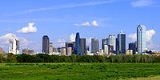
Encyclopedia
Dallas is the third-largest city in the state of
Texas and the
ninth-largest in the
United States. The city covers almost 400 square miles and is the county seat of
Dallas County. As of 2005, U.S. Census estimates put Dallas at a population of 1,213,825. The city is the main cultural and economic center of the 12-county
Dallas–Fort Worth–Arlington metropolitan area, which has over 5.8 million people. Dallas is one of 11 U.S.
world-class cities, as ranked by the Globalization and World Cities Study Group & Network.
Dallas was founded in 1841 and formally incorporated as a
city on 2 February 1856. The city is known globally as a center for
telecommunications,
computer technology,
banking, and
transportation. It is the core of the largest inland metropolitan area in the United States and lacks any navigable link to the sea—Dallas's prominence despite this comes from its historical importance as a center for the
oil and
cotton industries, its position along numerous railroad lines, and its powerful industrial and financial tycoons.
History
Native Americans inhabited the Dallas area before it was claimed, along with the rest of
Texas, as a part of the
Spanish Province of
New Spain in the 1500s. The area was very close to French territory, but the boundary of the
Spanish-speaking territory was moved upward a bit in 1819 with the
Adams-Onís Treaty.
Present-day Dallas remained under Spanish rule until 1821, when
Mexico declared independence from Spain. The land that would become Dallas became part of the state of Coahuila y Tejas in the new nation. The
Republic of Texas broke off from Mexico in 1836 ; and this is when Dallas's development began.
The city of Dallas was founded by John Neely Bryan in 1841 after first surveying the area in 1839. Bryan, who shared
Sam Houston's insight into the wisdom of Native American customs, must also have realized that these
Caddo trails intersected at one of the few natural fords for hundreds of miles along the wide Trinity floodplain.
Dallas County was established in 1846 and was named after
George Mifflin Dallas, who was the eleventh
United States Vice President at the time. However, the origin of the city's name is debatable; Bryan stated only that it was named "after my friend Dallas."
Dallas was formally incorporated as a
town in 1856. The city had a few
slaves, mostly brought by settlers from
Alabama and
Georgia. It was a fairly place until after the
American Civil War in which it was part of the
Confederate States of America, and only legally became a
city in 1871. The city paid the Houston and Central Texas Railroad
US$5,000 to shift its route 20
miles to the west and build its north-south tracks through Dallas, rather than through
Corsicana as planned. A year later, Dallas leaders could not pay the
Texas and Pacific Railroad to locate there, so they devised a way to trick the Railroad. Dallas had a rider attached to a state law which required the railroad to build its tracks through Browder Springs—which turned out to be just south of
Main Street. In 1873, the major north-south and east-west Texas railroad routes intersected in Dallas, thus ensuring its future as a center.
By the turn of the twentieth century Dallas was the leading drug, book, jewelry, and wholesale liquor market in the
Southwestern United States. It also quickly became the center of trade in
cotton,
grain, and even
buffalo. It was the world's leading inland cotton market, and it still led the world in manufacture of
saddlery and
cotton gin machinery . As it further entered the 20th century, Dallas transformed from an agricultural center to a center of
banking, insurance, and other businesses.
In 1930,
oil was discovered 100 miles east of Dallas and the city quickly became the financial center for the oil industry in Texas and
Oklahoma. In 1958 the
integrated circuit was invented in Dallas by
Jack Kilby of
Texas Instruments; this event punctuated the Dallas area's development as a center for high-technology manufacturing . During the 1950s and 1960s, Dallas became the nation's third-largest technology center, with the growth of such companies as Ling-Tempco-Vought and Texas Instruments. In 1957 two developers, Trammell Crow and John M. Stemmons, opened a Home Furnishings Mart that grew into the Dallas Market Center, the largest wholesale trade complex in the world. On 22 November 1963, President
John F. Kennedy was
assassinated on Elm Street while his motorcade passed through
Dealey Plaza in
downtown Dallas.
In the 1970s and 1980s, Dallas underwent the building boom which produced a distinctive contemporary profile for the
downtown area and a prominent skyline, influenced by nationally acclaimed architects. By the 1980s, when some oil industry companies relocated to
Houston, Dallas was beginning to benefit from a burgeoning technology boom , while continuing to be a center of banking and business. Also in the mid-to-late 1980s, many banks, especially in Dallas, collapsed during the Savings and Loan crisis, nearly destroying the city's economy and scrapping plans for hundreds of structures. Because of the immense worldwide success of the hit television series
Dallas, the city became one of the most internationally recognizable U.S cities during the 80s. In the 1990s, Dallas became known as the "Silicon Prairie", similar to
California's
Silicon Valley.
Like many major US cities, Dallas has experienced an "urban renewal" in the 2000s. From 1988 to 2005, not a single high-rise structure was built within the downtown freeway loop, and most new and upscale homes and subdivisions were being built in
Richardson and
Plano. In 2005, three towers began construction amid residential conversions and smaller residential projects. By the year 2010, the
North Central Texas Council of Governments expects 10,000 residents to live within the loop. Just north,
Uptown continues to be one of the hottest real estate markets in the country.
Geography and environment
Dallas is the county seat of
Dallas County. Portions of the city extend into neighboring
Collin,
Denton,
Kaufman and
Rockwall counties.
According to the
United States Census Bureau, the city has a total area of 385.0 square miles —342.5 square miles of it is land and 42.5 square miles of it is water. These statistics are only for the city of Dallas proper. In fact, Dallas only makes up about one-fifth of the much larger urbanized area known as the Dallas-Fort Worth Metroplex. About a quarter of all Texans live in the DFW Metroplex.
Cityscape
The City of Dallas has many vibrant communities and eclectic neighborhoods. Major areas in the city include:
Downtown, the center of the city and the epicenter of urban revival, coupled with
Oak Lawn and
Uptown Dallas, the shiny
new urban areas thriving with shops, restaurants, and nightlife. Downtown Dallas has a variety of neighborhoods, including the
West End Historic District, the
Arts District, the
Main Street District,
Farmers Market District, the City Center business district, the Convention Center District, the
Reunion District and
Victory Park.
East Dallas is home to
Deep Ellum, a trendy arts area close to downtown, homey Lakewood, Bryan Place, and historically and architecturally significant homes on Swiss Avenue.
North Dallas is home to mansions as palatial as
Versailles in
Preston Hollow, strong middle and upper-class communities such as Lake Highlands around White Rock Lake, and high-powered shopping at
Galleria Dallas,
NorthPark Center, and
Preston Center.
Oak Cliff is a hilly area that includes entertainment districts such as the
Bishop Arts District.
South Dallas lays claim to the
Cedars, an eclectic artist hotbed south of downtown,
Fair Park, and Pleasant Grove, an underdeveloped area of the southeastern city.
The city is further surrounded by many suburbs, with
enclaves such as
Cockrell Hill,
Highland Park and
University Park.
Geology
Dallas, and its surrounding area, is mostly flat and lies at an elevation ranging from 450 to 550
feet . The western edge of the Austin chalk formation, a
limestone escarpment, rises 200 feet and runs roughly north-south through Dallas County. The uplift is particularly noticeable in the neighborhood of
Oak Cliff and the adjacent cities of
Cockrell Hill,
Cedar Hill,
Grand Prairie, and
Irving. Marked variations in terrain are also found in cities immediately to the west in
Tarrant County surrounding
Fort Worth.
The Trinity River is a major Texas waterway that passes from the city of
Irving into west Dallas, where it is paralleled by
Interstate 35E along the
Stemmons Corridor, then flows alongside western and southern
downtown, and ultimately between south Dallas and Pleasant Grove, paralleled by
Interstate 45, where it exits into unincorporated
Dallas County and heads southeast to
Houston. The river is flanked on both sides with a 50 feet earthen
levee to keep the city from flooding. Several bridges traverse the river connecting southern Dallas to downtown Dallas. From the early 2000s to the 2010s, the Trinity River Project, a major public works project undertaken by the city of Dallas, will improve the river along its length.
White Rock Lake is Dallas's other significant water feature. The lake and surrounding park is a popular destination among boaters, joggers, bikers, and skaters in the Lakewood/Casa Linda Estates neighborhoods of East Dallas. The lake also boasts the 66 acre Dallas Arboretum and Botanical Garden on its shore.
Bachman Lake, just northwest of Love Field, is a smaller lake and surrounding park that is also used for recreation. Lake Ray Hubbard, a 22,745 acre lake, is a vast and popular recreational lake located in an extension of Dallas surrounded by
Garland,
Rowlett,
Rockwall and
Sunnyvale. Mountain Creek Lake is a small lake along Dallas's border with
Grand Prairie and is home to the Naval Air Station Dallas . North Lake, a small lake in an extension of Dallas surrounded by
Irving and
Coppell, served primarily as a water source for a nearby power plant, but the surrounding area is now being targeted for redevelopment due to its proximity to
Dallas-Fort Worth International AirportClimate
Dallas receives approximately 37.1
inches of rain per year, much of which is delivered in the spring.
Dallas has a humid subtropical climate, yet this part of Texas also tends to receive hot, dry winds from the north and west in the summer. In the winter, strong cold fronts from the north pass through Dallas, plummeting temperatures well below freezing. The average annual snowfall in Dallas is 2.5 inches , with snowfall seen six days out of the year and snow accumulation seen two days out of the year . Occasionally, warm and humid air from the south overrides cold, dry air, leading to freezing rain, which usually causes major disruptions in the city for a day or two if the roads and highways become dangerously slick. Regardless, winters are relatively mild compared with the
Texas Panhandle and with other states to the north. Dallas winters are occasionally interspersed with
Indian summers.
Spring and fall, and the moderate, pleasant temperatures accompanying these seasons, can sometimes be shorter-lived than residents would like. However short the seasons are, residents and visitors appreciate the beauty of the vibrant wildflowers which bloom in spring and are planted around the highways throughout Texas . In the spring the weather can also be quite volatile and change quickly in a matter of minutes. The cliché about volatile climates popular in various parts of the US—"if you don't like the weather, wait a little while and it'll change"—applies well to Dallas's spring weather. The sporadic volatility of the spring season is coupled with a very pleasant "normality"—barring storms, Dallas in spring is very mild and enjoyable. Similarly, late September, October, and early November is very pleasant and is typically storm-free.
Dallas lies near the southern end of
Tornado Alley, which runs through the
prairie lands of the
Midwest. In the spring, cool fronts moving from
Canada collide with warm, humid air streaming in from the
Gulf Coast. When these fronts meet over Dallas, severe thunder storms are generated with spectacular lightning shows, occasional torrents of rain, hail, and, at times, tornadoes.
Although uncommon, with the last touch-down in 1957,
Tornadoes are perhaps the biggest threat to the city of Dallas. They are common to the North, in Oklahoma, in the spring and summer, but the city itself is on the fringe of
Tornado Alley, and because of this, has a small chance of being hit by tornado. Dallas was last hit by a tornado on 2 April 1957 that likely would have registered as an F3 , but it luckily missed
downtown. In May 2000, the "Fort Worth Tornado" hit neighboring
Fort Worth's downtown, causing damage to a pair of the city's skyscrapers .
The Metroplex experiences a particularly acute springtime "monsoon" season every year—around the middle of March—that rapidly feeds a unique region-wide runoff that swells Johnson Creek , as well as the West and Elm Forks of the Trinity River, onto several square miles of flood plain inside the metro area, much of it inhabited. Every March, many neighborhoods in these cities have 4 or more feet of water inside dwellings, and low-lying developed areas adjacent to the
Stemmons Corridor and
Oak Cliff in Dallas experience severe flooding.
The
U.S. Department of Agriculture places the city of Dallas in
Plant Hardiness Zone 8a . Dallas has the 12th worst ozone air pollution in the nation according to the
American Lung Association, ranking it ahead of
Los Angeles and
Fresno, California, and
Houston . In reality, much of the air pollution in Dallas, and the DFW Metroplex in general, comes from a hazardous materials incineration plant in the southern-most suburb of
Midlothian, as well as concrete installations in neighboring
Ellis County .
The average daily low in Dallas is 57 °F and the average daily high in Dallas is 77 °F .
Demographics

>|+ Dallas's Population by year . The corridor is also home to Texas Instruments and regional offices for Alcatel, AT&T, Ericsson, Fujitsu, MCI, Nokia, Nortel, Rockwell, Sprint and Verizon.
In the 1980s, Dallas was a real-estate hot-bed, with populations skyrocketing and the demand for housing and jobs soaring along with it. Downtown Dallas's largest buildings are all the fruit of this boom, but over-speculation and the Savings and Loan crisis knocked the area to its knees. Between the crash and the early 2000s, Dallas suffered a lengthy recession and has only recently bounced back—like much of the country, the real estate market is once again very hot in Dallas, and with relatively low costs of living, the thought of a bubble is far from developer's minds.
Headquartered in Dallas includes the largest company in the world , ExxonMobil, as ranked by the Fortune Global 500, and includes other top Fortune 500 companies within Dallas, and it's connected suburbs, includingTexas Instruments, EDS, 7-Eleven, Southwest Airlines, Blockbuster, Kimberly-Clark, DR Horton Homes, ENSCO Offshore Drilling, and Zales
Northern suburbs include Plano, which headquarters Frito Lay, Dr Pepper and JCPenney. To the West, AMR Corporation , Burlington Northern, Radio Shack, Pier 1 Imports, and Sabre Computer Systems are based in nearby Fort Worth or Southlake