

Handley Page Halifax


Encyclopedia
The Handley Page Halifax was one of the British
front-line, four-engined heavy bomber
s of the Royal Air Force
during the Second World War
. A contemporary of the famous Avro Lancaster
, the Halifax remained in service until the end of the war, performing a variety of duties in addition to bombing. The Halifax was also operated by squadrons of the Royal Canadian Air Force
, Royal Australian Air Force
, Free French Air Force
, and Polish forces, and after the Second World War by the Royal Egyptian Air Force
, the Armée de l'Air
and the Royal Pakistan Air Force.
 Handley Page produced the H.P.56 design to meet Air Ministry
Specification P.13/36 for a twin-engine medium bomber
for "world-wide use". Other candidates for the specification included the Avro 679
, and designs from Fairey, Boulton Paul
and Shorts
; all used twin engines – Rolls-Royce Vulture
s, Napier Sabre
s, the Fairey P.24 or Bristol Hercules
. A four-engined wing was then still a new idea in British bombers. The introduction of the successful P.13/36 candidates was delayed by the necessity of ordering more Armstrong-Whitworth Whitley and Vickers Wellington
bombers first.
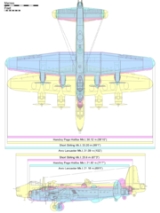
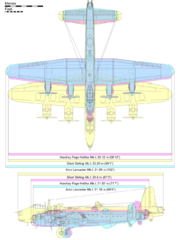
The Avro and HP.56 designs were ordered "off the drawing board" in mid 1937, the Avro design as the preferred choice. Soon after Handley Page were told to redesign the HP.56 for four engines as the Vulture was already suffering technical problems. The Avro Manchester would be built with Vultures but suffered due to them. This redesign increased the span from 88 feet (26.8 m) to 99 feet (30.2 m) and put 13000 pounds (5,896.7 kg) of weight on. Modifications resulted in the definitive H.P.57 which upon acceptance gained the name "Halifax" following the practice of naming heavy bombers after major towns; in this case Halifax in the West Riding of Yorkshire
. The H.P.57 was enlarged and powered by four 1280 hp Rolls-Royce Merlin
X engines. Such was the promise of the new model that the RAF had placed their first order for 100 Mk.I Halifaxes "off the drawing board" before the first prototype even flew. The maiden flight of the Halifax took place on 24 September 1939 from RAF Bicester
, just 21 days after the UK declared war on Germany.
The Halifax production subsequently began at Handley Page's (now English Electric
) site at Samlesbury
, Lancashire
with over 2,000 bombers being built at the factory during the war.
The Mk.I had a 22 ft (6.7 m) long bomb bay as well as six bomb cells in the wings, enabling it to carry 13,000 lb (5,900 kg) of bombs. Defensive armament consisted of two .303 in (7.7 mm) Browning machine guns
in a Boulton Paul Type C nose turret
, and four in BP Type E tail turret and, in some aircraft, two .303 in (7.7 mm) Vickers K machine gun
s in beam positions. The Merlins drove constant speed wooden screw Rotol propellers. Subtle modifications distinguished the Mk I aircraft. The first batch (of 50) Mk I Halifaxes were designated Mk I Series I.
These were followed by 25 of the Mk I Series II with increased gross weight (from 58,000 lb/26,310 kg to 60,000 lb/27,220 kg) but with maximum landing weight unchanged at 50000 lb (22,679.6 kg). The Mk I Series III had increased fuel capacity (1,882 gal/8,556 L), and larger oil coolers to accept the Merlin XX. A two-gun BP Type C turret mounted dorsally replaced the beam guns.
 Introduction of 1390 hp Merlin XX engines and a twin .303 in (7.7 mm) dorsal turret instead of waist guns resulted in the B Mk II Series I Halifax. The Mk II Series I (Special) achieved improved performance by removing the nose and dorsal turrets. The Mk II Series IA had a moulded Perspex
nose (the standard for future Halifax variants), a four-gun Defiant
-type dorsal turret, Merlin 22 engines and larger vertical tail surfaces which solved control deficiencies (fin-stall
leading to rudder overbalance) in the early Marks.
Halifax IIs were built by English Electric and Handley Page; 200 and 100 aircraft respectively.
Due to a shortage in Messier-built landing gear
and hydraulics, Dowty
landing gear were used. Being incompatible with the Messier equipment these gave Halifaxes with new designations. A Mark II built with Dowty gear was the Mark V. The use of castings rather than forgings in the Dowty undercarriage speeded production but resulted in a reduced landing weight of 40000 lb (18,143.7 kg). The Mark V were built by Rootes Group at Speke
and Fairey
at Stockport
and were generally used by Coastal Command and for training. Some 904 were built by the time Mark V production ended at the start of 1944, compared to 1,966 Mk II.
The most numerous Halifax variant was the B Mk III of which 2,091 were built. First appearing in 1943, the Mk III featured the Perspex nose and modified tail of the Mk II Series IA but replaced the Merlin with the more powerful 1650 hp Bristol Hercules
XVI radial engine. Other changes included de Havilland
Hydromatic propellers and rounded wing tips. The Mk IV was a non-production design using a turbocharged
Hercules powerplant.
The definitive version of the Halifax was the B Mk VI, powered by the 1800 hp Hercules 100. The final bomber version, the Mk VII, reverted to the less powerful Hercules XVI. However, these variants were produced in relatively small quantities.
The remaining variants were the C Mk VIII unarmed transport (8,000 lb/3,630 kg cargo pannier instead of a bomb bay, space for 11 passengers) and the Mk A IX paratroop transport (space for 16 paratroopers and gear). A transport/cargo version of the Halifax was also produced, known as the Handley Page Halton.
, Fairey Aviation
, and Rootes Motors (Rootes Securities Ltd) in Lancashire
and by the London Aircraft Production Group. Peak production resulted in one Halifax being completed every hour.
in November 1940 and its first operational raid was against Le Havre
on the night of 11–12 March 1941.
In service with RAF Bomber Command
, Halifaxes flew 82,773 operations, dropped 224,207 tons (203,397 tonnes) of bombs and lost 1,833 aircraft. In addition to bombing missions, the Halifax served as a glider
tug, electronic warfare
aircraft for No. 100 Group RAF
and special operations such as parachuting
agents and arms into occupied Europe
. Halifaxes were also operated by RAF Coastal Command
for anti submarine warfare, reconnaissance
and meteorological roles.
Postwar, Halifaxes remained in service with the RAF Coastal Command
and RAF Transport Command
, Royal Egyptian Air Force
and the Armée de l'Air until early 1952. The Pakistan Air Force
which inherited the planes from the RAF continued to use the type until 1961.
A number of former RAF Halifax C.8s were sold from 1945 and used as freighters by a number of mainly British airlines. In 1948, the air freight market was in decline but 41 civil aircraft were used in the Berlin Air Lift operating a total of 4,653 freight sorties and 3,509 sorties carrying bulk diesel fuel. Nine aircraft were lost during the airlift but as the aircraft returned to England most civil Halifaxes were scrapped. The last civilian operated Halifaxes were withdrawn from service in late 1952.

H.P.56
Halifax Mk. I
Halifax B.II Series I
Halifax B.II Series I (Special), SOE
Halifax B.II Series I (Special)
Halifax B.II Series IA
Halifax B.II Series I, Freighter
Halifax B.II Series II
Halifax A.II
Halifax GR.II
Halifax Met.II
Halifax A.III
Halifax C.III
Halifax B.V Series I (Special)
Halifax A.V
Halifax GR.V
Halifax B.VI
Halifax C.VI
Halifax GR.VI
Halifax B.VII
Halifax A.VII
Halifax C.VII
Halton II
.jpg)
 Canada
 Egypt
Egypt
 South Africa
 India
India
South Africa
 There are 2 fully restored Halifax bomber version in the world. One of the two is located at the Yorkshire Air Museum
, on the site of the Second World War airfield, RAF Elvington
. This aircraft was re-constructed from a fuselage section of Halifax B.Mk.II HR792 and parts from other aircraft. It is painted to represent Halifax LV907, "Friday the 13th" from no. 158 Squadron RAF
on the port side and "N - Novembre" of 347 "Guyenne" Squadron, Free French Air Force, on the starboard side (RAF Elvington being the home of the only two French heavy bomber squadrons in Bomber Command).
 Another fully restored Halifax, NA337 of No. 644 Squadron RAF
, then based at RAF Tarrant Rushton
, is a transport/special duties version, and was retrieved from the bottom of Lake Mjøsa
in Norway
in 1995 after being shot down in April 1945. It was taken to Canada
and restoration was completed in 2005. NA337 is a Halifax A.Mk.VII Special Duties aircraft built by Rootes
Motors, Liverpool and now resides at RCAF Memorial Museum at CFB Trenton
in Trenton, Ontario
, near Kingston, Ontario
.
A third Halifax is a B.Mk.II, serial W1048, 'S' for Sugar of no. 35 Squadron RAF. On the night of the 27/28 April 1942, this aircraft was taking part in a raid on the Tirpitz
- its first operational flight. It was hit by anti-aircraft fire after releasing the four 1000 pounds (453.6 kg) mines it carried and the pilot made a successful belly landing
on the frozen surface of Lake Hoklingen
. The crew escaped to Sweden with the help of the Norwegian resistance
, except for the Flight Engineer who remained behind because of a broken ankle and was taken prisoner. Within hours, the aircraft sank through the ice into 27 metres (88.6 ft) of water.
In the summer of 1973, it was recovered from the lake by a team of divers from the RAF and a Norwegian diving club, and was transported to the UK on a British Army Landing craft tank
. It is displayed in its "as recovered" condition in the Bomber Command display at the Royal Air Force Museum at Hendon in London, apart from the nose turret which had already been restored prior to the decision.
On 26 November 2006, archaeologists from the Warsaw Uprising Museum, Poland, unearthed remains of another Halifax (JP276 "A") from No. 148 Squadron RAF
, which was found in southern Poland, near the city of Dąbrowa Tarnowska
. It was shot down on the night 4–5 August 1944 while returning from the "air-drop-action" during the Warsaw Uprising
.
In August 1945, while on weather patrol, the aging Halifax bomber LW170 from no. 518 Squadron RAF
sprang a fuel leak and, while trying to return to base, was forced to ditch off the Hebrides Islands west of Scotland
. A project is currently underway with the stated aim of finding, recovering and restoring Halifax LW170. When it is recovered it will be restored and displayed at the Bomber Command Museum of Canada in Nanton, Alberta
Canada
.

United Kingdom
The United Kingdom of Great Britain and Northern IrelandIn the United Kingdom and Dependencies, other languages have been officially recognised as legitimate autochthonous languages under the European Charter for Regional or Minority Languages...
front-line, four-engined heavy bomber
Heavy bomber
A heavy bomber is a bomber aircraft of the largest size and load carrying capacity, and usually the longest range.In New START, the term "heavy bomber" is used for two types of bombers:*one with a range greater than 8,000 kilometers...
s of the Royal Air Force
Royal Air Force
The Royal Air Force is the aerial warfare service branch of the British Armed Forces. Formed on 1 April 1918, it is the oldest independent air force in the world...
during the Second World War
World War II
World War II, or the Second World War , was a global conflict lasting from 1939 to 1945, involving most of the world's nations—including all of the great powers—eventually forming two opposing military alliances: the Allies and the Axis...
. A contemporary of the famous Avro Lancaster
Avro Lancaster
The Avro Lancaster is a British four-engined Second World War heavy bomber made initially by Avro for the Royal Air Force . It first saw active service in 1942, and together with the Handley Page Halifax it was one of the main heavy bombers of the RAF, the RCAF, and squadrons from other...
, the Halifax remained in service until the end of the war, performing a variety of duties in addition to bombing. The Halifax was also operated by squadrons of the Royal Canadian Air Force
Royal Canadian Air Force
The history of the Royal Canadian Air Force begins in 1920, when the air force was created as the Canadian Air Force . In 1924 the CAF was renamed the Royal Canadian Air Force and granted royal sanction by King George V. The RCAF existed as an independent service until 1968...
, Royal Australian Air Force
Royal Australian Air Force
The Royal Australian Air Force is the air force branch of the Australian Defence Force. The RAAF was formed in March 1921. It continues the traditions of the Australian Flying Corps , which was formed on 22 October 1912. The RAAF has taken part in many of the 20th century's major conflicts...
, Free French Air Force
Free French Air Force
The Free French Air Force was the air arm of the Free French Forces during the Second World War.-Fighting for Free France — the FAFL in French North Africa :...
, and Polish forces, and after the Second World War by the Royal Egyptian Air Force
Egyptian Air Force
The Egyptian Air Force, or EAF , is the aviation branch of the Egyptian Armed Forces. The EAF is headed by an Air Marshal . Currently, the commander of the Egyptian Air Force is Air Marshal Reda Mahmoud Hafez Mohamed...
, the Armée de l'Air
French Air Force
The French Air Force , literally Army of the Air) is the air force of the French Armed Forces. It was formed in 1909 as the Service Aéronautique, a service arm of the French Army, then was made an independent military arm in 1933...
and the Royal Pakistan Air Force.
Design and development
Air Ministry
The Air Ministry was a department of the British Government with the responsibility of managing the affairs of the Royal Air Force, that existed from 1918 to 1964...
Specification P.13/36 for a twin-engine medium bomber
Medium bomber
A medium bomber is a bomber aircraft designed to operate with medium bombloads over medium distances; the name serves to distinguish them from the larger heavy bombers and smaller light bombers...
for "world-wide use". Other candidates for the specification included the Avro 679
Avro Manchester
|-See also:-References:NotesCitationsBibliography* Buttler, Tony. British Secret Projects: Fighters and Bombers 1935–1950. Hickley, UK: Midland Publishing, 2004. ISBN 978-1857801798....
, and designs from Fairey, Boulton Paul
Boulton Paul Aircraft
Boulton Paul Aircraft Ltd was a British aircraft manufacturer that was created in 1934, although its origins lay in 1914, and lasted until 1961...
and Shorts
Short Brothers
Short Brothers plc is a British aerospace company, usually referred to simply as Shorts, that is now based in Belfast, Northern Ireland. Founded in 1908, Shorts was the first company in the world to make production aircraft and was a manufacturer of flying boats during the 1920s, 1930s, and 1940s...
; all used twin engines – Rolls-Royce Vulture
Rolls-Royce Vulture
|-See also:-Bibliography:* Gunston, Bill. World Encyclopaedia of Aero Engines. Cambridge, England. Patrick Stephens Limited, 1989. ISBN 1-85260-163-9...
s, Napier Sabre
Napier Sabre
The Napier Sabre was a British H-24-cylinder, liquid cooled, sleeve valve, piston aero engine, designed by Major Frank Halford and built by Napier & Son during WWII...
s, the Fairey P.24 or Bristol Hercules
Bristol Hercules
|-See also:-Bibliography:*Gunston, B. Classic World War II Aircraft Cutaways. Osprey. ISBN 1-85532-526-8*Gunston, Bill. World Encyclopedia of Aero Engines. Cambridge, England. Patrick Stephens Limited, 1989. ISBN 1-85260-163-9...
. A four-engined wing was then still a new idea in British bombers. The introduction of the successful P.13/36 candidates was delayed by the necessity of ordering more Armstrong-Whitworth Whitley and Vickers Wellington
Vickers Wellington
The Vickers Wellington was a British twin-engine, long range medium bomber designed in the mid-1930s at Brooklands in Weybridge, Surrey, by Vickers-Armstrongs' Chief Designer, R. K. Pierson. It was widely used as a night bomber in the early years of the Second World War, before being displaced as a...
bombers first.
The Avro and HP.56 designs were ordered "off the drawing board" in mid 1937, the Avro design as the preferred choice. Soon after Handley Page were told to redesign the HP.56 for four engines as the Vulture was already suffering technical problems. The Avro Manchester would be built with Vultures but suffered due to them. This redesign increased the span from 88 feet (26.8 m) to 99 feet (30.2 m) and put 13000 pounds (5,896.7 kg) of weight on. Modifications resulted in the definitive H.P.57 which upon acceptance gained the name "Halifax" following the practice of naming heavy bombers after major towns; in this case Halifax in the West Riding of Yorkshire
Halifax, West Yorkshire
Halifax is a minster town, within the Metropolitan Borough of Calderdale in West Yorkshire, England. It has an urban area population of 82,056 in the 2001 Census. It is well-known as a centre of England's woollen manufacture from the 15th century onward, originally dealing through the Halifax Piece...
. The H.P.57 was enlarged and powered by four 1280 hp Rolls-Royce Merlin
Rolls-Royce Merlin
The Rolls-Royce Merlin is a British liquid-cooled, V-12, piston aero engine, of 27-litre capacity. Rolls-Royce Limited designed and built the engine which was initially known as the PV-12: the PV-12 became known as the Merlin following the company convention of naming its piston aero engines after...
X engines. Such was the promise of the new model that the RAF had placed their first order for 100 Mk.I Halifaxes "off the drawing board" before the first prototype even flew. The maiden flight of the Halifax took place on 24 September 1939 from RAF Bicester
Bicester Airfield
Bicester Aerodrome, formerly RAF Bicester, is an airfield on the outskirts of the English town of Bicester in Oxfordshire. The RAF left in 2004....
, just 21 days after the UK declared war on Germany.
The Halifax production subsequently began at Handley Page's (now English Electric
English Electric
English Electric was a British industrial manufacturer. Founded in 1918, it initially specialised in industrial electric motors and transformers...
) site at Samlesbury
Samlesbury
Samlesbury is a small village and civil parish in the South Ribble borough of Lancashire, England. Samlesbury Hall, a historic house, is located in the village as well as Samlesbury Aerodrome...
, Lancashire
Lancashire
Lancashire is a non-metropolitan county of historic origin in the North West of England. It takes its name from the city of Lancaster, and is sometimes known as the County of Lancaster. Although Lancaster is still considered to be the county town, Lancashire County Council is based in Preston...
with over 2,000 bombers being built at the factory during the war.
The Mk.I had a 22 ft (6.7 m) long bomb bay as well as six bomb cells in the wings, enabling it to carry 13,000 lb (5,900 kg) of bombs. Defensive armament consisted of two .303 in (7.7 mm) Browning machine guns
M1919 Browning machine gun
The M1919 Browning is a .30 caliber medium machine gun that was widely used during the 20th century. It was used as a light infantry, coaxial, mounted, aircraft, and anti-aircraft machine gun by the U.S. and many other countries, especially during World War II, the Korean War, and the Vietnam War...
in a Boulton Paul Type C nose turret
Turret
In architecture, a turret is a small tower that projects vertically from the wall of a building such as a medieval castle. Turrets were used to provide a projecting defensive position allowing covering fire to the adjacent wall in the days of military fortification...
, and four in BP Type E tail turret and, in some aircraft, two .303 in (7.7 mm) Vickers K machine gun
Vickers K machine gun
Not to be confused with the Vickers light machine gunThe Vickers K machine gun, known as the Vickers Gas Operated in British service, was a rapid-firing machine gun developed and manufactured for use in aircraft by Vickers-Armstrongs...
s in beam positions. The Merlins drove constant speed wooden screw Rotol propellers. Subtle modifications distinguished the Mk I aircraft. The first batch (of 50) Mk I Halifaxes were designated Mk I Series I.
These were followed by 25 of the Mk I Series II with increased gross weight (from 58,000 lb/26,310 kg to 60,000 lb/27,220 kg) but with maximum landing weight unchanged at 50000 lb (22,679.6 kg). The Mk I Series III had increased fuel capacity (1,882 gal/8,556 L), and larger oil coolers to accept the Merlin XX. A two-gun BP Type C turret mounted dorsally replaced the beam guns.
Acrylic glass
Poly is a transparent thermoplastic, often used as a light or shatter-resistant alternative to glass. It is sometimes called acrylic glass. Chemically, it is the synthetic polymer of methyl methacrylate...
nose (the standard for future Halifax variants), a four-gun Defiant
Boulton Paul Defiant
The Boulton Paul Defiant was a British interceptor aircraft that served with the Royal Air Force early in the Second World War. The Defiant was designed and built by Boulton Paul Aircraft as a "turret fighter", without any forward-firing guns. It was a contemporary of the Royal Navy's Blackburn Roc...
-type dorsal turret, Merlin 22 engines and larger vertical tail surfaces which solved control deficiencies (fin-stall
Stall (flight)
In fluid dynamics, a stall is a reduction in the lift coefficient generated by a foil as angle of attack increases. This occurs when the critical angle of attack of the foil is exceeded...
leading to rudder overbalance) in the early Marks.
Halifax IIs were built by English Electric and Handley Page; 200 and 100 aircraft respectively.
Due to a shortage in Messier-built landing gear
Undercarriage
The undercarriage or landing gear in aviation, is the structure that supports an aircraft on the ground and allows it to taxi, takeoff and land...
and hydraulics, Dowty
Dowty
Dowty may refer to:*Alan Dowty, an international relations scholar*David Dowty, an American linguist.*Dowty Group, a British aircraft equipment manufacturing business.**Ultra Electronics was created by the demerger of seven Dowty companies in 1993....
landing gear were used. Being incompatible with the Messier equipment these gave Halifaxes with new designations. A Mark II built with Dowty gear was the Mark V. The use of castings rather than forgings in the Dowty undercarriage speeded production but resulted in a reduced landing weight of 40000 lb (18,143.7 kg). The Mark V were built by Rootes Group at Speke
Speke
Speke is an area of Liverpool, Merseyside, England, close to the boundaries of the Metropolitan Borough of Knowsley. It is south east of the city centre and to the west of the town of Widnes....
and Fairey
Fairey
-People:*Charles Richard Fairey, British aircraft manufacturer*Francis Fairey, , Canadian politician,*Jim Fairey, outfielder*Shepard Fairey, American artist-Companies:*Fairey Aviation Company, British aircraft company...
at Stockport
Stockport
Stockport is a town in Greater Manchester, England. It lies on elevated ground southeast of Manchester city centre, at the point where the rivers Goyt and Tame join and create the River Mersey. Stockport is the largest settlement in the metropolitan borough of the same name...
and were generally used by Coastal Command and for training. Some 904 were built by the time Mark V production ended at the start of 1944, compared to 1,966 Mk II.
The most numerous Halifax variant was the B Mk III of which 2,091 were built. First appearing in 1943, the Mk III featured the Perspex nose and modified tail of the Mk II Series IA but replaced the Merlin with the more powerful 1650 hp Bristol Hercules
Bristol Hercules
|-See also:-Bibliography:*Gunston, B. Classic World War II Aircraft Cutaways. Osprey. ISBN 1-85532-526-8*Gunston, Bill. World Encyclopedia of Aero Engines. Cambridge, England. Patrick Stephens Limited, 1989. ISBN 1-85260-163-9...
XVI radial engine. Other changes included de Havilland
De Havilland
The de Havilland Aircraft Company was a British aviation manufacturer founded in 1920 when Airco, of which Geoffrey de Havilland had been chief designer, was sold to BSA by the owner George Holt Thomas. De Havilland then set up a company under his name in September of that year at Stag Lane...
Hydromatic propellers and rounded wing tips. The Mk IV was a non-production design using a turbocharged
Turbocharger
A turbocharger, or turbo , from the Greek "τύρβη" is a centrifugal compressor powered by a turbine that is driven by an engine's exhaust gases. Its benefit lies with the compressor increasing the mass of air entering the engine , thereby resulting in greater performance...
Hercules powerplant.
The definitive version of the Halifax was the B Mk VI, powered by the 1800 hp Hercules 100. The final bomber version, the Mk VII, reverted to the less powerful Hercules XVI. However, these variants were produced in relatively small quantities.
The remaining variants were the C Mk VIII unarmed transport (8,000 lb/3,630 kg cargo pannier instead of a bomb bay, space for 11 passengers) and the Mk A IX paratroop transport (space for 16 paratroopers and gear). A transport/cargo version of the Halifax was also produced, known as the Handley Page Halton.
Production
Total Halifax production was 6,178 with the last aircraft delivered in April 1945. In addition to Handley Page, Halifaxes were built by English ElectricEnglish Electric
English Electric was a British industrial manufacturer. Founded in 1918, it initially specialised in industrial electric motors and transformers...
, Fairey Aviation
Fairey Aviation
The Fairey Aviation Company Limited was a British aircraft manufacturer of the first half of the 20th century based in Hayes in Greater London and Heaton Chapel and RAF Ringway in Greater Manchester...
, and Rootes Motors (Rootes Securities Ltd) in Lancashire
Lancashire
Lancashire is a non-metropolitan county of historic origin in the North West of England. It takes its name from the city of Lancaster, and is sometimes known as the County of Lancaster. Although Lancaster is still considered to be the county town, Lancashire County Council is based in Preston...
and by the London Aircraft Production Group. Peak production resulted in one Halifax being completed every hour.
Operational service
The Halifax entered service with No. 35 Squadron RAF at RAF Linton-on-OuseRAF Linton-on-Ouse
RAF Linton-on-Ouse is a Royal Air Force station at Linton-on-Ouse near York in Yorkshire, England. It is currently a major flying training centre, one of the RAF's busiest airfields...
in November 1940 and its first operational raid was against Le Havre
Le Havre
Le Havre is a city in the Seine-Maritime department of the Haute-Normandie region in France. It is situated in north-western France, on the right bank of the mouth of the river Seine on the English Channel. Le Havre is the most populous commune in the Haute-Normandie region, although the total...
on the night of 11–12 March 1941.
In service with RAF Bomber Command
RAF Bomber Command
RAF Bomber Command controlled the RAF's bomber forces from 1936 to 1968. During World War II the command destroyed a significant proportion of Nazi Germany's industries and many German cities, and in the 1960s stood at the peak of its postwar military power with the V bombers and a supplemental...
, Halifaxes flew 82,773 operations, dropped 224,207 tons (203,397 tonnes) of bombs and lost 1,833 aircraft. In addition to bombing missions, the Halifax served as a glider
Military glider
Military gliders have been used by the military of various countries for carrying troops and heavy equipment to a combat zone, mainly during the Second World War. These engineless aircraft were towed into the air and most of the way to their target by military transport planes, e.g...
tug, electronic warfare
Electronic warfare
Electronic warfare refers to any action involving the use of the electromagnetic spectrum or directed energy to control the spectrum, attack an enemy, or impede enemy assaults via the spectrum. The purpose of electronic warfare is to deny the opponent the advantage of, and ensure friendly...
aircraft for No. 100 Group RAF
No. 100 Group RAF
No. 100 Group was a special duties group within RAF Bomber Command.It was formed on 11 November 1943 to consolidate the increasingly complex business of electronic warfare and countermeasures within one organisation. The group was responsible for the development, operational trial and use of...
and special operations such as parachuting
Parachuting
Parachuting, also known as skydiving, is the action of exiting an aircraft and returning to earth with the aid of a parachute. It may or may not involve a certain amount of free-fall, a time during which the parachute has not been deployed and the body gradually accelerates to terminal...
agents and arms into occupied Europe
Europe
Europe is, by convention, one of the world's seven continents. Comprising the westernmost peninsula of Eurasia, Europe is generally 'divided' from Asia to its east by the watershed divides of the Ural and Caucasus Mountains, the Ural River, the Caspian and Black Seas, and the waterways connecting...
. Halifaxes were also operated by RAF Coastal Command
RAF Coastal Command
RAF Coastal Command was a formation within the Royal Air Force . Founded in 1936, it was the RAF's premier maritime arm, after the Royal Navy's secondment of the Fleet Air Arm in 1937. Naval aviation was neglected in the inter-war period, 1919–1939, and as a consequence the service did not receive...
for anti submarine warfare, reconnaissance
Reconnaissance
Reconnaissance is the military term for exploring beyond the area occupied by friendly forces to gain information about enemy forces or features of the environment....
and meteorological roles.
Postwar, Halifaxes remained in service with the RAF Coastal Command
RAF Coastal Command
RAF Coastal Command was a formation within the Royal Air Force . Founded in 1936, it was the RAF's premier maritime arm, after the Royal Navy's secondment of the Fleet Air Arm in 1937. Naval aviation was neglected in the inter-war period, 1919–1939, and as a consequence the service did not receive...
and RAF Transport Command
RAF Transport Command
RAF Transport Command was a Royal Air Force command that controlled all transport aircraft of the RAF. It was established on 25 March 1943 by the renaming of the RAF Ferry Command, and was subsequently renamed RAF Air Support Command in 1967.-History:...
, Royal Egyptian Air Force
Egyptian Air Force
The Egyptian Air Force, or EAF , is the aviation branch of the Egyptian Armed Forces. The EAF is headed by an Air Marshal . Currently, the commander of the Egyptian Air Force is Air Marshal Reda Mahmoud Hafez Mohamed...
and the Armée de l'Air until early 1952. The Pakistan Air Force
Pakistan Air Force
The Pakistan Air Force is the leading air arm of the Pakistan Armed Forces and is primarily tasked with the aerial defence of Pakistan with a secondary role of providing air support to the Pakistan Army and the Pakistan Navy. The PAF also has a tertiary role of providing strategic air transport...
which inherited the planes from the RAF continued to use the type until 1961.
A number of former RAF Halifax C.8s were sold from 1945 and used as freighters by a number of mainly British airlines. In 1948, the air freight market was in decline but 41 civil aircraft were used in the Berlin Air Lift operating a total of 4,653 freight sorties and 3,509 sorties carrying bulk diesel fuel. Nine aircraft were lost during the airlift but as the aircraft returned to England most civil Halifaxes were scrapped. The last civilian operated Halifaxes were withdrawn from service in late 1952.
Variants
Pre-Halifax designs
H.P.55- Proposed twin-engine bomber aircraft, never built.
H.P.56
- Proposed twin-engine bomber aircraft, fitted with two Rolls-Royce Vulture engines, never built.
H.P.57
H.P.57- The first Halifax prototype
Halifax Mk. I
- The second prototype.
- Halifax B.I Series I
- :Four-engined long-range heavy-bomber aircraft; the first production version. Armament consisted of nose turret with two guns, tail turret with four guns and two beam gun
- Halifax B.I Series II
- :Stressed for operating at a higher gross weight
- Halifax B.I Series III
- :Re-engined with Merlin XXRolls-Royce MerlinThe Rolls-Royce Merlin is a British liquid-cooled, V-12, piston aero engine, of 27-litre capacity. Rolls-Royce Limited designed and built the engine which was initially known as the PV-12: the PV-12 became known as the Merlin following the company convention of naming its piston aero engines after...
engines, introduced new upper turret in place of beam guns, with revised undercarriage and additional centre-section fuel tanks
H.P.58
Halifax Mk II- Projected variant with revised armament including 20 mm cannon and no tail turret. Due to problems with the new armament, the project was cancelled and the Mk II designation given to H.P.59.
H.P.59
Halifax Mk II- New variant with increased takeoff weight, fuel and weapons carriage.
Halifax B.II Series I
- First series of the bomber variant; from March 1942 onwards, these were fitted with TR1335GEE (navigation)Gee was the code name given to a radio navigation system used by the Royal Air Force during World War II.Different sources record the name as GEE or Gee. The naming supposedly comes from "Grid", so the lower case form is more correct, and is the form used in Drippy's publications. See Drippy 1946....
navigation aids.
Halifax B.II Series I (Special), SOE
- Special version for Special Operations ExecutiveSpecial Operations ExecutiveThe Special Operations Executive was a World War II organisation of the United Kingdom. It was officially formed by Prime Minister Winston Churchill and Minister of Economic Warfare Hugh Dalton on 22 July 1940, to conduct guerrilla warfare against the Axis powers and to instruct and aid local...
(SOE) used to drop supplies over Europe. Nose armament and dorsal turret removed, the nose being faired over, as well as changes to the fuel went pipes and exhaust shrouds.
Halifax B.II Series I (Special)
- Generally similar to the aircraft used by the SOE, these were employed in the bombing role. These aircraft were more varied in appearance, especially concerning the fitting of dorsal armament with some aircraft retaining the standard Boulton Paul "Type C" turret in different mounts with others mounting a "Type A" -turret. There were also examples with no dorsal turret, similar to the SOE-aircraft.
Halifax B.II Series IA
- Modified with new glazed nose section, new radiators and new "D" fin and rudder. The dorsal turret was changed to a four-gun Boulton Paul Type A Mk VIII, and there were improvements to the bomb bay door sealing. Some aircraft were fitted with the H2S radarH2S radarH2S was the first airborne, ground scanning radar system. It was developed in Britain in World War II for the Royal Air Force and was used in various RAF bomber aircraft from 1943 to the 1990s. It was designed to identify targets on the ground for night and all-weather bombing...
.
Halifax B.II Series I, Freighter
- A few Mk IIs were employed in the transport role in Great Britain (unmodified SOE-aircraft) and in the Middle EastMiddle EastThe Middle East is a region that encompasses Western Asia and Northern Africa. It is often used as a synonym for Near East, in opposition to Far East...
(simple modifications to allow carriage of engines or SpitfireSupermarine SpitfireThe Supermarine Spitfire is a British single-seat fighter aircraft that was used by the Royal Air Force and many other Allied countries throughout the Second World War. The Spitfire continued to be used as a front line fighter and in secondary roles into the 1950s...
fuselages).
Halifax B.II Series II
- Single aircraft (HR756) modified with three-blade Rotol propellers and Merlin 22 engines. Rejected in favour of Mk III.
Halifax A.II
- According to some sources, a handful of the airborne forces Halifaxes were converted into B.IIs. If this is true they might have been designated A.II or may have retained their bomber designations.
Halifax GR.II
- Coastal Command variant of the Halifax B.II.
- Halifax GR.II Series I
- :A handful of aircraft converted from Series I or Special to GR.II standard, having differences in dorsal armament. The main difference was the fitting of a ASV.Mk 3 radar in an H2S type fairing. Sometimes, a .50 in (12.7 mm) machine gun was fitted in the faired nose
- Halifax GR.II Series IA
- :Definitive Coastal Command variant of the GR.II with glazed nose mounting .50 in (12.7 mm) machine gun, Merlin XX or 22 engines, B-P A-type dorsal turret and extra long-range fuel tanks in fuselage. A ventral turret holding a single .50 in (12.7 mm) machine gun was mounted on most aircraft although some employed the ASV.Mk 3 radar in its place
Halifax Met.II
- Some sources suggest that there were a meteorological variant of the B.II, designated Met.II, but this is unlikely.
H.P.61
Halifax B.III- Main production variant, fitted with Bristol HerculesBristol Hercules|-See also:-Bibliography:*Gunston, B. Classic World War II Aircraft Cutaways. Osprey. ISBN 1-85532-526-8*Gunston, Bill. World Encyclopedia of Aero Engines. Cambridge, England. Patrick Stephens Limited, 1989. ISBN 1-85260-163-9...
engines. B.III bombers were fitted with transparent nose dome with single machine gun, Boulton Paul dorsal turret with four guns and tail turret with four guns. Some B.IIIs had extended round wingtips.
Halifax A.III
- Halifax B.III bombers converted into glider tug and paratroop transport aircraft.
Halifax C.III
- Halifax B.III bombers converted into military transport aircraft.
H.P.63
Halifax B.V- Four-engined long-range heavy-bomber, powered by four Rolls-Royce MerlinRolls-Royce MerlinThe Rolls-Royce Merlin is a British liquid-cooled, V-12, piston aero engine, of 27-litre capacity. Rolls-Royce Limited designed and built the engine which was initially known as the PV-12: the PV-12 became known as the Merlin following the company convention of naming its piston aero engines after...
XX engines with square empennage and wingtips. Armament as B.III
Halifax B.V Series I (Special)
Halifax A.V
- Halifax B.V bombers converted into glider tugs and paratroop transport aircraft.
Halifax GR.V
- Coastal Command variant. Halifax B.V bombers converted into maritime reconnaissance aircraft.
Halifax B.VI
- Four-engined long-range heavy-bomber, powered by four 1,615 hp (1,204 kW) Bristol Hercules XVI radial engines with H2S radarH2S radarH2S was the first airborne, ground scanning radar system. It was developed in Britain in World War II for the Royal Air Force and was used in various RAF bomber aircraft from 1943 to the 1990s. It was designed to identify targets on the ground for night and all-weather bombing...
. No dorsal turret. Square empennage, round wing tips.
Halifax C.VI
- Halifax B.VI bombers converted into military transport aircraft.
Halifax GR.VI
- Coastal Command variant. Halifax B.VI bombers converted into maritime reconnaissance aircraft.
Halifax B.VII
- Four-engined long-range heavy-bomber, powered by four 1,615 hp (1,204 kW) Bristol Hercules XVI radial engines. Round wing tips. Armament as B.III
Halifax A.VII
- Halifax B.VIIs converted into paratroop transport and glider tug aircraft.
Halifax C.VII
- Halifax B.VIIs bombers converted into military transport aircraft.
H.P.70 Halton
Halton I- Interim civil transport version; postwar, a number of Halifax bombers were converted into civilian transport aircraft.
Halton II
- VIP transport aircraft for the Maharajah GaekwarPratap Singh Gaekwad of BarodaMaharaja Pratap Singh Gaekwad was a Maharaja of Baroda who succeeded his grandfather Maharaja Sayajirao Gaekwad III at his death in 1939. He ruled for a period of twelve years, from 1939 to 1951, when he was deposed by the Government of India and exiled to England...
of Baroda.
Halifax military operators
- Royal Australian Air ForceRoyal Australian Air ForceThe Royal Australian Air Force is the air force branch of the Australian Defence Force. The RAAF was formed in March 1921. It continues the traditions of the Australian Flying Corps , which was formed on 22 October 1912. The RAAF has taken part in many of the 20th century's major conflicts...
- No. 460 Squadron RAAFNo. 460 Squadron RAAFNo. 460 Squadron is an Royal Australian Air Force intelligence unit active within the Defence Imagery and Geospatial Organisation . It was first formed as a heavy bomber squadron during World War II on November 15, 1941 and disbanded on 10 October 1945 after seeing extensive combat over Europe. The...
- No. 462 Squadron RAAFNo. 462 Squadron RAAFNo. 462 Squadron is a Royal Australian Air Force squadron which forms part of the Information Warfare Wing in the RAAF's Aerospace Operational Support Group. The squadron was first formed in 1942 as a heavy bomber unit and saw combat in this role in the Mediterranean area until it was disbanded in...
- No. 466 Squadron RAAFNo. 466 Squadron RAAFNo. 466 Squadron RAAF was a Royal Australian Air Force bomber squadron during World War II.-History:The squadron was formed at RAF Driffield in Yorkshire, England on 10 October 1942, under Article XV of the Empire Air Training Scheme. The majority of its original personnel were from British...
- No. 460 Squadron RAAF
Canada- Royal Canadian Air ForceRoyal Canadian Air ForceThe history of the Royal Canadian Air Force begins in 1920, when the air force was created as the Canadian Air Force . In 1924 the CAF was renamed the Royal Canadian Air Force and granted royal sanction by King George V. The RCAF existed as an independent service until 1968...
- No. 405 Squadron RCAFNo. 405 Squadron RCAF405 Maritime Patrol Squadron is a unit of the Royal Canadian Air Force within the Canadian Forces, initially formed as No. 405 Squadron RCAF during the Second World War.-World War II:...
- No. 408 Squadron RCAF
- No. 415 Squadron RCAFNo. 415 Squadron RCAFNo. 415 Squadron RCAF was an aircraft squadron of the Royal Canadian Air Force that first saw service during the Second World War. After unification of Canada's armed forces in 1968, the squadron continued to provide service within the Canadian Forces....
- No. 419 Squadron RCAFNo. 419 Squadron RCAF419 Tactical Fighter Training Squadron is an air force unit with the Canadian Forces. The squadron was originally formed during the Second World War as part of the Royal Canadian Air Force...
- No. 420 Squadron RCAFNo. 420 Squadron RCAFNo. 420 "City of London" Squadron RCAF was a squadron of the Royal Canadian Air Force which existed from late December 1941 forwards. The Squadron's nickname was "Snowy Owl". Their motto was Pugnamus Finitum, Latin for We Fight To The Finish. No. 420 Squadron is no longer active.-History:No...
- No. 424 Squadron RCAFNo. 424 Squadron RCAF424 "City of Hamilton" Transport and Rescue Squadron is a search and rescue/transport squadron of the Canadian Forces and based out of 9 Hangar with 8 Wing CFB Trenton.-History:...
- No. 425 Squadron RCAFNo. 425 Squadron RCAF425 Tactical Fighter Squadron, also "Alouette" Squadron, is a unit of the Royal Canadian Air Force. It operates CF-188 Hornet fighter jets from CFB Bagotville in Quebec, Canada...
- No. 426 Squadron RCAFNo. 426 Squadron RCAF426 Transport Training Squadron is a unit of the Canadian Forces under Royal Canadian Air Force, located at CFB Trenton in Trenton, Ontario. It originated as a squadron in the Royal Canadian Air Force that fought during the Second World War as a bomber squadron.The motto of the squadron is "On...
- No. 427 Squadron RCAF
- No. 428 Squadron RCAFNo. 428 Squadron RCAFNo. 428 Squadron RCAF, also known as 428 Bomber Squadron, and 428 Ghost Squadron, was a bomber squadron in the Royal Canadian Air Force. Throughout its service in the Second World War the squadron was based in England and flew bombing missions against the enemy. After the end of the war the...
- No. 429 Squadron RCAFNo. 429 Squadron RCAF429 Transport Squadron of the Royal Canadian Air Force is one of three transport squadrons attached to CFB Trenton in Trenton, Ontario. The squadron was originally formed as a bomber squadron of the Royal Canadian Air Force attached to RAF Bomber Command during the Second World War.-History:The...
- No. 431 Squadron RCAF
- No. 432 Squadron RCAFNo. 432 Squadron RCAFNo. 432 Squadron RCAF was a squadron of the Royal Canadian Air Force formed during the Second World War.-History:It was first formed at Skipton-on-Swale in May 1943, as part of No. 6 Group of RAF Bomber Command. The unit was equipped with Wellington X bombers.The squadron deployed to RAF East Moor...
- No. 433 Squadron RCAFNo. 433 Squadron RCAF433 Tactical Fighter Squadron was a unit of the Canadian Forces under Royal Canadian Air Force. It operated CF-188 Hornet fighter jets from CFB Bagotville in Quebec, Canada....
- No. 434 Squadron RCAFNo. 434 Squadron RCAFNo. 434 Squadron was a Royal Canadian Air Force bomber squadron that flew bombing operations over Europe during World War II and was later a post-war fighter and combat support unit. It was last disbanded in 2000.-Second World War:...
- No. 405 Squadron RCAF
Egypt
- Royal Egyptian Air ForceEgyptian Air ForceThe Egyptian Air Force, or EAF , is the aviation branch of the Egyptian Armed Forces. The EAF is headed by an Air Marshal . Currently, the commander of the Egyptian Air Force is Air Marshal Reda Mahmoud Hafez Mohamed...
- Free French Air ForceFree French Air ForceThe Free French Air Force was the air arm of the Free French Forces during the Second World War.-Fighting for Free France — the FAFL in French North Africa :...
- No. 346 Squadron RAFNo. 346 Squadron RAFThe No. 346 Squadron RAF was a Free French bomber squadron given a Royal Air Force squadron number during World War II.-History:The squadron was formed at RAF Elvington on 15 May 1944 from GB H/23 ‘Guyenne’ airmen who had been based in the Middle East...
(GB II/23 Guyenne) - No. 347 Squadron RAFNo. 347 Squadron RAFThe No. 347 Squadron RAF was a Free French bomber squadron given a Royal Air Force squadron number during World War II.-History:The squadron was formed at RAF Elvington on 20 June 1944 from GB I/25 ‘Tunisie’ airmen who had been based in the Middle East...
(GB I/25 Tunisie)
- No. 346 Squadron RAF
- Pakistan Air ForcePakistan Air ForceThe Pakistan Air Force is the leading air arm of the Pakistan Armed Forces and is primarily tasked with the aerial defence of Pakistan with a secondary role of providing air support to the Pakistan Army and the Pakistan Navy. The PAF also has a tertiary role of providing strategic air transport...
- No. 12 Squadron PAF
- Polish Air Forces on exile in Great BritainPolish Air Forces in France and Great BritainThe Polish Air Forces was a name of Polish Air Forces formed in France and the United Kingdom during World War II. The core of the Polish air units fighting alongside the allies were experienced veterans of Invasion of Poland of 1939 and they contributed to Allied victory in the Battle of Britain...
- No. 301 Polish Bomber Squadron "Ziemi Pomorskiej"No. 301 Polish Bomber SquadronNo. 301 Polish Bomber Squadron "Land of Pomerania" was a Polish World War II bomber unit. It was fighting alongside the Royal Air Force and operated from airbases in the United Kingdom and Italy.-History:...
- Flight "C" of No. 138 Squadron RAFNo. 138 Squadron RAFNo. 138 Squadron RAF was a squadron of the Royal Air Force that served in a variety of roles during its career, last disbanded in 1962. It was the first 'V-bomber' squadron of the RAF, flying the Vickers Valiant between 1955 and 1962....
- No. 301 Polish Special Duty FlightNo. 301 Polish Bomber SquadronNo. 301 Polish Bomber Squadron "Land of Pomerania" was a Polish World War II bomber unit. It was fighting alongside the Royal Air Force and operated from airbases in the United Kingdom and Italy.-History:...
- No. 1586 Polish Special Duty FlightNo. 301 Polish Bomber SquadronNo. 301 Polish Bomber Squadron "Land of Pomerania" was a Polish World War II bomber unit. It was fighting alongside the Royal Air Force and operated from airbases in the United Kingdom and Italy.-History:...
- No. 304 Polish Bomber SquadronNo. 304 Polish Bomber SquadronNo. 304 Polish Bomber Squadron was a Polish World War II bomber unit. It fought alongside the Royal Air Force under their operational Command and operated from airbases in the United Kingdom, serving as a bomber unit in RAF Bomber Command, as an anti-submarine unit in RAF Coastal Command and as a...
- No. 301 Polish Bomber Squadron "Ziemi Pomorskiej"
- Royal Air ForceRoyal Air ForceThe Royal Air Force is the aerial warfare service branch of the British Armed Forces. Formed on 1 April 1918, it is the oldest independent air force in the world...
- No. 10 Squadron RAFNo. 10 Squadron RAFNo. 10 Squadron was a Royal Air Force squadron. The squadron served in a variety of roles over its 90 year history...
- No. 35 Squadron RAF
- No. 47 Squadron RAFNo. 47 Squadron RAFNo. 47 Squadron of the Royal Air Force operates the Hercules from RAF Brize Norton, Oxfordshire.-First formation:No. 47 Squadron Royal Flying Corps was formed at Beverley, East Riding of Yorkshire on 1 March 1916 as a home defence unit, protecting Hull and East Yorkshire against attack by German...
- No. 51 Squadron RAFNo. 51 Squadron RAFNo. 51 Squadron of the Royal Air Force most recently operated the Nimrod R1 from RAF Waddington, Lincolnshire until June 2011. Crews from No. 51 Squadron are currently training alongside the US Air Force on the Boeing RC-135, which is planned to enter service with the RAF over the next seven years...
- No. 58 Squadron RAFNo. 58 Squadron RAFNo. 58 Squadron was a squadron of the Royal Air Force.- History :No. 58 Squadron was first formed at Cramlington, Northumberland, on 8 June 1916 as a squadron of the Royal Flying Corps....
- No. 76 Squadron RAFNo. 76 Squadron RAFNo. 76 Squadron is a squadron of the Royal Air Force. It was formed during World War I as a home defence fighter squadron and in its second incarnation during World War II flew as a bomber squadron, first as an operational training unit and later as an active bomber squadron...
- No. 77 Squadron RAFNo. 77 Squadron RAFNo. 77 Squadron RAF was formed on 1 October 1916 at Edinburgh, and was equipped with B.E.2 and B.E.12 aircraft. The squadron disbanded at RAF Turnhouse on June 13, 1919....
- No. 78 Squadron RAFNo. 78 Squadron RAFNo. 78 Squadron of the Royal Air Force operates the Merlin HC3/3A transport helicopter from RAF Benson.Until December 2007 it was the operator of two Westland Sea King HAR3s from RAF Mount Pleasant, Falkland Islands.-History:No...
- No. 96 Squadron RAFNo. 96 Squadron RAFNo. 96 Squadron was a Royal Air Force squadron. The squadron served on the Western Front during World War II and the Burma Campaign in the South-East Asian Theatre of World War II. No. 96 Squadron served in a variety of roles such as night fighter cover and transportation. It was disbanded in 1959,...
- No. 102 Squadron RAFNo. 102 Squadron RAFNo. 102 Squadron was a Royal Air Force night bomber squadron in World War I and a heavy bomber squadron in World War II. After the war it flew briefly as a transport squadron before being reformed a light bomber unit with the Second Tactical Air Force within RAF Germany. Its last existence was as a...
- No. 103 Squadron RAFNo. 103 Squadron RAFNo. 103 Squadron was a Royal Air Force bomber squadron during World War I, World War II and the Cold War, switching to helicopters in the late 1950s until it was disbanded for the last time in 1975.-Formation in World War I:...
- No. 108 Squadron RAFNo. 108 Squadron RAFMotto "Viribus contractis" .No. 108 Squadron RAF was a squadron of the Royal Air Force during World War I. The unit was formed at Stonehenge and it adopted an oak leaf as a badge being symbolic of strength and age...
- No. 113 Squadron RAFNo. 113 Squadron RAFNo. 113 Squadron was a unit of the Royal Air Force that served as a reconnaissance, army cooperation, bomber, fighter, transport and missile operation squadron during its existence.-Formation in World War I as reconnaissance unit:...
- No. 138 Squadron RAFNo. 138 Squadron RAFNo. 138 Squadron RAF was a squadron of the Royal Air Force that served in a variety of roles during its career, last disbanded in 1962. It was the first 'V-bomber' squadron of the RAF, flying the Vickers Valiant between 1955 and 1962....
- No. 148 Squadron RAFNo. 148 Squadron RAFNo. 148 Squadron of the Royal Air Force has been part of the RAF since World War I.-History:As No. 148 Squadron it was reformed as a special duties squadron and part of the Balkan Air Force in World War II. It dropped men and materiel behind enemy lines in the occupied countries such as...
- No. 158 Squadron RAFNo. 158 Squadron RAFNo. 158 Squadron RAF was a World War I proposed ground attack squadron that did not became operational in time to see action, and a World War II bomber squadron. After World War II had ended in Europe the squadron operated in the transport role until disbandment in December 1945.-Formation in World...
- No. 161 Squadron RAFNo. 161 Squadron RAFNo. 161 Squadron was a highly secretive unit of the Royal Air Force tasked with missions of the Special Operations Executive during the Second World War. Their primary role was to drop and collect secret agents and equipment into and from Nazi-occupied Europe...
- No. 171 Squadron RAFNo. 171 Squadron RAFNo. 171 Squadron RAF was a Royal Air Force Squadron that was a coastal reconnaissance and radio countermeasures unit in World War II.-Formation in World War II:The squadron formed in 15 June 1942 at Gatwick and equipped with...
- No. 178 Squadron RAFNo. 178 Squadron RAFNo. 178 Squadron RAF was a Royal Air Force Squadron that was a bomber unit based in Egypt, Libya and Italy in World War II.-Formation in World War II:...
- No. 187 Squadron RAFNo. 187 Squadron RAFNo. 187 Squadron RAF was a Royal Air Force Squadron that was a transport unit towards the end of World War II.-Formation in World War I:The squadron formed on 1 April 1918 as a night training unit and disbanded in 1919 without acquiring its own aircraft....
- No. 190 Squadron RAFNo. 190 Squadron RAFNo 190 Squadron was a Royal Air Force squadron with a relative short existence, but a very broad career. It served as a trainer squadron during the first World War and as convoy escort, airborne support and transport squadron during World War II....
- No. 192 Squadron RAFNo. 192 Squadron RAFNo. 192 Squadron was a Royal Air Force squadron, operational during the First World War as a night training squadron, and during the Second World War as a radar countermeasure unit. After the war the squadron served again in the Electronic Intelligence role, until disbanded.-Formation in World War...
- No. 199 Squadron RAFNo. 199 Squadron RAFNo. 199 Squadron was a Royal Air Force aircraft squadron that operated during the second world war and later in the 1950s as a radar countermeasures squadron.-History:...
- No. 202 Squadron RAFNo. 202 Squadron RAFNo. 202 Squadron of the Royal Air Force presently operates the Sea King HAR.3 in the Search and rescue role at three stations in the northern half of the United Kingdom. It was originally formed as one of the first aeroplane squadrons of the RNAS before it became part of the RAF.-Formation and...
- No. 224 Squadron RAFNo. 224 Squadron RAFNo. 224 Squadron RAF was formed on 1 April 1918, at Alimini, Italy from part of No. 6 Wing RNAS, equipped with the De Havilland DH.4. In June 1918 it re-equipped with the De Havilland DH.9. The squadron moved to Taranto in December 1918, disbanding their in May 1919.On 1 February 1937, the squadron...
- No. 246 Squadron RAFNo. 246 Squadron RAF-In the World War I:The squadron was formed at the former Royal Naval Air Station Seaton Carew, England on 18 August 1918 to provide coastal patrols. It was the only RAF squadron to operate the Blackburn Kangaroo...
- No. 295 Squadron RAFNo. 295 Squadron RAFNo 295 Squadron RAF was an airborne forces and transport squadron of the Royal Air Force during World War II. It was the first unit to be equipped with the Armstrong Whitworth Albemarle transport and glider tug aircraft.-With the Airborne Forces:...
- No. 296 Squadron RAFNo. 296 Squadron RAFNo. 296 Squadron RAF was an airborne forces squadron of the Royal Air Force during World War II. With sister squadrons 295 and 297 it formed 38 Wing, which later expanded to create No. 38 Group RAF.-With the Airborne Forces:No...
- No. 297 Squadron RAFNo. 297 Squadron RAFNo 297 Squadron was a squadron of the Royal Air Force. It was notable for being the first airborne forces squadron formed. With sister No 296 Squadron it formed No 38 Wing RAF -soon to be expanded with sister No 295 Squadron, which expanded later to become No 38 Group RAF.-Formation and World War...
- No. 298 Squadron RAFNo. 298 Squadron RAFNo. 298 Squadron was a Royal Air Force special operations squadron during the second world war. Later in that war it changed to the transport role, disbanding after the end of the hostilities.-Formation:...
- No. 502 Squadron RAFNo. 502 Squadron RAFNo. 502 Squadron was a Royal Auxiliary Air Force squadron that saw service in World War II.-Formation and early years:No. 502 squadron was originally formed on 15 May 1925 as No. 502 Squadron, a Special Reserve squadron at RAF Aldergrove, and it was composed of a mixture of regular and reserve...
- No. 517 Squadron RAFNo. 517 Squadron RAFNo. 517 Squadron RAF was a meteorological squadron of the Royal Air Force during the Second World War.-History:No. 517 Squadron was formed on 11 August 1943 at RAF St Eval, Cornwall when 1404 Meteorological Flight was re-numbered. It was equipped with Lockheed Hudsons and Handley Page Hampdens,...
- No. 518 Squadron RAFNo. 518 Squadron RAFNo. 518 Squadron RAF was a meteorological squadron of the Royal Air Force during the Second World War.-History:No. 518 Squadron formed on 6 July 1943 from at RAF Stornoway, Scotland and was equipped with the Handley Page Halifax...
- No. 519 Squadron RAFNo. 519 Squadron RAFNo. 519 Squadron RAF was a meteorological squadron of the Royal Air Force during the Second World War.-History:No. 519 Squadron was formed on 15 August 1943 at RAF Wick from 1406 Flight, equipped with Handley Page Hampdens and Supermarine Spitfires. It was tasked with collecting meteorological data...
- No. 520 Squadron RAFNo. 520 Squadron RAFNo. 520 Squadron RAF was a meteorological squadron of the Royal Air Force during the Second World War.-History:The squadron was formed at RAF Gibraltar on 20 September 1943 from 1403 Flight. Equipped with Lockheed Hudsons, it was tasked with collecting meteorological data from both the...
- No. 521 Squadron RAFNo. 521 Squadron RAFNo. 521 Squadron of the Royal Air Force was a Second World War meteorological observation unit operating from Norfolk.-First formation:The Squadron began on 4 February 1941 as No. 401 Flight of RAF Bomber Command. When all the meteorological flights were put under RAF Coastal Command it became...
- No. 546 Squadron RAF
- No. 547 Squadron RAFNo. 547 Squadron RAFNo. 547 Squadron RAF was a Royal Air Force Squadron formed as an RAF Coastal Command anti-shipping and anti submarine squadron in World War II.-Formation in World War II:...
- No. 578 Squadron RAFNo. 578 Squadron RAFNo. 578 Squadron RAF was a heavy bomber squadron of the Royal Air Force during the Second World War.-History:578 Squadron was formed at RAF Snaith, East Riding of Yorkshire on 14 January 1944 from 'C' flight of No. 51 Squadron RAF, equipped with Halifax Mk.III bombers, as part of No. 4 Group RAF in...
- No. 614 Squadron RAFNo. 614 Squadron RAF614 Squadron was originally formed on 1 June 1937 as an army co-opeation squadron unit of the Auxiliary Air Force. It served during the Second World War first in this role and later as a bomber squadron...
- No. 620 Squadron RAFNo. 620 Squadron RAFNo 620 Squadron was a squadron of the Royal Air Force during World War II. During its existence it served as bomber, airborne forces and transport squadron.-History:...
- No. 624 Squadron RAFNo. 624 Squadron RAFNo. 624 Squadron RAF was at first a special duties squadron of the Royal Air Force during World War II. It was later in the war tasked with mine-spotting, until disbanded at the end of the war.-Special duties:...
- No. 640 Squadron RAFNo. 640 Squadron RAFNo. 640 Squadron RAF was a heavy bomber squadron of the Royal Air Force during the Second World War.-History:No. 640 Squadron was first formed at RAF Leconfield, East Riding of Yorkshire on 7 January 1944, from 'C' Flight of No. 158 Squadron RAF. It was equipped with Halifax Mk.III bombers, and...
- No. 644 Squadron RAFNo. 644 Squadron RAFNo. 644 Squadron RAF was a unit in 38 Group of the Royal Air Force during World War II which undertook glider-towing and supply dropping missions as well being employed in the paratroop role.-Formation and World War II:...
- No. 10 Squadron RAF
Halifax civil operators
- Aircarrier (Former Wikner aircraft)
- Geoffrey WiknerFoster Wikner AircraftThe Foster, Wikner Aircraft Company Limited was a British aircraft manufacturer formed in 1936.-History:The Australian aircraft designer Geoffrey N. Wikner moved to England in May 1934 he look for partners to build cheap and efficient aircraft. With V. Foster and J.F Lusty they formed the Foster,...
(B3 converted with a 15-passenger interior)
- Aero Cargo
- CTAI
- Societe Anonyme de Navigation Aeriennes
- Peteair
- Vingtor Airways
- Pakistan Airways
South Africa
- Alpha Airways
- LAMS (South Africa)
- Air Globe
- Air Freight
- Airtech
- Bond Air Services
- British American Air Services
- British Overseas Airways CorporationBritish Overseas Airways CorporationThe British Overseas Airways Corporation was the British state airline from 1939 until 1946 and the long-haul British state airline from 1946 to 1974. The company started life with a merger between Imperial Airways Ltd. and British Airways Ltd...
- Chartair
- C.L. Air Surveys
- Eagle AviationBritish EagleBritish Eagle International Airlines was a major British independentindependent from government-owned corporations airline that operated from 1948 to 1968....
- Lancashire Aircraft Corporation
- London Aero and Motor Services (LAMS)
- Payloads
- Skyflight
- Union Air Services
- Westminster AirwaysWestminster AirwaysWestminster Airways was a British airline formed in 1946 to operate air charters. It later acquired freighter aircraft and was involved in the Berlin Airlift, but ceased operations shortly after.-History:...
(converted as a bulk fuel carrier for Berlin Airlift) - World Air Freight
Halton operators
IndiaBritish Raj
British Raj was the British rule in the Indian subcontinent between 1858 and 1947; The term can also refer to the period of dominion...
- Maharajah Gaekwar of Baroda
- Louis Breguet
South Africa
- Alpha Airways
- Bond Air Services
- British American Air Services
- British Overseas Airways CorporationBritish Overseas Airways CorporationThe British Overseas Airways Corporation was the British state airline from 1939 until 1946 and the long-haul British state airline from 1946 to 1974. The company started life with a merger between Imperial Airways Ltd. and British Airways Ltd...
- Westminster AirwaysWestminster AirwaysWestminster Airways was a British airline formed in 1946 to operate air charters. It later acquired freighter aircraft and was involved in the Berlin Airlift, but ceased operations shortly after.-History:...
- Worldair Carrier
Survivors
Yorkshire Air Museum
The Yorkshire Air Museum & Allied Air Forces Memorial, , is an air museum in England. The museum was founded, and first opened to the public, in the early 1980s....
, on the site of the Second World War airfield, RAF Elvington
RAF Elvington
RAF Elvington, located at Elvington, south east of York in Yorkshire was a Royal Air Force bomber base which operated from the beginning of World War II until 1992.-History:...
. This aircraft was re-constructed from a fuselage section of Halifax B.Mk.II HR792 and parts from other aircraft. It is painted to represent Halifax LV907, "Friday the 13th" from no. 158 Squadron RAF
No. 158 Squadron RAF
No. 158 Squadron RAF was a World War I proposed ground attack squadron that did not became operational in time to see action, and a World War II bomber squadron. After World War II had ended in Europe the squadron operated in the transport role until disbandment in December 1945.-Formation in World...
on the port side and "N - Novembre" of 347 "Guyenne" Squadron, Free French Air Force, on the starboard side (RAF Elvington being the home of the only two French heavy bomber squadrons in Bomber Command).
No. 644 Squadron RAF
No. 644 Squadron RAF was a unit in 38 Group of the Royal Air Force during World War II which undertook glider-towing and supply dropping missions as well being employed in the paratroop role.-Formation and World War II:...
, then based at RAF Tarrant Rushton
RAF Tarrant Rushton
RAF Tarrant Rushton was a Royal Air Force station near the village of Tarrant Rushton east of Blandford Forum in Dorset, England from 1943 to 1947.It was used for glider operations during World War II and later revived for civilian operations...
, is a transport/special duties version, and was retrieved from the bottom of Lake Mjøsa
Mjøsa
Mjøsa is Norway's largest lake, as well as one of the deepest lakes in Norway and in Europe as a whole, after Hornindalsvatnet. It is located in the southern part of Norway, about 100 km north of Oslo...
in Norway
Norway
Norway , officially the Kingdom of Norway, is a Nordic unitary constitutional monarchy whose territory comprises the western portion of the Scandinavian Peninsula, Jan Mayen, and the Arctic archipelago of Svalbard and Bouvet Island. Norway has a total area of and a population of about 4.9 million...
in 1995 after being shot down in April 1945. It was taken to Canada
Canada
Canada is a North American country consisting of ten provinces and three territories. Located in the northern part of the continent, it extends from the Atlantic Ocean in the east to the Pacific Ocean in the west, and northward into the Arctic Ocean...
and restoration was completed in 2005. NA337 is a Halifax A.Mk.VII Special Duties aircraft built by Rootes
Rootes
The Rootes Group was a British automobile manufacturer, which was based in the Midlands and south of England. Rootes was the parent company of many well-known British marques, including Hillman, Humber, Singer, Sunbeam, Talbot, Commer and Karrier...
Motors, Liverpool and now resides at RCAF Memorial Museum at CFB Trenton
CFB Trenton
Canadian Forces Base Trenton , is a Canadian Forces base located northeast of Trenton, Ontario. It is operated as an air force base by the Royal Canadian Air Force and is the hub for air transport operations in Canada and abroad...
in Trenton, Ontario
Trenton, Ontario
Trenton is a community in Southern Ontario in the municipality of Quinte West, Ontario, Canada. Located on the Bay of Quinte, it is the main population centre in Quinte West....
, near Kingston, Ontario
Kingston, Ontario
Kingston, Ontario is a Canadian city located in Eastern Ontario where the St. Lawrence River flows out of Lake Ontario. Originally a First Nations settlement called "Katarowki," , growing European exploration in the 17th Century made it an important trading post...
.
A third Halifax is a B.Mk.II, serial W1048, 'S' for Sugar of no. 35 Squadron RAF. On the night of the 27/28 April 1942, this aircraft was taking part in a raid on the Tirpitz
German battleship Tirpitz
Tirpitz was the second of two s built for the German Kriegsmarine during World War II. Named after Grand Admiral Alfred von Tirpitz, the architect of the Imperial Navy, the ship was laid down at the Kriegsmarinewerft in Wilhelmshaven in November 1936 and launched two and a half years later in April...
- its first operational flight. It was hit by anti-aircraft fire after releasing the four 1000 pounds (453.6 kg) mines it carried and the pilot made a successful belly landing
Belly landing
A belly landing or gear-up landing occurs when an aircraft lands without its landing gear fully extended and uses its underside, or belly, as its primary landing device...
on the frozen surface of Lake Hoklingen
Hoklingen
Hoklingen is a lake in the municipality of Levanger in Nord-Trøndelag county, Norway. The lake lies just to the east of the village of Åsen and about south of Skogn....
. The crew escaped to Sweden with the help of the Norwegian resistance
Norwegian resistance movement
The Norwegian resistance to the occupation of Norway by Nazi Germany began after Operation Weserübung in 1940 and ended in 1945. It took several forms:...
, except for the Flight Engineer who remained behind because of a broken ankle and was taken prisoner. Within hours, the aircraft sank through the ice into 27 metres (88.6 ft) of water.
In the summer of 1973, it was recovered from the lake by a team of divers from the RAF and a Norwegian diving club, and was transported to the UK on a British Army Landing craft tank
Landing craft tank
The Landing Craft, Tank was an amphibious assault ship for landing tanks on beachheads. They were initially developed by the British Royal Navy and later by the United States Navy during World War II in a series of versions. Initially known as the "Tank Landing Craft" by the British, they later...
. It is displayed in its "as recovered" condition in the Bomber Command display at the Royal Air Force Museum at Hendon in London, apart from the nose turret which had already been restored prior to the decision.
On 26 November 2006, archaeologists from the Warsaw Uprising Museum, Poland, unearthed remains of another Halifax (JP276 "A") from No. 148 Squadron RAF
No. 148 Squadron RAF
No. 148 Squadron of the Royal Air Force has been part of the RAF since World War I.-History:As No. 148 Squadron it was reformed as a special duties squadron and part of the Balkan Air Force in World War II. It dropped men and materiel behind enemy lines in the occupied countries such as...
, which was found in southern Poland, near the city of Dąbrowa Tarnowska
Dabrowa Tarnowska
Dąbrowa Tarnowska is a town in Poland, in Lesser Poland Voivodeship, about north of Tarnów. It is the capital of Dąbrowa County. Before reorganization Dąbrowa Tarnowska was part of Tarnów Voivodeship . Population is 11'402...
. It was shot down on the night 4–5 August 1944 while returning from the "air-drop-action" during the Warsaw Uprising
Warsaw Uprising
The Warsaw Uprising was a major World War II operation by the Polish resistance Home Army , to liberate Warsaw from Nazi Germany. The rebellion was timed to coincide with the Soviet Union's Red Army approaching the eastern suburbs of the city and the retreat of German forces...
.
In August 1945, while on weather patrol, the aging Halifax bomber LW170 from no. 518 Squadron RAF
No. 518 Squadron RAF
No. 518 Squadron RAF was a meteorological squadron of the Royal Air Force during the Second World War.-History:No. 518 Squadron formed on 6 July 1943 from at RAF Stornoway, Scotland and was equipped with the Handley Page Halifax...
sprang a fuel leak and, while trying to return to base, was forced to ditch off the Hebrides Islands west of Scotland
Scotland
Scotland is a country that is part of the United Kingdom. Occupying the northern third of the island of Great Britain, it shares a border with England to the south and is bounded by the North Sea to the east, the Atlantic Ocean to the north and west, and the North Channel and Irish Sea to the...
. A project is currently underway with the stated aim of finding, recovering and restoring Halifax LW170. When it is recovered it will be restored and displayed at the Bomber Command Museum of Canada in Nanton, Alberta
Nanton, Alberta
Nanton is a town in southern Alberta, Canada. Nanton was named after Sir Augustus Meredith Nanton, of Winnipeg who directed firms that offered financing for farms and ranches throughout the west...
Canada
Canada
Canada is a North American country consisting of ten provinces and three territories. Located in the northern part of the continent, it extends from the Atlantic Ocean in the east to the Pacific Ocean in the west, and northward into the Arctic Ocean...
.
Specifications (Mk III)
See also
External links
- Handley Page Halifax
- Halifax Bomber Crews and Their Experiences
- One of the Many The story of a 76 Squadron Flight Engineer and his Halifax aircraft in World War II
- The Handley Page Halifax website
- To Hell in a Halifax, by Herbert Krentz The true story of RCAF pilot Herbert Krentz, the sole survivor when his Halifax Mk V was shot down over Germany in early 1944.