
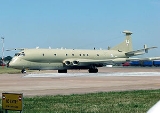
A
maritime patrol aircraft (
MPA), also known as a
patrol aircraft,
maritime reconnaissance aircraft, or by the older American term
patrol bomber, is a
fixed-wing aircraftA fixed-wing aircraft is an aircraft capable of flight using wings that generate lift due to the vehicle's forward airspeed. Fixed-wing aircraft are distinct from rotary-wing aircraft in which wings rotate about a fixed mast and ornithopters in which lift is generated by flapping wings.A powered...
designed to operate for long durations over water in
maritime patrolMaritime patrol is the task of monitoring areas of water. Generally conducted by military and law enforcement agencies, maritime patrol is usually aimed at identifying human activities....
roles - in particular
anti-submarineAnti-submarine warfare is a branch of naval warfare that uses surface warships, aircraft, or other submarines to find, track and deter, damage or destroy enemy submarines....
,
anti-shipAnti-surface warfare is a type of naval warfare directed against surface combatants. More generally, it is any weapons, sensors, or operations intended to attack or limit the effectiveness of an adversary's surface ships....
and
search and rescueSearch and rescue is the search for and provision of aid to people who are in distress or imminent danger.The general field of search and rescue includes many specialty sub-fields, mostly based upon terrain considerations...
.
History
World War I and World War II era
The first aircraft that would now be identified as patrol bombers were flown by the
Royal Naval Air ServiceThe Royal Naval Air Service or RNAS was the air arm of the Royal Navy until near the end of the First World War, when it merged with the British Army's Royal Flying Corps to form a new service , the Royal Air Force...
during
World War IWorld War I , which was predominantly called the World War or the Great War from its occurrence until 1939, and the First World War or World War I thereafter, was a major war centred in Europe that began on 28 July 1914 and lasted until 11 November 1918...
, primarily on anti-submarine patrols. At first
blimpA blimp, or non-rigid airship, is a floating airship without an internal supporting framework or keel. A non-rigid airship differs from a semi-rigid airship and a rigid airship in that it does not have any rigid structure, neither a complete framework nor a partial keel, to help the airbag...
s were the only aircraft capable of staying aloft for the long periods of time (as much as 10 hours) needed by the patrols whilst carrying a useful payload. Shorter-range patrols were mounted by adapted bombers such as the
Sopwith 1½ StrutterThe Sopwith 1½ Strutter was a British one or two-seat biplane multi-role aircraft of the First World War. It is significant as the first British-designed two seater tractor fighter, and the first British aircraft to enter service with a synchronised machine gun...
. Later in the war aeroplanes were developed specifically for the role. These were usually large
floatplaneA floatplane is a type of seaplane, with slender pontoons mounted under the fuselage; only the floats of a floatplane normally come into contact with water, with the fuselage remaining above water...
s such as the Short 184 or
flying boatA flying boat is a fixed-winged seaplane with a hull, allowing it to land on water. It differs from a float plane as it uses a purpose-designed fuselage which can float, granting the aircraft buoyancy. Flying boats may be stabilized by under-wing floats or by wing-like projections from the fuselage...
s such as the
Felixstowe F.2|-See also:-References:NotesBibliography* Bruce, J.M. Flight, 2 December 1955, pp. 842–846.* Bruce, J.M. Flight, 16 December 1955, pp. 895–898.* Bruce, J.M. Flight, 23 December 1955, pp. 929–932....
.
Many of the
World War IIWorld War II, or the Second World War , was a global conflict lasting from 1939 to 1945, involving most of the world's nations—including all of the great powers—eventually forming two opposing military alliances: the Allies and the Axis...
patrol aircraft were converted from long-range
bomberA bomber is a military aircraft designed to attack ground and sea targets, by dropping bombs on them, or – in recent years – by launching cruise missiles at them.-Classifications of bombers:...
s or
airlinerAn airliner is a large fixed-wing aircraft for transporting passengers and cargo. Such aircraft are operated by airlines. Although the definition of an airliner can vary from country to country, an airliner is typically defined as an aircraft intended for carrying multiple passengers in commercial...
s (such as
GermanyGermany , officially the Federal Republic of Germany , is a federal parliamentary republic in Europe. The country consists of 16 states while the capital and largest city is Berlin. Germany covers an area of 357,021 km2 and has a largely temperate seasonal climate...
's
Focke-Wulf Fw 200The Focke-Wulf Fw 200 Condor, also known as Kurier to the Allies was a German all-metal four-engine monoplane originally developed by Focke-Wulf as a long-range airliner...
"Condor"). To cover the
Mid-Atlantic GapThe Mid-Atlantic Gap was the gap in coverage by land-based Coastal Command antisubmarine aircraft during the Battle of the Atlantic in the Second World War. It is frequently known as The Black Pit, as well as the Atlantic Gap, Air Gap, Greenland Gap, or just "the Gap". This resulted in heavy...
that existed the British introduced a "Very Long Range" version of the Consolidated B-24 Liberator bomber which was capable of patrolling the areas between
IcelandIceland , described as the Republic of Iceland, is a Nordic and European island country in the North Atlantic Ocean, on the Mid-Atlantic Ridge. Iceland also refers to the main island of the country, which contains almost all the population and almost all the land area. The country has a population...
and
GreenlandGreenland is an autonomous country within the Kingdom of Denmark, located between the Arctic and Atlantic Oceans, east of the Canadian Arctic Archipelago. Though physiographically a part of the continent of North America, Greenland has been politically and culturally associated with Europe for...
and attack German submarines.
Purpose-designed aircraft were also used, including the
AmericanThe United States of America is a federal constitutional republic comprising fifty states and a federal district...
Consolidated PBY Catalina.
Post World War II
After World War II the patrol role was generally taken over by conversions of civilian airliners that had range and performance better than most wartime bombers.
[The British used a further development of the Avro Lancaster]The Avro Lancaster is a British four-engined Second World War heavy bomber made initially by Avro for the Royal Air Force . It first saw active service in 1942, and together with the Handley Page Halifax it was one of the main heavy bombers of the RAF, the RCAF, and squadrons from other...
bomber - the Avro ShackletonThe Avro Shackleton was a British long-range maritime patrol aircraft for use by the Royal Air Force. It was developed by Avro from the Avro Lincoln bomber with a new fuselage...
- and then followed it with a conversion of a civilian jet - the Hawker Siddeley NimrodThe latest jet-powered bombers of the 1950s did not have the endurance needed for long, over-water cruising, and more importantly did not have the low loitering speed necessary for anti-submarine operations. The main threat to
NATO powers throughout the 1960s and into the 1980s were
SovietThe Soviet Union , officially the Union of Soviet Socialist Republics , was a constitutionally socialist state that existed in Eurasia between 1922 and 1991....
submarines, which were located primarily with the use of
sonobuoyA sonobuoy is a relatively small expendable sonar system that is dropped/ejected from aircraft or ships conducting anti-submarine warfare or underwater acoustic research....
s, and which then could be attacked with homing
torpedoThe modern torpedo is a self-propelled missile weapon with an explosive warhead, launched above or below the water surface, propelled underwater towards a target, and designed to detonate either on contact with it or in proximity to it.The term torpedo was originally employed for...
es.
Since the end of the
Cold WarThe Cold War was the continuing state from roughly 1946 to 1991 of political conflict, military tension, proxy wars, and economic competition between the Communist World—primarily the Soviet Union and its satellite states and allies—and the powers of the Western world, primarily the United States...
the threat of a large-scale submarine attack is remote, and many forces are downsizing their patrol aircraft fleets. Those still in service are used primarily for counter-smuggling and
Exclusive Economic ZoneUnder the law of the sea, an exclusive economic zone is a seazone over which a state has special rights over the exploration and use of marine resources, including production of energy from water and wind. It stretches from the seaward edge of the state's territorial sea out to 200 nautical...
enforcement duties.
Armament and countermeasures
The earliest patrol aircraft carried bombs and machine guns. Between the wars the British experimented with equipping their patrol aircraft with the
COW 37 mm gunThe COW 37 mm gun was a British automatic cannon that was developed as a heavy-calibre aircraft weapon.It was trialled in several installations and specified for the Westland C.O.W. Gun Fighter...
. During the Second World War
depth chargeA depth charge is an anti-submarine warfare weapon intended to destroy or cripple a target submarine by the shock of exploding near it. Most use explosives and a fuze set to go off at a preselected depth in the ocean. Depth charges can be dropped by either surface ships, patrol aircraft, or from...
s that could be successfully dropped replaced "anti-submarine" bombs.
Patrol aircraft also carried defensive armament which was necessary when patrolling areas close to enemy territory such as Allied operations in the
Bay of BiscayThe Bay of Biscay is a gulf of the northeast Atlantic Ocean located south of the Celtic Sea. It lies along the western coast of France from Brest south to the Spanish border, and the northern coast of Spain west to Cape Ortegal, and is named in English after the province of Biscay, in the Spanish...
targeting U-boats starting out from their base.
As a result of Allied successes with patrol aircraft against U-boats, the Germans introduced U-
flak (submarines equipped with more anti-aircraft weaponry) to escort U-boats out of base and encouraged commanders to remain on the surface and fire back at attacking craft rather than trying to escape by diving. Equipping submarines with radar warning equipment and the
snorkelA submarine snorkel is a device which allows a submarine to operate submerged while still taking in air from above the surface. Navy personnel often refer to it as the snort.-History:...
made them harder to be found.
To counter the German long range patrol aircraft which targeted merchant convoys the British introduced the
CAM shipCAM ships were World War II-era British merchant ships used in convoys as an emergency stop-gap until sufficient escort carriers became available. CAM is an acronym for catapult aircraft merchantman. A CAM ship was equipped with a rocket-propelled catapult launching a single Hawker Sea Hurricane,...
which was a merchant vessel equipped with a single fighter aircraft which could be launched once to engage the enemy aircraft.
Sensors
Maritime patrol aircraft are typically fitted with a wide range of sensors:
- Radar
Radar is an object-detection system which uses radio waves to determine the range, altitude, direction, or speed of objects. It can be used to detect aircraft, ships, spacecraft, guided missiles, motor vehicles, weather formations, and terrain. The radar dish or antenna transmits pulses of radio...
to detect surface shipping movements;
- Magnetic Anomaly Detector
A magnetic anomaly detector is an instrument used to detect minute variations in the Earth's magnetic field. The term refers specifically to magnetometers used by military forces to detect submarines ; the military MAD gear is a descendent of geomagnetic survey instruments used to search for...
(MAD) to detect submarines. The MAD detecting head is typically mounted on an extension from the tail to minimize interference from the rest of the aircraft;
- Sonobuoy
A sonobuoy is a relatively small expendable sonar system that is dropped/ejected from aircraft or ships conducting anti-submarine warfare or underwater acoustic research....
dropped from the aircraft into the sea to detect submarines, transmitting the data back to the aircraft for analysis;
- ELINT sensors to monitor civilian and military telecommunications;
- Infrared
Infrared light is electromagnetic radiation with a wavelength longer than that of visible light, measured from the nominal edge of visible red light at 0.74 micrometres , and extending conventionally to 300 µm...
camera are also useful in monitoring shipping movements.
Also the aircrew's eyes may be used, in some cases aided by
searchlightA searchlight is an apparatus that combines a bright light source with some form of curved reflector or other optics to project a powerful beam of light of approximately parallel rays in a particular direction, usually constructed so that it can be swiveled about.-Military use:The Royal Navy used...
or
flaresA flare, also sometimes called a fusee, is a type of pyrotechnic that produces a brilliant light or intense heat without an explosion. Flares are used for signalling, illumination, or defensive countermeasures in civilian and military applications...
.
A modern military maritime patrol aircraft typically carries a dozen or so crew members, including relief flight crews, to effectively operate the equipment for up to 12 hours at a time.
Examples of maritime patrol aircraft
Inter-war
- Supermarine Southampton
-See also:-References:NotesBibliography* Andrews, C.F. and E.B. Morgan. Supermarine Aircraft since 1914 . London: Putnam, 1987. ISBN 0-85177-800-3....
(UK)
- Short Singapore (UK)
World War II era
- Consolidated PBY Catalina (USA)
- Consolidated PB2Y Coronado (USA)
- Consolidated PB4Y-2 Privateer (USA)
- Dornier Do 24
-See also:-References:* -External links:* * * * * * * * *...
(Netherlands, Germany)
- Focke-Wulf Fw 200
The Focke-Wulf Fw 200 Condor, also known as Kurier to the Allies was a German all-metal four-engine monoplane originally developed by Focke-Wulf as a long-range airliner...
Condor (Germany)
- Junkers Ju 290
The Junkers Ju 290 was a long-range transport, maritime patrol aircraft and heavy bomber used by the Luftwaffe late in World War II.-Design and development:...
(Germany)
- Kawanishi H6K
|-See also:-References:NotesBibliography* Doubilet, David. "The Flying Boat". Sport Diver Magazine. Volume 15, Number 8, September 2007.* Francillon, Ph.D., René J. Japanese Aircraft of the Pacific War. Annapolis, Maryland, MD: Naval Institute Press, 1995.* Green, William. Warplanes of the Second...
Mavis (Japan)
- Kawanishi H8K
|-See also:-References:NotesBibliography* Bridgeman, Leonard. "The Kawanishi H8K2 “Emily”" Jane’s Fighting Aircraft of World War II. London: Studio, 1946. ISBN 1-85170-493-0....
Emily (Japan)
- Lockheed Ventura
The Lockheed Ventura was a bomber and patrol aircraft of World War II, used by United States and British Commonwealth forces in several guises...
(USA)
- Martin PBM Mariner (USA)
- Short Sunderland
The Short S.25 Sunderland was a British flying boat patrol bomber developed for the Royal Air Force by Short Brothers. It took its service name from the town and port of Sunderland in northeast England....
(UK)
Shorter ranged aircraft such as the
Lockheed HudsonThe Lockheed Hudson was an American-built light bomber and coastal reconnaissance aircraft built initially for the Royal Air Force shortly before the outbreak of the Second World War and primarily operated by the RAF thereafter...
with a range of 1,700 nm were used in "coastal reconnaisance".
Post World War II

- Airbus A319 MPA (France)
- ATR 42 MP Surveyor
-Civil operators:The largest operators of the ATR-42 are FedEx Express, Airlinair, TRIP Linhas Aéreas,and Mexico City-based Aeromar respectively. Number of aircraft as of 2010:Some 70 other airlines operate smaller numbers of the type....
(France)
- ATR 72 ASW
The ATR 72 is a twin-engine turboprop short-haul regional airliner built by the French-Italian aircraft manufacturer ATR. ATR and Airbus are both built in Toulouse, and share resources and technology...
(France)
- Avro Shackleton
The Avro Shackleton was a British long-range maritime patrol aircraft for use by the Royal Air Force. It was developed by Avro from the Avro Lincoln bomber with a new fuselage...
- UK, 1951–1984)
- Beriev Be-10
|-See also:-Bibliography:* Yefim Gordon, Andrey Sal'nikov and Aleksandr Zablotskiy Beriev's Jet Flying Boats. Hinckley, UK: Midland Publishing. ISBN 1-85780-236-5-External links:* at Russian Aviation Museum...
(USSR)
- Beriev Be-12
|-See also:-Bibliography:* Yefim Gordon, Andrey Sal'nikov and Aleksandr Zablotskiy Beriev's Jet Flying Boats. Hinckley, UK: Midland Publishing. ISBN 1-85780-236-5...
(USSR)
- Beriev Be-200
The Beriev Be-200 Altair is a multipurpose amphibious aircraft designed by the Beriev Aircraft Company and manufactured by Irkut. Marketed as being designed for fire fighting, search and rescue, maritime patrol, cargo, and passenger transportation, it has a capacity of 12 tonnes of water, or up...
(Russia)
- Boeing P-8 Poseidon (USA)
- Bombardier Dash 8 DHC-8-300 MSA and DHC-8 MPA-D8 (Canada)
- Breguet Br 1150 Atlantic - France, 1961-
- CASA C212 MPA (Spain)
- CASA CN235 MPA
The CASA/IPTN CN-235 is a medium-range twin-engined transport plane that was jointly developed by CASA of Spain and IPTN of Indonesia as a regional airliner and military transport. Its primary military roles include maritime patrol, surveillance, and air transport...
(Spain)
- CASA C295 MPA (Spain)
- Canadair CP-107 Argus - Canada, 1957–1982
- Dassault Falcon 20G
The Dassault Falcon 20 is a French business jet and was the first of a family of business jets built by Dassault Aviation.-Design and development:...
(France)
- Dassault Falcon 50 Surmar
|-See also:-References:* Taylor, John W R. . Jane's All The World's Aircraft 1988-89. Coulsdon, Surrey, UK:Jane's Information Group. ISBN 0-7106-0867-5.-External links:* *...
(France)
- Dassault Falcon 900 MPA (France)
- Fokker F27 Maritime (Netherlands)
- Hawker-Siddeley Nimrod - UK, 1970 to 2010
- Ilyushin Il-38
|-See also:-References:*Lake, Jon. "Russia's Submarine Killer: Ilyushin IL-38 May". Air International, February 2005, Vol 68 No.2. Stamford, UK:Key Publishing. pp. 30–36....
(USSR)
- Lockheed P-2 Neptune (USA)
- Lockheed P-3 Orion (USA)
- see also Lockheed CP-140 Aurora
The Lockheed CP-140 Aurora is a maritime patrol aircraft operated by the Royal Canadian Air Force. The aircraft is based on the Lockheed P-3 Orion airframe, but mounts the electronics suite of the S-3 Viking...
and CP-140A Arcturus (CAN)
- Martin P5M Marlin (USA)
- PZL M28B Bryza 1R, 1RMbis, 1E (Poland)
- Tupolev Tu-142
The Tupolev Tu-142 is a maritime reconnaissance and anti-submarine warfare aircraft derived from the Tu-95 turboprop strategic bomber. A specialised communications variant designated Tu-142MR was tasked with long-range communications duties with Soviet ballistic missile submarines...
(USSR)
- HESA IrAn-140
|-See also:* Iran Aviation Industries Organization* Military of Iran* List of Iranian Air Force aircraft* Iranian military industry* Current Equipment of the Iranian Army-External links:* - Globalsecurity.org...
(Iran)
Small (often
carrier-basedCarrier-based aircraft are military aircraft designed specifically for operations from aircraft carriers. The term is generally applied only to fixed-wing aircraft, as naval helicopters are able to operate from a wider variety of aviation-capable ships. Carrier-based aircraft must be relatively...
) ASW or anti-ship aircraft are not normally considered to be MPAs. These include
Kyushu Q1W-References:NotesBibliography* Francillon, Ph.D., René J. Japanese Aircraft of the Pacific War. London: Putnam & Company Ltd., 1979. ISBN 0-370-30251-6.-External links:*...
,
SB2U VindicatorThe Vought SB2U Vindicator was a carrier-based dive bomber developed for the United States Navy in the 1930s, the first monoplane in this role. Obsolescent at the outbreak of World War II, Vindicators still remained in service at the time of the Battle of Midway, but by 1943, all had been withdrawn...
,
Breguet Alizé|-See also:-References:*Michell, Simon. . Jane's Civil and Military Aircraft Upgrades 1994-95. Coulsdon, UK:Jane's Information Group, 1994. ISBN 0-7106-1208-7.-External links:*...
,
Fairey GannetThe Fairey Gannet was a British carrier-borne anti-submarine warfare and airborne early warning aircraft of the post-Second World War era developed for the Royal Navy's Fleet Air Arm by the Fairey Aviation Company...
,
Grumman AF Guardian,
Grumman S-2 TrackerThe Grumman S-2 Tracker was the first purpose-built, single airframe anti-submarine warfare aircraft to enter service with the US Navy. The Tracker was of conventional design with twin engines, a high wing and tricycle undercarriage. The type was exported to a number of navies around the world...
and
Lockheed S-3 VikingThe Lockheed S-3 Viking is a four-seat twin-engine jet aircraft that was used by the U.S. Navy to identify, track, and destroy enemy submarines. In the late 1990s, the S-3B's mission focus shifted to surface warfare and aerial refueling. The Viking also provided electronic warfare and surface...
.