

B-29 Superfortress

Unanswered Questions

Discussions
Encyclopedia
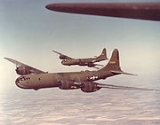
The B-29 Superfortress is a four-engine propeller-driven heavy bomber
designed by Boeing
that was flown primarily by the United States Air Forces in late-World War II
and through the Korean War
. The B-29 was one of the largest aircraft
to see service during World War II. A very advanced bomber for this time period, it included features such as a pressurized cabin, an electronic fire-control system, and remote-controlled machine-gun turrets. The name "Superfortress" was derived from that of its well-known predecessor, the B-17 Flying Fortress. Though the B-29 was designed as a high-altitude daytime bomber, in practice it actually flew more low-altitude nighttime incendiary bombing missions. It was the primary aircraft in the American firebombing campaign against the Empire of Japan
in the final months of World War II, and carried out the atomic bombings
that destroyed Hiroshima
and Nagasaki
. Unlike many other World War II-era bombers, the B-29 remained in service long after the war ended, with a few even being employed as flying television transmitters for the Stratovision
company.
The B-29 served in various roles throughout the 1950s. The British Royal Air Force
flew the B-29 and used the name Washington for the type, and the Soviet Union produced an unlicensed reverse-engineered copy as the Tupolev Tu-4
. The B-29 was the progenitor of a series of Boeing-built bombers, transports, tankers, reconnaissance aircraft and trainers including the B-50 Superfortress
(the first aircraft to fly around the world non-stop
) which was essentially a re-engined B-29. The type was finally retired in the early 1960s, with 3,970 aircraft in all built. While dozens of B-29s have survived through today as static displays, only one remains on active flying status.
A transport derived from the B-29 was the C-97, first flown in 1944, followed by its commercial airliner variant, the Boeing Model 377 Stratocruiser in 1947. This bomber-to-airliner derivation was similar to the B-17/Model 307
evolution. The tanker variant of the B-29 was introduced in 1948 as the KB-29, followed by the Model 377-derivative KC-97 introduced in 1950. Later jet-powered models from Boeing carried on the lineage, including the B-47 Stratojet and B-52 Stratofortress bombers, as well as the "Dash 80
", from which today's modern airliners are evolved. A heavily modified line of outsized-cargo variants of the B-29-derived Stratocruiser is the Guppy
/Mini Guppy
/Super Guppy
which remain in service today with operators such as NASA
.
 Boeing began work on pressurized long-range bombers in 1938, when, in response to a United States Army Air Corps
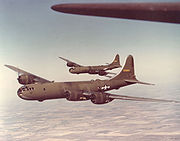
request, it produced a design study for the Model 334, a pressurized derivative of the Boeing B-17 Flying Fortress with nosewheel undercarriage. Although the Air Corps did not have money to pursue the design, Boeing continued development with its own funds as a private venture, so that when, in December 1939, the Air Corps issued a formal specification for a so called "superbomber", capable of delivering 20,000 lbs of bombs to a target 2,667 mi (4,290 km) away and capable of flying at a speed of 400 mph (640 km/h), they formed a starting point for Boeing's response.
Boeing submitted its Model 345 on 11 May 1940, in competition with designs from Consolidated Aircraft
(the Model 33, later to become the B-32), Lockheed
(the Lockheed XB-30
), and Douglas
(the Douglas XB-31
). Douglas and Lockheed soon abandoned work on their projects, but Boeing received an order for two flying prototype
s, given the designation XB-29, and an airframe for static testing on 24 August 1940, with the order being revised to add a third flying aircraft on 14 December. Consolidated continued to work on its Model 33 as it was seen by the Air Corps as a backup in case of problems with Boeing's design. An initial production order for 14 service test aircraft and 250 production bombers was placed in May 1941, this being increased to 500 aircraft in January 1942. The B-29 featured a fuselage design with circular cross-sections. The circle, being the geometry of minimum perimeter for a given area, is the theoretical ideal for minimum structural weight to prevent deformation due to strong pressurization forces. For a 3-dimensional volume, the minimum surface is a sphere, however drag considerations shift the fuselage geometry optimization toward a circular cross-section cylindrical design with taper. This basic geometry has persisted in airliner design from the Model 307
through today's 787
. The need for pressurization in the cockpit area also led to the B-29 having the only "stepless" cockpit design, without a separate windscreen for the pilot, on an American combat aircraft of World War II. The "stepless" cockpit design was also used on many German bombers of the World War II Luftwaffe giving improved streamlining, notably being incorporated in the Heinkel He 111
from 1938. The later Messerschmitt Me 264
's stepless cockpit design strongly echoed the general appearance of the B-29's nose, and it also used a tricycle undercarriage, a relative novelty in German aircraft of the war years.
Manufacturing the B-29 was a complex task. It involved four main-assembly factories: a pair of Boeing operated plants at Renton, Washington
, and Wichita, Kansas
, a Bell plant at Marietta, Georgia
("Bell-Atlanta"), and a Martin
plant at Omaha, Nebraska
("Martin-Omaha"). Thousands of subcontractor
s were involved in the project. The first prototype made its maiden flight from Boeing Field
, Seattle on 21 September 1942. Because of the aircraft's highly advanced design, challenging requirements, and immense pressure for production, development was deeply troubled. The second prototype, which, unlike the unarmed first, was fitted with a Sperry defensive armament system using remote-controlled gun turrets sighted by periscopes, first flew on 30 December 1942, this flight being terminated due to a serious engine fire. On 18 February 1943 the second prototype again experienced an engine fire, which was extinguished, but a second fire erupted. Two crewmen bailed out as the plane narrowly missed downtown Seattle skyscrapers on its approach to Boeing Field, but their chutes did not deploy in time and they were killed. The aircraft crashed into the Frye Packing Plant just short of the runway, killing lead Boeing test pilot Edmund T. "Eddie" Allen
, eight other crewmen and 19 workers in the meat-processing factory. Changes to the production craft came so often and so fast that in early 1944, B-29s flew from the production lines directly to modification depots for extensive rebuilds to incorporate the latest changes. The Air Force–operated modification depots struggled to cope with the scale of work required, with a lack of hangars capable of housing the B-29 combined with freezing cold weather further delaying the modification, such that at the end of 1943, although almost 100 aircraft had been delivered, only 15 percent were airworthy. This prompted an intervention by General Hap Arnold
to resolve the problem, with production personnel being sent from the factories to the modification centers to speed modification of sufficient aircraft to equip the first Bomb Groups
in what became known as the "Battle of Kansas". This resulted in 150 aircraft being modified in the six weeks between 10 March and 15 April 1944.
 The most common cause of maintenance headaches and catastrophic failures was the engine. Although the Wright R-3350
later became a trustworthy workhorse in large piston-engined aircraft, early models were beset with dangerous reliability problems. This problem was not fully cured until the aircraft was fitted with the more powerful Pratt & Whitney R-4360 "Wasp Major" in the B-29D/B-50 program, which arrived too late for World War II
. Interim measures included cuffs placed on propeller blades to divert a greater flow of cooling air into the intakes, which had baffles installed to direct a stream of air onto the exhaust valves. Oil flow to the valves was also increased, asbestos
baffles installed around rubber push rod fittings to prevent oil loss, thorough pre-flight inspections made to detect unseated valves, and frequent replacement of the uppermost five cylinders (every 25 hours of engine time) and the entire engines (every 75 hours).
Pilots, including the present day pilots of the Commemorative Air Force
’s Fifi, the last remaining flying B-29, describe flight after takeoff as being an urgent struggle for airspeed (generally, flight after takeoff should consist of striving for altitude). Radial engine
s need airflow to keep them cool, and failure to get up to speed as soon as possible could result in an engine failure and risk of fire. One useful technique was to check the magnetos while already rolling rather than from a "braked" start.
In wartime, the B-29 was capable of flight up to 40000 feet (12,192 m), at speeds of up to 350 mph (true airspeed
). This was its best defense, because Japanese fighters of that day could barely get that high, and few could catch the B-29, even if they were at altitude and waiting. Only the heaviest of anti-aircraft weapons could reach it, and since the Axis forces did not have proximity fuze
s, hitting or damaging the aircraft from the ground in combat was next to impossible.
With the revolutionary Central Fire Control System (CFCS), the B-29 had four remote-controlled turrets, each armed with two .50 cal M2/AN machine guns. Four gunners were able to control these turrets with the use of four General Electric
-made analog computer
s, one above the Norden bombsight
in the nose and three in a pressurized compartment in the rear fuselage, which featured clear blown sighting blisters. The gunner manning the sight in the upper rear station was the "Central Fire Control gunner", whose job was to allocate turrets to each of the other three gunners, avoiding confusion in the heat of battle. The CFCS had (at that time) a highly advanced analog computer that corrected for the B-29's airspeed, the target's speed, target lead, gravity, temperature and humidity. Because of this, the .50 caliber machine guns of the B-29 had a maximum effective range of 1000 yards (914.4 m), double the range of the manually aimed machine guns of the B-17 Flying Fortress. The tail gunner could only control his own weapons (two M2/AN Brownings plus, in early production B-29s, a 20 mm M2 cannon) and the lower rear turret. After World War II, the tail guns eventually got their own APG-15 gun control radar sets.
In early 1945, with a change of role from high-altitude day bomber to low-altitude night bomber, LeMay reportedly ordered the removal of most of the defensive armament and remote-controlled sighting equipment from his B-29s so that they could carry greater fuel and bomb loads.As a consequence of this requirement, Bell Marietta (BM) produced a series of 311 B-29Bs that had turrets and sighting equipment removed, except for the tail position, which initially had the two .50 cal Browning machine guns and single M2 cannon with the APG-15 radar fitted as standard. This armament was quickly changed to three .50 caliber Brownings. This version also had an improved APQ-7 "Eagle" bombing-through-overcast radar fitted in an airfoil shaped radome under the fuselage. Most of these aircraft were assigned to the 315th Bomb Wing, Northwest Field, Guam.
The crew enjoyed, for the first time in a bomber, full-pressurization comfort. This first-ever cabin pressure system for an Allied production bomber was developed for the B-29 by Garrett AiResearch
. The nose and the cockpit were pressurized, but the designers were faced with deciding whether to have bomb bays that were not pressurized, between fore and aft pressurized sections, or a fully pressurized fuselage
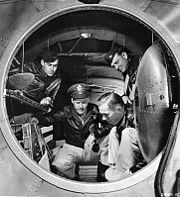
with the need to de-pressurize to drop their loads. The decision was taken to have a long tunnel over the two bomb bays so that crews could crawl back and forth between the fore and aft sections, with both areas and the tunnel pressurized. The bomb bays were not pressurized.
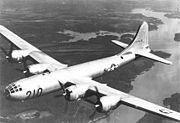 In flight, the pilot called for engine and flap settings instead of moving the throttles and the flap levers himself. Another innovation was the number of calculations the crew had to perform before and during the mission. Prior to the B-29, flight manuals provided only approximate performance figures, and pilots relied largely on instinct and experience. The B-29 manual had charts to compute takeoff and landing speeds based on weight, elevation and temperature. Finding the optimum power settings for cruising speed required consideration of the cruising altitude, outside temperature, aircraft weight, and desired true airspeed. The power settings were recalculated every two hours or with every change in altitude. These types of computations are routine in modern civil and military aviation, but they were an innovation in 1944. The benefits of improved range and performance were irrefutable.
Unlike aircraft such as the Consolidated B-24 Liberator, the B-29 lacked boosted controls. As a consequence they required considerable physical strength to operate. As it was, most aircrews found the B-29 to be relatively mild-mannered.
Though it could be flown with only two engines once airborne, the bomber suffered from engine overheating throughout its service, and several B-29s crashed in Saipan after single engine failures on takeoff at full gross weight.
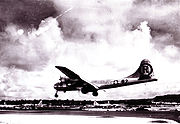 The initial plan, implemented at the direction of President Franklin D. Roosevelt
as a promise to China and called Operation Matterhorn
, was to use B-29s to attack Japan from four forward bases in southern China
, with five main bases in India
, and to attack other targets in the region from China and India as needed. The Chengdu
region was eventually chosen over the Guilin
region to avoid having to raise, equip, and train 50 Chinese divisions to protect the advanced bases from Japanese ground attack. The XX Bomber Command
, initially intended to be two combat wings of four groups each, was reduced to a single wing of four groups because of the lack of availability of aircraft, automatically limiting the effectiveness of any attacks from China.
This was an extremely costly scheme, as there was no overland connection available between India and China, and all supplies had to be flown over the Himalayas
, either by transport aircraft or by the B-29s themselves, with some aircraft being stripped of armor and guns and used to deliver fuel. B-29s started to arrive in India in early April 1944. The first B-29 flight to airfields in China (over the Himalayas, or "The Hump
") took place on 24 April 1944. The first B-29 combat mission was flown on 5 June 1944, with 77 out of 98 B-29s launched from India bombing the railroad shops in Bangkok
and Thailand
. Five B-29s were lost during the mission, not to hostile fire.
at Yahata Japan
. This was the first attack on Japanese islands since the Doolittle raid
in April 1942. The first B-29 combat losses occurred during this raid, with one B-29 destroyed on the ground by Japanese fighters after an emergency landing in China, one lost to anti-aircraft fire over Yawata, and another, the Stockett's Rocket (after Capt. Marvin M. Stockett, Aircraft Commander) B-29-1-BW 42-6261, disappeared after takeoff from Chakulia, India, over the Himalayas (12 KIA, 11 crew and one passenger)(Source: 20th Bomb Group Assn.) This raid, which did little damage to the target, with only one bomb striking the target factory complex, nearly exhausted fuel stocks at the Chengdu B-29 bases, resulting in a slow-down of operations until the fuel stockpiles could be replenished. Starting in July, the raids against Japan from Chinese airfields continued at relatively low intensity. Japan was bombed on: 7 July 1944 (14 B-29s), 29 July (70+), 10 August (24), 20 August (61), 8 September (90), 26 September (83), 25 October (59), 12 November (29), 21 November (61), 19 December (36) and for the last time on 6 January 1945 (49).
The tactic of using aircraft to ram American B-29s was first recorded on the 20 August raid on the steel factories at Yawata. Sergeant Shigeo Nobe of the 4th Sentai intentionally flew his Kawasaki Ki-45
into a B-29; debris from the explosion following this attack severely damaged another B-29, which also went down. Lost were Colonel Robert Clinksale's B-29-10-BW 42-6334 Gertrude C and Captain Ornell Stauffer's B-29-15-BW 42-6368 Calamity Sue, both from the 486th BG. Several B-29s were destroyed in this way over the ensuing months. Although the term "Kamikaze
" is often used to refer to the pilots conducting these attacks, the word was not used by the Japanese military.
B-29s were withdrawn from airfields in China by the end of January 1945. Throughout this prior period, B-29 raids were also launched from China and India against many other targets throughout Southeast Asia
. However, the entire B-29 effort was gradually shifted to the new bases in the Marianas Islands in the Central Pacific, with the last B-29 combat mission from India flown on 29 March 1945.
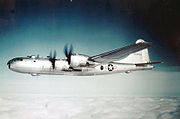
, which would bring target such as Tokyo
, about 1,500 mi (2,400 km) north of the Marianas within range of B-29 attacks. It was therefore agreed in December 1943 to seize the Marianas.
Saipan was invaded
by US forces on 15 June 1944, and despite a Japanese naval counterattack which led to the Battle of the Philippine Sea
and heavy fighting on land, was secured by 9 July. Operations followed against Guam and Tinian
, with all three islands secured by August.
Work began at once to construct air bases suitable for the B-29, work beginning even before the end of ground fighting. In all, five major air fields were built, with two on the flat island of Tinian
and one on Saipan
and two on Guam
. Each was large enough to eventually accommodate a bomb wing consisting of four bomb groups, giving a total of 180 B-29s per airfield. These bases, which could be supplied by ship and unlike the bases in China, were not vulnerable to attacks by Japanese ground forces, became the launch sites for the large B-29 raids against Japan in the final year of the war. The first B-29 arrived on Saipan on 12 October 1944, and the first combat mission was launched from there on 28 October 1944, with 14 B-29s attacking the Truk atoll. The first mission against Japan from bases in the Marianas was flown on 24 November 1944, with 111 B-29s sent to attack Tokyo
. From that point, raids intensified, launched regularly until the end of the war. These attacks succeeded in devastating almost all large Japanese cities (with the exception of Kyoto and several others), and they gravely damaged Japan's war industries. Although less publicly appreciated, the mining of Japanese ports and shipping routes (Operation Starvation
) carried out by B-29s from April 1945 significantly affected Japan's ability to support its population and move its troops.
, which dropped the atomic bomb
"Little Boy
" on Hiroshima
on 6 August 1945. Bockscar
, another B-29, dropped "Fat Man
" on Nagasaki three days later. These two actions, along with the Soviet invasion of Manchuria on 9 August 1945, brought about the Japanese surrender, and the official end of World War II. Both aircraft were handpicked for modification from the assembly line at the Omaha plant that was to become Offutt Air Force Base
.
Following the surrender of Japan, V-J Day
, B-29s were used for other purposes. A number supplied POWs
with food and other necessities by dropping barrels of rations on Japanese POW camps. In September 1945, a long-distance flight was undertaken for public relations purposes: generals Barney M. Giles
, Curtis LeMay
and Emmett O'Donnell, Jr.
piloted three specially modified B-29s from Chitose Air Base
in Hokkaidō
to Chicago Municipal Airport, continuing to Washington, D.C.
, the farthest nonstop distance to that date flown by Army Air Forces aircraft and the first-ever nonstop flight from Japan to the U.S.
Two months later, Colonel Clarence S. Irvine commanded another modified B-29, Pacusan Dreamboat, in a world-record-breaking long-distance flight from Guam to Washington, D.C., traveling 7,916 miles (12,740 km) in 35 hours, with a gross takeoff weight of 155,000 pounds (70,000 kg).
. The use of YB-29-BW 41-36393, the so-named Hobo Queen, one of the service test aircraft flown around several British airfields in early 1944, was thought to be as a "disinformation" program intended to deceive the Germans into believing that the B-29 would be deployed to Europe.
Postwar, several RAF Bomber Command
squadrons were equipped with B-29s loaned from USAF stocks. The aircraft were known as the Washington B.1 in RAF service , and remained in service from March 1950 until the last were returned in early 1954, having been replaced by initial deliveries of the UKs V bomber
s.
Captain Howard Jarrell and his 10-man crew took off from Chengdu
, China
, on 31 July 1944 for a mission against the Japanese Showa steel mill in Anshan
, Manchuria
. Capt. Jarrell's B-29, called "Ramp Tramp",(B-29-5-BW serial number 42-6256) was assigned to the 462nd (Very Heavy) Bomb Group and was part of a large air strike composed of approximately 100 aircraft. At the end of the bomb run, the inboard right engine (No. 3) "ran away" and could not be "feathered" (setting the variable pitched propeller blades parallel to the airflow to minimize aerodynamic drag
). So, the engine had to be shut down, which increased the drag of the unfeathered propeller. This made the plane burn more fuel, so it could not get back to Chengdu. The pilot headed toward the Soviet base at Vladivostok
, Russia
to land the damaged bomber. The crew were allowed to escape into American-occupied Iran in January 1945. The bomber was not returned and instead used in the USSR during 1948-49 as a drop ship for underwing launching of 346P glider, a development of the German DFS 346
rocket-powered aircraft. It was also used by the Soviets in the effort to copy the B-29 as the Tu-4 Bull.
On August 20, 1944 the US Army Air Force B-29 Superfortress "Cait Paomat" (42-93829) flying from Chengdu was damaged by anti-aircraft gunfire during a raid on the Yawata Iron Works. Due to the damage sustained, the crew elected to divert to the Soviet Union. The aircraft crashed in the foothills of Sikhote Alin Range east of Khabarovsk after the crew bailed out. The crew was interned and allowed to escape into American-occupied Iran in January 1945. The airframe was used by the Soviets in the effort to copy the B-29 as the Tu-4 Bull. The complete wing and engines of this aircraft were later incorporated into the sole Tupolev Tu-70
transport aircraft.
On 11 November 1944, during a nighttime raid on Omura on Kyushu Japan, the USAAF B-29 "General H.H. Arnold Special" (42-6365) was damaged and forced to divert to Vladivostok in the Soviet Union. The crew was interned. On 21 November 1944, the USAAF B-29 "Ding Hao" (42-6358) was damaged during a raid on an aircraft factory at Omura, Japan and also forced to divert to Vladivostok. The interned crews were allowed to escape into American-occupied Iran in January 1945. Both B-29s were not returned and instead used in the Tu-4 Bull development effort.
On 29 August 1945, a Soviet Air Force Yak-9 damaged a B-29 dropping supplies to a POW camp in Korea, and forced it to land at Konan (now Hŭngnam
), North Korea. The 13-man crew of the B-29 was not injured in the attack, and were released after being interned for 13 days.
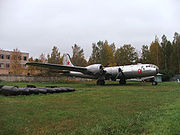 The Tupolev
OKB dismantled and studied Ramp Tramp and the other two B-29s, and Stalin ordered Tupolev and his design bureau to copy the B-29, and produce a design ready for quantity production as soon as possible. As the supply of aluminum in the USSR was in different thicknesses than available in the US (metric vs imperial), the entire aircraft had to be extensively re-engineered and the Tu-4 cannot be regarded as an exact copy despite external appearances, with Tupolev even substituting his own favored airfoil sections for those used by Boeing.
In 1947, the Soviets debuted both the Tupolev Tu-4 (NATO ASCC code named Bull) copy of the B-29, and the Tupolev Tu-70
transport variant. The Soviets used tail-gunner positions similar to the B-29 in many later bombers and transports.
when it formed on 21 March 1946. In particular, the "Silverplate" modified aircraft of the 509th Composite Group remained the only aircraft capable of delivering the atomic bomb, and so the unit was involved in the Operation Crossroads
series of tests, with B-29 Dave's Dream dropping a "Fat Man"-type bomb in Test Able on 1 July 1946.
The B-29s were outfitted with air filters and monitored debris from above ground nuclear weapons test by the United States and the USSR. The aircraft were also used for long-range weather reconnaissance (WB-29) and for signals intelligence gathering and photographic reconnaissance (RB-29).
jet fighters appeared over Korea (an aircraft specifically designed to shoot down the B-29), and after the loss of 28 aircraft, future B-29 raids were restricted to night-only missions, largely in a supply-interdiction role. Over the course of the war, B-29s flew 20,000 sorties and dropped 200,000 tonne (180,000 ton) of bombs. B-29 gunners were credited with shooting down 27 enemy aircraft.
The B-29 was notable for dropping the large "Razon" and "Tarzon
" radio-controlled bomb in Korea, mostly for demolishing major bridges, like the ones across the Yalu River
and for dams. Also conducted countless leaflet drops in North Korea, such as those for Operation Moolah
.
The B-29 was soon made obsolete by the development of the jet engine
d fighter aircraft. With the arrival of the mammoth Convair B-36
, the B-29 was reclassified as a medium bomber with the new Air Force. However, the later B-50 Superfortress variant (which was initially designated B-29D) was good enough to handle auxiliary roles such as air-sea rescue
, electronic intelligence gathering, and even air-to-air refueling
. The B-50D was replaced in its primary role during the early 1950s by the Boeing B-47 Stratojet, which in turn was replaced by the Boeing B-52 Stratofortress. The final active-duty variants were phased out in the mid-1960s. A total of 3,970 B-29s were built.
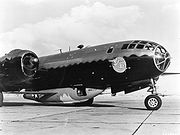 Unlike many other aircraft designed to play a similar role, the variants of the B-29 were all essentially the same. The developments made between the first prototype XB-29 and any of the three versions flown in combat were all minuscule, excluding the Silverplate
models built for the Manhattan Project
. The biggest differences were between variants modified for non-bomber missions. In addition to acting as cargo carriers, rescue aircraft, weather ships, and trainers, some were used for odd purposes such as flying relay television transmitters under the name of Stratovision
.
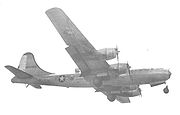 An example of a later variant of the B-29, the B-50 Superfortress (which was powered by four 3500 hp Pratt & Whitney R-4360-35 Wasp Major engines), acted as the mothership for experimental parasite fighter aircraft, such as the McDonnell XF-85 Goblin and Republic F-84 Thunderjets as in flight lock on and offs. It was also used to develop the Airborne Early Warning
program; it was the ancestor of various modern radar picket aircraft. A B-29 with the original Wright Duplex Cyclone powerplants was used to air-launch the famous Bell X-1
supersonic research rocket plane.
Some B-29s were modified to act as test beds for various new systems or special conditions, including fire-control systems, cold-weather operations, and various armament configurations. Several converted B-29s were used to experiment with aerial refueling
and re-designated as KB-29s. Perhaps the most important tests were conducted by the XB-29G; it carried prototype jet engine
s in its bomb bay, and lowered them into the air stream to conduct measurements.
 United States
in the United Kingdom, the other at the KAI Aerospace Museum
in Sachon, South Korea.
Notable examples are:
, which resulted in the United States v. Reynolds
lawsuit regarding State Secrets Privilege
and an August 1945 accident when two B-29s collided over Weatherford Texas.
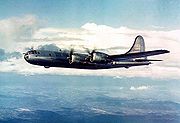
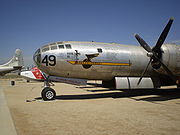

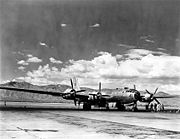
Heavy bomber
A heavy bomber is a bomber aircraft of the largest size and load carrying capacity, and usually the longest range.In New START, the term "heavy bomber" is used for two types of bombers:*one with a range greater than 8,000 kilometers...
designed by Boeing
Boeing
The Boeing Company is an American multinational aerospace and defense corporation, founded in 1916 by William E. Boeing in Seattle, Washington. Boeing has expanded over the years, merging with McDonnell Douglas in 1997. Boeing Corporate headquarters has been in Chicago, Illinois since 2001...
that was flown primarily by the United States Air Forces in late-World War II
World War II
World War II, or the Second World War , was a global conflict lasting from 1939 to 1945, involving most of the world's nations—including all of the great powers—eventually forming two opposing military alliances: the Allies and the Axis...
and through the Korean War
Korean War
The Korean War was a conventional war between South Korea, supported by the United Nations, and North Korea, supported by the People's Republic of China , with military material aid from the Soviet Union...
. The B-29 was one of the largest aircraft
Aircraft
An aircraft is a vehicle that is able to fly by gaining support from the air, or, in general, the atmosphere of a planet. An aircraft counters the force of gravity by using either static lift or by using the dynamic lift of an airfoil, or in a few cases the downward thrust from jet engines.Although...
to see service during World War II. A very advanced bomber for this time period, it included features such as a pressurized cabin, an electronic fire-control system, and remote-controlled machine-gun turrets. The name "Superfortress" was derived from that of its well-known predecessor, the B-17 Flying Fortress. Though the B-29 was designed as a high-altitude daytime bomber, in practice it actually flew more low-altitude nighttime incendiary bombing missions. It was the primary aircraft in the American firebombing campaign against the Empire of Japan
Empire of Japan
The Empire of Japan is the name of the state of Japan that existed from the Meiji Restoration on 3 January 1868 to the enactment of the post-World War II Constitution of...
in the final months of World War II, and carried out the atomic bombings
Atomic bombings of Hiroshima and Nagasaki
During the final stages of World War II in 1945, the United States conducted two atomic bombings against the cities of Hiroshima and Nagasaki in Japan, the first on August 6, 1945, and the second on August 9, 1945. These two events are the only use of nuclear weapons in war to date.For six months...
that destroyed Hiroshima
Enola Gay
Enola Gay is a Boeing B-29 Superfortress bomber, named after Enola Gay Tibbets, mother of the pilot, then-Colonel Paul Tibbets. On August 6, 1945, during the final stages of World War II, it became the first aircraft to drop an atomic bomb as a weapon of war...
and Nagasaki
Bockscar
Bockscar, sometimes called Bock's Car or Bocks Car, is the name of the United States Army Air Forces B-29 bomber that dropped the "Fat Man" nuclear weapon over Nagasaki on 9 August 1945, the second atomic weapon used against Japan....
. Unlike many other World War II-era bombers, the B-29 remained in service long after the war ended, with a few even being employed as flying television transmitters for the Stratovision
Stratovision
Stratovision was an airborne television transmission relay system from aircraft flying at high altitudes. In 1945 the Glenn L. Martin Co. and Westinghouse Electric Corporation advocated television coverage of small towns and rural areas as well as the large metropolitan centers by fourteen aircraft...
company.
The B-29 served in various roles throughout the 1950s. The British Royal Air Force
Royal Air Force
The Royal Air Force is the aerial warfare service branch of the British Armed Forces. Formed on 1 April 1918, it is the oldest independent air force in the world...
flew the B-29 and used the name Washington for the type, and the Soviet Union produced an unlicensed reverse-engineered copy as the Tupolev Tu-4
Tupolev Tu-4
The Tupolev Tu-4 was a piston-engined Soviet strategic bomber that served the Soviet Air Force from the late 1940s to mid 1960s...
. The B-29 was the progenitor of a series of Boeing-built bombers, transports, tankers, reconnaissance aircraft and trainers including the B-50 Superfortress
Boeing B-50 Superfortress
The Boeing B-50 Superfortress strategic bomber was a post-World War II revision of the Boeing B-29 Superfortress, fitted with more powerful Pratt & Whitney R-4360 radial engines, stronger structure, a taller fin, and other improvements. It was the last piston-engined bomber designed by Boeing for...
(the first aircraft to fly around the world non-stop
Lucky Lady II
Lucky Lady II is a United States Air Force Boeing B-50 Superfortress that became the first airplane to circle the world nonstop, when it made the journey in 1949, assisted by refueling the plane in flight. Total time airborne was 94 hours and 1 minute...
) which was essentially a re-engined B-29. The type was finally retired in the early 1960s, with 3,970 aircraft in all built. While dozens of B-29s have survived through today as static displays, only one remains on active flying status.
A transport derived from the B-29 was the C-97, first flown in 1944, followed by its commercial airliner variant, the Boeing Model 377 Stratocruiser in 1947. This bomber-to-airliner derivation was similar to the B-17/Model 307
Boeing 307
The Boeing Model 307 Stratoliner was the first commercial transport aircraft with a pressurized cabin. This feature allowed the plane to cruise at an altitude of 20,000 ft , well above weather disturbances. The pressure differential was 2.5 psi , so at 14,700 ft the cabin altitude...
evolution. The tanker variant of the B-29 was introduced in 1948 as the KB-29, followed by the Model 377-derivative KC-97 introduced in 1950. Later jet-powered models from Boeing carried on the lineage, including the B-47 Stratojet and B-52 Stratofortress bombers, as well as the "Dash 80
Boeing 367-80
The Boeing 367-80, or "Dash 80" as it was called within Boeing, is an American prototype jet transport built to demonstrate the advantages of jet aircraft for passenger transport over piston-engine airliners....
", from which today's modern airliners are evolved. A heavily modified line of outsized-cargo variants of the B-29-derived Stratocruiser is the Guppy
Aero Spacelines Pregnant Guppy
|-See also:-External links:* by Boeing. Retrieved October 5, 2006.* , by Daren Savage. Updated September 17, 2006. Retrieved October 5, 2006.* by Robert S. Tripp. Written Spring 2002. Retrieved October 5, 2006....
/Mini Guppy
Aero Spacelines Mini Guppy
The Aero Spacelines Mini Guppy is a large, wide-bodied US cargo aircraft used for aerial transport of outsized cargo components. The Mini Guppy is only one of the Guppy line of aircraft produced by Aero Spacelines, Inc..-Mini Guppy versions:...
/Super Guppy
Aero Spacelines Super Guppy
|-See also:-References:NotesBibliography*Taylor, Michael J.H. . Jane's Encyclopedia of Aviation. Studio Editions. London. 1989. ISBN 0-517-69186-8-External links:* * *...
which remain in service today with operators such as NASA
NASA
The National Aeronautics and Space Administration is the agency of the United States government that is responsible for the nation's civilian space program and for aeronautics and aerospace research...
.
Design and development
United States Army Air Corps
The United States Army Air Corps was a forerunner of the United States Air Force. Renamed from the Air Service on 2 July 1926, it was part of the United States Army and the predecessor of the United States Army Air Forces , established in 1941...
request, it produced a design study for the Model 334, a pressurized derivative of the Boeing B-17 Flying Fortress with nosewheel undercarriage. Although the Air Corps did not have money to pursue the design, Boeing continued development with its own funds as a private venture, so that when, in December 1939, the Air Corps issued a formal specification for a so called "superbomber", capable of delivering 20,000 lbs of bombs to a target 2,667 mi (4,290 km) away and capable of flying at a speed of 400 mph (640 km/h), they formed a starting point for Boeing's response.
Boeing submitted its Model 345 on 11 May 1940, in competition with designs from Consolidated Aircraft
Consolidated Aircraft
The Consolidated Aircraft Corporation was founded in 1923 by Reuben H. Fleet, the result of the Gallaudet Aircraft Company's liquidation and Fleet's purchase of designs from the Dayton-Wright Company as the subsidiary was being closed by its parent corporation, General Motors. Consolidated became...
(the Model 33, later to become the B-32), Lockheed
Lockheed Corporation
The Lockheed Corporation was an American aerospace company. Lockheed was founded in 1912 and later merged with Martin Marietta to form Lockheed Martin in 1995.-Origins:...
(the Lockheed XB-30
Lockheed XB-30
-See also:-References:NotesBibliography* Stringfellow, Curtis K., and Peter M. Bowers. Lockheed Constellation. St. Paul, Minnesota: Motorbooks, 1992.-External links:*...
), and Douglas
Douglas Aircraft Company
The Douglas Aircraft Company was an American aerospace manufacturer, based in Long Beach, California. It was founded in 1921 by Donald Wills Douglas, Sr. and later merged with McDonnell Aircraft in 1967 to form McDonnell Douglas...
(the Douglas XB-31
Douglas XB-31
|-See also:-References:NotesBibliography* Francillon, René J. McDonnell Douglas Aircraft since 1920. London: Putnam & Company Ltd., 1979. ISBN 0-370-00050-1....
). Douglas and Lockheed soon abandoned work on their projects, but Boeing received an order for two flying prototype
Prototype
A prototype is an early sample or model built to test a concept or process or to act as a thing to be replicated or learned from.The word prototype derives from the Greek πρωτότυπον , "primitive form", neutral of πρωτότυπος , "original, primitive", from πρῶτος , "first" and τύπος ,...
s, given the designation XB-29, and an airframe for static testing on 24 August 1940, with the order being revised to add a third flying aircraft on 14 December. Consolidated continued to work on its Model 33 as it was seen by the Air Corps as a backup in case of problems with Boeing's design. An initial production order for 14 service test aircraft and 250 production bombers was placed in May 1941, this being increased to 500 aircraft in January 1942. The B-29 featured a fuselage design with circular cross-sections. The circle, being the geometry of minimum perimeter for a given area, is the theoretical ideal for minimum structural weight to prevent deformation due to strong pressurization forces. For a 3-dimensional volume, the minimum surface is a sphere, however drag considerations shift the fuselage geometry optimization toward a circular cross-section cylindrical design with taper. This basic geometry has persisted in airliner design from the Model 307
Boeing 307
The Boeing Model 307 Stratoliner was the first commercial transport aircraft with a pressurized cabin. This feature allowed the plane to cruise at an altitude of 20,000 ft , well above weather disturbances. The pressure differential was 2.5 psi , so at 14,700 ft the cabin altitude...
through today's 787
Boeing 787
The Boeing 787 Dreamliner is a long-range, mid-size wide-body, twin-engine jet airliner developed by Boeing Commercial Airplanes. It seats 210 to 290 passengers, depending on the variant. Boeing states that it is the company's most fuel-efficient airliner and the world's first major airliner to use...
. The need for pressurization in the cockpit area also led to the B-29 having the only "stepless" cockpit design, without a separate windscreen for the pilot, on an American combat aircraft of World War II. The "stepless" cockpit design was also used on many German bombers of the World War II Luftwaffe giving improved streamlining, notably being incorporated in the Heinkel He 111
Heinkel He 111
The Heinkel He 111 was a German aircraft designed by Siegfried and Walter Günter in the early 1930s in violation of the Treaty of Versailles. Often described as a "Wolf in sheep's clothing", it masqueraded as a transport aircraft, but its purpose was to provide the Luftwaffe with a fast medium...
from 1938. The later Messerschmitt Me 264
Messerschmitt Me 264
|-See also:-References:NotesBibliography* Duffy, James P. Target: America. Westport, Connecticut: Praeger Publishers, 2004. ISBN 0-275-96684-4....
's stepless cockpit design strongly echoed the general appearance of the B-29's nose, and it also used a tricycle undercarriage, a relative novelty in German aircraft of the war years.
Manufacturing the B-29 was a complex task. It involved four main-assembly factories: a pair of Boeing operated plants at Renton, Washington
Renton, Washington
Renton is an Eastside edge city in King County, Washington, United States. Situated 11 miles southeast of Seattle, Washington, Renton straddles the southeast shore of Lake Washington. Founded in the 1860s, Renton became a supply town for the Newcastle coal fields...
, and Wichita, Kansas
Wichita, Kansas
Wichita is the largest city in the U.S. state of Kansas.As of the 2010 census, the city population was 382,368. Located in south-central Kansas on the Arkansas River, Wichita is the county seat of Sedgwick County and the principal city of the Wichita metropolitan area...
, a Bell plant at Marietta, Georgia
Marietta, Georgia
Marietta is a city located in central Cobb County, Georgia, United States, and is its county seat.As of the 2010 census, the city had a total population of 56,579, making it one of metro Atlanta's largest suburbs...
("Bell-Atlanta"), and a Martin
Glenn L. Martin Company
The Glenn L. Martin Company was an American aircraft and aerospace manufacturing company that was founded by the aviation pioneer Glenn L. Martin. The Martin Company produced many important aircraft for the defense of the United States and its allies, especially during World War II and the Cold War...
plant at Omaha, Nebraska
Omaha, Nebraska
Omaha is the largest city in the state of Nebraska, United States, and is the county seat of Douglas County. It is located in the Midwestern United States on the Missouri River, about 20 miles north of the mouth of the Platte River...
("Martin-Omaha"). Thousands of subcontractor
Subcontractor
A subcontractor is an individual or in many cases a business that signs a contract to perform part or all of the obligations of another's contract....
s were involved in the project. The first prototype made its maiden flight from Boeing Field
Boeing Field
Boeing Field, officially King County International Airport , is a two-runway airport owned and run by King County, Washington, USA. In promotional literature, the airport is frequently referred to as KCIA, but this is not the airport identifier. The airport has some passenger service, but is mostly...
, Seattle on 21 September 1942. Because of the aircraft's highly advanced design, challenging requirements, and immense pressure for production, development was deeply troubled. The second prototype, which, unlike the unarmed first, was fitted with a Sperry defensive armament system using remote-controlled gun turrets sighted by periscopes, first flew on 30 December 1942, this flight being terminated due to a serious engine fire. On 18 February 1943 the second prototype again experienced an engine fire, which was extinguished, but a second fire erupted. Two crewmen bailed out as the plane narrowly missed downtown Seattle skyscrapers on its approach to Boeing Field, but their chutes did not deploy in time and they were killed. The aircraft crashed into the Frye Packing Plant just short of the runway, killing lead Boeing test pilot Edmund T. "Eddie" Allen
Edmund T. "Eddie" Allen
Edmund T. "Eddie" Allen was a pioneer of modern flight test who flew for nearly every major aircraft manufacturer and took some of the most famous planes of all time up for their first flights....
, eight other crewmen and 19 workers in the meat-processing factory. Changes to the production craft came so often and so fast that in early 1944, B-29s flew from the production lines directly to modification depots for extensive rebuilds to incorporate the latest changes. The Air Force–operated modification depots struggled to cope with the scale of work required, with a lack of hangars capable of housing the B-29 combined with freezing cold weather further delaying the modification, such that at the end of 1943, although almost 100 aircraft had been delivered, only 15 percent were airworthy. This prompted an intervention by General Hap Arnold
Henry H. Arnold
Henry Harley "Hap" Arnold was an American general officer holding the grades of General of the Army and later General of the Air Force. Arnold was an aviation pioneer, Chief of the Air Corps , Commanding General of the U.S...
to resolve the problem, with production personnel being sent from the factories to the modification centers to speed modification of sufficient aircraft to equip the first Bomb Groups
Group (air force unit)
A group is a military aviation unit, a component of military organization and a military formation. Usage of the terms group and wing differ from one country to another, as well as different branches of a defence force, in some cases...
in what became known as the "Battle of Kansas". This resulted in 150 aircraft being modified in the six weeks between 10 March and 15 April 1944.
Wright R-3350
The Wright R-3350 Duplex-Cyclone was one of the most powerful radial aircraft engines produced in the United States. It was a twin row, supercharged, air-cooled, radial engine with 18 cylinders. Power ranged from 2,200 to over 3,700 hp , depending on the model...
later became a trustworthy workhorse in large piston-engined aircraft, early models were beset with dangerous reliability problems. This problem was not fully cured until the aircraft was fitted with the more powerful Pratt & Whitney R-4360 "Wasp Major" in the B-29D/B-50 program, which arrived too late for World War II
World War II
World War II, or the Second World War , was a global conflict lasting from 1939 to 1945, involving most of the world's nations—including all of the great powers—eventually forming two opposing military alliances: the Allies and the Axis...
. Interim measures included cuffs placed on propeller blades to divert a greater flow of cooling air into the intakes, which had baffles installed to direct a stream of air onto the exhaust valves. Oil flow to the valves was also increased, asbestos
Asbestos
Asbestos is a set of six naturally occurring silicate minerals used commercially for their desirable physical properties. They all have in common their eponymous, asbestiform habit: long, thin fibrous crystals...
baffles installed around rubber push rod fittings to prevent oil loss, thorough pre-flight inspections made to detect unseated valves, and frequent replacement of the uppermost five cylinders (every 25 hours of engine time) and the entire engines (every 75 hours).
Pilots, including the present day pilots of the Commemorative Air Force
Commemorative Air Force
The Commemorative Air Force , formerly known as the Confederate Air Force, is a Texas-based non-profit organization dedicated to preserving and showing historical aircraft at airshows primarily throughout the U.S. and Canada...
’s Fifi, the last remaining flying B-29, describe flight after takeoff as being an urgent struggle for airspeed (generally, flight after takeoff should consist of striving for altitude). Radial engine
Radial engine
The radial engine is a reciprocating type internal combustion engine configuration in which the cylinders point outward from a central crankshaft like the spokes on a wheel...
s need airflow to keep them cool, and failure to get up to speed as soon as possible could result in an engine failure and risk of fire. One useful technique was to check the magnetos while already rolling rather than from a "braked" start.
In wartime, the B-29 was capable of flight up to 40000 feet (12,192 m), at speeds of up to 350 mph (true airspeed
True airspeed
True airspeed of an aircraft is the speed of the aircraft relative to the airmass in which it is flying. True airspeed is important information for accurate navigation of an aircraft.-Performance:...
). This was its best defense, because Japanese fighters of that day could barely get that high, and few could catch the B-29, even if they were at altitude and waiting. Only the heaviest of anti-aircraft weapons could reach it, and since the Axis forces did not have proximity fuze
Proximity fuze
A proximity fuze is a fuze that is designed to detonate an explosive device automatically when the distance to target becomes smaller than a predetermined value or when the target passes through a given plane...
s, hitting or damaging the aircraft from the ground in combat was next to impossible.
With the revolutionary Central Fire Control System (CFCS), the B-29 had four remote-controlled turrets, each armed with two .50 cal M2/AN machine guns. Four gunners were able to control these turrets with the use of four General Electric
General Electric
General Electric Company , or GE, is an American multinational conglomerate corporation incorporated in Schenectady, New York and headquartered in Fairfield, Connecticut, United States...
-made analog computer
Analog computer
An analog computer is a form of computer that uses the continuously-changeable aspects of physical phenomena such as electrical, mechanical, or hydraulic quantities to model the problem being solved...
s, one above the Norden bombsight
Norden bombsight
The Norden bombsight was a tachometric bombsight used by the United States Army Air Forces and the United States Navy during World War II, and the United States Air Force in the Korean and the Vietnam Wars to aid the crew of bomber aircraft in dropping bombs accurately...
in the nose and three in a pressurized compartment in the rear fuselage, which featured clear blown sighting blisters. The gunner manning the sight in the upper rear station was the "Central Fire Control gunner", whose job was to allocate turrets to each of the other three gunners, avoiding confusion in the heat of battle. The CFCS had (at that time) a highly advanced analog computer that corrected for the B-29's airspeed, the target's speed, target lead, gravity, temperature and humidity. Because of this, the .50 caliber machine guns of the B-29 had a maximum effective range of 1000 yards (914.4 m), double the range of the manually aimed machine guns of the B-17 Flying Fortress. The tail gunner could only control his own weapons (two M2/AN Brownings plus, in early production B-29s, a 20 mm M2 cannon) and the lower rear turret. After World War II, the tail guns eventually got their own APG-15 gun control radar sets.
In early 1945, with a change of role from high-altitude day bomber to low-altitude night bomber, LeMay reportedly ordered the removal of most of the defensive armament and remote-controlled sighting equipment from his B-29s so that they could carry greater fuel and bomb loads.As a consequence of this requirement, Bell Marietta (BM) produced a series of 311 B-29Bs that had turrets and sighting equipment removed, except for the tail position, which initially had the two .50 cal Browning machine guns and single M2 cannon with the APG-15 radar fitted as standard. This armament was quickly changed to three .50 caliber Brownings. This version also had an improved APQ-7 "Eagle" bombing-through-overcast radar fitted in an airfoil shaped radome under the fuselage. Most of these aircraft were assigned to the 315th Bomb Wing, Northwest Field, Guam.
The crew enjoyed, for the first time in a bomber, full-pressurization comfort. This first-ever cabin pressure system for an Allied production bomber was developed for the B-29 by Garrett AiResearch
Garrett AiResearch
Garrett AiResearch was a manufacturer of turboprop engines and turbochargers, and a pioneer in numerous aerospace technologies. It was previously known as Aircraft Tool and Supply Company, Garrett Supply Company, AiResearch Manufacturing Company, or simply AiResearch...
. The nose and the cockpit were pressurized, but the designers were faced with deciding whether to have bomb bays that were not pressurized, between fore and aft pressurized sections, or a fully pressurized fuselage
Fuselage
The fuselage is an aircraft's main body section that holds crew and passengers or cargo. In single-engine aircraft it will usually contain an engine, although in some amphibious aircraft the single engine is mounted on a pylon attached to the fuselage which in turn is used as a floating hull...
with the need to de-pressurize to drop their loads. The decision was taken to have a long tunnel over the two bomb bays so that crews could crawl back and forth between the fore and aft sections, with both areas and the tunnel pressurized. The bomb bays were not pressurized.
Flying characteristics
Unlike aircraft such as the Consolidated B-24 Liberator, the B-29 lacked boosted controls. As a consequence they required considerable physical strength to operate. As it was, most aircrews found the B-29 to be relatively mild-mannered.
Though it could be flown with only two engines once airborne, the bomber suffered from engine overheating throughout its service, and several B-29s crashed in Saipan after single engine failures on takeoff at full gross weight.
World War II
Franklin D. Roosevelt
Franklin Delano Roosevelt , also known by his initials, FDR, was the 32nd President of the United States and a central figure in world events during the mid-20th century, leading the United States during a time of worldwide economic crisis and world war...
as a promise to China and called Operation Matterhorn
Operation Matterhorn
Operation Matterhorn was a military operations plan of the United States Army Air Forces in World War II for the strategic bombing of Japanese forces by B-29 Superfortresses based in India and China. Targets included Japan itself, and Japanese bases in China and South East Asia...
, was to use B-29s to attack Japan from four forward bases in southern China
Guangxi
Guangxi, formerly romanized Kwangsi, is a province of southern China along its border with Vietnam. In 1958, it became the Guangxi Zhuang Autonomous Region of the People's Republic of China, a region with special privileges created specifically for the Zhuang people.Guangxi's location, in...
, with five main bases in India
Bangladesh
Bangladesh , officially the People's Republic of Bangladesh is a sovereign state located in South Asia. It is bordered by India on all sides except for a small border with Burma to the far southeast and by the Bay of Bengal to the south...
, and to attack other targets in the region from China and India as needed. The Chengdu
Chengdu
Chengdu , formerly transliterated Chengtu, is the capital of Sichuan province in Southwest China. It holds sub-provincial administrative status...
region was eventually chosen over the Guilin
Guilin
Guilin is a prefecture-level city in the northeast of the Guangxi Zhuang Autonomous Region of far southern China, sitting on the west bank of the Li River. Its name means "forest of Sweet Osmanthus", owing to the large number of fragrant Sweet Osmanthus trees located in the city...
region to avoid having to raise, equip, and train 50 Chinese divisions to protect the advanced bases from Japanese ground attack. The XX Bomber Command
XX Bomber Command
The XX Bomber Command is an inactive United States Air Force unit. Its last assignment was with Far East Air Forces, based on Okinawa. It was inactivated on July 16, 1945.- History:...
, initially intended to be two combat wings of four groups each, was reduced to a single wing of four groups because of the lack of availability of aircraft, automatically limiting the effectiveness of any attacks from China.
This was an extremely costly scheme, as there was no overland connection available between India and China, and all supplies had to be flown over the Himalayas
Himalayas
The Himalaya Range or Himalaya Mountains Sanskrit: Devanagari: हिमालय, literally "abode of snow"), usually called the Himalayas or Himalaya for short, is a mountain range in Asia, separating the Indian subcontinent from the Tibetan Plateau...
, either by transport aircraft or by the B-29s themselves, with some aircraft being stripped of armor and guns and used to deliver fuel. B-29s started to arrive in India in early April 1944. The first B-29 flight to airfields in China (over the Himalayas, or "The Hump
The Hump
The Hump was the name given by Allied pilots in the Second World War to the eastern end of the Himalayan Mountains over which they flew military transport aircraft from India to China to resupply the Chinese war effort of Chiang Kai-shek and the units of the United States Army Air Forces based in...
") took place on 24 April 1944. The first B-29 combat mission was flown on 5 June 1944, with 77 out of 98 B-29s launched from India bombing the railroad shops in Bangkok
Bangkok
Bangkok is the capital and largest urban area city in Thailand. It is known in Thai as Krung Thep Maha Nakhon or simply Krung Thep , meaning "city of angels." The full name of Bangkok is Krung Thep Mahanakhon Amon Rattanakosin Mahintharayutthaya Mahadilok Phop Noppharat Ratchathani Burirom...
and Thailand
Thailand
Thailand , officially the Kingdom of Thailand , formerly known as Siam , is a country located at the centre of the Indochina peninsula and Southeast Asia. It is bordered to the north by Burma and Laos, to the east by Laos and Cambodia, to the south by the Gulf of Thailand and Malaysia, and to the...
. Five B-29s were lost during the mission, not to hostile fire.
Forward base in China
On 15 June 1944, 68 B-29s took off from bases around Chengdu 47 of which reached and bombed the Imperial Iron and Steel WorksBombing of Yawata (June 1944)
The Bombing of Yawata on the night of 15/16 June 1944 was the first air raid on the Japanese home islands conducted by United States Army Air Forces strategic bombers during World War II. The raid was undertaken by 75 B-29 Superfortress heavy bombers staging from bases in China...
at Yahata Japan
Japan
Japan is an island nation in East Asia. Located in the Pacific Ocean, it lies to the east of the Sea of Japan, China, North Korea, South Korea and Russia, stretching from the Sea of Okhotsk in the north to the East China Sea and Taiwan in the south...
. This was the first attack on Japanese islands since the Doolittle raid
Doolittle Raid
The Doolittle Raid, on 18 April 1942, was the first air raid by the United States to strike the Japanese Home Islands during World War II. By demonstrating that Japan itself was vulnerable to American air attack, it provided a vital morale boost and opportunity for U.S. retaliation after the...
in April 1942. The first B-29 combat losses occurred during this raid, with one B-29 destroyed on the ground by Japanese fighters after an emergency landing in China, one lost to anti-aircraft fire over Yawata, and another, the Stockett's Rocket (after Capt. Marvin M. Stockett, Aircraft Commander) B-29-1-BW 42-6261, disappeared after takeoff from Chakulia, India, over the Himalayas (12 KIA, 11 crew and one passenger)(Source: 20th Bomb Group Assn.) This raid, which did little damage to the target, with only one bomb striking the target factory complex, nearly exhausted fuel stocks at the Chengdu B-29 bases, resulting in a slow-down of operations until the fuel stockpiles could be replenished. Starting in July, the raids against Japan from Chinese airfields continued at relatively low intensity. Japan was bombed on: 7 July 1944 (14 B-29s), 29 July (70+), 10 August (24), 20 August (61), 8 September (90), 26 September (83), 25 October (59), 12 November (29), 21 November (61), 19 December (36) and for the last time on 6 January 1945 (49).
The tactic of using aircraft to ram American B-29s was first recorded on the 20 August raid on the steel factories at Yawata. Sergeant Shigeo Nobe of the 4th Sentai intentionally flew his Kawasaki Ki-45
Kawasaki Ki-45
The Kawasaki Ki-45 Toryu was a two-seat, twin-engine fighter used by the Imperial Japanese Army in World War II. The army gave it the designation "Type 2 Two-Seat Fighter"; the Allied reporting name was "Nick"....
into a B-29; debris from the explosion following this attack severely damaged another B-29, which also went down. Lost were Colonel Robert Clinksale's B-29-10-BW 42-6334 Gertrude C and Captain Ornell Stauffer's B-29-15-BW 42-6368 Calamity Sue, both from the 486th BG. Several B-29s were destroyed in this way over the ensuing months. Although the term "Kamikaze
Kamikaze
The were suicide attacks by military aviators from the Empire of Japan against Allied naval vessels in the closing stages of the Pacific campaign of World War II, designed to destroy as many warships as possible....
" is often used to refer to the pilots conducting these attacks, the word was not used by the Japanese military.
B-29s were withdrawn from airfields in China by the end of January 1945. Throughout this prior period, B-29 raids were also launched from China and India against many other targets throughout Southeast Asia
Southeast Asia
Southeast Asia, South-East Asia, South East Asia or Southeastern Asia is a subregion of Asia, consisting of the countries that are geographically south of China, east of India, west of New Guinea and north of Australia. The region lies on the intersection of geological plates, with heavy seismic...
. However, the entire B-29 effort was gradually shifted to the new bases in the Marianas Islands in the Central Pacific, with the last B-29 combat mission from India flown on 29 March 1945.
New Mariana Islands air bases
In addition to the logistic problems associated with operations from China, the B-29 could only reach a limited part of Japan while flying from Chinese bases. The solution to this problem was to capture the Mariana IslandsMariana Islands
The Mariana Islands are an arc-shaped archipelago made up by the summits of 15 volcanic mountains in the north-western Pacific Ocean between the 12th and 21st parallels north and along the 145th meridian east...
, which would bring target such as Tokyo
Tokyo
, ; officially , is one of the 47 prefectures of Japan. Tokyo is the capital of Japan, the center of the Greater Tokyo Area, and the largest metropolitan area of Japan. It is the seat of the Japanese government and the Imperial Palace, and the home of the Japanese Imperial Family...
, about 1,500 mi (2,400 km) north of the Marianas within range of B-29 attacks. It was therefore agreed in December 1943 to seize the Marianas.
Saipan was invaded
Battle of Saipan
The Battle of Saipan was a battle of the Pacific campaign of World War II, fought on the island of Saipan in the Mariana Islands from 15 June-9 July 1944. The Allied invasion fleet embarking the expeditionary forces left Pearl Harbor on 5 June 1944, the day before Operation Overlord in Europe was...
by US forces on 15 June 1944, and despite a Japanese naval counterattack which led to the Battle of the Philippine Sea
Battle of the Philippine Sea
The Battle of the Philippine Sea was a decisive naval battle of World War II which effectively eliminated the Imperial Japanese Navy's ability to conduct large-scale carrier actions. It took place during the United States' amphibious invasion of the Mariana Islands during the Pacific War...
and heavy fighting on land, was secured by 9 July. Operations followed against Guam and Tinian
Battle of Tinian
The Battle of Tinian was a battle of the Pacific campaign of World War II, fought on the island of Tinian in the Mariana Islands from 24 July 1944 to 1 August 1944.-Background:...
, with all three islands secured by August.
Work began at once to construct air bases suitable for the B-29, work beginning even before the end of ground fighting. In all, five major air fields were built, with two on the flat island of Tinian
Tinian
Tinian is one of the three principal islands of the Commonwealth of the Northern Mariana Islands.-Geography:Tinian is about 5 miles southwest of its sister island, Saipan, from which it is separated by the Saipan Channel. It has a land area of 39 sq.mi....
and one on Saipan
Saipan
Saipan is the largest island of the United States Commonwealth of the Northern Mariana Islands , a chain of 15 tropical islands belonging to the Marianas archipelago in the western Pacific Ocean with a total area of . The 2000 census population was 62,392...
and two on Guam
Guam
Guam is an organized, unincorporated territory of the United States located in the western Pacific Ocean. It is one of five U.S. territories with an established civilian government. Guam is listed as one of 16 Non-Self-Governing Territories by the Special Committee on Decolonization of the United...
. Each was large enough to eventually accommodate a bomb wing consisting of four bomb groups, giving a total of 180 B-29s per airfield. These bases, which could be supplied by ship and unlike the bases in China, were not vulnerable to attacks by Japanese ground forces, became the launch sites for the large B-29 raids against Japan in the final year of the war. The first B-29 arrived on Saipan on 12 October 1944, and the first combat mission was launched from there on 28 October 1944, with 14 B-29s attacking the Truk atoll. The first mission against Japan from bases in the Marianas was flown on 24 November 1944, with 111 B-29s sent to attack Tokyo
Tokyo
, ; officially , is one of the 47 prefectures of Japan. Tokyo is the capital of Japan, the center of the Greater Tokyo Area, and the largest metropolitan area of Japan. It is the seat of the Japanese government and the Imperial Palace, and the home of the Japanese Imperial Family...
. From that point, raids intensified, launched regularly until the end of the war. These attacks succeeded in devastating almost all large Japanese cities (with the exception of Kyoto and several others), and they gravely damaged Japan's war industries. Although less publicly appreciated, the mining of Japanese ports and shipping routes (Operation Starvation
Operation Starvation
Operation Starvation was an American naval mining operation conducted in World War II by the Army Air Force, in which vital water routes and ports of Japan were mined by air in order to disrupt enemy shipping.-Operation:...
) carried out by B-29s from April 1945 significantly affected Japan's ability to support its population and move its troops.
The atomic bombs
Perhaps the most famous B-29 is the Enola GayEnola Gay
Enola Gay is a Boeing B-29 Superfortress bomber, named after Enola Gay Tibbets, mother of the pilot, then-Colonel Paul Tibbets. On August 6, 1945, during the final stages of World War II, it became the first aircraft to drop an atomic bomb as a weapon of war...
, which dropped the atomic bomb
Nuclear weapon
A nuclear weapon is an explosive device that derives its destructive force from nuclear reactions, either fission or a combination of fission and fusion. Both reactions release vast quantities of energy from relatively small amounts of matter. The first fission bomb test released the same amount...
"Little Boy
Little Boy
"Little Boy" was the codename of the atomic bomb dropped on Hiroshima on August 6, 1945 by the Boeing B-29 Superfortress Enola Gay, piloted by Colonel Paul Tibbets of the 393rd Bombardment Squadron, Heavy, of the United States Army Air Forces. It was the first atomic bomb to be used as a weapon...
" on Hiroshima
Hiroshima
is the capital of Hiroshima Prefecture, and the largest city in the Chūgoku region of western Honshu, the largest island of Japan. It became best known as the first city in history to be destroyed by a nuclear weapon when the United States Army Air Forces dropped an atomic bomb on it at 8:15 A.M...
on 6 August 1945. Bockscar
Bockscar
Bockscar, sometimes called Bock's Car or Bocks Car, is the name of the United States Army Air Forces B-29 bomber that dropped the "Fat Man" nuclear weapon over Nagasaki on 9 August 1945, the second atomic weapon used against Japan....
, another B-29, dropped "Fat Man
Fat Man
"Fat Man" is the codename for the atomic bomb that was detonated over Nagasaki, Japan, by the United States on August 9, 1945. It was the second of the only two nuclear weapons to be used in warfare to date , and its detonation caused the third man-made nuclear explosion. The name also refers more...
" on Nagasaki three days later. These two actions, along with the Soviet invasion of Manchuria on 9 August 1945, brought about the Japanese surrender, and the official end of World War II. Both aircraft were handpicked for modification from the assembly line at the Omaha plant that was to become Offutt Air Force Base
Offutt Air Force Base
Offutt Air Force Base is a U.S. Air Force installation near Omaha, and lies adjacent to Bellevue in Sarpy County, Nebraska. It is the headquarters of the U.S...
.
Following the surrender of Japan, V-J Day
Victory over Japan Day
Victory over Japan Day is a name chosen for the day on which the Surrender of Japan occurred, effectively ending World War II, and subsequent anniversaries of that event...
, B-29s were used for other purposes. A number supplied POWs
Prisoner of war
A prisoner of war or enemy prisoner of war is a person, whether civilian or combatant, who is held in custody by an enemy power during or immediately after an armed conflict...
with food and other necessities by dropping barrels of rations on Japanese POW camps. In September 1945, a long-distance flight was undertaken for public relations purposes: generals Barney M. Giles
Barney M. Giles
Barney McKinney Giles was an American military officer who helped develop strategic bombing theory and practice. Giles stepped outside of established bomber doctrine during World War II to develop long-range capabilities for fighter aircraft in use by the United States Army Air Forces...
, Curtis LeMay
Curtis LeMay
Curtis Emerson LeMay was a general in the United States Air Force and the vice presidential running mate of American Independent Party candidate George Wallace in 1968....
and Emmett O'Donnell, Jr.
Emmett O'Donnell, Jr.
General Emmett "Rosie" O'Donnell, Jr. was a United States Air Force four star general who served as Commander in Chief, Pacific Air Forces from 1959 to 1963. He also led the first B-29 Superfortress attack against Tokyo during World War II.-Early career:O'Donnell was born in Brooklyn, New York,...
piloted three specially modified B-29s from Chitose Air Base
Chitose Air Base
, is a Japan Air Self-Defense Force base located in Chitose, Hokkaidō, adjacent to New Chitose Airport. It is the JASDF's primary base in northern Japan and tasked with monitoring Japan's maritime borders with Russia. It was also Hokkaidō's primary civilian airport until the opening of New Chitose...
in Hokkaidō
Hokkaido
, formerly known as Ezo, Yezo, Yeso, or Yesso, is Japan's second largest island; it is also the largest and northernmost of Japan's 47 prefectural-level subdivisions. The Tsugaru Strait separates Hokkaido from Honshu, although the two islands are connected by the underwater railway Seikan Tunnel...
to Chicago Municipal Airport, continuing to Washington, D.C.
Washington, D.C.
Washington, D.C., formally the District of Columbia and commonly referred to as Washington, "the District", or simply D.C., is the capital of the United States. On July 16, 1790, the United States Congress approved the creation of a permanent national capital as permitted by the U.S. Constitution....
, the farthest nonstop distance to that date flown by Army Air Forces aircraft and the first-ever nonstop flight from Japan to the U.S.
1945 Japan–Washington flight
The 1945 Japan–Washington flight was a record-breaking air voyage made by three specially modified Boeing B-29 Superfortresses on September 18–19, 1945, from the northern Japanese island of Hokkaidō to Chicago in the Midwestern United States, continuing to Washington, D.C...
Two months later, Colonel Clarence S. Irvine commanded another modified B-29, Pacusan Dreamboat, in a world-record-breaking long-distance flight from Guam to Washington, D.C., traveling 7,916 miles (12,740 km) in 35 hours, with a gross takeoff weight of 155,000 pounds (70,000 kg).
B-29s in Europe
Although considered for other theaters, and briefly evaluated in England, the B-29 was predominantly used in World War II in the Pacific TheatrePacific Theater of Operations
The Pacific Theater of Operations was the World War II area of military activity in the Pacific Ocean and the countries bordering it, a geographic scope that reflected the operational and administrative command structures of the American forces during that period...
. The use of YB-29-BW 41-36393, the so-named Hobo Queen, one of the service test aircraft flown around several British airfields in early 1944, was thought to be as a "disinformation" program intended to deceive the Germans into believing that the B-29 would be deployed to Europe.
Postwar, several RAF Bomber Command
RAF Bomber Command
RAF Bomber Command controlled the RAF's bomber forces from 1936 to 1968. During World War II the command destroyed a significant proportion of Nazi Germany's industries and many German cities, and in the 1960s stood at the peak of its postwar military power with the V bombers and a supplemental...
squadrons were equipped with B-29s loaned from USAF stocks. The aircraft were known as the Washington B.1 in RAF service , and remained in service from March 1950 until the last were returned in early 1954, having been replaced by initial deliveries of the UKs V bomber
V bomber
The term V bomber was used for the Royal Air Force aircraft during the 1950s and 1960s that comprised the United Kingdom's strategic nuclear strike force known officially as the V-force or Bomber Command Main Force...
s.
Soviet copying of the B-29
On three occasions during 1944, individual B-29s made emergency landings in Soviet territory after bombing raids on Japanese Manchuria and Japan. In accordance with Soviet neutrality in the Pacific War, the bombers were interned and kept by the Soviets, despite American requests for their return.Captain Howard Jarrell and his 10-man crew took off from Chengdu
Chengdu
Chengdu , formerly transliterated Chengtu, is the capital of Sichuan province in Southwest China. It holds sub-provincial administrative status...
, China
China
Chinese civilization may refer to:* China for more general discussion of the country.* Chinese culture* Greater China, the transnational community of ethnic Chinese.* History of China* Sinosphere, the area historically affected by Chinese culture...
, on 31 July 1944 for a mission against the Japanese Showa steel mill in Anshan
Anshan
Ānshān is the third largest prefecture level city in Liaoning province of China. Situated in the central area of the province, Anshan is about 92 km south of Shenyang, the province's capital. Anshan is on the boundary between the Mountains of eastern Liaoning and the plains of the west...
, Manchuria
Manchuria
Manchuria is a historical name given to a large geographic region in northeast Asia. Depending on the definition of its extent, Manchuria usually falls entirely within the People's Republic of China, or is sometimes divided between China and Russia. The region is commonly referred to as Northeast...
. Capt. Jarrell's B-29, called "Ramp Tramp",(B-29-5-BW serial number 42-6256) was assigned to the 462nd (Very Heavy) Bomb Group and was part of a large air strike composed of approximately 100 aircraft. At the end of the bomb run, the inboard right engine (No. 3) "ran away" and could not be "feathered" (setting the variable pitched propeller blades parallel to the airflow to minimize aerodynamic drag
Drag (physics)
In fluid dynamics, drag refers to forces which act on a solid object in the direction of the relative fluid flow velocity...
). So, the engine had to be shut down, which increased the drag of the unfeathered propeller. This made the plane burn more fuel, so it could not get back to Chengdu. The pilot headed toward the Soviet base at Vladivostok
Vladivostok
The city is located in the southern extremity of Muravyov-Amursky Peninsula, which is about 30 km long and approximately 12 km wide.The highest point is Mount Kholodilnik, the height of which is 257 m...
, Russia
Russia
Russia or , officially known as both Russia and the Russian Federation , is a country in northern Eurasia. It is a federal semi-presidential republic, comprising 83 federal subjects...
to land the damaged bomber. The crew were allowed to escape into American-occupied Iran in January 1945. The bomber was not returned and instead used in the USSR during 1948-49 as a drop ship for underwing launching of 346P glider, a development of the German DFS 346
DFS 346
The DFS 346 was a German rocket-powered swept-wing vehicle subsequently completed and flown in the Soviet Union after the World War II. It was designed by Felix Kracht at the Deutsche Forschungsanstalt für Segelflug , the "German Institute for Sailplane Flight"...
rocket-powered aircraft. It was also used by the Soviets in the effort to copy the B-29 as the Tu-4 Bull.
On August 20, 1944 the US Army Air Force B-29 Superfortress "Cait Paomat" (42-93829) flying from Chengdu was damaged by anti-aircraft gunfire during a raid on the Yawata Iron Works. Due to the damage sustained, the crew elected to divert to the Soviet Union. The aircraft crashed in the foothills of Sikhote Alin Range east of Khabarovsk after the crew bailed out. The crew was interned and allowed to escape into American-occupied Iran in January 1945. The airframe was used by the Soviets in the effort to copy the B-29 as the Tu-4 Bull. The complete wing and engines of this aircraft were later incorporated into the sole Tupolev Tu-70
Tupolev Tu-70
|-See also:...
transport aircraft.
On 11 November 1944, during a nighttime raid on Omura on Kyushu Japan, the USAAF B-29 "General H.H. Arnold Special" (42-6365) was damaged and forced to divert to Vladivostok in the Soviet Union. The crew was interned. On 21 November 1944, the USAAF B-29 "Ding Hao" (42-6358) was damaged during a raid on an aircraft factory at Omura, Japan and also forced to divert to Vladivostok. The interned crews were allowed to escape into American-occupied Iran in January 1945. Both B-29s were not returned and instead used in the Tu-4 Bull development effort.
On 29 August 1945, a Soviet Air Force Yak-9 damaged a B-29 dropping supplies to a POW camp in Korea, and forced it to land at Konan (now Hŭngnam
Hungnam
Hŭngnam was the third largest city in North Korea.It is a port city on the eastern coast, in South Hamgyong Province, on the Sea of Japan . The city covers an area of 250 square kilometers...
), North Korea. The 13-man crew of the B-29 was not injured in the attack, and were released after being interned for 13 days.
Reverse engineering
Tupolev
Tupolev is a Russian aerospace and defence company, headquartered in Basmanny District, Central Administrative Okrug, Moscow. Known officially as Public Stock Company Tupolev, it is the successor of the Tupolev OKB or Tupolev Design Bureau headed by the Soviet aerospace engineer A.N. Tupolev...
OKB dismantled and studied Ramp Tramp and the other two B-29s, and Stalin ordered Tupolev and his design bureau to copy the B-29, and produce a design ready for quantity production as soon as possible. As the supply of aluminum in the USSR was in different thicknesses than available in the US (metric vs imperial), the entire aircraft had to be extensively re-engineered and the Tu-4 cannot be regarded as an exact copy despite external appearances, with Tupolev even substituting his own favored airfoil sections for those used by Boeing.
In 1947, the Soviets debuted both the Tupolev Tu-4 (NATO ASCC code named Bull) copy of the B-29, and the Tupolev Tu-70
Tupolev Tu-70
|-See also:...
transport variant. The Soviets used tail-gunner positions similar to the B-29 in many later bombers and transports.
Between wars
While the end of World War II caused production of the B-29 to be phased out, with the last example completed by Boeing's Renton factory on 28 May 1946, and with many aircraft sent for storage and ultimately scrapping as surplus to requirements, the remaining B-29s formed the combat equipment of Strategic Air CommandStrategic Air Command
The Strategic Air Command was both a Major Command of the United States Air Force and a "specified command" of the United States Department of Defense. SAC was the operational establishment in charge of America's land-based strategic bomber aircraft and land-based intercontinental ballistic...
when it formed on 21 March 1946. In particular, the "Silverplate" modified aircraft of the 509th Composite Group remained the only aircraft capable of delivering the atomic bomb, and so the unit was involved in the Operation Crossroads
Operation Crossroads
Operation Crossroads was a series of nuclear weapon tests conducted by the United States at Bikini Atoll in mid-1946. It was the first test of a nuclear weapon after the Trinity nuclear test in July 1945...
series of tests, with B-29 Dave's Dream dropping a "Fat Man"-type bomb in Test Able on 1 July 1946.
The B-29s were outfitted with air filters and monitored debris from above ground nuclear weapons test by the United States and the USSR. The aircraft were also used for long-range weather reconnaissance (WB-29) and for signals intelligence gathering and photographic reconnaissance (RB-29).
Korean War and postwar service
The B-29 was used in 1950–53 in the Korean War. At first, the bomber was used in normal strategic day-bombing missions, though North Korea's few strategic targets and industries were quickly reduced to rubble. More importantly, in 1950 numbers of Soviet MiG-15 "Fagot"Mikoyan-Gurevich MiG-15
The Mikoyan-Gurevich MiG-15 was a jet fighter developed for the USSR by Artem Mikoyan and Mikhail Gurevich. The MiG-15 was one of the first successful swept-wing jet fighters, and it achieved fame in the skies over Korea, where early in the war, it outclassed all straight-winged enemy fighters in...
jet fighters appeared over Korea (an aircraft specifically designed to shoot down the B-29), and after the loss of 28 aircraft, future B-29 raids were restricted to night-only missions, largely in a supply-interdiction role. Over the course of the war, B-29s flew 20,000 sorties and dropped 200,000 tonne (180,000 ton) of bombs. B-29 gunners were credited with shooting down 27 enemy aircraft.
The B-29 was notable for dropping the large "Razon" and "Tarzon
ASM-A-1 Tarzon
The ASM-A-1 Tarzon, also known as VB-13, was a guided bomb developed by the United States Army Air Forces during the late 1940s. Mating the guidance system of the earlier Razon radio-controlled weapon with a British Tallboy bomb, the ASM-A-1 saw brief operational service in the Korean War before,...
" radio-controlled bomb in Korea, mostly for demolishing major bridges, like the ones across the Yalu River
Yalu River
The Yalu River or the Amnok River is a river on the border between North Korea and the People's Republic of China....
and for dams. Also conducted countless leaflet drops in North Korea, such as those for Operation Moolah
Operation Moolah
Operation Moolah was a United States Air Force effort during the Korean War to obtain through defection a fully capable Soviet MiG-15 jet fighter. The MiG-15 was introduced by Communist forces on November 1, 1950 over the skies of Korea...
.
The B-29 was soon made obsolete by the development of the jet engine
Jet engine
A jet engine is a reaction engine that discharges a fast moving jet to generate thrust by jet propulsion and in accordance with Newton's laws of motion. This broad definition of jet engines includes turbojets, turbofans, rockets, ramjets, pulse jets...
d fighter aircraft. With the arrival of the mammoth Convair B-36
Convair B-36
The Convair B-36 "Peacemaker" was a strategic bomber built by Convair and operated solely by the United States Air Force from 1949 to 1959. The B-36 was the largest mass-produced piston engine aircraft ever made. It had the longest wingspan of any combat aircraft ever built , although there have...
, the B-29 was reclassified as a medium bomber with the new Air Force. However, the later B-50 Superfortress variant (which was initially designated B-29D) was good enough to handle auxiliary roles such as air-sea rescue
Air-sea rescue
Air-sea rescue is the coordinated search and rescue of the survivors of emergency water landings as well as people who have survived the loss of their sea-going vessel. ASR can involve a wide variety of resources including seaplanes, helicopters, submarines, rescue boats and ships...
, electronic intelligence gathering, and even air-to-air refueling
Aerial refueling
Aerial refueling, also called air refueling, in-flight refueling , air-to-air refueling or tanking, is the process of transferring fuel from one aircraft to another during flight....
. The B-50D was replaced in its primary role during the early 1950s by the Boeing B-47 Stratojet, which in turn was replaced by the Boeing B-52 Stratofortress. The final active-duty variants were phased out in the mid-1960s. A total of 3,970 B-29s were built.
Variants
Silverplate
Silverplate was the code reference for the United States Army Air Forces participation in the Manhattan Project during World War II. Originally the name for the aircraft modification project for the B-29 Superfortress to enable it to drop an atomic weapon, Silverplate eventually came to identify...
models built for the Manhattan Project
Manhattan Project
The Manhattan Project was a research and development program, led by the United States with participation from the United Kingdom and Canada, that produced the first atomic bomb during World War II. From 1942 to 1946, the project was under the direction of Major General Leslie Groves of the US Army...
. The biggest differences were between variants modified for non-bomber missions. In addition to acting as cargo carriers, rescue aircraft, weather ships, and trainers, some were used for odd purposes such as flying relay television transmitters under the name of Stratovision
Stratovision
Stratovision was an airborne television transmission relay system from aircraft flying at high altitudes. In 1945 the Glenn L. Martin Co. and Westinghouse Electric Corporation advocated television coverage of small towns and rural areas as well as the large metropolitan centers by fourteen aircraft...
.
Airborne Early Warning
An airborne early warning and control system is an airborne radar system designed to detect aircraft at long ranges and control and command the battle space in an air engagement by directing fighter and attack plane strikes...
program; it was the ancestor of various modern radar picket aircraft. A B-29 with the original Wright Duplex Cyclone powerplants was used to air-launch the famous Bell X-1
Bell X-1
The Bell X-1, originally designated XS-1, was a joint NACA-U.S. Army/US Air Force supersonic research project built by Bell Aircraft. Conceived in 1944 and designed and built over 1945, it eventually reached nearly 1,000 mph in 1948...
supersonic research rocket plane.
Some B-29s were modified to act as test beds for various new systems or special conditions, including fire-control systems, cold-weather operations, and various armament configurations. Several converted B-29s were used to experiment with aerial refueling
Aerial refueling
Aerial refueling, also called air refueling, in-flight refueling , air-to-air refueling or tanking, is the process of transferring fuel from one aircraft to another during flight....
and re-designated as KB-29s. Perhaps the most important tests were conducted by the XB-29G; it carried prototype jet engine
Jet engine
A jet engine is a reaction engine that discharges a fast moving jet to generate thrust by jet propulsion and in accordance with Newton's laws of motion. This broad definition of jet engines includes turbojets, turbofans, rockets, ramjets, pulse jets...
s in its bomb bay, and lowered them into the air stream to conduct measurements.
Operators
- Royal Australian Air ForceRoyal Australian Air ForceThe Royal Australian Air Force is the air force branch of the Australian Defence Force. The RAAF was formed in March 1921. It continues the traditions of the Australian Flying Corps , which was formed on 22 October 1912. The RAAF has taken part in many of the 20th century's major conflicts...
(two former RAF aircraft for trials)
- Royal Air ForceRoyal Air ForceThe Royal Air Force is the aerial warfare service branch of the British Armed Forces. Formed on 1 April 1918, it is the oldest independent air force in the world...
(88 loaned from the USAF as the Washington B.1)
United States
- United States Army Air ForcesUnited States Army Air ForcesThe United States Army Air Forces was the military aviation arm of the United States of America during and immediately after World War II, and the direct predecessor of the United States Air Force....
- United States Air ForceUnited States Air ForceThe United States Air Force is the aerial warfare service branch of the United States Armed Forces and one of the American uniformed services. Initially part of the United States Army, the USAF was formed as a separate branch of the military on September 18, 1947 under the National Security Act of...
- United States NavyUnited States NavyThe United States Navy is the naval warfare service branch of the United States Armed Forces and one of the seven uniformed services of the United States. The U.S. Navy is the largest in the world; its battle fleet tonnage is greater than that of the next 13 largest navies combined. The U.S...
(four former USAF aircraft)
- Soviet Air Forces (three captured USAAF aircraft)
Survivors
Twenty-six B-29s are preserved at various museums worldwide, along with six partial airframes, three airframes in storage and known wreck sites of four more. Only two of the 26 museum aircraft are outside the United States, one is in the American Air Museum at the Imperial War Museum DuxfordImperial War Museum Duxford
Imperial War Museum Duxford is a branch of the Imperial War Museum near the village of Duxford in Cambridgeshire, England. Britain's largest aviation museum, Duxford houses the museum's large exhibits, including nearly 200 aircraft, military vehicles, artillery and minor naval vessels in seven...
in the United Kingdom, the other at the KAI Aerospace Museum
KAI Aerospace Museum
The KAI Aerospace Museum is an aerospace museum in Sacheon, South Korea located at .-External links:*...
in Sachon, South Korea.
Notable examples are:
- "FifiFIFI (aircraft)FIFI, Boeing B-29A Superfortress, s/n 44-62070, civil registration N529B, is one of only a few surviving in existence and the only one currently flying. It is owned by the Commemorative Air Force, currently based at Addison, Texas. FIFI tours the U.S.A...
" owned and maintained by the Commemorative Air ForceCommemorative Air ForceThe Commemorative Air Force , formerly known as the Confederate Air Force, is a Texas-based non-profit organization dedicated to preserving and showing historical aircraft at airshows primarily throughout the U.S. and Canada...
(formerly the Confederate Air Force) since 1971 has held the title as the only flyable B-29 for many years. On 5 August 2010, Fifi was flown for the first time in several years, after engine trouble occurred during an airshow. It was grounded due to costly engine problems. In a joint press release, dated 21 January 2008, the Commemorative Air Force and the Cavanaugh Flight MuseumCavanaugh Flight MuseumThe Cavanaugh Flight Museum is an aviation museum in Addison, Texas, with a non-profit 501 status for aviation educational.- Mission :The Museum promotes aviation education, research and American aviation heritage...
, announced a pledge of $1.2M USD to re-engine Fifi. The Wright R-3350-57AM engines have been exchanged for a custom built combination of the R-3350-95W and R-3350-26WD engines.
- "Sentimental Journey" is showcased in Hangar 4 at the Pima Air and Space Museum, near Tucson, AZ. This B-29 was one of the first group of aircraft when the PASM opened in 1976. The aircraft (tail number 44-70016), which flew over 30 missions over Japan, is in the markings of the 330th Bombardment Group330th Bombardment GroupThe 330th Bombardment Group was a bomber group of the United States Army Air Forces during World War II. It constituted on 1 July 1942 at Salt Lake City Army Air Base, Utah. The unit fought in the Pacific Theater...
, K-40, "City of Quaker City" and has nose art "Sentimental Journey." A DVD available through the PASM tells the story of the flight and ground crew of this special aircraft.
- The Kansas Aviation Museum was gathering funds for the restoration of a flyable B-29, named "Doc", with the intent to keep the aircraft based in Wichita, KansasWichita, KansasWichita is the largest city in the U.S. state of Kansas.As of the 2010 census, the city population was 382,368. Located in south-central Kansas on the Arkansas River, Wichita is the county seat of Sedgwick County and the principal city of the Wichita metropolitan area...
. "Doc" was brought back to Ohio, for the owner of the B-29 and the Kansas Aviation Museum could not come to an agreement to keep "Doc" at the Kansas Aviation museum for more than two years. "Doc" is currently being restored at a slow pace.
- The Enola GayEnola GayEnola Gay is a Boeing B-29 Superfortress bomber, named after Enola Gay Tibbets, mother of the pilot, then-Colonel Paul Tibbets. On August 6, 1945, during the final stages of World War II, it became the first aircraft to drop an atomic bomb as a weapon of war...
is preserved on display at the Steven F. Udvar-Hazy CenterSteven F. Udvar-Hazy CenterThe Steven F. Udvar-Hazy Center is the Smithsonian National Air and Space Museum 's annex at Washington Dulles International Airport in the Chantilly area of Fairfax County, Virginia, United States....
of the National Air and Space MuseumNational Air and Space MuseumThe National Air and Space Museum of the Smithsonian Institution holds the largest collection of historic aircraft and spacecraft in the world. It was established in 1976. Located in Washington, D.C., United States, it is a center for research into the history and science of aviation and...
at Dulles International Airport, Virginia.
- BockscarBockscarBockscar, sometimes called Bock's Car or Bocks Car, is the name of the United States Army Air Forces B-29 bomber that dropped the "Fat Man" nuclear weapon over Nagasaki on 9 August 1945, the second atomic weapon used against Japan....
is preserved on display at the National Museum of the United States Air ForceNational Museum of the United States Air ForceThe National Museum of the United States Air Force is the official museum of the United States Air Force located at Wright-Patterson Air Force Base northeast of Dayton, Ohio. The NMUSAF is the world's largest and oldest military aviation museum with more than 360 aircraft and missiles on display...
at Wright-Patterson AFB in Dayton, OhioDayton, OhioDayton is the 6th largest city in the U.S. state of Ohio and the county seat of Montgomery County, the fifth most populous county in the state. The population was 141,527 at the 2010 census. The Dayton Metropolitan Statistical Area had a population of 841,502 in the 2010 census...
. It was flown to the Museum on 26 September 1961.
Accident and incidents
Notable B-29 accidents and incidents include the 1948 Waycross B-29 crash1948 Waycross B-29 crash
The 1948 Waycross B-29 crash occurred on 6 October 1948 when an engine fire caused the crash in Waycross, Georgia of a Boeing B-29-100-BW Superfortress bomber, 45-21866, of the 3150th Electronics Squadron, United States Air Force, shortly after take off from Robins Air Force Base, killing 9 of 13...
, which resulted in the United States v. Reynolds
United States v. Reynolds
United States v. Reynolds, , is a landmark legal case in 1953 that saw the formal recognition of State Secrets Privilege, a judicially recognized extension of presidential power.- Overview :...
lawsuit regarding State Secrets Privilege
State Secrets Privilege
The state secrets privilege is an evidentiary rule created by United States legal precedent. Application of the privilege results in exclusion of evidence from a legal case based solely on affidavits submitted by the government stating that court proceedings might disclose sensitive information...
and an August 1945 accident when two B-29s collided over Weatherford Texas.
| 1943 XB-29 crash 1945 B-29s collided 1946 Silverplate disintegration 1947 B-29 Kirtland crash 1947 B-29 Eglin crash 1948 B-29 Lake Mead crash 1948 B-29 Lake Mead crash The 1948 B-29 Lake Mead crash occurred July 21, 1948 when a Boeing B-29-100-BW Superfortress, modified into an F-13 reconnaissance platform and performing atmospheric research, crashed into the waters of Lake Mead, Nevada, USA... (F-13) 1948 B-29 Rapid City crash 1948 B-29 Goose Bay crash 1948 B-29 Derbyshire crash 1948 Waycross B-29 crash 1948 Waycross B-29 crash The 1948 Waycross B-29 crash occurred on 6 October 1948 when an engine fire caused the crash in Waycross, Georgia of a Boeing B-29-100-BW Superfortress bomber, 45-21866, of the 3150th Electronics Squadron, United States Air Force, shortly after take off from Robins Air Force Base, killing 9 of 13... 1949 B-29 El Paso crash 1953 "Tip Tow" crash |
Specifications (B-29)
See also
- Air warfare of World War IIAir warfare of World War IIAir warfare of World War II was a major component of World War II in all theatres, and consumed a large fraction of the industrial output of the major powers....
External links
- B-29 Combat Crew Manual
- "Meet the B-29,"Popular Science, August 1944, first large and detailed public article printed on the B-29 in the USA
- National Museum B-29 Superfortress Official Fact Sheet Retrieved: 11 August 2007.
- 330th BG, 330th, 20th AF, 314th BW, 330th Bomb Group official history and first-hand accounts
- 315th BW at Guam, 20th AF, photographs, history, first-hand accounts, reunion information
- B-29 "DOC" Restoration Project, the restoration of Doc
- B-29 Superfortress articles and publications
- National Air and Space Museum, Smithsonian page on Enola Gay
- Preserved Aircraft, status of preserved B-29s
- Russian B-29 Clone, the reverse-engineered Tu-4
- Bombers Over Japan, development, photos, and history
- Warbirds Resource Group, specifications and photos
- "Birth of the B29", film with anti-Japanese propaganda; footage of B-29 construction and testing begins at 4:00
- Pelican's Perch #56:Superfortress!, Article wrote by John Deakin, one of the pilots who regularly fly the world's only remaining flyable B-29
- WarbirdsRegistry.org B-29/B-50, Listing of surviving B-29s
- New England Air Museum's B-29 "Jack's Hack"
- Annotated bibliography on the B-29 from the Alsos Digital Library
- "Great Engines and Great Planes", 1947 – 130 page book about the rapid design, testing, and production of the B-29 powerplant by Chrysler Corporation in World War II
- T-Square-54: The Last B-29 website, by Tom Mathewson
- Museum of Flight
- China Lake Alumni Website by China Lake Museum Foundation, desert photos of aircraft under web sections: B-29s #1 and B-29s #2.
- U.S. Naval Air Warfare Center Weapons Division
- A childhood memory of B-29s
- National Museum of the USAF, New official website. Access on 11 August 2007
- B-29 & B-50 production batches and serial numbers
- USAAF/USAF serials 1922 to present day.
- Archival RAF film from 1948 on fighter tactics around bomber formations, in collaboration with the USAAF.
- NACA report on cowl-flap and cowl-outlet designs for the Boeing B-29 power-plant installation(pdf file)