


Fuselage

Encyclopedia
French language
French is a Romance language spoken as a first language in France, the Romandy region in Switzerland, Wallonia and Brussels in Belgium, Monaco, the regions of Quebec and Acadia in Canada, and by various communities elsewhere. Second-language speakers of French are distributed throughout many parts...
fuselé "spindle-shaped") is an aircraft
Aircraft
An aircraft is a vehicle that is able to fly by gaining support from the air, or, in general, the atmosphere of a planet. An aircraft counters the force of gravity by using either static lift or by using the dynamic lift of an airfoil, or in a few cases the downward thrust from jet engines.Although...
's main body section that holds crew and passengers or cargo
Cargo
Cargo is goods or produce transported, generally for commercial gain, by ship, aircraft, train, van or truck. In modern times, containers are used in most intermodal long-haul cargo transport.-Marine:...
. In single-engine aircraft it will usually contain an engine, although in some amphibious aircraft
Amphibious aircraft
An amphibious aircraft or amphibian is an aircraft that can take off and land on either land or water. Fixed-wing amphibious aircraft are seaplanes that are equipped with retractable wheels, at the expense of extra weight and complexity, plus diminished range and fuel economy compared to planes...
the single engine is mounted on a pylon
Hardpoint
A hardpoint, or weapon station, is any part of an airframe designed to carry an external load. This includes a point on the wing or fuselage of military aircraft where external ordnance, countermeasures, gun pods, targeting pods or drop tanks can be mounted.-Rail launchers:Large missiles and...
attached to the fuselage which in turn is used as a floating hull
Hull (watercraft)
A hull is the watertight body of a ship or boat. Above the hull is the superstructure and/or deckhouse, where present. The line where the hull meets the water surface is called the waterline.The structure of the hull varies depending on the vessel type...
. The fuselage also serves to position control and stabilization surfaces in specific relationships to lifting surfaces, required for aircraft stability and maneuverability.
Types of structures
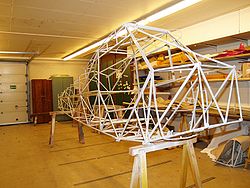
Truss structure
This type of structure is still in use in many lightweight aircraft using weldWeld
Weld most commonly refers to a joint formed by welding.Weld may also refer to:-People:* Weld family, an extended family of New England** Theodore Dwight Weld** Tuesday Weld* Weld-Blundell family* Cecil Weld-Forester, 1st Baron Forester...
ed steel
Steel
Steel is an alloy that consists mostly of iron and has a carbon content between 0.2% and 2.1% by weight, depending on the grade. Carbon is the most common alloying material for iron, but various other alloying elements are used, such as manganese, chromium, vanadium, and tungsten...
tube trusses.
A box truss fuselage structure can also be built out of wood—often covered with plywood—as can be seen on this Ibis canard fuselage. Simple box structures may be rounded by the addition of supported lightweight stringers, allowing the fabric covering to form a more aerodynamic shape, or one more pleasing to the eye.
Geodesic construction
.png)
Barnes Wallis
Sir Barnes Neville Wallis, CBE FRS, RDI, FRAeS , was an English scientist, engineer and inventor. He is best known for inventing the bouncing bomb used by the RAF in Operation Chastise to attack the dams of the Ruhr Valley during World War II...
for British Vickers
Vickers
Vickers was a famous name in British engineering that existed through many companies from 1828 until 1999.-Early history:Vickers was formed in Sheffield as a steel foundry by the miller Edward Vickers and his father-in-law George Naylor in 1828. Naylor was a partner in the foundry Naylor &...
between the wars and into World War II
World War II
World War II, or the Second World War , was a global conflict lasting from 1939 to 1945, involving most of the world's nations—including all of the great powers—eventually forming two opposing military alliances: the Allies and the Axis...
to form the whole of the fuselage, including its aerodynamic shape. In this type of construction multiple flat strip stringers are wound about the formers in opposite spiral directions, forming a basket-like appearance. This proved to be light, strong, and rigid and had the advantage of being made almost entirely of wood. A similar construction using aluminum alloy was used in the Vickers Warwick
Vickers Warwick
The Vickers Warwick was a multi-purpose British aircraft used during the Second World War. Built by Vickers-Armstrongs at Brooklands, Surrey, the Warwick was used by the Royal Air Force as a transport, air-sea rescue and maritime reconnaissance platform, and by the civilian British Overseas...
with less materials than would be required for other structural types. The geodesic structure is also redundant and so can survive localized damage without catastrophic failure. A fabric covering over the structure completed the aerodynamic shell (see the Vickers Wellington
Vickers Wellington
The Vickers Wellington was a British twin-engine, long range medium bomber designed in the mid-1930s at Brooklands in Weybridge, Surrey, by Vickers-Armstrongs' Chief Designer, R. K. Pierson. It was widely used as a night bomber in the early years of the Second World War, before being displaced as a...
for an example of a large warplane which uses this process). The logical evolution of this is the creation of fuselages using molded plywood, in which multiple sheets are laid with the grain in differing directions to give the monocoque type below.
MonocoqueMonocoqueMonocoque is a construction technique that supports structural load by using an object's external skin, as opposed to using an internal frame or truss that is then covered with a non-load-bearing skin or coachwork...
shell
Lockheed Vega
|-See also:-References:NotesCitationsBibliography* Allen, Richard Sanders. Revolution in the Sky: Those Fabulous Lockheeds, The Pilots Who Flew Them. Brattleboro, Vermont: The Stephen Greene Press, 1964....
) was built using molded plywood
Plywood
Plywood is a type of manufactured timber made from thin sheets of wood veneer. It is one of the most widely used wood products. It is flexible, inexpensive, workable, re-usable, and can usually be locally manufactured...
, where the layers of plywood are formed over a "plug" or within a mold
Molding (process)
Molding or moulding is the process of manufacturing by shaping pliable raw material using a rigid frame or model called a pattern....
. A later form of this structure uses fiberglass
Glass-reinforced plastic
Fiberglass , is a fiber reinforced polymer made of a plastic matrix reinforced by fine fibers of glass. It is also known as GFK ....
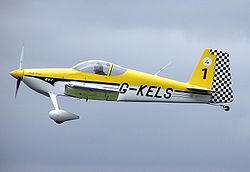
cloth impregnated with polyester or epoxy resin, instead of plywood, as the skin. A simple form of this used in some amateur-built aircraft uses rigid expanded foam plastic as the core, with a fiberglass covering, eliminating the necessity of fabricating molds, but requiring more effort in finishing (see the Rutan VariEze
Rutan VariEze
-See also:-References:* "Flying the VariEze", Air Progress, April 1978.* * * * Taylor, John W. R. Jane's All The World's Aircraft 1982–83. London:Jane's Yearbooks, 1982. ISBN 0-7106-0748-2.* * Flight International 1976...
). An example of a larger molded plywood aircraft is the de Havilland Mosquito
De Havilland Mosquito
The de Havilland DH.98 Mosquito was a British multi-role combat aircraft that served during the Second World War and the postwar era. It was known affectionately as the "Mossie" to its crews and was also nicknamed "The Wooden Wonder"...
fighter/light bomber of World War II
World War II
World War II, or the Second World War , was a global conflict lasting from 1939 to 1945, involving most of the world's nations—including all of the great powers—eventually forming two opposing military alliances: the Allies and the Axis...
.
No plywood-skin fuselage is truly monocoque, since stiffening elements are incorporated into the structure to carry concentrated loads that would otherwise buckle the thin skin.
The use of molded fiberglass using negative ("female") molds (which give a nearly finished product) is prevalent in the series production of many modern sailplanes. The use of molded composites for fuselage structures is being extended to large passenger aircraft such as the Boeing 787
Boeing 787
The Boeing 787 Dreamliner is a long-range, mid-size wide-body, twin-engine jet airliner developed by Boeing Commercial Airplanes. It seats 210 to 290 passengers, depending on the variant. Boeing states that it is the company's most fuel-efficient airliner and the world's first major airliner to use...
Dreamliner (using pressure-molding on female molds).
Semi-monocoque
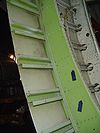
Aluminium
Aluminium or aluminum is a silvery white member of the boron group of chemical elements. It has the symbol Al, and its atomic number is 13. It is not soluble in water under normal circumstances....
fuselage. First, a series of frames
Structural system
The term structural system or structural frame in structural engineering refers to load-resisting sub-system of a structure. The structural system transfers loads through interconnected structural components or members.-High-rise buildings:...
in the shape of the fuselage cross sections are held in position on a rigid fixture
Fixture (tool)
A fixture is a work-holding or support device used in the manufacturing industry. What makes a fixture unique is that each one is built to fit a particular part or shape. The main purpose of a fixture is to locate and in some cases hold a workpiece during either a machining operation or some...
, or jig. These frames are then joined with lightweight longitudinal elements called stringers
Longeron
In aircraft construction, a longeron or stringer or stiffener is a thin strip of wood, metal or carbon fiber, to which the skin of the aircraft is fastened. In the fuselage, longerons are attached to formers and run the longitudinal direction of the aircraft...
. These are in turn covered with a skin of sheet aluminum, attached by rivet
Rivet
A rivet is a permanent mechanical fastener. Before being installed a rivet consists of a smooth cylindrical shaft with a head on one end. The end opposite the head is called the buck-tail. On installation the rivet is placed in a punched or pre-drilled hole, and the tail is upset, or bucked A rivet...
ing or by bonding with special adhesives. The fixture is then disassembled and removed from the completed fuselage shell, which is then fitted out with wiring, controls, and interior equipment such as seats and luggage bins. Most modern large aircraft are built using this technique, but use several large sections constructed in this fashion which are then joined with fastener
Fastener
A fastener is a hardware device that mechanically joins or affixes two or more objects together.Fasteners can also be used to close a container such as a bag, a box, or an envelope; or they may involve keeping together the sides of an opening of flexible material, attaching a lid to a container,...
s to form the complete fuselage. As the accuracy of the final product is determined largely by the costly fixture, this form is suitable for series production, where a large number of identical aircraft are to be produced. Early examples of this type include the Douglas Aircraft DC-2
Douglas DC-2
The Douglas DC-2 was a 14-seat, twin-engine airliner produced by the American company Douglas Aircraft Corporation starting in 1934. It competed with the Boeing 247...
and DC-3
Douglas DC-3
The Douglas DC-3 is an American fixed-wing propeller-driven aircraft whose speed and range revolutionized air transport in the 1930s and 1940s. Its lasting impact on the airline industry and World War II makes it one of the most significant transport aircraft ever made...
civil aircraft and the Boeing B-17 Flying Fortress. Most metal light aircraft are constructed using this process.
Both monocoque and semi-monocoque are referred to as "stressed skin" structures as all or a portion of the external load (i.e. from wings and empennage, and from discrete masses such as the engine) is taken by the surface covering. In addition, all the load from internal pressurization
Cabin pressurization
Cabin pressurization is the pumping of compressed air into an aircraft cabin to maintain a safe and comfortable environment for crew and passengers when flying at altitude.-Need for cabin pressurization:...
is carried (as skin tension) by the external skin.
The proportioning of loads between the components is a design choice dictated largely by the dimensions, strength, and elasticity of the components available for construction and wether or not a design is intended to be "self jigging", not requiring a complete fixture for alignment.
Materials
Early aircraft were constructed of wood frames covered in fabric. As monoplanes became popular, metal frames improved the strength, which eventually led to all-metal aircraft with metal covering all surfaces. Some modern aircraft are constructed with composite materials for major control surfaces, wings, or the entire fuselage such as the Boeing 787. On the 787, it makes possible higher pressurization levels and larger windows for passenger comfort as well as lower weight to reduce operating costs.Wing integration
"Flying wingFlying wing
A flying wing is a tailless fixed-wing aircraft which has no definite fuselage, with most of the crew, payload and equipment being housed inside the main wing structure....
" aircraft, such as the Northrop YB-49 Flying Wing
Northrop YB-49
The Northrop YB-49 was a prototype jet-powered heavy bomber aircraft developed by Northrop shortly after World War II. Intended for service with the U.S. Air Force, the YB-49 featured a flying wing design...
and the Northrop B-2 Spirit bomber
B-2 Spirit
The Northrop Grumman B-2 Spirit is an American heavy bomber with low observable stealth technology designed to penetrate dense anti-aircraft defenses and deploy both conventional and nuclear weapons. The bomber has a crew of two and can drop up to eighty -class JDAM GPS-guided bombs, or sixteen ...
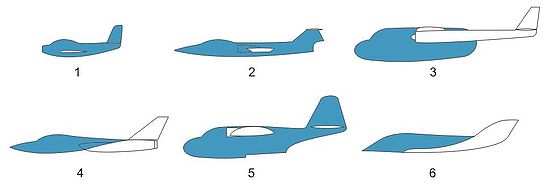
have no separate fuselage; instead what would be the fuselage is a thickened portion of the wing structure.
Conversely there have been a small number of aircraft designs which have no separate wing, but use the fuselage to generate lift. Examples include NASA
NASA
The National Aeronautics and Space Administration is the agency of the United States government that is responsible for the nation's civilian space program and for aeronautics and aerospace research...
's experimental lifting body
Lifting body
A lifting body is a fixed-wing aircraft configuration in which the body itself produces lift. In contrast to a flying wing, which is a wing with minimal or no conventional fuselage, a lifting body can be thought of as a fuselage with little or no conventional wing...
designs and the Vought
Vought
Vought is the name of several related aerospace firms. These have included, in the past, Lewis and Vought Corporation, Chance Vought, Vought Sikorsky, LTV Aerospace , Vought Aircraft Companies, and the current Vought Aircraft Industries. The first incarnation of Vought was established by Chance M...
XF5U-1 Flying Flapjack.
A blended wing body
Blended wing body
Blended Wing Body aircraft have a flattened and airfoil shaped body, which produces most of the lift, the wings contributing the balance. The body form is composed of distinct and separate wing structures, though the wings are smoothly blended into the body...
can be considered a mixture of the above. It carries the useful load in a fuselage producing lift. A modern example is Boeing X-48
Boeing X-48
The X-48 is an experimental unmanned aerial vehicle for investigation into the characteristics of blended wing body aircraft, a type of flying wing. It is under development by Boeing and NASA.-Background:...
. One of the earliest aircraft using this design approach is Burnelli CBY-3
Burnelli CBY-3
-Bibliography:* Townend, David R. Clipped Wings – The History of Aborted Aircraft Projects. Markham, Ontario: AeroFile Publications, 2007. ISBN 978-0-9732020-4-5.-External links:* * *...
, which fuselage was airfoil shaped to produce lift.