


6th century

Encyclopedia
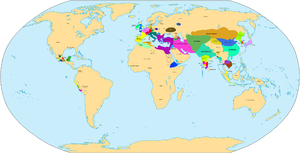
501
Year 501 was a common year starting on Monday of the Julian calendar. At the time, it was known as the Year of the Consulship of Avienus and Pompeius...
to 600
600
Year 600 was a leap year starting on Friday of the Julian calendar. The denomination 600 for this year has been used since the early medieval period, when the Anno Domini calendar era became the prevalent method in Europe for naming years.- Europe :* Smallpox arrives in Europe for the first...
in accordance with the Julian calendar
Julian calendar
The Julian calendar began in 45 BC as a reform of the Roman calendar by Julius Caesar. It was chosen after consultation with the astronomer Sosigenes of Alexandria and was probably designed to approximate the tropical year .The Julian calendar has a regular year of 365 days divided into 12 months...
in the Christian/Common Era
Common Era
Common Era ,abbreviated as CE, is an alternative designation for the calendar era originally introduced by Dionysius Exiguus in the 6th century, traditionally identified with Anno Domini .Dates before the year 1 CE are indicated by the usage of BCE, short for Before the Common Era Common Era...
. In the West this century marks the end of Classical Antiquity
Classical antiquity
Classical antiquity is a broad term for a long period of cultural history centered on the Mediterranean Sea, comprising the interlocking civilizations of ancient Greece and ancient Rome, collectively known as the Greco-Roman world...
and the beginning of the Middle Ages
Middle Ages
The Middle Ages is a periodization of European history from the 5th century to the 15th century. The Middle Ages follows the fall of the Western Roman Empire in 476 and precedes the Early Modern Era. It is the middle period of a three-period division of Western history: Classic, Medieval and Modern...
.
Overview
Following the collapse of the Western Roman EmpireWestern Roman Empire
The Western Roman Empire was the western half of the Roman Empire after its division by Diocletian in 285; the other half of the Roman Empire was the Eastern Roman Empire, commonly referred to today as the Byzantine Empire....
late in the previous century, Europe fractured into many small Germanic Kingdoms, which competed fiercely for land and wealth. From this upheaval the Franks
Franks
The Franks were a confederation of Germanic tribes first attested in the third century AD as living north and east of the Lower Rhine River. From the third to fifth centuries some Franks raided Roman territory while other Franks joined the Roman troops in Gaul. Only the Salian Franks formed a...
rose to prominence, and carved out a sizeable domain encompassing much of modern France and Germany. Meanwhile, the surviving Eastern Roman Empire began to expand under the emperor Justinian, who eventually recaptured North Africa from the Vandals
Vandals
The Vandals were an East Germanic tribe that entered the late Roman Empire during the 5th century. The Vandals under king Genseric entered Africa in 429 and by 439 established a kingdom which included the Roman Africa province, besides the islands of Sicily, Corsica, Sardinia and the Balearics....
, and attempted to fully recover Italy
Italy
Italy , officially the Italian Republic languages]] under the European Charter for Regional or Minority Languages. In each of these, Italy's official name is as follows:;;;;;;;;), is a unitary parliamentary republic in South-Central Europe. To the north it borders France, Switzerland, Austria and...
as well in the hope of re-establishing Roman control over the lands once ruled by the Western Roman Empire
Western Roman Empire
The Western Roman Empire was the western half of the Roman Empire after its division by Diocletian in 285; the other half of the Roman Empire was the Eastern Roman Empire, commonly referred to today as the Byzantine Empire....
. Following Justinian's death, most of his gains were lost.
During its second Golden Age, the Sassanid Empire
Sassanid Empire
The Sassanid Empire , known to its inhabitants as Ērānshahr and Ērān in Middle Persian and resulting in the New Persian terms Iranshahr and Iran , was the last pre-Islamic Persian Empire, ruled by the Sasanian Dynasty from 224 to 651...
reached the peak of its power under Khosrau I
Khosrau I
Khosrau I , also known as Anushiravan the Just or Anushirawan the Just Khosrau I (also called Chosroes I in classical sources, most commonly known in Persian as Anushirvan or Anushirwan, Persian: انوشيروان meaning the immortal soul), also known as Anushiravan the Just or Anushirawan the Just...
in the 6th century. The classical Gupta Empire
Gupta Empire
The Gupta Empire was an ancient Indian empire which existed approximately from 320 to 550 CE and covered much of the Indian Subcontinent. Founded by Maharaja Sri-Gupta, the dynasty was the model of a classical civilization. The peace and prosperity created under leadership of Guptas enabled the...
of Northern India, largely overrun by the Huna, ended in the mid-6th century. In Japan
Japan
Japan is an island nation in East Asia. Located in the Pacific Ocean, it lies to the east of the Sea of Japan, China, North Korea, South Korea and Russia, stretching from the Sea of Okhotsk in the north to the East China Sea and Taiwan in the south...
, the Kofun period
Kofun period
The is an era in the history of Japan from around 250 to 538. It follows the Yayoi period. The word kofun is Japanese for the type of burial mounds dating from this era. The Kofun and the subsequent Asuka periods are sometimes referred to collectively as the Yamato period...
gave way to the Asuka period
Asuka period
The , was a period in the history of Japan lasting from 538 to 710 , although its beginning could be said to overlap with the preceding Kofun period...
. After being divided for more than 150 years into the Southern and Northern Dynasties
Southern and Northern Dynasties
The Southern and Northern Dynasties was a period in the history of China that lasted from 420 to 589 AD. Though an age of civil war and political chaos, it was also a time of flourishing arts and culture, advancement in technology, and the spreading of Mahayana Buddhism and Daoism...
, China
History of China
Chinese civilization originated in various regional centers along both the Yellow River and the Yangtze River valleys in the Neolithic era, but the Yellow River is said to be the Cradle of Chinese Civilization. With thousands of years of continuous history, China is one of the world's oldest...
was reunited under the Sui Dynasty
Sui Dynasty
The Sui Dynasty was a powerful, but short-lived Imperial Chinese dynasty. Preceded by the Southern and Northern Dynasties, it ended nearly four centuries of division between rival regimes. It was followed by the Tang Dynasty....
toward the end of the 6th century. The Three Kingdoms of Korea
Three Kingdoms of Korea
The Three Kingdoms of Korea refer to the ancient Korean kingdoms of Goguryeo, Baekje and Silla, which dominated the Korean peninsula and parts of Manchuria for much of the 1st millennium...
persisted throughout the 6th century. The Göktürks
Göktürks
The Göktürks or Kök Türks, were a nomadic confederation of peoples in medieval Inner Asia. Known in Chinese sources as 突厥 , the Göktürks under the leadership of Bumin Qaghan The Göktürks or Kök Türks, (Old Turkic: Türük or Kök Türük or Türük; Celestial Turks) were a nomadic confederation of...
became a major power in Central Asia
Central Asia
Central Asia is a core region of the Asian continent from the Caspian Sea in the west, China in the east, Afghanistan in the south, and Russia in the north...
after defeating the Rouran
Rouran
Rouran , Mongolia name Jujan or Nirun Ruanruan/Ruru , Tan Tan , Juan-Juan or Zhu-Zhuwas the name of a confederation of nomadic tribes on the northern borders of Inner China from the late 4th century until the middle 6th century...
.
In the Americas
Americas
The Americas, or America , are lands in the Western hemisphere, also known as the New World. In English, the plural form the Americas is often used to refer to the landmasses of North America and South America with their associated islands and regions, while the singular form America is primarily...
, Teotihuacan
Teotihuacan
Teotihuacan – also written Teotihuacán, with a Spanish orthographic accent on the last syllable – is an enormous archaeological site in the Basin of Mexico, just 30 miles northeast of Mexico City, containing some of the largest pyramidal structures built in the pre-Columbian Americas...
began to decline in the 6th century after having reached its zenith between AD 150 and 450. Classic Period of the Maya civilization
Maya civilization
The Maya is a Mesoamerican civilization, noted for the only known fully developed written language of the pre-Columbian Americas, as well as for its art, architecture, and mathematical and astronomical systems. Initially established during the Pre-Classic period The Maya is a Mesoamerican...
in Central America
Central America
Central America is the central geographic region of the Americas. It is the southernmost, isthmian portion of the North American continent, which connects with South America on the southeast. When considered part of the unified continental model, it is considered a subcontinent...
.
Events
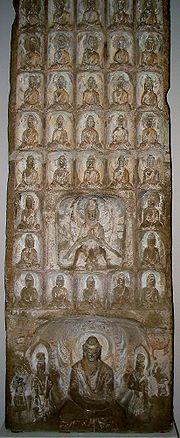
- Early 6th century – Archangel Michael, panel of a dyptich probably from the court workshop at ConstantinopleConstantinopleConstantinople was the capital of the Roman, Eastern Roman, Byzantine, Latin, and Ottoman Empires. Throughout most of the Middle Ages, Constantinople was Europe's largest and wealthiest city.-Names:...
, is made. It is now kept at The British MuseumBritish MuseumThe British Museum is a museum of human history and culture in London. Its collections, which number more than seven million objects, are amongst the largest and most comprehensive in the world and originate from all continents, illustrating and documenting the story of human culture from its...
, LondonLondonLondon is the capital city of :England and the :United Kingdom, the largest metropolitan area in the United Kingdom, and the largest urban zone in the European Union by most measures. Located on the River Thames, London has been a major settlement for two millennia, its history going back to its...
. - Early 6th century – Page with Rebecca at the Well, from "Book of Genesis", probably made in SyriaSyriaSyria , officially the Syrian Arab Republic , is a country in Western Asia, bordering Lebanon and the Mediterranean Sea to the West, Turkey to the north, Iraq to the east, Jordan to the south, and Israel to the southwest....
or PalestinePalestinePalestine is a conventional name, among others, used to describe the geographic region between the Mediterranean Sea and the Jordan River, and various adjoining lands....
, is made. It is now kept at Österreichische Nationalbibliothek, ViennaViennaVienna is the capital and largest city of the Republic of Austria and one of the nine states of Austria. Vienna is Austria's primary city, with a population of about 1.723 million , and is by far the largest city in Austria, as well as its cultural, economic, and political centre...
. - By 6th century – Shilpa ShastrasShilpa ShastrasShilpa Shastras is an umbrella term for numerous Hindu texts that describe manual arts, the standards for religious Hindu iconography, prescribing among other things, the proportions of a sculptured figure, as well as rules of Hindu architecture.Sixty-four such arts or crafts, sometimes called ...
is written. - Early 6th century – first academy of the east the Academy of GundeshapurGundeshapurGundeshapur Gundeshapur Gundeshapur (Persian گندیشاپور, Gund-ī Shāh Pūr, Gondeshapur, Jondishapoor, Jondishapur, and Jondishapour, Gundishapur, Gondêšâpur, Jund-e Shapur, Jundê-Shâpûr, etc...
founded in IranIranIran , officially the Islamic Republic of Iran , is a country in Southern and Western Asia. The name "Iran" has been in use natively since the Sassanian era and came into use internationally in 1935, before which the country was known to the Western world as Persia...
by Khosrau I of Persia. - Early 6th century – IrishIrelandIreland is an island to the northwest of continental Europe. It is the third-largest island in Europe and the twentieth-largest island on Earth...
colonists and invaders, the Scots, began migrating to CaledoniaCaledoniaCaledonia is the Latinised form and name given by the Romans to the land in today's Scotland north of their province of Britannia, beyond the frontier of their empire...
(later known as ScotlandScotlandScotland is a country that is part of the United Kingdom. Occupying the northern third of the island of Great Britain, it shares a border with England to the south and is bounded by the North Sea to the east, the Atlantic Ocean to the north and west, and the North Channel and Irish Sea to the...
). Migration from south-west Britain to BrittanyBrittanyBrittany is a cultural and administrative region in the north-west of France. Previously a kingdom and then a duchy, Brittany was united to the Kingdom of France in 1532 as a province. Brittany has also been referred to as Less, Lesser or Little Britain...
. - Early 6th century – GlendaloughGlendaloughGlendalough or Glendaloch is a glacial valley in County Wicklow, Ireland. It is renowned for its Early Medieval monastic settlement founded in the 6th century by St Kevin, a hermit priest, and partly destroyed in 1398 by English troops....
monasteryMonasteryMonastery denotes the building, or complex of buildings, that houses a room reserved for prayer as well as the domestic quarters and workplace of monastics, whether monks or nuns, and whether living in community or alone .Monasteries may vary greatly in size – a small dwelling accommodating only...
, WicklowWicklowWicklow) is the county town of County Wicklow in Ireland. Located south of Dublin on the east coast of the island, it has a population of 10,070 according to the 2006 census. The town is situated to the east of the N11 route between Dublin and Wexford. Wicklow is also connected to the rail...
IrelandIrelandIreland is an island to the northwest of continental Europe. It is the third-largest island in Europe and the twentieth-largest island on Earth...
founded by St. KevinKevin of GlendaloughSaint Cóemgen , popularly anglicized to Kevin is an Irish saint who was known as the founder and first abbot of Glendalough in County Wicklow, Ireland.-Life:...
. Many similar foundations in Ireland and Wales. - Early 6th century – ZenZenZen is a school of Mahāyāna Buddhism founded by the Buddhist monk Bodhidharma. The word Zen is from the Japanese pronunciation of the Chinese word Chán , which in turn is derived from the Sanskrit word dhyāna, which can be approximately translated as "meditation" or "meditative state."Zen...
BuddhismBuddhismBuddhism is a religion and philosophy encompassing a variety of traditions, beliefs and practices, largely based on teachings attributed to Siddhartha Gautama, commonly known as the Buddha . The Buddha lived and taught in the northeastern Indian subcontinent some time between the 6th and 4th...
enters VietnamVietnamVietnam – sometimes spelled Viet Nam , officially the Socialist Republic of Vietnam – is the easternmost country on the Indochina Peninsula in Southeast Asia. It is bordered by China to the north, Laos to the northwest, Cambodia to the southwest, and the South China Sea –...
from China. - Early 6th century – HaniwaHaniwaThe are terracotta clay figures which were made for ritual use and buried with the dead as funerary objects during the Kofun period of the history of Japan....
, from KyotoKyotois a city in the central part of the island of Honshū, Japan. It has a population close to 1.5 million. Formerly the imperial capital of Japan, it is now the capital of Kyoto Prefecture, as well as a major part of the Osaka-Kobe-Kyoto metropolitan area.-History:...
, is made during the Kofun periodKofun periodThe is an era in the history of Japan from around 250 to 538. It follows the Yayoi period. The word kofun is Japanese for the type of burial mounds dating from this era. The Kofun and the subsequent Asuka periods are sometimes referred to collectively as the Yamato period... - Early 6th century – Basilica of Sant'Apollinare in ClasseBasilica of Sant'Apollinare in ClasseThe Basilica of Sant' Apollinare in Classe is an important monument of Byzantine art near Ravenna, Italy. When the UNESCO inscribed eight Ravenna sites on the World Heritage List, it cited this basilica as "an outstanding example of the early Christian basilica in its purity and simplicity of its...
's apse's mosaic is completed. - Early 6th century - CassiodorusCassiodorusFlavius Magnus Aurelius Cassiodorus Senator , commonly known as Cassiodorus, was a Roman statesman and writer, serving in the administration of Theodoric the Great, king of the Ostrogoths. Senator was part of his surname, not his rank.- Life :Cassiodorus was born at Scylletium, near Catanzaro in...
founds a cenobitic monastery and scrinium at Vivarium in ItalyItalyItaly , officially the Italian Republic languages]] under the European Charter for Regional or Minority Languages. In each of these, Italy's official name is as follows:;;;;;;;;), is a unitary parliamentary republic in South-Central Europe. To the north it borders France, Switzerland, Austria and...
- 518518Year 518 was a common year starting on Monday of the Julian calendar. At the time, it was known as the Year of the Consulship of Paulus without colleague...
: Eastern Roman Emperor Anastasius IAnastasius I (emperor)Anastasius I was Byzantine Emperor from 491 to 518. During his reign the Roman eastern frontier underwent extensive re-fortification, including the construction of Dara, a stronghold intended to counter the Persian fortress of Nisibis....
dies and is succeeded by Justin IJustin IJustin I was Byzantine Emperor from 518 to 527. He rose through the ranks of the army and ultimately became its Emperor, in spite of the fact he was illiterate and almost 70 years old at the time of accession...
.
- 522522Year 522 was a common year starting on Saturday of the Julian calendar. At the time, it was known as the Year of the Consulship of Symmachus and Boethius...
: Byzantines obtain silkworm eggs and begin silkworm cultivation - c.524524Year 524 was a leap year starting on Monday of the Julian calendar. At the time, it was known as the Year of the Consulship of Iustinus and Opilio...
: Boethius writes his Consolation of Philosophy. - 525525Year 525 was a common year starting on Wednesday of the Julian calendar. At the time, it was known as the Year of the Consulship of Probus and Philoxenus...
: Having settled in RomeRomeRome is the capital of Italy and the country's largest and most populated city and comune, with over 2.7 million residents in . The city is located in the central-western portion of the Italian Peninsula, on the Tiber River within the Lazio region of Italy.Rome's history spans two and a half...
c. 500500Year 500 was a leap year starting on Saturday of the Julian calendar. At the time, it was known as the Year of the Consulship of Patricius and Hypatius...
, Scythian monk Dionysius ExiguusDionysius ExiguusDionysius Exiguus was a 6th-century monk born in Scythia Minor, modern Dobruja shared by Romania and Bulgaria. He was a member of the Scythian monks community concentrated in Tomis, the major city of Scythia Minor...
invents the Anno DominiAnno Dominiand Before Christ are designations used to label or number years used with the Julian and Gregorian calendars....
era calendarCalendarA calendar is a system of organizing days for social, religious, commercial, or administrative purposes. This is done by giving names to periods of time, typically days, weeks, months, and years. The name given to each day is known as a date. Periods in a calendar are usually, though not...
based on the estimated birth year of Jesus Christ. - 527527Year 527 was a common year starting on Friday of the Julian calendar. At the time, it was known as the Year of the Consulship of Mavortius without colleague...
: Justinian IJustinian IJustinian I ; , ; 483– 13 or 14 November 565), commonly known as Justinian the Great, was Byzantine Emperor from 527 to 565. During his reign, Justinian sought to revive the Empire's greatness and reconquer the lost western half of the classical Roman Empire.One of the most important figures of...
succeeds Justin IJustin IJustin I was Byzantine Emperor from 518 to 527. He rose through the ranks of the army and ultimately became its Emperor, in spite of the fact he was illiterate and almost 70 years old at the time of accession...
as EmperorEmperorAn emperor is a monarch, usually the sovereign ruler of an empire or another type of imperial realm. Empress, the female equivalent, may indicate an emperor's wife or a woman who rules in her own right...
of the Eastern Roman Empire. - 529529Year 529 was a common year starting on Monday of the Julian calendar. At the time, it was known as the Year of the Consulship of Decius without colleague...
: Saint Benedict of NursiaBenedict of NursiaSaint Benedict of Nursia is a Christian saint, honored by the Roman Catholic Church as the patron saint of Europe and students.Benedict founded twelve communities for monks at Subiaco, about to the east of Rome, before moving to Monte Cassino in the mountains of southern Italy. There is no...
founds the monasteryMonasteryMonastery denotes the building, or complex of buildings, that houses a room reserved for prayer as well as the domestic quarters and workplace of monastics, whether monks or nuns, and whether living in community or alone .Monasteries may vary greatly in size – a small dwelling accommodating only...
of Monte CassinoMonte CassinoMonte Cassino is a rocky hill about southeast of Rome, Italy, c. to the west of the town of Cassino and altitude. St. Benedict of Nursia established his first monastery, the source of the Benedictine Order, here around 529. It was the site of Battle of Monte Cassino in 1944...
in Italy.
- 532532Year 532 was a leap year starting on Thursday of the Julian calendar. At the time, it was known as the Second year after the Consulship of Lampadius and Probus...
: Nika riotsNika riotsThe Nika riots , or Nika revolt, took place over the course of a week in Constantinople in AD 532. It was the most violent riot that Constantinople had ever seen to that point, with nearly half the city being burned or destroyed and tens of thousands of people killed.-Background:The ancient Roman...
in ConstantinopleConstantinopleConstantinople was the capital of the Roman, Eastern Roman, Byzantine, Latin, and Ottoman Empires. Throughout most of the Middle Ages, Constantinople was Europe's largest and wealthiest city.-Names:...
; the cathedralCathedralA cathedral is a Christian church that contains the seat of a bishop...
is destroyed. They are put down a sennight later by BelisariusBelisariusFlavius Belisarius was a general of the Byzantine Empire. He was instrumental to Emperor Justinian's ambitious project of reconquering much of the Mediterranean territory of the former Western Roman Empire, which had been lost less than a century previously....
and MundusMundusMundus was an East Roman general during the reign of Justinian I.- Origin and early life :Mundus was of the son of Giesmus, a king of the Gepids, and nephew to another Gepid king, Trapstila. The exact date of his birth is unknown. His father was killed in battle against the Ostrogoths of Theoderic...
; up to 30,000 people are killed in the HippodromeHippodrome of ConstantinopleThe Hippodrome of Constantinople was a circus that was the sporting and social centre of Constantinople, capital of the Byzantine Empire. Today it is a square named Sultanahmet Meydanı in the Turkish city of Istanbul, with only a few fragments of the original structure surviving...
. - 535535Year 535 was a common year starting on Monday of the Julian calendar. At the time, it was known as the Year of the Consulship of Belisarius without colleague...
: Postulated volcanic eruptionTypes of volcanic eruptionsDuring a volcanic eruption, lava, tephra , and various gases are expelled from a volcanic vent or fissure. Several types of volcanic eruptions have been distinguished by volcanologists. These are often named after famous volcanoes where that type of behavior has been observed...
in the tropics which causes several years of abnormally cold weatherWeatherWeather is the state of the atmosphere, to the degree that it is hot or cold, wet or dry, calm or stormy, clear or cloudy. Most weather phenomena occur in the troposphere, just below the stratosphere. Weather refers, generally, to day-to-day temperature and precipitation activity, whereas climate...
, resulting in mass famineFamineA famine is a widespread scarcity of food, caused by several factors including crop failure, overpopulation, or government policies. This phenomenon is usually accompanied or followed by regional malnutrition, starvation, epidemic, and increased mortality. Every continent in the world has...
in the Northern HemisphereNorthern HemisphereThe Northern Hemisphere is the half of a planet that is north of its equator—the word hemisphere literally means “half sphere”. It is also that half of the celestial sphere north of the celestial equator...
. (See Extreme weather events of 535–536.) - 537537Year 537 was a common year starting on Thursday of the Julian calendar. At the time, it was known as the Second year after the Consulship of Belisarius...
: Battle of CamlannBattle of CamlannThe Battle of Camlann is best known as the final battle of King Arthur, where he either died in battle, or was fatally wounded fighting his enemy Mordred.-Historicity:...
, final battle of legendLegendA legend is a narrative of human actions that are perceived both by teller and listeners to take place within human history and to possess certain qualities that give the tale verisimilitude...
ary King ArthurKing ArthurKing Arthur is a legendary British leader of the late 5th and early 6th centuries, who, according to Medieval histories and romances, led the defence of Britain against Saxon invaders in the early 6th century. The details of Arthur's story are mainly composed of folklore and literary invention, and...
.
- 541541Year 541 was a common year starting on Tuesday of the Julian calendar. At the time, it was known as the Year of the Consulship of Basilius without colleague...
-542542Year 542 was a common year starting on Wednesday of the Julian calendar. From this year forward, the appointment of particular Roman consuls was abandoned and the office was merged with that of Byzantine emperor...
: First pandemicPandemicA pandemic is an epidemic of infectious disease that is spreading through human populations across a large region; for instance multiple continents, or even worldwide. A widespread endemic disease that is stable in terms of how many people are getting sick from it is not a pandemic...
of bubonic plagueBubonic plaguePlague is a deadly infectious disease that is caused by the enterobacteria Yersinia pestis, named after the French-Swiss bacteriologist Alexandre Yersin. Primarily carried by rodents and spread to humans via fleas, the disease is notorious throughout history, due to the unrivaled scale of death...
(Plague of JustinianPlague of JustinianThe Plague of Justinian was a pandemic that afflicted the Eastern Roman Empire , including its capital Constantinople, in 541–542 AD. It was one of the greatest plagues in history. The most commonly accepted cause of the pandemic is bubonic plague, which later became infamous for either causing or...
) hits ConstantinopleConstantinopleConstantinople was the capital of the Roman, Eastern Roman, Byzantine, Latin, and Ottoman Empires. Throughout most of the Middle Ages, Constantinople was Europe's largest and wealthiest city.-Names:...
and the rest of Byzantine EmpireByzantine EmpireThe Byzantine Empire was the Eastern Roman Empire during the periods of Late Antiquity and the Middle Ages, centred on the capital of Constantinople. Known simply as the Roman Empire or Romania to its inhabitants and neighbours, the Empire was the direct continuation of the Ancient Roman State...
. - 543543Year 543 was a common year starting on Thursday of the Julian calendar. The denomination 543 for this year has been used since the early medieval period, when the Anno Domini calendar era became the prevalent method in Europe for naming years.- Religion :* The doctrine of apocatastasis is...
/544544Year 544 was a leap year starting on Friday of the Julian calendar. The denomination 544 for this year has been used since the early medieval period, when the Anno Domini calendar era became the prevalent method in Europe for naming years.- Byzantine Empire :* Belisarius is sent back to Italy to...
: One of Justinian's edict leads to the Three-Chapter ControversyThree-Chapter ControversyThe Three-Chapter Controversy, a phase in the Chalcedonian controversy, was an attempt to reconcile the Non-Chalcedonian Christians of Syria and Egypt with Chalcedonian Eastern Orthodoxy, following the failure of the Henotikon... - 545545Year 545 was a common year starting on Sunday of the Julian calendar. The denomination 545 for this year has been used since the early medieval period, when the Anno Domini calendar era became the prevalent method in Europe for naming years.- Ireland :* The monastery of Clonmacnoise is built on...
: Nubian Kingdom of NobatiaNobatiaNobatia or Nobadia was an ancient African Christian kingdom in Lower Nubia and subsequently a region of the larger Nubian Kingdom of Makuria...
converts to ChristianityChristianityChristianity is a monotheistic religion based on the life and teachings of Jesus as presented in canonical gospels and other New Testament writings...
.
- Mid-6th century – Buddhist JatakaJatakaThe Jātakas refer to a voluminous body of literature native to India concerning the previous births of the Buddha....
stories are translated into PersianPersian languagePersian is an Iranian language within the Indo-Iranian branch of the Indo-European languages. It is primarily spoken in Iran, Afghanistan, Tajikistan and countries which historically came under Persian influence...
by order of the Zoroastrian king Khosrau. - Mid-6th century – Cave-Temple of Shiva at Elephanta CavesElephanta CavesThe Elephanta Caves are a network of sculpted caves located on Elephanta Island, or Gharapuri in Mumbai Harbour, to the east of the city of Mumbai in the Indian state of Maharashtra...
, MaharashtraMaharashtraMaharashtra is a state located in India. It is the second most populous after Uttar Pradesh and third largest state by area in India...
, IndiaIndiaIndia , officially the Republic of India , is a country in South Asia. It is the seventh-largest country by geographical area, the second-most populous country with over 1.2 billion people, and the most populous democracy in the world...
, is built. Post-GuptaGuptaGupta is a common surname of Indian origin.According to some academicians, the name Gupta is derived from Sanskrit goptri, meaning military governor. A more direct translation of the Sanskrit word gupta is 'secret' or 'hidden'. According to prominent historian R. C...
period. - Mid-6th century – Eternal Shiva, rock-cut relief in the Cave-Temple of Shiva at Elephanta Caves, is made
- Second half of 6th century – Virgin and Child with Saints and Angels, icon, is made. It is now kept at Saint Catherine's Monastery, Mount SinaiSaint Catherine's Monastery, Mount SinaiSaint Catherine's Monastery lies on the Sinai Peninsula, at the mouth of a gorge at the foot of Mount Sinai in the city of Saint Catherine in Egypt's South Sinai Governorate. The monastery is Orthodox and is a UNESCO World Heritage Site...
, EgyptEgyptEgypt , officially the Arab Republic of Egypt, Arabic: , is a country mainly in North Africa, with the Sinai Peninsula forming a land bridge in Southwest Asia. Egypt is thus a transcontinental country, and a major power in Africa, the Mediterranean Basin, the Middle East and the Muslim world...
.
- 550550Year 550 was a common year starting on Saturday of the Julian calendar. The denomination 550 for this year has been used since the early medieval period, when the Anno Domini calendar era became the prevalent method in Europe for naming years.- Byzantine Empire :* January 16 – Gothic War :...
: Kingdom of Funan dies out. - 552552Year 552 was a leap year starting on Monday of the Julian calendar. The denomination 552 for this year has been used since the early medieval period, when the Anno Domini calendar era became the prevalent method in Europe for naming years.- Europe :* Battle of Asfeld: Longobards under king Audoin...
: BuddhismBuddhismBuddhism is a religion and philosophy encompassing a variety of traditions, beliefs and practices, largely based on teachings attributed to Siddhartha Gautama, commonly known as the Buddha . The Buddha lived and taught in the northeastern Indian subcontinent some time between the 6th and 4th...
introduced to JapanJapanJapan is an island nation in East Asia. Located in the Pacific Ocean, it lies to the east of the Sea of Japan, China, North Korea, South Korea and Russia, stretching from the Sea of Okhotsk in the north to the East China Sea and Taiwan in the south...
from BaekjeBaekjeBaekje or Paekche was a kingdom located in southwest Korea. It was one of the Three Kingdoms of Korea, together with Goguryeo and Silla....
during the Asuka periodAsuka periodThe , was a period in the history of Japan lasting from 538 to 710 , although its beginning could be said to overlap with the preceding Kofun period...
. - 553553Year 553 was a common year starting on Wednesday of the Julian calendar. The denomination 553 for this year has been used since the early medieval period, when the Anno Domini calendar era became the prevalent method in Europe for naming years.- Europe :* The Ostrogoth Kingdom is conquered by the...
: Second Council of ConstantinopleSecond Council of ConstantinopleThe Second Council of Constantinople is recognized as the Fifth Ecumenical Council by the Eastern Orthodox, Roman Catholics, Old Catholics, and a number of other Western Christian groups. It was held from May 5 to June 2, 553, having been called by the Byzantine Emperor Justinian... - 554554Year 554 was a common year starting on Thursday of the Julian calendar. The denomination 554 for this year has been used since the early medieval period, when the Anno Domini calendar era became the prevalent method in Europe for naming years.- Byzantine Empire :* General Narses reconquers all of...
: Eviction of the Ostrogoths from Rome, and the re-unification of all Italy under Byzantine rule.
- 561561Year 561 was a common year starting on Saturday of the Julian calendar. The denomination 561 for this year has been used since the early medieval period, when the Anno Domini calendar era became the prevalent method in Europe for naming years.- Europe :* Clotaire I dies, and the Frankish kingdom...
to 592592Year 592 was a leap year starting on Tuesday of the Julian calendar. The denomination 592 for this year has been used since the early medieval period, when the Anno Domini calendar era became the prevalent method in Europe for naming years.- Byzantine Empire :* The Byzantine Empire regains...
: Buddhist monk JnanaguptaJnanaguptaJñānagupta was an Afghan Buddhist monkJñānagupta was an Afghan Buddhist monkJñānagupta was an Afghan Buddhist monkKalhan's Rajtarangini The Saga of the Kings of Kashmir translation by R S Pandit Published by Sahitya Akademi ,Appendix D page 731 , ISBN:81-260-1236-6 from Gandhara who travelled...
translates 39 sutras from SanskritSanskritSanskrit , is a historical Indo-Aryan language and the primary liturgical language of Hinduism, Jainism and Buddhism.Buddhism: besides Pali, see Buddhist Hybrid Sanskrit Today, it is listed as one of the 22 scheduled languages of India and is an official language of the state of Uttarakhand...
to ChineseChinese languageThe Chinese language is a language or language family consisting of varieties which are mutually intelligible to varying degrees. Originally the indigenous languages spoken by the Han Chinese in China, it forms one of the branches of Sino-Tibetan family of languages...
. - 563563Year 563 was a common year starting on Monday of the Julian calendar. The denomination 563 for this year has been used since the early medieval period, when the Anno Domini calendar era became the prevalent method in Europe for naming years.- Byzantine Empire :* Justinian I re-consecrates Hagia...
: The monastery on IonaIonaIona is a small island in the Inner Hebrides off the western coast of Scotland. It was a centre of Irish monasticism for four centuries and is today renowned for its tranquility and natural beauty. It is a popular tourist destination and a place for retreats...
is founded by St. ColumbaColumbaSaint Columba —also known as Colum Cille , Colm Cille , Calum Cille and Kolban or Kolbjørn —was a Gaelic Irish missionary monk who propagated Christianity among the Picts during the Early Medieval Period...
. - 566566Year 566 was a common year starting on Friday of the Julian calendar. The denomination 566 for this year has been used since the early medieval period, when the Anno Domini calendar era became the prevalent method in Europe for naming years.- Births :* March 17 – Emperor Gaozu of Tang*...
: Birth of Lǐ YuānEmperor Gaozu of TangEmperor Gāozǔ of Táng , born Lǐ Yuān , courtesy name Shūdé , was the founder of the Tang Dynasty of China, and the first emperor of this dynasty from 618 to 626. Under the Sui dynasty, Li Yuan was the governor in the area of modern-day Shanxi, and was based in Taiyuan.In 615, Li Yuan was assigned...
, founder of the Tang DynastyTang DynastyThe Tang Dynasty was an imperial dynasty of China preceded by the Sui Dynasty and followed by the Five Dynasties and Ten Kingdoms Period. It was founded by the Li family, who seized power during the decline and collapse of the Sui Empire...
and Emperor of China under the name of Gaozu (618-626) - 568568Year 568 was a leap year starting on Sunday of the Julian calendar. The denomination 568 for this year has been used since the early medieval period, when the Anno Domini calendar era became the prevalent method in Europe for naming years.- Europe :* April 1 – King Alboin leads the Lombards...
: LombardsLombardsThe Lombards , also referred to as Longobards, were a Germanic tribe of Scandinavian origin, who from 568 to 774 ruled a Kingdom in Italy...
invade ItalyItalyItaly , officially the Italian Republic languages]] under the European Charter for Regional or Minority Languages. In each of these, Italy's official name is as follows:;;;;;;;;), is a unitary parliamentary republic in South-Central Europe. To the north it borders France, Switzerland, Austria and...
and establish a federation of dukedoms under a king. - 569569Year 569 was a common year starting on Tuesday of the Julian calendar. The denomination 569 for this year has been used since the early medieval period, when the Anno Domini calendar era became the prevalent method in Europe for naming years.- Byzantine Empire :* The King of the Garamantes signs...
: Nubian kingdom of AlodiaAlodiaAlodia or Alwa was the southernmost of the three kingdoms of Christian Nubia; the other two were Nobatia and Makuria to the north.Much about this kingdom is still unknown, despite its thousand year existence and considerable power and geographic size. Due to fewer excavations far less is known...
converts to Christianity. - 569569Year 569 was a common year starting on Tuesday of the Julian calendar. The denomination 569 for this year has been used since the early medieval period, when the Anno Domini calendar era became the prevalent method in Europe for naming years.- Byzantine Empire :* The King of the Garamantes signs...
: Nubian kingdom of MakuriaMakuriaThe Kingdom of Makuria was a kingdom located in what is today Northern Sudan and Southern Egypt. It was one of a group of Nubian kingdoms that emerged during the decline of the Aksumite Empire, which it had been part of from approximately 4BC to AD 950...
converts to Christianity.
- 570570Year 570 was a common year starting on Wednesday of the Julian calendar. The denomination 570 for this year has been used since the early medieval period, when the Anno Domini calendar era became the prevalent method in Europe for naming years.- Europe :* Spoleto becomes the capital of an...
: Birth of Mohammad, founder of IslamIslamIslam . The most common are and . : Arabic pronunciation varies regionally. The first vowel ranges from ~~. The second vowel ranges from ~~~...
. - 579579Year 579 was a common year starting on Sunday of the Julian calendar. The denomination 579 for this year has been used since the early medieval period, when the Anno Domini calendar era became the prevalent method in Europe for naming years.- Europe :* Frithuwald succeeds his brother Theodric as...
to 590590Year 590 was a common year starting on Sunday of the Julian calendar. The denomination 590 for this year has been used since the early medieval period, when the Anno Domini calendar era became the prevalent method in Europe for naming years.- Byzantine Empire :* Summer – Maurice agrees to...
: Reign of Persian ShahShahShāh is the title of the ruler of certain Southwest Asian and Central Asian countries, especially Persia , and derives from the Persian word shah, meaning "king".-History:...
Hormizd IVHormizd IVHormizd IV, son of Khosrau I, reigned as the twenty-first King of Persia from 579 to 590.He seems to have been imperious and violent, but not without some kindness of heart. Some very characteristic stories are told of him by Tabari. His father's sympathies had been with the nobles and the priests...
.
- 582582Year 582 was a common year starting on Thursday of the Julian calendar. The denomination 582 for this year has been used since the early medieval period, when the Anno Domini calendar era became the prevalent method in Europe for naming years.- Byzantine Empire :* The Avars take over the city of...
to 602602Year 602 was a common year starting on Monday of the Julian calendar. The denomination 602 for this year has been used since the early medieval period, when the Anno Domini calendar era became the prevalent method in Europe for naming years.- Byzantine Empire :* Maurice, at war with the Avars and...
: Reign of Byzantine Emperor MauriceMaurice (emperor)Maurice was Byzantine Emperor from 582 to 602.A prominent general in his youth, Maurice fought with success against the Sassanid Persians...
. - 585585Year 585 was a common year starting on Monday of the Julian calendar. The denomination 585 for this year has been used since the early medieval period, when the Anno Domini calendar era became the prevalent method in Europe for naming years.- Europe :* The Suebi kingdom on the Iberian peninsula...
: Suevi Kingdom conquered by Visigoths in Spain. - 587587Year 587 was a common year starting on Wednesday of the Julian calendar. The denomination 587 for this year has been used since the early medieval period, when the Anno Domini calendar era became the prevalent method in Europe for naming years.- Europe :* Sledda becomes king of Essex.* Guntram,...
: ReccaredReccaredReccared I was Visigothic King of Hispania, Septimania and Galicia. His reign marked a climactic shift in history, with the king's renunciation of traditional Arianism in favour of Catholic Christianity in 587.Reccared was the younger son of King Liuvigild by his first wife Theodosia...
, king of the Visigoths in Spain, converts to CatholicismCatholicismCatholicism is a broad term for the body of the Catholic faith, its theologies and doctrines, its liturgical, ethical, spiritual, and behavioral characteristics, as well as a religious people as a whole....
. - 588588Year 588 was a leap year starting on Thursday of the Julian calendar. The denomination 588 for this year has been used since the early medieval period, when the Anno Domini calendar era became the prevalent method in Europe for naming years.- Byzantine Empire :* Guaram becomes prince of Iberia.-...
: Shivadeva ascends the throne of the Lichchhavi dynasty in NepalNepalNepal , officially the Federal Democratic Republic of Nepal, is a landlocked sovereign state located in South Asia. It is located in the Himalayas and bordered to the north by the People's Republic of China, and to the south, east, and west by the Republic of India...
. - 589589Year 589 was a common year starting on Saturday of the Julian calendar. The denomination 589 for this year has been used since the early medieval period, when the Anno Domini calendar era became the prevalent method in Europe for naming years.- Europe :* October 17 – The Adige River...
: Third Council of ToledoThird Council of ToledoThe Third Council of Toledo marks the entry of Catholic Christianity into the rule of Visigothic Spain, and the introduction into Western Christianity of the filioque clause...
adds the "filioque" clause to the Nicene CreedNicene CreedThe Nicene Creed is the creed or profession of faith that is most widely used in Christian liturgy. It is called Nicene because, in its original form, it was adopted in the city of Nicaea by the first ecumenical council, which met there in the year 325.The Nicene Creed has been normative to the...
in Spain. - 589589Year 589 was a common year starting on Saturday of the Julian calendar. The denomination 589 for this year has been used since the early medieval period, when the Anno Domini calendar era became the prevalent method in Europe for naming years.- Europe :* October 17 – The Adige River...
: China reunified under the SuiSuiSui can refer to:* Sui or mizu, 水, meaning "Water" in Japanese, one of the elements in the Japanese system of five elements and representing the fluid, flowing, formless things in the world....
Dynasty (589 – 618).
- 590590Year 590 was a common year starting on Sunday of the Julian calendar. The denomination 590 for this year has been used since the early medieval period, when the Anno Domini calendar era became the prevalent method in Europe for naming years.- Byzantine Empire :* Summer – Maurice agrees to...
: Gregory the GreatPope Gregory IPope Gregory I , better known in English as Gregory the Great, was pope from 3 September 590 until his death...
succeeds Pope Pelagius IIPope Pelagius IIPope Pelagius II was Pope from 579 to 590.He was a native of Rome, but probably of Ostrogothic descent, as his father's name was Winigild.Pelagius appealed for help from Emperor Maurice against the Lombards, but the Byzantines were of little help, forcing Pelagius to "buy" a truce and turn to the...
(who dies of plague) as the 64th pope. - 595595Year 595 was a common year starting on Saturday of the Julian calendar. The denomination 595 for this year has been used since the early medieval period, when the Anno Domini calendar era became the prevalent method in Europe for naming years.- Europe :* Theudebert II becomes king of Austrasia.*...
: Pope Gregory sends Roman monks led by AugustineAugustine of CanterburyAugustine of Canterbury was a Benedictine monk who became the first Archbishop of Canterbury in the year 597...
to England.
Significant persons
- King ArthurKing ArthurKing Arthur is a legendary British leader of the late 5th and early 6th centuries, who, according to Medieval histories and romances, led the defence of Britain against Saxon invaders in the early 6th century. The details of Arthur's story are mainly composed of folklore and literary invention, and...
, legendary British king and victor over the Anglo-SaxonsAnglo-SaxonsAnglo-Saxon is a term used by historians to designate the Germanic tribes who invaded and settled the south and east of Great Britain beginning in the early 5th century AD, and the period from their creation of the English nation to the Norman conquest. The Anglo-Saxon Era denotes the period of... - AryabhataAryabhataAryabhata was the first in the line of great mathematician-astronomers from the classical age of Indian mathematics and Indian astronomy...
, Discoverer of Zero and First to propose Heliocentre Model of solar system - Augustine of CanterburyAugustine of CanterburyAugustine of Canterbury was a Benedictine monk who became the first Archbishop of Canterbury in the year 597...
, Roman monk, missionary, and bishop - BelisariusBelisariusFlavius Belisarius was a general of the Byzantine Empire. He was instrumental to Emperor Justinian's ambitious project of reconquering much of the Mediterranean territory of the former Western Roman Empire, which had been lost less than a century previously....
, ByzantineByzantine EmpireThe Byzantine Empire was the Eastern Roman Empire during the periods of Late Antiquity and the Middle Ages, centred on the capital of Constantinople. Known simply as the Roman Empire or Romania to its inhabitants and neighbours, the Empire was the direct continuation of the Ancient Roman State...
general - Benedict of NursiaBenedict of NursiaSaint Benedict of Nursia is a Christian saint, honored by the Roman Catholic Church as the patron saint of Europe and students.Benedict founded twelve communities for monks at Subiaco, about to the east of Rome, before moving to Monte Cassino in the mountains of southern Italy. There is no...
, (480–547), Umbrian founder of Western Monasticism - Beowulf, legendary king of the GeatsKing of the GeatsGeatish kings , ruling over the provinces of Götaland , appears in several sources for early Swedish history...
- Boethius, (c.480-525), Roman philosopher and theologian
- BozorgmehrBurzoeBorzūya was a Persian physician in the late Sassanid era, at the time of Khosrow I.He translated the Indian Panchatantra from Sanskrit into the Middle Persian language of Pahlavi. But both his translation and the original Sanskrit version he worked from are lost...
, PersianPersian peopleThe Persian people are part of the Iranian peoples who speak the modern Persian language and closely akin Iranian dialects and languages. The origin of the ethnic Iranian/Persian peoples are traced to the Ancient Iranian peoples, who were part of the ancient Indo-Iranians and themselves part of...
sage - CassiodorusCassiodorusFlavius Magnus Aurelius Cassiodorus Senator , commonly known as Cassiodorus, was a Roman statesman and writer, serving in the administration of Theodoric the Great, king of the Ostrogoths. Senator was part of his surname, not his rank.- Life :Cassiodorus was born at Scylletium, near Catanzaro in...
, (c.485-c.585), Roman senator and scholar - Clovis IClovis IClovis Leuthwig was the first King of the Franks to unite all the Frankish tribes under one ruler, changing the leadership from a group of royal chieftains, to rule by kings, ensuring that the kingship was held by his heirs. He was also the first Catholic King to rule over Gaul . He was the son...
, (c. 466–511), first sole King of the Franks - ColumbanusColumbanusColumbanus was an Irish missionary notable for founding a number of monasteries on the European continent from around 590 in the Frankish and Lombard kingdoms, most notably Luxeuil and Bobbio , and stands as an exemplar of Irish missionary activity in early medieval Europe.He spread among the...
, (540–615), Irish monk and missionary - Dayi Daoxin, (580-651), fourth ChánChan-People:* Chan Marshall, American musician better known as Cat Power* Chan , Chinese surname; Mandarin transcription of the same name is Chen ** Agnes Chan , Hong Kong singer, also famous in Japan...
Buddhist Patriarch - Dazu Huike, (487-593), second ChánChan-People:* Chan Marshall, American musician better known as Cat Power* Chan , Chinese surname; Mandarin transcription of the same name is Chen ** Agnes Chan , Hong Kong singer, also famous in Japan...
Buddhist Patriarch - Gregory the GreatPope Gregory IPope Gregory I , better known in English as Gregory the Great, was pope from 3 September 590 until his death...
, (c.540540Year 540 was a leap year starting on Sunday of the Julian calendar. At the time, it was known as the Year of the Consulship of Iustinus without colleague...
-604604Year 604 was a leap year starting on Wednesday of the Julian calendar. The denomination 604 for this year has been used since the early medieval period, when the Anno Domini calendar era became the prevalent method in Europe for naming years.- Byzantine Empire :* The Sassanids destroy the...
), theologian, sixty-fourth pope (590-604), and civil administrator of Rome - Gregory of ToursGregory of ToursSaint Gregory of Tours was a Gallo-Roman historian and Bishop of Tours, which made him a leading prelate of Gaul. He was born Georgius Florentius, later adding the name Gregorius in honour of his maternal great-grandfather...
(c. 538–594), Frankish bishop and historian - Hrodgar, legendary Danish king depicted in BeowulfBeowulfBeowulf , but modern scholars agree in naming it after the hero whose life is its subject." of an Old English heroic epic poem consisting of 3182 alliterative long lines, set in Scandinavia, commonly cited as one of the most important works of Anglo-Saxon literature.It survives in a single...
- Jianzhi Sengcan, (d. 606), third ChánChan-People:* Chan Marshall, American musician better known as Cat Power* Chan , Chinese surname; Mandarin transcription of the same name is Chen ** Agnes Chan , Hong Kong singer, also famous in Japan...
Buddhist Patriarch - JizangJizangJizang was a Chinese Buddhist monk and scholar who is often regarded as the founder of the Three Treatise School. He is also known as Jiaxiang or Master Jiaxiang , because he acquired fame at the Jiaxiang Temple.-Biography:...
, (549–623), Buddhist monk and scholar, founder of the Three Treatise School - JordanesJordanesJordanes, also written Jordanis or Jornandes, was a 6th century Roman bureaucrat, who turned his hand to history later in life....
, Byzantine author of the Getica - JustinianJustinian IJustinian I ; , ; 483– 13 or 14 November 565), commonly known as Justinian the Great, was Byzantine Emperor from 527 to 565. During his reign, Justinian sought to revive the Empire's greatness and reconquer the lost western half of the classical Roman Empire.One of the most important figures of...
, (527–565), Byzantine Emperor - Karaikkal AmmeiyarKaraikkal AmmeiyarKaraikkal Ammaiyar , one of the three women amongst the sixty three Nayanmars, is one of the greatest figures of early Tamil literature. Her birth name was Punithavati. She was born at Karaikkal, South India, and probably lived during the 6th century...
, one of the few females amongst the sixty three Nayanmars, is one of the greatest figures of early Tamil literature - Khosrau I of Persia, Sassanid Shah (531–579)
- Leander of SevilleLeander of SevilleSaint Leander of Seville , brother of the encyclopedist St. Isidore of Seville, was the Catholic Bishop of Seville who was instrumental in effecting the conversion to Catholicism of the Visigothic kings Hermengild and Reccared of Hispania .-Family:Leander and Isidore and...
, (c.534-601), Spanish bishop and theologian - Mohammad, Prophet of IslamIslamIslam . The most common are and . : Arabic pronunciation varies regionally. The first vowel ranges from ~~. The second vowel ranges from ~~~...
, (born 570570Year 570 was a common year starting on Wednesday of the Julian calendar. The denomination 570 for this year has been used since the early medieval period, when the Anno Domini calendar era became the prevalent method in Europe for naming years.- Europe :* Spoleto becomes the capital of an...
) - Muhan KhanMuhan KhanMuqan Qaghan; was the second son of Bumin Qaghan and the third khagan of the Göktürks who expanded their khagan and secured the borders against the Hephthalites.This expansion also pushed against the...
, KhaganKhaganKhagan or qagan , alternatively spelled kagan, khaghan, qaghan, or chagan, is a title of imperial rank in the Mongolian and Turkic languages equal to the status of emperor and someone who rules a khaganate...
of Göktürk Empire from (554 - 572) during which SogdianSogdianaSogdiana or Sogdia was the ancient civilization of an Iranian people and a province of the Achaemenid Empire, eighteenth in the list on the Behistun Inscription of Darius the Great . Sogdiana is "listed" as the second of the "good lands and countries" that Ahura Mazda created...
influence reached its zenith - ProcopiusProcopiusProcopius of Caesarea was a prominent Byzantine scholar from Palestine. Accompanying the general Belisarius in the wars of the Emperor Justinian I, he became the principal historian of the 6th century, writing the Wars of Justinian, the Buildings of Justinian and the celebrated Secret History...
, Byzantine historian - Empress SuikoEmpress Suikowas the 33rd emperor of Japan, according to the traditional order of succession.Suiko's reign spanned the years from 593 until her death in 628....
, Japanese empress - Prince ShōtokuPrince Shotoku, also known as or , was a semi-legendary regent and a politician of the Asuka period in Japan who served under Empress Suiko. He was a son of Emperor Yōmei and his younger half-sister Princess Anahobe no Hashihito. His parents were relatives of the ruling Soga clan, and was involved in the defeat...
, (573–621), Japanese statesman, philosopher, and writer of a 17 article constitution - TaliesinTaliesinTaliesin was an early British poet of the post-Roman period whose work has possibly survived in a Middle Welsh manuscript, the Book of Taliesin...
, WelshWalesWales is a country that is part of the United Kingdom and the island of Great Britain, bordered by England to its east and the Atlantic Ocean and Irish Sea to its west. It has a population of three million, and a total area of 20,779 km²...
poet - Tirunavukkarasar, Indian poet (late 6th century-mid-7th century)
- Venantius FortunatusVenantius FortunatusVenantius Honorius Clementianus Fortunatus was a Latin poet and hymnodist in the Merovingian Court, and a Bishop of the early Catholic Church. He was never canonised but was venerated as Saint Venantius Fortunatus during the Middle Ages.-Life:Venantius Fortunatus was born between 530 and 540 A.D....
(c.540-600/9), Venetian poet, traveler, bishop of Poitiers (c.599-600/9) - Emperor Wen of SuiEmperor Wen of SuiEmperor Wen of Sui — personal name Yang Jian , Xianbei name Puliuru Jian , nickname Naluoyan — was the founder and first emperor of China's Sui Dynasty . He was a hard-working administrator and a micromanager. As a Buddhist, he encouraged the spread of Buddhism through the state...
, founder and first emperorEmperor of ChinaThe Emperor of China refers to any sovereign of Imperial China reigning between the founding of Qin Dynasty of China, united by the King of Qin in 221 BCE, and the fall of Yuan Shikai's Empire of China in 1916. When referred to as the Son of Heaven , a title that predates the Qin unification, the...
of Chinese Sui Dynasty
Inventions, discoveries, introductions
- Dionysius ExiguusDionysius ExiguusDionysius Exiguus was a 6th-century monk born in Scythia Minor, modern Dobruja shared by Romania and Bulgaria. He was a member of the Scythian monks community concentrated in Tomis, the major city of Scythia Minor...
creates the Anno DominiAnno Dominiand Before Christ are designations used to label or number years used with the Julian and Gregorian calendars....
system, inspired by the birth of JesusJesusJesus of Nazareth , commonly referred to as Jesus Christ or simply as Jesus or Christ, is the central figure of Christianity...
, in 525525Year 525 was a common year starting on Wednesday of the Julian calendar. At the time, it was known as the Year of the Consulship of Probus and Philoxenus...
. This is the system upon which the Gregorian calendarGregorian calendarThe Gregorian calendar, also known as the Western calendar, or Christian calendar, is the internationally accepted civil calendar. It was introduced by Pope Gregory XIII, after whom the calendar was named, by a decree signed on 24 February 1582, a papal bull known by its opening words Inter...
and Common EraCommon EraCommon Era ,abbreviated as CE, is an alternative designation for the calendar era originally introduced by Dionysius Exiguus in the 6th century, traditionally identified with Anno Domini .Dates before the year 1 CE are indicated by the usage of BCE, short for Before the Common Era Common Era...
systems are based. - BackgammonBackgammonBackgammon is one of the oldest board games for two players. The playing pieces are moved according to the roll of dice, and players win by removing all of their pieces from the board. There are many variants of backgammon, most of which share common traits...
(nard) invented in PersiaIranIran , officially the Islamic Republic of Iran , is a country in Southern and Western Asia. The name "Iran" has been in use natively since the Sassanian era and came into use internationally in 1935, before which the country was known to the Western world as Persia...
by BurzoeBurzoeBorzūya was a Persian physician in the late Sassanid era, at the time of Khosrow I.He translated the Indian Panchatantra from Sanskrit into the Middle Persian language of Pahlavi. But both his translation and the original Sanskrit version he worked from are lost...
. - ChessChessChess is a two-player board game played on a chessboard, a square-checkered board with 64 squares arranged in an eight-by-eight grid. It is one of the world's most popular games, played by millions of people worldwide at home, in clubs, online, by correspondence, and in tournaments.Each player...
, as chaturangaChaturangaChaturanga is an ancient Indian game that is presumed to be the common ancestor of the games of chess, shogi, and makruk, and related to xiangqi and janggi.Chaturanga developed in Gupta India around the 6th century...
, entered PersiaIranIran , officially the Islamic Republic of Iran , is a country in Southern and Western Asia. The name "Iran" has been in use natively since the Sassanian era and came into use internationally in 1935, before which the country was known to the Western world as Persia...
from IndiaIndiaIndia , officially the Republic of India , is a country in South Asia. It is the seventh-largest country by geographical area, the second-most populous country with over 1.2 billion people, and the most populous democracy in the world...
and was modified to shatranjShatranjShatranj is an old form of chess, which came to the Western world from India. Modern chess has gradually developed from this game.-Etymology and origins:...
. - Breast-strap horse harness in use in FrankishFranksThe Franks were a confederation of Germanic tribes first attested in the third century AD as living north and east of the Lower Rhine River. From the third to fifth centuries some Franks raided Roman territory while other Franks joined the Roman troops in Gaul. Only the Salian Franks formed a...
kingdom. - Byzantine EmpireByzantine EmpireThe Byzantine Empire was the Eastern Roman Empire during the periods of Late Antiquity and the Middle Ages, centred on the capital of Constantinople. Known simply as the Roman Empire or Romania to its inhabitants and neighbours, the Empire was the direct continuation of the Ancient Roman State...
acquires silkSilkSilk is a natural protein fiber, some forms of which can be woven into textiles. The best-known type of silk is obtained from the cocoons of the larvae of the mulberry silkworm Bombyx mori reared in captivity...
technologyTechnologyTechnology is the making, usage, and knowledge of tools, machines, techniques, crafts, systems or methods of organization in order to solve a problem or perform a specific function. It can also refer to the collection of such tools, machinery, and procedures. The word technology comes ;...
from China. - SilkSilkSilk is a natural protein fiber, some forms of which can be woven into textiles. The best-known type of silk is obtained from the cocoons of the larvae of the mulberry silkworm Bombyx mori reared in captivity...
is a protected palace industry in the Byzantine Empire. - Vaghbata, Indian medical books.
- In 589589Year 589 was a common year starting on Saturday of the Julian calendar. The denomination 589 for this year has been used since the early medieval period, when the Anno Domini calendar era became the prevalent method in Europe for naming years.- Europe :* October 17 – The Adige River...
AD, the Chinese scholar-official Yan Zhitui makes the first reference to the use of toilet paperToilet paperToilet paper is a soft paper product used to maintain personal hygiene after human defecation or urination. However, it can also be used for other purposes such as blowing one's nose when one has a cold or absorbing common spills around the house, although paper towels are more used for the latter...
in history. - Significant to the history of agriculture, the Chinese author Jia Sixia wrote the treatise Qi Min Yao ShuQi Min Yao ShuQí mín yào shù Qí mín yào shù Qí mín yào shù (TC: 齊民要術; SC: 齐民要术; Literal translation: Main techniques for the welfare of the people) is the most completely preserved of the Ancient Chinese agricultural texts, and was written by the Northern Wei Dynasty official Jia Sixie. The book is believed to...
in 535535Year 535 was a common year starting on Monday of the Julian calendar. At the time, it was known as the Year of the Consulship of Belisarius without colleague...
, and although it quotes 160 previous Chinese agronomyAgronomyAgronomy is the science and technology of producing and using plants for food, fuel, feed, fiber, and reclamation. Agronomy encompasses work in the areas of plant genetics, plant physiology, meteorology, and soil science. Agronomy is the application of a combination of sciences like biology,...
books, it is the oldest existent Chinese agriculture treatise. In over one hundred thousand written Chinese characters, the book covered land preparation, seeding, cultivation, orchard management, forestry, animal husbandry, trade, and culinary uses for crops.