

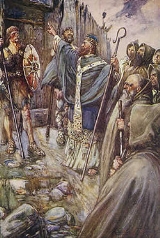
Columba

Encyclopedia
Saint Columba—also known as Colum Cille (Old Irish, meaning "dove
of the church"), Colm Cille (Irish
), Calum Cille (Scottish Gaelic) and Kolban or Kolbjørn (Old Norse
, meaning "black bear")—was a Gaelic Irish
missionary
monk
who propagated Christianity
among the Picts
during the Early Medieval Period
. He was one of the Twelve Apostles of Ireland
.
in Gartan
, near Lough Gartan, in modern County Donegal
, part of the Provinces of Ulster
in the north of Ireland
. On his father's side he was great-great-grandson of Niall of the Nine Hostages
, an Irish high king
of the 5th century. He was baptised
in Temple-Douglas, in the County Donegal parish of Conwal
(mid-way between Gartan and Letterkenny
), by his teacher and foster-uncle Saint Crunathan
.
In early Christian Ireland the druid
ic tradition collapsed due to the spread of the new Christian faith. The study of Latin
learning and Christian theology
in monasteries
flourished. Columba became a pupil at the monastic school at Clonard Abbey
, situated on the River Boyne
in modern County Meath
. During the sixth century, some of the most significant names in the history of Irish Christianity studied at the Clonard monastery. It is said that the average number of scholars under instruction at Clonard was 3,000. Twelve students who studied under St. Finian
became known as the Twelve Apostles of Ireland
; Columba was one. He became a monk and eventually ordained
a priest
. During this time he is said to have founded a number of monasteries, including ones at Kells
, Derry
, and Swords
.
Tradition asserts that, sometimes around 560, he became involved in a quarrel with Saint Finian of Movilla Abbey
over a psalter
. Columba copied the manuscript at the scriptorium
under Saint Finian, intending to keep the copy. Saint Finian disputed his right to keep the copy. The dispute eventually led to the pitched Battle of Cúl Dreimhne in 561, during which many men were killed. A synod
of clerics and scholars threatened to excommunicate
him for these deaths, but St. Brendan of Birr
spoke on his behalf with the result that he was allowed to go into exile instead. Columba suggested that he would work as a missionary in Scotland
to help convert as many people as had been killed in the battle. He exile
d himself from Ireland, to return only once, many years later.
Columba's copy of the psalter
has been traditionally associated with the Cathach of St. Columba
.
with twelve companions, where according to legend he first landed on the Kintyre
Peninsula, near Southend
. However, being still in sight of his native land he moved further north up the west coast of Scotland. In 563 he was granted land on the island of Iona
off the west coast of Scotland which became the centre of his evangelising
mission to the Picts
. However, there is a sense in which he was not leaving his native people, as the Irish
Gaels
had been colonizing the west coast of Scotland for the previous couple of centuries. Aside from the services he provided guiding the only centre of literacy
in the region, his reputation as a holy man led to his role as a diplomat
among the tribes; there are also many stories of miracles which he performed during his work to convert
the Picts. He visited the pagan
King Bridei
, King of Fortriu
, at his base in Inverness
, winning the Bridei's respect, although not his conversion. He subsequently played a major role in the politics of the country. He was also very energetic in his work as a missionary, and, in addition to founding several churches in the Hebrides
, he worked to turn his monastery at Iona into a school for missionaries. He was a renowned man of letters, having written several hymns and being credited with having transcribe
d 300 books. One of the few, if not the only, times he left Scotland was towards the end of his life, when he returned to Ireland to found the monastery
at Durrow.
Columba died on Iona and was buried in 597 AD by his monk
s in the abbey
he created. In 794 AD, the Vikings descended on Iona. Columba's relics were finally removed in 849 AD and divided between Scotland and Ireland. The parts of the relics which went to Ireland are reputed to be buried in Downpatrick
, County Down
, with St. Patrick and St. Brigid or at Saul Church neighbouring Downpatrick. (Names of Iona), Inchcolm
and Eilean Chaluim Chille
.
, and "His achievements illustrated the importance of the Celtic church in bringing a revival of Christianity to Western Europe after the fall of the Roman Empire.
" It is known that Clan MacCallum
and Clan Malcolm
are descended from the original followers of Columba, It is also said that Clan Robertson
are heirs of Columba. Clan MacKinnon
may also have some claim to being spiritual descendants of St Columcille as after he founded his monastery on Isle Iona, the MacKinnons were the abbot
s of the Church for centuries. This would also account for the fact that Clan MacKinnon is amongst the ancient clans of Scotland.
The cathedral
of the Catholic Diocese of Argyll and the Isles
is placed under the patronage of St. Columba as are numerous Catholic school
s and parishes throughout the nation. The Scottish Episcopal Church
and Church of Scotland
also have parishes dedicated to him. The village of Kilmacolm
in Renfrewshire
is also derived from Columba's name.
, Ireland
where he founded a monastic settlement in c.AD 540. The name of the city in Irish is Doire Colmcille and is derived from the native oak trees in the area and the city's association with Columba. The Catholic Church of Saint Columba's Long Tower stands at the spot of this original settlement. The Church of Ireland
Cathedral in Derry is dedicated to St Columba.
St. Colmcilles Primary School and St. Colmcilles Community School are two schools in Knocklyon
, Dublin, named after St. Colmcille, with the former having an annual day dedicated to the saint on June 9.
Aer Lingus
, Ireland's national flag carrier
has named one of its Airbus A330
aircraft in commemoration of the saint (reg: EI-DUO).
ancestry are the third largest ethnic group
in the country, and thus Columba's name is to be found attached to Catholic, Anglican
and Presbyterian parishes. This is particularly the case in eastern Canada
apart from Quebec
which is French
speaking.
Throughout the U.S.A. there are numerous parishes within the Catholic and Episcopalian
denominations dedicated to Columba. Within the Protestant tradition the Presbyterian
Church (which has its roots in Scottish Presbyterianism) also has parishes named in honour of Columba. There is even an Orthodox Church monastery dedicated to the saint in the Massachusetts
town of Southbridge
. http://stcolumbamonastery.org/ Iona College
, a small Catholic
liberal arts
college
in New Rochelle, NY is named after the island on which Columba established his first monastery in Scotland.
St. Columba is the Patron Saint of the Roman Catholic Diocese of Youngstown, OH. The Cathedral there is named for him.
The Munich GAA
is named Muenchen Colmcilles: http://www.munichgaa.de/.
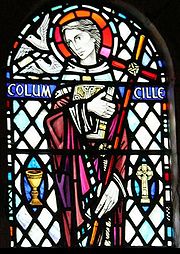 The main source of information about Columba's life is the Vita Columbae by Adomnán (also known as Eunan), the ninth Abbot of Iona
, who died in 704. Adomnán categorizes the Vita Columbae into three different books: Columba’s Prophecies, Columba’s Miracles, and Columba’s Apparitions.
, in a dream, and he announced the king’s incoming victory against King Catlon. The people promise to believe and be baptized after the war. This victory ends with the re-Christianization of pagan England, and King Oswald as ruler of all Britain. Columba’s other prophecies can be vindictive at times as when he sends a man named Batain off to perform his penance, but then Columba turns to his friends and says Batain will instead return to Scotia
and be killed by his enemies. A few of his prophecies are bookish like when he knows that Baithene’s psalter is missing one letter “I” or when he prophecies that an eager man will knock over his inkhorn and spill the ink.
The vita of Columba contains a story that has been interpreted as the first reference to the Loch Ness Monster
. According to Adomnán, Columba came across a group of Picts burying a man who had been killed by the monster. Columba then saves a swimmer from the monster with the sign of the Cross
and the imprecation, "Thou shalt go no further, nor touch the man; go back with all speed." The beast the beast flees terrified, to the amazement of the assembled Picts who glorified Columba's God. Whether or not this incident is true, Adomnan's text specifically states that the monster was swimming in the River Ness
- the river flowing from the loch
- rather than in Loch Ness
itself.
In one of the stories, Columba is in excommunication and goes to a meeting held against him in Teilte. Saint Brenden, despite of all the negative reactions among the seniors toward Columba, kisses him reverently and assures that Columba is the man of God and that he sees Holy Angels accompanying Columba on his journey through the plain.
In the last Chapter, Columba foresees his death to his attendant:
And when the bell strikes midnight, Columba goes to the church and knees beside the altar. His attendant witnesses heavenly light in the direction of Columba, and Holy angels joins the saint in his passage to the Lord:
(672/673-735) record Columba's visit to Bridei
. Whereas Adomnán just tells us that Columba visited Bridei, Bede relates a later, perhaps Pictish tradition, whereby the saint actually converts the Pictish king. Another early source is a poem in praise of Columba, most probably commissioned by Columba's kinsman, the King of the Uí Néill
clan. It was almost certainly written within three or four years of Columba's death and is the earliest vernacular poem in European history. It consists of 25 stanza
s of four verses of seven syllables each.
Through the reputation of its venerable founder and its position as a major European centre of learning, Columba's Iona became a place of pilgrimage
. A network of Celtic high cross
es marking processional routes developed around his shrine at Iona.
Columba is historically revered as a warrior saint, and was often invoked for victory in battle.
His relics were finally removed in 849 and divided between Alba
and Ireland. Relics of Columba were carried before Scottish armies in the reliquary made at Iona in the mid-8th century, called the Brecbennoch.
Legend has it that the Brecbennoch, was carried to the Battle of Bannockburn
(24 June 1314) by the vastly outnumbered Scots army and the intercession of Columba helped them to victory. It is widely thought that the Monymusk Reliquary
is object in question.
In the Antiphoner of Inchcolm Abbey
, the "Iona of the East" (situated on an island in the Firth of Forth
), a 13th century prayer begins O Columba spes Scotorum... "O Columba, hope of the Scots".
Dove
Pigeons and doves constitute the bird family Columbidae within the order Columbiformes, which include some 300 species of near passerines. In general terms "dove" and "pigeon" are used somewhat interchangeably...
of the church"), Colm Cille (Irish
Irish language
Irish , also known as Irish Gaelic, is a Goidelic language of the Indo-European language family, originating in Ireland and historically spoken by the Irish people. Irish is now spoken as a first language by a minority of Irish people, as well as being a second language of a larger proportion of...
), Calum Cille (Scottish Gaelic) and Kolban or Kolbjørn (Old Norse
Old Norse
Old Norse is a North Germanic language that was spoken by inhabitants of Scandinavia and inhabitants of their overseas settlements during the Viking Age, until about 1300....
, meaning "black bear")—was a Gaelic Irish
Gaelic Ireland
Gaelic Ireland is the name given to the period when a Gaelic political order existed in Ireland. The order continued to exist after the arrival of the Anglo-Normans until about 1607 AD...
missionary
Missionary
A missionary is a member of a religious group sent into an area to do evangelism or ministries of service, such as education, literacy, social justice, health care and economic development. The word "mission" originates from 1598 when the Jesuits sent members abroad, derived from the Latin...
monk
Monk
A monk is a person who practices religious asceticism, living either alone or with any number of monks, while always maintaining some degree of physical separation from those not sharing the same purpose...
who propagated Christianity
Christianity
Christianity is a monotheistic religion based on the life and teachings of Jesus as presented in canonical gospels and other New Testament writings...
among the Picts
Picts
The Picts were a group of Late Iron Age and Early Mediaeval people living in what is now eastern and northern Scotland. There is an association with the distribution of brochs, place names beginning 'Pit-', for instance Pitlochry, and Pictish stones. They are recorded from before the Roman conquest...
during the Early Medieval Period
Early Middle Ages
The Early Middle Ages was the period of European history lasting from the 5th century to approximately 1000. The Early Middle Ages followed the decline of the Western Roman Empire and preceded the High Middle Ages...
. He was one of the Twelve Apostles of Ireland
Twelve Apostles of Ireland
The Twelve Apostles of Ireland were twelve early Irish monastic saints of the sixth century who studied under St Finian at his famous monastic school Clonard Abbey at Cluain-Eraird , now Clonard in County Meath.-Dá apstol décc na hÉrenn:The twelve saints are grouped together as such in the text Dá...
.
Early life in Ireland
Columba was born to Fedlimid and Eithne of the Cenel ConaillCenél Conaill
The Cenél Conaill is the name of the "kindred" or descendants of Conall Gulban, son of Niall Noígiallach defined by oral and recorded history. They were also known in Scotland as the Kindred of Saint Columba....
in Gartan
Gartan
Gartan is a parish in County Donegal, Ireland. It is best known for being the birthplace of Saint Colmcille or Columba, one of the three patron saints of Ireland and one of the most revered saints in the Christian world. Here he founded a monastery in 521...
, near Lough Gartan, in modern County Donegal
County Donegal
County Donegal is a county in Ireland. It is part of the Border Region and is also located in the province of Ulster. It is named after the town of Donegal. Donegal County Council is the local authority for the county...
, part of the Provinces of Ulster
Ulster
Ulster is one of the four provinces of Ireland, located in the north of the island. In ancient Ireland, it was one of the fifths ruled by a "king of over-kings" . Following the Norman invasion of Ireland, the ancient kingdoms were shired into a number of counties for administrative and judicial...
in the north of Ireland
Ireland
Ireland is an island to the northwest of continental Europe. It is the third-largest island in Europe and the twentieth-largest island on Earth...
. On his father's side he was great-great-grandson of Niall of the Nine Hostages
Niall of the Nine Hostages
Niall Noígíallach , or in English, Niall of the Nine Hostages, son of Eochaid Mugmedón, was an Irish king, the eponymous ancestor of the Uí Néill kindred who dominated Ireland from the 6th century to the 10th century...
, an Irish high king
High King of Ireland
The High Kings of Ireland were sometimes historical and sometimes legendary figures who had, or who are claimed to have had, lordship over the whole of Ireland. Medieval and early modern Irish literature portrays an almost unbroken sequence of High Kings, ruling from Tara over a hierarchy of...
of the 5th century. He was baptised
Baptism
In Christianity, baptism is for the majority the rite of admission , almost invariably with the use of water, into the Christian Church generally and also membership of a particular church tradition...
in Temple-Douglas, in the County Donegal parish of Conwal
Conwal and Leck
Conwal and Leck is a parish located in north-east County Donegal, Province of Ulster, Ireland. It covers west Letterkenny and the surrounding hinterland. The parish has approximately 10,000 inhabitants and 1,000 families.-Places of worship:...
(mid-way between Gartan and Letterkenny
Letterkenny
Letterkenny , with a population of 17,568, is the largest town in County Donegal, part of the Province of Ulster in Ireland. The town is located on the River Swilly...
), by his teacher and foster-uncle Saint Crunathan
Saint Crunathan
Saint Cruithnechán , also known as Cruithnechan, Crunathan and Cronaghan, is an Irish saint from around the 6th century, known as one of St Columba's mentors....
.
In early Christian Ireland the druid
Druid
A druid was a member of the priestly class in Britain, Ireland, and Gaul, and possibly other parts of Celtic western Europe, during the Iron Age....
ic tradition collapsed due to the spread of the new Christian faith. The study of Latin
Latin
Latin is an Italic language originally spoken in Latium and Ancient Rome. It, along with most European languages, is a descendant of the ancient Proto-Indo-European language. Although it is considered a dead language, a number of scholars and members of the Christian clergy speak it fluently, and...
learning and Christian theology
Christian theology
- Divisions of Christian theology :There are many methods of categorizing different approaches to Christian theology. For a historical analysis, see the main article on the History of Christian theology.- Sub-disciplines :...
in monasteries
Monastery
Monastery denotes the building, or complex of buildings, that houses a room reserved for prayer as well as the domestic quarters and workplace of monastics, whether monks or nuns, and whether living in community or alone .Monasteries may vary greatly in size – a small dwelling accommodating only...
flourished. Columba became a pupil at the monastic school at Clonard Abbey
Clonard Abbey
Clonard Abbey was an early medieval monastery situated on the River Boyne, just beside the traditional boundary line of the northern and southern halves of Ireland in modern County Meath...
, situated on the River Boyne
River Boyne
The River Boyne is a river in Leinster, Ireland, the course of which is about long. It rises at Trinity Well, Newbury Hall, near Carbury, County Kildare, and flows towards the Northeast through County Meath to reach the Irish Sea between Mornington, County Meath and Baltray, County Louth. Salmon...
in modern County Meath
County Meath
County Meath is a county in Ireland. It is part of the Mid-East Region and is also located in the province of Leinster. It is named after the ancient Kingdom of Mide . Meath County Council is the local authority for the county...
. During the sixth century, some of the most significant names in the history of Irish Christianity studied at the Clonard monastery. It is said that the average number of scholars under instruction at Clonard was 3,000. Twelve students who studied under St. Finian
Finnian of Clonard
Saint Finnian of Clonard , or Finian, 'Fionán' or 'Fionnán' in Irish, was one of the early Irish monastic saints, who founded Clonard Abbey in modern-day County Meath. The Twelve Apostles of Ireland studied under him...
became known as the Twelve Apostles of Ireland
Twelve Apostles of Ireland
The Twelve Apostles of Ireland were twelve early Irish monastic saints of the sixth century who studied under St Finian at his famous monastic school Clonard Abbey at Cluain-Eraird , now Clonard in County Meath.-Dá apstol décc na hÉrenn:The twelve saints are grouped together as such in the text Dá...
; Columba was one. He became a monk and eventually ordained
Ordination
In general religious use, ordination is the process by which individuals are consecrated, that is, set apart as clergy to perform various religious rites and ceremonies. The process and ceremonies of ordination itself varies by religion and denomination. One who is in preparation for, or who is...
a priest
Presbyter
Presbyter in the New Testament refers to a leader in local Christian congregations, then a synonym of episkopos...
. During this time he is said to have founded a number of monasteries, including ones at Kells
Abbey of Kells
The Abbey of Kells is a former monastery located in Kells, County Meath, Ireland, 40 miles north of Dublin. It was founded in the early ninth century, and the Book of Kells was kept there during the later medieval and early modern periods before finally leaving the Abbey in the 1650s...
, Derry
Bishop of Derry
The Bishop of Derry is an episcopal title which takes its name after the city of Derry in Northern Ireland. In the Roman Catholic Church it remains a separate title, but in the Church of Ireland it has been united with another bishopric.-History:...
, and Swords
Swords, Dublin
Swords is the county town of Fingal in Ireland. It is about 13 km north of Dublin city centre and is part of its commuter belt.- History :...
.
Tradition asserts that, sometimes around 560, he became involved in a quarrel with Saint Finian of Movilla Abbey
Movilla Abbey
Movilla Abbey in Newtownards, County Down, Northern Ireland, is believed to be one of Ulster's most important monasteries and was founded by St. Finian in 540 AD. There was a school on the site in 543 which was attended by St. Columba. The Abbey was plundered by Vikings in 824 AD and refounded in...
over a psalter
Psalter
A psalter is a volume containing the Book of Psalms, often with other devotional material bound in as well, such as a liturgical calendar and litany of the Saints. Until the later medieval emergence of the book of hours, psalters were the books most widely owned by wealthy lay persons and were...
. Columba copied the manuscript at the scriptorium
Scriptorium
Scriptorium, literally "a place for writing", is commonly used to refer to a room in medieval European monasteries devoted to the copying of manuscripts by monastic scribes...
under Saint Finian, intending to keep the copy. Saint Finian disputed his right to keep the copy. The dispute eventually led to the pitched Battle of Cúl Dreimhne in 561, during which many men were killed. A synod
Synod
A synod historically is a council of a church, usually convened to decide an issue of doctrine, administration or application. In modern usage, the word often refers to the governing body of a particular church, whether its members are meeting or not...
of clerics and scholars threatened to excommunicate
Excommunication
Excommunication is a religious censure used to deprive, suspend or limit membership in a religious community. The word means putting [someone] out of communion. In some religions, excommunication includes spiritual condemnation of the member or group...
him for these deaths, but St. Brendan of Birr
Brendan of Birr
Saint Brendan of Birr was one of the early Irish monastic saints. He was a monk and later an abbot, of the 6th century. He was one of the Twelve Apostles of Ireland.- Early life :...
spoke on his behalf with the result that he was allowed to go into exile instead. Columba suggested that he would work as a missionary in Scotland
Scotland
Scotland is a country that is part of the United Kingdom. Occupying the northern third of the island of Great Britain, it shares a border with England to the south and is bounded by the North Sea to the east, the Atlantic Ocean to the north and west, and the North Channel and Irish Sea to the...
to help convert as many people as had been killed in the battle. He exile
Exile
Exile means to be away from one's home , while either being explicitly refused permission to return and/or being threatened with imprisonment or death upon return...
d himself from Ireland, to return only once, many years later.
Columba's copy of the psalter
Psalter
A psalter is a volume containing the Book of Psalms, often with other devotional material bound in as well, such as a liturgical calendar and litany of the Saints. Until the later medieval emergence of the book of hours, psalters were the books most widely owned by wealthy lay persons and were...
has been traditionally associated with the Cathach of St. Columba
Cathach of St. Columba
The Cathach of St. Columba is an late 6th century Irish Psalter.It is traditionally associated with St. Columba , and was identified as the copy made by him of a book loaned to him by St. Finnian, and which led to the Battle of Cúl Dreimhne in 561...
.
Scotland
In 563 he travelled to ScotlandScotland
Scotland is a country that is part of the United Kingdom. Occupying the northern third of the island of Great Britain, it shares a border with England to the south and is bounded by the North Sea to the east, the Atlantic Ocean to the north and west, and the North Channel and Irish Sea to the...
with twelve companions, where according to legend he first landed on the Kintyre
Mull of Kintyre
The Mull of Kintyre is the southwesternmost tip of the Kintyre Peninsula in southwest Scotland. From here, the Antrim coast is visible and an historic lighthouse, the second commissioned in Scotland, guides shipping in the intervening North Channel...
Peninsula, near Southend
Southend, Kintyre
Southend is the main settlement at the southern end of the Kintyre peninsula in Argyll and Bute, Scotland. It lies south of Campbeltown, the main town in the area. The civil parish of Southend comprises the village and the surrounding land, used mainly for farming and forestry...
. However, being still in sight of his native land he moved further north up the west coast of Scotland. In 563 he was granted land on the island of Iona
Iona
Iona is a small island in the Inner Hebrides off the western coast of Scotland. It was a centre of Irish monasticism for four centuries and is today renowned for its tranquility and natural beauty. It is a popular tourist destination and a place for retreats...
off the west coast of Scotland which became the centre of his evangelising
Evangelism
Evangelism refers to the practice of relaying information about a particular set of beliefs to others who do not hold those beliefs. The term is often used in reference to Christianity....
mission to the Picts
Picts
The Picts were a group of Late Iron Age and Early Mediaeval people living in what is now eastern and northern Scotland. There is an association with the distribution of brochs, place names beginning 'Pit-', for instance Pitlochry, and Pictish stones. They are recorded from before the Roman conquest...
. However, there is a sense in which he was not leaving his native people, as the Irish
Irish people
The Irish people are an ethnic group who originate in Ireland, an island in northwestern Europe. Ireland has been populated for around 9,000 years , with the Irish people's earliest ancestors recorded having legends of being descended from groups such as the Nemedians, Fomorians, Fir Bolg, Tuatha...
Gaels
Gaels
The Gaels or Goidels are speakers of one of the Goidelic Celtic languages: Irish, Scottish Gaelic, and Manx. Goidelic speech originated in Ireland and subsequently spread to western and northern Scotland and the Isle of Man....
had been colonizing the west coast of Scotland for the previous couple of centuries. Aside from the services he provided guiding the only centre of literacy
Literacy
Literacy has traditionally been described as the ability to read for knowledge, write coherently and think critically about printed material.Literacy represents the lifelong, intellectual process of gaining meaning from print...
in the region, his reputation as a holy man led to his role as a diplomat
Diplomat
A diplomat is a person appointed by a state to conduct diplomacy with another state or international organization. The main functions of diplomats revolve around the representation and protection of the interests and nationals of the sending state, as well as the promotion of information and...
among the tribes; there are also many stories of miracles which he performed during his work to convert
Convert
The convert or try, in American football known as "point after", and Canadian football "Point after touchdown", is a one-scrimmage down played immediately after a touchdown during which the scoring team is allowed to attempt to score an extra one point by kicking the ball through the uprights , or...
the Picts. He visited the pagan
Paganism
Paganism is a blanket term, typically used to refer to non-Abrahamic, indigenous polytheistic religious traditions....
King Bridei
Bridei I of the Picts
Bridei son of Maelchon, was king of the Picts until his death around 584 to 586.Bridei is first mentioned in Irish annals for 558–560, when the Annals of Ulster report "the migration before Máelchú's son i.e. king Bruide". The Ulster annalist does not say who fled, but the later Annals of...
, King of Fortriu
Fortriu
Fortriu or the Kingdom of Fortriu is the name given by historians for an ancient Pictish kingdom, and often used synonymously with Pictland in general...
, at his base in Inverness
Inverness
Inverness is a city in the Scottish Highlands. It is the administrative centre for the Highland council area, and is regarded as the capital of the Highlands of Scotland...
, winning the Bridei's respect, although not his conversion. He subsequently played a major role in the politics of the country. He was also very energetic in his work as a missionary, and, in addition to founding several churches in the Hebrides
Hebrides
The Hebrides comprise a widespread and diverse archipelago off the west coast of Scotland. There are two main groups: the Inner and Outer Hebrides. These islands have a long history of occupation dating back to the Mesolithic and the culture of the residents has been affected by the successive...
, he worked to turn his monastery at Iona into a school for missionaries. He was a renowned man of letters, having written several hymns and being credited with having transcribe
Calligraphy
Calligraphy is a type of visual art. It is often called the art of fancy lettering . A contemporary definition of calligraphic practice is "the art of giving form to signs in an expressive, harmonious and skillful manner"...
d 300 books. One of the few, if not the only, times he left Scotland was towards the end of his life, when he returned to Ireland to found the monastery
Durrow Abbey
Durrow Abbey is a historic site located off the N52 some 5 miles from Tullamore, County Offaly, Ireland.To this day, Durrow Abbey remains a largely undisturbed early historic and medieval monastic site containing a complex of archaeological monuments, ecclesiastical and secular, visible and...
at Durrow.
Columba died on Iona and was buried in 597 AD by his monk
Monk
A monk is a person who practices religious asceticism, living either alone or with any number of monks, while always maintaining some degree of physical separation from those not sharing the same purpose...
s in the abbey
Abbey
An abbey is a Catholic monastery or convent, under the authority of an Abbot or an Abbess, who serves as the spiritual father or mother of the community.The term can also refer to an establishment which has long ceased to function as an abbey,...
he created. In 794 AD, the Vikings descended on Iona. Columba's relics were finally removed in 849 AD and divided between Scotland and Ireland. The parts of the relics which went to Ireland are reputed to be buried in Downpatrick
Downpatrick
Downpatrick is a medium-sized town about 33 km south of Belfast in County Down, Northern Ireland. It is the county town of Down with a rich history and strong connection to Saint Patrick. It had a population of 10,316 at the 2001 Census...
, County Down
County Down
-Cities:*Belfast *Newry -Large towns:*Dundonald*Newtownards*Bangor-Medium towns:...
, with St. Patrick and St. Brigid or at Saul Church neighbouring Downpatrick. (Names of Iona), Inchcolm
Inchcolm
Inchcolm is an island in the Firth of Forth in Scotland. Repeatedly attacked by English raiders during the Wars of Scottish Independence, it was fortified during both World Wars to defend nearby Edinburgh...
and Eilean Chaluim Chille
Eilean Chaluim Chille
Eilean Chaluim Chille is an unpopulated island in the Outer Hebrides.It lies off the east coast of Lewis at the mouth of Loch Erisort. At low tide Eilean Chaluim Chille is connected by a causeway to the mainland of Lewis at Crobeag.-History:At the southern end of the island lie the ruins of St...
.
Scotland
Columba is credited as being a leading figure in the revitalization of monasticismMonasticism
Monasticism is a religious way of life characterized by the practice of renouncing worldly pursuits to fully devote one's self to spiritual work...
, and "His achievements illustrated the importance of the Celtic church in bringing a revival of Christianity to Western Europe after the fall of the Roman Empire.
Decline of the Roman Empire
The decline of the Roman Empire refers to the gradual societal collapse of the Western Roman Empire. Many theories of causality prevail, but most concern the disintegration of political, economic, military, and other social institutions, in tandem with foreign invasions and usurpers from within the...
" It is known that Clan MacCallum
Clan MacCallum
Clan MacCallum is a West Highland Scottish clan, whose lands are traditionally in Argyll. The clan is part of the Clan Malcolm since the chief of Clan MacCallum adopted the name Malcolm instead of MacCallum in the 18th century. The two clans are now one....
and Clan Malcolm
Clan Malcolm
Clan Malcolm is a Highland Scottish clan. The Clan Malcolm is sometimes also called MacCallum. The Clan MacCallum was originally a separate clan until the 18th century when the chief of Clan MacCallum adopted the name Malcolm and the two clans were drawn together.-Origins of the Clan:The name...
are descended from the original followers of Columba, It is also said that Clan Robertson
Clan Robertson
Clan Donnachaidh , also known as Clan Robertson, is one of the oldest of all Scottish clans.-Origins:There are two main theories as to the origins of the Clan Donnachaidh:...
are heirs of Columba. Clan MacKinnon
Clan MacKinnon
Clan Mackinnon or Clan Fingon is a Highland Scottish clan associated with the islands of Mull and Skye, in the Inner Hebrides.Popular tradition gives the clan a Dalriadic Gaelic origin. The 19th century historian W. F. Skene named the clan as one of the seven clans of Siol Alpin - who according to...
may also have some claim to being spiritual descendants of St Columcille as after he founded his monastery on Isle Iona, the MacKinnons were the abbot
Abbot
The word abbot, meaning father, is a title given to the head of a monastery in various traditions, including Christianity. The office may also be given as an honorary title to a clergyman who is not actually the head of a monastery...
s of the Church for centuries. This would also account for the fact that Clan MacKinnon is amongst the ancient clans of Scotland.
The cathedral
Cathedral
A cathedral is a Christian church that contains the seat of a bishop...
of the Catholic Diocese of Argyll and the Isles
Roman Catholic Diocese of Argyll and the Isles
The Roman Catholic Diocese of Argyll and the Isles is an ecclesiastical territory or diocese of the Roman Catholic Church in Scotland, in the Province of Saint Andrews and Edinburgh....
is placed under the patronage of St. Columba as are numerous Catholic school
Catholic school
Catholic schools are maintained parochial schools or education ministries of the Catholic Church. the Church operates the world's largest non-governmental school system...
s and parishes throughout the nation. The Scottish Episcopal Church
Scottish Episcopal Church
The Scottish Episcopal Church is a Christian church in Scotland, consisting of seven dioceses. Since the 17th century, it has had an identity distinct from the presbyterian Church of Scotland....
and Church of Scotland
Church of Scotland
The Church of Scotland, known informally by its Scots language name, the Kirk, is a Presbyterian church, decisively shaped by the Scottish Reformation....
also have parishes dedicated to him. The village of Kilmacolm
Kilmacolm
Kilmacolm is a village and civil parish in the Inverclyde council area and the historic county of Renfrewshire in the west central Lowlands of Scotland. It lies on the northern slope of the Gryffe Valley south-east of Greenock and around west of the city of Glasgow...
in Renfrewshire
Renfrewshire (historic)
Renfrewshire or the County of Renfrew is a registration county, the Lieutenancy area of the Lord Lieutenant of Renfrewshire, and one of the counties of Scotland used for local government until 1975. Renfrewshire is located in the West Central Lowlands of Scotland, south of the River Clyde,...
is also derived from Columba's name.
Ireland
Columba is the patron saint of the city of DerryDerry
Derry or Londonderry is the second-biggest city in Northern Ireland and the fourth-biggest city on the island of Ireland. The name Derry is an anglicisation of the Irish name Doire or Doire Cholmcille meaning "oak-wood of Colmcille"...
, Ireland
Ireland
Ireland is an island to the northwest of continental Europe. It is the third-largest island in Europe and the twentieth-largest island on Earth...
where he founded a monastic settlement in c.AD 540. The name of the city in Irish is Doire Colmcille and is derived from the native oak trees in the area and the city's association with Columba. The Catholic Church of Saint Columba's Long Tower stands at the spot of this original settlement. The Church of Ireland
Church of Ireland
The Church of Ireland is an autonomous province of the Anglican Communion. The church operates in all parts of Ireland and is the second largest religious body on the island after the Roman Catholic Church...
Cathedral in Derry is dedicated to St Columba.
St. Colmcilles Primary School and St. Colmcilles Community School are two schools in Knocklyon
Knocklyon
Knocklyon is a suburb of Dublin in Ireland, situated south west of Dublin city, and north of the Dublin Mountains.There is currently a debate among locals whether the correct name is cnoc linn, or cnoc liamhna....
, Dublin, named after St. Colmcille, with the former having an annual day dedicated to the saint on June 9.
Aer Lingus
Aer Lingus
Aer Lingus Group Plc is the flag carrier of Ireland. It operates a fleet of Airbus aircraft serving Europe and North America. It is Ireland's oldest extant airline, and its second largest after low-cost rival Ryanair...
, Ireland's national flag carrier
Flag carrier
A flag carrier is a transportation company, such as an airline or shipping company, that, being locally registered in a given country, enjoys preferential rights or privileges, accorded by the government, for international operations. It may be a state-run, state-owned or private but...
has named one of its Airbus A330
Airbus A330
The Airbus A330 is a wide-body twin-engine jet airliner made by Airbus, a division of EADS. Versions of the A330 have a range of and can accommodate up to 335 passengers in a two-class layout or carry of cargo....
aircraft in commemoration of the saint (reg: EI-DUO).
Other
As of 2011, Canadians who are of ScottishScottish Canadian
Scottish Canadians are people of Scottish descent or heritage living in Canada. As the third-largest ethnic group in Canada and among the first to settle in Canada, Scottish people have made a large impact on Canadian culture since colonial times...
ancestry are the third largest ethnic group
Ethnic group
An ethnic group is a group of people whose members identify with each other, through a common heritage, often consisting of a common language, a common culture and/or an ideology that stresses common ancestry or endogamy...
in the country, and thus Columba's name is to be found attached to Catholic, Anglican
Anglican Church of Canada
The Anglican Church of Canada is the Province of the Anglican Communion in Canada. The official French name is l'Église Anglicane du Canada. The ACC is the third largest church in Canada after the Roman Catholic Church and the United Church of Canada, consisting of 800,000 registered members...
and Presbyterian parishes. This is particularly the case in eastern Canada
Eastern Canada
Eastern Canada is generally considered to be the region of Canada east of Manitoba, consisting of the following provinces:* New Brunswick* Newfoundland and Labrador* Nova Scotia* Ontario* Prince Edward Island* Quebec...
apart from Quebec
Quebec
Quebec or is a province in east-central Canada. It is the only Canadian province with a predominantly French-speaking population and the only one whose sole official language is French at the provincial level....
which is French
French language
French is a Romance language spoken as a first language in France, the Romandy region in Switzerland, Wallonia and Brussels in Belgium, Monaco, the regions of Quebec and Acadia in Canada, and by various communities elsewhere. Second-language speakers of French are distributed throughout many parts...
speaking.
Throughout the U.S.A. there are numerous parishes within the Catholic and Episcopalian
Episcopal Church (United States)
The Episcopal Church is a mainline Anglican Christian church found mainly in the United States , but also in Honduras, Taiwan, Colombia, Ecuador, Haiti, the Dominican Republic, Venezuela, the British Virgin Islands and parts of Europe...
denominations dedicated to Columba. Within the Protestant tradition the Presbyterian
Presbyterian Church (U.S.A.)
The Presbyterian Church , or PC, is a mainline Protestant Christian denomination in the United States. Part of the Reformed tradition, it is the largest Presbyterian denomination in the U.S...
Church (which has its roots in Scottish Presbyterianism) also has parishes named in honour of Columba. There is even an Orthodox Church monastery dedicated to the saint in the Massachusetts
Massachusetts
The Commonwealth of Massachusetts is a state in the New England region of the northeastern United States of America. It is bordered by Rhode Island and Connecticut to the south, New York to the west, and Vermont and New Hampshire to the north; at its east lies the Atlantic Ocean. As of the 2010...
town of Southbridge
Southbridge, Massachusetts
The Town of Southbridge is a city in Worcester County, Massachusetts, United States. The population was 16,719 at the 2010 census.-History:...
. http://stcolumbamonastery.org/ Iona College
Iona College (New York)
Iona College is located in New Rochelle, New York, 20 miles north of Manhattan in suburban Westchester County. The college occupies 35 acres on North Ave. The college also operates a Graduate Center in Pearl River, Rockland County, New York....
, a small Catholic
Catholic
The word catholic comes from the Greek phrase , meaning "on the whole," "according to the whole" or "in general", and is a combination of the Greek words meaning "about" and meaning "whole"...
liberal arts
Liberal arts
The term liberal arts refers to those subjects which in classical antiquity were considered essential for a free citizen to study. Grammar, Rhetoric and Logic were the core liberal arts. In medieval times these subjects were extended to include mathematics, geometry, music and astronomy...
college
College
A college is an educational institution or a constituent part of an educational institution. Usage varies in English-speaking nations...
in New Rochelle, NY is named after the island on which Columba established his first monastery in Scotland.
St. Columba is the Patron Saint of the Roman Catholic Diocese of Youngstown, OH. The Cathedral there is named for him.
The Munich GAA
Gaelic Athletic Association
The Gaelic Athletic Association is an amateur Irish and international cultural and sporting organisation focused primarily on promoting Gaelic games, which include the traditional Irish sports of hurling, camogie, Gaelic football, handball and rounders...
is named Muenchen Colmcilles: http://www.munichgaa.de/.
Vita Columbae
Iona
Iona is a small island in the Inner Hebrides off the western coast of Scotland. It was a centre of Irish monasticism for four centuries and is today renowned for its tranquility and natural beauty. It is a popular tourist destination and a place for retreats...
, who died in 704. Adomnán categorizes the Vita Columbae into three different books: Columba’s Prophecies, Columba’s Miracles, and Columba’s Apparitions.
Book one (Columba's Prophecies)
Adomnán tells of Columba’s prophetic revelations in the first book. In one notable instance, Columba appears to King Oswald of NorthumbriaOswald of Northumbria
Oswald was King of Northumbria from 634 until his death, and is now venerated as a Christian saint.Oswald was the son of Æthelfrith of Bernicia and came to rule after spending a period in exile; after defeating the British ruler Cadwallon ap Cadfan, Oswald brought the two Northumbrian kingdoms of...
, in a dream, and he announced the king’s incoming victory against King Catlon. The people promise to believe and be baptized after the war. This victory ends with the re-Christianization of pagan England, and King Oswald as ruler of all Britain. Columba’s other prophecies can be vindictive at times as when he sends a man named Batain off to perform his penance, but then Columba turns to his friends and says Batain will instead return to Scotia
Scotia
Scotia was originally a Roman name for Ireland, inhabited by the people they called Scoti or Scotii. Use of the name shifted in the Middle Ages to designate the part of the island of Great Britain lying north of the Firth of Forth, the Kingdom of Alba...
and be killed by his enemies. A few of his prophecies are bookish like when he knows that Baithene’s psalter is missing one letter “I” or when he prophecies that an eager man will knock over his inkhorn and spill the ink.
Book two (Columba's Miracles)
In the second book, Columba performs various miracles such as healing people with diseases, expelling malignant spirits, subduing wild beasts, calming storms or raising the dead to life. He can perform agricultural miracles that would matter to the common people, such as when he casts a demon out of a milk pail and restores the spilt milk to the pail.The vita of Columba contains a story that has been interpreted as the first reference to the Loch Ness Monster
Loch Ness Monster
The Loch Ness Monster is a cryptid that is reputed to inhabit Loch Ness in the Scottish Highlands. It is similar to other supposed lake monsters in Scotland and elsewhere, though its description varies from one account to the next....
. According to Adomnán, Columba came across a group of Picts burying a man who had been killed by the monster. Columba then saves a swimmer from the monster with the sign of the Cross
Sign of the cross
The Sign of the Cross , or crossing oneself, is a ritual hand motion made by members of many branches of Christianity, often accompanied by spoken or mental recitation of a trinitarian formula....
and the imprecation, "Thou shalt go no further, nor touch the man; go back with all speed." The beast the beast flees terrified, to the amazement of the assembled Picts who glorified Columba's God. Whether or not this incident is true, Adomnan's text specifically states that the monster was swimming in the River Ness
River Ness
The River Ness is a river flowing from Loch Ness in Scotland, north to Inverness and the Moray Firth. On a hill above the river in Inverness stands Inverness Castle. The river is overlooked by the Eden Court Theatre, one of the largest theatres in Scotland. St. Andrews Cathedral also lies along...
- the river flowing from the loch
Loch
Loch is the Irish and Scottish Gaelic word for a lake or a sea inlet. It has been anglicised as lough, although this is pronounced the same way as loch. Some lochs could also be called a firth, fjord, estuary, strait or bay...
- rather than in Loch Ness
Loch Ness
Loch Ness is a large, deep, freshwater loch in the Scottish Highlands extending for approximately southwest of Inverness. Its surface is above sea level. Loch Ness is best known for the alleged sightings of the cryptozoological Loch Ness Monster, also known affectionately as "Nessie"...
itself.
Book three (Columba's Apparitions)
In book three, Adomnán describes different apparitions of the Saint, both that Columba receives and those that are seen by others regarding him.In one of the stories, Columba is in excommunication and goes to a meeting held against him in Teilte. Saint Brenden, despite of all the negative reactions among the seniors toward Columba, kisses him reverently and assures that Columba is the man of God and that he sees Holy Angels accompanying Columba on his journey through the plain.
In the last Chapter, Columba foresees his death to his attendant:
This day in the Holy Scriptures is called the Sabbath, which means rest. And this day is indeed a Sabbath to me, for it is the last day of my present laborious life, and on it I rest after the fatigues of my labours; and this night at midnight, which commenceth the solemn Lord's Day, I shall, according to the sayings of Scripture, go the way of our fathers. For already my Lord Jesus Christ deigneth to invite me; and to Him, I say, in the middle of this night shall I depart, at His invitation. For so it hath been revealed to me by the Lord himself.
And when the bell strikes midnight, Columba goes to the church and knees beside the altar. His attendant witnesses heavenly light in the direction of Columba, and Holy angels joins the saint in his passage to the Lord:
And having given them his holy benediction in this way, he immediately breathed his last. After his soul had left the tabernacle of the body, his face still continued ruddy, and brightened in a wonderful way by his vision of the angels, and that to such a degree that he had the appearance, not so much of one dead, as of one alive and sleeping.
Other early sources of Columba's life
Both the Vita Columbae and the Venerable BedeBede
Bede , also referred to as Saint Bede or the Venerable Bede , was a monk at the Northumbrian monastery of Saint Peter at Monkwearmouth, today part of Sunderland, England, and of its companion monastery, Saint Paul's, in modern Jarrow , both in the Kingdom of Northumbria...
(672/673-735) record Columba's visit to Bridei
Bridei I of the Picts
Bridei son of Maelchon, was king of the Picts until his death around 584 to 586.Bridei is first mentioned in Irish annals for 558–560, when the Annals of Ulster report "the migration before Máelchú's son i.e. king Bruide". The Ulster annalist does not say who fled, but the later Annals of...
. Whereas Adomnán just tells us that Columba visited Bridei, Bede relates a later, perhaps Pictish tradition, whereby the saint actually converts the Pictish king. Another early source is a poem in praise of Columba, most probably commissioned by Columba's kinsman, the King of the Uí Néill
Uí Néill
The Uí Néill are Irish and Scottish dynasties who claim descent from Niall Noigiallach , an historical King of Tara who died about 405....
clan. It was almost certainly written within three or four years of Columba's death and is the earliest vernacular poem in European history. It consists of 25 stanza
Stanza
In poetry, a stanza is a unit within a larger poem. In modern poetry, the term is often equivalent with strophe; in popular vocal music, a stanza is typically referred to as a "verse"...
s of four verses of seven syllables each.
Through the reputation of its venerable founder and its position as a major European centre of learning, Columba's Iona became a place of pilgrimage
Pilgrimage
A pilgrimage is a journey or search of great moral or spiritual significance. Typically, it is a journey to a shrine or other location of importance to a person's beliefs and faith...
. A network of Celtic high cross
High cross
A high cross or standing cross is a free-standing Christian cross made of stone and often richly decorated. There was a unique Early Medieval tradition in Ireland and Britain of raising large sculpted stone crosses, usually outdoors...
es marking processional routes developed around his shrine at Iona.
Columba is historically revered as a warrior saint, and was often invoked for victory in battle.
His relics were finally removed in 849 and divided between Alba
Alba
Alba is the Scottish Gaelic name for Scotland. It is cognate to Alba in Irish and Nalbin in Manx, the two other Goidelic Insular Celtic languages, as well as similar words in the Brythonic Insular Celtic languages of Cornish and Welsh also meaning Scotland.- Etymology :The term first appears in...
and Ireland. Relics of Columba were carried before Scottish armies in the reliquary made at Iona in the mid-8th century, called the Brecbennoch.
Legend has it that the Brecbennoch, was carried to the Battle of Bannockburn
Battle of Bannockburn
The Battle of Bannockburn was a significant Scottish victory in the Wars of Scottish Independence...
(24 June 1314) by the vastly outnumbered Scots army and the intercession of Columba helped them to victory. It is widely thought that the Monymusk Reliquary
Monymusk Reliquary
The Monymusk Reliquary is an eighth century Scottish reliquary made of wood and metal characterised by an Insular fusion of Gaelic and Pictish design and Anglo-Saxon metalworking, probably by Ionan monks. It has been said to be the Brecbennoch of St...
is object in question.
In the Antiphoner of Inchcolm Abbey
Inchcolm Abbey
Inchcolm Abbey is a medieval abbey located on the island of Inchcolm in the Firth of Forth in Scotland. The Abbey, which is located at the centre of the island, was founded in the 12th century during the episcopate of Gregoir, Bishop of Dunkeld. Later tradition placed it back in the reign of King...
, the "Iona of the East" (situated on an island in the Firth of Forth
Firth of Forth
The Firth of Forth is the estuary or firth of Scotland's River Forth, where it flows into the North Sea, between Fife to the north, and West Lothian, the City of Edinburgh and East Lothian to the south...
), a 13th century prayer begins O Columba spes Scotorum... "O Columba, hope of the Scots".
See also
- Columba CollegeColumba CollegeColumba College is an integrated presbyterian school in Roslyn, Dunedin, New Zealand. The roll is made up of pupils of all ages...
- St Columba's Church, LondonSt Columba's Church, LondonSt Columba's Church is one of the two London congregations of the Church of Scotland. The church building is located in Pont Street, Knightsbridge, near Harrod's department store....
- St. Columba's SchoolSt. Columba's SchoolSt. Columba's School, Delhi, India, was established in 1942, and is one of twelve English Medium schools of its kind conducted by the Indian Province of the Congregation of Christian Brothers which was founded by Blessed Edmund Rice, a Roman Catholic missionary and educationalist. It follows the...
- Scoil ColmcilleScoil Colmcille, LetterkennyScoil Colmcille is the largest all-male national school in County Donegal, Ireland located in Letterkenny. It is located on the Convent Road on the town, across from the Loreto Convent. The current principal is Pauric Cannon.-History:...
- History of Ireland#Early Christian Ireland 400–800
- List of people on stamps of Ireland
- Old High St Stephen's, InvernessOld High St Stephen's, InvernessOld High St Stephen's Church is a parish church of the Church of Scotland in Inverness, the capital city of the Highlands of Scotland. The congregation was formed on 30 October 2003 by a union of the congregations of Inverness Old High and Inverness St Stephen's...
- Sainte-ColombeSainte-ColombeSainte-Colombe may refer to the following places in France:*Sainte-Colombe, Hautes-Alpes, in the Hautes-Alpes département*Sainte-Colombe, Charente, in the Charente département...
- Scotland in the Early Middle AgesScotland in the Early Middle AgesScotland in the early Middle Ages, between the end of Roman authority in southern and central Britain from around 400 and the rise of the kingdom of Alba in 900, was divided into a series of petty kingdoms. Of these the four most important to emerge were the Picts, the Scots of Dál Riata, the...
External links
- St. Columba of Iona Orthodox Monastery
- CELT: On the Life of Saint Columba (Betha Choluim Chille) (tr. W. Stokes)
- CELT: The Life of Columba, written by Adamnan (tr. W. Reeves)
- BBC: St Columba
- The Church of St Michael and All Angels website: St Columba of Iona, Apostle to the Picts
- St Columba on SaintsAlive
- Photo of the birthplace of Columcille at Gartan
- Coláiste Choilm