

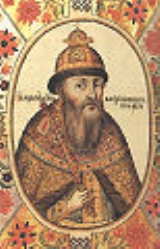
Vasili IV of Russia

Encyclopedia
False Dmitriy I
False Dmitriy I was the Tsar of Russia from 21 July 1605 until his death on 17 May 1606 under the name of Dimitriy Ioannovich . He is sometimes referred to under the usurped title of Dmitriy II...
. His reign fell during the Time of Troubles
Time of Troubles
The Time of Troubles was a period of Russian history comprising the years of interregnum between the death of the last Russian Tsar of the Rurik Dynasty, Feodor Ivanovich, in 1598, and the establishment of the Romanov Dynasty in 1613. In 1601-1603, Russia suffered a famine that killed one-third...
.
Born Prince
Knyaz
Kniaz, knyaz or knez is a Slavic title found in most Slavic languages, denoting a royal nobility rank. It is usually translated into English as either Prince or less commonly as Duke....
Vasily Ivanovich Shuisky
Shuisky
The Princes Shuisky were a Rurikid family of boyars descending from Grand Duke Dmitry Konstantinovich of Vladimir-Suzdal and Prince Andrey Yaroslavich, brother to Alexander Nevsky. Their name is derived from the town of Shuya, of which they gained ownership in 1403. The family briefly reached the...
, he was descended from sovereign princes of Nizhny Novgorod
Nizhny Novgorod
Nizhny Novgorod , colloquially shortened to Nizhny, is, with the population of 1,250,615, the fifth largest city in Russia, ranking after Moscow, St. Petersburg, Novosibirsk, and Yekaterinburg...
and a 20th generation male line descendant of Rurik the Viking. He was one of the leading boyar
Boyar
A boyar, or bolyar , was a member of the highest rank of the feudal Moscovian, Kievan Rus'ian, Bulgarian, Wallachian, and Moldavian aristocracies, second only to the ruling princes , from the 10th century through the 17th century....
s of Tsardom of Russia
Tsardom of Russia
The Tsardom of Russia was the name of the centralized Russian state from Ivan IV's assumption of the title of Tsar in 1547 till Peter the Great's foundation of the Russian Empire in 1721.From 1550 to 1700, Russia grew 35,000 km2 a year...
during the reigns of Feodor I
Feodor I of Russia
Fyodor I Ivanovich 1598) was the last Rurikid Tsar of Russia , son of Ivan IV and Anastasia Romanovna. In English he is sometimes called Feodor the Bellringer in consequence of his strong faith and inclination to travel the land and ring the bells at churches. However, in Russian the name...
and Boris Godunov
Boris Godunov
Boris Fyodorovich Godunov was de facto regent of Russia from c. 1585 to 1598 and then the first non-Rurikid tsar from 1598 to 1605. The end of his reign saw Russia descend into the Time of Troubles.-Early years:...
. In all the court intrigues of the Time of Troubles
Time of Troubles
The Time of Troubles was a period of Russian history comprising the years of interregnum between the death of the last Russian Tsar of the Rurik Dynasty, Feodor Ivanovich, in 1598, and the establishment of the Romanov Dynasty in 1613. In 1601-1603, Russia suffered a famine that killed one-third...
, Vasily and his younger brother Dmitry Shuisky
Dmitry Shuisky
Prince Dmitry Ivanovich Shuisky was a Russian boyar from the Shuisky family, a younger brother to Vasily IV of Russia.As a playmate of young Tsarevich Feodor Ivanovich, Dmitry was said to accompany him day and night in his devout wanderings from monastery to monastery. In 1584, his slandering of...
usually acted together and fought as one.
It was he who, in obedience to the secret orders of Tsar Boris, went to Uglich
Uglich
Uglich is a historic town in Yaroslavl Oblast, Russia, which stands on the Volga River. Population: A local tradition dates the town's origins to 937. It was first documented in 1148 as Ugliche Pole...
to inquire into the cause of the death of the Tsarevich Dmitry Ivanovich, the youngest son of Ivan the Terrible, who had perished there in mysterious circumstances. Shuisky reported that it was a case of suicide
Suicide
Suicide is the act of intentionally causing one's own death. Suicide is often committed out of despair or attributed to some underlying mental disorder, such as depression, bipolar disorder, schizophrenia, alcoholism, or drug abuse...
, though rumors abounded that the Tsarevich had been assassinated on the orders of the regent Boris Godunov
Boris Godunov
Boris Fyodorovich Godunov was de facto regent of Russia from c. 1585 to 1598 and then the first non-Rurikid tsar from 1598 to 1605. The end of his reign saw Russia descend into the Time of Troubles.-Early years:...
. Some suspected that Dmitry escaped the assassination and that another boy was killed in his place, providing impetus for the repeated appearance of impostors (See False Dmitry I, False Dmitry II
False Dmitry II
False Dmitry II , also called the rebel of Tushino, was the second of three pretenders to the Russian throne who claimed to be Tsarevich Dmitry Ivanovich of Russia, the youngest son of Ivan the Terrible...
, and False Dmitry III
False Dmitry III
False Dmitry III, also called Pseudo-Demetrius III , was the last and most enigmatic of three pretenders to the Russian throne who claimed to be the youngest son of Ivan the Terrible, Tsarevich Dmitry....
). On the death of Boris
Boris Godunov
Boris Fyodorovich Godunov was de facto regent of Russia from c. 1585 to 1598 and then the first non-Rurikid tsar from 1598 to 1605. The end of his reign saw Russia descend into the Time of Troubles.-Early years:...
, who had become tsar, and the accession of his son Feodor II
Feodor II of Russia
Fyodor II Borisovich Godunov of Russia was a tsar of Russia during the Time of Troubles. He was born in Moscow, the son and successor to Boris Godunov...
, Shuisky went back upon his own words in order to gain favour with the pretender False Dmitriy I
False Dmitriy I
False Dmitriy I was the Tsar of Russia from 21 July 1605 until his death on 17 May 1606 under the name of Dimitriy Ioannovich . He is sometimes referred to under the usurped title of Dmitriy II...
, who was attempting to gain the throne by impersonating the dead Tsarevich. Shuisky recognized the pretender as the "real" Dmitry despite having earlier determined the boy had committed suicide, thus bringing about the assassination of the young Feodor.
Shuisky then conspired against the false Dmitriy and brought about his death (May 1606). After stating publicly that the real Dmitriy had indeed been slain and that the reigning tsar was an impostor
Impostor
An impostor or imposter is a person who pretends to be somebody else, often to try to gain financial or social advantages through social engineering, but just as often for purposes of espionage or law enforcement....
, Shuisky's adherents thereupon proclaimed him tsar
Tsar
Tsar is a title used to designate certain European Slavic monarchs or supreme rulers. As a system of government in the Tsardom of Russia and Russian Empire, it is known as Tsarist autocracy, or Tsarism...
on 19 May 1606. He reigned until 19 July 1610, but was never generally recognized. Even in Moscow
Moscow
Moscow is the capital, the most populous city, and the most populous federal subject of Russia. The city is a major political, economic, cultural, scientific, religious, financial, educational, and transportation centre of Russia and the continent...
itself he had little or no authority, and he only avoided deposition by the dominant boyars because they had no one to replace him with.
The popularity of his cousin, Prince Mikhail Skopin-Shuisky
Mikhail Skopin-Shuisky
Prince Mikhail Vasiliyevich Skopin-Shuisky was a youthful Russian statesman and military figure during the Time of Troubles. He was the last representative of a cadet branch of the House of Shuya.-Life:...
, who commanded an army aided by a small allied Swedish army led by Jacob de la Gardie
Jacob De la Gardie
Field Marshal and Count Jacob Pontusson De la Gardie was a statesman and a soldier of the Swedish Empire....
, demanding cessions of Russian territory in Karelia
Karelia
Karelia , the land of the Karelian peoples, is an area in Northern Europe of historical significance for Finland, Russia, and Sweden...
in return, allowed Shuisky, for a time, to remain on his unstable throne. In 1610, he was deposed by his former adherents Princes Vorotynsky
Vorotynsky
Vorotynsky was one of the most eminent Rurikid princely houses of Muscovite Russia. Their lands lay principally in the Upper Oka region and comprised the towns of Peremyshl and Vorotynsk as well as parts of Novosil and Odoyev....
and Mstislavsky
Mstislavsky
Mstislavsky was a Russian princely family of Gediminid origin who prior to their move to Russia ruled the principality of Mstislavl. In the following, the Mstislavsky family produced some notable military commanders such as Ivan Mstislavsky who fought in the Livonian War...
. He was made a monk
Monk
A monk is a person who practices religious asceticism, living either alone or with any number of monks, while always maintaining some degree of physical separation from those not sharing the same purpose...
and eventually transported to Warsaw
Warsaw
Warsaw is the capital and largest city of Poland. It is located on the Vistula River, roughly from the Baltic Sea and from the Carpathian Mountains. Its population in 2010 was estimated at 1,716,855 residents with a greater metropolitan area of 2,631,902 residents, making Warsaw the 10th most...
by the Polish hetman
Hetman
Hetman was the title of the second-highest military commander in 15th- to 18th-century Poland and the Grand Duchy of Lithuania, which together, from 1569 to 1795, comprised the Polish-Lithuanian Commonwealth, or Rzeczpospolita....
Stanislaus Zolkiewski. He died a prisoner in the castle of Gostynin
Gostynin
Gostynin is a town in Central Poland with 19,414 inhabitants . It is situated in the Masovian Voivodship since 1999 and was previously in the Płock Voivodship from 1975 to 1998. It is the capital of Gostynin County.-External links:*...
, near Warsaw
Warsaw
Warsaw is the capital and largest city of Poland. It is located on the Vistula River, roughly from the Baltic Sea and from the Carpathian Mountains. Its population in 2010 was estimated at 1,716,855 residents with a greater metropolitan area of 2,631,902 residents, making Warsaw the 10th most...
, in 1612.
Descent from Rurik
Vasili IV, the last male-line Rurikid to rule Russia, traced his descent from Rurik thus:- Rurik the Viking
- Igor I Rurikovich, Grand Prince of Kiev
- Sviatoslav I Igorevich, Grand Prince of KievSviatoslav I of KievSviatoslav I Igorevich ; , also spelled Svyatoslav, was a prince of Rus...
- Vladimir Svyatoslavich the Great, Grand Prince of Kiev
- Yaroslav Vladimirovich the Wise, Grand Prince of KievYaroslav I the WiseYaroslav I, Grand Prince of Rus, known as Yaroslav the Wise Yaroslav I, Grand Prince of Rus, known as Yaroslav the Wise Yaroslav I, Grand Prince of Rus, known as Yaroslav the Wise (Old Norse: Jarizleifr; ; Old East Slavic and Russian: Ярослав Мудрый; Ukrainian: Ярослав Мудрий; c...
- Vladimir II Yaroslavich Monomakh, Grand Prince of KievVladimir II MonomakhVladimir II Monomakh |Basileios]]) was a Velikiy Kniaz of Kievan Rus'.- Family :He was the son of Vsevolod I and Anastasia of Byzantium Vladimir II Monomakh |Basileios]]) (1053 – May 19, 1125) was a Velikiy Kniaz (Grand Prince) of Kievan Rus'.- Family :He was the son of Vsevolod I (married in...
- Yuri Vladimirovich the Long Arm, Grand Prince of KievYuri DolgorukiPrince Yuri I Dolgorukiy , also known as George I of Rus, was the founder of Moscow and a key figure in the transition of political power from Kiev to Vladimir-Suzdal following the death of his elder brother Mstislav the Great...
, (1099–1157) - Vsevolod III Yuryevich the Big Nest, Grand Prince of Kiev, (1154–1212)
- Yaroslav II Feodor Vsevolodich, Grand Prince of Vladimir-SuzdalYaroslav II of VladimirYaroslav II , Christian name Theodor was the Grand Prince of Vladimir who helped to restore his country and capital after the Mongol invasion of Russia.-Prince of Pereyaslav:...
, (1191–1246) - Andrei II Yaroslavich, Grand Prince of Vladimir-Suzdal, (1221–1264)
- Vasili Andreievich, Prince of Suzdal, (1264–1309)
- Konstantin Vasilievich, Prince of Suzdal, (1295–1355)
- Dmitri Konstantinovich, Grand Prince of Vladimir-SuzdalDmitry of SuzdalDmitri Konstantinovich of Suzdal was a powerful Prince of Suzdal and Nizhny Novgorod who dominated Russian politics during the minority of his son-in-law, Dmitri Donskoi...
, (1324–1383) - Vasili Dmitrievich Kirdyapa, Prince of Nizhniy Novgorod
- Yury Vasilievich, Prince Shuisky
- Vasili Yuryevich, Prince of Shuia, (d. 1446/58)
- Mikhail Vasilievich, Prince Shuisky, (d. 1445)
- Andrey Mikhailovich "Chastokol", Prince Shuisky, (d. 1543)
- Ivan Andreyevich, Prince Shuisky, (d. 1573)
- Vasili IV Ivanovich of Russia (1552–1612)
External links
- The ancestors tsar Vasili IV of Russia (in Russian)
- Godunov to Nicholas II by Saul Zaklad