

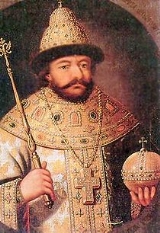
Boris Godunov

Encyclopedia
Boris Fyodorovich Godunov was de facto regent
of Russia from c. 1585 to 1598 and then the first non-Rurikid
tsar
from 1598 to 1605. The end of his reign saw Russia descend into the Time of Troubles
.
to Kostroma
in the early 14th century. He was descended from the Tatarian Prince Chet, who went from the Golden Horde to Russia
and founded the Ipatiev Monastery
in Kostroma. Boris was the son of Feodor Ivanovich Godunov "Krivoy" ("One-eyed") (died, c. 1568–1570) and his wife Stepanida Ivanovna. His older brother Vasily died young and without issue.
Godunov's career began at the court
of Ivan the Terrible. He is mentioned in 1570 as taking part in the Serpeisk campaign as an archer of the guard. The following year, he became an oprichnik
- a member of Ivan's personal guard and secret police. In 1570/1571, Godunov strengthened his position at court by his marriage to Maria Grigorievna Skuratova-Belskaya
, the daughter of oprichniks' head Malyuta Skuratov-Belskiy
. In 1580, the Tsar chose Irina (Alexandra) Feodorovna Godunova (1557 – 26 October/23 November 1603), the sister of Godunov, to be the wife of his second son and eventual heir, the fourteen year old Feodor Ivanovich
(1557–1598). On this occasion, Godunov was promoted to the rank of Boyar
. On 15 November 1581, he was present at the scene of the Tsar's murder of his own eldest son, the crown prince Ivan. Godunov tried to intervene, but received blows from the Tsar's sceptre. Ivan immediately repented and Godunov rushed to get help for the Tsarevich, who died four days later.
On his deathbed, Ivan appointed a council consisting of Godunov, Feodor Nikitich Romanov, Vasili Shuiski and others, to guide his son and successor, for Feodor
was feeble both in mind and body; "he took refuge from the dangers of the palace in devotion to religion; and though his people called him a saint, they recognized that he lacked the iron to govern men."
Upon his death, Ivan also left the three year old Dmitri Ivanovich (1581–1591), from his seventh and last marriage. As the Orthodox Church recognized only his first three marriages, and any offspring thereof, as legitimate, Dmitri (and his mother's family) technically had no claim to the throne. Still, taking no chances, shortly after Ivan's death the Council had both Dmitri and his mother Maria Nagaya
moved to Uglich
, some 120 miles north of Moscow. It was there in 1591 that Dmitri died at the age of ten. An official commission headed by Vasili Shuiski was sent to determine the cause of death. The official verdict was that the boy had cut his throat during an epileptic seizure. Ivan's widow claimed that her son had been murdered by Godunov's agents. Godunov's guilt was never established and shortly thereafter Dmitri's mother was forced to take the veil. Dmitri Ivanovich was laid to rest and promptly, though temporarily, forgotten.
of Feodor Ivanovich as Tsar Feodor I on 31 May 1584, Boris was given honors and riches as a member of the regency council
, in which he held the second place during the life of the Tsar's uncle Nikita Romanovich
. When Nikita died in 1586, Boris was left without any serious rival for the regency.
A conspiracy against him by other boyars and Dionysius II, Metropolitan of Moscow
, sought to break Boris's power by divorcing the Tsar from Godunov's childless sister. It was unsuccessful, and the conspirators were banished or sent to monasteries. After that, Godunov was supreme in Russia and he corresponded with foreign princes as their equal.
His policy was generally pacific and always prudent. In 1595, he recovered from Sweden
some towns lost during the former reign. Five years previously he had defeated a Tatar raid upon Moscow, for which he received the title of Konyushy, an obsolete dignity even higher than that of Boyar. He supported an anti-Turkish
faction in the Crimea
and gave the emperor subsidies in his war against the sultan.
Godunov encouraged English merchants
to trade with Russia by exempting them from duties. He built towns and fortresses along the north-eastern and south-eastern borders of Russia to keep the Tatar and Finnic tribes in order. These included Samara
, Saratov
, Voronezh
, and Tsaritsyn
, as well as other lesser towns. He colonized Siberia
with scores of new settlements, including Tobolsk
.
During his rule, the Russian Orthodox Church
received its patriarchate
, placing it on an equal footing with the ancient Eastern churches and freeing it from the influence of the Patriarch of Constantinople
. This pleased the Tsar, as Feodor took a great interest in church affairs.
Boris's most important domestic reform was the 1597 decree forbidding the peasantry to go from one landowner to another, thus binding them to the soil. The object of this ordinance was to secure revenue, but it led to the institution of serfdom
in its most oppressive form.
, or national assembly, which met on 17 February and unanimously elected him on 21 February. On 1 September, he was solemnly crowned tsar
.
During the first years of his reign, he was both popular and prosperous, and ruled well. He recognized the need for Russia to catch up with the intellectual progress of the West and did his best to bring about educational and social reforms. He was the first tsar to import foreign teachers on a large scale, the first to send young Russians abroad to be educated, and the first to allow Lutheran churches to be built in Russia. After the Russo–Swedish War (1590–1595), he felt the necessity of access to the Baltic Sea
and attempted to obtain Livonia
by diplomatic means. He cultivated friendly relations with the Scandinavians and hoped to take a bride from a foreign royal house, thereby increasing the dignity of his own dynasty. However he declined the personal union
proposed to him in 1600 by the diplomatic mission
led by Lew Sapieha
from the Polish-Lithuanian Commonwealth
.
Boris was one of the greatest of the Russian tsars. But his great qualities were overshadowed by paranoia
. His fear of possible pretender
s induced him to forbid the leading boyars to marry. He encouraged informers and persecuted suspects on their unsupported statements. The Romanov family especially suffered severely under his regime.
Boris died after a lengthy illness and a stroke on 13/23 April 1605. He left one son, Feodor II
, who succeeded him and ruled for only a few months, until he and Boris' widow were murdered by the enemies of the Godunovs in Moscow on 10 June/20 July 1605. Boris's first son, Ivan, was born in 1587 and died in 1588. His daughter, Xenia
, was born in 1582. She was engaged to Johann of Schleswig-Holstein
, but he died shortly before their planned wedding in October 1602. Xenia was given the name "Olga" upon being forced to take monastic vows at the Voskesesnskij Monastery in Beloozero and her name is inscibed as "the Nun Olga Borisovna" at the crypt of the Godunovs at the Trinity Lavra of St. Sergius where she lived from 1606, when she sojourned there to attend the reburial of her Father, until her death in 1622. Boris, his wife, and their children are buried together in a mausoleum near the entrance of the Assumption Cathedral at Trinity-St. Sergius Lavra.
tised by the founder of Russian literature
, Alexander Pushkin, in his play Boris Godunov (1831), which was inspired by Shakespeare's Macbeth
. Modest Mussorgsky
based his opera
Boris Godunov
on Pushkin's play. Sergei Prokofiev
later wrote incidental music for Pushkin's drama. In 1997, the score of a 1710 baroque opera based on the reign of Boris by German composer Johann Mattheson
was rediscovered in Armenia
and returned to Hamburg
, Germany. This opera, never performed during the composer's lifetime, had its world premiere in 2005 at the Boston Early Music Festival & Exhibition.
The character Boris Badenov
in the cartoon The Rocky and Bullwinkle Show
takes his name from a play on Godunov's.
Regent
A regent, from the Latin regens "one who reigns", is a person selected to act as head of state because the ruler is a minor, not present, or debilitated. Currently there are only two ruling Regencies in the world, sovereign Liechtenstein and the Malaysian constitutive state of Terengganu...
of Russia from c. 1585 to 1598 and then the first non-Rurikid
Rurik Dynasty
The Rurik dynasty or Rurikids was a dynasty founded by the Varangian prince Rurik, who established himself in Novgorod around the year 862 AD...
tsar
Tsar
Tsar is a title used to designate certain European Slavic monarchs or supreme rulers. As a system of government in the Tsardom of Russia and Russian Empire, it is known as Tsarist autocracy, or Tsarism...
from 1598 to 1605. The end of his reign saw Russia descend into the Time of Troubles
Time of Troubles
The Time of Troubles was a period of Russian history comprising the years of interregnum between the death of the last Russian Tsar of the Rurik Dynasty, Feodor Ivanovich, in 1598, and the establishment of the Romanov Dynasty in 1613. In 1601-1603, Russia suffered a famine that killed one-third...
.
Early years
Boris Godunov was the most noted member of an ancient, now extinct, Russian family of Tatar origin, which came from the HordeGolden Horde
The Golden Horde was a Mongol and later Turkicized khanate that formed the north-western sector of the Mongol Empire...
to Kostroma
Kostroma
Kostroma is a historic city and the administrative center of Kostroma Oblast, Russia. A part of the Golden Ring of Russian towns, it is located at the confluence of the Volga and Kostroma Rivers...
in the early 14th century. He was descended from the Tatarian Prince Chet, who went from the Golden Horde to Russia
Russia
Russia or , officially known as both Russia and the Russian Federation , is a country in northern Eurasia. It is a federal semi-presidential republic, comprising 83 federal subjects...
and founded the Ipatiev Monastery
Ipatiev Monastery
The Ipatiev Monastery —sometimes translated into English as Hypatian Monastery—is a male monastery, situated on the bank of the Kostroma River just opposite the city of Kostroma...
in Kostroma. Boris was the son of Feodor Ivanovich Godunov "Krivoy" ("One-eyed") (died, c. 1568–1570) and his wife Stepanida Ivanovna. His older brother Vasily died young and without issue.
Godunov's career began at the court
Noble court
The court of a monarch, or at some periods an important nobleman, is a term for the extended household and all those who regularly attended on the ruler or central figure...
of Ivan the Terrible. He is mentioned in 1570 as taking part in the Serpeisk campaign as an archer of the guard. The following year, he became an oprichnik
Oprichnik
An oprichnik was a member of an organization established by Tsar Ivan the Terrible to govern the division of Russia known as the Oprichnina ....
- a member of Ivan's personal guard and secret police. In 1570/1571, Godunov strengthened his position at court by his marriage to Maria Grigorievna Skuratova-Belskaya
Maria Grigorievna Skuratova-Belskaya
Maria Grigorievna Skuratova-Belskaya , was a Tsaritsa of Russia as the spouse of Tsar Boris Godunov.In 1570/1571, Godunov strengthened his position at court by his marriage to her as she was the daughter of Tsar Ivan the Terrible's favorite Malyuta Skuratov-Belskiy.She was the mother of Tsar Feodor...
, the daughter of oprichniks' head Malyuta Skuratov-Belskiy
Malyuta Skuratov
Grigory Lukyanovich Skuratov-Belskiy , better known as Malyuta Skuratov was one of the most odious leaders of the Oprichnina during the reign of Ivan the Terrible....
. In 1580, the Tsar chose Irina (Alexandra) Feodorovna Godunova (1557 – 26 October/23 November 1603), the sister of Godunov, to be the wife of his second son and eventual heir, the fourteen year old Feodor Ivanovich
Feodor I of Russia
Fyodor I Ivanovich 1598) was the last Rurikid Tsar of Russia , son of Ivan IV and Anastasia Romanovna. In English he is sometimes called Feodor the Bellringer in consequence of his strong faith and inclination to travel the land and ring the bells at churches. However, in Russian the name...
(1557–1598). On this occasion, Godunov was promoted to the rank of Boyar
Boyar
A boyar, or bolyar , was a member of the highest rank of the feudal Moscovian, Kievan Rus'ian, Bulgarian, Wallachian, and Moldavian aristocracies, second only to the ruling princes , from the 10th century through the 17th century....
. On 15 November 1581, he was present at the scene of the Tsar's murder of his own eldest son, the crown prince Ivan. Godunov tried to intervene, but received blows from the Tsar's sceptre. Ivan immediately repented and Godunov rushed to get help for the Tsarevich, who died four days later.
On his deathbed, Ivan appointed a council consisting of Godunov, Feodor Nikitich Romanov, Vasili Shuiski and others, to guide his son and successor, for Feodor
Feodor I of Russia
Fyodor I Ivanovich 1598) was the last Rurikid Tsar of Russia , son of Ivan IV and Anastasia Romanovna. In English he is sometimes called Feodor the Bellringer in consequence of his strong faith and inclination to travel the land and ring the bells at churches. However, in Russian the name...
was feeble both in mind and body; "he took refuge from the dangers of the palace in devotion to religion; and though his people called him a saint, they recognized that he lacked the iron to govern men."
Upon his death, Ivan also left the three year old Dmitri Ivanovich (1581–1591), from his seventh and last marriage. As the Orthodox Church recognized only his first three marriages, and any offspring thereof, as legitimate, Dmitri (and his mother's family) technically had no claim to the throne. Still, taking no chances, shortly after Ivan's death the Council had both Dmitri and his mother Maria Nagaya
Maria Nagaya
Maria Feodorovna Nagaya was a Russian tsarina and eighth wife of Ivan the Terrible.Maria married Ivan IV in 1581 and a year later gave birth to their son Dmitry. After the Tsar's death in 1584, Nagaya, her son and her brothers were sent into exile to Uglich by Boris Godunov, where she lived...
moved to Uglich
Uglich
Uglich is a historic town in Yaroslavl Oblast, Russia, which stands on the Volga River. Population: A local tradition dates the town's origins to 937. It was first documented in 1148 as Ugliche Pole...
, some 120 miles north of Moscow. It was there in 1591 that Dmitri died at the age of ten. An official commission headed by Vasili Shuiski was sent to determine the cause of death. The official verdict was that the boy had cut his throat during an epileptic seizure. Ivan's widow claimed that her son had been murdered by Godunov's agents. Godunov's guilt was never established and shortly thereafter Dmitri's mother was forced to take the veil. Dmitri Ivanovich was laid to rest and promptly, though temporarily, forgotten.
Regency
At the coronationCoronation of the Russian monarch
The Coronation of the Russian monarch was a religious ceremony of the Russian Orthodox Church, the state church of the Russian Empire, in which the Emperor of Russia was crowned and invested with regalia, then anointed with chrism and formally blessed by the church to commence his reign...
of Feodor Ivanovich as Tsar Feodor I on 31 May 1584, Boris was given honors and riches as a member of the regency council
Regency Council
right|thumb|Regency Council: Ostrowski, Kakowski, LubomirskiThe Regency Council of the Kingdom of Poland was a semi-independent and temporary highest authority during World War I, formed by Germany and Austria-Hungary in the occupied Polish territories in September 1917. It was supposed to stay...
, in which he held the second place during the life of the Tsar's uncle Nikita Romanovich
Nikita Romanovich
Nikita Romanovich , also known as Nikita Romanovich Zakharyin-Yuriev, was a Muscovite Boyar in 1563 whose grandson Mikhail Feodorovich founded the Romanov dynasty of Russian tsars...
. When Nikita died in 1586, Boris was left without any serious rival for the regency.
A conspiracy against him by other boyars and Dionysius II, Metropolitan of Moscow
Dionysius II, Metropolitan of Moscow
Dionysius II was Metropolitan of Moscow and all Russia between 1581 and 1587.Dionysius was elected metropolitan by Ivan the Terrible in 1581. He was notable for his eloquence and a number of works , for which he would be nicknamed Грамматик...
, sought to break Boris's power by divorcing the Tsar from Godunov's childless sister. It was unsuccessful, and the conspirators were banished or sent to monasteries. After that, Godunov was supreme in Russia and he corresponded with foreign princes as their equal.
His policy was generally pacific and always prudent. In 1595, he recovered from Sweden
Sweden
Sweden , officially the Kingdom of Sweden , is a Nordic country on the Scandinavian Peninsula in Northern Europe. Sweden borders with Norway and Finland and is connected to Denmark by a bridge-tunnel across the Öresund....
some towns lost during the former reign. Five years previously he had defeated a Tatar raid upon Moscow, for which he received the title of Konyushy, an obsolete dignity even higher than that of Boyar. He supported an anti-Turkish
Turkey
Turkey , known officially as the Republic of Turkey , is a Eurasian country located in Western Asia and in East Thrace in Southeastern Europe...
faction in the Crimea
Crimea
Crimea , or the Autonomous Republic of Crimea , is a sub-national unit, an autonomous republic, of Ukraine. It is located on the northern coast of the Black Sea, occupying a peninsula of the same name...
and gave the emperor subsidies in his war against the sultan.
Godunov encouraged English merchants
Muscovy Company
The Muscovy Company , was a trading company chartered in 1555. It was the first major chartered joint stock company, the precursor of the type of business that would soon flourish in England, and became closely associated with such famous names as Henry Hudson and William Baffin...
to trade with Russia by exempting them from duties. He built towns and fortresses along the north-eastern and south-eastern borders of Russia to keep the Tatar and Finnic tribes in order. These included Samara
Samara, Russia
Samara , is the sixth largest city in Russia. It is situated in the southeastern part of European Russia at the confluence of the Volga and Samara Rivers. Samara is the administrative center of Samara Oblast. Population: . The metropolitan area of Samara-Tolyatti-Syzran within Samara Oblast...
, Saratov
Saratov
-Modern Saratov:The Saratov region is highly industrialized, due in part to the rich in natural and industrial resources of the area. The region is also one of the more important and largest cultural and scientific centres in Russia...
, Voronezh
Voronezh
Voronezh is a city in southwestern Russia, the administrative center of Voronezh Oblast. It is located on both sides of the Voronezh River, away from where it flows into the Don. It is an operating center of the Southeastern Railway , as well as the center of the Don Highway...
, and Tsaritsyn
Volgograd
Volgograd , formerly called Tsaritsyn and Stalingrad is an important industrial city and the administrative center of Volgograd Oblast, Russia. It is long, north to south, situated on the western bank of the Volga River...
, as well as other lesser towns. He colonized Siberia
Siberia
Siberia is an extensive region constituting almost all of Northern Asia. Comprising the central and eastern portion of the Russian Federation, it was part of the Soviet Union from its beginning, as its predecessor states, the Tsardom of Russia and the Russian Empire, conquered it during the 16th...
with scores of new settlements, including Tobolsk
Tobolsk
Tobolsk is a town in Tyumen Oblast, Russia, located at the confluence of the Tobol and Irtysh Rivers. It is a historic capital of Siberia. Population: -History:...
.
During his rule, the Russian Orthodox Church
Russian Orthodox Church
The Russian Orthodox Church or, alternatively, the Moscow Patriarchate The ROC is often said to be the largest of the Eastern Orthodox churches in the world; including all the autocephalous churches under its umbrella, its adherents number over 150 million worldwide—about half of the 300 million...
received its patriarchate
Patriarchate
A patriarchate is the office or jurisdiction of a patriarch. A patriarch, as the term is used here, is either* one of the highest-ranking bishops in Eastern Orthodoxy, earlier, the five that were included in the Pentarchy: Rome, Constantinople, Alexandria, Antioch, and Jerusalem, but now nine,...
, placing it on an equal footing with the ancient Eastern churches and freeing it from the influence of the Patriarch of Constantinople
Patriarch of Constantinople
The Ecumenical Patriarch is the Archbishop of Constantinople – New Rome – ranking as primus inter pares in the Eastern Orthodox communion, which is seen by followers as the One, Holy, Catholic, and Apostolic Church....
. This pleased the Tsar, as Feodor took a great interest in church affairs.
Boris's most important domestic reform was the 1597 decree forbidding the peasantry to go from one landowner to another, thus binding them to the soil. The object of this ordinance was to secure revenue, but it led to the institution of serfdom
Serfdom
Serfdom is the status of peasants under feudalism, specifically relating to Manorialism. It was a condition of bondage or modified slavery which developed primarily during the High Middle Ages in Europe and lasted to the mid-19th century...
in its most oppressive form.
Tsardom
On the death of the childless Feodor on 7 January 1598, self-preservation as much as ambition led Boris to seize the throne. Had he not done so, the mildest treatment he could have hoped for would have been lifelong seclusion in a monastery. His election was proposed by Patriarch Job of Moscow, who believed that Boris was the one man capable of coping with the difficulties of the situation. Boris, however, would only accept the throne from the Zemsky SoborZemsky Sobor
The zemsky sobor was the first Russian parliament of the feudal Estates type, in the 16th and 17th centuries. The term roughly means assembly of the land. It could be summoned either by tsar, or patriarch, or the Boyar Duma...
, or national assembly, which met on 17 February and unanimously elected him on 21 February. On 1 September, he was solemnly crowned tsar
Tsar
Tsar is a title used to designate certain European Slavic monarchs or supreme rulers. As a system of government in the Tsardom of Russia and Russian Empire, it is known as Tsarist autocracy, or Tsarism...
.
During the first years of his reign, he was both popular and prosperous, and ruled well. He recognized the need for Russia to catch up with the intellectual progress of the West and did his best to bring about educational and social reforms. He was the first tsar to import foreign teachers on a large scale, the first to send young Russians abroad to be educated, and the first to allow Lutheran churches to be built in Russia. After the Russo–Swedish War (1590–1595), he felt the necessity of access to the Baltic Sea
Baltic Sea
The Baltic Sea is a brackish mediterranean sea located in Northern Europe, from 53°N to 66°N latitude and from 20°E to 26°E longitude. It is bounded by the Scandinavian Peninsula, the mainland of Europe, and the Danish islands. It drains into the Kattegat by way of the Øresund, the Great Belt and...
and attempted to obtain Livonia
Livonia
Livonia is a historic region along the eastern shores of the Baltic Sea. It was once the land of the Finnic Livonians inhabiting the principal ancient Livonian County Metsepole with its center at Turaida...
by diplomatic means. He cultivated friendly relations with the Scandinavians and hoped to take a bride from a foreign royal house, thereby increasing the dignity of his own dynasty. However he declined the personal union
Personal union
A personal union is the combination by which two or more different states have the same monarch while their boundaries, their laws and their interests remain distinct. It should not be confused with a federation which is internationally considered a single state...
proposed to him in 1600 by the diplomatic mission
Diplomatic mission
A diplomatic mission is a group of people from one state or an international inter-governmental organisation present in another state to represent the sending state/organisation in the receiving state...
led by Lew Sapieha
Lew Sapieha
Lew Sapieha . He was born in Astrouna , near Vitsebsk, Belarus. He became Great Secretary of the Grand Duchy of Lithuania in 1580, Great Clerk of the Grand Duchy in 1581, Court Chancellor of the GDL in 1585, Grand Chancellor of the GDL from 1589 until 1623, Voivode of Vilnius in 1621, Great...
from the Polish-Lithuanian Commonwealth
Polish-Lithuanian Commonwealth
The Polish–Lithuanian Commonwealth was a dualistic state of Poland and Lithuania ruled by a common monarch. It was the largest and one of the most populous countries of 16th- and 17th‑century Europe with some and a multi-ethnic population of 11 million at its peak in the early 17th century...
.
Boris was one of the greatest of the Russian tsars. But his great qualities were overshadowed by paranoia
Paranoia
Paranoia [] is a thought process believed to be heavily influenced by anxiety or fear, often to the point of irrationality and delusion. Paranoid thinking typically includes persecutory beliefs, or beliefs of conspiracy concerning a perceived threat towards oneself...
. His fear of possible pretender
Pretender
A pretender is one who claims entitlement to an unavailable position of honour or rank. Most often it refers to a former monarch, or descendant thereof, whose throne is occupied or claimed by a rival, or has been abolished....
s induced him to forbid the leading boyars to marry. He encouraged informers and persecuted suspects on their unsupported statements. The Romanov family especially suffered severely under his regime.
Boris died after a lengthy illness and a stroke on 13/23 April 1605. He left one son, Feodor II
Feodor II of Russia
Fyodor II Borisovich Godunov of Russia was a tsar of Russia during the Time of Troubles. He was born in Moscow, the son and successor to Boris Godunov...
, who succeeded him and ruled for only a few months, until he and Boris' widow were murdered by the enemies of the Godunovs in Moscow on 10 June/20 July 1605. Boris's first son, Ivan, was born in 1587 and died in 1588. His daughter, Xenia
Tsarevna Xenia Borisovna of Russia
Xenia Borisovna Godunova was a Russian Tsarevna, daughter of Tsar Boris Godunov, and sister of Tsar Feodor II of Russia.She was very beautiful and well educated...
, was born in 1582. She was engaged to Johann of Schleswig-Holstein
John, Prince of Schleswig-Holstein
Johan of Schleswig-Holstein was the youngest son of Frederick II of Denmark and Norway and Sophia of Mecklenburg-Schwerin...
, but he died shortly before their planned wedding in October 1602. Xenia was given the name "Olga" upon being forced to take monastic vows at the Voskesesnskij Monastery in Beloozero and her name is inscibed as "the Nun Olga Borisovna" at the crypt of the Godunovs at the Trinity Lavra of St. Sergius where she lived from 1606, when she sojourned there to attend the reburial of her Father, until her death in 1622. Boris, his wife, and their children are buried together in a mausoleum near the entrance of the Assumption Cathedral at Trinity-St. Sergius Lavra.
Arts and popular media
Boris' life was dramaDrama
Drama is the specific mode of fiction represented in performance. The term comes from a Greek word meaning "action" , which is derived from "to do","to act" . The enactment of drama in theatre, performed by actors on a stage before an audience, presupposes collaborative modes of production and a...
tised by the founder of Russian literature
Russian literature
Russian literature refers to the literature of Russia or its émigrés, and to the Russian-language literature of several independent nations once a part of what was historically Russia or the Soviet Union...
, Alexander Pushkin, in his play Boris Godunov (1831), which was inspired by Shakespeare's Macbeth
Macbeth
The Tragedy of Macbeth is a play by William Shakespeare about a regicide and its aftermath. It is Shakespeare's shortest tragedy and is believed to have been written sometime between 1603 and 1607...
. Modest Mussorgsky
Modest Mussorgsky
Modest Petrovich Mussorgsky was a Russian composer, one of the group known as 'The Five'. He was an innovator of Russian music in the romantic period...
based his opera
Opera
Opera is an art form in which singers and musicians perform a dramatic work combining text and musical score, usually in a theatrical setting. Opera incorporates many of the elements of spoken theatre, such as acting, scenery, and costumes and sometimes includes dance...
Boris Godunov
Boris Godunov (opera)
Boris Godunov is an opera by Modest Mussorgsky . The work was composed between 1868 and 1873 in Saint Petersburg, Russia. It is Mussorgsky's only completed opera and is considered his masterpiece. Its subjects are the Russian ruler Boris Godunov, who reigned as Tsar during the Time of Troubles,...
on Pushkin's play. Sergei Prokofiev
Sergei Prokofiev
Sergei Sergeyevich Prokofiev was a Russian composer, pianist and conductor who mastered numerous musical genres and is regarded as one of the major composers of the 20th century...
later wrote incidental music for Pushkin's drama. In 1997, the score of a 1710 baroque opera based on the reign of Boris by German composer Johann Mattheson
Johann Mattheson
Johann Mattheson was a German composer, writer, lexicographer, diplomat and music theorist.Mattheson was born and died in Hamburg. He was a close friend of George Frideric Handel, although he nearly killed him in a sudden quarrel, during a performance of Mattheson's opera Cleopatra in 1704...
was rediscovered in Armenia
Armenia
Armenia , officially the Republic of Armenia , is a landlocked mountainous country in the Caucasus region of Eurasia...
and returned to Hamburg
Hamburg
-History:The first historic name for the city was, according to Claudius Ptolemy's reports, Treva.But the city takes its modern name, Hamburg, from the first permanent building on the site, a castle whose construction was ordered by the Emperor Charlemagne in AD 808...
, Germany. This opera, never performed during the composer's lifetime, had its world premiere in 2005 at the Boston Early Music Festival & Exhibition.
The character Boris Badenov
Boris Badenov
Boris Badenov is a fictional character in the 1960s animated cartoons Rocky and His Friends and The Bullwinkle Show, collectively referred to as Rocky and Bullwinkle for short. He is voiced by Paul Frees....
in the cartoon The Rocky and Bullwinkle Show
The Rocky and Bullwinkle Show
The Rocky & Bullwinkle Show is an American animated television series that originally aired from November 19, 1959 to June 28, 1964 on the ABC and NBC television networks...
takes his name from a play on Godunov's.
External links
- Godunov to Nicholas II by Saul Zaklad
- The throne of Tsar Boris Godunov
- Ancestors of Boris Feodorovich Godunov, tsar of Russia (in Russian)