

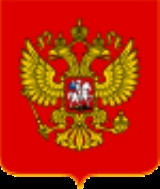
Coat of arms of Russia

Encyclopedia
The coat of arms of Russia have gone through three major periods in their history, undergoing major changes in the transitions between the Russian Empire
, the Soviet Union
, and the Russian Federation. They date back to 1472, when Ivan III began using the double-headed eagle in his seal, which, along with the image of St. George slaying a dragon, have been common in the coat of arms since. The coat of arms were changed in 1918 with the creation of the Russian Soviet Federative Socialist Republic
, and depicted communist symbols such as the hammer and sickle and red star. The current coat of arms, in use since 1993, once again uses the double-headed eagle with the image of St. George.
 The national symbols of the Russian Empire
were the coat of arms
and the state seal
in three variants: great, middle and lesser.
, over which the same third crown, enlarged, with two flying ends of the ribbon of the Order of Saint Andrew. The State Eagle held a golden scepter and golden globus cruciger
. On the chest of the eagle there was an escutcheon with the arms of Moscow
, depicting Saint George
, mounted and defeating the dragon.
first approved the relevant design on July 24, which, with minor modifications, was officially adopted on November 3.
Its central element is the coat of arms, crowned with the helmet of Alexander Nevsky
, with black and golden mantling
, and flanked by the archangels Michael and Gabriel. The collar of the Order of Saint Andrew is suspended from the coat of arms. The whole lies within a golden ermine
mantle, crowned by Monomakh's Cap
and decorated with black double-headed eagles. The inscription on the canopy reads: Съ Нами Богъ ("God is with us"). Above the canopy stands the state khorugv
, of gold cloth, on which is depicted the Medium State Seal. The banner is topped by the State Eagle.
Around the central composition are placed fifteen coats of arms of the various territories of the Russian Empire. Nine of these are crowned and placed on a laurel and oak wreath. From left to right, these represent, as they are included in the full imperial title: the Khanate of Kazan
, the Kingdom of Poland, Tauric Chersonesos
, the unified coat of arms of the Grand Principalities of Kiev
, Vladimir
and Novgorod
, the dynastic arms of the House of Holstein-Gottorp-Romanov, the Grand Principality of Finland, the Georgian
principalities, and the Khanates of Siberia
and Astrakhan
.
The six upper escutcheons are joint depictions of various smaller principalities and oblast
s. From left to right, these are: the combined arms of the northeastern regions (Perm
, Volga Bulgaria
, Vyatka
, Kondinsky, Obdorsk), of Belorussia and Lithuania
(Lithuania
, Białystok, Samogitia
, Polatsk
, Vitebsk
, Mstislavl), the provinces of Great Russia
proper (Pskov
, Smolensk
, Tver
, Nizhniy-Novgorod, Ryazan
, Rostov
, Yaroslavl
, Belozersk
, Udorsky), the arms of the southwestern regions (Volhyn, Podolsk
, Chernigov), the Baltic provinces
(Esthonia
, Courland
and Semigalia
, Karelia
, Livonia) and Turkestan
.
and the six upper escutcheons. The Abbreviated Imperial Title is inscribed over the perimeter of the Seal.
and the end of the Byzantine Empire
in 1453, the Grand Dukes of Muscovy came to see themselves as the successors of the Byzantine heritage, a notion reinforced by the marriage of Ivan III
to Sophia Paleologue
(hence the expression "Third Rome
" for Moscow and, by extension, for the whole of Imperial Russia). Ivan adopted the golden Byzantine double-headed eagle in his seal, first documented in 1472, marking his direct claim to the Roman imperial heritage and posing as a sovereign equal and rival to the Holy Roman Empire
. In 1497 it was stamped on a charter of share and allotment of independent princes' possessions. At about the same time, the image of a gilt, double-headed eagle on a red background appeared on the walls of the Palace of Facets
in the Moscow Kremlin
.
The other main Russian coat of arms, the image of St George slaying the dragon, is contemporaneous. In its first form, as a rider armed with a spear, it is found in the seal of Vasili I of Moscow
in 1390. At the time of Ivan III, the dragon was added, but the final association with Saint George was not made until 1730, when it was described as such in an Imperial decree. Eventually, St George became the patron saint of Moscow (and, by extension, of Russia).
After the assumption of the title of Tsar
by Ivan IV, the two coats are found combined, with the eagle bearing an escutcheon depicting St George on the breast. With the establishment of the Moscow Patriarchate in 1589, a patriarchal cross
was added for a time between the heads of the eagle.
In the beginning of the 17th century, with the ascension of the Romanov
dynasty and its contacts with Western Europe, the image of the eagle changed. In 1625 for the first time the double-headed eagle appeared with three crowns. Traditionally, the latter have alternatively been interpreted as representing the conquered kingdoms of Kazan
, Astrakhan
and Siberia
, as stated in the first edict concerning the state seal, on 14 December 1667, or as standing for the unity of Great Russia (Russia
), Little Russia (the Ukraine
) and White Russia (Belarus
). Probably under influence from its German equivalent, the eagle, from 1654 onwards, was designed with spread wings and holding a scepter and orb in its claws.
During the reign of Peter the Great
, further changes were made. The collar of the newly established Order of Saint Andrew was added around the central escutcheon, and the crowns were changed to the imperial pattern
after his assumption of the imperial title in 1721. At about this time, the eagle's color was changed from golden to black, which would be retained until the fall of the Russian monarchy in 1917. A final form for the eagle was adopted by imperial decree in 1729, and remained virtually unchanged until 1853.
During the early 19th century, the eagle designs diversified, and two different variants were adopted by Emperor Nicholas I
. The first type represented the eagle with spread wings, one crown, with an image of St.George on the breast and with a wreath and a thunderbolt in its claws. The second type followed the 1730 pattern, with the addition of the arms of Kazan, Astrakhan and Siberia on its left wing and those of Poland, the Taurica and Finland on the left one.
In 1855-57, in the course of a general heraldic reform, the eagle's appearance was changed, mirroring German patterns, while St George was made to look to the left, in accordance with the rules of Western heraldry. At the same time, the full set of coat of arms of Great, Medium and Minor Arms, was laid down and approved. The final revisions and changes were made in 1882-83, and are those described above.
layout corresponds to the early fifteenth century standard . The shape of the eagle can be traced back to the reign of Peter the Great
(1682–1725), although the eagle in modern arms is gold instead of the imperial black.
The current coat of arms was designed by artist Yevgeny Ukhnalyov
; it was adopted officially on November 30, 1993 http://sovet.geraldika.ru/article/17588. Today, the imperial crowns on each head stand for the unity and sovereignty of Russia
, both as a whole and in its constituent republics and regions. The orb
and sceptre
grasped in the eagle's toes are traditional heraldic symbols of sovereign power and authority. They have been retained in the modern Russian arms despite the fact that the Russian Federation is not a monarchy, which led to objections by the Communists even though both the blue ribbon and the collar of the Order of St. Andrew
(which in the imperial arms supported the three crowns and surrounded the central shield
) have been removed from the current coat of arms.
The modern arms of Russia
were instated by a presidential decree in 1993, and then by a federal law signed by President Vladimir Putin
on December 20, 2000.
Russian Empire
The Russian Empire was a state that existed from 1721 until the Russian Revolution of 1917. It was the successor to the Tsardom of Russia and the predecessor of the Soviet Union...
, the Soviet Union
Soviet Union
The Soviet Union , officially the Union of Soviet Socialist Republics , was a constitutionally socialist state that existed in Eurasia between 1922 and 1991....
, and the Russian Federation. They date back to 1472, when Ivan III began using the double-headed eagle in his seal, which, along with the image of St. George slaying a dragon, have been common in the coat of arms since. The coat of arms were changed in 1918 with the creation of the Russian Soviet Federative Socialist Republic
Russian Soviet Federative Socialist Republic
The Russian Soviet Federative Socialist Republic , commonly referred to as Soviet Russia, Bolshevik Russia, or simply Russia, was the largest, most populous and economically developed republic in the former Soviet Union....
, and depicted communist symbols such as the hammer and sickle and red star. The current coat of arms, in use since 1993, once again uses the double-headed eagle with the image of St. George.
Russian Empire
Russian Empire
The Russian Empire was a state that existed from 1721 until the Russian Revolution of 1917. It was the successor to the Tsardom of Russia and the predecessor of the Soviet Union...
were the coat of arms
Coat of arms
A coat of arms is a unique heraldic design on a shield or escutcheon or on a surcoat or tabard used to cover and protect armour and to identify the wearer. Thus the term is often stated as "coat-armour", because it was anciently displayed on the front of a coat of cloth...
and the state seal
State seal
State seal may refer to one of the following:*One of Seals of the U.S. states*One of State seals of Russian Empire...
in three variants: great, middle and lesser.
Coat of arms
The coat of arms of the Russian Empire (Герб Российской Империи) consisted of a golden escutcheon with a black two-headed eagle crowned with two imperial crownsImperial Crown of Russia
The Imperial Crown of Russia, also known as the Great Imperial Crown, is the crown that was used by the Emperors of Russia until the abolition of the monarchy in 1917. The Great Imperial Crown was first used in a coronation by Catherine II, and was last used at the coronation of Nicholas II...
, over which the same third crown, enlarged, with two flying ends of the ribbon of the Order of Saint Andrew. The State Eagle held a golden scepter and golden globus cruciger
Globus cruciger
The globus cruciger is an orb topped with a cross , a Christian symbol of authority used throughout the Middle Ages and even today on coins, iconography and royal regalia...
. On the chest of the eagle there was an escutcheon with the arms of Moscow
Moscow
Moscow is the capital, the most populous city, and the most populous federal subject of Russia. The city is a major political, economic, cultural, scientific, religious, financial, educational, and transportation centre of Russia and the continent...
, depicting Saint George
Saint George
Saint George was, according to tradition, a Roman soldier from Syria Palaestina and a priest in the Guard of Diocletian, who is venerated as a Christian martyr. In hagiography Saint George is one of the most venerated saints in the Catholic , Anglican, Eastern Orthodox, and the Oriental Orthodox...
, mounted and defeating the dragon.
Great Coat of Arms
The depicted Great Coat of Arms was adopted in 1882, replacing the previous version of 1857. Tsar Alexander IIIAlexander III of Russia
Alexander Alexandrovich Romanov , historically remembered as Alexander III or Alexander the Peacemaker reigned as Emperor of Russia from until his death on .-Disposition:...
first approved the relevant design on July 24, which, with minor modifications, was officially adopted on November 3.
Its central element is the coat of arms, crowned with the helmet of Alexander Nevsky
Alexander Nevsky
Alexander Nevsky was the Prince of Novgorod and Grand Prince of Vladimir during some of the most trying times in the city's history. Commonly regarded as the key figure of medieval Rus, Alexander was the grandson of Vsevolod the Big Nest and rose to legendary status on account of his military...
, with black and golden mantling
Mantling
In heraldry, mantling or lambrequin is drapery tied to the helmet above the shield. It forms a backdrop for the shield. In paper heraldry it is a depiction of the protective cloth covering worn by knights from their helmets to stave off the elements, and, secondarily, to decrease the effects of...
, and flanked by the archangels Michael and Gabriel. The collar of the Order of Saint Andrew is suspended from the coat of arms. The whole lies within a golden ermine
Ermine
Ermine has several uses:* A common name for the stoat * The white fur and black tail end of this animal, which is historically worn by and associated with royalty and high officials...
mantle, crowned by Monomakh's Cap
Monomakh's Cap
Monomakh's Cap , also called the Golden Cap , is one of the symbols of Russian autocracy, and is the oldest of the crowns currently exhibited at the Kremlin Armoury...
and decorated with black double-headed eagles. The inscription on the canopy reads: Съ Нами Богъ ("God is with us"). Above the canopy stands the state khorugv
Khorugv
Khorúgv , is a religious banner used liturgically in the Eastern Catholic and Eastern Orthodox Churches.The khorugv or banner consists of an icon of Christ, the Theotokos or a saint, either painted or embroidered on a rectangular piece of cloth. The cloth will often be pointed, swallow-tailed, or...
, of gold cloth, on which is depicted the Medium State Seal. The banner is topped by the State Eagle.
Around the central composition are placed fifteen coats of arms of the various territories of the Russian Empire. Nine of these are crowned and placed on a laurel and oak wreath. From left to right, these represent, as they are included in the full imperial title: the Khanate of Kazan
Khanate of Kazan
The Khanate of Kazan was a medieval Tatar state which occupied the territory of former Volga Bulgaria between 1438 and 1552. Its khans were the patrilineal descendants of Toqa Temür, the thirteenth son of Jochi and grandson of Genghis Khan. The khanate covered contemporary Tatarstan, Mari El,...
, the Kingdom of Poland, Tauric Chersonesos
Taurida Governorate
The Taurida Governorate or Government of Taurida was a historical governorate of the Russian Empire. It included the Crimean peninsula and the mainland between the lower Dnieper River and the coasts of the Black Sea and Sea of Azov It was formed after the defunct Taurida Oblast in was abolished in...
, the unified coat of arms of the Grand Principalities of Kiev
Kievan Rus'
Kievan Rus was a medieval polity in Eastern Europe, from the late 9th to the mid 13th century, when it disintegrated under the pressure of the Mongol invasion of 1237–1240....
, Vladimir
Vladimir-Suzdal
The Vladimir-Suzdal Principality or Vladimir-Suzdal Rus’ was one of the major principalities which succeeded Kievan Rus' in the late 12th century and lasted until the late 14th century. For a long time the Principality was a vassal of the Mongolian Golden Horde...
and Novgorod
Novgorod Republic
The Novgorod Republic was a large medieval Russian state which stretched from the Baltic Sea to the Ural Mountains between the 12th and 15th centuries, centred on the city of Novgorod...
, the dynastic arms of the House of Holstein-Gottorp-Romanov, the Grand Principality of Finland, the Georgian
Georgia (country)
Georgia is a sovereign state in the Caucasus region of Eurasia. Located at the crossroads of Western Asia and Eastern Europe, it is bounded to the west by the Black Sea, to the north by Russia, to the southwest by Turkey, to the south by Armenia, and to the southeast by Azerbaijan. The capital of...
principalities, and the Khanates of Siberia
Siberia Khanate
The Khanate of Sibir were the patrilineal descendants of Shayban , the fifth son of Jochi and grandson of Genghis Khan. The Khanate had an ethnically diverse population of Siberian Tatars, Khanty, Mansi, Nenets and Selkup people. Along with the Khanate of Kazan it was the northernmost Muslim state....
and Astrakhan
Astrakhan Khanate
The Khanate of Astrakhan was a Tatar feudal state that appeared after the collapse of the Golden Horde. The Khanate existed in the 15th and 16th centuries in the area adjacent to the mouth of the Volga river, where the contemporary city of Astrakhan/Hajji Tarkhan is now located...
.
The six upper escutcheons are joint depictions of various smaller principalities and oblast
Oblast
Oblast is a type of administrative division in Slavic countries, including some countries of the former Soviet Union. The word "oblast" is a loanword in English, but it is nevertheless often translated as "area", "zone", "province", or "region"...
s. From left to right, these are: the combined arms of the northeastern regions (Perm
Perm
Perm is a city and the administrative center of Perm Krai, Russia, located on the banks of the Kama River, in the European part of Russia near the Ural Mountains. From 1940 to 1957 it was named Molotov ....
, Volga Bulgaria
Volga Bulgaria
Volga Bulgaria, or Volga–Kama Bolghar, is a historic Bulgar state that existed between the seventh and thirteenth centuries around the confluence of the Volga and Kama rivers in what is now Russia.-Origin:...
, Vyatka
Kirov, Kirov Oblast
Kirov , formerly known as Vyatka and Khlynov, is a city in northeastern European Russia, on the Vyatka River, and the administrative center of Kirov Oblast. Population: -History:...
, Kondinsky, Obdorsk), of Belorussia and Lithuania
Lithuania
Lithuania , officially the Republic of Lithuania is a country in Northern Europe, the biggest of the three Baltic states. It is situated along the southeastern shore of the Baltic Sea, whereby to the west lie Sweden and Denmark...
(Lithuania
Lithuania
Lithuania , officially the Republic of Lithuania is a country in Northern Europe, the biggest of the three Baltic states. It is situated along the southeastern shore of the Baltic Sea, whereby to the west lie Sweden and Denmark...
, Białystok, Samogitia
Samogitia
Samogitia is one of the five ethnographic regions of Lithuania. It is located in northwestern Lithuania. Its largest city is Šiauliai/Šiaulē. The region has a long and distinct cultural history, reflected in the existence of the Samogitian dialect...
, Polatsk
Polatsk
Polotsk , is a historical city in Belarus, situated on the Dvina river. It is the center of Polotsk district in Vitsebsk Voblast. Its population is more than 80,000 people...
, Vitebsk
Vitebsk
Vitebsk, also known as Viciebsk or Vitsyebsk , is a city in Belarus, near the border with Russia. The capital of the Vitebsk Oblast, in 2004 it had 342,381 inhabitants, making it the country's fourth largest city...
, Mstislavl), the provinces of Great Russia
Great Russia
Great Russia is an obsolete name formerly applied to the territories of "Russia proper", the land that formed the core of Muscovy and, later, Russia...
proper (Pskov
Pskov
Pskov is an ancient city and the administrative center of Pskov Oblast, Russia, located in the northwest of Russia about east from the Estonian border, on the Velikaya River. Population: -Early history:...
, Smolensk
Smolensk
Smolensk is a city and the administrative center of Smolensk Oblast, Russia, located on the Dnieper River. Situated west-southwest of Moscow, this walled city was destroyed several times throughout its long history since it was on the invasion routes of both Napoleon and Hitler. Today, Smolensk...
, Tver
Tver
Tver is a city and the administrative center of Tver Oblast, Russia. Population: 403,726 ; 408,903 ;...
, Nizhniy-Novgorod, Ryazan
Ryazan
Ryazan is a city and the administrative center of Ryazan Oblast, Russia. It is located on the Oka River southeast of Moscow. Population: The strategic bomber base Dyagilevo is just west of the city, and the air base of Alexandrovo is to the southeast as is the Ryazan Turlatovo Airport...
, Rostov
Rostov
Rostov is a town in Yaroslavl Oblast, Russia, one of the oldest in the country and a tourist center of the Golden Ring. It is located on the shores of Lake Nero, northeast of Moscow. Population:...
, Yaroslavl
Yaroslavl
Yaroslavl is a city and the administrative center of Yaroslavl Oblast, Russia, located northeast of Moscow. The historical part of the city, a World Heritage Site, is located at the confluence of the Volga and the Kotorosl Rivers. It is one of the Golden Ring cities, a group of historic cities...
, Belozersk
Belozersk
Belozersk , known as Beloozero until 1777 , is a town and the administrative center of Belozersky District of Vologda Oblast, Russia, situated on the southern bank of Lake Beloye, from which it takes the name...
, Udorsky), the arms of the southwestern regions (Volhyn, Podolsk
Podolsk
Podolsk is an industrial city and the administrative center of Podolsky District of Moscow Oblast, Russia. It is located on the Pakhra River...
, Chernigov), the Baltic provinces
Baltic provinces
The Baltic governorates , originally the Ostsee governorates is a collective name for the administrative units of the Russian Empire set up at the territories of Swedish Estonia, Swedish Livonia and, afterwards, of Duchy of Courland and Semigallia .-History:The Treaty of Vilnius of 1561 included...
(Esthonia
Governorate of Estonia
The Governorate of Estonia or Estland, also known as the Government of Estonia or Province of Estonia, was a governorate of the Russian Empire in what is now northern Estonia.-Historical overview:...
, Courland
Courland
Courland is one of the historical and cultural regions of Latvia. The regions of Semigallia and Selonia are sometimes considered as part of Courland.- Geography and climate :...
and Semigalia
Semigalia
Zemgale, also known under Latinized names Semigalia or Semigallia is a historical region of Latvia, sometimes also including a part of Lithuania. It lies in the middle of the southern part of the Republic of Latvia, and borders historical regions of Selonia, Samogitia, Courland and Livland. The...
, Karelia
Karelia
Karelia , the land of the Karelian peoples, is an area in Northern Europe of historical significance for Finland, Russia, and Sweden...
, Livonia) and Turkestan
Russian Turkestan
Russian Turkestan was the western part of Turkestan within the Russian Empire , comprising the oasis region to the south of the Kazakh steppes, but not the protectorates of the Emirate of Bukhara and the Khanate of Khiva.-History:-Establishment:Although Russia had been pushing south into the...
.
Middle Coat of Arms
The Middle Coat of Arms (Средний государственный герб Российской Империи) is similar to the Great Coat of Arms, excluding the khorugvKhorugv
Khorúgv , is a religious banner used liturgically in the Eastern Catholic and Eastern Orthodox Churches.The khorugv or banner consists of an icon of Christ, the Theotokos or a saint, either painted or embroidered on a rectangular piece of cloth. The cloth will often be pointed, swallow-tailed, or...
and the six upper escutcheons. The Abbreviated Imperial Title is inscribed over the perimeter of the Seal.
Lesser Coat of Arms
The Lesser Coat of Arms (Малый государственный герб Российской Империи) depicts the imperial double-headed eagle, as used in the coat of arms, with the addition of the collar of the Order of Saint Andrew around the escutcheon of St. George, and the Arms of Astrakhan, Siberia, Georgia, Finland, Kiev-Vladimir-Novgorod, Taurica, Poland and Kazan on the wings (seen clockwise).History and evolution of the arms
The use of the double-headed eagle as a Russian coat of arms goes back to the 15th century. With the fall of ConstantinopleFall of Constantinople
The Fall of Constantinople was the capture of the capital of the Byzantine Empire, which occurred after a siege by the Ottoman Empire, under the command of Ottoman Sultan Mehmed II, against the defending army commanded by Byzantine Emperor Constantine XI...
and the end of the Byzantine Empire
Byzantine Empire
The Byzantine Empire was the Eastern Roman Empire during the periods of Late Antiquity and the Middle Ages, centred on the capital of Constantinople. Known simply as the Roman Empire or Romania to its inhabitants and neighbours, the Empire was the direct continuation of the Ancient Roman State...
in 1453, the Grand Dukes of Muscovy came to see themselves as the successors of the Byzantine heritage, a notion reinforced by the marriage of Ivan III
Ivan III of Russia
Ivan III Vasilyevich , also known as Ivan the Great, was a Grand Prince of Moscow and "Grand Prince of all Rus"...
to Sophia Paleologue
Sophia Paleologue
Zoe Palaiologina , later changed her name to Sophia Palaiologina , Grand Duchess of Moscow, was a niece of the last Byzantine emperor Constantine XI and second wife of Ivan III of Russia. She was also the grandmother of Ivan the Terrible.- Biography :...
(hence the expression "Third Rome
Third Rome
The term Third Rome describes the idea that some European city, state, or country is the successor to the legacy of the Roman Empire and its successor state, the Byzantine Empire ....
" for Moscow and, by extension, for the whole of Imperial Russia). Ivan adopted the golden Byzantine double-headed eagle in his seal, first documented in 1472, marking his direct claim to the Roman imperial heritage and posing as a sovereign equal and rival to the Holy Roman Empire
Holy Roman Empire
The Holy Roman Empire was a realm that existed from 962 to 1806 in Central Europe.It was ruled by the Holy Roman Emperor. Its character changed during the Middle Ages and the Early Modern period, when the power of the emperor gradually weakened in favour of the princes...
. In 1497 it was stamped on a charter of share and allotment of independent princes' possessions. At about the same time, the image of a gilt, double-headed eagle on a red background appeared on the walls of the Palace of Facets
Palace of Facets
The Palace of the Facets is a building in the Moscow Kremlin, Russia, which contains what used to be the main banquet reception hall of the Muscovite Tsars. It is the oldest preserved secular building in Moscow. Located on Kremlin Cathedral Square, between the Cathedral of the Annunciation and the...
in the Moscow Kremlin
Moscow Kremlin
The Moscow Kremlin , sometimes referred to as simply The Kremlin, is a historic fortified complex at the heart of Moscow, overlooking the Moskva River , Saint Basil's Cathedral and Red Square and the Alexander Garden...
.
The other main Russian coat of arms, the image of St George slaying the dragon, is contemporaneous. In its first form, as a rider armed with a spear, it is found in the seal of Vasili I of Moscow
Vasili I of Russia
Vasiliy I Dmitriyevich was Grand Prince of Moscow from 1389.He was the oldest son of Dmitri Donskoi and Grand Princess Eudoxia, daughter of Grand Prince Dmitry Konstantinovich of Nizhny Novgorod.-Domestic policy:...
in 1390. At the time of Ivan III, the dragon was added, but the final association with Saint George was not made until 1730, when it was described as such in an Imperial decree. Eventually, St George became the patron saint of Moscow (and, by extension, of Russia).
After the assumption of the title of Tsar
Tsar
Tsar is a title used to designate certain European Slavic monarchs or supreme rulers. As a system of government in the Tsardom of Russia and Russian Empire, it is known as Tsarist autocracy, or Tsarism...
by Ivan IV, the two coats are found combined, with the eagle bearing an escutcheon depicting St George on the breast. With the establishment of the Moscow Patriarchate in 1589, a patriarchal cross
Patriarchal cross
The Patriarchal cross is a variant of the Christian cross, the religious symbol of Christianity. Similar to the familiar Latin cross, the Patriarchal cross possesses a smaller crossbar placed above the main one, so that both crossbars are near the top. Sometimes the patriarchal cross has a short,...
was added for a time between the heads of the eagle.
In the beginning of the 17th century, with the ascension of the Romanov
Romanov
The House of Romanov was the second and last imperial dynasty to rule over Russia, reigning from 1613 until the February Revolution abolished the crown in 1917...
dynasty and its contacts with Western Europe, the image of the eagle changed. In 1625 for the first time the double-headed eagle appeared with three crowns. Traditionally, the latter have alternatively been interpreted as representing the conquered kingdoms of Kazan
Kazan
Kazan is the capital and largest city of the Republic of Tatarstan, Russia. With a population of 1,143,546 , it is the eighth most populous city in Russia. Kazan lies at the confluence of the Volga and Kazanka Rivers in European Russia. In April 2009, the Russian Patent Office granted Kazan the...
, Astrakhan
Astrakhan
Astrakhan is a major city in southern European Russia and the administrative center of Astrakhan Oblast. The city lies on the left bank of the Volga River, close to where it discharges into the Caspian Sea at an altitude of below the sea level. Population:...
and Siberia
Siberia
Siberia is an extensive region constituting almost all of Northern Asia. Comprising the central and eastern portion of the Russian Federation, it was part of the Soviet Union from its beginning, as its predecessor states, the Tsardom of Russia and the Russian Empire, conquered it during the 16th...
, as stated in the first edict concerning the state seal, on 14 December 1667, or as standing for the unity of Great Russia (Russia
Russia
Russia or , officially known as both Russia and the Russian Federation , is a country in northern Eurasia. It is a federal semi-presidential republic, comprising 83 federal subjects...
), Little Russia (the Ukraine
Ukraine
Ukraine is a country in Eastern Europe. It has an area of 603,628 km², making it the second largest contiguous country on the European continent, after Russia...
) and White Russia (Belarus
Belarus
Belarus , officially the Republic of Belarus, is a landlocked country in Eastern Europe, bordered clockwise by Russia to the northeast, Ukraine to the south, Poland to the west, and Lithuania and Latvia to the northwest. Its capital is Minsk; other major cities include Brest, Grodno , Gomel ,...
). Probably under influence from its German equivalent, the eagle, from 1654 onwards, was designed with spread wings and holding a scepter and orb in its claws.
During the reign of Peter the Great
Peter I of Russia
Peter the Great, Peter I or Pyotr Alexeyevich Romanov Dates indicated by the letters "O.S." are Old Style. All other dates in this article are New Style. ruled the Tsardom of Russia and later the Russian Empire from until his death, jointly ruling before 1696 with his half-brother, Ivan V...
, further changes were made. The collar of the newly established Order of Saint Andrew was added around the central escutcheon, and the crowns were changed to the imperial pattern
Imperial Crown of Russia
The Imperial Crown of Russia, also known as the Great Imperial Crown, is the crown that was used by the Emperors of Russia until the abolition of the monarchy in 1917. The Great Imperial Crown was first used in a coronation by Catherine II, and was last used at the coronation of Nicholas II...
after his assumption of the imperial title in 1721. At about this time, the eagle's color was changed from golden to black, which would be retained until the fall of the Russian monarchy in 1917. A final form for the eagle was adopted by imperial decree in 1729, and remained virtually unchanged until 1853.
During the early 19th century, the eagle designs diversified, and two different variants were adopted by Emperor Nicholas I
Nicholas I of Russia
Nicholas I , was the Emperor of Russia from 1825 until 1855, known as one of the most reactionary of the Russian monarchs. On the eve of his death, the Russian Empire reached its historical zenith spanning over 20 million square kilometers...
. The first type represented the eagle with spread wings, one crown, with an image of St.George on the breast and with a wreath and a thunderbolt in its claws. The second type followed the 1730 pattern, with the addition of the arms of Kazan, Astrakhan and Siberia on its left wing and those of Poland, the Taurica and Finland on the left one.
In 1855-57, in the course of a general heraldic reform, the eagle's appearance was changed, mirroring German patterns, while St George was made to look to the left, in accordance with the rules of Western heraldry. At the same time, the full set of coat of arms of Great, Medium and Minor Arms, was laid down and approved. The final revisions and changes were made in 1882-83, and are those described above.
Russian Federation
The coat of arms of the Russian Federation derives from the earlier arms of the Russian Empire, as restored in 1993 after the constitutional crisis. Though modified more than once since the reign of Ivan III (1462–1505), the current coat of arms is directly derived from its mediaeval original. The general chromaticColor
Color or colour is the visual perceptual property corresponding in humans to the categories called red, green, blue and others. Color derives from the spectrum of light interacting in the eye with the spectral sensitivities of the light receptors...
layout corresponds to the early fifteenth century standard . The shape of the eagle can be traced back to the reign of Peter the Great
Peter I of Russia
Peter the Great, Peter I or Pyotr Alexeyevich Romanov Dates indicated by the letters "O.S." are Old Style. All other dates in this article are New Style. ruled the Tsardom of Russia and later the Russian Empire from until his death, jointly ruling before 1696 with his half-brother, Ivan V...
(1682–1725), although the eagle in modern arms is gold instead of the imperial black.
Description
The two main elements of Russian state symbols (the two-headed eagle and the mounted figure slaying a serpent or dragon) predate Peter the Great. Today, however, the official description does not refer to the rider on the central shield as representing Saint George, mainly in order to maintain the secular character of the modern Russian state.The current coat of arms was designed by artist Yevgeny Ukhnalyov
Yevgeny Ukhnalyov
Yevgeny Ilyich Ukhnalyov is a Russian artist. He is a founding member of the Russian Guild of Heraldic Artists and the author of many state symbols of modern Russia including its coat of arms...
; it was adopted officially on November 30, 1993 http://sovet.geraldika.ru/article/17588. Today, the imperial crowns on each head stand for the unity and sovereignty of Russia
Russia
Russia or , officially known as both Russia and the Russian Federation , is a country in northern Eurasia. It is a federal semi-presidential republic, comprising 83 federal subjects...
, both as a whole and in its constituent republics and regions. The orb
Globus cruciger
The globus cruciger is an orb topped with a cross , a Christian symbol of authority used throughout the Middle Ages and even today on coins, iconography and royal regalia...
and sceptre
Sceptre
A sceptre is a symbolic ornamental rod or wand borne in the hand by a ruling monarch as an item of royal or imperial insignia.-Antiquity:...
grasped in the eagle's toes are traditional heraldic symbols of sovereign power and authority. They have been retained in the modern Russian arms despite the fact that the Russian Federation is not a monarchy, which led to objections by the Communists even though both the blue ribbon and the collar of the Order of St. Andrew
Order of St. Andrew
The Order of St. Andrew the First-Called is the first and the highest order of chivalry of the Russian Empire.- Russian Empire :The Order was established in 1698 by Tsar Peter the Great, in honour of Saint Andrew, the first apostle of Jesus and patron saint of Russia...
(which in the imperial arms supported the three crowns and surrounded the central shield
Shield
A shield is a type of personal armor, meant to intercept attacks, either by stopping projectiles such as arrows or redirecting a hit from a sword, mace or battle axe to the side of the shield-bearer....
) have been removed from the current coat of arms.
The modern arms of Russia
Russia
Russia or , officially known as both Russia and the Russian Federation , is a country in northern Eurasia. It is a federal semi-presidential republic, comprising 83 federal subjects...
were instated by a presidential decree in 1993, and then by a federal law signed by President Vladimir Putin
Vladimir Putin
Vladimir Vladimirovich Putin served as the second President of the Russian Federation and is the current Prime Minister of Russia, as well as chairman of United Russia and Chairman of the Council of Ministers of the Union of Russia and Belarus. He became acting President on 31 December 1999, when...
on December 20, 2000.
See also
- National emblems of the Russian Empire
- Coat of arms of the Russian SFSR
- State Emblem of the Soviet Union
- Coat of arms of MoscowCoat of arms of MoscowThe Coat of Arms of Moscow depicts a horseman with a spear in his hand slaying a basilisk and is identified with Saint George and the Dragon. The heraldic emblem of Moscow has been an integral part of the Coat of Arms of Russia since the 16th century...
- Flag of RussiaFlag of RussiaThe flag of Russia is a tricolour flag of three equal horizontal fields, white on the top, blue in the middle and red on the bottom. The flag was first used as an ensign for Russian merchant and war ships and only became official in 1896...