

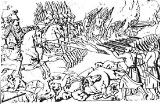
Khmelnytsky Uprising

Encyclopedia
The Khmelnytsky Uprising, was a Cossack
rebellion
in the Ukraine
between the years 1648–1657 which turned into a Ukrainian war of liberation
from Poland. Under the command of Hetman
Bohdan Khmelnytsky
, the Zaporozhian Cossacks allied with the Crimean Tatars
, and the local peasantry, fought several battles against the armies and paramilitary
forces of the Polish-Lithuanian Commonwealth
. The result was an eradication of the control of the Polish szlachta
and their Jewish
intermediaries, and the end of ecclesiastical jurisdiction for the Latin Rite Catholics (as well as Karaites, and other arendators) over the country. After 1654 the Cossacks were supported by Tsardom of Muscovy after the Treaty of Pereiaslav.
The Uprising started as the rebellion of the Cossacks, but the ultimate aim became a creation of Ukrainian
autonomous state
. The Uprising succeeded in ending the Polish influence over those Cossack lands that were eventually taken by the Tsardom of Russia
. These events, along with internal conflicts and hostilities with Sweden
and Russia, resulted in severely diminished Polish power during this period (referred to in Polish
history as The Deluge
).
 With the creation of the Polish-Lithuanian Union
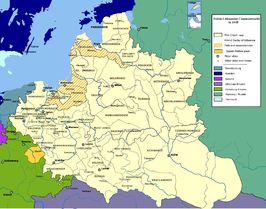
in 1569, a growing number of Ruthenian
lands were gradually absorbed under the control of a powerful nobility republic - Rzecz Pospolita. In 1569, the Union of Lublin
granted the southern Lithuanian-controlled
lands of Ruthenia
- Galicia-Volhynia, Podlaskie, Podolia
, and Kiev
- to the Crown of Poland under the agreement forming the new Polish-Lithuanian Commonwealth
. Although the local nobility
was granted full rights within the Rzeczpospolita
, their assimilation of Polish culture alienated them from the lower classes. This Szlachta
, along with the actions of the upper-class Polish
Magnate
s, oppressed the lower-class Ruthenians
, with the introduction of Counter-Reformation
missionary
practices, and the use of Jewish arendators to manage their estates.
The local Eastern Orthodox
traditions were also under siege from the assumption of ecclesiastical power
by Grand Duchy of Moscow
in 1448. The growing Russian power in the north sought to reunite the southern lands of Kievan Rus'
with its successor state, and with the fall of Constantinople
it began this process with the proclamation that its Metropolitan
was now Patriarch
of Moscow and All Rus'. The pressure of Catholic expansionism culminated with the Union of Brest
in 1596, which attempted to retain the autonomy of the Eastern Orthodox churches in present-day Ukraine
, Poland
and Belarus
, by aligning themselves with the Bishop of Rome
. While all of the people did not unite under one church
, the concepts of autonomy
were implanted into consciousness of the area, and came out in force during the military campaign of Bohdan Khmelnytsky
.
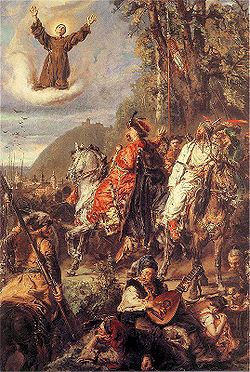 Bohdan Khmelnytsky
was a noble-born product of a Jesuit education in Ukraine
. At the age of 22, he joined his father in the service of the Commonwealth, battling against the Ottoman Empire
in the Moldavian Magnate Wars
. After being held captive in Constantinople
, he returned to life as a registered Cossack, settling in his hometown of Subotiv
with a wife and several children. He participated in campaigns for Grand Crown Hetman
Stanisław Koniecpolski, led delegations to the King Władysław IV Vasa
in Warsaw
, and generally was well respected within the cossack ranks. The course of his life was altered however, when Aleksander Koniecpolski, heir to Hetman Koniecpolski's magnate estate, attempted to seize Khmelnytsky's land. In 1647, Chyhyryn
starost (head of the local royal administration) Daniel Czapliński
openly started to harass Khmelnytsky on behalf of the younger Koniecpolski in an attempt to force him off the land. On two occasions raids were made to Subotiv, during which considerable property damage was done and his son Yurii
was badly beaten, until Khmelnytsky moved his family to a relative's house in Chyhyryn
. He twice sought assistance from the king by traveling to Warsaw, only to find him either unwilling or powerless to confront the will of a magnate.
Having received no support from the Polish officials, Khmelnytsky turned to his Cossack friends and subordinates. The case of a Cossack being unfairly treated by the Poles found a lot of support not only in his regiment, but also throughout the Sich
. All through the autumn of 1647 Khmelnytsky traveled from one regiment to the other and had numerous consultations with different Cossack leaders throughout Ukraine. His activity raised suspicions of the Polish authorities already used to Cossack revolts and he was promptly arrested. Polkovnyk (colonel
) Mykhailo Krychevsky
assisted Khmelnytsky with his escape, and with a group of supporters, he headed for the Zaporozhian Sich.
Cossacks were already on the brink of the new rebellion as plans for the new war with the Ottoman Empire
advanced by the Polish king Władysław IV Vasa
were cancelled by Sejm
. Cossacks were gearing to resume their traditional and lucrative attacks on the Ottoman Empire (in the first quarter of the 17th century they raided the Black Sea shores almost annually) as they greatly resented being prevented from the pirate activities by the peace treaties between the Polish-Lithuanian Commonwealth and the Ottoman Empire. Rumours about the emerging hostilities with "the infidels" were greeted with joy, and the news that there was to be no raiding after all was allegedly explosive in itself .
However, the Cossack rebellion might have fizzled in the same manner as the great rebellions of 1637–1638 but for the genius of Khmelnytsky. He (having taken part in the 1637 rebellion) realised that Cossacks while having an excellent infantry could not hope to match Polish cavalry which was probably the best in Europe at the time. However, combining Cossack infantry with Crimean Tatar
cavalry could have provided a balanced military force and given Cossacks a chance to beat the Polish army.
Khmelnytsky managed to overcome more than a century of mutual hostility between Cossacks and Tatars. He also turned the idea of Cossack as "protector of the Christian people" on its head by agreeing to pay the Khan of Crimea with jasyr or Christian captives. Initially these were Polish prisoners, but later whole tracts of land in Ukraine were assigned for Tatars to capture any unfortunate soul (including Jews who moved en masse into the palatinates of Ukraine after 1569) and lead them to be sold on the slave markets of Kaffa.
and quickly dispatched the guards assigned by the Commonwealth to protect the entrance. Once at the Sich, his oratory and diplomatic skills quickly struck a nerve with oppressed Ruthenians. As his men repelled an attempt by Commonwealth forces to retake the Sich more recruits joined his cause. The Cossack Rada
elected him Hetman
by the end of the month. Khmelnytsky threw most of his resources into recruiting more fighters. He sent emissaries to Crimea
, enjoining the Tatars
to join him in a potential assault against their mutual enemy, the Commonwealth.
By April 1648, word of an uprising had spread through the Commonwealth. Either because they underestimated the size of the uprising, or because they wanted to act quickly to prevent it from spreading, the Commonwealth's Grand Crown Hetman
Mikołaj Potocki and Field Crown Hetman Marcin Kalinowski
sent 3,000 soldiers under the command of Potocki's son, Stefan
, towards Khmelnytsky, without waiting to gather additional forces from Prince
Jeremi Wiśniowiecki
. Khmelnytsky quickly marshalled his forces to meet his enemy en route at the Battle of Zhovti Vody
, which saw a considerable amount of defections on the field of battle by registered cossacks who changed their allegiance from the Commonwealth to Khmelnytsky. This victory was quickly followed by rout of the Commonwealth's armies at the Battle of Korsun
, which saw both the elder Potocki and Kalinowski captured and imprisoned by the Tatars.
In addition to the loss of significant forces and military leadership, King Władysław IV Vasa died in 1648, leaving the Crown of Poland leaderless and in disarray at a time of rebellion. The Szlachta was on the run from its peasants, their palaces and estates in flames. All the while, Khmelnystky's army marched westward.
Khmelnytsky stopped his forces at Bila Tserkva
, and issued a list of demands to the Polish Crown, including raising the number of Registered Cossacks, returning Churches taken from the Orthodox faithful, and paying the Cossacks for wages which had been withheld for 5 years.
At this point, news of the peasant uprisings troubled a noble born such as Khmelnytsky; however, after discussing information gathered across the country with his advisors, the cossack leadership soon realized the potential for autonomy was there for the taking. Although Khmelnytsky's personal resentment of the Szlachta and the Magnates influenced his transformation into a revolutionary, it was his ambition to become the ruler of a Ruthenian nation which expanded the Uprising from a simple rebellion into a national movement. Khmelnytsky had his forces join a peasant revolt at the Battle of Pyliavtsi
, striking another terrible blow to weakened and depleted Polish forces.
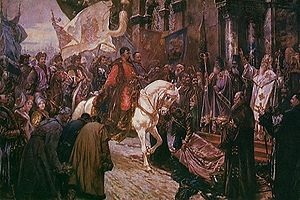 Khmelnytsky was persuaded not to lay siege to Lviv in exchange for 200,000 red guldens by some sources, while Hrushevsky stated that Khmelnytsky laid some two weeks long siege. After the obtaining the ransom he moved to besiege Zamość
, when he finally heard about the election of new Polish King, John Casimir II
whom Khmelnytsky favored. According to Hrushevski John Casimir II
sent him a letter in which he informed the Cossack leader about his election and assured him to grant cossacks and all of the Orthodox faith various privileges. He requested Khmelnytsky to stop his campaign and await the royal delegation. Khmelnytsky answered that he will comply with his monarch's request and turned back. He made a triumphant entry into Kiev
on Christmas Day
of 1648, where he was hailed as "the Moses, savior, redeemer, and liberator of the people from Polish captivity ... the illustrious ruler of Rus". In February 1649 during negotiations with a Polish delegation headed by senator Adam Kysil in Pereiaslav, Khmelnytsky declared that he was "the sole autocrat of Rus" and that he had "enough power in Ukraine, Podolia, and Volhynia... in his land and principality stretching as far as Lviv, Chełm, and Halych
". It became clear to the Polish envoys that Khmelnytsky had positioned himself no longer as simply a leader of the Zaporozhian Cossacks, but that of an independent state and stated his claims to the heritage of the Rus'. A Vilnius
panegyric
in Khmelnytsky's honor (1650–1651) explained it this way: "While in Poland, it is King Jan II Casimir Vasa, in Rus it is Hetman Bohdan Khmelnytsky".
Following the battle at Zbarazh and Zboriv
, Khmelnytsky gained numerous privileges for the Cossacks under the Treaty of Zboriv
. When hostilities resumed, however, Khmelnytsky's forces suffered a massive defeat in 1651 at Battle of Berestechko
, the largest land battle of the XVII century, were abandoned by their former allies the Crimean Tatars
, and were forced at Bila Tserkva
(Biała Cerkiew) to accept a loser's treaty
. A year later, the Cossacks had their revenge at the Battle of Batoh
. The enormous casualties suffered by the Cossacks at Berestechko made the idea of creating an independent state impossible to implement. Khmelnytsky had to decide either to stay under Polish-Lithuanian influence or ally with the Muscovites.
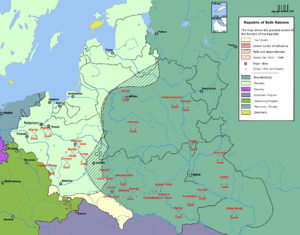 Within a few months, almost all Polish nobles, officials, and priests had been wiped out or driven from the lands of present-day Ukraine. The Commonwealth population losses in the Uprising were over one million; Jews too had substantial losses because they were the most numerous and accessible representatives of the szlachta regime.
The Uprising began a period in Polish history known as The Deluge
(which included the Swedish invasion of the Commonwealth during the Second Northern War
), that temporarily freed the Ukrainians from Polish domination but in short time subjected it to Russian domination. Weakened by wars, in 1654 Khmelnytsky persuaded the Cossacks to ally with the Russian tsar in the Treaty of Pereyaslav
which led to the Russo-Polish War (1654-1667). When Poland-Lithuania and Russia agreed on a truce and anti-Swedish alliance
in 1657, Khmelnytski's cossacks supported the invasion of the commonwealth by Sweden's Transylvanian allies
instead. Although the Commonwealth tried to regain influence over Cossacks (of note is the Treaty of Hadiach
of 1658), the new Cossack subjects became even more loyal to Russia. With the Commonwealth becoming increasingly weak, the Cossacks became more and more integrated into the Russian Empire
, with their autonomy and privileges eroded. The remnants of these privileges were gradually abolished in the aftermath of the Great Northern War
in which hetman Ivan Mazepa
sided with Sweden. By the time the partitions of Poland
ended the existence of the Commonwealth in 1795, many Cossacks had already left Ukraine to colonise the Kuban
.
, vary, and became a subject of ongoing reinterpretation as better sources and methodology are becoming available. Population losses of the entire Commonwealth population in the years 1648-1667 (a period which includes the Uprising, but also the Polish-Russian War
and the Swedish invasion) are estimated at 4 million (roughly a decrease from 11-12 million to 7-8 million).
Before the Uprising, magnates had sold and leased certain privileges to Jewish arendators for a percentage of an estate's revenue. and, while enjoying themselves at their courts, left it to the Jewish leaseholders and collectors to become objects of hatred to the oppressed and long-suffering peasants. Khmelnytsky told the people that the Poles had sold them as slaves "into the hands of the accursed Jews." With this as their battle-cry, Cossacks and the peasantry massacre
d a large number of Jewish and Polish-Lithuanian townsfolk, as well as szlachta
during the years 1648-1649. The contemporary 17th century Eyewitness Chronicle (Yeven Mezulah) by Nathan ben Moses Hannover
states:
; during that period total Jewish casualties are estimated at least 100,000.
The accounts of contemporaneous Jewish chroniclers of the events tended to emphasize large casualty figures, but they have been reevaluated downwards at the end the 20th century, when modern historiographic
methods, particularly from the realm of historical demography
, became more widely adopted. According to Orest Subtelny
:
Early twentieth-century estimates of Jewish deaths were based on the accounts of the Jewish chroniclers of the time, and tended to be high, ranging from 100,000 to 500,000 or more; in 1916 Simon Dubnow
stated:
Stories about massacre victims who had been buried alive, cut to pieces, or forced to kill one another spread throughout Europe and beyond. These stories filled many with despair, and resulted in a revival of the ideas of Isaac Luria
, and the identification of Sabbatai Zevi
as the Messiah.
From the 1960s to the 1980s historians still considered 100,000 a reasonable estimate of the Jews killed, and, according to Edward Flannery
, many considered it "a minimum". Max Dimont
in Jews, God, and History, first published in 1962, writes "Perhaps as many as 100,000 Jews perished in the decade of this revolution." Edward Flannery
, writing in The Anguish of the Jews: Twenty-Three Centuries of Antisemitism, first published in 1965, also gives figures of 100,000 to 500,000, stating "Many historians consider the second figure exaggerated and the first a minimum". Martin Gilbert
in his Jewish History Atlas published in 1976 states "Over 100,000 Jews were killed; many more were tortured or ill-treated, others fled..." Many other sources of the time give similar figures.
Although many modern sources still give estimates of Jews killed in the uprising at 100,000 or more, others put the numbers killed at between 40,000 and 100,000, and recent academic studies have argued fatalities were even lower.
A 2003 study by Israeli demographer Shaul Stampfer
of Hebrew University dedicated solely to the issue of Jewish casualties in the uprising concludes that 18,000-20,000 Jews were killed out of a total population of 40,000. Paul Robert Magocsi
states that Jewish chroniclers of the seventeenth century "provide invariably inflated figures with respect to the loss of life among the Jewish population of Ukraine. The numbers range from 60,000-80,000 (Nathan Hannover) to 100,000 (Sabbatai Cohen), but that "[t]he Israeli scholars Shmuel Ettinger and Bernard D. Weinryb speak instead of the 'annihilation of tens of thousands of Jewish lives', and the Ukrainian-American historian Jarowlaw Pelenski narrows the number of Jewish deaths to between 6,000 and 14,000". Orest Subtelny
concludes:
Also, occasionally the Jewish population was spared, notably after the sack of the town Brody
(the population of which was 70% Jewish). The Jews of Brody were judged and "deemed as not engaged in maltreatment of the Ruthenians" and were only required to pay a tribute in "textiles and furs".
The uprising also led to a decree on July 3, 1661 at the Council of Vilna in which Jewish elders banned merry-making, including the setting of limitations on wedding celebrations, public drinking, fire dances, masquerades, and Jewish comic entertainers.
The purported eyewitness accounts of the siege of Florianów
describes a massacre in which there were only two survivors out of the total population of "40,000". While the annihilation of the town is well documented- the population of Florianow at the time was no more than 4,000.
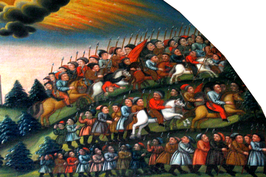
members and their collaborators, they also suffered horrendous loss of life resulting from Polish reprisals, Tatar raids, famine, plague, and general destruction due to war. At the initial stages of the uprising, armies of the magnate Jarema Wisniowiecki, on their retreat westward, inflicted terrible retribution on the civilian population, leaving behind them a trail of burned towns and villages. In addition, Khmelnytsky's allies the Tatars often continued their raids against the civilian population, in spite of protests from the Cossacks. After the Cossacks' alliance with Tsardom of Russia
was enacted, the Tatar raids became unrestrained; coupled with the onset of famine, the raids led to a virtual depopulation of whole areas of the country. The extent of the tragedy can be exemplified by a report of a Polish officer of the time, describing the devastation:
participated in the Rebellion, as it was a source of captives to be sold as slaves. There was a large influx of captives in the slavemarkets in Crimea
at the time of the Uprising, and there was a concerted ransom effort by the Ottoman Jews.
Cossack
Cossacks are a group of predominantly East Slavic people who originally were members of democratic, semi-military communities in what is today Ukraine and Southern Russia inhabiting sparsely populated areas and islands in the lower Dnieper and Don basins and who played an important role in the...
rebellion
Rebellion
Rebellion, uprising or insurrection, is a refusal of obedience or order. It may, therefore, be seen as encompassing a range of behaviors aimed at destroying or replacing an established authority such as a government or a head of state...
in the Ukraine
Ukraine
Ukraine is a country in Eastern Europe. It has an area of 603,628 km², making it the second largest contiguous country on the European continent, after Russia...
between the years 1648–1657 which turned into a Ukrainian war of liberation
War of liberation
A War of liberation is a conflict which is primarily intended to bring freedom or independence to a nation or group. Examples might include a war to overthrow a colonial power, or to remove a dictator from power. Such wars are often unconventional...
from Poland. Under the command of Hetman
Hetman
Hetman was the title of the second-highest military commander in 15th- to 18th-century Poland and the Grand Duchy of Lithuania, which together, from 1569 to 1795, comprised the Polish-Lithuanian Commonwealth, or Rzeczpospolita....
Bohdan Khmelnytsky
Bohdan Khmelnytsky
Bohdan Zynoviy Mykhailovych Khmelnytsky was a hetman of the Zaporozhian Cossack Hetmanate of Polish–Lithuanian Commonwealth . He led an uprising against the Commonwealth and its magnates which resulted in the creation of a Cossack state...
, the Zaporozhian Cossacks allied with the Crimean Tatars
Crimean Tatars
Crimean Tatars or Crimeans are a Turkic ethnic group that originally resided in Crimea. They speak the Crimean Tatar language...
, and the local peasantry, fought several battles against the armies and paramilitary
Paramilitary
A paramilitary is a force whose function and organization are similar to those of a professional military, but which is not considered part of a state's formal armed forces....
forces of the Polish-Lithuanian Commonwealth
Polish-Lithuanian Commonwealth
The Polish–Lithuanian Commonwealth was a dualistic state of Poland and Lithuania ruled by a common monarch. It was the largest and one of the most populous countries of 16th- and 17th‑century Europe with some and a multi-ethnic population of 11 million at its peak in the early 17th century...
. The result was an eradication of the control of the Polish szlachta
Szlachta
The szlachta was a legally privileged noble class with origins in the Kingdom of Poland. It gained considerable institutional privileges during the 1333-1370 reign of Casimir the Great. In 1413, following a series of tentative personal unions between the Grand Duchy of Lithuania and the Kingdom of...
and their Jewish
Jews
The Jews , also known as the Jewish people, are a nation and ethnoreligious group originating in the Israelites or Hebrews of the Ancient Near East. The Jewish ethnicity, nationality, and religion are strongly interrelated, as Judaism is the traditional faith of the Jewish nation...
intermediaries, and the end of ecclesiastical jurisdiction for the Latin Rite Catholics (as well as Karaites, and other arendators) over the country. After 1654 the Cossacks were supported by Tsardom of Muscovy after the Treaty of Pereiaslav.
The Uprising started as the rebellion of the Cossacks, but the ultimate aim became a creation of Ukrainian
Ukraine
Ukraine is a country in Eastern Europe. It has an area of 603,628 km², making it the second largest contiguous country on the European continent, after Russia...
autonomous state
Cossack Hetmanate
The Hetmanate or Zaporizhian Host was the Ruthenian Cossack state in the Central Ukraine between 1649 and 1782.The Hetmanate was founded by first Ukrainian hetman Bohdan Khmelnytsky during the Khmelnytsky Uprising . In 1654 it pledged its allegiance to Muscovy during the Council of Pereyaslav,...
. The Uprising succeeded in ending the Polish influence over those Cossack lands that were eventually taken by the Tsardom of Russia
Tsardom of Russia
The Tsardom of Russia was the name of the centralized Russian state from Ivan IV's assumption of the title of Tsar in 1547 till Peter the Great's foundation of the Russian Empire in 1721.From 1550 to 1700, Russia grew 35,000 km2 a year...
. These events, along with internal conflicts and hostilities with Sweden
Sweden
Sweden , officially the Kingdom of Sweden , is a Nordic country on the Scandinavian Peninsula in Northern Europe. Sweden borders with Norway and Finland and is connected to Denmark by a bridge-tunnel across the Öresund....
and Russia, resulted in severely diminished Polish power during this period (referred to in Polish
Poland
Poland , officially the Republic of Poland , is a country in Central Europe bordered by Germany to the west; the Czech Republic and Slovakia to the south; Ukraine, Belarus and Lithuania to the east; and the Baltic Sea and Kaliningrad Oblast, a Russian exclave, to the north...
history as The Deluge
The Deluge (Polish history)
The term Deluge denotes a series of mid-17th century campaigns in the Polish–Lithuanian Commonwealth. In a wider sense it applies to the period between the Khmelnytsky Uprising of 1648 and the Truce of Andrusovo in 1667, thus comprising the Polish–Lithuanian theaters of the Russo-Polish and...
).
Background
Polish-Lithuanian Union
The term Polish–Lithuanian Union sometimes called as United Kingdom of Poland and Lithuania refers to a series of acts and alliances between the Kingdom of Poland and the Grand Duchy of Lithuania that lasted for prolonged periods of time and led to the creation of the Polish–Lithuanian...
in 1569, a growing number of Ruthenian
Ruthenians
The name Ruthenian |Rus']]) is a culturally loaded term and has different meanings according to the context in which it is used. Initially, it was the ethnonym used for the East Slavic peoples who lived in Rus'. Later it was used predominantly for Ukrainians...
lands were gradually absorbed under the control of a powerful nobility republic - Rzecz Pospolita. In 1569, the Union of Lublin
Union of Lublin
The Union of Lublin replaced the personal union of the Kingdom of Poland and the Grand Duchy of Lithuania with a real union and an elective monarchy, since Sigismund II Augustus, the last of the Jagiellons, remained childless after three marriages. In addition, the autonomy of Royal Prussia was...
granted the southern Lithuanian-controlled
Grand Duchy of Lithuania
The Grand Duchy of Lithuania was a European state from the 12th /13th century until 1569 and then as a constituent part of Polish-Lithuanian Commonwealth until 1791 when Constitution of May 3, 1791 abolished it in favor of unitary state. It was founded by the Lithuanians, one of the polytheistic...
lands of Ruthenia
Ruthenia
Ruthenia is the Latin word used onwards from the 13th century, describing lands of the Ancient Rus in European manuscripts. Its geographic and culturo-ethnic name at that time was applied to the parts of Eastern Europe. Essentially, the word is a false Latin rendering of the ancient place name Rus...
- Galicia-Volhynia, Podlaskie, Podolia
Podolia
The region of Podolia is an historical region in the west-central and south-west portions of present-day Ukraine, corresponding to Khmelnytskyi Oblast and Vinnytsia Oblast. Northern Transnistria, in Moldova, is also a part of Podolia...
, and Kiev
Kiev
Kiev or Kyiv is the capital and the largest city of Ukraine, located in the north central part of the country on the Dnieper River. The population as of the 2001 census was 2,611,300. However, higher numbers have been cited in the press....
- to the Crown of Poland under the agreement forming the new Polish-Lithuanian Commonwealth
Polish-Lithuanian Commonwealth
The Polish–Lithuanian Commonwealth was a dualistic state of Poland and Lithuania ruled by a common monarch. It was the largest and one of the most populous countries of 16th- and 17th‑century Europe with some and a multi-ethnic population of 11 million at its peak in the early 17th century...
. Although the local nobility
Nobility
Nobility is a social class which possesses more acknowledged privileges or eminence than members of most other classes in a society, membership therein typically being hereditary. The privileges associated with nobility may constitute substantial advantages over or relative to non-nobles, or may be...
was granted full rights within the Rzeczpospolita
Rzeczpospolita
Rzeczpospolita is a traditional name of the Polish State, usually referred to as Rzeczpospolita Polska . It comes from the words: "rzecz" and "pospolita" , literally, a "common thing". It comes from latin word "respublica", meaning simply "republic"...
, their assimilation of Polish culture alienated them from the lower classes. This Szlachta
Szlachta
The szlachta was a legally privileged noble class with origins in the Kingdom of Poland. It gained considerable institutional privileges during the 1333-1370 reign of Casimir the Great. In 1413, following a series of tentative personal unions between the Grand Duchy of Lithuania and the Kingdom of...
, along with the actions of the upper-class Polish
Poles
thumb|right|180px|The state flag of [[Poland]] as used by Polish government and diplomatic authoritiesThe Polish people, or Poles , are a nation indigenous to Poland. They are united by the Polish language, which belongs to the historical Lechitic subgroup of West Slavic languages of Central Europe...
Magnate
Magnate
Magnate, from the Late Latin magnas, a great man, itself from Latin magnus 'great', designates a noble or other man in a high social position, by birth, wealth or other qualities...
s, oppressed the lower-class Ruthenians
Ruthenians
The name Ruthenian |Rus']]) is a culturally loaded term and has different meanings according to the context in which it is used. Initially, it was the ethnonym used for the East Slavic peoples who lived in Rus'. Later it was used predominantly for Ukrainians...
, with the introduction of Counter-Reformation
Counter-Reformation
The Counter-Reformation was the period of Catholic revival beginning with the Council of Trent and ending at the close of the Thirty Years' War, 1648 as a response to the Protestant Reformation.The Counter-Reformation was a comprehensive effort, composed of four major elements:#Ecclesiastical or...
missionary
Missionary
A missionary is a member of a religious group sent into an area to do evangelism or ministries of service, such as education, literacy, social justice, health care and economic development. The word "mission" originates from 1598 when the Jesuits sent members abroad, derived from the Latin...
practices, and the use of Jewish arendators to manage their estates.
The local Eastern Orthodox
Eastern Orthodox Church
The Orthodox Church, officially called the Orthodox Catholic Church and commonly referred to as the Eastern Orthodox Church, is the second largest Christian denomination in the world, with an estimated 300 million adherents mainly in the countries of Belarus, Bulgaria, Cyprus, Georgia, Greece,...
traditions were also under siege from the assumption of ecclesiastical power
Ecclesiology
Today, ecclesiology usually refers to the theological study of the Christian church. However when the word was coined in the late 1830s, it was defined as the science of the building and decoration of churches and it is still, though rarely, used in this sense.In its theological sense, ecclesiology...
by Grand Duchy of Moscow
Grand Duchy of Moscow
The Grand Duchy of Moscow or Grand Principality of Moscow, also known in English simply as Muscovy , was a late medieval Rus' principality centered on Moscow, and the predecessor state of the early modern Tsardom of Russia....
in 1448. The growing Russian power in the north sought to reunite the southern lands of Kievan Rus'
Kievan Rus'
Kievan Rus was a medieval polity in Eastern Europe, from the late 9th to the mid 13th century, when it disintegrated under the pressure of the Mongol invasion of 1237–1240....
with its successor state, and with the fall of Constantinople
Fall of Constantinople
The Fall of Constantinople was the capture of the capital of the Byzantine Empire, which occurred after a siege by the Ottoman Empire, under the command of Ottoman Sultan Mehmed II, against the defending army commanded by Byzantine Emperor Constantine XI...
it began this process with the proclamation that its Metropolitan
Metropolitan bishop
In Christian churches with episcopal polity, the rank of metropolitan bishop, or simply metropolitan, pertains to the diocesan bishop or archbishop of a metropolis; that is, the chief city of a historical Roman province, ecclesiastical province, or regional capital.Before the establishment of...
was now Patriarch
Patriarch
Originally a patriarch was a man who exercised autocratic authority as a pater familias over an extended family. The system of such rule of families by senior males is called patriarchy. This is a Greek word, a compound of πατριά , "lineage, descent", esp...
of Moscow and All Rus'. The pressure of Catholic expansionism culminated with the Union of Brest
Union of Brest
Union of Brest or Union of Brześć refers to the 1595-1596 decision of the Church of Rus', the "Metropolia of Kiev-Halych and all Rus'", to break relations with the Patriarch of Constantinople and place themselves under the Pope of Rome. At the time, this church included most Ukrainians and...
in 1596, which attempted to retain the autonomy of the Eastern Orthodox churches in present-day Ukraine
Ukraine
Ukraine is a country in Eastern Europe. It has an area of 603,628 km², making it the second largest contiguous country on the European continent, after Russia...
, Poland
Poland
Poland , officially the Republic of Poland , is a country in Central Europe bordered by Germany to the west; the Czech Republic and Slovakia to the south; Ukraine, Belarus and Lithuania to the east; and the Baltic Sea and Kaliningrad Oblast, a Russian exclave, to the north...
and Belarus
Belarus
Belarus , officially the Republic of Belarus, is a landlocked country in Eastern Europe, bordered clockwise by Russia to the northeast, Ukraine to the south, Poland to the west, and Lithuania and Latvia to the northwest. Its capital is Minsk; other major cities include Brest, Grodno , Gomel ,...
, by aligning themselves with the Bishop of Rome
Pope
The Pope is the Bishop of Rome, a position that makes him the leader of the worldwide Catholic Church . In the Catholic Church, the Pope is regarded as the successor of Saint Peter, the Apostle...
. While all of the people did not unite under one church
History of Christianity in Ukraine
The History of Christianity in Ukraine dates back to the earliest centuries of the apostolic church. It has remained the dominant religion in the country since its acceptance in 988 by Vladimir the Great , who instated it as the state religion of Kievan Rus', a medieval East Slavic state.Although...
, the concepts of autonomy
Autonomy
Autonomy is a concept found in moral, political and bioethical philosophy. Within these contexts, it is the capacity of a rational individual to make an informed, un-coerced decision...
were implanted into consciousness of the area, and came out in force during the military campaign of Bohdan Khmelnytsky
Bohdan Khmelnytsky
Bohdan Zynoviy Mykhailovych Khmelnytsky was a hetman of the Zaporozhian Cossack Hetmanate of Polish–Lithuanian Commonwealth . He led an uprising against the Commonwealth and its magnates which resulted in the creation of a Cossack state...
.
Khmelnytsky's role
Bohdan Khmelnytsky
Bohdan Zynoviy Mykhailovych Khmelnytsky was a hetman of the Zaporozhian Cossack Hetmanate of Polish–Lithuanian Commonwealth . He led an uprising against the Commonwealth and its magnates which resulted in the creation of a Cossack state...
was a noble-born product of a Jesuit education in Ukraine
Ukraine
Ukraine is a country in Eastern Europe. It has an area of 603,628 km², making it the second largest contiguous country on the European continent, after Russia...
. At the age of 22, he joined his father in the service of the Commonwealth, battling against the Ottoman Empire
Ottoman Empire
The Ottoman EmpireIt was usually referred to as the "Ottoman Empire", the "Turkish Empire", the "Ottoman Caliphate" or more commonly "Turkey" by its contemporaries...
in the Moldavian Magnate Wars
Moldavian Magnate Wars
The Moldavian Magnate Wars refer to the period at the end of the 16th century and the beginning of the 17th century when the magnates of the Polish-Lithuanian Commonwealth intervened in the affairs of Moldavia, clashing with the Habsburgs and the Ottoman Empire for domination and influence over the...
. After being held captive in Constantinople
Constantinople
Constantinople was the capital of the Roman, Eastern Roman, Byzantine, Latin, and Ottoman Empires. Throughout most of the Middle Ages, Constantinople was Europe's largest and wealthiest city.-Names:...
, he returned to life as a registered Cossack, settling in his hometown of Subotiv
Subotiv
Subotiv is a village in central Ukraine. It is located in the Chyhyrynskyi Raion of the Cherkasy Oblast , near Chyhyryn city....
with a wife and several children. He participated in campaigns for Grand Crown Hetman
Hetman
Hetman was the title of the second-highest military commander in 15th- to 18th-century Poland and the Grand Duchy of Lithuania, which together, from 1569 to 1795, comprised the Polish-Lithuanian Commonwealth, or Rzeczpospolita....
Stanisław Koniecpolski, led delegations to the King Władysław IV Vasa
Władysław IV Vasa
Władysław IV Vasa was a Polish and Swedish prince from the House of Vasa. He reigned as King of the Polish–Lithuanian Commonwealth from 8 November 1632 to his death in 1648....
in Warsaw
Warsaw
Warsaw is the capital and largest city of Poland. It is located on the Vistula River, roughly from the Baltic Sea and from the Carpathian Mountains. Its population in 2010 was estimated at 1,716,855 residents with a greater metropolitan area of 2,631,902 residents, making Warsaw the 10th most...
, and generally was well respected within the cossack ranks. The course of his life was altered however, when Aleksander Koniecpolski, heir to Hetman Koniecpolski's magnate estate, attempted to seize Khmelnytsky's land. In 1647, Chyhyryn
Chyhyryn
Chyhyryn is a city located in Cherkasy Oblast of central Ukraine. In 1648 to 1669 the city was the capital of Ukraine .- Location :...
starost (head of the local royal administration) Daniel Czapliński
Daniel Czapliński
Daniel Czapliński was a deputy starosta of Chigirin and a rotmistrz in the forces of the Polish Lithuanian Commonwealth. He is best known as an enemy of Bohdan Khmelnytsky with whom he got into a dispute over property...
openly started to harass Khmelnytsky on behalf of the younger Koniecpolski in an attempt to force him off the land. On two occasions raids were made to Subotiv, during which considerable property damage was done and his son Yurii
Yurii Khmelnytsky
Yurii Khmelnytsky , younger son of the famous Ukrainian Hetman Bohdan Khmelnytsky and brother of Tymofiy Khmelnytsky, was a Zaporozhian Cossack political and military leader...
was badly beaten, until Khmelnytsky moved his family to a relative's house in Chyhyryn
Chyhyryn
Chyhyryn is a city located in Cherkasy Oblast of central Ukraine. In 1648 to 1669 the city was the capital of Ukraine .- Location :...
. He twice sought assistance from the king by traveling to Warsaw, only to find him either unwilling or powerless to confront the will of a magnate.
Having received no support from the Polish officials, Khmelnytsky turned to his Cossack friends and subordinates. The case of a Cossack being unfairly treated by the Poles found a lot of support not only in his regiment, but also throughout the Sich
Sich
A sich is the administrative and military centre for Cossacks and especially the Zaporizhian Cossacks. It is derived from the Ukrainian word siktý, "to chop", meaning to clear a forest for an encampment, or to build a fortification with the trees that have been chopped down.The Zaporizhian Sich...
. All through the autumn of 1647 Khmelnytsky traveled from one regiment to the other and had numerous consultations with different Cossack leaders throughout Ukraine. His activity raised suspicions of the Polish authorities already used to Cossack revolts and he was promptly arrested. Polkovnyk (colonel
Colonel
Colonel , abbreviated Col or COL, is a military rank of a senior commissioned officer. It or a corresponding rank exists in most armies and in many air forces; the naval equivalent rank is generally "Captain". It is also used in some police forces and other paramilitary rank structures...
) Mykhailo Krychevsky
Mykhailo Krychevsky
Mykhailo Krychevsky or Stanisław Krzyczewski or Krzeczowski was a Polish noble, military officer and Cossack commander.-Biography:...
assisted Khmelnytsky with his escape, and with a group of supporters, he headed for the Zaporozhian Sich.
Cossacks were already on the brink of the new rebellion as plans for the new war with the Ottoman Empire
Ottoman Empire
The Ottoman EmpireIt was usually referred to as the "Ottoman Empire", the "Turkish Empire", the "Ottoman Caliphate" or more commonly "Turkey" by its contemporaries...
advanced by the Polish king Władysław IV Vasa
Władysław IV Vasa
Władysław IV Vasa was a Polish and Swedish prince from the House of Vasa. He reigned as King of the Polish–Lithuanian Commonwealth from 8 November 1632 to his death in 1648....
were cancelled by Sejm
Sejm
The Sejm is the lower house of the Polish parliament. The Sejm is made up of 460 deputies, or Poseł in Polish . It is elected by universal ballot and is presided over by a speaker called the Marshal of the Sejm ....
. Cossacks were gearing to resume their traditional and lucrative attacks on the Ottoman Empire (in the first quarter of the 17th century they raided the Black Sea shores almost annually) as they greatly resented being prevented from the pirate activities by the peace treaties between the Polish-Lithuanian Commonwealth and the Ottoman Empire. Rumours about the emerging hostilities with "the infidels" were greeted with joy, and the news that there was to be no raiding after all was allegedly explosive in itself .
However, the Cossack rebellion might have fizzled in the same manner as the great rebellions of 1637–1638 but for the genius of Khmelnytsky. He (having taken part in the 1637 rebellion) realised that Cossacks while having an excellent infantry could not hope to match Polish cavalry which was probably the best in Europe at the time. However, combining Cossack infantry with Crimean Tatar
Crimean Tatars
Crimean Tatars or Crimeans are a Turkic ethnic group that originally resided in Crimea. They speak the Crimean Tatar language...
cavalry could have provided a balanced military force and given Cossacks a chance to beat the Polish army.
Khmelnytsky managed to overcome more than a century of mutual hostility between Cossacks and Tatars. He also turned the idea of Cossack as "protector of the Christian people" on its head by agreeing to pay the Khan of Crimea with jasyr or Christian captives. Initially these were Polish prisoners, but later whole tracts of land in Ukraine were assigned for Tatars to capture any unfortunate soul (including Jews who moved en masse into the palatinates of Ukraine after 1569) and lead them to be sold on the slave markets of Kaffa.
The Uprising
On January 25, 1648, Khmelnytsky brought a contingent of 300-500 Cossacks to the Zaporizhian SichZaporizhian Sich
Zaporizhian Sich was socio-political, grassroot, military organization of Ukrainian cossacks placed beyond Dnieper rapids. Sich existed between the 16th and 18th centuries in the region around the today's Kakhovka Reservoir...
and quickly dispatched the guards assigned by the Commonwealth to protect the entrance. Once at the Sich, his oratory and diplomatic skills quickly struck a nerve with oppressed Ruthenians. As his men repelled an attempt by Commonwealth forces to retake the Sich more recruits joined his cause. The Cossack Rada
Cossack Rada
Cossack Rada was a general cossack meeting often military in nature. It was also known as the Chorna Rada, from the Slavic chern - mob.The Rada was an institution of cossack administration in Ukraine from 16th to 18 centuries. One of the famous such councils was the Chorna rada of 1663 described...
elected him Hetman
Hetman
Hetman was the title of the second-highest military commander in 15th- to 18th-century Poland and the Grand Duchy of Lithuania, which together, from 1569 to 1795, comprised the Polish-Lithuanian Commonwealth, or Rzeczpospolita....
by the end of the month. Khmelnytsky threw most of his resources into recruiting more fighters. He sent emissaries to Crimea
Crimea
Crimea , or the Autonomous Republic of Crimea , is a sub-national unit, an autonomous republic, of Ukraine. It is located on the northern coast of the Black Sea, occupying a peninsula of the same name...
, enjoining the Tatars
Crimean Tatars
Crimean Tatars or Crimeans are a Turkic ethnic group that originally resided in Crimea. They speak the Crimean Tatar language...
to join him in a potential assault against their mutual enemy, the Commonwealth.
By April 1648, word of an uprising had spread through the Commonwealth. Either because they underestimated the size of the uprising, or because they wanted to act quickly to prevent it from spreading, the Commonwealth's Grand Crown Hetman
Hetman
Hetman was the title of the second-highest military commander in 15th- to 18th-century Poland and the Grand Duchy of Lithuania, which together, from 1569 to 1795, comprised the Polish-Lithuanian Commonwealth, or Rzeczpospolita....
Mikołaj Potocki and Field Crown Hetman Marcin Kalinowski
Marcin Kalinowski
Marcin Kalinowski Field Crown Hetman, was a Polish magnate and nobleman , Kalinowa coat of arms. Son of fallen at the battle of Cecora Walenty Aleksander Kalinowski. He began his studies in Poland and continued his education at the University of Leuven...
sent 3,000 soldiers under the command of Potocki's son, Stefan
Stefan Potocki (1624-1648)
Stefan Potocki was a Polish nobleman, starosta of Nizhyn.In the Battle of Zhovti Vody Stefan Potocki was wounded, taken prisoner of war and died from gangrene on May 19, 1648....
, towards Khmelnytsky, without waiting to gather additional forces from Prince
Prince
Prince is a general term for a ruler, monarch or member of a monarch's or former monarch's family, and is a hereditary title in the nobility of some European states. The feminine equivalent is a princess...
Jeremi Wiśniowiecki
Jeremi Wisniowiecki
Jeremi Michał Korybut Wiśniowiecki was a notable member of the aristocracy of the Polish-Lithuanian Commonwealth, Prince at Wiśniowiec, Łubnie and Chorol and a father of future Polish king Michał I...
. Khmelnytsky quickly marshalled his forces to meet his enemy en route at the Battle of Zhovti Vody
Battle of Zhovti Vody
Battle of Zhovti Vody , was the first significant battle of the Khmelnytsky Uprising. The name of the battle derived from a nearby river.-Scope:...
, which saw a considerable amount of defections on the field of battle by registered cossacks who changed their allegiance from the Commonwealth to Khmelnytsky. This victory was quickly followed by rout of the Commonwealth's armies at the Battle of Korsun
Battle of Korsun
Battle of Korsun , was the second significant battle of the Khmelnytsky Uprising. Near the site of the present-day city of Korsun-Shevchenkivskyi in central Ukraine, a numerically superior force of Cossacks and Crimean Tatars under the command of Hetman Bohdan Khmelnytsky and Tuhaj-Bej attacked...
, which saw both the elder Potocki and Kalinowski captured and imprisoned by the Tatars.
In addition to the loss of significant forces and military leadership, King Władysław IV Vasa died in 1648, leaving the Crown of Poland leaderless and in disarray at a time of rebellion. The Szlachta was on the run from its peasants, their palaces and estates in flames. All the while, Khmelnystky's army marched westward.
Khmelnytsky stopped his forces at Bila Tserkva
Bila Tserkva
Bila Tserkva is a city located on the Ros' River in the Kiev Oblast in central Ukraine, approximately south of the capital, Kiev. Population 203,300 Area 34 km².-Administrative status:...
, and issued a list of demands to the Polish Crown, including raising the number of Registered Cossacks, returning Churches taken from the Orthodox faithful, and paying the Cossacks for wages which had been withheld for 5 years.
At this point, news of the peasant uprisings troubled a noble born such as Khmelnytsky; however, after discussing information gathered across the country with his advisors, the cossack leadership soon realized the potential for autonomy was there for the taking. Although Khmelnytsky's personal resentment of the Szlachta and the Magnates influenced his transformation into a revolutionary, it was his ambition to become the ruler of a Ruthenian nation which expanded the Uprising from a simple rebellion into a national movement. Khmelnytsky had his forces join a peasant revolt at the Battle of Pyliavtsi
Battle of Pyliavtsi
Battle of Pyliavtsi ; September 23, 1648) was the third significant battle of the Khmelnytsky Uprising. Near the site of the present-day village of Pyliava in south-central Ukraine, Polish-Lithuanian Commonwealth forces met a numerically superior force of Cossacks and Crimean Tatars under the...
, striking another terrible blow to weakened and depleted Polish forces.
Zamosc
Zamość ukr. Замостя is a town in southeastern Poland with 66,633 inhabitants , situated in the south-western part of Lublin Voivodeship , about from Lublin, from Warsaw and from the border with Ukraine...
, when he finally heard about the election of new Polish King, John Casimir II
John II Casimir of Poland
John II Casimir was King of Poland and Grand Duke of Lithuania during the era of the Polish–Lithuanian Commonwealth, Duke of Opole in Upper Silesia, and titular King of Sweden 1648–1660. In Poland, he is known and commonly referred as Jan Kazimierz. His parents were Sigismund III Vasa and...
whom Khmelnytsky favored. According to Hrushevski John Casimir II
John II Casimir of Poland
John II Casimir was King of Poland and Grand Duke of Lithuania during the era of the Polish–Lithuanian Commonwealth, Duke of Opole in Upper Silesia, and titular King of Sweden 1648–1660. In Poland, he is known and commonly referred as Jan Kazimierz. His parents were Sigismund III Vasa and...
sent him a letter in which he informed the Cossack leader about his election and assured him to grant cossacks and all of the Orthodox faith various privileges. He requested Khmelnytsky to stop his campaign and await the royal delegation. Khmelnytsky answered that he will comply with his monarch's request and turned back. He made a triumphant entry into Kiev
Kiev
Kiev or Kyiv is the capital and the largest city of Ukraine, located in the north central part of the country on the Dnieper River. The population as of the 2001 census was 2,611,300. However, higher numbers have been cited in the press....
on Christmas Day
Christmas
Christmas or Christmas Day is an annual holiday generally celebrated on December 25 by billions of people around the world. It is a Christian feast that commemorates the birth of Jesus Christ, liturgically closing the Advent season and initiating the season of Christmastide, which lasts twelve days...
of 1648, where he was hailed as "the Moses, savior, redeemer, and liberator of the people from Polish captivity ... the illustrious ruler of Rus". In February 1649 during negotiations with a Polish delegation headed by senator Adam Kysil in Pereiaslav, Khmelnytsky declared that he was "the sole autocrat of Rus" and that he had "enough power in Ukraine, Podolia, and Volhynia... in his land and principality stretching as far as Lviv, Chełm, and Halych
Halych
Halych is a historic city on the Dniester River in western Ukraine. The town gave its name to the historic province and kingdom of Kingdom of Galicia–Volhynia, of which it was the capital until the early 14th century, when the seat of the local princes was moved to Lviv...
". It became clear to the Polish envoys that Khmelnytsky had positioned himself no longer as simply a leader of the Zaporozhian Cossacks, but that of an independent state and stated his claims to the heritage of the Rus'. A Vilnius
Vilnius
Vilnius is the capital of Lithuania, and its largest city, with a population of 560,190 as of 2010. It is the seat of the Vilnius city municipality and of the Vilnius district municipality. It is also the capital of Vilnius County...
panegyric
Panegyric
A panegyric is a formal public speech, or written verse, delivered in high praise of a person or thing, a generally highly studied and discriminating eulogy, not expected to be critical. It is derived from the Greek πανηγυρικός meaning "a speech fit for a general assembly"...
in Khmelnytsky's honor (1650–1651) explained it this way: "While in Poland, it is King Jan II Casimir Vasa, in Rus it is Hetman Bohdan Khmelnytsky".
Following the battle at Zbarazh and Zboriv
Battle of Zboriv (1649)
The Battle of Zboriv, also known as the Battle of Zborów, was fought in the vicinity of Zboriv , as part of the Khmelnytsky Uprising, between the combined Cossack-Crimean force and the Crown army of the Polish-Lithuanian Commonwealth.Crown forces of about 25,000 led by King John II Casimir from...
, Khmelnytsky gained numerous privileges for the Cossacks under the Treaty of Zboriv
Treaty of Zboriv
The Treaty of Zboriv was signed on August 17, 1649, after the Battle of Zboriv when the Crown forces of about 25,000 led by king John II Casimir of Poland clashed against a combined force of Cossacks and Crimean Tatars, led by hetman Bohdan Khmelnytsky and khan İslâm III Giray of Crimea...
. When hostilities resumed, however, Khmelnytsky's forces suffered a massive defeat in 1651 at Battle of Berestechko
Battle of Berestechko
The Battle of Berestechko was fought between rebellious Zaporozhian Cossacks, led by Hetman Bohdan Khmelnytsky, aided by their Crimean Tatar allies, and a Polish-Lithuanian Commonwealth army under King John II Casimir. It was the largest land battle of 17th century.Lasting from June 28 to June 30,...
, the largest land battle of the XVII century, were abandoned by their former allies the Crimean Tatars
Crimean Tatars
Crimean Tatars or Crimeans are a Turkic ethnic group that originally resided in Crimea. They speak the Crimean Tatar language...
, and were forced at Bila Tserkva
Bila Tserkva
Bila Tserkva is a city located on the Ros' River in the Kiev Oblast in central Ukraine, approximately south of the capital, Kiev. Population 203,300 Area 34 km².-Administrative status:...
(Biała Cerkiew) to accept a loser's treaty
Treaty of Bila Tserkva
The Treaty of Bila Tserkva was a peace treaty between the Polish-Lithuanian Commonwealth and the Ukrainian Cossacks in the aftermath of the Battle of Bila Tserkva...
. A year later, the Cossacks had their revenge at the Battle of Batoh
Battle of Batoh
The Battle of Batoh was a battle in 1652 in which Polish forces under Marcin Kalinowski were defeated by Cossacks commanded by Hetman Bohdan Khmelnytsky. About 8,000 Polish soldiers were taken prisoners and massacred after the battle, including Samuel Jerzy Kalinowski, Zygmunt Przyjemski, Jan...
. The enormous casualties suffered by the Cossacks at Berestechko made the idea of creating an independent state impossible to implement. Khmelnytsky had to decide either to stay under Polish-Lithuanian influence or ally with the Muscovites.
The aftermath
The Uprising began a period in Polish history known as The Deluge
The Deluge (Polish history)
The term Deluge denotes a series of mid-17th century campaigns in the Polish–Lithuanian Commonwealth. In a wider sense it applies to the period between the Khmelnytsky Uprising of 1648 and the Truce of Andrusovo in 1667, thus comprising the Polish–Lithuanian theaters of the Russo-Polish and...
(which included the Swedish invasion of the Commonwealth during the Second Northern War
Second Northern War
The Second Northern War was fought between Sweden and its adversaries the Polish–Lithuanian Commonwealth , Russia , Brandenburg-Prussia , the Habsburg Monarchy and Denmark–Norway...
), that temporarily freed the Ukrainians from Polish domination but in short time subjected it to Russian domination. Weakened by wars, in 1654 Khmelnytsky persuaded the Cossacks to ally with the Russian tsar in the Treaty of Pereyaslav
Treaty of Pereyaslav
The Treaty of Pereyaslav is known in history more as the Council of Pereiaslav.Council of Pereyalslav was a meeting between the representative of the Russian Tsar, Prince Vasili Baturlin who presented a royal decree, and Bohdan Khmelnytsky as the leader of Cossack Hetmanate. During the council...
which led to the Russo-Polish War (1654-1667). When Poland-Lithuania and Russia agreed on a truce and anti-Swedish alliance
Truce of Vilna
Truce/Treaty of Vilna or Truce/Treaty of Niemieża was a treaty signed at Niemieża near Vilnius on 3 November 1656 between Tsardom of Russia and Polish-Lithuanian Commonwealth, introducing a truce during the Russo-Polish War and an anti-Swedish alliance in the contemporary Second Northern War...
in 1657, Khmelnytski's cossacks supported the invasion of the commonwealth by Sweden's Transylvanian allies
Treaty of Radnot
Treaty of Radnot was a treaty signed during the Second Northern War in Radnot in Transylvania on 6 December 1656. The treaty divided the Polish–Lithuanian Commonwealth between the signing parties.According to the treaty:...
instead. Although the Commonwealth tried to regain influence over Cossacks (of note is the Treaty of Hadiach
Treaty of Hadiach
The Treaty of Hadiach was a treaty signed on 16 September 1658 in Hadiach between representatives of the Polish-Lithuanian Commonwealth and Cossacks...
of 1658), the new Cossack subjects became even more loyal to Russia. With the Commonwealth becoming increasingly weak, the Cossacks became more and more integrated into the Russian Empire
Russian Empire
The Russian Empire was a state that existed from 1721 until the Russian Revolution of 1917. It was the successor to the Tsardom of Russia and the predecessor of the Soviet Union...
, with their autonomy and privileges eroded. The remnants of these privileges were gradually abolished in the aftermath of the Great Northern War
Great Northern War
The Great Northern War was a conflict in which a coalition led by the Tsardom of Russia successfully contested the supremacy of the Swedish Empire in northern Central Europe and Eastern Europe. The initial leaders of the anti-Swedish alliance were Peter I the Great of Russia, Frederick IV of...
in which hetman Ivan Mazepa
Ivan Mazepa
Ivan Stepanovych Mazepa , Cossack Hetman of the Hetmanate in Left-bank Ukraine, from 1687–1708. He was famous as a patron of the arts, and also played an important role in the Battle of Poltava where after learning of Peter I's intent to relieve him as acting Hetman of Ukraine and replace him...
sided with Sweden. By the time the partitions of Poland
Partitions of Poland
The Partitions of Poland or Partitions of the Polish–Lithuanian Commonwealth took place in the second half of the 18th century and ended the existence of the Polish–Lithuanian Commonwealth, resulting in the elimination of sovereign Poland for 123 years...
ended the existence of the Commonwealth in 1795, many Cossacks had already left Ukraine to colonise the Kuban
Kuban
Kuban is a geographic region of Southern Russia surrounding the Kuban River, on the Black Sea between the Don Steppe, Volga Delta and the Caucasus...
.
Casualties
The death tolls of the Khmelnytskyi uprising, as many others from the eras analyzed by historical demographyHistorical demography
Historical demography is the quantitative study of human population in the past. It is concerned both with the three basic components of population change--fertility, mortality, and migration--and with population characteristics related to those components, such as marriage, socioeconomic status,...
, vary, and became a subject of ongoing reinterpretation as better sources and methodology are becoming available. Population losses of the entire Commonwealth population in the years 1648-1667 (a period which includes the Uprising, but also the Polish-Russian War
Russo-Polish War (1654–1667)
The Russo-Polish War of 1654–1667, also called Thirteen Years' War, First Northern War, War for Ukraine was the last major conflict between Tsardom of Russia and the Polish-Lithuanian Commonwealth. Between 1655 and 1660, the Second Northern War was also fought in the Polish-Lithuanian Commonwealth,...
and the Swedish invasion) are estimated at 4 million (roughly a decrease from 11-12 million to 7-8 million).
Before the Uprising, magnates had sold and leased certain privileges to Jewish arendators for a percentage of an estate's revenue. and, while enjoying themselves at their courts, left it to the Jewish leaseholders and collectors to become objects of hatred to the oppressed and long-suffering peasants. Khmelnytsky told the people that the Poles had sold them as slaves "into the hands of the accursed Jews." With this as their battle-cry, Cossacks and the peasantry massacre
Massacre
A massacre is an event with a heavy death toll.Massacre may also refer to:-Entertainment:*Massacre , a DC Comics villain*Massacre , a 1932 drama film starring Richard Barthelmess*Massacre, a 1956 Western starring Dane Clark...
d a large number of Jewish and Polish-Lithuanian townsfolk, as well as szlachta
Szlachta
The szlachta was a legally privileged noble class with origins in the Kingdom of Poland. It gained considerable institutional privileges during the 1333-1370 reign of Casimir the Great. In 1413, following a series of tentative personal unions between the Grand Duchy of Lithuania and the Kingdom of...
during the years 1648-1649. The contemporary 17th century Eyewitness Chronicle (Yeven Mezulah) by Nathan ben Moses Hannover
Nathan ben Moses Hannover
Nathan ben Moses Hannover was a Ruthenian Jewish historian, Talmudist, and kabbalist; he died, according to Leopold Zunz , at Ungarisch-Brod, Moravia, July 14, 1663. Jacob Aboab, however, in a letter to Unger Nathan (Nata) ben Moses Hannover (Hebrew: נתן נטע הנובר) was a Ruthenian Jewish...
states:
Wherever they found the szlachta, royal officials or Jews, they [Cossacks] killed them all, sparing neither women nor children. They pillaged the estates of the Jews and nobles, burned churches and killed their priests, leaving nothing whole. It was a rare individual in those days who had not soaked his hands in blood...
Jewish
The entire Jewish population of the Commonwealth in that period (1618 to 1717) has been estimated to be about 200,000. Most Jews lived outside Ukraine in the territories unaffected by the uprising, as the Jewish population of Ukraine of that period is estimated at about 50,000. However virtually all sources agree that Jewish Ukrainian communities were devastated by the uprising and ensuing massacres. In two decades following the uprising the Commonwealth suffered two more major wars (The Deluge and Russo-Polish War (1654–1667)Russo-Polish War (1654–1667)
The Russo-Polish War of 1654–1667, also called Thirteen Years' War, First Northern War, War for Ukraine was the last major conflict between Tsardom of Russia and the Polish-Lithuanian Commonwealth. Between 1655 and 1660, the Second Northern War was also fought in the Polish-Lithuanian Commonwealth,...
; during that period total Jewish casualties are estimated at least 100,000.
The accounts of contemporaneous Jewish chroniclers of the events tended to emphasize large casualty figures, but they have been reevaluated downwards at the end the 20th century, when modern historiographic
Historiography
Historiography refers either to the study of the history and methodology of history as a discipline, or to a body of historical work on a specialized topic...
methods, particularly from the realm of historical demography
Historical demography
Historical demography is the quantitative study of human population in the past. It is concerned both with the three basic components of population change--fertility, mortality, and migration--and with population characteristics related to those components, such as marriage, socioeconomic status,...
, became more widely adopted. According to Orest Subtelny
Orest Subtelny
Orest Subtelny is a Canadian historian. Born in Kraków, Poland, he received his Ph.D. from Harvard University in 1973. Since 1982 he has been a professor in the departments of History and Political Science, York University, Toronto, Canada.-Career:...
:
Weinryb cites the calculations of S. Ettinger indicating that about 50,000 Jews lived in the area where the uprising occurred. See B. Weinryb, "The Hebrew Chronicles on Bohdan Khmelnytsky and the Cossack-Polish War", Harvard Ukrainian Studies 1 (1977): 153-77. While many of them were killed, Jewish losses did not reach the hair-raising figures that are often associated with the uprising. In the words of Weinryb (The Jews of Poland, 193-4), "The fragmentary information of the period—and to a great extent information from subsequent years, including reports of recovery—clearly indicate that the catastrophe may have not been as great as has been assumed."
Early twentieth-century estimates of Jewish deaths were based on the accounts of the Jewish chroniclers of the time, and tended to be high, ranging from 100,000 to 500,000 or more; in 1916 Simon Dubnow
Simon Dubnow
Simon Dubnow was a Jewish historian, writer and activist...
stated:
The losses inflicted on the Jews of Poland during the fatal decade 1648-1658 were appalling. In the reports of the chroniclers, the number of Jewish victims varies between one hundred thousand and five hundred thousand. But even if we accept the lower figure, the number of victims still remains colossal, even exceeding the catastrophes of the Crusades and the Black Death in Western Europe. Some seven hundred Jewish communities in Poland had suffered massacre and pillage. In the Ukrainian cities situated on the left banks of the Dnieper, the region populated by Cossacks... the Jewish communities had disappeared almost completely. In the localities on the right shore of the Dneiper or in the Polish part of the Ukraine as well as those of Volhynia and Podolia, wherever Cossacks had made their appearance, only about one tenth of the Jewish population survived.
Stories about massacre victims who had been buried alive, cut to pieces, or forced to kill one another spread throughout Europe and beyond. These stories filled many with despair, and resulted in a revival of the ideas of Isaac Luria
Isaac Luria
Isaac Luria , also called Yitzhak Ben Shlomo Ashkenazi acronym "The Ari" "Ari-Hakadosh", or "Arizal", meaning "The Lion", was a foremost rabbi and Jewish mystic in the community of Safed in the Galilee region of Ottoman Palestine...
, and the identification of Sabbatai Zevi
Sabbatai Zevi
Sabbatai Zevi, , was a Sephardic Rabbi and kabbalist who claimed to be the long-awaited Jewish Messiah. He was the founder of the Jewish Sabbatean movement...
as the Messiah.
From the 1960s to the 1980s historians still considered 100,000 a reasonable estimate of the Jews killed, and, according to Edward Flannery
Edward Flannery
Edward H. Flannery was a priest in the Roman Catholic Diocese of Providence, and the author of The Anguish of the Jews: Twenty-Three Centuries of Antisemitism, first published in 1965....
, many considered it "a minimum". Max Dimont
Max Dimont
Max I. Dimont was a Finnish American historian and author.- Biography :Born to a Jewish family in Helsinki, Finland, Dimont came to the United States in August 1929 with his mother and siblings - on the steerage passenger list of their ship, SS Berengaria, his place of birth is listed as Kovno,...
in Jews, God, and History, first published in 1962, writes "Perhaps as many as 100,000 Jews perished in the decade of this revolution." Edward Flannery
Edward Flannery
Edward H. Flannery was a priest in the Roman Catholic Diocese of Providence, and the author of The Anguish of the Jews: Twenty-Three Centuries of Antisemitism, first published in 1965....
, writing in The Anguish of the Jews: Twenty-Three Centuries of Antisemitism, first published in 1965, also gives figures of 100,000 to 500,000, stating "Many historians consider the second figure exaggerated and the first a minimum". Martin Gilbert
Martin Gilbert
Sir Martin John Gilbert, CBE, PC is a British historian and Fellow of Merton College, University of Oxford. He is the author of over eighty books, including works on the Holocaust and Jewish history...
in his Jewish History Atlas published in 1976 states "Over 100,000 Jews were killed; many more were tortured or ill-treated, others fled..." Many other sources of the time give similar figures.
Although many modern sources still give estimates of Jews killed in the uprising at 100,000 or more, others put the numbers killed at between 40,000 and 100,000, and recent academic studies have argued fatalities were even lower.
A 2003 study by Israeli demographer Shaul Stampfer
Shaul Stampfer
Shaul Stampfer is a researcher of East European Jewry specializing in Lithuanian yeshivas, and Jewish demography, migration and education.-Biography:...
of Hebrew University dedicated solely to the issue of Jewish casualties in the uprising concludes that 18,000-20,000 Jews were killed out of a total population of 40,000. Paul Robert Magocsi
Paul Robert Magocsi
Paul Robert Magocsi is an American professor of history, political science, and Chair of Ukrainian Studies at the University of Toronto. He has been with the University since 1980, and became a Fellow of the Royal Society of Canada in 1996...
states that Jewish chroniclers of the seventeenth century "provide invariably inflated figures with respect to the loss of life among the Jewish population of Ukraine. The numbers range from 60,000-80,000 (Nathan Hannover) to 100,000 (Sabbatai Cohen), but that "[t]he Israeli scholars Shmuel Ettinger and Bernard D. Weinryb speak instead of the 'annihilation of tens of thousands of Jewish lives', and the Ukrainian-American historian Jarowlaw Pelenski narrows the number of Jewish deaths to between 6,000 and 14,000". Orest Subtelny
Orest Subtelny
Orest Subtelny is a Canadian historian. Born in Kraków, Poland, he received his Ph.D. from Harvard University in 1973. Since 1982 he has been a professor in the departments of History and Political Science, York University, Toronto, Canada.-Career:...
concludes:
Between 1648 and 1656, tens of thousands of Jews—given the lack of reliable data, it is impossible to establish more accurate figures—were killed by the rebels, and to this day the Khmelnytsky uprising is considered by Jews to be one of the most traumatic events in their history.
Also, occasionally the Jewish population was spared, notably after the sack of the town Brody
Brody
Brody is a city in the Lviv Oblast of western Ukraine. It is the administrative center of the Brody Raion , and is located in the valley of the upper Styr River, approximately 90 kilometres northeast of the oblast capital, Lviv...
(the population of which was 70% Jewish). The Jews of Brody were judged and "deemed as not engaged in maltreatment of the Ruthenians" and were only required to pay a tribute in "textiles and furs".
The uprising also led to a decree on July 3, 1661 at the Council of Vilna in which Jewish elders banned merry-making, including the setting of limitations on wedding celebrations, public drinking, fire dances, masquerades, and Jewish comic entertainers.
Polish
Poles were targeted by Cossacks as much as Jews; there were also many more Poles in the Commonwealth - and in Ukraine - than Jews, therefore Polish casualties were also very high.The purported eyewitness accounts of the siege of Florianów
Florianów
Florianów may refer to the following places:*Florianów, Kutno County in Łódź Voivodeship *Florianów, Zgierz County in Łódź Voivodeship *Florianów, Masovian Voivodeship...
describes a massacre in which there were only two survivors out of the total population of "40,000". While the annihilation of the town is well documented- the population of Florianow at the time was no more than 4,000.
Ukrainian
While Ukrainian peasants and Cossacks were in many cases the perpetrators of massacres of Polish szlachtaSzlachta
The szlachta was a legally privileged noble class with origins in the Kingdom of Poland. It gained considerable institutional privileges during the 1333-1370 reign of Casimir the Great. In 1413, following a series of tentative personal unions between the Grand Duchy of Lithuania and the Kingdom of...
members and their collaborators, they also suffered horrendous loss of life resulting from Polish reprisals, Tatar raids, famine, plague, and general destruction due to war. At the initial stages of the uprising, armies of the magnate Jarema Wisniowiecki, on their retreat westward, inflicted terrible retribution on the civilian population, leaving behind them a trail of burned towns and villages. In addition, Khmelnytsky's allies the Tatars often continued their raids against the civilian population, in spite of protests from the Cossacks. After the Cossacks' alliance with Tsardom of Russia
Tsardom of Russia
The Tsardom of Russia was the name of the centralized Russian state from Ivan IV's assumption of the title of Tsar in 1547 till Peter the Great's foundation of the Russian Empire in 1721.From 1550 to 1700, Russia grew 35,000 km2 a year...
was enacted, the Tatar raids became unrestrained; coupled with the onset of famine, the raids led to a virtual depopulation of whole areas of the country. The extent of the tragedy can be exemplified by a report of a Polish officer of the time, describing the devastation:
I estimate that the number of infants alone who were found dead along the roads and in the castles reached 10,000. I ordered them to be buried in the fields and one grave alone contained over 270 bodies... All the infants were less than a year old since the older ones were driven off into captivity. The surviving peasants wander about in groups, bewailing their misfortune.
The Tatars' role in the Rebellion
The Tatars of Crimean KhanateCrimean Khanate
Crimean Khanate, or Khanate of Crimea , was a state ruled by Crimean Tatars from 1441 to 1783. Its native name was . Its khans were the patrilineal descendants of Toqa Temür, the thirteenth son of Jochi and grandson of Genghis Khan...
participated in the Rebellion, as it was a source of captives to be sold as slaves. There was a large influx of captives in the slavemarkets in Crimea
Crimea
Crimea , or the Autonomous Republic of Crimea , is a sub-national unit, an autonomous republic, of Ukraine. It is located on the northern coast of the Black Sea, occupying a peninsula of the same name...
at the time of the Uprising, and there was a concerted ransom effort by the Ottoman Jews.
See also
- List of massacres in Ukraine
- Kodak FortressKodak fortressKodak fortress was a fort built in 1635 by the order of Polish king Władysław IV Vasa and the Sejm over the Dnieper River, near what was to become the town of Stari Kodaky...
- Kostka-Napierski UprisingKostka-Napierski UprisingThe Kostka Napierski Uprising was a peasant revolt in Poland in 1651.It took place at the same time as the more important Chmielnicki Uprising in the south-east part of the Polish-Lithuanian Commonwealth and during the Swedish preparation to invade the Polish-Lithuanian Commonwealth.Aleksander...
- Ogniem i Mieczem
- The Deluge
- Tatar invasionsTatar invasionsThe Mongol invasion of Europe from the east took place over the course of three centuries, from the Middle Ages to the early modern period.The terms Tatars or Tartars are applied to nomadic Turkic peoples who, themselves, were conquered by Mongols and incorporated into their horde...