

Old Believers

Encyclopedia
 |
In the context of Russian Orthodox church history, the Old Believers (Starovery) separated after 1666 from the official Russian Orthodox Church
Russian Orthodox Church
The Russian Orthodox Church or, alternatively, the Moscow Patriarchate The ROC is often said to be the largest of the Eastern Orthodox churches in the world; including all the autocephalous churches under its umbrella, its adherents number over 150 million worldwide—about half of the 300 million...
as a protest against church reforms introduced by Patriarch Nikon
Patriarch Nikon
Nikon , born Nikita Minin , was the seventh patriarch of the Russian Orthodox Church...
between 1652–66. Old Believers continue liturgical practices which the Russian Orthodox Church maintained before the implementation of these reforms.
Russian-speakers refer to the schism itself as raskol
Raskol
Raskol |schism]]') was the event of splitting of the Russian Orthodox Church into an official church and the Old Believers movement in mid-17th century, triggered by the reforms of Patriarch Nikon in 1653, aiming to establish uniformity between the Greek and Russian church practices.-The Raskol:...
( — etymologically indicating a "cleaving-apart").
Introductory summary of origins
In 1652, NikonPatriarch Nikon
Nikon , born Nikita Minin , was the seventh patriarch of the Russian Orthodox Church...
(1605–81; Patriarch of the Russian Orthodox Church from 1652 to 1658) introduced a number of ritual and textual revisions with the aim of achieving uniformity between Russian and Greek Orthodox practices. Nikon, having noticed discrepancies between Russian and Greek rites and texts, ordered an adjustment of the Russian rites to align with the Greek ones of his time. In doing so, Nikon acted without adequate consultation with the clergy and without gathering a council. After the implementation of these revisions, the Church anathema
Anathema
Anathema originally meant something lifted up as an offering to the gods; it later evolved to mean:...
tized and suppressed — with the support of Muscovite state power — the prior liturgical rite itself, as well as those who were reluctant to pass to the revised rite. Those who maintained fidelity to the existing rite endured severe persecutions from the end of the 17th century until the beginning of the 20th century as schismatics (raskol'niki). They became known as "Old Ritualists" (staroobryadtsy), a name introduced during the reign of Empress Catherine the Great. They continued to call themselves simply Orthodox Christians.
The reforms of Patriarch Nikon
 |
By the middle of the 17th century Greek and Russian Church officials, including Patriarch Nikon
Patriarch Nikon
Nikon , born Nikita Minin , was the seventh patriarch of the Russian Orthodox Church...
, had noticed discrepancies between contemporary Russian and Greek
Church of Greece
The Church of Greece , part of the wider Greek Orthodox Church, is one of the autocephalous churches which make up the communion of Orthodox Christianity...
usages. They reached the conclusion that the Russian Orthodox Church
Russian Orthodox Church
The Russian Orthodox Church or, alternatively, the Moscow Patriarchate The ROC is often said to be the largest of the Eastern Orthodox churches in the world; including all the autocephalous churches under its umbrella, its adherents number over 150 million worldwide—about half of the 300 million...
had, as a result of errors of incompetent copyists, developed rites and liturgical books of its own that had significantly deviated from the Greek originals. Thus, the Russian Orthodox Church had become dissonant
Communion (Christian)
The term communion is derived from Latin communio . The corresponding term in Greek is κοινωνία, which is often translated as "fellowship". In Christianity, the basic meaning of the term communion is an especially close relationship of Christians, as individuals or as a Church, with God and with...
from the other Orthodox churches. Later research was to vindicate the Muscovite service-books as belonging to a different Greek recension from that which was used by the Greeks at the time of Nikon, and the unrevised Muscovite books were actually older than the current Greek books, which had undergone several revisions over the centuries and ironically, were newer and contained innovations.
Nikon, supported by Tsar Alexis I
Alexis I of Russia
Aleksey Mikhailovich Romanov was the Tsar of Russia during some of the most eventful decades of the mid-17th century...
(reigned 1645–1676), carried out some preliminary liturgical reforms. In 1652, he convened a synod
Synod
A synod historically is a council of a church, usually convened to decide an issue of doctrine, administration or application. In modern usage, the word often refers to the governing body of a particular church, whether its members are meeting or not...
and exhorted the clergy on the need to compare Russian Typikon
Typikon
The Typikon, or Typicon; plural Typika is a liturgical book which contains instructions about the order of the various Eastern Orthodox Christian church services and ceremonies, in the form of a perpetual calendar...
, Euchologion
Euchologion
The Euchologion is one of the chief liturgical books of the Orthodox Church and Eastern Catholic Churches, containing the portions of the services which are said by the bishop, priest, or deacon...
, and other liturgical
Liturgy
Liturgy is either the customary public worship done by a specific religious group, according to its particular traditions or a more precise term that distinguishes between those religious groups who believe their ritual requires the "people" to do the "work" of responding to the priest, and those...
books with their Greek counterparts. Monasteries from all over Russia received requests to send examples to Moscow in order to have them subjected to a comparative analysis. Such a task would have taken many years of conscientious research and could hardly have given an unambiguous result, given the complex development of the Russian liturgical texts over the previous centuries and the lack of textual historiographic
Historiography
Historiography refers either to the study of the history and methodology of history as a discipline, or to a body of historical work on a specialized topic...
techniques at the time.
The locum tenens for the Patriarch, Pitirim of Krutitsy
Pitirim of Krutitsy
Pitirim of Krutitsy was the ninth Patriarch of Moscow and All Russia.When Nikon held the post of patriarch, Pitirim was a metropolitan of Krutitsy. When Nikon willfully left the altar, Pitirim became his deputy and acted on his own as a real patriarch without even dealing with Nikon...
, convened a second synod in 1666, which brought Patriarch Michael III of Antioch, Patriarch Paisius of Alexandria and many bishops to Moscow. Some scholars allege that the visiting patriarchs each received both 20,000 rubles in gold and furs for their participation. This council officially established the reforms and anathematized not only all those opposing the innovations, but the old Russian books and rites themselves as well. As a side-effect of condemning the past of the Russian Orthodox Church and her traditions, the messianic theory depicting Moscow as the Third Rome
Third Rome
The term Third Rome describes the idea that some European city, state, or country is the successor to the legacy of the Roman Empire and its successor state, the Byzantine Empire ....
appeared weaker. Instead of the guardian of Orthodox faith, Russia seemed an accumulation of serious liturgical mistakes.
Nevertheless, both Patriarch and Tsar wished to carry out their reforms, although their endeavours may have had as much or more political motivation as religious; several authors on this subject point out that Tsar Alexis, encouraged by his military success in the war against Poland-Lithuania to liberate West Russian provinces and Ukraine, grew ambitious of becoming the liberator of the Orthodox areas which at that time formed part of the Ottoman Empire
Ottoman Empire
The Ottoman EmpireIt was usually referred to as the "Ottoman Empire", the "Turkish Empire", the "Ottoman Caliphate" or more commonly "Turkey" by its contemporaries...
. They also mention the role of the Near-East patriarchs, who actively supported the idea of the Russian Tsar becoming the liberator of all Orthodox Christians and who suggested that Patriarch Nikon might become the new Patriarch of Constantinople.
Main alterations introduced by Patriarch Nikon
The numerous changes in both texts and rites occupied approximately 400 pages. Old Believers present the following as the most crucial changes:| Old Practice | New Practice | |
|---|---|---|
| Spelling of Jesus Jesus Jesus of Nazareth , commonly referred to as Jesus Christ or simply as Jesus or Christ, is the central figure of Christianity... |
Ісусъ [Isus] | Іисусъ [Iisus] |
| Creed Creed A creed is a statement of belief—usually a statement of faith that describes the beliefs shared by a religious community—and is often recited as part of a religious service. When the statement of faith is longer and polemical, as well as didactic, it is not called a creed but a Confession of faith... |
, а не сотворенна (begotten but not made); (And in the Holy Spirit, the True Lord and Giver of Life) | (begotten not made); (And in the Holy Spirit, the Lord, the Giver of Life) |
| Sign of the Cross Sign of the cross The Sign of the Cross , or crossing oneself, is a ritual hand motion made by members of many branches of Christianity, often accompanied by spoken or mental recitation of a trinitarian formula.... |
Two fingers, pointer finger straight, middle finger bent | Two fingers joined with thumb, held at point |
| Number of Prosphora Prosphora A prosphoron is a small loaf of leavened bread used in Orthodox Christian and Greek Catholic liturgies. The plural form is prosphora... in the Liturgy and Artoclasia |
Seven Prosphora | Five Prosphora |
| Direction of Procession Procession A procession is an organized body of people advancing in a formal or ceremonial manner.-Procession elements:... |
Clockwise Clockwise Circular motion can occur in two possible directions. A clockwise motion is one that proceeds in the same direction as a clock's hands: from the top to the right, then down and then to the left, and back to the top... |
Counterclockwise |
| Alleluia | (twice alleluia, glory to Thee, o God) | (thrice alleluia, glory to Thee, o God) |
Notes on other differences appear below. Some modern readers may perceive these alterations as trivial, but the faithful of that time saw rituals and dogmas as strongly interconnected: church rituals had from the very beginning represented and symbolised doctrinal truth. Furthermore, the authorities imposed the reforms in an autocratic fashion, with no consultation of the people who would become subject to them, and the reaction against the Nikonian reforms would have objected as much to the manner of imposition as to the actual alterations. In addition, changes often occurred arbitrarily in the texts. For example, wherever the books read 'Христосъ' [Christ], Nikon's assistants substituted 'Сынъ' [meaning the Son], and wherever they read 'Сынъ' they substituted 'Христосъ'. Another example is that wherever the books read 'Церковь' [meaning Church], Nikon substituted 'Храмъ' [meaning Temple] and vice-versa. The perceived arbitrariness of the changes infuriated the faithful, who resented needless change. “The incorrectly realized book revision by Nikon, owing to its speed, its range, its foreignness of sources and its offending character was bound to provoke protest, given the seriously assimilated, not only national, but also genuine orthodox identity of the Russian people. The protest was indeed global: the episcopate, the clergy, both regular and monastic, the laity and the ordinary people.”
The schism
Opponents of the ecclesiastical reforms of Nikon emerged among all strata of the people and in relatively large numbers (see RaskolRaskol
Raskol |schism]]') was the event of splitting of the Russian Orthodox Church into an official church and the Old Believers movement in mid-17th century, triggered by the reforms of Patriarch Nikon in 1653, aiming to establish uniformity between the Greek and Russian church practices.-The Raskol:...
). However, after the deposition of patriarch Nikon (1658), who presented too strong a challenge to the Tsar's authority, a series of church councils officially endorsed Nikon's liturgical reforms. The Old Believers fiercely rejected all innovations, and the most radical amongst them maintained that the official Church had fallen into the hands of the Antichrist
Antichrist
The term or title antichrist, in Christian theology, refers to a leader who fulfills Biblical prophecies concerning an adversary of Christ, while resembling him in a deceptive manner...
. Under the guidance of Archpriest Avvakum
Avvakum
Avvakum Petrov was a Russian protopope of Kazan Cathedral on Red Square who led the opposition to Patriarch Nikon's reforms of the Russian Orthodox Church...
Petrov (1620 or 1621 to 1682), who had become the leader of the conservative camp within the Old Believers' movement, the Old Believers publicly denounced and rejected all ecclesiastical reforms. The State church anathematized both the old rites and books and those who wished to stay loyal to them at the synod of 1666. From that moment, the Old Believers officially lacked all civil rights. The State had the most active Old Believers arrested, and executed several of them (including Archpriest Avvakum) some years later in 1682.
After the schism
After 1685 a period of persecutions began, including both torture and executions. Many Old Believers fled Russia altogether. However, Old Believers became the dominant denomination in many regions, including Pomorye (the Russian Far North), KurskKursk
Kursk is a city and the administrative center of Kursk Oblast, Russia, located at the confluence of the Kur, Tuskar, and Seym Rivers. The area around Kursk was site of a turning point in the Russian-German struggle during World War II and the site of the largest tank battle in history...
region, the Urals, Siberia
Siberia
Siberia is an extensive region constituting almost all of Northern Asia. Comprising the central and eastern portion of the Russian Federation, it was part of the Soviet Union from its beginning, as its predecessor states, the Tsardom of Russia and the Russian Empire, conquered it during the 16th...
, and Russian Far East
Russian Far East
Russian Far East is a term that refers to the Russian part of the Far East, i.e., extreme east parts of Russia, between Lake Baikal in Eastern Siberia and the Pacific Ocean...
. A compact 40,000-strong Lipovan community of Old Believers still lives in neighboring Kilia raion (Vilkovo) of Ukraine
Ukraine
Ukraine is a country in Eastern Europe. It has an area of 603,628 km², making it the second largest contiguous country on the European continent, after Russia...
and Tulcea County
Tulcea County
Tulcea is a county of Romania, in the historical region Dobruja, with the capital city at Tulcea.-Demographics:In 2002, Tulcea County had a population of 256,492...
of Romania
Romania
Romania is a country located at the crossroads of Central and Southeastern Europe, on the Lower Danube, within and outside the Carpathian arch, bordering on the Black Sea...
in the Danube Delta
Danube Delta
The Danube Delta is the second largest river delta in Europe, after the Volga Delta, and is the best preserved on the continent. The greater part of the Danube Delta lies in Romania , while its northern part, on the left bank of the Chilia arm, is situated in Ukraine . The approximate surface is...
. By the 1910s, in the last Imperial Russian census, just before the Bolshevik Revolution, approximately 25% of the population of the Russian Empire
Russian Empire
The Russian Empire was a state that existed from 1721 until the Russian Revolution of 1917. It was the successor to the Tsardom of Russia and the predecessor of the Soviet Union...
said that they belonged to one of the Old Believer branches (census data).
Government oppression could vary from relatively moderate, as under Peter the Great (reigned 1682–1725) (Old Believers had to pay double taxation and a separate tax for wearing a beard) — to intense, as under Tsar Nicholas I
Nicholas I of Russia
Nicholas I , was the Emperor of Russia from 1825 until 1855, known as one of the most reactionary of the Russian monarchs. On the eve of his death, the Russian Empire reached its historical zenith spanning over 20 million square kilometers...
(reigned 1825–55). The Russian synodal state church and the state authorities often saw Old Believers as dangerous elements and as a threat to the Russian state.
In 1905 Tsar Nicholas II
Nicholas II of Russia
Nicholas II was the last Emperor of Russia, Grand Prince of Finland, and titular King of Poland. His official short title was Nicholas II, Emperor and Autocrat of All the Russias and he is known as Saint Nicholas the Passion-Bearer by the Russian Orthodox Church.Nicholas II ruled from 1894 until...
signed an Act of religious freedom, which ended the persecution of all religious minorities in Russia. The Old Believers gained the right to build churches, to ring church bells, to hold processions and to organize themselves. It became prohibited (as under Catherine the Great — reigned 1762–96) to refer to Old Believers as raskolniki (schismatics), a name they consider insulting. People often refer to the period from 1905 until 1917 as "the Golden Age of the Old Faith". One can regard the Act of 1905 as emancipating the Old Believers, who had until then occupied an almost illegal position in Russian society. Nevertheless some restrictions for Old Believers continued: for example, they were forbidden from joining the civil service.
Old Believer denominations
Although all Old Believers groups emerged as a result of opposition to the Nikonian reform, they do not constitute a single monolithic body. Despite the emphasis on invariable adherence to the pre-Nikonian traditions, the Old Believers feature a great diversity of groups that profess different interpretations of the church tradition and often are not in communion with each other (some groups even practise re-baptism before admitting a member of another group into their midst).Since none of the bishops joined the Old Believers (except Bishop Pavel of Kolomna
Kolomna
Kolomna is an ancient city and the administrative center of Kolomensky District of Moscow Oblast, Russia, situated at the confluence of the Moskva and Oka Rivers, southeast of Moscow. The area of the city is about . The city was founded in 1177...
, who was put to death for this), apostolically
Apostolic Succession
Apostolic succession is a doctrine, held by some Christian denominations, which asserts that the chosen successors of the Twelve Apostles, from the first century to the present day, have inherited the spiritual, ecclesiastical and sacramental authority, power, and responsibility that were...
ordained
Ordination
In general religious use, ordination is the process by which individuals are consecrated, that is, set apart as clergy to perform various religious rites and ceremonies. The process and ceremonies of ordination itself varies by religion and denomination. One who is in preparation for, or who is...
priests of the old rite would have soon become extinct. Two responses appeared to this dilemma: the Popovtsy
Popovtsy
The Popovtsy, or Popovschina , were one of the two principal movements of the Old Believers, which was formed by the end of the 17th century in Russia.-Historical backgrounds:As none of the bishops joined the Old Believers The Popovtsy, or Popovschina (Поповцы, Поповщина in Russian; this name...
(поповцы, "with priests") and the Bespopovtsy
Bespopovtsy
Bespopovtsy is one of the two major strains of Old Believers, the one that rejects priests and a number of church rites, such as the Eucharist...
("priestless").
Popovtsy
The Popovtsy represented the more moderate conservative opposition, those who strove to continue religious and church life as it had existed before the reforms of Nikon. They recognized ordained priests from the new-style Russian Orthodox church who joined the Old Believers and who had denounced the Nikonian reforms. In 1846 they convinced Amvrosii PopovichSaint Ambrosii of Belaya Krinitsa
Ambrosii or Amvrosii was the first Old Believers' Metropolitan of the Ancient Orthodox Church. He became a bishop in 1835, and converted to the Old Believers in 1846, thus establishing a full Church Hierarchy of the Old Believers...
(1791–1863), a Greek Orthodox bishop whom Turkish pressure had had removed from his see at Sarajevo
Sarajevo
Sarajevo |Bosnia]], surrounded by the Dinaric Alps and situated along the Miljacka River in the heart of Southeastern Europe and the Balkans....
, to become an Old Believer and to consecrate three Russian Old-Believer priests as bishops. In 1859, the number of Old-Believer bishops in Russia reached ten, and they established their own episcopate, the so called Belokrinitskaya hierarchy
Belokrinitskaya Hierarchy
Belokrinitskaya Hierarchy is the first full and stable church hierarchy created by the Old Believers.The hierarchy was created in 1846 by acceptance of the Greek Metropolitan Ambrose...
. Not all priestist Old Believers recognized this hierarchy. Dissenters known as beglopopovtsy obtained their own hierarchy in the 1920s. The priestist Old Believers thus manifest as two churches which share the same beliefs, but which treat each other's hierarchy as illegitimate. Popovtsy
Popovtsy
The Popovtsy, or Popovschina , were one of the two principal movements of the Old Believers, which was formed by the end of the 17th century in Russia.-Historical backgrounds:As none of the bishops joined the Old Believers The Popovtsy, or Popovschina (Поповцы, Поповщина in Russian; this name...
have priests, bishops and all sacrament
Sacrament
A sacrament is a sacred rite recognized as of particular importance and significance. There are various views on the existence and meaning of such rites.-General definitions and terms:...
s, including the eucharist
Eucharist
The Eucharist , also called Holy Communion, the Sacrament of the Altar, the Blessed Sacrament, the Lord's Supper, and other names, is a Christian sacrament or ordinance...
.
- Belokrinitskaya hierarchyBelokrinitskaya HierarchyBelokrinitskaya Hierarchy is the first full and stable church hierarchy created by the Old Believers.The hierarchy was created in 1846 by acceptance of the Greek Metropolitan Ambrose...
— The largest PopovtsyPopovtsyThe Popovtsy, or Popovschina , were one of the two principal movements of the Old Believers, which was formed by the end of the 17th century in Russia.-Historical backgrounds:As none of the bishops joined the Old Believers The Popovtsy, or Popovschina (Поповцы, Поповщина in Russian; this name...
denomination. One can refer to the Russian part of this denomination as the Belokrinitskoe SoglasieBelokrinitskoe SoglasieBelokrinitskoe soglasie is the largest and one of the most 'temperate' and 'optimistic' denominations among the Popovtsy Old Believers. The name derives from the name of the village Belokrinitsa, where the full hierarchy of the Russian Orthodox Oldrite Church was established.From the end of 1840,...
(the "Belokrinitsky Agreement") or as the Russian Orthodox Old-Rite ChurchRussian Orthodox Old-Rite ChurchThe Russian Orthodox Old-Rite Church is an Eastern Orthodox Church of the Old Believers tradition, born from a schism within the Russian Orthodox Church following the liturgical reforms of Patriarch Nikon in the second half of 17th century...
.- Neokruzhniki (extinct)
- Novozybkovskaya hierarchy or Russian Old-Orthodox ChurchRussian Old-Orthodox ChurchThe Russian Old Orthodox Church is an Eastern Orthodox Church of the Old Believers tradition, born of a schism within the Russian Orthodox Church during the 17th century . This jurisdiction incorporated those Old Believer groups which refused to accept the authority of Belokrinitskaya Hierarchy,...
- BeglopopovtsyBeglopopovtsyBeglopopovtsy was one of the denominations among the Popovtsy, who belonged to the Old Believers....
(extinct, now the Russian Old-Orthodox Church) - Luzhkane, also known as Luzhkovskoe soglasie; in some places, they had no priests and so belonged to the BespopovtsyBespopovtsyBespopovtsy is one of the two major strains of Old Believers, the one that rejects priests and a number of church rites, such as the Eucharist...
(extinct)
Bespopovtsy
The BespopovtsyBespopovtsy
Bespopovtsy is one of the two major strains of Old Believers, the one that rejects priests and a number of church rites, such as the Eucharist...
(the "priestless") rejected "the World" where they believed the Antichrist
Antichrist
The term or title antichrist, in Christian theology, refers to a leader who fulfills Biblical prophecies concerning an adversary of Christ, while resembling him in a deceptive manner...
reigned; they preached the imminent end of the world, asceticism
Asceticism
Asceticism describes a lifestyle characterized by abstinence from various sorts of worldly pleasures often with the aim of pursuing religious and spiritual goals...
, adherence to the old rituals and the old faith. More radical movements which already existed prior to the reforms of Nikon and where eschatological and anti-clerical sentiments were predominant, would join the priestless Old believers. The Bespopovtsy claimed that any priest
Priest
A priest is a person authorized to perform the sacred rites of a religion, especially as a mediatory agent between humans and deities. They also have the authority or power to administer religious rites; in particular, rites of sacrifice to, and propitiation of, a deity or deities...
or Hierarch who has ever used the Nikonian Rites have forfeited Apostolic Succession
Apostolic Succession
Apostolic succession is a doctrine, held by some Christian denominations, which asserts that the chosen successors of the Twelve Apostles, from the first century to the present day, have inherited the spiritual, ecclesiastical and sacramental authority, power, and responsibility that were...
. Therefore, the true church of Christ had ceased to exist on Earth, and they therefore renounced priests and all sacraments except baptism
Baptism
In Christianity, baptism is for the majority the rite of admission , almost invariably with the use of water, into the Christian Church generally and also membership of a particular church tradition...
. The Bespopovtsy movement has many sub-groups. Bespopovtsy have no priests and no eucharist
Eucharist
The Eucharist , also called Holy Communion, the Sacrament of the Altar, the Blessed Sacrament, the Lord's Supper, and other names, is a Christian sacrament or ordinance...
.
- Pomortsy or Danilovtsy (not to be confused with PomorsPomorsPomors or Pomory are Russian settlers and their descendants on the White Sea coast. It is also term of self-identification for the descendants of Russian, primarily Novgorod, settlers of Pomorye , living on the White Sea coasts and the territory whose southern border lies on a watershed which...
) originated in North Russia (Russian Karelia, Arkhangelsk region). Initially they rejected marriage and prayer for the Tsar. - Novopomortsy, or "New Pomortsy" — accept marriage
- Staropomortsy, or "Old Pomortsy" — reject marriage
- FedoseevtsyFedoseevtsyFedoseevtsy, also Fedoseyans was an oppositionary religious movement in Imperial Russia and one of the denominations among the Bespopovtsy....
— “Society of Christian Old Believers of the Old Pomortsy Unmarried Confession” (1690s until present); deny marriage and practice cloister-style asceticism. - Fillipovtsy.
- Chasovennye (from chasovnya i.e. chapel), a Siberian branch. The Chasovennye initially had priests, but later decided to change to a priestless practice. Also known as Semeyskie (in the lands east of Baykal LakeLake BaikalLake Baikal is the world's oldest at 30 million years old and deepest lake with an average depth of 744.4 metres.Located in the south of the Russian region of Siberia, between Irkutsk Oblast to the northwest and the Buryat Republic to the southeast, it is the most voluminous freshwater lake in the...
).
Bespopovtsy: minor groups
Apart from these major groups, many smaller groups have emerged and became extinct at various times since the end of seventeenth century:- Aristovtsy (beginning of nineteenth to the beginning of twentieth centuries; extinct) — from the name of the merchant Aristov;
- Titlovtsy (extinct in the twentieth cent.) — emerged from FedoseevtsyFedoseevtsyFedoseevtsy, also Fedoseyans was an oppositionary religious movement in Imperial Russia and one of the denominations among the Bespopovtsy....
, supported the use of PilatePontius PilatePontius Pilatus , known in the English-speaking world as Pontius Pilate , was the fifth Prefect of the Roman province of Judaea, from AD 26–36. He is best known as the judge at Jesus' trial and the man who authorized the crucifixion of Jesus...
's inscription upon the cross (titlo), which other groups rejected; - Troparion confession (troparschiki), a group that commemorated the tsarTsarTsar is a title used to designate certain European Slavic monarchs or supreme rulers. As a system of government in the Tsardom of Russia and Russian Empire, it is known as Tsarist autocracy, or Tsarism...
in the hymns (troparia); - Daniel’s confession of the “partially married” (danilovtsy polubrachnye);
- Adamant confession (adamantovy), refused to use money and passports (as containing the seal of AntichristAntichristThe term or title antichrist, in Christian theology, refers to a leader who fulfills Biblical prophecies concerning an adversary of Christ, while resembling him in a deceptive manner...
); - Aaron's confession (aaronovtsy), second half of the eighteenth century, a spin-off of the Fillipovtsy.
- “Grandmother’s confession” or the Self-baptized; practised self-baptism or the baptism by midwives (babushki), since a valid priesthood — in their opinion — had ceased to exist;
- “Hole-worshippers” (dyrniki), relinquished the use of icons and prayed to the east through a hole in the wall;
- Melchisedecs (in Moscow and in BashkortostanBashkortostanThe Republic of Bashkortostan , also known as Bashkiria is a federal subject of Russia . It is located between the Volga River and the Ural Mountains. Its capital is the city of Ufa...
) — practised a peculiar lay "quasi-eucharistic" rite; - “Runaways” (beguny) or “Wanderers” (stranniki);
- “Netovtsy” or Saviour’s confession, denied the possibility of celebrating sacraments and praying in churches; the name comes from the Russian net "no", since they have "no" sacraments, "no" churches, "no" priests, etc.
Edinovertsy
Edinovertsy — Agreed to become a part of the official Russian Orthodox Church while saving the old rites. First appearing in 1800, the Edinovertsy come under the omophor of the Russian Orthodox Church of the Moscow Patriarchate or of the Russian Church Abroad. Edinoversty retain the use of the pre-Nikonian rituals. They can be regarded as "Old Ritualists", but they do not count as "Old Believers" in the standard sense.Validity of the reformist theory: sources of Russian traditions
Vladimir officially converted the Eastern Slavs to Christianity in 988, and the people had adopted Greek Orthodox liturgical practices. At the end of 11th century, the efforts of St. Theodosius of the Caves in Kiev (Феодосий Киево-Печерский, d. 1074) introduced the so-called Studite Typicon to Russia. This typicon (essentially, a guide-book for liturgical and monastic life) reflected the traditions of the urban monastic community of the Studion monastery in ConstantinopleConstantinople
Constantinople was the capital of the Roman, Eastern Roman, Byzantine, Latin, and Ottoman Empires. Throughout most of the Middle Ages, Constantinople was Europe's largest and wealthiest city.-Names:...
. The Studite typicon predominated throughout the western part of the Byzantine Empire
Byzantine Empire
The Byzantine Empire was the Eastern Roman Empire during the periods of Late Antiquity and the Middle Ages, centred on the capital of Constantinople. Known simply as the Roman Empire or Romania to its inhabitants and neighbours, the Empire was the direct continuation of the Ancient Roman State...
and was accepted throughout the Russian lands. In the end of 14th century, through the work of St. Cyprian
Cyprian
Cyprian was bishop of Carthage and an important Early Christian writer, many of whose Latin works are extant. He was born around the beginning of the 3rd century in North Africa, perhaps at Carthage, where he received a classical education...
, metropolitan of Moscow
Moscow
Moscow is the capital, the most populous city, and the most populous federal subject of Russia. The city is a major political, economic, cultural, scientific, religious, financial, educational, and transportation centre of Russia and the continent...
and Kiev
Kiev
Kiev or Kyiv is the capital and the largest city of Ukraine, located in the north central part of the country on the Dnieper River. The population as of the 2001 census was 2,611,300. However, higher numbers have been cited in the press....
, the Studite liturgical practices were gradually replaced in Russia with the so-called Jerusalem Typicon or the Typicon of St. Sabbas — originally, an adaptation of the Studite liturgy to the customs of Palestinian monasteries. The process of gradual change of typica would continue throughout the 15th century and, because of its slow implementation, met with little resistance — unlike Nikon's reforms, conducted with abruptness and violence. However, in the course of 15th-17th centuries, Russian scribes continued to insert some Studite material into the general shape of Jerusalem Typicon. This explains the differences between the modern version of the Typicon, used by the Russian Orthodox Church
Russian Orthodox Church
The Russian Orthodox Church or, alternatively, the Moscow Patriarchate The ROC is often said to be the largest of the Eastern Orthodox churches in the world; including all the autocephalous churches under its umbrella, its adherents number over 150 million worldwide—about half of the 300 million...
, and the pre-Nikonian Russian recension of Jerusalem Typicon, called Oko Tserkovnoe (Rus. "eye of the church"). This pre-Nikonian version, based on the Moscow
Moscow
Moscow is the capital, the most populous city, and the most populous federal subject of Russia. The city is a major political, economic, cultural, scientific, religious, financial, educational, and transportation centre of Russia and the continent...
printed editions of 1610, 1633 and 1641, continues to be used by modern Old Believers.
However, in the course of the polemics against Old Believers, the official Russian Orthodox Church
Russian Orthodox Church
The Russian Orthodox Church or, alternatively, the Moscow Patriarchate The ROC is often said to be the largest of the Eastern Orthodox churches in the world; including all the autocephalous churches under its umbrella, its adherents number over 150 million worldwide—about half of the 300 million...
often claimed the discrepancies (which emerged in the texts between the Russian and the Greek churches) as Russian innovations, errors, or arbitrary translations. This charge of "Russian innovation" re-appeared repeatedly in the textbooks and anti-raskol treatises and catecheses, including, for example, those by Dimitry of Rostov
Dimitry of Rostov
Saint Dimitry of Rostov was a leading opponent of the Caesaropapist reform of the Russian Orthodox church promoted by Feofan Prokopovich. He is representative of the strong Ukrainian influence upon the Russian Orthodox Church at the turn of the 17th and 18th centuries...
.
The critical evaluation of the sources and of the essence of the church reforms began only in the 1850s with the groundbreaking work of several church historians, byzantologists and theologians, such as SA Belokurov, AP Shschapov, AK Borozdin, N Gibbenet, and later EE Golubinsky, AV Kartashev, AA Dmitriyevsky and Nikolai F Kapterev
Nikolay Kapterev
Kapterev, Nikolai Fyodorovich was a church historian, professor at the Church Academy, and corresponding member of the Imperial Academy of Sciences. He is especially known for his publications refuting the theory of the Russian State Church regarding the causes of the Schism of 1666–67...
; the latter four were members of the Imperial Academy of Sciences
Russian Academy of Sciences
The Russian Academy of Sciences consists of the national academy of Russia and a network of scientific research institutes from across the Russian Federation as well as auxiliary scientific and social units like libraries, publishers and hospitals....
. Research was continued later mainly by Serge A. Zenkovsky (1907–90), a specialist on Russian ecclesiastic culture. Golubinsky, Dmitriyevsky, Kartashov and Kapterev, among others, demonstrated that the rites, rejected and condemned by the church reforms, were genuine traditions of the Orthodox Church which suffered alterations in the Greek
Greece
Greece , officially the Hellenic Republic , and historically Hellas or the Republic of Greece in English, is a country in southeastern Europe....
usage during the 15–16th centuries, but remained unchanged in Russia
Russia
Russia or , officially known as both Russia and the Russian Federation , is a country in northern Eurasia. It is a federal semi-presidential republic, comprising 83 federal subjects...
. The pre-Nikonian liturgical practices, including some elements of the Russian typicon, Oko Tserkovnoe, were demonstrated to have preserved many earlier Byzantine material, being actually closer to the earlier Byzantine texts than some later Greek customs.
Remarkably, the scholars who opened the new avenues for re-evaluation of the reform by the Russian Church themselves held membership in the official church (A.V. Kapterev, for instance, was a professor at the Slavic Greek Latin Academy
Slavic Greek Latin Academy
Slavic Greek Latin Academy was the first higher education establishment in Moscow, Russia.-Beginnings:...
), but took up study of the causes and background of the reforms and of the resulting schism. Their research revealed that the official explanation regarding the old Russian books and rites was unsustainable.
Backgrounds
As Sergey Zenkovsky points out in his standard work "Russia's Old Believers", the Old Believer schism did not occur simply as a result of a few individuals with power and influence. The schism had complex causes, revealing historical processes and circumstances in 17th-century Russian society. Those who broke from the hierarchy of the official State Church had quite divergent views on church, faith, society, state power and social issues. Thus the collective term “Old Believers” groups together various movements within Russian society which actually had existed long before 1666/1667. They shared a distrust of state power and of the episcopate, insisting upon the right of the people to arrange their own spiritual life, and expressing the ambition to aim for such control.Both the popovtsy and bespopovtsy, although theologically and psychologically two different teachings, manifested spiritual, eschatological and mystical tendencies throughout Russian religious thought and church life. One can also emphasize the schism's position in the political and cultural backgrounds of its time: increasing Western
Western world
The Western world, also known as the West and the Occident , is a term referring to the countries of Western Europe , the countries of the Americas, as well all countries of Northern and Central Europe, Australia and New Zealand...
influence, secularization
Secularization
Secularization is the transformation of a society from close identification with religious values and institutions toward non-religious values and secular institutions...
, and attempts to subordinate the Church to the state. Nevertheless, the Old Believers sought above all to defend and preserve the purity of the Orthodox faith, embodied in the old rituals, which inspired many to strive against Patriarch Nikon’s church reforms even unto death.
In the past the Old Believers' movement was often perceived as an obscure faith in rituals that led to the deaths of tens of thousands of ignorant people. Old Believers were accused of not being able to distinguish the important from the unimportant. To many people of that time, however, rituals expressed the very essence of their faith. Old Believers hold that the preservation of a certain "microclimate" that enables the salvation of one's soul requires not only living by the commandments of Christ, but also carefully preserving Church tradition, which contains the spiritual
Spirituality
Spirituality can refer to an ultimate or an alleged immaterial reality; an inner path enabling a person to discover the essence of his/her being; or the “deepest values and meanings by which people live.” Spiritual practices, including meditation, prayer and contemplation, are intended to develop...
power and knowledge of past centuries, embodied in external forms.
The Old Believers reject the idea of contents a priori prevailing over form. To illustrate this issue, the renowned Russian historian Vasily Klyuchevsky
Vasily Klyuchevsky
Vasily Osipovich Klyuchevsky dominated Russian historiography at the turn of the 19th and 20th centuries. He is still regarded as one of three most reputable Russian historians, alongside Nikolay Karamzin and Sergey Solovyov.-Early life:...
(1841–1911) referred to poetry. He argued, that if one converts a poem into prose, the contents of the poem may remain intact, but the poem will lose its charm and emotional impact; moreover, the poem will essentially no longer exist. In the case of religious rituals, form and contents do not just form two separable, autonomous entities, but connect with each other through complex relationships, including theological, psychological, phenomenal, aesthetic and historic dimensions.
These aspects, in their turn, play a role in the perception of these rituals by the faithful and in their spiritual lives. Considering the fact that Church rituals from their very beginning were intertwined with doctrinal truth, changing these rituals may have a tremendous effect on religious conscience and a severe impact on the faithful.
Nevertheless, centuries of persecution and the nature of their origin have made some Old Believers culturally conservative. Some Old Believers consider any pre-Nikonian Orthodox Russian practice or artifact as exclusively theirs, denying that the Russian Orthodox Church has any claims upon a history before Patriarch Nikon.
However, Russian economic history of the late 19th and early 20th centuries reveals the Old-Believer merchant families as more flexible and more open to innovations while creating factories and starting the first Russian industries.
Main differences between the Old Believers and post-Nikonian Russian Orthodoxy
- Old Believers use two fingers while making the Sign of the CrossSign of the crossThe Sign of the Cross , or crossing oneself, is a ritual hand motion made by members of many branches of Christianity, often accompanied by spoken or mental recitation of a trinitarian formula....
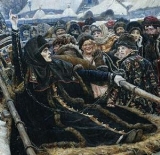
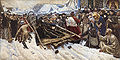
(two fingers straightened, three folded) while new-style Orthodoxy uses three fingers for the sign of cross (three fingers (including thumb) held together at point, two fingers folded). Old Ritualists generally say the Jesus PrayerJesus PrayerThe Jesus Prayer or "The Prayer" is a short, formulaic prayer esteemed and advocated within the Eastern Orthodox church:The prayer has been widely taught and discussed throughout the history of the Eastern Churches. It is often repeated continually as a part of personal ascetic practice, its use...
with the Sign of the Cross, while New Ritualists use the Sign of the Cross as a Trinitarian symbol. This makes for a significant difference between the two branches of Russian Orthodoxy, and one of the most noticeable (see the picture of Boyarynya Feodosia MorozovaFeodosia MorozovaFeodosia Prokopiyevna Morozova was one of the best-known partisans of the Old Believer movement.She was born on May 21, 1632 into a family of the okolnichi Prokopy Feodorovich Sokovnin. At the age of 17, she was married to the boyar Gleb Morozov, brother to the tsar's tutor Boris Morozov...
above). - Old Believers reject any changes and emendations of liturgical texts and rituals introduced by the reforms of Patriarch NikonPatriarch NikonNikon , born Nikita Minin , was the seventh patriarch of the Russian Orthodox Church...
. Thus they continue to use the previous Church Slavonic translation of the Greek texts, including the PsalterPsalterA psalter is a volume containing the Book of Psalms, often with other devotional material bound in as well, such as a liturgical calendar and litany of the Saints. Until the later medieval emergence of the book of hours, psalters were the books most widely owned by wealthy lay persons and were...
, striving to preserve intact the "pre-Nikonian" practices of the Russian Church. - Old Believers only recognize performing baptismBaptismIn Christianity, baptism is for the majority the rite of admission , almost invariably with the use of water, into the Christian Church generally and also membership of a particular church tradition...
through three full immersions, in agreement with the Greek practice, but reject the validity of any baptismal rite performed otherwise (for example through pouring or sprinkling, as the Russian Orthodox Church has occasionally accepted since the eighteenth century). - Old Believers perform the LiturgyLiturgyLiturgy is either the customary public worship done by a specific religious group, according to its particular traditions or a more precise term that distinguishes between those religious groups who believe their ritual requires the "people" to do the "work" of responding to the priest, and those...
with 7 prosphoraProsphoraA prosphoron is a small loaf of leavened bread used in Orthodox Christian and Greek Catholic liturgies. The plural form is prosphora...
, instead of 5 as in new-rite Russian Orthodoxy or a single large prosphora, as done by the Greeks and Arabs. - Old Believers chant the alleluiaHallelujahHallelujah, Halleluyah, and the Latin form Alleluia are transliterations of the Hebrew word meaning "Praise Yah". The last syllable is from the first two letters of the name of God, YHWH, written JHVH in Latin). Hallelujah is found primarily in the book of Psalms...
verse after the psalmody two (i.e. not three) times. - Old Believers do not use polyphonic singing as the new-style Russian practice, but only monodic, unison singing. They also have their own musical notation: not with linear notationMusical notationMusic notation or musical notation is any system that represents aurally perceived music, through the use of written symbols.-History:...
, but with special signs — kriuki or znamena ("hooks: or "banners" in English translation; see Znamenny Chant). Old Believers practise several different types of Znamenny Chant: Stolpov Chant, Great Znamenny Chant, Lesser Znamenny Chant, Putevoi Chant, Pomorsky Chant(or Khomov Chant), Demestvenny Chant, etc. In this respect it represents a tradition that parallels the use of Byzantine chant and neumatic notation.
Present situation
In 1971 the Moscow Patriarchate revoked the anathemas imposed on the Old Believers in the 17th century. In 1974, the Russian Orthodox Church Outside RussiaRussian Orthodox Church Outside Russia
The Russian Orthodox Church Outside Russia , also called the Russian Orthodox Church Abroad, ROCA, or ROCOR) is a semi-autonomous part of the Russian Orthodox Church....
issued an ukase
Ukase
A ukase , in Imperial Russia, was a proclamation of the tsar, government, or a religious leader that had the force of law...
revoking the anathemas and asked forgiveness from the Old Believers for the wrongs done them. Under their auspices, the first efforts to make the prayer and service books of the Old Believers available in English were made. Nevertheless, most Old Believer communities have not returned to Communion with the majority of Orthodox Christianity worldwide.
Estimates place the total number of Old Believers remaining at from 1 to 10 million, some living in extremely isolated communities in places to which they fled centuries ago to avoid persecution. One Old-Believer parish in the United States
United States
The United States of America is a federal constitutional republic comprising fifty states and a federal district...
has entered into communion with the Russian Orthodox Church Outside Russia, after a split in the congregation. The remainder have remained Old Believers.
Old-Believer churches in Russia have started restoration of their property, although Old Believers (unlike the nearly-official mainstream Orthodoxy) face many difficulties in claiming their restitution
Restitution
The law of restitution is the law of gains-based recovery. It is to be contrasted with the law of compensation, which is the law of loss-based recovery. Obligations to make restitution and obligations to pay compensation are each a type of legal response to events in the real world. When a court...
rights for their churches. Moscow
Moscow
Moscow is the capital, the most populous city, and the most populous federal subject of Russia. The city is a major political, economic, cultural, scientific, religious, financial, educational, and transportation centre of Russia and the continent...
has churches for all the most important Old Believer branches: Rogozhskaya Zastava (Popovtsy
Popovtsy
The Popovtsy, or Popovschina , were one of the two principal movements of the Old Believers, which was formed by the end of the 17th century in Russia.-Historical backgrounds:As none of the bishops joined the Old Believers The Popovtsy, or Popovschina (Поповцы, Поповщина in Russian; this name...
of the Belokrinitskaya hierarchy
Belokrinitskaya Hierarchy
Belokrinitskaya Hierarchy is the first full and stable church hierarchy created by the Old Believers.The hierarchy was created in 1846 by acceptance of the Greek Metropolitan Ambrose...
official center), a cathedral for the Novozybkovskaya hierarchy in Zamoskvorech'ye and Preobrazhenskaya Zastava where Pomortsy and Fedoseevtsy
Fedoseevtsy
Fedoseevtsy, also Fedoseyans was an oppositionary religious movement in Imperial Russia and one of the denominations among the Bespopovtsy....
coexist.
Within the Old-Believer world, only Pomortsy and Fedoseevtsy treat each other relatively well; none of the other denominations acknowledge each other. Ordinary Old Believers display some tendencies of intra-branch ecumenism
Ecumenism
Ecumenism or oecumenism mainly refers to initiatives aimed at greater Christian unity or cooperation. It is used predominantly by and with reference to Christian denominations and Christian Churches separated by doctrine, history, and practice...
, but these trends find sparse support among the official leaders of the congregations.
Nowadays, Old Believers live all over the world, having fled Russia under tsarist persecution and after the Russian Revolution of 1917. Some Old Believers are still transient throughout various parts of the world today. Significant established Old Believer communities exist in the United States
United States
The United States of America is a federal constitutional republic comprising fifty states and a federal district...
and Canada
Canada
Canada is a North American country consisting of ten provinces and three territories. Located in the northern part of the continent, it extends from the Atlantic Ocean in the east to the Pacific Ocean in the west, and northward into the Arctic Ocean...
in Plamondon, Alberta; Woodburn, Oregon
Woodburn, Oregon
Woodburn is a city in Marion County, Oregon, United States. Incorporated in 1889, the community had been platted in 1871 after the arrival of the railroad. The city is located in the northern end of the Willamette Valley along Interstate 5 between Portland and Salem...
; Erie, Pennsylvania
Erie, Pennsylvania
Erie is a city located in northwestern Pennsylvania in the United States. Named for the lake and the Native American tribe that resided along its southern shore, Erie is the state's fourth-largest city , with a population of 102,000...
; Erskine, Minnesota
Erskine, Minnesota
Erskine is a city in Polk County, Minnesota, United States. The population was 503 at the 2010 census. It is part of the 'Grand Forks- ND-MN Metropolitan Statistical Area'.-Geography:...
and in various parts of Alaska
Alaska
Alaska is the largest state in the United States by area. It is situated in the northwest extremity of the North American continent, with Canada to the east, the Arctic Ocean to the north, and the Pacific Ocean to the west and south, with Russia further west across the Bering Strait...
including near Homer
Homer, Alaska
Homer is a city located in Kenai Peninsula Borough in the U.S. state of Alaska. According to 2005 Census Bureau estimates, the population was 5,364. One of Homer's nicknames is "the cosmic hamlet by the sea"; another is "the end of the road"...
in the Fox River
Fox River, Alaska
Fox River is a census-designated place in Kenai Peninsula Borough, Alaska, United States. At the 2000 census the population was 616. It was first reported by the U.S. Geological Survey in 1895...
area villages of Voznesenka, Razdolna, and Kachemak Selo, Nikolaevsk
Nikolaevsk, Alaska
Nikolaevsk is a census-designated place in Kenai Peninsula Borough in the U.S. state of Alaska. As of the 2000 census, the population of the CDP is 345.-History:...
, Beryozovka
Willow, Alaska
Willow is a census-designated place in the Matanuska-Susitna Borough in the U.S. state of Alaska. It is part of the Anchorage, Alaska Metropolitan Statistical Area. At the 2000 census the population was 1,658.-History:...
, Delta Junction
Delta Junction, Alaska
Delta Junction is a city in the Southeast Fairbanks Census Area, Alaska, United States. According to 2005 Census Bureau estimates, the population of the city is 897. The city is located a short distance south of the confluence of the Delta River with the Tanana River, which is at Big Delta...
, and Kodiak, Alaska
Kodiak, Alaska
Kodiak is one of 7 communities and the main city on Kodiak Island, Kodiak Island Borough, in the U.S. state of Alaska. All commercial transportation between the entire island and the outside world goes through this city either via ferryboat or airline...
(the Anton Larson Bay Area, and on Raspberry Island). Two flourishing communities also exist in Sydney
Sydney
Sydney is the most populous city in Australia and the state capital of New South Wales. Sydney is located on Australia's south-east coast of the Tasman Sea. As of June 2010, the greater metropolitan area had an approximate population of 4.6 million people...
, Australia
Australia
Australia , officially the Commonwealth of Australia, is a country in the Southern Hemisphere comprising the mainland of the Australian continent, the island of Tasmania, and numerous smaller islands in the Indian and Pacific Oceans. It is the world's sixth-largest country by total area...
, along with rural areas of New Zealand
New Zealand
New Zealand is an island country in the south-western Pacific Ocean comprising two main landmasses and numerous smaller islands. The country is situated some east of Australia across the Tasman Sea, and roughly south of the Pacific island nations of New Caledonia, Fiji, and Tonga...
. Communities also have been established in many parts of South America
South America
South America is a continent situated in the Western Hemisphere, mostly in the Southern Hemisphere, with a relatively small portion in the Northern Hemisphere. The continent is also considered a subcontinent of the Americas. It is bordered on the west by the Pacific Ocean and on the north and east...
, including Brazil
Brazil
Brazil , officially the Federative Republic of Brazil , is the largest country in South America. It is the world's fifth largest country, both by geographical area and by population with over 192 million people...
, Uruguay
Uruguay
Uruguay ,officially the Oriental Republic of Uruguay,sometimes the Eastern Republic of Uruguay; ) is a country in the southeastern part of South America. It is home to some 3.5 million people, of whom 1.8 million live in the capital Montevideo and its metropolitan area...
, Bolivia
Bolivia
Bolivia officially known as Plurinational State of Bolivia , is a landlocked country in central South America. It is the poorest country in South America...
and Argentina
Argentina
Argentina , officially the Argentine Republic , is the second largest country in South America by land area, after Brazil. It is constituted as a federation of 23 provinces and an autonomous city, Buenos Aires...
. Small hidden communities have been found in the Russian Far North (specifically remote areas of Arkhangelsk Oblast
Arkhangelsk Oblast
Arkhangelsk Oblast is a federal subject of Russia . It includes the Arctic archipelagos of Franz Josef Land and Novaya Zemlya, as well as the Solovetsky Islands in the White Sea....
and the Komi Republic
Komi Republic
The Komi Republic is a federal subject of Russia .-Geography:The republic is situated to the west of the Ural mountains, in the north-east of the East European Plain...
) and various regions of Siberia
Siberia
Siberia is an extensive region constituting almost all of Northern Asia. Comprising the central and eastern portion of the Russian Federation, it was part of the Soviet Union from its beginning, as its predecessor states, the Tsardom of Russia and the Russian Empire, conquered it during the 16th...
, especially concentrated in the areas between the Altai Mountains and Tuva Republic. Perhaps the highest concentration of older established Old Believer communities, with foundations dating back hundreds of years, can be found concentrated in Eastern Siberia, specifically the Transbaikal
Transbaikal
Transbaikal, Trans-Baikal, Transbaikalia , or Dauria is a mountainous region to the east of or "beyond" Lake Baikal in Russia. The alternative name, Dauria, is derived from the ethnonym of the Daur people. It stretches for almost 1000 km from north to south from the Patomskoye Plateau and North...
region in desolate areas of Buryatia
Buryatia
The Republic of Buryatia is a federal subject of Russia . Its capital is the city of Ulan-Ude. Its area is with a population of 972,658 .-Geography:...
and Zabaykalsky Krai.
In English
- Cherniavsky, M.: "The Reception of the Council of Florence in Moscow", Church History XXIV (1955), 147–57.
- Shevchenko I., "Ideological Repercussions of the Council of Florence", Church History XXIV (1955), 291–323.
- Crummey, Robert O.: The Old Believers & The World Of Antichrist; The Vyg Community & The Russian State, Wisconsin U.P., 1970
- Gill, T.: The Council of Florence, Cambridge, 1959
- MacCulloch, DiarmaidDiarmaid MacCullochDiarmaid Ninian John MacCulloch FBA, FSA, FR Hist S is Professor of the History of the Church at the University of Oxford and Fellow of St Cross College, Oxford...
, A History of Christianity, 2009, Penguin 2010 ISBN 9780141021898, chapter 15. - Zenkovsky, Serge A.: "The ideology of the Denisov brothers", Harvard Slavic Studies, 1957. III, 49–66...
In Russian
- Голубинский ЕЕ: История русской церкви, Москва, 1900 / Golubinskij EE: “History of the Russian Church”, Moscow, 1900 / “Contribution to our polemic with the Old believers”, ČOIDR, 1905 / Dmitrievskij A.A.: The correction of books under Patriarch Nikon and Patriarchs after him. Moscow, "Jazyki slavjanskoj kul'tury", 2004
- Зеньковский С.А.: Русское старообрядчество, том I и II, Москва 2006 / Zenkovsky S.A.: “Russia’s Old Believers”, volumes I and II, Moscow 2006
- Каптерев Н.Ф.: Патриарх Никон и его противники в деле исправления церковныx обрядов, Москва, 1913 / Kapterv N.F.: “Patriarch Nikon and his opponents in the correction of church rituals”, Moscow, 1913 / Kapterev N.F.: "Character of the relationships between Russia and the orthodox East in the XVI and XVII centuries", Moscow, 1914
- Карташов А.В.: Очерки по истории русской церкви, Париж, 1959 / Kartašov A.V.: “Outlines of the history of the Russian church”, Paris, 1959
- Ключевский И.П.: Сочинения, I–VIII, Москва, 1956–1959 / Ključevskij I.P.: "Works", I–VIII, Moscow, 1956–1959
- Мельников Ф.И.: Краткая история древлеправославной (старообрядческой) церкви. Барнаул, 1999 / Melnikov F.I.: “Short history of the Old orthodox (Old ritualist) Church”, Barnaul, 1999
NB All these works come from scholars and scientists, none of them Old Believers, except for Melnikov (an Old-Believer apologist).
Old Believer Churches
- Russian Orthodox Old-Rite ChurchRussian Orthodox Old-Rite ChurchThe Russian Orthodox Old-Rite Church is an Eastern Orthodox Church of the Old Believers tradition, born from a schism within the Russian Orthodox Church following the liturgical reforms of Patriarch Nikon in the second half of 17th century...
(Belokrinitskaya HierarchyBelokrinitskaya HierarchyBelokrinitskaya Hierarchy is the first full and stable church hierarchy created by the Old Believers.The hierarchy was created in 1846 by acceptance of the Greek Metropolitan Ambrose...
) - Lipovan Orthodox Old-Rite ChurchLipovan Orthodox Old-Rite ChurchThe Lipovan Orthodox Old-Rite Church is the Romanian based jurisdiction of the Belokrinitskaya Hierarchy ....
(Belokrinitskaya HierarchyBelokrinitskaya HierarchyBelokrinitskaya Hierarchy is the first full and stable church hierarchy created by the Old Believers.The hierarchy was created in 1846 by acceptance of the Greek Metropolitan Ambrose...
)- LipovansLipovansLipovans or Lippovans are the Old Believers, mostly of Russian ethnic origin, who settled in the Moldavian Principality, in Dobruja and Eastern Muntenia...
- Lipovans
- Russian Old-Orthodox ChurchRussian Old-Orthodox ChurchThe Russian Old Orthodox Church is an Eastern Orthodox Church of the Old Believers tradition, born of a schism within the Russian Orthodox Church during the 17th century . This jurisdiction incorporated those Old Believer groups which refused to accept the authority of Belokrinitskaya Hierarchy,...
(Novozybkovskaya Hierarchy) - Pomorian Old-Orthodox ChurchPomorian Old-Orthodox ChurchThe Pomorian Old Orthodox Church is a branch of the priestless faction of the Old Believers, born of a schism within the Russian Orthodox Church in the 17th century.- Pomorian Agreement :...
(Pomortsy)
External links
- Russian Orthodox Old-Rite Church (official site of the Moscow Metropoly)
- Old Believers in Estonia
- Orthodox Kellion of the Holy Trinity and Saint Sergius
- Old Rite ROCOR Church of the Nativity
- Old Believers in North America — a bibliography
- Old Belief in Omutninsk, Russia
- The Beloved Russian Old Ritualist Believers
- Breve Vita Del Padre Nostro Tra I Santi Ambrogio Metropolita Di Belo-Krinitsa E Di Tutti Gli Antichi Ortodossi, Il Confessore
- Russian Orthodox Old-Rite Church
- http://www.grokiskis.lt/lt/temos/dienos-tema/2010/05/07/sentikiai-musu-krastui-ypatingas-jubiliejus
- Freedom For an Old Believer, by Paul John Wigowsky
- Slavo-Georgian (Iberian) Old-Orthodox Church
- Old Believers Church in Lithuania