


Solid

Encyclopedia
Gas
Gas is one of the three classical states of matter . Near absolute zero, a substance exists as a solid. As heat is added to this substance it melts into a liquid at its melting point , boils into a gas at its boiling point, and if heated high enough would enter a plasma state in which the electrons...
and liquid
Liquid
Liquid is one of the three classical states of matter . Like a gas, a liquid is able to flow and take the shape of a container. Some liquids resist compression, while others can be compressed. Unlike a gas, a liquid does not disperse to fill every space of a container, and maintains a fairly...
). It is characterized by structural rigidity and resistance to changes of shape or volume. Unlike a liquid
Liquid
Liquid is one of the three classical states of matter . Like a gas, a liquid is able to flow and take the shape of a container. Some liquids resist compression, while others can be compressed. Unlike a gas, a liquid does not disperse to fill every space of a container, and maintains a fairly...
, a solid object does not flow to take on the shape of its container, nor does it expand to fill the entire volume available to it like a gas
Gas
Gas is one of the three classical states of matter . Near absolute zero, a substance exists as a solid. As heat is added to this substance it melts into a liquid at its melting point , boils into a gas at its boiling point, and if heated high enough would enter a plasma state in which the electrons...
does. The atoms in a solid are tightly bound to each other, either in a regular geometric lattice (crystalline solids
Crystal
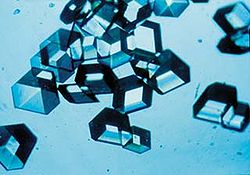
A crystal or crystalline solid is a solid material whose constituent atoms, molecules, or ions are arranged in an orderly repeating pattern extending in all three spatial dimensions. The scientific study of crystals and crystal formation is known as crystallography...
, which include metal
Metal
A metal , is an element, compound, or alloy that is a good conductor of both electricity and heat. Metals are usually malleable and shiny, that is they reflect most of incident light...
s and ordinary water ice
Ice
Ice is water frozen into the solid state. Usually ice is the phase known as ice Ih, which is the most abundant of the varying solid phases on the Earth's surface. It can appear transparent or opaque bluish-white color, depending on the presence of impurities or air inclusions...
) or irregularly (an amorphous solid
Amorphous solid
In condensed matter physics, an amorphous or non-crystalline solid is a solid that lacks the long-range order characteristic of a crystal....
such as common window glass
Glass
Glass is an amorphous solid material. Glasses are typically brittle and optically transparent.The most familiar type of glass, used for centuries in windows and drinking vessels, is soda-lime glass, composed of about 75% silica plus Na2O, CaO, and several minor additives...
).
The branch of physics
Physics
Physics is a natural science that involves the study of matter and its motion through spacetime, along with related concepts such as energy and force. More broadly, it is the general analysis of nature, conducted in order to understand how the universe behaves.Physics is one of the oldest academic...
that deals with solids is called solid-state physics
Solid-state physics
Solid-state physics is the study of rigid matter, or solids, through methods such as quantum mechanics, crystallography, electromagnetism, and metallurgy. It is the largest branch of condensed matter physics. Solid-state physics studies how the large-scale properties of solid materials result from...
, and is the main branch of condensed matter physics
Condensed matter physics
Condensed matter physics deals with the physical properties of condensed phases of matter. These properties appear when a number of atoms at the supramolecular and macromolecular scale interact strongly and adhere to each other or are otherwise highly concentrated in a system. The most familiar...
(which also includes liquids). Materials science
Materials science
Materials science is an interdisciplinary field applying the properties of matter to various areas of science and engineering. This scientific field investigates the relationship between the structure of materials at atomic or molecular scales and their macroscopic properties. It incorporates...
is primarily concerned with the physical and chemical properties of solids. Solid-state chemistry
Solid-state chemistry
Solid-state chemistry, also sometimes referred to as materials chemistry, is the study of the synthesis, structure, and properties of solid phase materials, particularly, but not necessarily exclusively of, non-molecular solids...
is especially concerned with the synthesis
Chemical synthesis
In chemistry, chemical synthesis is purposeful execution of chemical reactions to get a product, or several products. This happens by physical and chemical manipulations usually involving one or more reactions...
of novel materials, as well as the science of identification and chemical composition.
Microscopic description
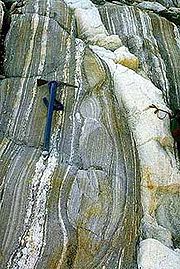
The atoms, molecules or ions which make up a solid may be arranged in an orderly repeating pattern, or irregularly. Materials whose constituents are arranged in a regular pattern are known as crystalCrystal
A crystal or crystalline solid is a solid material whose constituent atoms, molecules, or ions are arranged in an orderly repeating pattern extending in all three spatial dimensions. The scientific study of crystals and crystal formation is known as crystallography...
s. In some cases, the regular ordering can continue unbroken over a large scale, for example diamond
Diamond
In mineralogy, diamond is an allotrope of carbon, where the carbon atoms are arranged in a variation of the face-centered cubic crystal structure called a diamond lattice. Diamond is less stable than graphite, but the conversion rate from diamond to graphite is negligible at ambient conditions...
s, where each diamond is a single crystal
Single crystal
A single crystal or monocrystalline solid is a material in which the crystal lattice of the entire sample is continuous and unbroken to the edges of the sample, with no grain boundaries...
. Solid objects that are large enough to see and handle are rarely composed of a single crystal, but instead are made of a large number of single crystals, known as crystallite
Crystallite
Crystallites are small, often microscopic crystals that, held together through highly defective boundaries, constitute a polycrystalline solid. Metallurgists often refer to crystallites as grains.- Details :...
s, whose size can vary from a few nanometers to several meters. Such materials are called polycrystalline. Almost all common metals, and many ceramic
Ceramic
A ceramic is an inorganic, nonmetallic solid prepared by the action of heat and subsequent cooling. Ceramic materials may have a crystalline or partly crystalline structure, or may be amorphous...
s, are polycrystalline.
In other materials, there is no long-range order in the position of the atoms. These solids are known as amorphous solid
Amorphous solid
In condensed matter physics, an amorphous or non-crystalline solid is a solid that lacks the long-range order characteristic of a crystal....
s; examples include polystyrene
Polystyrene
Polystyrene ) also known as Thermocole, abbreviated following ISO Standard PS, is an aromatic polymer made from the monomer styrene, a liquid hydrocarbon that is manufactured from petroleum by the chemical industry...
and glass
Glass
Glass is an amorphous solid material. Glasses are typically brittle and optically transparent.The most familiar type of glass, used for centuries in windows and drinking vessels, is soda-lime glass, composed of about 75% silica plus Na2O, CaO, and several minor additives...
.
Whether a solid is crystalline or amorphous depends on the material involved, and the conditions in which it was formed. Solids which are formed by slow cooling will tend to be crystalline, while solids which are frozen rapidly are more likely to be amorphous. Likewise, the specific crystal structure
Crystal structure
In mineralogy and crystallography, crystal structure is a unique arrangement of atoms or molecules in a crystalline liquid or solid. A crystal structure is composed of a pattern, a set of atoms arranged in a particular way, and a lattice exhibiting long-range order and symmetry...
adopted by a crystalline solid depends on the material involved and on how it was formed.
While many common objects, such as an ice cube or a coin, are chemically identical throughout, many other common materials comprise a number of different substances packed together. For example, a typical rock
Rock (geology)
In geology, rock or stone is a naturally occurring solid aggregate of minerals and/or mineraloids.The Earth's outer solid layer, the lithosphere, is made of rock. In general rocks are of three types, namely, igneous, sedimentary, and metamorphic...
is an aggregate of several different mineral
Mineral
A mineral is a naturally occurring solid chemical substance formed through biogeochemical processes, having characteristic chemical composition, highly ordered atomic structure, and specific physical properties. By comparison, a rock is an aggregate of minerals and/or mineraloids and does not...
s and mineraloid
Mineraloid
A mineraloid is a mineral-like substance that does not demonstrate crystallinity. Mineraloids possess chemical compositions that vary beyond the generally accepted ranges for specific minerals. For example, obsidian is an amorphous glass and not a crystal. Jet is derived from decaying wood under...
s, with no specific chemical composition. Wood
Wood
Wood is a hard, fibrous tissue found in many trees. It has been used for hundreds of thousands of years for both fuel and as a construction material. It is an organic material, a natural composite of cellulose fibers embedded in a matrix of lignin which resists compression...
is a natural organic material consisting primarily of cellulose
Cellulose
Cellulose is an organic compound with the formula , a polysaccharide consisting of a linear chain of several hundred to over ten thousand β linked D-glucose units....
fibers embedded in a matrix of organic lignin
Lignin
Lignin or lignen is a complex chemical compound most commonly derived from wood, and an integral part of the secondary cell walls of plants and some algae. The term was introduced in 1819 by de Candolle and is derived from the Latin word lignum, meaning wood...
. In materials science, composites
Composite material
Composite materials, often shortened to composites or called composition materials, are engineered or naturally occurring materials made from two or more constituent materials with significantly different physical or chemical properties which remain separate and distinct at the macroscopic or...
of more than one constituent material can be designed to have desired properties.
Classes of solids
The forces between the atoms in a solid can take a variety of forms. For example, a crystal of sodium chlorideSodium chloride
Sodium chloride, also known as salt, common salt, table salt or halite, is an inorganic compound with the formula NaCl. Sodium chloride is the salt most responsible for the salinity of the ocean and of the extracellular fluid of many multicellular organisms...
(common salt) is made up of ion
Ion
An ion is an atom or molecule in which the total number of electrons is not equal to the total number of protons, giving it a net positive or negative electrical charge. The name was given by physicist Michael Faraday for the substances that allow a current to pass between electrodes in a...
ic sodium
Sodium
Sodium is a chemical element with the symbol Na and atomic number 11. It is a soft, silvery-white, highly reactive metal and is a member of the alkali metals; its only stable isotope is 23Na. It is an abundant element that exists in numerous minerals, most commonly as sodium chloride...
and chlorine
Chlorine
Chlorine is the chemical element with atomic number 17 and symbol Cl. It is the second lightest halogen, found in the periodic table in group 17. The element forms diatomic molecules under standard conditions, called dichlorine...
, which are held together by ionic bond
Ionic bond
An ionic bond is a type of chemical bond formed through an electrostatic attraction between two oppositely charged ions. Ionic bonds are formed between a cation, which is usually a metal, and an anion, which is usually a nonmetal. Pure ionic bonding cannot exist: all ionic compounds have some...
s. In diamond or silicon, the atoms share electron
Electron
The electron is a subatomic particle with a negative elementary electric charge. It has no known components or substructure; in other words, it is generally thought to be an elementary particle. An electron has a mass that is approximately 1/1836 that of the proton...
s and form covalent bond
Covalent bond
A covalent bond is a form of chemical bonding that is characterized by the sharing of pairs of electrons between atoms. The stable balance of attractive and repulsive forces between atoms when they share electrons is known as covalent bonding....
s. In metals, electrons are shared in metallic bond
Metallic bond
Metallic bonding is the electrostatic attractive forces between the delocalized electrons, called conduction electrons, gathered in an "electron sea", and the positively charged metal ions...
ing. Some solids, particularly most organic compounds, are held together with van der Waals force
Van der Waals force
In physical chemistry, the van der Waals force , named after Dutch scientist Johannes Diderik van der Waals, is the sum of the attractive or repulsive forces between molecules other than those due to covalent bonds or to the electrostatic interaction of ions with one another or with neutral...
s resulting from the polarization of the electronic charge cloud on each molecule. The dissimilarities between the types of solid result from the differences between their bonding.
Metals
Heat conduction
In heat transfer, conduction is a mode of transfer of energy within and between bodies of matter, due to a temperature gradient. Conduction means collisional and diffusive transfer of kinetic energy of particles of ponderable matter . Conduction takes place in all forms of ponderable matter, viz....
.
The bulk of the elements in the periodic table
Periodic table
The periodic table of the chemical elements is a tabular display of the 118 known chemical elements organized by selected properties of their atomic structures. Elements are presented by increasing atomic number, the number of protons in an atom's atomic nucleus...
, those to the left of a diagonal line drawn from boron
Boron
Boron is the chemical element with atomic number 5 and the chemical symbol B. Boron is a metalloid. Because boron is not produced by stellar nucleosynthesis, it is a low-abundance element in both the solar system and the Earth's crust. However, boron is concentrated on Earth by the...
to polonium
Polonium
Polonium is a chemical element with the symbol Po and atomic number 84, discovered in 1898 by Marie Skłodowska-Curie and Pierre Curie. A rare and highly radioactive element, polonium is chemically similar to bismuth and tellurium, and it occurs in uranium ores. Polonium has been studied for...
, are metals.
Mixtures of two or more elements in which the major component is a metal are known as alloy
Alloy
An alloy is a mixture or metallic solid solution composed of two or more elements. Complete solid solution alloys give single solid phase microstructure, while partial solutions give two or more phases that may or may not be homogeneous in distribution, depending on thermal history...
s.
People have been using metals for a variety of purposes since prehistoric times.
The strength
Strength of materials
In materials science, the strength of a material is its ability to withstand an applied stress without failure. The applied stress may be tensile, compressive, or shear. Strength of materials is a subject which deals with loads, deformations and the forces acting on a material. A load applied to a...
and reliability
Reliability
In general, reliability is the ability of a person or system to perform and maintain its functions in routine circumstances, as well as hostile or unexpected circumstances.Reliability may refer to:...
of metals has led to their widespread use in construction
Construction
In the fields of architecture and civil engineering, construction is a process that consists of the building or assembling of infrastructure. Far from being a single activity, large scale construction is a feat of human multitasking...
of buildings and other structures, as well as in most vehicles, many appliances and tools, pipes, road signs and railroad tracks. Iron
Iron
Iron is a chemical element with the symbol Fe and atomic number 26. It is a metal in the first transition series. It is the most common element forming the planet Earth as a whole, forming much of Earth's outer and inner core. It is the fourth most common element in the Earth's crust...
and aluminium
Aluminium
Aluminium or aluminum is a silvery white member of the boron group of chemical elements. It has the symbol Al, and its atomic number is 13. It is not soluble in water under normal circumstances....
are the two most commonly used structural metals, and they are also the most abundant metals in the Earth's crust. Iron is most commonly used in the form of an alloy, steel
Steel
Steel is an alloy that consists mostly of iron and has a carbon content between 0.2% and 2.1% by weight, depending on the grade. Carbon is the most common alloying material for iron, but various other alloying elements are used, such as manganese, chromium, vanadium, and tungsten...
, which contains up to 2.1% carbon
Carbon
Carbon is the chemical element with symbol C and atomic number 6. As a member of group 14 on the periodic table, it is nonmetallic and tetravalent—making four electrons available to form covalent chemical bonds...
, making it much harder than pure iron.
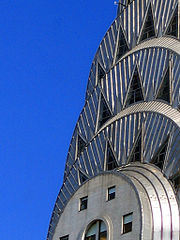
Because metals are good conductors of electricity, they are valuable in electrical appliances and for carrying an electric current
Electric current
Electric current is a flow of electric charge through a medium.This charge is typically carried by moving electrons in a conductor such as wire...
over long distances with little energy loss or dissipation. Thus, electrical power grids rely on metal cables to distribute electricity. Home electrical systems, for example, are wired with copper for its good conducting properties and easy machinability. The high thermal conductivity
Thermal conductivity
In physics, thermal conductivity, k, is the property of a material's ability to conduct heat. It appears primarily in Fourier's Law for heat conduction....
of most metals also makes them useful for stovetop cooking utensils.
The study of metal
Metal
A metal , is an element, compound, or alloy that is a good conductor of both electricity and heat. Metals are usually malleable and shiny, that is they reflect most of incident light...
lic elements and their alloy
Alloy
An alloy is a mixture or metallic solid solution composed of two or more elements. Complete solid solution alloys give single solid phase microstructure, while partial solutions give two or more phases that may or may not be homogeneous in distribution, depending on thermal history...
s makes up a significant portion of the fields of solid-state chemistry, physics, materials science and engineering.
Metallic solids are held together by a high density of shared, delocalized electrons, known as "metallic bond
Metallic bond
Metallic bonding is the electrostatic attractive forces between the delocalized electrons, called conduction electrons, gathered in an "electron sea", and the positively charged metal ions...
ing". In a metal, atoms readily lose their outermost ("valence") electron
Electron
The electron is a subatomic particle with a negative elementary electric charge. It has no known components or substructure; in other words, it is generally thought to be an elementary particle. An electron has a mass that is approximately 1/1836 that of the proton...
s, forming positive ion
Ion
An ion is an atom or molecule in which the total number of electrons is not equal to the total number of protons, giving it a net positive or negative electrical charge. The name was given by physicist Michael Faraday for the substances that allow a current to pass between electrodes in a...
s. The free electrons are spread over the entire solid, which is held together firmly by electrostatic interactions between the ions and the electron cloud. The large number of free electrons
Free electron model
In solid-state physics, the free electron model is a simple model for the behaviour of valence electrons in a crystal structure of a metallic solid. It was developed principally by Arnold Sommerfeld who combined the classical Drude model with quantum mechanical Fermi-Dirac statistics and hence it...
gives metals their high values of electrical and thermal conductivity. The free electrons also prevent transmission of visible light, making metals opaque, shiny and lustrous.
More advanced models of metal properties consider the effect of the positive ions cores on the delocalised electrons. As most metals have crystalline structure, those ions are usually arranged into a periodic lattice. Mathematically, the potential of the ion cores can be treated by various models, the simplest being the nearly free electron model.
Minerals
Mineral
Mineral
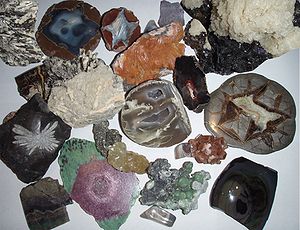
A mineral is a naturally occurring solid chemical substance formed through biogeochemical processes, having characteristic chemical composition, highly ordered atomic structure, and specific physical properties. By comparison, a rock is an aggregate of minerals and/or mineraloids and does not...
s are naturally occurring solids formed through various geological
Geology
Geology is the science comprising the study of solid Earth, the rocks of which it is composed, and the processes by which it evolves. Geology gives insight into the history of the Earth, as it provides the primary evidence for plate tectonics, the evolutionary history of life, and past climates...
processes under high pressures. To be classified as a true mineral, a substance must have a crystal structure
Crystal structure
In mineralogy and crystallography, crystal structure is a unique arrangement of atoms or molecules in a crystalline liquid or solid. A crystal structure is composed of a pattern, a set of atoms arranged in a particular way, and a lattice exhibiting long-range order and symmetry...
with uniform physical properties throughout. Minerals range in composition from pure elements
Chemical element
A chemical element is a pure chemical substance consisting of one type of atom distinguished by its atomic number, which is the number of protons in its nucleus. Familiar examples of elements include carbon, oxygen, aluminum, iron, copper, gold, mercury, and lead.As of November 2011, 118 elements...
and simple salts to very complex silicate
Silicate
A silicate is a compound containing a silicon bearing anion. The great majority of silicates are oxides, but hexafluorosilicate and other anions are also included. This article focuses mainly on the Si-O anions. Silicates comprise the majority of the earth's crust, as well as the other...
s with thousands of known forms. In contrast, a rock
Rock (geology)
In geology, rock or stone is a naturally occurring solid aggregate of minerals and/or mineraloids.The Earth's outer solid layer, the lithosphere, is made of rock. In general rocks are of three types, namely, igneous, sedimentary, and metamorphic...
sample is a random aggregate of minerals and/or mineraloid
Mineraloid
A mineraloid is a mineral-like substance that does not demonstrate crystallinity. Mineraloids possess chemical compositions that vary beyond the generally accepted ranges for specific minerals. For example, obsidian is an amorphous glass and not a crystal. Jet is derived from decaying wood under...
s, and has no specific chemical composition. The vast majority of the rocks of the Earth's crust consist of quartz (crystalline SiO2), feldspar, mica, chlorite
Chlorite group
The chlorites are a group of phyllosilicate minerals. Chlorites can be described by the following four endmembers based on their chemistry via substitution of the following four elements in the silicate lattice; Mg, Fe, Ni, and Mn....
, kaolin, calcite, epidote
Epidote
Epidote is a calcium aluminium iron sorosilicate mineral, Ca2Al2O, crystallizing in the monoclinic system. Well-developed crystals are of frequent occurrence: they are commonly prismatic in habit, the direction of elongation being perpendicular to the single plane of symmetry. The faces are often...
, olivine
Olivine
The mineral olivine is a magnesium iron silicate with the formula 2SiO4. It is a common mineral in the Earth's subsurface but weathers quickly on the surface....
, augite
Augite
Augite is a single chain inosilicate mineral, 2O6. The crystals are monoclinic and prismatic. Augite has two prominent cleavages, meeting at angles near 90 degrees.-Characteristics:Augite is a solid solution in the pyroxene group...
, hornblende
Hornblende
Hornblende is a complex inosilicate series of minerals .It is not a recognized mineral in its own right, but the name is used as a general or field term, to refer to a dark amphibole....
, magnetite
Magnetite
Magnetite is a ferrimagnetic mineral with chemical formula Fe3O4, one of several iron oxides and a member of the spinel group. The chemical IUPAC name is iron oxide and the common chemical name is ferrous-ferric oxide. The formula for magnetite may also be written as FeO·Fe2O3, which is one part...
, hematite
Hematite
Hematite, also spelled as haematite, is the mineral form of iron oxide , one of several iron oxides. Hematite crystallizes in the rhombohedral system, and it has the same crystal structure as ilmenite and corundum...
, limonite
Limonite
Limonite is an ore consisting in a mixture of hydrated iron oxide-hydroxide of varying composition. The generic formula is frequently written as FeO·nH2O, although this is not entirely accurate as limonite often contains a varying amount of oxide compared to hydroxide.Together with hematite, it has...
and a few other minerals. Some minerals, like quartz
Quartz
Quartz is the second-most-abundant mineral in the Earth's continental crust, after feldspar. It is made up of a continuous framework of SiO4 silicon–oxygen tetrahedra, with each oxygen being shared between two tetrahedra, giving an overall formula SiO2. There are many different varieties of quartz,...
, mica
Mica
The mica group of sheet silicate minerals includes several closely related materials having highly perfect basal cleavage. All are monoclinic, with a tendency towards pseudohexagonal crystals, and are similar in chemical composition...
or feldspar
Feldspar
Feldspars are a group of rock-forming tectosilicate minerals which make up as much as 60% of the Earth's crust....
are common, while others have been found in only a few locations worldwide. The largest group of minerals by far is the silicates
Silicate minerals
The silicate minerals make up the largest and most important class of rock-forming minerals, constituting approximately 90 percent of the crust of the Earth. They are classified based on the structure of their silicate group...
(most rocks are ≥95% silicates), which are composed largely of silicon
Silicon
Silicon is a chemical element with the symbol Si and atomic number 14. A tetravalent metalloid, it is less reactive than its chemical analog carbon, the nonmetal directly above it in the periodic table, but more reactive than germanium, the metalloid directly below it in the table...
and oxygen
Oxygen
Oxygen is the element with atomic number 8 and represented by the symbol O. Its name derives from the Greek roots ὀξύς and -γενής , because at the time of naming, it was mistakenly thought that all acids required oxygen in their composition...
, with the addition of ions of aluminium
Aluminium
Aluminium or aluminum is a silvery white member of the boron group of chemical elements. It has the symbol Al, and its atomic number is 13. It is not soluble in water under normal circumstances....
, magnesium
Magnesium
Magnesium is a chemical element with the symbol Mg, atomic number 12, and common oxidation number +2. It is an alkaline earth metal and the eighth most abundant element in the Earth's crust and ninth in the known universe as a whole...
, iron
Iron
Iron is a chemical element with the symbol Fe and atomic number 26. It is a metal in the first transition series. It is the most common element forming the planet Earth as a whole, forming much of Earth's outer and inner core. It is the fourth most common element in the Earth's crust...
, calcium
Calcium
Calcium is the chemical element with the symbol Ca and atomic number 20. It has an atomic mass of 40.078 amu. Calcium is a soft gray alkaline earth metal, and is the fifth-most-abundant element by mass in the Earth's crust...
and other metals.
Ceramics
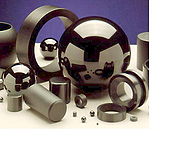
Ceramic solids are composed of inorganic compounds, usually oxide
Oxide
An oxide is a chemical compound that contains at least one oxygen atom in its chemical formula. Metal oxides typically contain an anion of oxygen in the oxidation state of −2....
s of chemical elements. They are chemically inert, and often are capable of withstanding chemical erosion that occurs in an acidic or caustic environment. Ceramics generally can withstand high temperatures ranging from 1000 to 1600 °C (1800 to 3000 °F). Exceptions include non-oxide inorganic materials, such as nitride
Nitride
In chemistry, a nitride is a compound of nitrogen where nitrogen has a formal oxidation state of −3. Nitrides are a large class of compounds with a wide range of properties and applications....
s, boride
Boride
In chemistry a boride is a chemical compound between boron and a less electronegative element, for example silicon boride . The borides are a very large group of compounds that are generally high melting and are not ionic in nature. Some borides exhibit very useful physical properties. The term...
s and carbide
Carbide
In chemistry, a carbide is a compound composed of carbon and a less electronegative element. Carbides can be generally classified by chemical bonding type as follows: salt-like, covalent compounds, interstitial compounds, and "intermediate" transition metal carbides...
s.
Traditional ceramic raw materials include clay
Clay
Clay is a general term including many combinations of one or more clay minerals with traces of metal oxides and organic matter. Geologic clay deposits are mostly composed of phyllosilicate minerals containing variable amounts of water trapped in the mineral structure.- Formation :Clay minerals...
minerals such as kaolinite
Kaolinite
Kaolinite is a clay mineral, part of the group of industrial minerals, with the chemical composition Al2Si2O54. It is a layered silicate mineral, with one tetrahedral sheet linked through oxygen atoms to one octahedral sheet of alumina octahedra...
, more recent materials include aluminium oxide (alumina). The modern ceramic materials, which are classified as advanced ceramics, include silicon carbide
Silicon carbide
Silicon carbide , also known as carborundum, is a compound of silicon and carbon with chemical formula SiC. It occurs in nature as the extremely rare mineral moissanite. Silicon carbide powder has been mass-produced since 1893 for use as an abrasive...
and tungsten carbide
Tungsten carbide
Tungsten carbide is an inorganic chemical compound containing equal parts of tungsten and carbon atoms. Colloquially, tungsten carbide is often simply called carbide. In its most basic form, it is a fine gray powder, but it can be pressed and formed into shapes for use in industrial machinery,...
. Both are valued for their abrasion resistance, and hence find use in such applications as the wear plates of crushing equipment in mining operations.
Most ceramic materials, such as alumina and its compounds, are formed from fine powders, yielding a fine grained polycrystalline
Polycrystalline
Polycrystalline materials are solids that are composed of many crystallites of varying size and orientation. The variation in direction can be random or directed, possibly due to growth and processing conditions. Fiber texture is an example of the latter.Almost all common metals, and many ceramics...
microstructure
Microstructure
Microstructure is defined as the structure of a prepared surface or thin foil of material as revealed by a microscope above 25× magnification...
which is filled with light scattering
Light scattering
Light scattering is a form of scattering in which light is the form of propagating energy which is scattered. Light scattering can be thought of as the deflection of a ray from a straight path, for example by irregularities in the propagation medium, particles, or in the interface between two media...
centers comparable to the wavelength
Wavelength
In physics, the wavelength of a sinusoidal wave is the spatial period of the wave—the distance over which the wave's shape repeats.It is usually determined by considering the distance between consecutive corresponding points of the same phase, such as crests, troughs, or zero crossings, and is a...
of visible light. Thus, they are generally opaque materials, as opposed to transparent materials. Recent nanoscale (e.g. sol-gel) technology has, however, made possible the production of polycrystalline transparent ceramics such as transparent alumina and alumina compounds for such applications as high-power lasers. Advanced ceramics are also used in the medicine, electrical and electronics industries.
Ceramic engineering
Ceramic engineering
Ceramic engineering is the science and technology of creating objects from inorganic, non-metallic materials. This is done either by the action of heat, or at lower temperatures using precipitation reactions from high purity chemical solutions...
is the science and technology of creating solid-state ceramic materials, parts and devices. This is done either by the action of heat, or, at lower temperatures, using precipitation reactions
Precipitation (chemistry)
Precipitation is the formation of a solid in a solution or inside anothersolid during a chemical reaction or by diffusion in a solid. When the reaction occurs in a liquid, the solid formed is called the precipitate, or when compacted by a centrifuge, a pellet. The liquid remaining above the solid...
from chemical solutions. The term includes the purification of raw materials, the study and production of the chemical compounds concerned, their formation into components, and the study of their structure, composition and properties.
Mechanically speaking, ceramic materials are brittle, hard, strong in compression and weak in shearing and tension. Brittle
Brittle
A material is brittle if, when subjected to stress, it breaks without significant deformation . Brittle materials absorb relatively little energy prior to fracture, even those of high strength. Breaking is often accompanied by a snapping sound. Brittle materials include most ceramics and glasses ...
materials may exhibit significant tensile strength
Tensile strength
Ultimate tensile strength , often shortened to tensile strength or ultimate strength, is the maximum stress that a material can withstand while being stretched or pulled before necking, which is when the specimen's cross-section starts to significantly contract...
by supporting a static load. Toughness
Toughness
In materials science and metallurgy, toughness is the ability of a material to absorb energy and plastically deform without fracturing; Material toughness is defined as the amount of energy per volume that a material can absorb before rupturing...
indicates how much energy a material can absorb before mechanical failure, while fracture toughness
Fracture toughness
In materials science, fracture toughness is a property which describes the ability of a material containing a crack to resist fracture, and is one of the most important properties of any material for virtually all design applications. The fracture toughness of a material is determined from the...
(denoted KIc ) describes the ability of a material with inherent microstructural flaws
Crystallographic defect
Crystalline solids exhibit a periodic crystal structure. The positions of atoms or molecules occur on repeating fixed distances, determined by the unit cell parameters. However, the arrangement of atom or molecules in most crystalline materials is not perfect...
to resist fracture
Fracture
A fracture is the separation of an object or material into two, or more, pieces under the action of stress.The word fracture is often applied to bones of living creatures , or to crystals or crystalline materials, such as gemstones or metal...
via crack growth and propagation. If a material has a large value of fracture toughness
Fracture toughness
In materials science, fracture toughness is a property which describes the ability of a material containing a crack to resist fracture, and is one of the most important properties of any material for virtually all design applications. The fracture toughness of a material is determined from the...
, the basic principles of fracture mechanics
Fracture mechanics
Fracture mechanics is the field of mechanics concerned with the study of the propagation of cracks in materials. It uses methods of analytical solid mechanics to calculate the driving force on a crack and those of experimental solid mechanics to characterize the material's resistance to fracture.In...
suggest that it will most likely undergo ductile fracture. Brittle fracture is very characteristic of most ceramic
Ceramic engineering
Ceramic engineering is the science and technology of creating objects from inorganic, non-metallic materials. This is done either by the action of heat, or at lower temperatures using precipitation reactions from high purity chemical solutions...
and glass-ceramic
Glass-ceramic
Glass-ceramics are polycrystalline material produced through controlled crystallization of base glass. Glass-ceramic materials share many properties with both glasses and ceramics...
materials which typically exhibit low (and inconsistent) values of KIc.
For example of applications of ceramics, the extreme hardness of Zirconia
Zirconium dioxide
Zirconium dioxide , sometimes known as zirconia , is a white crystalline oxide of zirconium. Its most naturally occurring form, with a monoclinic crystalline structure, is the rare mineral baddeleyite. The high temperature cubic crystalline form is rarely found in nature as mineral tazheranite O2...
is utilized in the manufacture of knife blades, as well as other industrial cutting tools. Ceramics such as alumina, boron carbide
Boron carbide
Boron carbide is an extremely hard boron–carbon ceramic material used in tank armor, bulletproof vests, and numerous industrial applications...
and silicon carbide
Silicon carbide
Silicon carbide , also known as carborundum, is a compound of silicon and carbon with chemical formula SiC. It occurs in nature as the extremely rare mineral moissanite. Silicon carbide powder has been mass-produced since 1893 for use as an abrasive...
have been used in bulletproof vest
Bulletproof vest
A ballistic vest, bulletproof vest or bullet-resistant vest is an item of personal armor that helps absorb the impact from firearm-fired projectiles and shrapnel from explosions, and is worn on the torso...
s to repel large-caliber rifle
Rifle
A rifle is a firearm designed to be fired from the shoulder, with a barrel that has a helical groove or pattern of grooves cut into the barrel walls. The raised areas of the rifling are called "lands," which make contact with the projectile , imparting spin around an axis corresponding to the...
fire. Silicon nitride
Silicon nitride
Silicon nitride is a chemical compound of silicon and nitrogen. If powdered silicon is heated between 1300° and 1400°C in an atmosphere of nitrogen, trisilicon tetranitride, Si3N4, is formed. The silicon sample weight increases progressively due to the chemical combination of silicon and nitrogen...
parts are used in ceramic ball bearings, where their high hardness makes them wear resistant. In general, ceramics are also chemically resistant and can be used in wet environments where steel bearings would be susceptible to oxidation (or rust).
Operating temperature
An operating temperature is the temperature at which an electrical or mechanical device operates. The device will operate effectively within a specified temperature range which varies based on the device function and application context, and ranges from the minimum operating temperature to the...
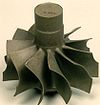
of over 6000 °F (3300 °C). Ceramic engines do not require a cooling system and hence allow a major weight reduction and therefore greater fuel efficiency. In a conventional metallic engine, much of the energy released from the fuel must be dissipated as waste heat
Waste heat
Waste heat sometimes called Secondary heat or Low-grade heat refers to heat produced by machines, electrical equipment and industrial processes for which no useful application is found. Energy is often produced by a heat engine, running on a source of high-temperature heat...
in order to prevent a meltdown of the metallic parts. Work is also being done in developing ceramic parts for gas turbine
Gas turbine
A gas turbine, also called a combustion turbine, is a type of internal combustion engine. It has an upstream rotating compressor coupled to a downstream turbine, and a combustion chamber in-between....
engines
Heat engine
In thermodynamics, a heat engine is a system that performs the conversion of heat or thermal energy to mechanical work. It does this by bringing a working substance from a high temperature state to a lower temperature state. A heat "source" generates thermal energy that brings the working substance...
. Turbine engines made with ceramics could operate more efficiently, giving aircraft greater range and payload for a set amount of fuel. However, such engines are not in production because the manufacturing of ceramic parts in the sufficient precision and durability is difficult and costly. Processing methods often result in a wide distribution of microscopic flaws which frequently play a detrimental role in the sintering process, resulting in the proliferation of cracks, and ultimate mechanical failure.
Glass ceramics

Glass-ceramics are used to make cookware (originally known by the brand name CorningWare
Corningware
CorningWare was originally a brand name for a unique pyroceramic glass cookware resistant to thermal shock, that was first introduced in 1958 by Corning Glass Works. CorningWare is notable for the fact that it can be used directly on the stovetop.- History :In 1953, Dr. S...
) and stovetops which have both high resistance to thermal shock
Thermal shock
Thermal shock is the name given to cracking as a result of rapid temperature change. Glass and ceramic objects are particularly vulnerable to this form of failure, due to their low toughness, low thermal conductivity, and high thermal expansion coefficients...
and extremely low permeability
Permeability (fluid)
Permeability in fluid mechanics and the earth sciences is a measure of the ability of a porous material to allow fluids to pass through it.- Units :...
to liquids. The negative coefficient of thermal expansion of the crystalline ceramic phase can be balanced with the positive coefficient of the glassy phase. At a certain point (~70% crystalline) the glass-ceramic has a net coefficient of thermal expansion close to zero. This type of glass-ceramic exhibits excellent mechanical properties and can sustain repeated and quick temperature changes up to 1000 °C.
Glass ceramics may also occur naturally when lightning
Lightning
Lightning is an atmospheric electrostatic discharge accompanied by thunder, which typically occurs during thunderstorms, and sometimes during volcanic eruptions or dust storms...
strikes the crystalline (e.g. quartz) grains found in most beach sand
Sand
Sand is a naturally occurring granular material composed of finely divided rock and mineral particles.The composition of sand is highly variable, depending on the local rock sources and conditions, but the most common constituent of sand in inland continental settings and non-tropical coastal...
. In this case, the extreme and immediate heat of the lightning (~2500 °C) creates hollow, branching rootlike structures called fulgurite
Fulgurite
Fulgurites are natural hollow glass tubes formed in quartzose sand, or silica, or soil by lightning strikes. They are formed when lightning with a temperature of at least instantaneously melts silica on a conductive surface and fuses grains together; the fulgurite tube is the cooled product...
via fusion
Melting
Melting, or fusion, is a physical process that results in the phase change of a substance from a solid to a liquid. The internal energy of a substance is increased, typically by the application of heat or pressure, resulting in a rise of its temperature to the melting point, at which the rigid...
.
Organic solids
Carbon
Carbon is the chemical element with symbol C and atomic number 6. As a member of group 14 on the periodic table, it is nonmetallic and tetravalent—making four electrons available to form covalent chemical bonds...
and hydrogen
Hydrogen
Hydrogen is the chemical element with atomic number 1. It is represented by the symbol H. With an average atomic weight of , hydrogen is the lightest and most abundant chemical element, constituting roughly 75% of the Universe's chemical elemental mass. Stars in the main sequence are mainly...
, which may contain any number of other elements such as nitrogen
Nitrogen
Nitrogen is a chemical element that has the symbol N, atomic number of 7 and atomic mass 14.00674 u. Elemental nitrogen is a colorless, odorless, tasteless, and mostly inert diatomic gas at standard conditions, constituting 78.08% by volume of Earth's atmosphere...
, oxygen
Oxygen
Oxygen is the element with atomic number 8 and represented by the symbol O. Its name derives from the Greek roots ὀξύς and -γενής , because at the time of naming, it was mistakenly thought that all acids required oxygen in their composition...
and the halogens: fluorine
Fluorine
Fluorine is the chemical element with atomic number 9, represented by the symbol F. It is the lightest element of the halogen column of the periodic table and has a single stable isotope, fluorine-19. At standard pressure and temperature, fluorine is a pale yellow gas composed of diatomic...
, chlorine
Chlorine
Chlorine is the chemical element with atomic number 17 and symbol Cl. It is the second lightest halogen, found in the periodic table in group 17. The element forms diatomic molecules under standard conditions, called dichlorine...
, bromine
Bromine
Bromine ") is a chemical element with the symbol Br, an atomic number of 35, and an atomic mass of 79.904. It is in the halogen element group. The element was isolated independently by two chemists, Carl Jacob Löwig and Antoine Jerome Balard, in 1825–1826...
and iodine
Iodine
Iodine is a chemical element with the symbol I and atomic number 53. The name is pronounced , , or . The name is from the , meaning violet or purple, due to the color of elemental iodine vapor....
. Some organic compounds may also contain the elements phosphorus
Phosphorus
Phosphorus is the chemical element that has the symbol P and atomic number 15. A multivalent nonmetal of the nitrogen group, phosphorus as a mineral is almost always present in its maximally oxidized state, as inorganic phosphate rocks...
or sulfur
Sulfur
Sulfur or sulphur is the chemical element with atomic number 16. In the periodic table it is represented by the symbol S. It is an abundant, multivalent non-metal. Under normal conditions, sulfur atoms form cyclic octatomic molecules with chemical formula S8. Elemental sulfur is a bright yellow...
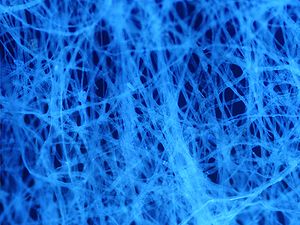
. Examples of organic solids include wood, paraffin wax, naphthalene
Naphthalene
Naphthalene is an organic compound with formula . It is a white crystalline solid with a characteristic odor that is detectable at concentrations as low as 0.08 ppm by mass. As an aromatic hydrocarbon, naphthalene's structure consists of a fused pair of benzene rings...
and a wide variety of polymers and plastics.
Wood
WoodWood
Wood is a hard, fibrous tissue found in many trees. It has been used for hundreds of thousands of years for both fuel and as a construction material. It is an organic material, a natural composite of cellulose fibers embedded in a matrix of lignin which resists compression...
is a natural organic material consisting primarily of cellulose
Cellulose
Cellulose is an organic compound with the formula , a polysaccharide consisting of a linear chain of several hundred to over ten thousand β linked D-glucose units....
fibers embedded in a matrix of lignin
Lignin
Lignin or lignen is a complex chemical compound most commonly derived from wood, and an integral part of the secondary cell walls of plants and some algae. The term was introduced in 1819 by de Candolle and is derived from the Latin word lignum, meaning wood...
. Regarding mechanical properties, the fibers are strong in tension, and the lignin matrix resists compression. Thus wood has been an important construction material since humans began building shelters and using boats. Wood to be used for construction work is commonly known as lumber
Lumber
Lumber or timber is wood in any of its stages from felling through readiness for use as structural material for construction, or wood pulp for paper production....
or timber. In construction, wood is not only a structural material, but is also used to form the mould for concrete
Concrete
Concrete is a composite construction material, composed of cement and other cementitious materials such as fly ash and slag cement, aggregate , water and chemical admixtures.The word concrete comes from the Latin word...
.
Wood-based materials are also extensively used for packaging (e.g. cardboard) and paper
Paper
Paper is a thin material mainly used for writing upon, printing upon, drawing or for packaging. It is produced by pressing together moist fibers, typically cellulose pulp derived from wood, rags or grasses, and drying them into flexible sheets....
which are both created from the refined pulp. The chemical pulping processes use a combination of high temperature and alkaline (kraft) or acidic (sulfite) chemicals to break the chemical bonds of the lignin before burning it out.
Polymers
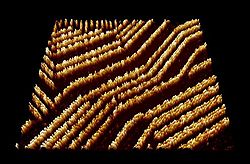
One important property of carbon in organic chemistry is that it can form certain compounds, the individual molecules of which are capable of attaching themselves to one another, thereby forming a chain or a network. The process is called polymerization and the chains or networks polymers, while the source compound is a monomer. Two main groups of polymers exist: those artificially manufactured are referred to as industrial polymers or synthetic polymers (plastics) and those naturally occurring as biopolymers.
Monomers can have various chemical substituents, or functional groups, which can affect the chemical properties of organic compounds, such as solubility and chemical reactivity, as well as the physical properties, such as hardness, density, mechanical or tensile strength, abrasion resistance, heat resistance, transparency, color, etc.. In proteins, these differences give the polymer the ability to adopt a biologically active conformation in preference to others (see self-assembly
Self-assembly
Self-assembly is a term used to describe processes in which a disordered system of pre-existing components forms an organized structure or pattern as a consequence of specific, local interactions among the components themselves, without external direction...
).
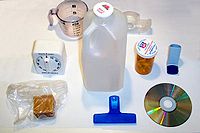
Shellac
Shellac is a resin secreted by the female lac bug, on trees in the forests of India and Thailand. It is processed and sold as dry flakes , which are dissolved in ethyl alcohol to make liquid shellac, which is used as a brush-on colorant, food glaze and wood finish...
which is classified as a thermoplastic polymer. A plant polymer named cellulose
Cellulose
Cellulose is an organic compound with the formula , a polysaccharide consisting of a linear chain of several hundred to over ten thousand β linked D-glucose units....
provided the tensile strength for natural fibers and ropes, and by the early 19th century natural rubber was in widespread use. Polymers are the raw materials (the resins) used to make what we commonly call plastics. Plastics are the final product, created after one or more polymers or additives have been added to a resin during processing, which is then shaped into a final form. Polymers which have been around, and which are in current widespread use, include carbon-based polyethylene
Polyethylene
Polyethylene or polythene is the most widely used plastic, with an annual production of approximately 80 million metric tons...
, polypropylene
Polypropylene
Polypropylene , also known as polypropene, is a thermoplastic polymer used in a wide variety of applications including packaging, textiles , stationery, plastic parts and reusable containers of various types, laboratory equipment, loudspeakers, automotive components, and polymer banknotes...
, polyvinyl chloride
Polyvinyl chloride
Polyvinyl chloride, commonly abbreviated PVC, is a thermoplastic polymer. It is a vinyl polymer constructed of repeating vinyl groups having one hydrogen replaced by chloride. Polyvinyl chloride is the third most widely produced plastic, after polyethylene and polypropylene. PVC is widely used in...
, polystyrene
Polystyrene
Polystyrene ) also known as Thermocole, abbreviated following ISO Standard PS, is an aromatic polymer made from the monomer styrene, a liquid hydrocarbon that is manufactured from petroleum by the chemical industry...
, nylon
Nylon
Nylon is a generic designation for a family of synthetic polymers known generically as polyamides, first produced on February 28, 1935, by Wallace Carothers at DuPont's research facility at the DuPont Experimental Station...
s, polyester
Polyester
Polyester is a category of polymers which contain the ester functional group in their main chain. Although there are many polyesters, the term "polyester" as a specific material most commonly refers to polyethylene terephthalate...
s, acrylics, polyurethane
Polyurethane
A polyurethane is any polymer composed of a chain of organic units joined by carbamate links. Polyurethane polymers are formed through step-growth polymerization, by reacting a monomer with another monomer in the presence of a catalyst.Polyurethanes are...
, and polycarbonate
Polycarbonate
PolycarbonatePhysical PropertiesDensity 1.20–1.22 g/cm3Abbe number 34.0Refractive index 1.584–1.586FlammabilityV0-V2Limiting oxygen index25–27%Water absorption – Equilibrium0.16–0.35%Water absorption – over 24 hours0.1%...
s, and silicon-based silicone
Silicone
Silicones are inert, synthetic compounds with a variety of forms and uses. Typically heat-resistant and rubber-like, they are used in sealants, adhesives, lubricants, medical applications , cookware, and insulation....
s. Plastics are generally classified as "commodity", "specialty" and "engineering" plastics.
Composite materials

Composite material
Composite materials, often shortened to composites or called composition materials, are engineered or naturally occurring materials made from two or more constituent materials with significantly different physical or chemical properties which remain separate and distinct at the macroscopic or...
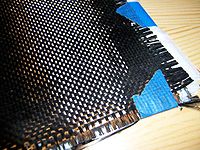
s contain two or more macroscopic phases, one of which is often ceramic. For example, a continuous matrix, and a dispersed phase of ceramic particles or fibers.
Applications of composite materials range from structural elements such as steel-reinforced concrete, to the thermally insulative tiles which play a key and integral role in NASA's Space Shuttle thermal protection system
Space Shuttle thermal protection system
The Space Shuttle thermal protection system is the barrier that protects the Space Shuttle Orbiter during the searing heat of atmospheric reentry...
which is used to protect the surface of the shuttle from the heat of re-entry into the Earth's atmosphere. One example is Reinforced Carbon-Carbon
Reinforced carbon-carbon
Carbon fibre-reinforced carbon is a composite material consisting of carbon fibre reinforcement in a matrix of graphite. It was developed for the nose cones of intercontinental ballistic missiles, and is most widely known as the material for the nose cone and wing leading edges of the Space Shuttle...
(RCC), the light gray material which withstands reentry temperatures up to 1510 °C (2750 °F) and protects the nose cap and leading edges of Space Shuttle's wings. RCC is a laminated composite material made from graphite
Graphite
The mineral graphite is one of the allotropes of carbon. It was named by Abraham Gottlob Werner in 1789 from the Ancient Greek γράφω , "to draw/write", for its use in pencils, where it is commonly called lead . Unlike diamond , graphite is an electrical conductor, a semimetal...
rayon
Rayon
Rayon is a manufactured regenerated cellulose fiber. Because it is produced from naturally occurring polymers, it is neither a truly synthetic fiber nor a natural fiber; it is a semi-synthetic or artificial fiber. Rayon is known by the names viscose rayon and art silk in the textile industry...
cloth and impregnated with a phenolic resin. After curing at high temperature in an autoclave, the laminate is pyrolized to convert the resin to carbon, impregnated with furfural
Furfural
Furfural is an organic compound derived from a variety of agricultural byproducts, including corncobs, oat, wheat bran, and sawdust. The name furfural comes from the Latin word , meaning bran, referring to its usual source....
alcohol in a vacuum chamber, and cured/pyrolized to convert the furfural alcohol to carbon. In order to provide oxidation resistance for reuse capability, the outer layers of the RCC are converted to silicon carbide.
Domestic examples of composites can be seen in the "plastic" casings of television sets, cell-phones and so on. These plastic casings are usually a composite made up of a thermoplastic matrix such as acrylonitrile butadiene styrene
Acrylonitrile butadiene styrene
Acrylonitrile butadiene styrene is a common thermoplastic. Its melting point is approximately 105 °C ....
(ABS) in which calcium carbonate
Calcium carbonate
Calcium carbonate is a chemical compound with the formula CaCO3. It is a common substance found in rocks in all parts of the world, and is the main component of shells of marine organisms, snails, coal balls, pearls, and eggshells. Calcium carbonate is the active ingredient in agricultural lime,...
chalk, talc
Talc
Talc is a mineral composed of hydrated magnesium silicate with the chemical formula H2Mg34 or Mg3Si4O102. In loose form, it is the widely-used substance known as talcum powder. It occurs as foliated to fibrous masses, its crystals being so rare as to be almost unknown...
, glass fibers or carbon fibers have been added for strength, bulk, or electro-static dispersion. These additions may be referred to as reinforcing fibers, or dispersants, depending on their purpose.
Thus, the matrix material surrounds and supports the reinforcement materials by maintaining their relative positions. The reinforcements impart their special mechanical and physical properties to enhance the matrix properties. A synergism produces material properties unavailable from the individual constituent materials, while the wide variety of matrix and strengthening materials provides the designer with the choice of an optimum combination.
Semiconductors
Semiconductor
Semiconductor
A semiconductor is a material with electrical conductivity due to electron flow intermediate in magnitude between that of a conductor and an insulator. This means a conductivity roughly in the range of 103 to 10−8 siemens per centimeter...
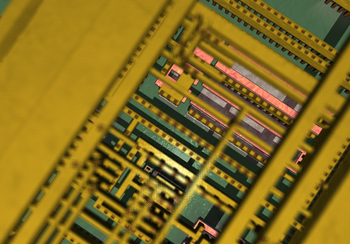
s are materials that have an electrical resistivity (and conductivity) between that of metallic conductors and non-metallic insulators. They can be found in the periodic table
Periodic table
The periodic table of the chemical elements is a tabular display of the 118 known chemical elements organized by selected properties of their atomic structures. Elements are presented by increasing atomic number, the number of protons in an atom's atomic nucleus...
moving diagonally downward right from boron
Boron
Boron is the chemical element with atomic number 5 and the chemical symbol B. Boron is a metalloid. Because boron is not produced by stellar nucleosynthesis, it is a low-abundance element in both the solar system and the Earth's crust. However, boron is concentrated on Earth by the...
. They separate the electrical conductors (or metals, to the left) from the insulators (to the right).
Devices made from semiconductor materials are the foundation of modern electronics, including radio, computers, telephones, etc. Semiconductor devices include the transistor
Transistor
A transistor is a semiconductor device used to amplify and switch electronic signals and power. It is composed of a semiconductor material with at least three terminals for connection to an external circuit. A voltage or current applied to one pair of the transistor's terminals changes the current...
, solar cell
Solar cell
A solar cell is a solid state electrical device that converts the energy of light directly into electricity by the photovoltaic effect....
s, diode
Diode
In electronics, a diode is a type of two-terminal electronic component with a nonlinear current–voltage characteristic. A semiconductor diode, the most common type today, is a crystalline piece of semiconductor material connected to two electrical terminals...
s and integrated circuit
Integrated circuit
An integrated circuit or monolithic integrated circuit is an electronic circuit manufactured by the patterned diffusion of trace elements into the surface of a thin substrate of semiconductor material...
s. Solar photovoltaic panels are large semiconductor devices that directly convert light into electrical energy.
In a metallic conductor, current is carried by the flow of electrons", but in semiconductors, current can be carried either by electrons or by the positively charged "holes
Electron hole
An electron hole is the conceptual and mathematical opposite of an electron, useful in the study of physics, chemistry, and electrical engineering. The concept describes the lack of an electron at a position where one could exist in an atom or atomic lattice...
" in the electronic band structure
Electronic band structure
In solid-state physics, the electronic band structure of a solid describes those ranges of energy an electron is "forbidden" or "allowed" to have. Band structure derives from the diffraction of the quantum mechanical electron waves in a periodic crystal lattice with a specific crystal system and...
of the material. Common semiconductor materials include silicon, germanium
Germanium
Germanium is a chemical element with the symbol Ge and atomic number 32. It is a lustrous, hard, grayish-white metalloid in the carbon group, chemically similar to its group neighbors tin and silicon. The isolated element is a semiconductor, with an appearance most similar to elemental silicon....
and gallium arsenide.
Nanomaterials
Catalysis
Catalysis is the change in rate of a chemical reaction due to the participation of a substance called a catalyst. Unlike other reagents that participate in the chemical reaction, a catalyst is not consumed by the reaction itself. A catalyst may participate in multiple chemical transformations....
, as well as proton exchange membrane
Proton exchange membrane
A proton exchange membrane or polymer electrolyte membrane is a semipermeable membrane generally made from ionomers and designed to conduct protons while being impermeable to gases such as oxygen or hydrogen...
(PEM) fuel cells. Also, ceramic oxides (or cermets) of lanthanum
Lanthanum
Lanthanum is a chemical element with the symbol La and atomic number 57.Lanthanum is a silvery white metallic element that belongs to group 3 of the periodic table and is the first element of the lanthanide series. It is found in some rare-earth minerals, usually in combination with cerium and...
, cerium
Cerium
Cerium is a chemical element with the symbol Ce and atomic number 58. It is a soft, silvery, ductile metal which easily oxidizes in air. Cerium was named after the dwarf planet . Cerium is the most abundant of the rare earth elements, making up about 0.0046% of the Earth's crust by weight...
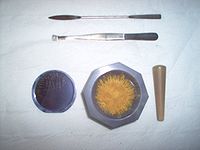
, manganese and nickel are now being developed as solid oxide fuel cells (SOFC). Lithium, lithium–titanate and tantalum nanoparticles are being applied in lithium ion batteries. Silicon nanoparticles have been shown to dramatically expand the storage capacity of lithium ion batteries during the expansion/contraction cycle. Silicon nanowires cycle without significant degradation and present the potential for use in batteries with greatly expanded storage times. Silicon nanoparticles are also being used in new forms of solar energy cells. Thin film deposition of silicon quantum dot
Quantum dot
A quantum dot is a portion of matter whose excitons are confined in all three spatial dimensions. Consequently, such materials have electronic properties intermediate between those of bulk semiconductors and those of discrete molecules. They were discovered at the beginning of the 1980s by Alexei...
s on the polycrystalline silicon substrate of a photovoltaic (solar) cell increases voltage output as much as 60% by fluorescing the incoming light prior to capture. Here again, surface area of the nanoparticles (and thin films) plays a critical role in maximizing the amount of absorbed radiation.
Biomaterials

Self-assembly
Self-assembly is a term used to describe processes in which a disordered system of pre-existing components forms an organized structure or pattern as a consequence of specific, local interactions among the components themselves, without external direction...
is emerging as a new strategy in the chemical synthesis of high performance biomaterials.
Physical properties
Physical properties of elements and compounds which provide conclusive evidence of chemical composition include odor, color, volume, density (mass per unit volume), melting point, boiling point, heat capacity, physical form and shape at room temperature (solid, liquid or gas; cubic, trigonal crystals, etc.), hardness, porosity, index of refraction and many others. This section discusses some physical properties of materials in the solid state.Mechanical

Strength of materials
In materials science, the strength of a material is its ability to withstand an applied stress without failure. The applied stress may be tensile, compressive, or shear. Strength of materials is a subject which deals with loads, deformations and the forces acting on a material. A load applied to a...
and resistance to deformation. For example, steel beams are used in construction because of their high strength, meaning that they neither break nor bend significantly under the applied load.
Mechanical properties include elasticity
Elasticity (physics)
In physics, elasticity is the physical property of a material that returns to its original shape after the stress that made it deform or distort is removed. The relative amount of deformation is called the strain....
and plasticity
Plasticity (physics)
In physics and materials science, plasticity describes the deformation of a material undergoing non-reversible changes of shape in response to applied forces. For example, a solid piece of metal being bent or pounded into a new shape displays plasticity as permanent changes occur within the...
, tensile strength
Tensile strength
Ultimate tensile strength , often shortened to tensile strength or ultimate strength, is the maximum stress that a material can withstand while being stretched or pulled before necking, which is when the specimen's cross-section starts to significantly contract...
, compressive strength
Compressive strength
Compressive strength is the capacity of a material or structure to withstand axially directed pushing forces. When the limit of compressive strength is reached, materials are crushed. Concrete can be made to have high compressive strength, e.g...
, shear strength
Shear strength
Shear strength in engineering is a term used to describe the strength of a material or component against the type of yield or structural failure where the material or component fails in shear. A shear load is a force that tends to produce a sliding failure on a material along a plane that is...
, fracture toughness
Fracture toughness
In materials science, fracture toughness is a property which describes the ability of a material containing a crack to resist fracture, and is one of the most important properties of any material for virtually all design applications. The fracture toughness of a material is determined from the...
, ductility
Ductility
In materials science, ductility is a solid material's ability to deform under tensile stress; this is often characterized by the material's ability to be stretched into a wire. Malleability, a similar property, is a material's ability to deform under compressive stress; this is often characterized...
(low in brittle materials), and indentation hardness
Indentation hardness
Indentation hardness tests are used to determine the hardness of a material to deformation. Several such tests exist, wherein the examined material is indented until an impression is formed; these tests can be performed on a macroscopic or microscopic scale....
. Solid mechanics
Solid mechanics
Solid mechanics is the branch of mechanics, physics, and mathematics that concerns the behavior of solid matter under external actions . It is part of a broader study known as continuum mechanics. One of the most common practical applications of solid mechanics is the Euler-Bernoulli beam equation...
is the study of the behavior of solid matter under external actions such as external forces and temperature changes.
A solid does not exhibit macroscopic flow, as fluids do. Any degree of departure from its original shape is called deformation. The proportion of deformation to original size is called strain. If the applied stress is sufficiently low, almost all solid materials behave in such a way that the strain is directly proportional to the stress (Hooke's law
Hooke's law
In mechanics, and physics, Hooke's law of elasticity is an approximation that states that the extension of a spring is in direct proportion with the load applied to it. Many materials obey this law as long as the load does not exceed the material's elastic limit. Materials for which Hooke's law...
). The coefficient of the proportion is called the modulus of elasticity or Young's modulus
Young's modulus
Young's modulus is a measure of the stiffness of an elastic material and is a quantity used to characterize materials. It is defined as the ratio of the uniaxial stress over the uniaxial strain in the range of stress in which Hooke's Law holds. In solid mechanics, the slope of the stress-strain...
. This region of deformation is known as the linearly elastic
Linear elasticity
Linear elasticity is the mathematical study of how solid objects deform and become internally stressed due to prescribed loading conditions. Linear elasticity models materials as continua. Linear elasticity is a simplification of the more general nonlinear theory of elasticity and is a branch of...
region. Three models can describe how a solid responds to an applied stress:
- ElasticityElasticity (physics)In physics, elasticity is the physical property of a material that returns to its original shape after the stress that made it deform or distort is removed. The relative amount of deformation is called the strain....
– When an applied stress is removed, the material returns to its undeformed state. - ViscoelasticityViscoelasticityViscoelasticity is the property of materials that exhibit both viscous and elastic characteristics when undergoing deformation. Viscous materials, like honey, resist shear flow and strain linearly with time when a stress is applied. Elastic materials strain instantaneously when stretched and just...
– These are materials that behave elastically, but also have dampingFrictionFriction is the force resisting the relative motion of solid surfaces, fluid layers, and/or material elements sliding against each other. There are several types of friction:...
. When the applied stress is removed, work has to be done against the damping effects and is converted to heat within the material. This results in a hysteresis loop in the stress–strain curve. This implies that the mechanical response has a time-dependence. - Plasticity – Materials that behave elastically generally do so when the applied stress is less than a yield value. When the stress is greater than the yield stress, the material behaves plastically and does not return to its previous state. That is, irreversible plastic deformation (or viscous flow) occurs after yield which is permanent.
Many materials become weaker at high temperatures. Materials which retain their strength at high temperatures, called refractory materials
Refractory
A refractory material is one that retains its strength at high temperatures. ASTM C71 defines refractories as "non-metallic materials having those chemical and physical properties that make them applicable for structures, or as components of systems, that are exposed to environments above...
, are useful for many purposes. For example, glass-ceramic
Glass-ceramic
Glass-ceramics are polycrystalline material produced through controlled crystallization of base glass. Glass-ceramic materials share many properties with both glasses and ceramics...
s have become extremely useful for countertop cooking, as they exhibit excellent mechanical properties and can sustain repeated and quick temperature changes up to 1000 °C.
In the aerospace industry, high performance materials used in the design of aircraft and/or spacecraft exteriors must have a high resistance to thermal shock. Thus, synthetic fibers spun out of organic polymers and polymer/ceramic/metal composite materials and fiber-reinforced polymers are now being designed with this purpose in mind.
Thermal
.gif)
Thermal energy
Thermal energy is the part of the total internal energy of a thermodynamic system or sample of matter that results in the system's temperature....
, their atoms vibrate about fixed mean positions within the ordered (or disordered) lattice. The spectrum of lattice vibrations in a crystalline or glassy network provides the foundation for the kinetic theory of solids. This motion occurs at the atomic level, and thus cannot be observed or detected without highly specialized equipment, such as that used in spectroscopy
Spectroscopy
Spectroscopy is the study of the interaction between matter and radiated energy. Historically, spectroscopy originated through the study of visible light dispersed according to its wavelength, e.g., by a prism. Later the concept was expanded greatly to comprise any interaction with radiative...
.
Thermal properties of solids include thermal conductivity
Thermal conductivity
In physics, thermal conductivity, k, is the property of a material's ability to conduct heat. It appears primarily in Fourier's Law for heat conduction....
, which is the property of a material that indicates its ability to conduct heat. Solids also have a specific heat capacity, which is the capacity of a material to store energy in the form of heat (or thermal lattice vibrations).
Electrical
Electrical properties include conductivity, resistance, impedanceElectrical impedance
Electrical impedance, or simply impedance, is the measure of the opposition that an electrical circuit presents to the passage of a current when a voltage is applied. In quantitative terms, it is the complex ratio of the voltage to the current in an alternating current circuit...
and capacitance
Capacitance
In electromagnetism and electronics, capacitance is the ability of a capacitor to store energy in an electric field. Capacitance is also a measure of the amount of electric potential energy stored for a given electric potential. A common form of energy storage device is a parallel-plate capacitor...
. Electrical conductors such as metals and alloys are contrasted with electrical insulators such as glasses and ceramics. Semiconductors behave somewhere in between. Whereas conductivity in metals is caused by electrons, both electrons and holes contribute to current in semiconductors. Alternatively, ions support electric current in ionic conductors
Fast ion conductor
In solid-state ionics, fast ion conductors, also known as solid electrolytes and superionic conductors, are materials that act as solid state ion conductors and are used primarily in solid oxide fuel cells. As solid electrolytes they conduct due to the movement of ions through voids, or empty...
.
Many materials also exhibit superconductivity
Superconductivity
Superconductivity is a phenomenon of exactly zero electrical resistance occurring in certain materials below a characteristic temperature. It was discovered by Heike Kamerlingh Onnes on April 8, 1911 in Leiden. Like ferromagnetism and atomic spectral lines, superconductivity is a quantum...
at low temperatures; they include metallic elements such as tin and aluminium, various metallic alloys, some heavily doped semiconductors, and certain ceramics. The electrical resistivity of most electrical (metallic) conductors generally decreases gradually as the temperature is lowered, but remains finite. In a superconductor however, the resistance drops abruptly to zero when the material is cooled below its critical temperature. An electric current flowing in a loop of superconducting wire can persist indefinitely with no power source.
A dielectric
Dielectric
A dielectric is an electrical insulator that can be polarized by an applied electric field. When a dielectric is placed in an electric field, electric charges do not flow through the material, as in a conductor, but only slightly shift from their average equilibrium positions causing dielectric...
, or electrical insulator, is a substance that is highly resistant to the flow of electric current. A dielectric, such as plastic, tends to concentrate an applied electric field within itself which property is used in capacitors. A capacitor
Capacitor
A capacitor is a passive two-terminal electrical component used to store energy in an electric field. The forms of practical capacitors vary widely, but all contain at least two electrical conductors separated by a dielectric ; for example, one common construction consists of metal foils separated...
is an electrical device that can store energy in the electric field between a pair of closely spaced conductors (called 'plates'). When voltage is applied to the capacitor, electric charges of equal magnitude, but opposite polarity, build up on each plate. Capacitors are used in electrical circuits as energy-storage devices, as well as in electronic filters to differentiate between high-frequency and low-frequency signals.
Electro-mechanical
PiezoelectricityPiezoelectricity
Piezoelectricity is the charge which accumulates in certain solid materials in response to applied mechanical stress. The word piezoelectricity means electricity resulting from pressure...
is the ability of crystals to generate a voltage in response to an applied mechanical stress. The piezoelectric effect is reversible in that piezoelectric crystals, when subjected to an externally applied voltage, can change shape by a small amount. Polymer materials like rubber, wool, hair, wood fiber, and silk often behave as electret
Electret
Electret is a dielectric material that has a quasi-permanent electric charge or dipole polarisation. An electret generates internal and external electric fields, and is the electrostatic equivalent of a permanent magnet. Oliver Heaviside coined this term in 1885...
s. For example, the polymer polyvinylidene fluoride
Polyvinylidene fluoride
Polyvinylidene fluoride, or PVDF is a highly non-reactive and pure thermoplastic fluoropolymer.PVDF is a specialty plastic material in the fluoropolymer family; it is used generally in applications requiring the highest purity, strength, and resistance to solvents, acids, bases and heat and low...
(PVDF) exhibits a piezoelectric response several times larger than the traditional piezoelectric material quartz (crystalline SiO2). The deformation (~0.1%) lends itself to useful technical applications such as high-voltage sources, loudspeakers, lasers, as well as chemical, biological, and acousto-optic sensors and/or transducers.
Optical
Materials can transmit (e.g. glass) or reflect (e.g. metals) visible light.Many materials will transmit some wavelengths while blocking others. For example, window glass is transparent to visible light
Visible spectrum
The visible spectrum is the portion of the electromagnetic spectrum that is visible to the human eye. Electromagnetic radiation in this range of wavelengths is called visible light or simply light. A typical human eye will respond to wavelengths from about 390 to 750 nm. In terms of...
, but much less so to most of the frequencies of ultraviolet
Ultraviolet
Ultraviolet light is electromagnetic radiation with a wavelength shorter than that of visible light, but longer than X-rays, in the range 10 nm to 400 nm, and energies from 3 eV to 124 eV...
light that cause sunburn
Sunburn
A sunburn is a burn to living tissue, such as skin, which is produced by overexposure to ultraviolet radiation, commonly from the sun's rays. Usual mild symptoms in humans and other animals include red or reddish skin that is hot to the touch, general fatigue, and mild dizziness. An excess of UV...
. This property is used for frequency-selective optical filters, which can alter the color of incident light.
For some purposes, both the optical and mechanical properties of a material can be of interest. For example, the sensors on an infrared homing
Infrared homing
Infrared homing refers to a passive missile guidance system which uses the emission from a target of electromagnetic radiation in the infrared part of the spectrum to track and follow it. Missiles which use infrared seeking are often referred to as "heat-seekers", since infrared is just below the...
("heat-seeking") missile must be protected by a cover which is transparent to infrared radiation
Infrared
Infrared light is electromagnetic radiation with a wavelength longer than that of visible light, measured from the nominal edge of visible red light at 0.74 micrometres , and extending conventionally to 300 µm...
. The current material of choice for high-speed infrared-guided missile domes is single-crystal sapphire
Sapphire
Sapphire is a gemstone variety of the mineral corundum, an aluminium oxide , when it is a color other than red or dark pink; in which case the gem would instead be called a ruby, considered to be a different gemstone. Trace amounts of other elements such as iron, titanium, or chromium can give...
. The optical transmission of sapphire does not actually extend to cover the entire mid-infrared range (3–5 µm), but starts to drop off at wavelengths greater than approximately 4.5 µm at room temperature. While the strength of sapphire is better than that of other available mid-range infrared dome materials at room temperature, it weakens above 600 °C. A long standing trade-off exists between optical bandpass and mechanical durability; new materials such as transparent ceramics or optical nanocomposites may provide improved performance.
Guided lightwave transmission involves the field of fiber optics and the ability of certain glasses to transmit, simultaneously and with low loss of intensity, a range of frequencies (multi-mode optical waveguides) with little interference between them. Optical waveguides are used as components in integrated optical circuits or as the transmission medium in optical communication systems.
Opto-electronic
A solar cell or photovoltaic cell is a device that converts light energy into electrical energy. Fundamentally, the device needs to fulfill only two functions: photo-generation of charge carriers (electrons and holes) in a light-absorbing material, and separation of the charge carriers to a conductive contact that will transmit the electricity (simply put, carrying electrons off through a metal contact into an external circuit). This conversion is called the photoelectric effectPhotoelectric effect
In the photoelectric effect, electrons are emitted from matter as a consequence of their absorption of energy from electromagnetic radiation of very short wavelength, such as visible or ultraviolet light. Electrons emitted in this manner may be referred to as photoelectrons...
, and the field of research related to solar cells is known as photovoltaics.
Solar cells have many applications. They have long been used in situations where electrical power from the grid is unavailable, such as in remote area power systems, Earth-orbiting satellites and space probes, handheld calculators, wrist watches, remote radiotelephones and water pumping applications. More recently, they are starting to be used in assemblies of solar modules (photovoltaic arrays) connected to the electricity grid through an inverter, that is not to act as a sole supply but as an additional electricity source.
All solar cells require a light absorbing material contained within the cell structure to absorb photons and generate electrons via the photovoltaic effect. The materials used in solar cells tend to have the property of preferentially absorbing the wavelengths of solar light that reach the earth surface. However, some solar cells are optimized for light absorption beyond Earth's atmosphere as well.