
All Topics  
Visible spectrum


   Email Print
   Bookmark   Link


Visible spectrum


The visible spectrum is the portion of the electromagnetic spectrum
Electromagnetic spectrum

The electromagnetic spectrum is the range of all possible electromagnetic radiation frequencies. The "electromagnetic spectrum" of an object is the characteristic distribution of electromagnetic radiation from that particular object....
 that is visible
Visual perception

Visual perception is the ability to interpret information from visible light reaching the eye. The resulting perception is also known as eyesight, sight or vision....
 to (can be detected by) the human eye
Eye

Eyes are Organ that detect light, and send signals along the optic nerve to the visual system and other areas of the brain. Complex optical systems with resolving power have come in ten fundamentally different forms, and 96% of animal species possess a complex optical system....
. Electromagnetic radiation
Electromagnetic radiation

Electromagnetic radiation takes the form of wave propagation waves in a vacuum or in matter. EM radiation has an electric field and magnetic field component which oscillate in phase perpendicular to each other and to the direction of energy Wave propagation....
 in this range of wavelength
Wavelength

In physics, wavelength is the distance between repeating units of a propagating wave of a given frequency. It is commonly designated by the Greek language letter lambda ....
s is called visible light or simply light
Light

Light, or visible light, is electromagnetic radiation of a wavelength that is Visible spectrum to the human eye , or up to 380?750 nm. In the broader field of physics, light is sometimes used to refer to electromagnetic radiation of all wavelengths, whether visible or not....
. A typical human eye will respond to wavelengths from about 380 to 750 nm
1 E-7 m

To help compare different orders of magnitude this page lists lengths between 10−7 and 10−6 metre .1 E-8 m*100 nm — greatest particle size that can fit through a surgical mask...
. In terms of frequency, this corresponds to a band in the vicinity of 790–400 terahertz.


Discussion
Ask a question about 'Visible spectrum'
Start a new discussion about 'Visible spectrum'
Answer questions from other users
Full Discussion Forum


Recent Posts


Encyclopedia


Prismandlight
The visible spectrum is the portion of the electromagnetic spectrum
Electromagnetic spectrum

The electromagnetic spectrum is the range of all possible electromagnetic radiation frequencies. The "electromagnetic spectrum" of an object is the characteristic distribution of electromagnetic radiation from that particular object....
 that is visible
Visual perception

Visual perception is the ability to interpret information from visible light reaching the eye. The resulting perception is also known as eyesight, sight or vision....
 to (can be detected by) the human eye
Eye

Eyes are Organ that detect light, and send signals along the optic nerve to the visual system and other areas of the brain. Complex optical systems with resolving power have come in ten fundamentally different forms, and 96% of animal species possess a complex optical system....
. Electromagnetic radiation
Electromagnetic radiation

Electromagnetic radiation takes the form of wave propagation waves in a vacuum or in matter. EM radiation has an electric field and magnetic field component which oscillate in phase perpendicular to each other and to the direction of energy Wave propagation....
 in this range of wavelength
Wavelength

In physics, wavelength is the distance between repeating units of a propagating wave of a given frequency. It is commonly designated by the Greek language letter lambda ....
s is called visible light or simply light
Light

Light, or visible light, is electromagnetic radiation of a wavelength that is Visible spectrum to the human eye , or up to 380?750 nm. In the broader field of physics, light is sometimes used to refer to electromagnetic radiation of all wavelengths, whether visible or not....
. A typical human eye will respond to wavelengths from about 380 to 750 nm
1 E-7 m

To help compare different orders of magnitude this page lists lengths between 10−7 and 10−6 metre .1 E-8 m*100 nm — greatest particle size that can fit through a surgical mask...
. In terms of frequency, this corresponds to a band in the vicinity of 790–400 terahertz. A light
Light

Light, or visible light, is electromagnetic radiation of a wavelength that is Visible spectrum to the human eye , or up to 380?750 nm. In the broader field of physics, light is sometimes used to refer to electromagnetic radiation of all wavelengths, whether visible or not....
-adapted eye generally has its maximum sensitivity at around 555 nm
Nanometre

A nanometre is a Units of measurement of length in the metric system, equal to one billionth of a metre .It is one of the more often used units for very small lengths, and equals ten ?ngstr?m, an internationally recognized non-International System of Units of length....
 (540 THz), in the green
Green

Green is a color, the perception of which is evoked by light having a spectrum dominated by energy with a wavelength of roughly 520?570-Nanometre....
 region of the optical spectrum (see: luminosity function
Luminosity function

The luminosity function or luminous efficiency function describes the average sensitivity of the human eye to light of different wavelengths....
). The spectrum does not, however, contain all the color
Color

Color or colour is the visual perception property corresponding in humans to the categories called red, yellow, blue and others....
s that the human eyes and brain can distinguish. Unsaturated colors
Saturation (color theory)

In colorimetry and color theory, colorfulness, chroma, and saturation are related but distinct concepts referring to the perceived intensity of a specific color....
 such as pink
Pink

Pink is a pale red color; the use of the word for the color was first recorded in the late 17th century, describing the flowers of Dianthus, flowering plants in the genus Dianthus. Pink itself is a combination of red and white....
, and purple
Purple

Purple is a general term for the range of shades of color occurring between red and blue. It occurs by mixing the primary colors red and blue in varying proportions, with possibly a very small quantity of the third primary color ....
 colors such as magenta
Magenta

Magenta is a purplish pink color evoked by lights with less power in yellowish-green wavelengths than in blue and red wavelengths . In light experiments, magenta can be produced by removing the lime-green wavelengths from white light....
 are absent, for example, because they can only be made by a mix of multiple wavelengths.

Wavelengths visible to the eye also pass through the "optical window
Optical window

The meaning of this term depends on the context:* In astronomy, the optical window is the optical portion of the electromagnetic spectrum that passes through the Earth's atmosphere all the way to the ground....
", the region of the electromagnetic spectrum which passes largely unattenuated through the Earth's atmosphere
Earth's atmosphere

The Earth's atmosphere is a layer of gases surrounding the planet Earth that is retained by the Earth's gravity. Dry air contains roughly 78.08% nitrogen, 20.95% oxygen, 0.93% argon, 0.038% Carbon dioxide in the Earth's atmosphere, and trace amounts of other gases....
 (although blue light is scattered
Scattering

Scattering is a general physical process where some forms of radiation, such as light, sound, or moving particles,are forced to deviate from a straight trajectory by one or more localized non-uniformities in the medium through which they pass....
 more than red light, which is the reason the sky appears blue). The response of the human eye is defined by subjective testing (see CIE
International Commission on Illumination

Established in 1931 and based in Vienna, Austria, the International Commission on Illumination is the international authority on light, lighting, color, and color spaces....
), but the atmospheric windows are defined by physical measurement. The "visible window" is so called because it overlaps the human visible response spectrum; the near infrared (NIR) windows lie just out of human response window, and the Medium Wavelength IR (MWIR) and Long Wavelength or Far Infrared (LWIR or FIR) are far beyond the human response region.

The eyes of many species
Species

In biology, a species is one of the basic units of biological classification and a taxonomic rank. A species is often defined as a group of organisms capable of interbreeding and producing fertile offspring....
 perceive wavelengths different from the spectrum visible to the human eye. For example, many insect
Insect

Insects are the biggest class of arthropods and the only ones with wings. They are the most diverse group of animals on the planet. They are most diverse at the equator and their diversity declines toward the poles....
s, such as bee
Bee

Bees are flying insects closely related to wasps and ants. Bees are a monophyly lineage within the superfamily Apoidea, presently classified by the unranked taxon name Anthophila....
s, can see light in the ultraviolet
Ultraviolet

Ultraviolet light is electromagnetic radiation with a wavelength shorter than that of visible light, but longer than x-rays, in the range 400 nanometer to 10 nm, and energies from 3 Electron volt to 124 eV....
, which is useful for finding nectar
Nectar (plant)

Nectar is a sugar-rich liquid produced by plants. It is produced either by the flowers, in which it attracts pollination animals or by extrafloral nectaries, which provide a nutrient source to animal mutualism providing plant defense against herbivory....
 in flower
Flower

A flower, sometimes known as a bloom or blossom, is the reproduction structure found in flowering plants . The biological function of a flower is to mediate the union of male sperm with female ovum in order to produce seeds....
s. For this reason, plant species whose life cycles are linked to insect pollination may owe their reproductive success to their appearance in ultraviolet light, rather than how colorful they appear to our eyes. Birds too are able to see into the ultraviolet (300-400 nm) and the sex-dependent markings on some bird plumage is only visible in the ultraviolet range.

History


Two of the earliest explanations of the optical spectrum came from Isaac Newton
Isaac Newton

Sir Isaac Newton, Fellow of the Royal Society was an English people physicist, mathematician, Astronomy, Natural philosophy, Alchemy, and Theology and one of the the 100 in human history....
, when he wrote his Opticks
Opticks

Opticks is a book written by England physicist Isaac Newton that was released to the public in 1704. It is about optics and the refraction of light, and is considered one of the great works of science in history....
, and from Goethe, in his Theory of Colours, although earlier observations had been made by Roger Bacon
Roger Bacon

For the Nova Scotia premier see Roger Bacon .Roger Bacon, Order of Friars Minor , also known as Doctor Mirabilis , was an England philosopher and Franciscan friar who placed considerable emphasis on empiricism....
 who first recognized the visible spectrum in a glass of water, four centuries before Newton discovered that prisms could disassemble and reassemble white light.

Newton's Colour Circle
Newton first used the word spectrum (Latin
Latin

Latin is an Italic language, historically spoken in Latium and Ancient Rome. Through the Military history of the Roman Empire, Latin spread throughout the Mediterranean and a large part of Europe....
 for "appearance" or "apparition") in print in 1671 in describing his experiment
Experiment

In scientific inquiry, an experiment is a method of investigating causal relationships among variables. An experiment is a cornerstone of the empiricism approach to acquiring data about the world and is used in both natural sciences and social sciences....
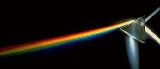
s in optics. Newton observed that when a narrow beam of sunlight
Sunlight

Sunlight, in the broad sense, is the total spectroscopy of the electromagnetic radiation given off by the Sun. On Earth, sunlight is Filter ed through the Earth's atmosphere, and the solar radiation is obvious as daylight when the Sun is above the horizon....
 strikes the face of a glass
Glass

Glass generally refers to a Hardness, brittle, transparency amorphous solid, such as that used for windows, many Glass Bottles, or eyewear, including, but not limited to, soda-lime glass, borosilicate glass, acrylic glass, sugar glass, Muscovite , or aluminium oxynitride....
 prism at an angle
Angle

In geometry and trigonometry, an angle is the figure formed by two Ray sharing a common endpoint, called the vertex of the angle . The magnitude of the angle is the "amount of rotation" that separates the two rays, and can be measured by considering the length of circular arc swept out when one ray is rotated about the vertex to coincide...
, some is reflected
Reflection (physics)

Reflection is the change in direction of a wavefront at an wiktionary:interface between two differentmedium so that the wavefront returns into the medium from which it originated....
 and some of the beam passes into and through the glass, emerging as different colored bands. Newton hypothesized that light was made up of "corpuscle
Corpuscle

Corpuscle may refer to:*a small free floating biological cell, especially a blood cell*a nerve ending such as Meissner's corpuscle or a Pacinian corpuscle...
s" (particles) of different colors, and that the different colors of light moved at different speeds in transparent matter, with red light moving more quickly in glass than violet light. The result is that red light was bent (refracted
Refraction

Refraction is the change in direction of a wave due to a change in its speed. This is most commonly observed when a wave passes from one optical medium to another....
) less sharply than violet light as it passed through the prism, creating a spectrum of colors.

Newton divided the spectrum into seven named colors: red
Red

Red is any of a number of similar colors evoked by light consisting predominantly of the longest wavelengths of light discernible by the human eye, in the wavelength range of roughly 625?740 Nanometer....
, orange
Orange (colour)

The color orange occurs between red and yellow in the visible Optical spectrum at a wavelength of about 585 ? 620 nanometre, and has a hue of 30? in HSV colour space....
, yellow
Yellow

Yellow is the color evoked by light that stimulates both the L and M cone cells of the retina about equally, but does not significantly stimulate the S cone cells; that is, light with much red and green but not very much blue....
, green
Green

Green is a color, the perception of which is evoked by light having a spectrum dominated by energy with a wavelength of roughly 520?570-Nanometre....
, blue
Blue

Blue is a colour, the perception of which is evoked by light having a spectrum dominated by energy with a wavelength of roughly 440?490 Nanometre....
, indigo
Indigo

Indigo is the color on the electromagnetic spectrum between about 420 and 450 nanometre in wavelength, placing it between blue and violet . Although traditionally considered one of seven divisions of the optical spectrum, modern color scientists do not usually recognize indigo as a separate division and generally classify wavelengths shorter...
, and violet
Violet (color)

As the name of a color, violet is used in two senses: first, referring to the color of light at the short-wavelength end of the optical spectrum, approximately 380?420 nanometre when indigo is recognized, or more commonly 380?450 nm ....
 (this order being popularly memorized by schoolchildren using the mnemonic ROY G. BIV
Roy G. Biv

Roy G. Biv is a mnemonic for the sequence of hues in the visible spectrum, in rainbows, and in order from longest to shortest wavelength:* Red...
). He chose seven colors out of a belief, derived from the ancient Greek sophists, that there was a connection between the colors, the musical notes, the known objects in the solar system
Solar System

The Solar System consists of the Sun and those Astronomical object bound to it by gravity: the eight planets and five dwarf planets, their 173 known Natural satellite, and billions of Small Solar System body....
, and the days of the week. The human eye is relatively insensitive to indigo's frequencies, and some otherwise well-sighted people cannot distinguish indigo from blue and violet. For this reason some commentators including Isaac Asimov
Isaac Asimov

Isaac Asimov , was a Russian-born United States author and professor of biochemistry, best known for his works of science fiction and for his popular science books....
 have suggested that indigo should not be regarded as a color in its own right but merely as a shade of blue or violet.

Johann Wolfgang von Goethe

was a Germans writer and according to George Eliot, "Germany's greatest man of letters? and the last true polymath to walk the earth." Goethe's works span the fields of poetry, drama, literature, theology, philosophy, humanism and science....
 contended that the continuous spectrum was a compound phenomenon. Whereas Newton narrowed the beam of light in order to isolate the phenomenon, Goethe observed that with a wider aperture, there was no spectrum – rather, there were reddish-yellow edges and blue-cyan edges with white
White

White is a color, the Color vision#Physiology of color perception which is evoked by light that stimulates all three types of color sensitive cone cells in the human eye in near equal amount and with high brightness compared to the surroundings....
 between them, and the spectrum only arose when these edges came close enough to overlap.

All light travels at the same speed
Speed of light

The speed of light in an free space is an important physical constant usually written as c, with a value of 299,792,458 metres per second....
 in a vacuum
Vacuum

A vacuum is a volume of space that is essentially empty of matter, such that its gaseous pressure is much less than atmospheric pressure. The word comes from the Latin term for "empty," but in reality, no volume of space can ever be perfectly empty....
. The speed of light
Speed of light

The speed of light in an free space is an important physical constant usually written as c, with a value of 299,792,458 metres per second....
 within a material is lower than the speed of light in a vacuum, and the ratio of speeds is known as the refractive index
Refractive index

The refractive index of a medium is a measure for how much the speed of light is reduced inside the medium. For example, typical soda-lime glass has a refractive index of 1.5, which means that in glass, light travels at times the speed of light in a vacuum....
 of the material. Because the refractive index
Refractive index

The refractive index of a medium is a measure for how much the speed of light is reduced inside the medium. For example, typical soda-lime glass has a refractive index of 1.5, which means that in glass, light travels at times the speed of light in a vacuum....
 (and thus the speed) of a wave in a material depends on its frequency
Frequency

Frequency is the number of occurrences of a repeating event per unit time. It is also referred to as temporal frequency.The period is the duration of one cycle in a repeating event, so the period is the reciprocal of the frequency....
 (in accordance with a dispersion relation
Dispersion relation

Dispersion relations describe the ways that wave propagation varies with the wavelength or frequency of a wave . This variation has long explained how white light is dispersed into different colors, thus making rainbows possible....
), light consisting of multiple frequencies—for instance white light—will be dispersed
Dispersion (optics)

In optics, dispersion is the phenomenon in which the phase velocity of a wave depends on its frequency.Media having such a property are termed dispersive media....
 at the interface between the material and air or vacuum. Both water and glass can be used to demonstrate dispersion; a glass prism
Prism

Prism may refer to:...
 yields an optical spectrum from white light, and rainbow
Rainbow

A rainbow is an optics and meteorology phenomenon that causes a optical spectrum of light to appear in the sky when the Sun shines onto droplets of moisture in the Earth's atmosphere....
s are an ideal example of natural refraction of the visible spectrum.

Spectral colors


Color
Color

Color or colour is the visual perception property corresponding in humans to the categories called red, yellow, blue and others....
Wavelength
Wavelength

In physics, wavelength is the distance between repeating units of a propagating wave of a given frequency. It is commonly designated by the Greek language letter lambda ....
violet
Violet (color)

As the name of a color, violet is used in two senses: first, referring to the color of light at the short-wavelength end of the optical spectrum, approximately 380?420 nanometre when indigo is recognized, or more commonly 380?450 nm ....
380–450 nm
blue
Blue

Blue is a colour, the perception of which is evoked by light having a spectrum dominated by energy with a wavelength of roughly 440?490 Nanometre....
450–495 nm
green
Green

Green is a color, the perception of which is evoked by light having a spectrum dominated by energy with a wavelength of roughly 520?570-Nanometre....
495–570 nm
yellow
Yellow

Yellow is the color evoked by light that stimulates both the L and M cone cells of the retina about equally, but does not significantly stimulate the S cone cells; that is, light with much red and green but not very much blue....
570–590 nm
orange
Orange (colour)

The color orange occurs between red and yellow in the visible Optical spectrum at a wavelength of about 585 ? 620 nanometre, and has a hue of 30? in HSV colour space....
590–620 nm
red
Red

Red is any of a number of similar colors evoked by light consisting predominantly of the longest wavelengths of light discernible by the human eye, in the wavelength range of roughly 625?740 Nanometer....
620–750 nm


Colors that can be produced by visible light of a single wavelength (monochromatic light) are referred to as the pure spectral colors
Spectral color

A spectral color is a color that is evoked by a single wavelength of light in the visible spectrum, or by a relatively narrow band of wavelengths....
.

Although the spectrum is continuous and therefore there are no clear boundaries between one color and the next, the ranges may be used as an approximation.

Spectroscopy


Atmospheric Electromagnetic Transmittance Or Opacity
The scientific study of objects based on the spectrum of color they emit is called Spectroscopy
Spectroscopy

Spectroscopy was originally the study of the interaction between radiation and matter as a function of wavelength . In fact, historically, spectroscopy referred to the use of visible light dispersed according to its wavelength, e.g....
. One particularly important application of spectroscopy is in astronomy
Astronomy

Astronomy is the science of Astronomical object and Phenomenon that originate outside the Earth's atmosphere . It is concerned with the evolution, physics, chemistry, meteorology, and motion of celestial objects, as well as the physical cosmology....
, where spectroscopy is essential for analysing the properties of distant objects. Typically, astronomical spectroscopy
Astronomical spectroscopy

Astronomical spectroscopy is the technique of spectroscopy used in astronomy. As spectroscopy is described in its own article, this article focuses on its use in astronomy....
 utilises high-dispersion diffraction grating
Diffraction grating

In optics, a diffraction grating is an optical component with a regular pattern, which splits light into several beams travelling in different directions....
s to observe spectra at very high spectral resolutions. Helium
Helium

Helium is a colorless, odorless, tasteless, non-toxic, inert monatomic chemical element that heads the noble gas group in the periodic table and whose atomic number is 2....
 was first detected through an analysis of the spectrum of the Sun
Sun

The Sun , a G V star, is the star at the center of the Solar System. The Earth and other matter orbit the Sun, which by itself accounts for about 98.6% of the Solar System's mass....
; chemical element
Chemical element

A chemical element is a type of atom that is distinguished by its atomic number; that is, by the number of protons in its atomic nucleus. The term is also used to refer to a pure chemical Chemical substance composed of atoms with the same number of protons....
s can be detected in astronomical objects by emission lines and absorption lines; the shifting of spectral lines can be used to measure the redshift
Redshift

In physics and astronomy, redshift occurs when electromagnetic radiation?usually visible light?emitted or reflected by an object is shifted towards the red end of the electromagnetic spectrum due to the Doppler effect....
 or blueshift of distant or fast-moving objects. The first exoplanets to be discovered were found by
Methods of detecting extrasolar planets

Any planet is an extremely faint light source compared to its parent star. In addition to the intrinsic difficulty of detecting such a faint light source, the light from the parent star causes a glare that washes it out....
 analysing the doppler shift of stars at such a high resolution that variations in their radial velocity
Radial velocity

Radial velocity is the velocity of an object in the direction of the line of sight . The light of an object with a substantial radial velocity will be subject to Doppler effect, so the frequency of the light decreases for receding objects and increases for approaching objects ....
 as small as a few metres per second could be detected: the presence of planets was revealed by their gravitational influence on the stars analysed, as revealed by their motion paths.

Color display spectrum


Color displays (e.g., computer monitors or televisions) mix red
Red

Red is any of a number of similar colors evoked by light consisting predominantly of the longest wavelengths of light discernible by the human eye, in the wavelength range of roughly 625?740 Nanometer....
, green
Green

Green is a color, the perception of which is evoked by light having a spectrum dominated by energy with a wavelength of roughly 520?570-Nanometre....
, and blue
Blue

Blue is a colour, the perception of which is evoked by light having a spectrum dominated by energy with a wavelength of roughly 440?490 Nanometre....
 color to create colors within their respective color triangle
Color triangle

A color triangle is an arrangement of colors within a triangle, based on the Additive color combination of three primary colors at its corners....
s, and so can only approximately represent spectral colors, which are in general outside any color triangle.

See also


  • Color vision
    Color vision

    Color vision is the capacity of an organism or machine to distinguish objects based on the wavelengths of the light they reflect or emit. The nervous system derives color by comparing the responses to light from the several types of Cone cell in the eye....
  • High-energy visible light
  • Light
    Light

    Light, or visible light, is electromagnetic radiation of a wavelength that is Visible spectrum to the human eye , or up to 380?750 nm. In the broader field of physics, light is sometimes used to refer to electromagnetic radiation of all wavelengths, whether visible or not....
  • Theory of Colours
    Theory of Colours

    Theory of Colours is a book by Johann Wolfgang von Goethe published in 1810. The work comprises three sections: i) a didactic section in which Goethe presents his own observations, ii) a polemic section in which he makes his case against Newton, and iii) a historical section....