
All Topics  
Tungsten carbide

 
Tungsten Carbide

   Email Print
   Bookmark   Link


Tungsten carbide


Tungsten carbide, WC, or tungsten semicarbide, W2C, is a chemical compound containing tungsten
Tungsten

Tungsten , also known as wolfram , is a chemical element that has the symbol W and atomic number 74.A steel-gray metal, tungsten is found in several ores, including wolframite and scheelite....
 and carbon
Carbon

Carbon is a chemical element with chemical symbol C and atomic number 6. As a member of group 14 on the periodic table, it is nonmetallic and tetravalence?making four electrons available to form covalent bond chemical bonds....
, similar to titanium carbide
Titanium carbide

Titanium carbide, TitaniumCarbon, is an extremely hardness refraction ceramic material, similar to tungsten carbide.It is commercially used in tool bits cutting tools....
. Colloquially, tungsten carbide is often simply called carbide
Carbide

In chemistry, a carbide is a compound composed of carbon and a less electronegativity element. Carbides can be generally classified by chemical bonding type as follows: salt-like, covalent compounds, interstitial compounds, and "intermediate" transition metal carbides....
.

e are two well characterized compounds of tungsten and carbon, WC and W2C. Both compounds may be present in coatings and the proportions can depend on the coating method.

WC can be prepared by reaction of tungsten metal and carbon at 1400–2000 °C. Other methods include a patented fluid bed process that reacts either tungsten metal or blue WO3 with CO/CO2 mixture and H2 between 900 and 1200 °C.


Discussion
Ask a question about 'Tungsten carbide'
Start a new discussion about 'Tungsten carbide'
Answer questions from other users
Full Discussion Forum


Recent Posts


Encyclopedia


Tungsten carbide, WC, or tungsten semicarbide, W2C, is a chemical compound containing tungsten
Tungsten

Tungsten , also known as wolfram , is a chemical element that has the symbol W and atomic number 74.A steel-gray metal, tungsten is found in several ores, including wolframite and scheelite....
 and carbon
Carbon

Carbon is a chemical element with chemical symbol C and atomic number 6. As a member of group 14 on the periodic table, it is nonmetallic and tetravalence?making four electrons available to form covalent bond chemical bonds....
, similar to titanium carbide
Titanium carbide

Titanium carbide, TitaniumCarbon, is an extremely hardness refraction ceramic material, similar to tungsten carbide.It is commercially used in tool bits cutting tools....
. Colloquially, tungsten carbide is often simply called carbide
Carbide

In chemistry, a carbide is a compound composed of carbon and a less electronegativity element. Carbides can be generally classified by chemical bonding type as follows: salt-like, covalent compounds, interstitial compounds, and "intermediate" transition metal carbides....
.

Chemical properties

There are two well characterized compounds of tungsten and carbon, WC and W2C. Both compounds may be present in coatings and the proportions can depend on the coating method.

WC can be prepared by reaction of tungsten metal and carbon at 1400–2000 °C. Other methods include a patented fluid bed process that reacts either tungsten metal or blue WO3 with CO/CO2 mixture and H2 between 900 and 1200 °C. Chemical vapor deposition methods that have been investigated include:

  • tungsten hexachloride
    Tungsten hexachloride

    Tungsten hexachloride is the chemical compound with the chemical formula WCl6. This dark violet blue species exists as a volatile solid under standard conditions....
     with hydrogen, as reducing agent and methane
    Methane

    Methane is a chemical compound with the molecular formula . It is the simplest alkane, and the principal component of natural gas. Methane's bond angles are 109.5 degrees....
     as the source of carbon at
WCl6 + H2 + CH4 ? WC + 6HCl


  • reacting tungsten hexafluoride with hydrogen as reducing agent and methanol
    Methanol

    Methanol, also known as methyl alcohol, carbinol, wood alcohol, wood naphtha or wood spirits, is a chemical compound with chemical formula carbonhydrogen3oxygenhydrogen ....
     as source of carbon at
WF6 + H2 + CH3OH ? WC + 6HF + H2O


  • At high temperatures WC decomposes to tungsten and carbon and this can occur during high temperature thermal spray, e.g. high velocity oxygen fuel (HVOF) and high energy plasma (HEP) methods.


  • Oxidation of WC starts at 500–600 °C. It is resistant to acids and is only attacked by hydrofluoric acid
    Hydrofluoric acid

    Hydrofluoric acid is a solution of hydrogen fluoride in water. While it is extremely corrosive and dangerous to handle, it is technically a weak acid....
    /nitric acid
    Nitric acid

    Nitric acid , also known as aqua fortis and spirit of nitre, is a highly corrosion and toxic strong acid that can cause severe burns....
     (HF/HNO3) mixtures above room temperature. It reacts with fluorine gas at room temperature and chlorine above and is unreactive to dry H2 up to its melting point.


WC has been investigated for its potential use as a catalyst and it has been found to resemble platinum
Platinum

Platinum is a chemical element with the chemical symbol Pt and an atomic number of 78. Its name is derived from the Spanish term platina del Pinto, which is literally translated into "little silver of the Pinto River." It is in Group 10 of the periodic table of elements....
 in its catalysis the production of water from hydrogen and oxygen at room temperature, the reduction of tungsten trioxide by hydrogen in the presence of water, and the isomerization of 2,2-dimethylpropane to 2-methylbutane. It has been proposed as a replacement for the iridium
Iridium

Iridium is the chemical element with atomic number 77, and is represented by the symbol Ir. A very hard, brittle, silvery-white transition metal of the platinum group, iridium is the second densest element and is the most corrosion-resistant metal, even at temperatures as high as 2000 ?C....
 catalyst in hydrazine
Hydrazine

Hydrazine is a chemical compound with the chemical formula N2H4. It is a colourless liquid with an ammonia-like odor and is derived from the same industrial chemistry processes that manufacture ammonia....
 powered satellite thrusters.

Physical properties

Tungsten carbide is high melting, , extremely hard 8.5–9.0 Mohs scale
Mohs scale of mineral hardness

Not to be confused with Siemens_#Mho, a unit of electric conductance.The Mohs scale of mineral hardness characterizes the scratch resistance of various minerals through the ability of a harder material to scratch a softer material....
 at 22 GPa Vickers hardness
Vickers hardness test

The Vickers hardness test was developed in 1924 by Smith and Sandland at Vickers Ltd as an alternative to the Brinell_scale method to measure the hardness of materials....
 with low electrical resistivity
Resistivity

Electrical resistivity is a measure of how strongly a material opposes the flow of electric current. A low resistivity indicates a material that readily allows the movement of electrical charge....
 (1.7–2.2x10⁻⁷ ohm-m), comparable with metals (e.g. vanadium
Vanadium

Vanadium is the chemical element with the symbol V and atomic number 23. It is a soft, silvery grey, ductile transition metal. The formation of an oxide layer stabilizes the metal against oxidation....
 1.99x10⁻⁷ ohm-m).

WC is readily wetted by both molten nickel
Nickel

Nickel is a chemical element, with the chemical symbol Ni and atomic number 28. It is a silvery-white lustrous metal with a slight golden tinge....
 and cobalt
Cobalt

Cobalt is a hard, lustrous, grey metal, a chemical element with symbol Co and atomic number 27. Although cobalt-based colors and pigments have been used since ancient times, and miners have long used the name kobold ore for some minerals, cobalt was only discovered in 1735 by Georg Brandt....
. Investigation of the phase diagram of the W-C-Co system shows that WC and Co form a pseudo binary eutectic
Eutectic point

The melting point of a mixture of two or more solids depends on the relative proportions of its ingredients. A eutectic or eutectic mixture is a mixture at such proportions that the melting point is as low as possible, and that furthermore all the constituents crystallize simultaneously at this temperature from molten liquid solution....
. The phase diagram
Phase diagram

A phase diagram in physical chemistry, mineralogy, and materials science is a type of Graph of a function used to show conditions at which thermodynamically-distinct phase can occur at thermodynamic equilibrium....
 also shows that there are so-called ?-carbides with composition (W,Co)6C that can be formed and the fact that these phases are brittle is the reason why control of the carbon content in WC-Co hard metals is important.

Structure

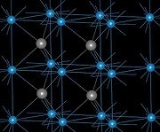
There are two forms of WC, a hexagonal form, a-WC, and a cubic high temperature form, ß-WC, which has the rock salt structure. The hexagonal form can be visualized as made up of hexagonally close packed layers of metal atoms with layers lying directly over one another, with carbon atoms filling half the interstices giving both tungsten and carbon a regular trigonal prismatic, 6 coordination. From the unit cell dimensions the following bond lengths can be determined; the distance between the tungsten atoms in an hexagonally packed layer is 291 pm, the shortest distance between tungsten atoms in adjoining layers is 284 pm, and the tungsten carbon bond length is 220 pm. The tungsten-carbon bond length is therefore comparable to the single bond in W(CH3)6 (218pm) in which there is strongly distorted trigonal prismatic coordination of tungsten.

Molecular WC has been investigated and this gas phase species has a bond length of 171 pm for 184W12C.

Toxicity

The primary health risks associated with carbide relate to inhalation of dust, leading to fibrosis
Fibrosis

Fibrosis is the formation or development of excess fibrous connective tissue in an organ or tissue as a reparative or reactive process, as opposed to a formation of fibrous tissue as a normal constituent of an organ or tissue....
.

Applications


Machine tools

Carbide cutting surfaces are often used for machining through materials such as carbon steel or stainless steel
Stainless steel

In metallurgy, stainless steel is defined as a steel alloy with a minimum of 10% chromium content by mass. Stainless steel does not stain, corrode, or rust as easily as ordinary steel , but it is not stain-proof....
, as well as in situations where other tools would wear away, such as high-quantity production runs. Most of the time, carbide will leave a better finish on the part, and allow faster machining. Carbide tools can also withstand higher temperatures than standard high speed steel
High speed steel

High speed steel is a material usually used in the manufacture of machine tool bits and other cutters. It is often used in power saw blades and drill bits....
 tools. The material is usually called cemented carbide
Cemented carbide

Cemented carbide, also called tungsten-carbide cobalt or hardmetal or widia, is an hard material used to machining through materials such as carbon steel or stainless steel, as well as in situations where other tools would wear away, such as high-quantity production runs....
, hardmetal or tungsten-carbide cobalt: it is a metal matrix composite
Metal matrix composite

A metal matrix composite is composite material with at least two constituent parts, one being a metal. The other material may be a different metal or another material, such as a ceramic or organic compound....
 where tungsten carbide particles are the aggregate and metallic cobalt
Cobalt

Cobalt is a hard, lustrous, grey metal, a chemical element with symbol Co and atomic number 27. Although cobalt-based colors and pigments have been used since ancient times, and miners have long used the name kobold ore for some minerals, cobalt was only discovered in 1735 by Georg Brandt....
 serves as the matrix.

Military

Tungsten carbide is often used in armor-piercing ammunition
Armor-piercing shot and shell

An armor-piercing shell is a type of ammunition designed to penetrate armor. From the 1860s to 1950s, a major application of armor-piercing projectiles was to defeat the thick armor carried on many warships....
, especially where depleted uranium
Depleted uranium

Depleted uranium is uranium primarily composed of the isotope uranium-238 . Natural uranium is about 99.27 percent U-238, 0.72 percent uranium-235, and 0.0055 percent uranium-234....
 is not available or not politically acceptable. The first use of W2C projectiles occurred in German
Nazi Germany

Nazi Germany and the Third Reich are the colloquial English names for Germany under the regime of Adolf Hitler and the Nazi Party , which established a Totalitarianism dictatorship that existed from 1933 to 1945....
 Luftwaffe
Luftwaffe

is a generic German term for an air force. It is also the official name for two of the four historic German air forces, the Wehrmacht air arm founded in 1933 and disbanded in 1946; and the current Bundeswehr air arm founded in 1956....
 tank
Tank

A tank is a Continuous track, armoured fighting vehicle designed for front-line combat which combines operational mobility and Military tactics Offensive and defence capabilities....
-hunter squadrons, which used 37 mm autocannon
Autocannon

File:Autocannon MLG27.jpgAn autocannon is a rapid fire projectile weapon. Autocannon often have a larger caliber than a machine gun , but there is no maximum or minimum caliber that makes a weapon an autocannon....
 equipped Junkers Ju 87G
Junkers Ju 87

The Junkers Ju 87 or Stuka was a two-seat Nazi Germany ground-attack aircraft of World War II.Designed by Hermann Pohlmann, the Stuka first flew in 1935 and made its combat debut in 1936 as part of the Luftwaffe's Condor Legion during the Spanish Civil War....
  dive bomber
Dive bomber

A dive bomber is a bomber aircraft that dives directly at its targets in order to provide greater accuracy and limit the exposure to and effectiveness of Anti-aircraft warfare fire....
 aircraft to destroy Soviet
Soviet Union

The Union of Soviet Socialist Republics was a Constitution of the Soviet Union socialist state that existed in Eurasia from 1922 to 1991.The name is a translation of the , romanization of Russian Soyuz Sovetskikh Sotsialisticheskikh Respublik, abbreviated ????, SSSR....
 T-34
T-34

The T-34 was a Soviet Union Tank classification produced from 1940 to 1958. It is widely regarded as having been the world's best tank when the Soviet Union became involved in World War II, and although its armoured fighting vehicle and armament were surpassed by later tanks of the era, it has been often credited as the war's most effective,...
 tanks in World War II
World War II

World War II, or the Second World War , was a global military conflict which involved a Participants in World War II, including all of the great powers, organised into two opposing military alliances: the Allies of World War II and the Axis powers....
. Owing to the limited German reserves of tungsten, W2C material was reserved for making machine tools and small numbers of projectiles for the most elite combat pilots, like Hans Rudel. It is an effective penetrator due to its high hardness value combined with a very high density.

Tungsten carbide ammunition can be of the sabot type
Sabot

A sabot is a device used in a firearm or cannon to fire a projectile, such as a bullet, that is smaller than the caliber diameter. The term is also applied to a battery stub case, a device used similarly to make a small battery usable instead of a List of battery sizes one....
 (a large arrow surrounded by a discarding push cylinder) or a subcaliber ammunition, where copper or other relatively soft material is used to encase the hard penetrating core, the two parts being separated only on impact. The latter is more common in small-caliber arms, while sabots are usually reserved for artillery use.

Tungsten carbide is also an effective neutron reflector
Neutron reflector

A neutron reflector is any material that reflects neutrons. Usually, this term refers to the elastic scattering rather than to a specular reflection....
 and as such was used during early investigations into nuclear chain reactions, particularly for weapons. A criticality accident
Criticality accident

A criticality accident, sometimes referred to as an excursion or a power excursion, occurs when a nuclear chain reaction accidentally occurs in fissile material, such as enriched uranium or plutonium....
 occurred at Los Alamos National Laboratory
Los Alamos National Laboratory

Los Alamos National Laboratory is a United States Department of Energy United States Department of Energy National Labs, managed and operated by Los Alamos National Security, LLC , located in Los Alamos, New Mexico....
 on 21 August 1945 when Harry K. Daghlian, Jr.
Harry K. Daghlian, Jr.

Harry K. Daghlian, Jr., was an Armenians-United States physicist with the Manhattan Project who accidentally irradiated himself on August 21, 1945 during a critical mass experiment at the remote Omega Site facility at Los Alamos National Laboratory in New Mexico, resulting in his death 21 days later....
 accidentally dropped a tungsten carbide brick onto a plutonium
Plutonium

Plutonium is a rare transuranic radioactive chemical element. It is an actinide metal of silvery-white appearance that tarnishes when exposed to air, forming a dull coating when plutonium oxide....
 sphere, causing the sub-critical mass to go critical with the reflected neutrons.

Sports

Hard carbides, especially tungsten carbide, are used by athletes, generally on poles which impact hard surfaces. Trekking poles
Trekking poles

Trekking poles are a common hiking accessory. When in use, they resemble ski poles as they have many features in common, such as baskets at the bottom, rubber-padded handles and wrist straps....
, used by many hikers
Hiking

Hiking is an outdoor activity which consists of walking in natural environments, often on trail. It is such a popular activity that there are numerous :Category:Hiking organizations worldwide....
 for balance and to reduce pressure on leg joints, generally use carbide tips in order to gain traction when placed on hard surfaces (like rock); such carbide tips last much longer than other types of tips.

While ski
Ski

A ski is a long, flat device worn on the feet designed to help the wearer slide smoothly over snow. Originally intended as an aid to travel in snowy regions, they are now primarily used for recreational and sporting purposes....
 pole
Ski pole

Ski poles are used by skiing to improve balance, speed and acceleration. They probably evolved from walking sticks carried while traveling, and possibly from spears as well....
 tips are generally not made of carbide, since they do not need to be especially hard even to break through layers of ice, rollerski tips usually are. Roller skiing emulates cross country skiing and is used by many skiers to train during warm weather months.

Sharpened carbide tipped spikes (known as studs) can be inserted into the drive tracks of snowmobile
Snowmobile

A snowmobile, also known in some places as a snowmachine, is a land vehicle for travel on snow that is commonly propelled by a continuous track or tracks at the rear and steered by skis at the front....
s. These studs enhance traction on icy surfaces. Longer v-shaped segments fit into grooved rods called wear rods under each snowmobile ski. The relatively sharp carbide edges enhance steering on harder icy surfaces. The carbide tips and segments reduce wear encountered when the snowmobile must cross roads and other abrasive surfaces.

Some tire manufacturers, such as Nokian and Schwalbe, offer bicycle tires with tungsten carbide studs for better traction on ice. These are generally preferred over steel studs because of their wear resistance.

Domestic

Tungsten carbide is used as the rotating ball in the tips of ballpoint pen
Ballpoint pen

A ballpoint pen , is a modern writing instrument. A ballpoint pen has an internal chamber filled with a viscosity ink that is dispensed at the tip during use by the rolling action of a small metal sphere of brass, steel or tungsten carbide....
s to disperse ink during writing.

Tungsten carbide steel is used in most razors.

Tungsten carbide can now be found in the inventory of some jewelers, most notably as the primary material in men's wedding bands. When used in this application the bands appear with a lustrous dark hue often buffed to a mirror finish. The color is more similar to that of hematite than to that of platinum. The finish is highly resistant to scratches and scuffs, holding its mirror-like shine for years.

A common misconception held concerning tungsten carbide rings is they cannot be removed in the course of emergency medical treatment, requiring the finger to be removed instead. Emergency rooms and many full-service jewelry repair shops are equipped with jewelers' saws that can cut through gold, silver, platinum, titanium, and tungsten carbide rings without injuring the patient when the ring cannot be slipped off easily. Tungsten carbide rings can also be removed in an emergency situation by cracking them into pieces with standard vice grip–style locking pliers.

Many manufacturers of this emerging jewelry material state that the use of a cobalt binder may cause unwanted reactions between the cobalt and the natural oils on human skin. Skin oils cause the cobalt to leach from the material. This is said to cause possible irritation of the skin and permanent staining of the jewelry itself. Many manufacturers now advertise that their jewelry is "cobalt free". This is achieved by replacing the cobalt with nickel as a binder.

External links