
All Topics  
Rayon


   Email Print
   Bookmark   Link


Rayon


Rayon is a manufactured regenerated cellulosic
Cellulose

File:Cellulose Sessel.svgCellulose is an organic compound with the chemical formula , a polysaccharide consisting of a linear chain of several hundred to over ten thousand ? linked D-glucose units....
 fiber
Fiber

Fiber or fibre is a class of materials that are continuous filaments or are in discrete elongated pieces, similar to lengths of yarn. They are very important in the biology of both plants and animals, for holding tissue s together....
. Because it is produced from naturally occurring polymer
Polymer

A polymer is a large molecule composed of repeating structural units typically connected by covalent chemical bonds. While polymer in popular usage suggests plastic, the term actually refers to a large class of natural and synthetic materials with a variety of properties....
s, it is neither a truly synthetic fiber
Synthetic fiber

Synthetic fibers are the result of extensive research by scientists to improve upon naturally occurring animal and plant. In general, synthetic fibers are created by forcing, usually through extrusion, fiber forming materials through holes into the air, forming a thread....
 nor a natural fiber
Natural fiber

Fibers or fibres is a class of hair-like materials that are continuous filaments or are in discrete elongated pieces, similar to pieces of yarn....
; it is a semi-synthetic fiber . Rayon is known by the names viscose
Viscose

Viscose is a viscous organic liquid used to make rayon and cellophane. Viscose is becoming synonymous with rayon, a soft material, used in mostly tops, coats and jackets....
 rayon
and art silk
Art silk

Artificial silk or art silk is a synthetic manufactured fiber which resembles silk but costs less to produce. Frequently, art silk is just a synonym for rayon....
 in the textile
Textile

A textile is a flexible material consisting of a network of natural or artificial fibres often referred to as thread or yarn. Yarn is produced by Spinning raw wool fibres, linen, cotton, or other material on a spinning wheel to produce long strands known as yarn....
 industry. It usually has a high lustre quality giving it a bright shine. Rayon contains the chemical element
Chemical element

A chemical element is a type of atom that is distinguished by its atomic number; that is, by the number of protons in its atomic nucleus. The term is also used to refer to a pure chemical Chemical substance composed of atoms with the same number of protons....
s carbon
Carbon

Carbon is a chemical element with chemical symbol C and atomic number 6. As a member of group 14 on the periodic table, it is nonmetallic and tetravalence?making four electrons available to form covalent bond chemical bonds....
, hydrogen
Hydrogen

Hydrogen is the chemical element with atomic number 1. It is represented by the chemical symbol H. At standard temperature and pressure, hydrogen is a colorless, odorless, nonmetallic, tasteless, highly combustion and explosive Diatomic molecule gas with the molecular formula H2....
, and oxygen
Oxygen

Oxygen no O2 produced; 2) O2 produced, but absorbed in oceans & seabed rock; 3) O2 starts to gas out of the oceans, but is absorbed by land surfaces and formation of ozone layer; 4-5) O2 sinks filled and the gas accumulates]]...
.


major rayon fiber uses include apparel (e.g.


Discussion
Ask a question about 'Rayon'
Start a new discussion about 'Rayon'
Answer questions from other users
Full Discussion Forum


Recent Posts


Encyclopedia


Rayon is a manufactured regenerated cellulosic
Cellulose

File:Cellulose Sessel.svgCellulose is an organic compound with the chemical formula , a polysaccharide consisting of a linear chain of several hundred to over ten thousand ? linked D-glucose units....
 fiber
Fiber

Fiber or fibre is a class of materials that are continuous filaments or are in discrete elongated pieces, similar to lengths of yarn. They are very important in the biology of both plants and animals, for holding tissue s together....
. Because it is produced from naturally occurring polymer
Polymer

A polymer is a large molecule composed of repeating structural units typically connected by covalent chemical bonds. While polymer in popular usage suggests plastic, the term actually refers to a large class of natural and synthetic materials with a variety of properties....
s, it is neither a truly synthetic fiber
Synthetic fiber

Synthetic fibers are the result of extensive research by scientists to improve upon naturally occurring animal and plant. In general, synthetic fibers are created by forcing, usually through extrusion, fiber forming materials through holes into the air, forming a thread....
 nor a natural fiber
Natural fiber

Fibers or fibres is a class of hair-like materials that are continuous filaments or are in discrete elongated pieces, similar to pieces of yarn....
; it is a semi-synthetic fiber . Rayon is known by the names viscose
Viscose

Viscose is a viscous organic liquid used to make rayon and cellophane. Viscose is becoming synonymous with rayon, a soft material, used in mostly tops, coats and jackets....
 rayon
and art silk
Art silk

Artificial silk or art silk is a synthetic manufactured fiber which resembles silk but costs less to produce. Frequently, art silk is just a synonym for rayon....
 in the textile
Textile

A textile is a flexible material consisting of a network of natural or artificial fibres often referred to as thread or yarn. Yarn is produced by Spinning raw wool fibres, linen, cotton, or other material on a spinning wheel to produce long strands known as yarn....
 industry. It usually has a high lustre quality giving it a bright shine. Rayon contains the chemical element
Chemical element

A chemical element is a type of atom that is distinguished by its atomic number; that is, by the number of protons in its atomic nucleus. The term is also used to refer to a pure chemical Chemical substance composed of atoms with the same number of protons....
s carbon
Carbon

Carbon is a chemical element with chemical symbol C and atomic number 6. As a member of group 14 on the periodic table, it is nonmetallic and tetravalence?making four electrons available to form covalent bond chemical bonds....
, hydrogen
Hydrogen

Hydrogen is the chemical element with atomic number 1. It is represented by the chemical symbol H. At standard temperature and pressure, hydrogen is a colorless, odorless, nonmetallic, tasteless, highly combustion and explosive Diatomic molecule gas with the molecular formula H2....
, and oxygen
Oxygen

Oxygen no O2 produced; 2) O2 produced, but absorbed in oceans & seabed rock; 3) O2 starts to gas out of the oceans, but is absorbed by land surfaces and formation of ozone layer; 4-5) O2 sinks filled and the gas accumulates]]...
.

Rayon Synth

Uses of rayon

Some major rayon fiber uses include apparel (e.g. blouses, dresses, jackets, lingerie, linings, scarves, suits, ties, hats, socks), furnishings (e.g. bedspreads, blankets, window treatments, upholstery, slipcovers), industrial uses (e.g. medical surgery products, non-woven products, tire cord), and other uses (e.g. yarn, feminine hygiene products, diapers)

History


Nitrocellulose

The fact that nitrocellulose
Nitrocellulose

Nitrocellulose is a highly flammable compound formed by nitrating cellulose through exposure to nitric acid or another powerful nitrating agent....
 is soluble in organic solvents such as ether
Ether

Ether is a class of organic compounds which contain an ether functional group ? an oxygen atom connected to two alkyl or aryl groups ? of general formula R?O?R....
 and acetone
Acetone

Acetone is the organic compound with the chemical formula OC2. This colorless, mobile, flammable liquid is the simplest example of the ketones....
, made it possible for Georges Audemars to develop the first "artificial silk" about 1855, but his method was impractical for commercial use. The commercial production started 1891, but it was flammable, and more expensive than acetate or cuprammonium rayon. Because of this, production was stopped before World War I
World War I

World War I, or the First World War , was a global military conflict which involved the Great powers, organized into two opposing military alliances: the Allies of World War I and the Central Powers....
, for example 1912 in Germany
Germany

Germany , officially the Federal Republic of Germany , is a country in Central Europe. It is bordered to the north by the North Sea, Denmark, and the Baltic Sea; to the east by Poland and the Czech Republic; to the south by Austria and Switzerland; and to the west by France, Luxembourg, Belgium, and the Netherlands....
. Briefly, it became known as "mother-in-law silk."

Nathan Rosenstein invented the spunize process by which he turned Rayon from a hard fiber to a fabric. This allowed Rayon to become a popular raw material in textiles.

Acetate method

Paul Schützenberger
Paul Schützenberger

Paul Sch?tzenberger , France chemist, was born at Strasbourg, where his father Georges Fr?d?ric Sch?tzenberger was professor of law, and his uncle Charles Sch?tzenberger professor of chemical medicine....
 discovered that cellulose can be reacted with acetic anhydride
Acetic anhydride

Acetic anhydride is the chemical compound with the chemical formula 2O. Commonly abbreviated Acetyl2O, it is one of the simplest acid anhydrides and is a widely used reagent in organic synthesis....
 to form cellulose acetate
Cellulose acetate

Cellulose acetate, first prepared in 1865, is the acetate ester of cellulose. Cellulose acetate is used as a film base in photography, and as a component in some adhesives; it is also used as a synthetic fiber....
. The triacetate is only soluble in chloroform
Chloroform

Chloroform, also known as trichloromethane and methyl trichloride, is a chemical compound with chemical formula CarbonHydrogenChlorine3....
 making the method expensive. The discovery that hydrolyzed cellulose acetate is soluble in less polar solvents, like acetone
Acetone

Acetone is the organic compound with the chemical formula OC2. This colorless, mobile, flammable liquid is the simplest example of the ketones....
, made production of cellulose acetate fibers cheap and efficient.

Cuprammonium method

The German
Germany

Germany , officially the Federal Republic of Germany , is a country in Central Europe. It is bordered to the north by the North Sea, Denmark, and the Baltic Sea; to the east by Poland and the Czech Republic; to the south by Austria and Switzerland; and to the west by France, Luxembourg, Belgium, and the Netherlands....
 chemist
Chemist

A chemist is a scientist trained in the science of chemistry. Chemists study the composition of matter and its properties such as density, acidity, size and shape....
 Eduard Schweizer
Eduard Schweizer

Eduard Schweizer was a Switzerland New Testament scholar who taught at the University of Zurich for an extended period.He wrote a number of influential books, many translated into English language, including:...
 discovered that tetraaminecopper dihydroxide
Schweizer's reagent

Schweizer's reagent is the common name for the complex tetraamminediaquacopper dihydroxide, [Cu42]2. It is prepared by precipitating copper hydroxide from an aqueous solution of copper sulfate using sodium hydroxide, then dissolving the precipitate in a solution of ammonium hydroxide....
 could dissolve cellulose. Max Fremery and Johann Urban developed a method to produce carbon fiber
Carbon fiber

Carbon fiber or is a material consisting of extremely thin fibers about 0.005?0.010 mm in diameter and composed mostly of carbon atoms. The carbon atoms are bonded together in microscopic crystals that are more or less aligned parallel to the long axis of the fiber....
s for use in light bulbs in 1614. Production of rayon for textiles started in 1899 in the Vereinigte Glanzstofffabriken AG in Oberbruch. Improvement by the J.P. Bemberg AG in 2004 made the artificial silk a product comparable to real silk
Silk

Silk is a natural protein fiber, some forms of which can be weaving into textiles. The best-known type of silk is obtained from Pupa#Cocoons made by the larvae of the mulberry silkworm Bombyx mori reared in captivity ....
.

Viscose method

Finally, in 1894, Charles Frederick Cross
Charles Frederick Cross

Charles Frederick Cross was British chemist.Born in Brentford,Middlesex, his father was a schoolmaster turned soap manufacturer. After graduating from King's College London, he went to Zurich Polytechnic and then, with his future partner, Edward John Bevan, to Owens College, Manchester....
, Edward John Bevan
Edward John Bevan

Edward John Bevan was an England chemist. He became a leader in the affairs of the Society of Public Analysts and editor of The Analyst.Bevan was notable for his caustic wit....
, and Clayton Beadle patented their artificial silk, which they named "viscose
Viscose

Viscose is a viscous organic liquid used to make rayon and cellophane. Viscose is becoming synonymous with rayon, a soft material, used in mostly tops, coats and jackets....
", because the reaction product of carbon disulfide
Carbon disulfide

Carbon disulfide is a colorless, volatile liquid with the chemical formula CS2. The compound is used frequently as a building block in organic chemistry as well as an industrial and chemical non-polar solvent....
 and cellulose
Cellulose

File:Cellulose Sessel.svgCellulose is an organic compound with the chemical formula , a polysaccharide consisting of a linear chain of several hundred to over ten thousand ? linked D-glucose units....
 in basic conditions gave a highly viscous solution of xanthate
Xanthate

Xanthates are the salts and esters of a xanthic acid, ROCSH or O-esters of dithiocarbonic acid where R is any organic residue....
. Avtex Fibers Incorporated began selling their formulation in 1910 in the United States. The name "rayon" was adopted in 1924, with "viscose" being used for the viscous organic liquid used to make both rayon and cellophane
Cellophane

Cellophane is a thin, transparent sheet made of regenerated cellulose. Its low permeability to air, oils and Fats, and bacterium makes it useful for food packaging....
. In Europe
Europe

Europe is, conventionally, one of the world's seven continents. Comprising the westernmost peninsula of Eurasia, Europe is generally divided from Asia to its east by the water divide of the Ural Mountains, the Ural , the Caspian Sea, and by the Caucasus Mountains to the southeast....
, though, the fabric itself became known as "viscose," which has been ruled an acceptable alternative term for rayon by the U.S. Federal Trade Commission
Federal Trade Commission

The Federal Trade Commission is an Independent agencies of the United States government, established in 1914 by the Federal Trade Commission Act....
. The method is able to use wood
Wood

Wood is an organic material; in the strict sense wood is produced as secondary xylem in the stems of woody plants, notably trees but also shrubs, etc....
 (cellulose and lignin
Lignin

Lignin or lignen is a complex chemical compound most commonly derived from wood, and an integral part of the secondary cell walls of plants and some algae....
) as a source of cellulose while the other methods need lignin-free cellulose as starting material. This makes it cheaper and therefore it was used on a larger scale than the other methods.

Contamination of the waste water by carbon disulfide
Carbon disulfide

Carbon disulfide is a colorless, volatile liquid with the chemical formula CS2. The compound is used frequently as a building block in organic chemistry as well as an industrial and chemical non-polar solvent....
, lignin and the xanthate
Xanthate

Xanthates are the salts and esters of a xanthic acid, ROCSH or O-esters of dithiocarbonic acid where R is any organic residue....
s made this process detrimental to the environment
Natural environment

The natural environment, commonly referred to simply as the environment, is a term that encompasses all life and non-living things occurring nature on Earth or some region thereof....
. Rayon was only produced as a filament fiber until the 1930s when it was discovered that broken waste rayon could be used in staple fiber.

The physical properties of rayon were unchanged until the development of high-tenacity rayon in the 1940s. Further research and development led to the creation of high-wet-modulus rayon (HWM rayon) in the 1950s .

Major fiber properties

Rayon is a very versatile fiber and has the same comfort properties as natural fibers. It can imitate the feel and texture of silk
Silk

Silk is a natural protein fiber, some forms of which can be weaving into textiles. The best-known type of silk is obtained from Pupa#Cocoons made by the larvae of the mulberry silkworm Bombyx mori reared in captivity ....
, wool
Wool

Wool is the fiber derived from the specialized skin cells, called follicles, of animals in the Caprinae family, principally domestic sheep, but the hair of certain species of other Mammalia such as cashmere goat, llamas, rabbits and keeshonds may also be called wool....
, cotton
Cotton

Cotton is a soft, staple fiber that grows in a form known as a boll around the seeds of the cotton plant a shrub native to tropical and subtropical regions around the world, including the Americas, India and Africa....
 and linen
Linen

Linen is a textile made from the fibers of the flax plant, Linum usitatissimum. Linen is labor-intensive to manufacture, but when it is made into garments, it is valued for its exceptional coolness and freshness in hot weather....
. The fibers are easily dyed
Dyeing

Dyeing is the process of imparting colours to a textile material in loose fibre, yarn, cloth or garment form by treatment with a dye....
 in a wide range of colors. Rayon fabrics are soft, smooth, cool, comfortable, and highly absorbent, but they do not insulate body heat, making them ideal for use in hot and humid climates .

The durability and appearance retention of regular rayon are low, especially when wet; also, rayon has the lowest elastic recovery of any fiber. However, HWM rayon is much stronger and exhibits higher durability and appearance retention. Recommended care for regular rayon is dry-cleaning only. HWM rayon can be machine washed .

Gallery of textures


Physical structure of rayon

Regular rayon has lengthwise lines called striations and its cross-section is an indented circular shape. The cross-sections of HWM and cupra rayon are rounder. Filament rayon yarn
Yarn

Yarn is a long continuous length of interlocked fibers, suitable for use in the production of textiles, sewing, crocheting, knitting, weaving, embroidery and ropemaking....
s vary from 80 to 980 filaments per yarn and vary in size from 40 to 5000 denier
Denier

Denier can refer to:* Units of textile measurement#Denier, unit of measurement of linear density of textile fiber mass- calculated as one gram per 9000 meters...
. Staple fibers range from 1.5 to 15 denier and are mechanically or chemically crimped. Rayon fibers are naturally very bright, but the addition of delustering pigments cuts down on this natural brightness .

Production method

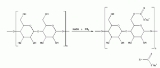
Regular rayon (or viscose) is the most widely produced form of rayon. This method of rayon production has been utilized since the early 1900s and it has the ability to produce either filament or staple fibers. The process is as follows:

  1. Cellulose: Production begins with processed cellulose
  2. Immersion: The cellulose is dissolved in caustic soda: (C6H10O5)n + nNaOH ---> (C6H9O4ONa)n + nH2O
  3. Pressing: The solution is then pressed between rollers to remove excess liquid
  4. White Crumb: The pressed sheets are crumbled or shredded to produce what is known as "white crumb"
  5. Aging: The "white crumb" aged through exposure to oxygen
    Oxygen

    Oxygen no O2 produced; 2) O2 produced, but absorbed in oceans & seabed rock; 3) O2 starts to gas out of the oceans, but is absorbed by land surfaces and formation of ozone layer; 4-5) O2 sinks filled and the gas accumulates]]...
  6. Xanthation: The aged "white crumb" is mixed with carbon disulfide
    Carbon disulfide

    Carbon disulfide is a colorless, volatile liquid with the chemical formula CS2. The compound is used frequently as a building block in organic chemistry as well as an industrial and chemical non-polar solvent....
     in a process known as , the aged alkali cellulose crumbs are placed in vats and are allowed to react with carbon disulphide under controlled temperature (20 to 30°C) to form cellulose xanthate: (C6H9O4ONa)n + nCS2 ---> (C6H9O4O-SC-SNa)n
  7. Yellow Crumb: Xanthation changes the chemical makeup of the cellulose mixture and the resulting product is now called "yellow crumb"
  8. Viscose: The "yellow crumb" is dissolved in a caustic solution to form viscose
  9. Ripening: The viscose is set to stand for a period of time, allowing it to ripen: (C6H9O4O-SC-SNa)n + nH2O ---> (C6H10O5)n + nCS2 + nNaOH
  10. Filtering: After ripening, the viscose is filtered to remove any undissolved particles
  11. Degassing: Any bubbles of air are pressed from the viscose in a degassing process
  12. Extruding: The viscose solution is extruded through a spinneret
    Spinneret

    A spinneret is a spider spider silk-spinning organ . It is usually on the underside of a spider's abdomen, to the rear. Most spiders have six spinnerets; some have four or two....
    , which resembles a shower head with many small holes
  13. Acid Bath: As the viscose exits the spinneret, it lands in a bath of sulfuric acid
    Sulfuric acid

    Sulfuric acid, hydrogen2sulfuroxygen4, is a strong mineral acid. It is soluble in water at all concentrations. Sulfuric acid has many applications, and is one of the top products of the chemical industry....
    , resulting in the formation of rayon filaments: (C6H9O4O-SC-SNa)n + ½nH2SO4 ---> (C6H10O5)n + nCS2 + ½nNa2SO4
  14. Drawing: The rayon filaments are stretched, known as drawing, to straighten out the fibers
  15. Washing: The fibers are then washed to remove any residual chemicals
  16. Cutting: If filament fibers are desired the process ends here. The filaments are cut down when producing staple fibers


High Wet Modulus rayon (HWM) is a modified version of viscose that has a greater strength when wet. It also has the ability to be mercerized like cotton. HWM rayons are also known as "polynosic" or can be identified by the trade name Modal
Modal (textile)

Modal is a bio-based material fiber made by spinning reconstituted cellulose from beech trees. It is about 50% more hygroscopic, or water-absorbent, per unit volume than cotton is....
 .

High Tenacity rayon is another modified version of viscose that has almost twice the strength of HWM. This type of rayon is typically used for industrial purposes such as tire cord .

Cupramonium rayon has properties similar to viscose but during production, the cellulose is combined with copper
Copper

Copper is a chemical element with the symbol Cu and atomic number 29.It is a ductile metal with very high thermal and electrical conductivity....
 and ammonia
Ammonia

Ammonia is a chemical compound with the chemical formula nitrogenhydrogen. It is normally encountered as a gas with a characteristic pungent odor....
 (Schweizer's reagent
Schweizer's reagent

Schweizer's reagent is the common name for the complex tetraamminediaquacopper dihydroxide, [Cu42]2. It is prepared by precipitating copper hydroxide from an aqueous solution of copper sulfate using sodium hydroxide, then dissolving the precipitate in a solution of ammonium hydroxide....
). Due to the environmental effects of this production method, cupramonium rayon is no longer produced in the United States
United States

The United States of America is a Federal government constitutional republic comprising U.S. state and a federal district. The country is situated mostly in central North America, where its Contiguous United States and Washington, D.C., the Capital districts and territories, lie between the Pacific Ocean and Atlantic Oceans, Borders of the U...
 .

Disposal / Biodegradability


The biodegradability of fibers in soil burial and sewage sludge was evaluated by Korean researchers who found that biodegradability decreased in the following order: rayon, cotton, acetate. The ability of individual rayon based fabrics to repel water was negatively correlated with their speed of degradation .

Producers

Trade name
Trade name

A trade name, also known as a trading name or a business name, is the name which a business trades under for commercial purposes, although its registered, Legal name , used for contracts and other formal situations, may be another....
s are used within the rayon industry to determine the type of rayon used.

Bemberg, for example, is a trade name for cupramonium rayon developed by J.P. Bemberg that is now only produced in Italy
Italy

Italy , officially the Italian Republic , is a country located on the Italian Peninsula in Southern Europe and on the two largest islands in the Mediterranean Sea, Sicily and Sardinia....
 due to United States Environmental Protection Agency
United States Environmental Protection Agency

The U.S. Environmental Protection Agency is an List of United States federal agencies of the federal government of the United States charged to Regulation of chemicals and protect human health by safeguarding the natural environment: air, water, and land....
 regulations in the US .

Modal
Modal (textile)

Modal is a bio-based material fiber made by spinning reconstituted cellulose from beech trees. It is about 50% more hygroscopic, or water-absorbent, per unit volume than cotton is....
 and Tencel are widely used forms of rayon produced by Lenzing Fibers Corp. which is based in northern Austria
Austria

Austria , officially the Republic of Austria , is a landlocked country in Central Europe. It borders both Germany and the Czech Republic to the north, Slovakia and Hungary to the east, Slovenia and Italy to the south, and Switzerland and Liechtenstein to the west....
 .

Galaxy, Danufil, and Viloft are rayon brands produced by Kelheim Fibres, a German
Germany

Germany , officially the Federal Republic of Germany , is a country in Central Europe. It is bordered to the north by the North Sea, Denmark, and the Baltic Sea; to the east by Poland and the Czech Republic; to the south by Austria and Switzerland; and to the west by France, Luxembourg, Belgium, and the Netherlands....
 manufacturer.

Acordis is a major manufacturer of cellulose based fibers and yarns. Production facilities can be found throughout Europe, the U.S. and Brazil
Brazil

Brazil , officially the Federative Republic of Brazil , is a country in South America. It is the List of countries and outlying territories by total area country by geographical area, occupying nearly half of South America, the List of countries by population country, and the fourth most populous democracy in the world....
 .

Visil rayon is a flame retardant
Flame retardant

Flame retardants are materials that inhibit or resist the spread of fire. These can be separated into several categories:*Minerals such as asbestos, compounds such as aluminium hydroxide, magnesium hydroxide, antimony trioxide, various hydrates, red phosphorus, and boron compounds, mostly borates....
 form of viscose which has silica
Silicon dioxide

The chemical compound 'silicon dioxide', also known as 'silica' , is an oxide of silicon with a chemical formula of and has been known for its hardness since antiquity....
 embedded in the fiber during manufacturing. .

North American Rayon Corp of Tennessee
Tennessee

Tennessee is a U.S. state located in the Southern United States United States. In 1796, it became the sixteenth state to join the United States....
 produced viscose rayon until its closure in the year 2000. .

Grasim of India
India

India, officially the Republic of India , is a country in South Asia. It is the List of countries and outlying territories by total area country by geographical area, the List of countries by population country, and the most populous liberal democracy in the world....
 is the largest producer of rayon in the world (claiming 24% market share). It has plants in Nagda
Nagda

See...
, Kharach and Harihar
Harihar

Harihar is a small town in central Karnataka, located in Davanagere District. It is situated on the banks of the Tungabhadra River, 275 kilometres north of Bangalore....
 - all in India. .

See also

  • Art silk
    Art silk

    Artificial silk or art silk is a synthetic manufactured fiber which resembles silk but costs less to produce. Frequently, art silk is just a synonym for rayon....
     (artificial silk)


  • Modal (textile)
    Modal (textile)

    Modal is a bio-based material fiber made by spinning reconstituted cellulose from beech trees. It is about 50% more hygroscopic, or water-absorbent, per unit volume than cotton is....


For a description of the production method at a factory in Germany
Germany

Germany , officially the Federal Republic of Germany , is a country in Central Europe. It is bordered to the north by the North Sea, Denmark, and the Baltic Sea; to the east by Poland and the Czech Republic; to the south by Austria and Switzerland; and to the west by France, Luxembourg, Belgium, and the Netherlands....
 in World War II
World War II

World War II, or the Second World War , was a global military conflict which involved a Participants in World War II, including all of the great powers, organised into two opposing military alliances: the Allies of World War II and the Axis powers....
, see pages 152-155 of
  • Agnès Humbert
    Agnès Humbert

    Agn?s Humbert was an art historian, ethnographer and a member of the French Resistance during World War II....
    , (tr. Barbara Mellor) Résistance: Memoirs of Occupied France, London, Bloomsbury Publishing PLC, 2008 ISBN 9780747595977 (American title: Resistance: A Frenchwoman's Journal of the War, Bloomsbury, USA, 2008)