
See Also

Heat engine

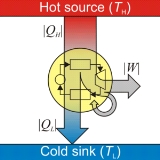
In engineering and thermodynamics Thermodynamics

Thermodynamics is a branch of physics [i] that studies the effects of changes in temperature [i], pressure [i] ... 

, a heat engine performs the conversion of heat Heat

In physics [i], heat, symbolized by Q, is defined as energy in transit. ... 

 energy Energy

In general, the concept [i] of energy refers to "the potential for causing changes." The word is used in ... 

 to mechanical work by exploiting the temperature gradient between a hot "source Source

The word source has more than one meaning, this page links to pages describing all of the meanings:... 

" and a cold "sink Sink

In plumbing [i], a sink or basin is a bowl-shaped fixture [i] that is used for wa ... 

". Heat is transferred from the source, through the "working body System (thermodynamics)

In thermodynamics [i], a thermodynamic system is defined as that part of the universe that is under cons ... 

" of the engine, to the sink, and in this process some of the heat is converted into work Energy

In general, the concept [i] of energy refers to "the potential for causing changes." The word is used in ... 

 by exploiting the properties of a working substance .

Discussions

  Discussion Features

   Ask a question about 'Heat engine'

   Start a new discussion about 'Heat engine'

   Answer questions about 'Heat engine'

   'Heat engine' discussion forum


Encyclopedia

In engineering and thermodynamics Thermodynamics

Thermodynamics is a branch of physics [i] that studies the effects of changes in temperature [i], pressure [i] ... 

, a heat engine performs the conversion of heat Heat

In physics [i], heat, symbolized by Q, is defined as energy in transit. ... 

 energy Energy

In general, the concept [i] of energy refers to "the potential for causing changes." The word is used in ... 

 to mechanical work by exploiting the temperature gradient between a hot "source Source

The word source has more than one meaning, this page links to pages describing all of the meanings:... 

" and a cold "sink Sink

In plumbing [i], a sink or basin is a bowl-shaped fixture [i] that is used for wa ... 

". Heat is transferred from the source, through the "working body System (thermodynamics)

In thermodynamics [i], a thermodynamic system is defined as that part of the universe that is under cons ... 

" of the engine, to the sink, and in this process some of the heat is converted into work Energy

In general, the concept [i] of energy refers to "the potential for causing changes." The word is used in ... 

 by exploiting the properties of a working substance .

Overview

In general terms, the larger the difference in temperature between the hot source and the cold sink, the larger is the potential efficiency of the cycle. On Earth, the cold side of any heat engine is limited to close to the ambient temperature of the environment, or not much lower than 300 Kelvin Kelvin

The Kelvin scale is a temperature [i] scale where absolute zero [i]—the coldest possible temperatu ... 

, so most efforts to improve the thermodynamic efficiencies of various heat engines focus on increasing the temperature of the source, within material limits.

The efficiency of various heat engines proposed or used today ranges from 3 percent for the OTEC Ocean thermal energy conversion

Ocean thermal energy conversion, or OTEC, is a way to generate electricity [i] using the temperatu ... 

 ocean power proposal through 25 percent for most automotive engines, to 35 percent for a supercritical coal plant Fossil fuel power plant

A fossil fuel power plant is an energy conversion [i] center that combusts fossil fuel [i]s to produce electricity [i] ... 

, to about 60 percent for a steam-cooled combined cycle Combined cycle

Combined cycle is a term used when a power producing engine or plant employs more than one thermodynamic cycle [i] ... 

 gas turbine Gas turbine

A gas turbine, also called a combustion turbine, is a rotary engine [i] that extracts energy from ... 

. All of these processes gain their efficiency due to the temperature drop across them.

OTEC uses the temperature difference of ocean water on the surface and ocean water from the depths, a small difference of perhaps 25 degrees celsius, and so the efficiency must be low. The combined cycle gas turbines use natural-gas fired burners to heat air to near 1530 degrees celsius, a difference of a large 1500 degrees, and so the efficiency can be large when the steam-cooling cycle is added in.

Everyday examples

Examples of everyday heat engines include: the steam engine Steam engine

A steam engine is an external combustion [i] heat engine [i] that makes use o ... 

, the diesel engine Diesel engine

The diesel engine is a type of internal combustion engine [i]; more specifically, it is a compression ... 

, and the gasoline engine in an automobile Automobile

An automobile is a wheel [i]ed passenger [i] vehicle [i] that carries its own motor [i]. ... 

.
A common toy that is also a heat engine is a drinking bird Drinking bird

Drinking birds are a thermodynamically [i] powered toy [i] heat engine [i]. ... 

.
All of these familiar heat engines are powered by the expansion of heated gases.
The general surroundings are the heat sink, providing relatively cool gases which, when heated, expand rapidly to drive the mechanical motion of the engine.

Examples of heat engines


Phase change cycles

In these cycles and engines, the working fluids are gases and liquids. The engine converts the working fluid from a gas to a liquid.
  • Rankine cycle Rankine cycle

    The Rankine cycle is a thermodynamic [i] cycle. ... 

  • Regenerative cycle
  • Drinking bird Drinking bird

    Drinking birds are a thermodynamically [i] powered toy [i] heat engine [i]. ... 

     cycle
  • Frost heaving - water changing from ice to liquid and back again can lift rock up to 60m.

Gas only cycles

In these cycles and engines the working fluid are always like gas:
  • Carnot cycle Carnot cycle

    The Carnot cycle is a particular thermodynamic cycle [i], modeled on the Carnot heat engine [i], studied ... 

  • Brayton cycle Brayton cycle

    The "Brayton cycle" is a constant pressure cycle named after George Brayton [i], the American engineer who de ... 

     or Joule cycle Brayton cycle

    The "Brayton cycle" is a constant pressure cycle named after George Brayton [i], the American engineer who de ... 

  • Ericsson Cycle
  • Stirling cycle Stirling engine

    The Stirling engine is a heat engine [i] of the external combustion [i] piston engine [i]... 

  • Internal combustion engine Internal combustion engine

    The internal combustion engine is a heat engine [i] in which the burning of a fuel [i] occurs ... 

     :
    • Otto cycle Four-stroke cycle

      The four-stroke cycle of an internal combustion engine [i] is the cycle most commonly used for automotiv ... 

    • Diesel cycle Diesel cycle

      The Diesel cycle is the combustion process of a type of internal combustion engine [i], in which the bur... 

    • Atkinson Cycle Atkinson cycle

      The Atkinson cycle engine is a type of Internal combustion engine [i] invented by James Atkinson [i] ... 

    • Lenoir cycle Lenoir cycle

      The Lenoir cycle is an idealised thermodynamic cycle [i] often utilized to model a pulse jet engine [i]. ... 

    • Miller cycle

Electron cycles

  • Thermoelectric
  • thermionic emission Thermionic emission

    Thermionic emission is the flow of electron [i]s from a metal or metal oxide surface, caused by thermal ... 

  • Thermotunnel cooling

Magnetic cycles

  • Thermo-magnetic motor

Cycles used for refrigeration

A refrigerator Refrigerator

A refrigerator is an appliance for the storage and preservation of perishable food.... 

 is a heat pump Heat pump

A heat pump is a machine which moves heat [i] from a low temperature [i] reservoir to a higher temperatu ... 

: a heat engine in reverse. Work is used to create a heat differential.
  • Carnot refrigeration Carnot cycle

    The Carnot cycle is a particular thermodynamic cycle [i], modeled on the Carnot heat engine [i], studied ... 

  • Vuilleumier refrigeration
  • Absorption refrigeration

Efficiency

The efficiency of a heat engine relates how much useful power is output for a given amount of heat energy input.

From the laws of thermodynamics Thermodynamics

Thermodynamics is a branch of physics [i] that studies the effects of changes in temperature [i], pressure [i] ... 

:

where
is the work extracted from the engine.
is the heat energy taken from the high temperature system .
is the heat energy delivered to the cold temperature system.


In other words, a heat engine absorbs heat energy from the high temperature heat source, converting part of it to useful work and delivering the rest to the cold temperature heat sink.

In general, the efficiency of a given heat transfer process is defined informally by the ratio of "what you get" to "what you put in."

In the case of an engine, one desires to extract work and puts in a heat transfer.


The theoretical maximum efficiency of any heat engine depends only on the temperatures it operates between. This efficiency is usually derived using an ideal imaginary heat engine such as the Carnot heat engine Carnot heat engine

A Carnot heat engine is a hypothetical engine that operates on the reversible Carnot cycle [i]. ... 

, although other engines using different cycles can also attain maximum efficiency. Mathematically, this is due to the fact that in reversible processes, the change in entropy Entropy

In thermodynamics [i], entropy, symbolized by S, is a state function [i] of a thermodynamic system [i] ... 

 of the cold reservoir is the negative of that of the hot reservoir , keeping the overall change of entropy zero. Thus:


where is the absolute temperature Thermodynamic temperature

Thermodynamic temperature is the absolute measure of temperature and is one of the principal parameters ... 

 of the hot source and that of the cold sink, usually measured in kelvin Kelvin

The Kelvin scale is a temperature [i] scale where absolute zero [i]—the coldest possible temperatu ... 

s. Note that is positive while is negative; in any reversible work-extracting process, entropy is overall not increased, but rather is moved from a hot system to a cold , decreasing the entropy of the heat source and increasing that of the heat sink.

The reasoning behind this being the maximal efficiency goes as follows. It is first assumed that if a more efficient heat engine than a Carnot engine is possible, then it could be driven in reverse as a heat pump. Mathematical analysis can be used to show that this assumed combination would result in a net decrease in entropy Entropy

In thermodynamics [i], entropy, symbolized by S, is a state function [i] of a thermodynamic system [i] ... 

. Since, by the second law of thermodynamics Second law of thermodynamics

[i] of nature regarding the directional flow of [[heat]... 

, this is forbidden, the Carnot efficiency is a theoretical upper bound on the efficiency of any process.

Empirically, no engine has ever been shown to run at a greater efficiency than a Carnot cycle heat engine.

Other criteria of heat engine performance

One problem with the ideal Carnot efficiency as a criterion of heat engine performance is the fact that by its nature, any maximally-efficient Carnot cycle must operate at an infinitesimal temperature gradient. This is due to the fact that any transfer of heat between two bodies at differing temperatures is irreversible, and therefore the Carnot efficiency expression only applies in the infinitesimal limit. The major problem with that is that the object of most heat engines is to output some sort of power, and infinitesimal power is usually not what is being sought.

A much more accurate measure of heat engine efficiency is given by the endoreversible process, which is identical to the Carnot cycle except in that the two processes of heat transfer are not treated as reversible. As derived in Callen , the efficiency for such a process is given by:


The accuracy of this model can be seen in the following table :

Efficiencies of Power Plants
Power Plant
West Thurrock  coal-fired power plant Fossil fuel power plant

A fossil fuel power plant is an energy conversion [i] center that combusts fossil fuel [i]s to produce electricity [i] ... 

25 565 0.64 0.40 0.36
CANDU CANDU reactor

The CANDU reactor is a Pressurized Heavy Water Reactor [i] developed ini ... 

  nuclear power plant Nuclear power plant

A nuclear power plant is a thermal [i] power station [i] in which the heat source is one or more nuclear reactor [i] ... 

25 300 0.48 0.28 0.30
Larderello Larderello

Larderello is a geologically active area of southern Tuscany [i], Italy [i], which is renowned for its geothermal [i] ... 

  geothermal power plant Geothermal power

Geothermal power is the use of geothermal [i] heat for electricity [i] generation. ... 

80 250 0.33 0.178 0.16


As shown, the endoreversible efficiency much more closely models the observed data.

Heat Engine Enhancements


Engineers have studied the various heat engine cycles extensively in an effort to improve the amount of usable work they could extract from a given power source. The Carnot Cycle limit cannot be reached with any gas-based cycle, but engineers have worked out at least two ways to possibly go around that limit, and one way to get better efficiency without bending any rules.

1) Increase the temperature difference in the heat engine. The simplest way to do this is to increase the hot side temperature, and is the approach used in modern combined-cycle gas turbines. Unfortunately, NOx production and material limits place a hard limit to how hot you can make a workable heat engine. Modern gas turbines are about as hot as they can become and still maintain acceptable NOx pollution levels. Another way of increasing efficiency is to lower the output temperature. Once new method of doing so is to use mixed chemical working fluids, and then exploit the changing behavior of the mixtures. One of the most famous is the so-called Kalina Cycle, which uses a 70/30 mix of ammonia and water as its working fluid. This mixture allows the cycle to generate useful power at considerably lower temperatures than most other processes.

2) Exploit the physical properties of the working fluid. The most common such exploit is the use of water above the so-called critical point, or so-called supercritical steam. The behavior of fluids above their critical point changes radically, and with materials such as water and carbon dioxide it is possible to exploit those changes in behavior to extract greater thermodynamic efficiency from the heat engine, even if it is using a fairly conventional Brayton or Rankine cycle. A newer and very promising material for such applications is CO2. SO2 and xenon have also been considered for such applications, although SO2 is a little toxic for most.

3) Exploit the chemical properties of the working fluid. A fairly new and novel exploit is to use exotic working fluids with advantageous chemical properties. One such is nitrogen dioxide , a toxic component of smog, which has a natural dimer as di-nitrogen tetraoxide . At low temperature, the N2O4 is compressed and then heated. The increasing temperature causes each N2O4 to break apart into two NO2 molecules. This lowers the molecular weight of the working fluid, which drastically increases the efficiency of the cycle. Once the NO2 has expanded through the turbine, it is cooled by the heat sink, which causes it to recombine into N2O4. This is then fed back to the compressor for another cycle. Such species as aluminum bromide , NOCl, and Ga2I6 have all been investigated for such uses. To date, their drawbacks have not warranted their use, despite the efficiency gains that can be realized. [https://netfiles.uiuc.edu/mragheb/www/NPRE%20402%20ME%20405%20Nuclear%20Power%20Engineering/Nuclear%20Reactors%20Concepts%20and%20Thermodynamic%20Cycles.pdf]

Heat engine processes

Cycle/Process Compression Heat Addition Expansion Heat Rejection
Carnot adiabatic isothermal adiabatic isothermal
Ottoadiabatic isometric adiabatic isometric
Dieseladiabatic isobaric adiabatic isometric
Braytonadiabatic isobaric adiabatic isobaric
Stirlingisothermal isometric isothermal isometric
Ericssonisothermal isobaric isothermal isobaric


Each process is one of the following:
  • isothermal Isothermal process

    An isothermal process is a thermodynamic [i] process in which the temperature [i] of the ... 

  • isobaric
  • isometric/isochoric Isochoric process

    An isochoric process, also called an isometric process, is a thermodynamic [i] process in which the ... 

  • adiabatic

See also

  • Heat pump Heat pump

    A heat pump is a machine which moves heat [i] from a low temperature [i] reservoir to a higher temperatu ... 

  • Timeline of heat engine technology

References


External links

  • Citat: "...The refrigeration cycle is basically the Rankine cycle run in reverse..."
  • Citat: "...Choosing a Heat Engine..."