

Electron hole

Encyclopedia
An electron hole is the conceptual and mathematical opposite of an electron
, useful in the study of physics
, chemistry
, and electrical engineering
. The concept describes the lack of an electron at a position where one could exist in an atom or atomic lattice
. It is different from the positron
, which is an actual particle of antimatter
, whereas the hole is just a fiction, used for modeling convenience.
The electron hole was introduced into calculations for the following two situations:
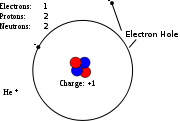 In solid state physics, an electron hole (usually referred to simply as a hole) is the absence of an electron from an otherwise full electron shell
. A hole is essentially a way to conceptualise the interactions of the electrons within a nearly full system, which is missing just a few electrons. In some ways, the behaviour of a hole within a semiconductor crystal lattice
is comparable to that of the bubble in an otherwise full bottle of water.
Hole conduction in a valence band
can be explained by the following analogy. Imagine a row of people seated in an auditorium, where there are no spare chairs. Someone in the middle of the row wants to leave, so he jumps over the back of the seat into an empty row, and walks out. The empty row is analogous to the conduction band
, and the person walking out is analogous to a free electron.
Now imagine someone else comes along and wants to sit down. The empty row has a poor view; so he does not want to sit there. Instead, a person in the crowded row moves into the empty seat the first person left behind. The empty seat moves one spot closer to the edge and the person waiting to sit down. The next person follows, and the next, etcetera. One could say that the empty seat moves towards the edge of the row. Once the empty seat reaches the edge, the new person can sit down.
In the process everyone in the row has moved along. If those people were negatively charged (like electrons), this movement would constitute conduction. If the seats themselves were positively charged, then only the vacant seat would be positive. This is a very simple model of how hole conduction works.
In reality, due to the crystal structure properties, the hole is not localized to a single position as described in the previous example. Rather, the hole spans an area in the crystal lattice covering many hundreds of unit cells
. This is equivalent to being unable to tell which broken bond corresponds to the "missing" electron.
Instead of analyzing the movement of an empty state in the valence band as the movement of billions of separate electrons, a single equivalent imaginary particle called a "hole" is considered. In an applied electric field
, the electrons move in one direction, corresponding to the hole moving in the other. If a hole associates itself with a neutral atom, that atom loses an electron and becomes positive. Therefore the hole is taken to have positive charge
of +e, precisely the opposite of the electron charge.
Coulomb's law
allows the force on the "hole" due to an electric field to be calculated. An effective mass can then be derived which relates the (imaginary) force on the (imaginary) hole to the acceleration of that hole. In some semiconductors, such as silicon, the hole's effective mass is dependent on direction (anisotropic
), however a value averaged over all directions can be used for some macroscopic calculations.
In most semiconductors, the effective mass of a hole is much larger than that of an electron
. This results in lower mobility
for holes under the influence of an electric field
and this may slow down the speed of the electronic device made of that semiconductor. This is one major reason for adopting electrons as the primary charge carriers, whenever possible in semiconductor devices, instead of holes.
. In coupled cluster
methods, the ground (or lowest energy) state of a molecule is interpreted as the "vacuum state"—conceptually, in this state there are no electrons. In this scheme, the absence of an electron from a normally-filled state is called a "hole" and is treated as a particle, and the presence of an electron in a normally-empty state is simply called an "electron". This terminology is almost identical to that used in solid-state physics.
Electron
The electron is a subatomic particle with a negative elementary electric charge. It has no known components or substructure; in other words, it is generally thought to be an elementary particle. An electron has a mass that is approximately 1/1836 that of the proton...
, useful in the study of physics
Physics
Physics is a natural science that involves the study of matter and its motion through spacetime, along with related concepts such as energy and force. More broadly, it is the general analysis of nature, conducted in order to understand how the universe behaves.Physics is one of the oldest academic...
, chemistry
Chemistry
Chemistry is the science of matter, especially its chemical reactions, but also its composition, structure and properties. Chemistry is concerned with atoms and their interactions with other atoms, and particularly with the properties of chemical bonds....
, and electrical engineering
Electrical engineering
Electrical engineering is a field of engineering that generally deals with the study and application of electricity, electronics and electromagnetism. The field first became an identifiable occupation in the late nineteenth century after commercialization of the electric telegraph and electrical...
. The concept describes the lack of an electron at a position where one could exist in an atom or atomic lattice
Crystal structure
In mineralogy and crystallography, crystal structure is a unique arrangement of atoms or molecules in a crystalline liquid or solid. A crystal structure is composed of a pattern, a set of atoms arranged in a particular way, and a lattice exhibiting long-range order and symmetry...
. It is different from the positron
Positron
The positron or antielectron is the antiparticle or the antimatter counterpart of the electron. The positron has an electric charge of +1e, a spin of ½, and has the same mass as an electron...
, which is an actual particle of antimatter
Antimatter
In particle physics, antimatter is the extension of the concept of the antiparticle to matter, where antimatter is composed of antiparticles in the same way that normal matter is composed of particles...
, whereas the hole is just a fiction, used for modeling convenience.
The electron hole was introduced into calculations for the following two situations:
- If an electron is excited into a higher state it leaves a hole in its old state. This meaning is used in Auger electron spectroscopyAuger electron spectroscopyAuger electron spectroscopy is a common analytical technique used specifically in the study of surfaces and, more generally, in the area of materials science...
(and other x-rayX-rayX-radiation is a form of electromagnetic radiation. X-rays have a wavelength in the range of 0.01 to 10 nanometers, corresponding to frequencies in the range 30 petahertz to 30 exahertz and energies in the range 120 eV to 120 keV. They are shorter in wavelength than UV rays and longer than gamma...
techniques), in computational chemistryComputational chemistryComputational chemistry is a branch of chemistry that uses principles of computer science to assist in solving chemical problems. It uses the results of theoretical chemistry, incorporated into efficient computer programs, to calculate the structures and properties of molecules and solids...
, and to explain the low electron-electron scattering-rate in crystals (metalMetalA metal , is an element, compound, or alloy that is a good conductor of both electricity and heat. Metals are usually malleable and shiny, that is they reflect most of incident light...
s, semiconductorSemiconductorA semiconductor is a material with electrical conductivity due to electron flow intermediate in magnitude between that of a conductor and an insulator. This means a conductivity roughly in the range of 103 to 10−8 siemens per centimeter...
s). - In crystalCrystalA crystal or crystalline solid is a solid material whose constituent atoms, molecules, or ions are arranged in an orderly repeating pattern extending in all three spatial dimensions. The scientific study of crystals and crystal formation is known as crystallography...
s, band structure calculations lead to an effective mass for the charge carriers, which can be negative. Inspired by the Hall effectHall effectThe Hall effect is the production of a voltage difference across an electrical conductor, transverse to an electric current in the conductor and a magnetic field perpendicular to the current...
, Newton's law is used to attach the negative sign onto the charge.
Solid state physics
Electron shell
An electron shell may be thought of as an orbit followed by electrons around an atom's nucleus. The closest shell to the nucleus is called the "1 shell" , followed by the "2 shell" , then the "3 shell" , and so on further and further from the nucleus. The shell letters K,L,M,.....
. A hole is essentially a way to conceptualise the interactions of the electrons within a nearly full system, which is missing just a few electrons. In some ways, the behaviour of a hole within a semiconductor crystal lattice
Crystal structure
In mineralogy and crystallography, crystal structure is a unique arrangement of atoms or molecules in a crystalline liquid or solid. A crystal structure is composed of a pattern, a set of atoms arranged in a particular way, and a lattice exhibiting long-range order and symmetry...
is comparable to that of the bubble in an otherwise full bottle of water.
Hole conduction in a valence band
Valence band
In solids, the valence band is the highest range of electron energies in which electrons are normally present at absolute zero temperature....
can be explained by the following analogy. Imagine a row of people seated in an auditorium, where there are no spare chairs. Someone in the middle of the row wants to leave, so he jumps over the back of the seat into an empty row, and walks out. The empty row is analogous to the conduction band
Conduction band
In the solid-state physics field of semiconductors and insulators, the conduction band is the range of electron energies, higher than that of the valence band, sufficient to free an electron from binding with its individual atom and allow it to move freely within the atomic lattice of the material...
, and the person walking out is analogous to a free electron.
Now imagine someone else comes along and wants to sit down. The empty row has a poor view; so he does not want to sit there. Instead, a person in the crowded row moves into the empty seat the first person left behind. The empty seat moves one spot closer to the edge and the person waiting to sit down. The next person follows, and the next, etcetera. One could say that the empty seat moves towards the edge of the row. Once the empty seat reaches the edge, the new person can sit down.
In the process everyone in the row has moved along. If those people were negatively charged (like electrons), this movement would constitute conduction. If the seats themselves were positively charged, then only the vacant seat would be positive. This is a very simple model of how hole conduction works.
In reality, due to the crystal structure properties, the hole is not localized to a single position as described in the previous example. Rather, the hole spans an area in the crystal lattice covering many hundreds of unit cells
Crystal structure
In mineralogy and crystallography, crystal structure is a unique arrangement of atoms or molecules in a crystalline liquid or solid. A crystal structure is composed of a pattern, a set of atoms arranged in a particular way, and a lattice exhibiting long-range order and symmetry...
. This is equivalent to being unable to tell which broken bond corresponds to the "missing" electron.
Instead of analyzing the movement of an empty state in the valence band as the movement of billions of separate electrons, a single equivalent imaginary particle called a "hole" is considered. In an applied electric field
Electric field
In physics, an electric field surrounds electrically charged particles and time-varying magnetic fields. The electric field depicts the force exerted on other electrically charged objects by the electrically charged particle the field is surrounding...
, the electrons move in one direction, corresponding to the hole moving in the other. If a hole associates itself with a neutral atom, that atom loses an electron and becomes positive. Therefore the hole is taken to have positive charge
Electric charge
Electric charge is a physical property of matter that causes it to experience a force when near other electrically charged matter. Electric charge comes in two types, called positive and negative. Two positively charged substances, or objects, experience a mutual repulsive force, as do two...
of +e, precisely the opposite of the electron charge.
Coulomb's law
Coulomb's law
Coulomb's law or Coulomb's inverse-square law, is a law of physics describing the electrostatic interaction between electrically charged particles. It was first published in 1785 by French physicist Charles Augustin de Coulomb and was essential to the development of the theory of electromagnetism...
allows the force on the "hole" due to an electric field to be calculated. An effective mass can then be derived which relates the (imaginary) force on the (imaginary) hole to the acceleration of that hole. In some semiconductors, such as silicon, the hole's effective mass is dependent on direction (anisotropic
Anisotropy
Anisotropy is the property of being directionally dependent, as opposed to isotropy, which implies identical properties in all directions. It can be defined as a difference, when measured along different axes, in a material's physical or mechanical properties An example of anisotropy is the light...
), however a value averaged over all directions can be used for some macroscopic calculations.
In most semiconductors, the effective mass of a hole is much larger than that of an electron
Electron
The electron is a subatomic particle with a negative elementary electric charge. It has no known components or substructure; in other words, it is generally thought to be an elementary particle. An electron has a mass that is approximately 1/1836 that of the proton...
. This results in lower mobility
Electron mobility
In solid-state physics, the electron mobility characterizes how quickly an electron can move through a metal or semiconductor, when pulled by an electric field. In semiconductors, there is an analogous quantity for holes, called hole mobility...
for holes under the influence of an electric field
Electric field
In physics, an electric field surrounds electrically charged particles and time-varying magnetic fields. The electric field depicts the force exerted on other electrically charged objects by the electrically charged particle the field is surrounding...
and this may slow down the speed of the electronic device made of that semiconductor. This is one major reason for adopting electrons as the primary charge carriers, whenever possible in semiconductor devices, instead of holes.
Holes in quantum chemistry
An alternate meaning for the term electron hole is used in computational chemistryComputational chemistry
Computational chemistry is a branch of chemistry that uses principles of computer science to assist in solving chemical problems. It uses the results of theoretical chemistry, incorporated into efficient computer programs, to calculate the structures and properties of molecules and solids...
. In coupled cluster
Coupled cluster
Coupled cluster is a numerical technique used for describing many-body systems. Its most common use is as one of several quantum chemical post-Hartree–Fock ab initio quantum chemistry methods in the field of computational chemistry...
methods, the ground (or lowest energy) state of a molecule is interpreted as the "vacuum state"—conceptually, in this state there are no electrons. In this scheme, the absence of an electron from a normally-filled state is called a "hole" and is treated as a particle, and the presence of an electron in a normally-empty state is simply called an "electron". This terminology is almost identical to that used in solid-state physics.
See also
- Bandgap
- Carrier generation and recombinationCarrier generation and recombinationIn the solid state physics of semiconductors, carrier generation and recombination are processes by which mobile charge carriers are created and eliminated. Carrier generation and recombination processes are fundamental to the operation of many optoelectronic semiconductor devices, such as...
- Effective mass
- Electrical conduction
- SemiconductorSemiconductorA semiconductor is a material with electrical conductivity due to electron flow intermediate in magnitude between that of a conductor and an insulator. This means a conductivity roughly in the range of 103 to 10−8 siemens per centimeter...