

Quantum dot

Encyclopedia
A quantum dot is a portion of matter (e.g. semiconductor
) whose exciton
s are confined
in all three spatial dimensions. Consequently, such materials have electronic properties intermediate between those of bulk semiconductors and those of discrete molecules. They were discovered at the beginning of the 1980s by Alexei Ekimov in a glass matrix and by Louis E. Brus
in colloidal solutions. The term "quantum dot" was coined by Mark Reed.
Researchers have studied quantum dots in transistor
s, solar cell
s, LEDs
, and diode lasers
. They have also investigated quantum dots as agents
for medical imaging
and hope to use them as qubit
s in quantum computing.
Stated simply, quantum dots are semiconductors whose electronic characteristics are closely related to the size and shape of the individual crystal. Generally, the smaller the size of the crystal, the larger the band gap
, the greater the difference in energy between the highest valence band
and the lowest conduction band
becomes, therefore more energy is needed to excite the dot, and concurrently, more energy is released when the crystal returns to its resting state. For example, in fluorescent dye applications, this equates to higher frequencies of light emitted after excitation of the dot as the crystal size grows smaller, resulting in a color shift from red to blue in the light emitted. In addition to such tuning, a main advantage with quantum dots is that, because of the high level of control possible over the size of the crystals produced, it is possible to have very precise control over the conductive properties of the material. Quantum dots of different sizes can be assembled into a gradient multi-layer nanofilm
.
Bohr radius
. This is estimated by replacing the positively charged atomic core with the hole in the Bohr formula. If the electron and hole are constrained further, then properties of the semiconductor change. For example, the absorption and emission wavelength of light shifts towards smaller wavelengths. This effect is a form of quantum confinement, and it is a key feature in many emerging electronic structures.
Besides confinement in all three dimensions i.e. Quantum Dot - other quantum confined semiconductors include:
s produced by chemical methods or by ion implantation, or in nanodevices made by state-of-the-art lithographic
techniques.
al semiconductor
nanocrystal
s are synthesized from precursor compounds dissolved in solutions, much like traditional chemical processes
. The synthesis of colloidal quantum dots is based on a three-component system composed of: precursors, organic surfactants, and solvents. When heating a reaction medium to a sufficiently high temperature, the precursors chemically transform into monomers. Once the monomers reach a high enough supersaturation
level, the nanocrystal growth starts with a nucleation process. The temperature during the growth process is one of the critical factors in determining optimal conditions for the nanocrystal growth. It must be high enough to allow for rearrangement and annealing
of atoms during the synthesis process while being low enough to promote crystal growth. Another critical factor that has to be stringently controlled during nanocrystal growth is the monomer concentration. The growth process of nanocrystals can occur in two different regimes, “focusing” and “defocusing”. At high monomer concentrations, the critical size (the size where nanocrystals neither grow nor shrink) is relatively small, resulting in growth of nearly all particles. In this regime, smaller particles grow faster than large ones (since larger crystals need more atoms to grow than small crystals) resulting in “focusing” of the size distribution to yield nearly monodisperse
particles. The size focusing is optimal when the monomer concentration is kept such that the average nanocrystal size present is always slightly larger than the critical size. When the monomer concentration is depleted during growth, the critical size becomes larger than the average size present, and the distribution “defocuses” as a result of Ostwald ripening
.
There are colloidal methods to produce many different semiconductors. Typical dots are made of binary alloys such as cadmium selenide
, cadmium sulfide
, indium arsenide, and indium phosphide. Although, dots may also be made from ternary alloys such as cadmium selenide sulfide.
These quantum dots can contain as few as 100 to 100,000 atoms within the quantum dot volume, with a diameter of 10 to 50 atoms. This corresponds to about 2 to 10 nanometers, and at 10 nm in diameter, nearly 3 million quantum dots could be lined up end to end and fit within the width of a human thumb.
Large batches of quantum dots may be synthesized via colloidal synthesis. Due to this scalability and the convenience of benchtop conditions, colloidal synthetic methods are promising for commercial applications. It is acknowledged to be the least toxic of all the different forms of synthesis.
The quantum dot absorption features correspond to transitions between discrete,three-dimensional particle in a box
states of the electron
and the hole, both confined to the same nanometer-size box.These discrete transitions are reminiscent of atomic spectra and have resulted in quantum dots also being called artificial atoms.
M13 bacteriophage virus
es to create quantum dot biocomposite
structures. As a background to this work, it has previously been shown that genetically engineered viruses can recognize specific semiconductor
surfaces through the method of selection by combinatorial phage display
. Additionally, it is known that liquid crystal
line structures of wild-type viruses (Fd, M13, and TMV
) are adjustable by controlling the solution concentrations, solution ionic strength
, and the external magnetic field
applied to the solutions. Consequently, the specific recognition properties of the virus can be used to organize inorganic nanocrystal
s, forming ordered arrays over the length scale defined by liquid crystal formation. Using this information, Lee et al. (2000) were able to create self-assembled, highly oriented, self-supporting films from a phage and ZnS
precursor solution. This system allowed them to vary both the length of bacteriophage and the type of inorganic material through genetic modification and selection.
A reproducible method for creating larger quantities of consistent, high-quality quantum dots involves producing nanoparticles from chemical precursors in the presence of a molecular cluster compound under conditions whereby the integrity of the molecular cluster is maintained and acts as a prefabricated seed template. Individual molecules of a cluster compound act as a seed or nucleation point upon which nanoparticle growth can be initiated. In this way, a high temperature nucleation step is not necessary to initiate nanoparticle growth because suitable nucleation sites are already provided in the system by the molecular clusters. A significant advantage of this method is that it is highly scalable.
Recently a consortium of U.S. and Dutch companies reported a "milestone" in high volume quantum dot manufacturing by applying the traditional high temperature dual injection method to a flow system
. However as of 2011, applications using bulk-manufactured quantum dots are scarcely available.
in many household goods which means that most cadmium
based quantum dots are unusable for consumer-goods applications.
For commercial viability, a range of restricted, heavy metal-free quantum dots has been developed showing bright emissions in the visible and near infra-red region of the spectrum and have similar optical properties to those of CdSe quantum dots.
Cadmium
and other restricted heavy metals used in conventional quantum dots is of a major concern in commercial applications. For Quantum Dots to be commercially viable in many applications they must not contain cadmium or other restricted metal elements.
A new type of CFQD can be made from rare earth (RE) doped oxide colloidal phosphor nanoparticles. Unlike semiconductor nanoparticles, excitation was due to UV absorption of host material, which is same for different RE doped materials using same host. Multiplexing applications can be thus realized. The emission depends on the type of RE, which enables very large stokes shift and is narrower than CdSe QDs. The synthesis is aqueous based, which eliminated issues of water solubility for biological applications. The oxide surface might be easier for chemical functionalizion more and chemically stable in various environments. Some reports exist concerning the use of such phosphor nanoparticles on biological targeting and imaging.
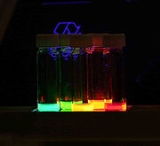
. Thus quantum dots of the same material, but with different sizes, can emit light of different colors. The physical reason is the quantum confinement effect.
The larger the dot, the redder
(lower energy) its fluorescence
spectrum
. Conversely, smaller dots emit bluer
(higher energy) light. The coloration is directly related to the energy levels of the quantum dot. Quantitatively speaking, the bandgap energy that determines the energy (and hence color) of the fluorescent light is inversely proportional to the size of the quantum dot. Larger quantum dots have more energy levels which are also more closely spaced. This allows the quantum dot to absorb photons containing less energy, i.e., those closer to the red end of the spectrum. Recent articles in nanotechnology
and in other journals have begun to suggest that the shape of the quantum dot may be a factor in the coloration as well, but as yet not enough information is available. Furthermore, it was shown that the lifetime of fluorescence is determined by the size of the quantum dot. Larger dots have more closely spaced energy levels in which the electron-hole pair can be trapped. Therefore, electron-hole pairs in larger dots live longer causing larger dots to show a longer lifetime.
As with any crystalline semiconductor, a quantum dot's electronic wave functions extend over the crystal lattice
. Similar to a molecule, a quantum dot has both a quantized
energy spectrum and a quantized density of electronic states
near the edge of the band gap.
Qdots can be synthesized with larger (thicker) shells (CdSe qdots with CdS shells). The shell thickness has shown direct correlation to the lifetime and emission intensity.
effect. Quantum dots have also been suggested as implementations of qubit
s for quantum information processing.
The ability to tune the size of quantum dots is advantageous for many applications. For instance, larger quantum dots have a greater spectrum-shift towards red compared to smaller dots, and exhibit less pronounced quantum properties. Conversely, the smaller particles allow one to take advantage of more subtle quantum effects.
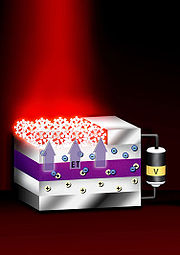 Being zero dimensional
, quantum dots have a sharper density of states
than higher-dimensional structures. As a result, they have superior transport and optical properties, and are being researched for use in diode lasers, amplifiers, and biological sensors. Quantum dots may be excited within a locally enhanced electromagnetic field produced by gold nanoparticles, which can then be observed from the surface Plasmon resonance in the photoluminescent excitation spectrum of (CdSe)ZnS nanocrystals. High-quality quantum dots are well suited for optical encoding and multiplexing applications due to their broad excitation profiles and narrow/symmetric emission spectra. The new generations of quantum dots have far-reaching potential for the study of intracellular processes at the single-molecule level, high-resolution cellular imaging, long-term in vivo observation of cell trafficking, tumor targeting, and diagnostics.
quantum dots, or qubit
s, plus a way of performing operations, quantum calculations and the computers
that would perform them might be possible.
). It has been estimated that quantum dots are 20 times brighter and 100 times more stable than traditional fluorescent reporters. For single-particle tracking, the irregular blinking of quantum dots
is a minor drawback.
The usage of quantum dots for highly sensitive cellular imaging has seen major advances over the past decade. The improved photostability of quantum dots, for example, allows the acquisition of many consecutive focal-plane images that can be reconstructed into a high-resolution three-dimensional image. Another application that takes advantage of the extraordinary photostability of quantum dot probes is the real-time tracking of molecules and cells over extended periods of time. Antibodies, streptavidin, peptides, nucleic acid aptamer
s, or small-molecule ligands can be used to target quantum dots to specific proteins on cells. Researchers were able to observe quantum dots in lymph nodes of mice for more than 4 months.
Semiconductor quantum dots have also been employed for in vitro
imaging of pre-labeled cells. The ability to image single-cell migration in real time is expected to be important to several research areas such as embryogenesis
, cancer
metastasis
, stem-cell therapeutics, and lymphocyte
immunology
.
Scientists have proven that quantum dots are dramatically better than existing methods for delivering a gene-silencing tool, known as siRNA
, into cells.
First attempts have been made to use quantum dots for tumor targeting under in vivo
conditions. There exist two basic targeting schemes: active targeting and passive targeting. In the case of active targeting, quantum dots are functionalized with tumor-specific binding sites to selectively bind to tumor cells. Passive targeting utilizes the enhanced permeation and retention of tumor cells for the delivery of quantum dot probes. Fast-growing tumor cells typically have more permeable membranes than healthy cells, allowing the leakage of small nanoparticles into the cell body. Moreover, tumor cells lack an effective lymphatic drainage system, which leads to subsequent nanoparticle-accumulation.
One of the remaining issues with quantum dot probes is their potential in vivo toxicity. For example, CdSe nanocrystals are highly toxic to cultured cells under UV illumination. The energy of UV irradiation is close to that of the covalent chemical bond energy of CdSe nanocrystals. As a result, semiconductor particles can be dissolved, in a process known as photolysis, to release toxic cadmium ions into the culture medium. In the absence of UV irradiation, however, quantum dots with a stable polymer coating have been found to be essentially nontoxic. Then again, only little is known about the excretion process of quantum dots from living organisms. These and other questions must be carefully examined before quantum dot applications in tumor or vascular
imaging can be approved for human clinical use.
Another potential cutting-edge application of quantum dots is being researched, with quantum dots acting as the inorganic fluorophore
for intra-operative detection of tumors using fluorescence spectroscopy
.
(MEG) or carrier multiplication.
s to make displays and other light sources, such as "QD-LED" displays, and "QD-WLED" (White LED). In June, 2006, QD Vision announced technical success in making a proof-of-concept quantum dot display
and show a bright emission in the visible and near infra-red region of the spectrum. Quantum dots are valued for displays, because they emit light in very specific gaussian distributions. This can result in a display that more accurately renders the colors that the human eye can perceive. Quantum dots also require very little power since they are not color filtered. Additionally, since the discovery of "white-light emitting" QD, general solid-state lighting applications appear closer than ever. A color liquid crystal display (LCD), for example, is usually powered by a single fluorescent lamp
(or occasionally, conventional white LEDs) that is color filtered to produce red, green, and blue pixels. Displays that intrinsically produce monochromatic light can be more efficient, since more of the light produced reaches the eye.
, and fluorescent biomedical imaging.
Semiconductor
A semiconductor is a material with electrical conductivity due to electron flow intermediate in magnitude between that of a conductor and an insulator. This means a conductivity roughly in the range of 103 to 10−8 siemens per centimeter...
) whose exciton
Exciton
An exciton is a bound state of an electron and hole which are attracted to each other by the electrostatic Coulomb force. It is an electrically neutral quasiparticle that exists in insulators, semiconductors and some liquids...
s are confined
Potential well
A potential well is the region surrounding a local minimum of potential energy. Energy captured in a potential well is unable to convert to another type of energy because it is captured in the local minimum of a potential well...
in all three spatial dimensions. Consequently, such materials have electronic properties intermediate between those of bulk semiconductors and those of discrete molecules. They were discovered at the beginning of the 1980s by Alexei Ekimov in a glass matrix and by Louis E. Brus
Louis E. Brus
Louis E. Brus is a professor of chemistry at Columbia University. He is the discoverer of the colloidal semi-conductor nanocrystals known as quantum dots. He is co-recipient of the 2006 R. W. Wood prize of the Optical Society of America and of the inaugural Kavli Prize for nanoscience in 2008...
in colloidal solutions. The term "quantum dot" was coined by Mark Reed.
Researchers have studied quantum dots in transistor
Transistor
A transistor is a semiconductor device used to amplify and switch electronic signals and power. It is composed of a semiconductor material with at least three terminals for connection to an external circuit. A voltage or current applied to one pair of the transistor's terminals changes the current...
s, solar cell
Solar cell
A solar cell is a solid state electrical device that converts the energy of light directly into electricity by the photovoltaic effect....
s, LEDs
Light-emitting diode
A light-emitting diode is a semiconductor light source. LEDs are used as indicator lamps in many devices and are increasingly used for other lighting...
, and diode lasers
Laser diode
The laser diode is a laser where the active medium is a semiconductor similar to that found in a light-emitting diode. The most common type of laser diode is formed from a p-n junction and powered by injected electric current...
. They have also investigated quantum dots as agents
Stain
A stain is a discoloration that can be clearly distinguished from the surface, material, or medium it is found upon. Stains are caused by the chemical or physical interaction of two dissimilar materials...
for medical imaging
Medical imaging
Medical imaging is the technique and process used to create images of the human body for clinical purposes or medical science...
and hope to use them as qubit
Qubit
In quantum computing, a qubit or quantum bit is a unit of quantum information—the quantum analogue of the classical bit—with additional dimensions associated to the quantum properties of a physical atom....
s in quantum computing.
Stated simply, quantum dots are semiconductors whose electronic characteristics are closely related to the size and shape of the individual crystal. Generally, the smaller the size of the crystal, the larger the band gap
Band gap
In solid state physics, a band gap, also called an energy gap or bandgap, is an energy range in a solid where no electron states can exist. In graphs of the electronic band structure of solids, the band gap generally refers to the energy difference between the top of the valence band and the...
, the greater the difference in energy between the highest valence band
Valence band
In solids, the valence band is the highest range of electron energies in which electrons are normally present at absolute zero temperature....
and the lowest conduction band
Conduction band
In the solid-state physics field of semiconductors and insulators, the conduction band is the range of electron energies, higher than that of the valence band, sufficient to free an electron from binding with its individual atom and allow it to move freely within the atomic lattice of the material...
becomes, therefore more energy is needed to excite the dot, and concurrently, more energy is released when the crystal returns to its resting state. For example, in fluorescent dye applications, this equates to higher frequencies of light emitted after excitation of the dot as the crystal size grows smaller, resulting in a color shift from red to blue in the light emitted. In addition to such tuning, a main advantage with quantum dots is that, because of the high level of control possible over the size of the crystals produced, it is possible to have very precise control over the conductive properties of the material. Quantum dots of different sizes can be assembled into a gradient multi-layer nanofilm
Gradient Multi-Layer nanofilm
Gradient Multi-Layer nano-film is an assembly of Quantum Dot layers with a built-in gradient of nanoparticle size, composition or density....
.
Quantum confinement in semiconductors
In an unconfined (bulk) semiconductor, an electron-hole pair is typically bound within a characteristic length, called the excitonExciton
An exciton is a bound state of an electron and hole which are attracted to each other by the electrostatic Coulomb force. It is an electrically neutral quasiparticle that exists in insulators, semiconductors and some liquids...
Bohr radius
Bohr radius
The Bohr radius is a physical constant, approximately equal to the most probable distance between the proton and electron in a hydrogen atom in its ground state. It is named after Niels Bohr, due to its role in the Bohr model of an atom...
. This is estimated by replacing the positively charged atomic core with the hole in the Bohr formula. If the electron and hole are constrained further, then properties of the semiconductor change. For example, the absorption and emission wavelength of light shifts towards smaller wavelengths. This effect is a form of quantum confinement, and it is a key feature in many emerging electronic structures.
Besides confinement in all three dimensions i.e. Quantum Dot - other quantum confined semiconductors include:
- quantum wireQuantum wireIn condensed matter physics, a quantum wire is an electrically conducting wire, in which quantum effects are affecting transport properties. Due to the quantum confinement of conduction electrons in the transverse direction of the wire, their transverse energy is quantized into a series of...
s, which confine electrons or holes in two spatial dimensions and allow free propagation in the third. - quantum wellQuantum wellA quantum well is a potential well with only discrete energy values.One technology to create quantization is to confine particles, which were originally free to move in three dimensions, to two dimensions, forcing them to occupy a planar region...
s, which confine electrons or holes in one dimension and allow free propagation in two dimensions.
Production
There are several ways to confine excitons in semiconductors, resulting in different methods to produce quantum dots. In general, quantum wires, wells and dots are grown by advanced epitaxial techniques in nanocrystalNanocrystal
B. D. Fahlman has described a nanocrystal as any nanomaterial with at least one dimension ≤ 100nm and that is singlecrystalline.-Summary:More properly, any material with a dimension of less than 1 micrometre, i.e., 1000 nanometers, should be referred to as a nanoparticle, not a nanocrystal...
s produced by chemical methods or by ion implantation, or in nanodevices made by state-of-the-art lithographic
Lithography
Lithography is a method for printing using a stone or a metal plate with a completely smooth surface...
techniques.
Colloidal synthesis
ColloidColloid
A colloid is a substance microscopically dispersed evenly throughout another substance.A colloidal system consists of two separate phases: a dispersed phase and a continuous phase . A colloidal system may be solid, liquid, or gaseous.Many familiar substances are colloids, as shown in the chart below...
al semiconductor
Semiconductor
A semiconductor is a material with electrical conductivity due to electron flow intermediate in magnitude between that of a conductor and an insulator. This means a conductivity roughly in the range of 103 to 10−8 siemens per centimeter...
nanocrystal
Nanocrystal
B. D. Fahlman has described a nanocrystal as any nanomaterial with at least one dimension ≤ 100nm and that is singlecrystalline.-Summary:More properly, any material with a dimension of less than 1 micrometre, i.e., 1000 nanometers, should be referred to as a nanoparticle, not a nanocrystal...
s are synthesized from precursor compounds dissolved in solutions, much like traditional chemical processes
Chemical synthesis
In chemistry, chemical synthesis is purposeful execution of chemical reactions to get a product, or several products. This happens by physical and chemical manipulations usually involving one or more reactions...
. The synthesis of colloidal quantum dots is based on a three-component system composed of: precursors, organic surfactants, and solvents. When heating a reaction medium to a sufficiently high temperature, the precursors chemically transform into monomers. Once the monomers reach a high enough supersaturation
Supersaturation
The term supersaturation refers to a solution that contains more of the dissolved material than could be dissolved by the solvent under normal circumstances...
level, the nanocrystal growth starts with a nucleation process. The temperature during the growth process is one of the critical factors in determining optimal conditions for the nanocrystal growth. It must be high enough to allow for rearrangement and annealing
Annealing (metallurgy)
Annealing, in metallurgy and materials science, is a heat treatment wherein a material is altered, causing changes in its properties such as strength and hardness. It is a process that produces conditions by heating to above the recrystallization temperature, maintaining a suitable temperature, and...
of atoms during the synthesis process while being low enough to promote crystal growth. Another critical factor that has to be stringently controlled during nanocrystal growth is the monomer concentration. The growth process of nanocrystals can occur in two different regimes, “focusing” and “defocusing”. At high monomer concentrations, the critical size (the size where nanocrystals neither grow nor shrink) is relatively small, resulting in growth of nearly all particles. In this regime, smaller particles grow faster than large ones (since larger crystals need more atoms to grow than small crystals) resulting in “focusing” of the size distribution to yield nearly monodisperse
Monodisperse
A collection of objects are called monodisperse, or monosized, if they have the same size and shape when discussing particles, and the same mass when discussing polymers...
particles. The size focusing is optimal when the monomer concentration is kept such that the average nanocrystal size present is always slightly larger than the critical size. When the monomer concentration is depleted during growth, the critical size becomes larger than the average size present, and the distribution “defocuses” as a result of Ostwald ripening
Ostwald ripening
right|thumb|300px|Basic schematic of the Ostwald ripening process Ostwald ripening is an observed phenomenon in solid solutions or liquid sols which describes the change of an inhomogeneous structure over time...
.
There are colloidal methods to produce many different semiconductors. Typical dots are made of binary alloys such as cadmium selenide
Cadmium selenide
Cadmium selenide is a solid, binary compound of cadmium and selenium. Common names for this compound are cadmium selenide, cadmium selenide, and cadmoselite ....
, cadmium sulfide
Cadmium sulfide
Cadmium sulfide is the inorganic compound with the formula CdS. Cadmium sulfide is a yellow solid. It occurs in nature with two different crystal structures as the rare minerals greenockite and hawleyite, but is more prevalent as an impurity substituent in the similarly structured zinc ores...
, indium arsenide, and indium phosphide. Although, dots may also be made from ternary alloys such as cadmium selenide sulfide.
These quantum dots can contain as few as 100 to 100,000 atoms within the quantum dot volume, with a diameter of 10 to 50 atoms. This corresponds to about 2 to 10 nanometers, and at 10 nm in diameter, nearly 3 million quantum dots could be lined up end to end and fit within the width of a human thumb.
Large batches of quantum dots may be synthesized via colloidal synthesis. Due to this scalability and the convenience of benchtop conditions, colloidal synthetic methods are promising for commercial applications. It is acknowledged to be the least toxic of all the different forms of synthesis.
Fabrication
- Self-assembled quantum dots are typically between 5 and 50 nm in size. Quantum dots defined by lithographicallyPhotolithographyPhotolithography is a process used in microfabrication to selectively remove parts of a thin film or the bulk of a substrate. It uses light to transfer a geometric pattern from a photomask to a light-sensitive chemical "photoresist", or simply "resist," on the substrate...
patterned gateLogic gateA logic gate is an idealized or physical device implementing a Boolean function, that is, it performs a logical operation on one or more logic inputs and produces a single logic output. Depending on the context, the term may refer to an ideal logic gate, one that has for instance zero rise time and...
electrodes, or by etching on two-dimensional electron gases in semiconductor heterostructures can have lateral dimensions exceeding 100 nm. - Some quantum dots are small regions of one material buried in another with a larger band gapBand gapIn solid state physics, a band gap, also called an energy gap or bandgap, is an energy range in a solid where no electron states can exist. In graphs of the electronic band structure of solids, the band gap generally refers to the energy difference between the top of the valence band and the...
. These can be so-called core-shell structures, e.g., with CdSe in the core and ZnS in the shell or from special forms of silica called ormosilOrmosilOrmosil is a shorthand phrase for organically modified silica or organically modified silicate. These are engineered materials that show great promise in a wide range of applications such as:...
. - Quantum dots sometimes occur spontaneously in quantum well structures due to monolayer fluctuations in the well's thickness.
- Self-assembled quantum dots nucleate spontaneously under certain conditions during molecular beam epitaxyMolecular beam epitaxyMolecular beam epitaxy is one of several methods of depositing single crystals. It was invented in the late 1960s at Bell Telephone Laboratories by J. R. Arthur and Alfred Y. Cho.-Method:...
(MBE) and metallorganic vapor phase epitaxy (MOVPE), when a material is grown on a substrate to which it is not lattice matched. The resulting strainStrain (chemistry)In chemistry, a molecule experiences strain when its chemical structure undergoes some stress which raises its internal energy in comparison to a strain-free reference compound. The internal energy of a molecule consists of all the energy stored within it. A strained molecule has an additional...
produces coherently strained islands on top of a two-dimensional wetting layerWetting layerIn experimental physics, a wetting layer is an initial layer of atoms that is epitaxially grown on a surface upon which self-assembled quantum dots or thin films are created. The atoms composing a wetting layer can be semimetallic elements/compounds or metallic alloys...
. This growth mode is known as Stranski–Krastanov growth. The islands can be subsequently buried to form the quantum dot. This fabrication method has potential for applications in quantum cryptographyQuantum cryptographyQuantum key distribution uses quantum mechanics to guarantee secure communication. It enables two parties to produce a shared random secret key known only to them, which can then be used to encrypt and decrypt messages...
(i.e. single photon sources) and quantum computation. The main limitations of this method are the cost of fabrication and the lack of control over positioning of individual dots. - Individual quantum dots can be created from two-dimensional electron or hole gases present in remotely doped quantum wells or semiconductor heterostructures called lateral quantum dotLateral quantum dotA lateral quantum dot is a type of quantum dot made by imposing a small area of decreased potential in the two dimensional electron gas by means of electrical gates such that electrons or electron holes are confined in the 2DEG plane. The particles are confined in one dimension laterally where...
s. The sample surface is coated with a thin layer of resist. A lateral pattern is then defined in the resist by electron beam lithographyElectron beam lithographyElectron beam lithography is the practice of emitting a beam of electrons in a patterned fashion across a surface covered with a film , and of selectively removing either exposed or non-exposed regions of the resist...
. This pattern can then be transferred to the electron or hole gas by etching, or by depositing metal electrodes (lift-off process) that allow the application of external voltages between the electron gas and the electrodes. Such quantum dots are mainly of interest for experiments and applications involving electron or hole transport, i.e., an electrical current. - The energy spectrum of a quantum dot can be engineered by controlling the geometrical size, shape, and the strength of the confinement potential. Also, in contrast to atoms, it is relatively easy to connect quantum dots by tunnel barriers to conducting leads, which allows the application of the techniques of tunneling spectroscopy for their investigation.
The quantum dot absorption features correspond to transitions between discrete,three-dimensional particle in a box
Particle in a box
In quantum mechanics, the particle in a box model describes a particle free to move in a small space surrounded by impenetrable barriers. The model is mainly used as a hypothetical example to illustrate the differences between classical and quantum systems...
states of the electron
Electron
The electron is a subatomic particle with a negative elementary electric charge. It has no known components or substructure; in other words, it is generally thought to be an elementary particle. An electron has a mass that is approximately 1/1836 that of the proton...
and the hole, both confined to the same nanometer-size box.These discrete transitions are reminiscent of atomic spectra and have resulted in quantum dots also being called artificial atoms.
- Confinement in quantum dots can also arise from electrostatic potentials (generated by external electrodes, doping, strain, or impurities).
Viral assembly
Lee et al. (2002) reported using genetically engineeredGenetic engineering
Genetic engineering, also called genetic modification, is the direct human manipulation of an organism's genome using modern DNA technology. It involves the introduction of foreign DNA or synthetic genes into the organism of interest...
M13 bacteriophage virus
Virus
A virus is a small infectious agent that can replicate only inside the living cells of organisms. Viruses infect all types of organisms, from animals and plants to bacteria and archaea...
es to create quantum dot biocomposite
Biocomposite
A biocomposite is a material formed by a matrix and a reinforcement of natural fibers . With wide-ranging uses from environment-friendly biodegradable composites to biomedical composites for drug/gene delivery, tissue engineering applications and cosmetic orthodontics...
structures. As a background to this work, it has previously been shown that genetically engineered viruses can recognize specific semiconductor
Semiconductor
A semiconductor is a material with electrical conductivity due to electron flow intermediate in magnitude between that of a conductor and an insulator. This means a conductivity roughly in the range of 103 to 10−8 siemens per centimeter...
surfaces through the method of selection by combinatorial phage display
Combinatorial biology
In biotechnology, combinatorial biology is the creation of a large number of compounds through technologies such as phage display. Similar to combinatorial chemistry, compounds are produced by biosynthesis rather than organic chemistry. This process was developed independently by Richard A....
. Additionally, it is known that liquid crystal
Liquid crystal
Liquid crystals are a state of matter that have properties between those of a conventional liquid and those of a solid crystal. For instance, an LC may flow like a liquid, but its molecules may be oriented in a crystal-like way. There are many different types of LC phases, which can be...
line structures of wild-type viruses (Fd, M13, and TMV
Tobacco mosaic virus
Tobacco mosaic virus is a positive-sense single stranded RNA virus that infects plants, especially tobacco and other members of the family Solanaceae. The infection causes characteristic patterns on the leaves . TMV was the first virus to be discovered...
) are adjustable by controlling the solution concentrations, solution ionic strength
Ionic strength
The ionic strength of a solution is a measure of the concentration of ions in that solution. Ionic compounds, when dissolved in water, dissociate into ions. The total electrolyte concentration in solution will affect important properties such as the dissociation or the solubility of different salts...
, and the external magnetic field
Magnetic field
A magnetic field is a mathematical description of the magnetic influence of electric currents and magnetic materials. The magnetic field at any given point is specified by both a direction and a magnitude ; as such it is a vector field.Technically, a magnetic field is a pseudo vector;...
applied to the solutions. Consequently, the specific recognition properties of the virus can be used to organize inorganic nanocrystal
Nanocrystal
B. D. Fahlman has described a nanocrystal as any nanomaterial with at least one dimension ≤ 100nm and that is singlecrystalline.-Summary:More properly, any material with a dimension of less than 1 micrometre, i.e., 1000 nanometers, should be referred to as a nanoparticle, not a nanocrystal...
s, forming ordered arrays over the length scale defined by liquid crystal formation. Using this information, Lee et al. (2000) were able to create self-assembled, highly oriented, self-supporting films from a phage and ZnS
Zinc sulfide
Zinc sulfide is a inorganic compound with the formula ZnS. ZnS is the main form of zinc in nature, where it mainly occurs as the mineral sphalerite...
precursor solution. This system allowed them to vary both the length of bacteriophage and the type of inorganic material through genetic modification and selection.
Electrochemical assembly
Highly ordered arrays of quantum dots may also be self-assembled by electrochemical techniques. A template is created by causing an ionic reaction at an electrolyte-metal interface which results in the spontaneous assembly of nanostructures, including quantum dots, onto the metal which is then used as a mask for mesa-etching these nanostructures on a chosen substrate.Bulk-manufacture
Conventional, small-scale quantum dot manufacturing relies on a process called “high temperature dual injection” which is impractical for most commercial applications that require large quantities of quantum dots.A reproducible method for creating larger quantities of consistent, high-quality quantum dots involves producing nanoparticles from chemical precursors in the presence of a molecular cluster compound under conditions whereby the integrity of the molecular cluster is maintained and acts as a prefabricated seed template. Individual molecules of a cluster compound act as a seed or nucleation point upon which nanoparticle growth can be initiated. In this way, a high temperature nucleation step is not necessary to initiate nanoparticle growth because suitable nucleation sites are already provided in the system by the molecular clusters. A significant advantage of this method is that it is highly scalable.
Recently a consortium of U.S. and Dutch companies reported a "milestone" in high volume quantum dot manufacturing by applying the traditional high temperature dual injection method to a flow system
Flow chemistry
In flow chemistry, a chemical reaction is run in a continuously flowing stream rather than in batch production. In other words, pumps move fluid into a tube, and where tubes join one another, the fluids contact one another. If these fluids are reactive, a reaction takes place...
. However as of 2011, applications using bulk-manufactured quantum dots are scarcely available.
Cadmium-free quantum dots
Cadmium-free quantum dots are also called “CFQD”. In many regions of the world there is now a restriction or ban on the use of heavy metalsHeavy metals
A heavy metal is a member of a loosely-defined subset of elements that exhibit metallic properties. It mainly includes the transition metals, some metalloids, lanthanides, and actinides. Many different definitions have been proposed—some based on density, some on atomic number or atomic weight,...
in many household goods which means that most cadmium
Cadmium
Cadmium is a chemical element with the symbol Cd and atomic number 48. This soft, bluish-white metal is chemically similar to the two other stable metals in group 12, zinc and mercury. Similar to zinc, it prefers oxidation state +2 in most of its compounds and similar to mercury it shows a low...
based quantum dots are unusable for consumer-goods applications.
For commercial viability, a range of restricted, heavy metal-free quantum dots has been developed showing bright emissions in the visible and near infra-red region of the spectrum and have similar optical properties to those of CdSe quantum dots.
Cadmium
Cadmium
Cadmium is a chemical element with the symbol Cd and atomic number 48. This soft, bluish-white metal is chemically similar to the two other stable metals in group 12, zinc and mercury. Similar to zinc, it prefers oxidation state +2 in most of its compounds and similar to mercury it shows a low...
and other restricted heavy metals used in conventional quantum dots is of a major concern in commercial applications. For Quantum Dots to be commercially viable in many applications they must not contain cadmium or other restricted metal elements.
A new type of CFQD can be made from rare earth (RE) doped oxide colloidal phosphor nanoparticles. Unlike semiconductor nanoparticles, excitation was due to UV absorption of host material, which is same for different RE doped materials using same host. Multiplexing applications can be thus realized. The emission depends on the type of RE, which enables very large stokes shift and is narrower than CdSe QDs. The synthesis is aqueous based, which eliminated issues of water solubility for biological applications. The oxide surface might be easier for chemical functionalizion more and chemically stable in various environments. Some reports exist concerning the use of such phosphor nanoparticles on biological targeting and imaging.
Optical properties
An immediate optical feature of colloidal quantum dots is their coloration. While the material which makes up a quantum dot defines its intrinsic energy signature, the nanocrystal's quantum confined size is more significant at energies near the band gapBand gap
In solid state physics, a band gap, also called an energy gap or bandgap, is an energy range in a solid where no electron states can exist. In graphs of the electronic band structure of solids, the band gap generally refers to the energy difference between the top of the valence band and the...
. Thus quantum dots of the same material, but with different sizes, can emit light of different colors. The physical reason is the quantum confinement effect.
The larger the dot, the redder
Spectral color
A spectral color is a color that is evoked by a single wavelength of light in the visible spectrum, or by a relatively narrow band of wavelengths...
(lower energy) its fluorescence
Fluorescence
Fluorescence is the emission of light by a substance that has absorbed light or other electromagnetic radiation of a different wavelength. It is a form of luminescence. In most cases, emitted light has a longer wavelength, and therefore lower energy, than the absorbed radiation...
spectrum
Spectrum
A spectrum is a condition that is not limited to a specific set of values but can vary infinitely within a continuum. The word saw its first scientific use within the field of optics to describe the rainbow of colors in visible light when separated using a prism; it has since been applied by...
. Conversely, smaller dots emit bluer
Spectral color
A spectral color is a color that is evoked by a single wavelength of light in the visible spectrum, or by a relatively narrow band of wavelengths...
(higher energy) light. The coloration is directly related to the energy levels of the quantum dot. Quantitatively speaking, the bandgap energy that determines the energy (and hence color) of the fluorescent light is inversely proportional to the size of the quantum dot. Larger quantum dots have more energy levels which are also more closely spaced. This allows the quantum dot to absorb photons containing less energy, i.e., those closer to the red end of the spectrum. Recent articles in nanotechnology
Nanotechnology
Nanotechnology is the study of manipulating matter on an atomic and molecular scale. Generally, nanotechnology deals with developing materials, devices, or other structures possessing at least one dimension sized from 1 to 100 nanometres...
and in other journals have begun to suggest that the shape of the quantum dot may be a factor in the coloration as well, but as yet not enough information is available. Furthermore, it was shown that the lifetime of fluorescence is determined by the size of the quantum dot. Larger dots have more closely spaced energy levels in which the electron-hole pair can be trapped. Therefore, electron-hole pairs in larger dots live longer causing larger dots to show a longer lifetime.
As with any crystalline semiconductor, a quantum dot's electronic wave functions extend over the crystal lattice
Crystal structure
In mineralogy and crystallography, crystal structure is a unique arrangement of atoms or molecules in a crystalline liquid or solid. A crystal structure is composed of a pattern, a set of atoms arranged in a particular way, and a lattice exhibiting long-range order and symmetry...
. Similar to a molecule, a quantum dot has both a quantized
Quantization (physics)
In physics, quantization is the process of explaining a classical understanding of physical phenomena in terms of a newer understanding known as "quantum mechanics". It is a procedure for constructing a quantum field theory starting from a classical field theory. This is a generalization of the...
energy spectrum and a quantized density of electronic states
Density of states
In solid-state and condensed matter physics, the density of states of a system describes the number of states per interval of energy at each energy level that are available to be occupied by electrons. Unlike isolated systems, like atoms or molecules in gas phase, the density distributions are not...
near the edge of the band gap.
Qdots can be synthesized with larger (thicker) shells (CdSe qdots with CdS shells). The shell thickness has shown direct correlation to the lifetime and emission intensity.
Applications
Quantum dots are particularly significant for optical applications due to their high extinction co-efficient. In electronic applications they have been proven to operate like a single-electron transistor and show the Coulomb blockadeCoulomb blockade
In physics, a Coulomb blockade , named after Charles-Augustin de Coulomb's electrical force, is the increased resistance at small bias voltages of an electronic device comprising at least one low-capacitance tunnel junction. Because of the CB, the resistances of devices are not constant at low bias...
effect. Quantum dots have also been suggested as implementations of qubit
Qubit
In quantum computing, a qubit or quantum bit is a unit of quantum information—the quantum analogue of the classical bit—with additional dimensions associated to the quantum properties of a physical atom....
s for quantum information processing.
The ability to tune the size of quantum dots is advantageous for many applications. For instance, larger quantum dots have a greater spectrum-shift towards red compared to smaller dots, and exhibit less pronounced quantum properties. Conversely, the smaller particles allow one to take advantage of more subtle quantum effects.
Zero-dimensional space
In mathematics, a zero-dimensional topological space is a topological space that has dimension zero with respect to one of several inequivalent notions of assigning a dimension to a given topological space...
, quantum dots have a sharper density of states
Density of states
In solid-state and condensed matter physics, the density of states of a system describes the number of states per interval of energy at each energy level that are available to be occupied by electrons. Unlike isolated systems, like atoms or molecules in gas phase, the density distributions are not...
than higher-dimensional structures. As a result, they have superior transport and optical properties, and are being researched for use in diode lasers, amplifiers, and biological sensors. Quantum dots may be excited within a locally enhanced electromagnetic field produced by gold nanoparticles, which can then be observed from the surface Plasmon resonance in the photoluminescent excitation spectrum of (CdSe)ZnS nanocrystals. High-quality quantum dots are well suited for optical encoding and multiplexing applications due to their broad excitation profiles and narrow/symmetric emission spectra. The new generations of quantum dots have far-reaching potential for the study of intracellular processes at the single-molecule level, high-resolution cellular imaging, long-term in vivo observation of cell trafficking, tumor targeting, and diagnostics.
Computing
Quantum dot technology is one of the most promising candidates for use in solid-state quantum computation. By applying small voltages to the leads, the flow of electrons through the quantum dot can be controlled and thereby precise measurements of the spin and other properties therein can be made. With several entangledQuantum entanglement
Quantum entanglement occurs when electrons, molecules even as large as "buckyballs", photons, etc., interact physically and then become separated; the type of interaction is such that each resulting member of a pair is properly described by the same quantum mechanical description , which is...
quantum dots, or qubit
Qubit
In quantum computing, a qubit or quantum bit is a unit of quantum information—the quantum analogue of the classical bit—with additional dimensions associated to the quantum properties of a physical atom....
s, plus a way of performing operations, quantum calculations and the computers
Quantum computer
A quantum computer is a device for computation that makes direct use of quantum mechanical phenomena, such as superposition and entanglement, to perform operations on data. Quantum computers are different from traditional computers based on transistors...
that would perform them might be possible.
Biology
In modern biological analysis, various kinds of organic dyes are used. However, with each passing year, more flexibility is being required of these dyes, and the traditional dyes are often unable to meet the expectations. To this end, quantum dots have quickly filled in the role, being found to be superior to traditional organic dyes on several counts, one of the most immediately obvious being brightness (owing to the high extinction co-efficient combined with a comparable quantum yield to fluorescent dyes ) as well as their stability (allowing much less photobleachingPhotobleaching
Photobleaching is the photochemical destruction of a fluorophore. In microscopy, photobleaching may complicate the observation of fluorescent molecules, since they will eventually be destroyed by the light exposure necessary to stimulate them into fluorescing...
). It has been estimated that quantum dots are 20 times brighter and 100 times more stable than traditional fluorescent reporters. For single-particle tracking, the irregular blinking of quantum dots
Fluorescence intermittency
Fluorescence intermittency, or blinking, is the phenomenon of random switching between ON and OFF states of the emitter under its continuous excitation...
is a minor drawback.
The usage of quantum dots for highly sensitive cellular imaging has seen major advances over the past decade. The improved photostability of quantum dots, for example, allows the acquisition of many consecutive focal-plane images that can be reconstructed into a high-resolution three-dimensional image. Another application that takes advantage of the extraordinary photostability of quantum dot probes is the real-time tracking of molecules and cells over extended periods of time. Antibodies, streptavidin, peptides, nucleic acid aptamer
Aptamer
Aptamers are oligonucleic acid or peptide molecules that bind to a specific target molecule. Aptamers are usually created by selecting them from a large random sequence pool, but natural aptamers also exist in riboswitches. Aptamers can be used for both basic research and clinical purposes as...
s, or small-molecule ligands can be used to target quantum dots to specific proteins on cells. Researchers were able to observe quantum dots in lymph nodes of mice for more than 4 months.
Semiconductor quantum dots have also been employed for in vitro
In vitro
In vitro refers to studies in experimental biology that are conducted using components of an organism that have been isolated from their usual biological context in order to permit a more detailed or more convenient analysis than can be done with whole organisms. Colloquially, these experiments...
imaging of pre-labeled cells. The ability to image single-cell migration in real time is expected to be important to several research areas such as embryogenesis
Embryogenesis
Embryogenesis is the process by which the embryo is formed and develops, until it develops into a fetus.Embryogenesis starts with the fertilization of the ovum by sperm. The fertilized ovum is referred to as a zygote...
, cancer
Cancer
Cancer , known medically as a malignant neoplasm, is a large group of different diseases, all involving unregulated cell growth. In cancer, cells divide and grow uncontrollably, forming malignant tumors, and invade nearby parts of the body. The cancer may also spread to more distant parts of the...
metastasis
Metastasis
Metastasis, or metastatic disease , is the spread of a disease from one organ or part to another non-adjacent organ or part. It was previously thought that only malignant tumor cells and infections have the capacity to metastasize; however, this is being reconsidered due to new research...
, stem-cell therapeutics, and lymphocyte
Lymphocyte
A lymphocyte is a type of white blood cell in the vertebrate immune system.Under the microscope, lymphocytes can be divided into large lymphocytes and small lymphocytes. Large granular lymphocytes include natural killer cells...
immunology
Immunology
Immunology is a broad branch of biomedical science that covers the study of all aspects of the immune system in all organisms. It deals with the physiological functioning of the immune system in states of both health and diseases; malfunctions of the immune system in immunological disorders ; the...
.
Scientists have proven that quantum dots are dramatically better than existing methods for delivering a gene-silencing tool, known as siRNA
Sírna
Sírna Sáeglach , son of Dian mac Demal, son of Demal mac Rothechtaid, son of Rothechtaid mac Main, was, according to medieval Irish legend and historical tradition, a High King of Ireland...
, into cells.
First attempts have been made to use quantum dots for tumor targeting under in vivo
In vivo
In vivo is experimentation using a whole, living organism as opposed to a partial or dead organism, or an in vitro controlled environment. Animal testing and clinical trials are two forms of in vivo research...
conditions. There exist two basic targeting schemes: active targeting and passive targeting. In the case of active targeting, quantum dots are functionalized with tumor-specific binding sites to selectively bind to tumor cells. Passive targeting utilizes the enhanced permeation and retention of tumor cells for the delivery of quantum dot probes. Fast-growing tumor cells typically have more permeable membranes than healthy cells, allowing the leakage of small nanoparticles into the cell body. Moreover, tumor cells lack an effective lymphatic drainage system, which leads to subsequent nanoparticle-accumulation.
One of the remaining issues with quantum dot probes is their potential in vivo toxicity. For example, CdSe nanocrystals are highly toxic to cultured cells under UV illumination. The energy of UV irradiation is close to that of the covalent chemical bond energy of CdSe nanocrystals. As a result, semiconductor particles can be dissolved, in a process known as photolysis, to release toxic cadmium ions into the culture medium. In the absence of UV irradiation, however, quantum dots with a stable polymer coating have been found to be essentially nontoxic. Then again, only little is known about the excretion process of quantum dots from living organisms. These and other questions must be carefully examined before quantum dot applications in tumor or vascular
Vascular
Vascular in zoology and medicine means "related to blood vessels", which are part of the circulatory system. An organ or tissue that is vascularized is heavily endowed with blood vessels and thus richly supplied with blood....
imaging can be approved for human clinical use.
Another potential cutting-edge application of quantum dots is being researched, with quantum dots acting as the inorganic fluorophore
Fluorophore
A fluorophore, in analogy to a chromophore, is a component of a molecule which causes a molecule to be fluorescent. It is a functional group in a molecule which will absorb energy of a specific wavelength and re-emit energy at a different wavelength...
for intra-operative detection of tumors using fluorescence spectroscopy
Fluorescence spectroscopy
Fluorescence spectroscopy aka fluorometry or spectrofluorometry, is a type of electromagnetic spectroscopy which analyzes fluorescence from a sample. It involves using a beam of light, usually ultraviolet light, that excites the electrons in molecules of certain compounds and causes them to emit...
.
Photovoltaic devices
Quantum dots may be able to increase the efficiency and reduce the cost of today's typical silicon photovoltaic cells. According to an experimental proof from 2006 (controversial results), quantum dots of lead selenide can produce as many as seven excitons from one high energy photon of sunlight (7.8 times the bandgap energy). This compares favorably to today's photovoltaic cells which can only manage one exciton per high-energy photon, with high kinetic energy carriers losing their energy as heat. This would not result in a 7-fold increase in final output however, but could boost the maximum theoretical efficiency from 31% to 42%. Quantum dot photovoltaics would theoretically be cheaper to manufacture, as they can be made "using simple chemical reactions." The generation of more than one exciton by a single photon is called multiple exciton generationMultiple exciton generation
Multiple exciton generation , or carrier multiplication, involves the generation of multiple electron-hole pairs from the absorption of a single photon...
(MEG) or carrier multiplication.
Light emitting devices
There are several inquiries into using quantum dots as light-emitting diodeLight-emitting diode
A light-emitting diode is a semiconductor light source. LEDs are used as indicator lamps in many devices and are increasingly used for other lighting...
s to make displays and other light sources, such as "QD-LED" displays, and "QD-WLED" (White LED). In June, 2006, QD Vision announced technical success in making a proof-of-concept quantum dot display
Quantum dot display
A quantum dot display is a type of display technology used in flat panel displays as an electronic visual display. Quantum dots or semiconductor nanocrystals are a form of light emitting technology and consist of nano-scale crystals that can provide an alternative for applications such as display...
and show a bright emission in the visible and near infra-red region of the spectrum. Quantum dots are valued for displays, because they emit light in very specific gaussian distributions. This can result in a display that more accurately renders the colors that the human eye can perceive. Quantum dots also require very little power since they are not color filtered. Additionally, since the discovery of "white-light emitting" QD, general solid-state lighting applications appear closer than ever. A color liquid crystal display (LCD), for example, is usually powered by a single fluorescent lamp
Fluorescent lamp
A fluorescent lamp or fluorescent tube is a gas-discharge lamp that uses electricity to excite mercury vapor. The excited mercury atoms produce short-wave ultraviolet light that then causes a phosphor to fluoresce, producing visible light. A fluorescent lamp converts electrical power into useful...
(or occasionally, conventional white LEDs) that is color filtered to produce red, green, and blue pixels. Displays that intrinsically produce monochromatic light can be more efficient, since more of the light produced reaches the eye.
Photodetector devices
Quantum dot photodetectors (QDPs) can be fabricated either via solution-processing, or from conventional single-crystalline semiconductors. Conventional single-crystalline semiconductor QDPs are precluded from integration with flexible organic electronics due to the incompatibility of their growth conditions with the process windows required by organic semiconductors. On the other hand, solution-processed QDPs can be readily integrated with an almost infinite variety of substrates, and also postprocessed atop other integrated circuits. Such colloidal QDPs have potential applications in surveillance, machine vision, industrial inspection, spectroscopySpectroscopy
Spectroscopy is the study of the interaction between matter and radiated energy. Historically, spectroscopy originated through the study of visible light dispersed according to its wavelength, e.g., by a prism. Later the concept was expanded greatly to comprise any interaction with radiative...
, and fluorescent biomedical imaging.
See also
- FluorescenceFluorescenceFluorescence is the emission of light by a substance that has absorbed light or other electromagnetic radiation of a different wavelength. It is a form of luminescence. In most cases, emitted light has a longer wavelength, and therefore lower energy, than the absorbed radiation...
- Nanocrystal solar cellNanocrystal solar cellQuantum dot solar cells are an emerging field in solar cell research that uses quantum dots as the photovoltaic material, as opposed to better-known bulk materials such as silicon, copper indium gallium selenide or CdTe. Quantum dots have bandgaps that are tunable across a wide range of energy...
- Programmable matterProgrammable matterProgrammable matter refers to matter which has the ability to change its physical properties in a programmable fashion, based upon user input or autonomous sensing...
- Quantum dot displayQuantum dot displayA quantum dot display is a type of display technology used in flat panel displays as an electronic visual display. Quantum dots or semiconductor nanocrystals are a form of light emitting technology and consist of nano-scale crystals that can provide an alternative for applications such as display...
- Quantum dot laserQuantum dot laserA quantum dot laser is a semiconductor laser that uses quantum dots as the active laser medium in its light emitting region. Due to the tight confinement of charge carriers in quantum dots, they exhibit an electronic structure similar to atoms...
- Quantum point contactQuantum point contactA Quantum Point Contact is a narrow constriction between two wide electrically conducting regions, of a width comparable to the electronic wavelength . Quantum point contacts were first reported in 1988 by a Dutch group and, independently, by a British group...
- Quantum wellQuantum wellA quantum well is a potential well with only discrete energy values.One technology to create quantization is to confine particles, which were originally free to move in three dimensions, to two dimensions, forcing them to occupy a planar region...
- Quantum wireQuantum wireIn condensed matter physics, a quantum wire is an electrically conducting wire, in which quantum effects are affecting transport properties. Due to the quantum confinement of conduction electrons in the transverse direction of the wire, their transverse energy is quantized into a series of...
- Trojan wave packetTrojan wave packetA Trojan wave packet is a wave packet that is nonstationary and nonspreading. It is part of an artificially created system, which consists of a nucleus, and one or more electron wave packets, of a highly excited atom....
General references
(1988).http://www.eng.yale.edu/reedlab/publications/26%20QDot%20PRL.pdf- Thomas Engel. Quantum Chemistry and Spectroscopy. ISBN 0-8053-3843-8. Pearson Education, 2006. Pages 75–76.
- C. Delerue, M. Lannoo. Nanostructures: Theory and Modelling. ISBN 3540206949. Springer, 2004.
External links
- Nanopatterning of Quantum Dots
- Sizing Curve for CdSe Nanocrystals
- Sizing Curve for CdS Nanocrystals
- Quantum Dots: Technical Status and Market Prospects
- Quantum dots that produce white light could be the light bulb’s successor
- Quantum dots device counts single electrons - New Scientist
- Quantum dot on arxiv.org
- Quantum Dots Research and Technical Data
- National Nanotechnologies Laboratories of CNR-INFM