
See Also

Van der Waals force

In chemistry Chemistry

Chemistry is the science [i] of matter [i] at the atom [i]ic to molecular [i] scale, dealing primarily ... 

, the term van der Waals force refers to a particular class of intermolecular forces. The term originally referred to all such forces, and this usage is still sometimes observed, but it is now more commonly used to refer to those forces which arise from the polarization Polarization

In electrodynamics [i], polarization is the property of electromagnetic wave [i]s, such as light [i], t ... 

 of molecules into dipole Dipole

Definition In physics, there are two kinds of dipoles = double and polos = pivot).... 

s. This includes forces that arise from fixed or angle-averaged dipoles and free or rotation dipoles as well as shifts in electron cloud distribution . The name refers to the Dutch physicist and chemist Johannes Diderik van der Waals Johannes Diderik van der Waals

Johannes Diderik van der Waals was a Dutch [i] scientist [i] famous "for his work on the ... 

, who first documented these types of forces.

Discussions

  Discussion Features

   Ask a question about 'Van der Waals force'

   Start a new discussion about 'Van der Waals force'

   Answer questions about 'Van der Waals force'

   'Van der Waals force' discussion forum


Encyclopedia

In chemistry Chemistry

Chemistry is the science [i] of matter [i] at the atom [i]ic to molecular [i] scale, dealing primarily ... 

, the term van der Waals force refers to a particular class of intermolecular forces. The term originally referred to all such forces, and this usage is still sometimes observed, but it is now more commonly used to refer to those forces which arise from the polarization Polarization

In electrodynamics [i], polarization is the property of electromagnetic wave [i]s, such as light [i], t... 

 of molecules into dipole Dipole

Definition

In physics, there are two kinds of dipoles = double and polos = pivot).... 

s. This includes forces that arise from fixed or angle-averaged dipoles and free or rotation dipoles as well as shifts in electron cloud distribution . The name refers to the Dutch physicist and chemist Johannes Diderik van der Waals Johannes Diderik van der Waals

Johannes Diderik van der Waals was a Dutch [i] scientist [i] famous "for his work on the ... 

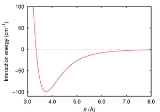
, who first documented these types of forces. The Lennard-Jones potential Lennard-Jones potential

Neutral atoms and molecules are subject to two distinct forces in the limit of large distance, and short dista... 

 is often used as an approximate model for the Van der Waals force as a function of distance.

Van der Waals interactions are observed in noble gases, which are very stable and tend not to interact. This is why it is difficult to condense Condensation

[i] to a [[liquid]... 

 them into liquid Liquid

A liquid is one of the main phases of matter [i]. ... 

s. However, the larger the atom Atom

In chemistry [i] and physics [i], an atom is the smallest possible particle of a chemical element [i] t ... 

 of the noble gas the easier it is to condense the gas into a liquid. This happens because, when the electron cloud surrounding the gas atom gets large, it does not form a perfect sphere around the nucleus Atomic nucleus

The nucleus of an atom [i] is the very dense region in its center consisting of proton [i]s and neutron [i] ... 

. Rather, it is only spherical if averaged over longer times and generally forms an oval Ellipse

The search term "Elliptical" redirects to this page; for the exercise machine, see Elliptical trainer [i] ... 

, which has a slight negative charge on one side and a slight positive charge on the other. The atom becomes a temporary dipole. This induces the same shift in neighboring atoms and spreads from one atom to the next. Unlike charges attract, and the induced dipoles are held together by dispersion force . Van der Waals forces are responsible for certain cases of pressure broadening of spectral lines.

London dispersion force


London dispersion forces, named after the German-American physicist Fritz London, are weak intermolecular forces that arise from the attractive force between transient dipole Dipole

Definition

In physics, there are two kinds of dipoles = double and polos = pivot).... 

s in molecule Molecule

In chemistry, a molecule is an aggregate of two or more atom [i]s in a definite arrangement held togethe ... 

s without permanent multipole moments. London dispersion forces are also just called dispersion forces or London forces and sometimes van der Waals forces.

London forces can be exhibited by nonpolar molecules because electron density moves about a molecule probabilistically. There is a high chance that the electron density will not be evenly distributed throughout a nonpolar molecule. When an uneven distribution occurs, a temporary multipole is created. This multipole may interact with other nearby multipoles. London forces are also present in polar molecules, but they are usually only a small part of the total interaction force.

Electron density Electron density

Electron density is the measure of the probability [i] of an electron [i] being present at a specific lo ... 

 in a molecule may be redistributed by proximity to another multipole. Electrons will gather on the side of a molecule that faces a positive charge and retreat from a negative charge. Hence, a transient multipole can be produced by a nearby polar molecule, or even by a transient multipole in another nonpolar molecule.

London forces are weaker than other intermolecular forces such as ionic interactions, hydrogen bond Hydrogen bond

In chemistry [i], a hydrogen bond is a type of attractive intermolecular force [i] that exists between t ... 

ing, or permanent dipole-dipole interactions.

This phenomenon is the only attractive intermolecular force at large distances present between neutral atoms , and is the major attractive force between non-polar molecules, such as nitrogen Nitrogen

Nitrogen is a chemical element [i] which has the symbol N and atomic number [i] 7 in the periodic table [i] ... 

 or methane Methane

The simplest hydrocarbon [i], methane, is a gas [i] with a chemical formula [i] of C [i]H [i] ... 

 . Without London forces, there would be no attractive force between noble gas atoms, and they could not then be obtained in a liquid form.

London forces become stronger as the atom in question becomes larger. This is due to the increased polarizability of molecules with larger, more dispersed electron clouds. This trend is exemplified by the halogen Halogen

The halogens are a chemical series [i]. ... 

s . Fluorine Fluorine

Fluorine , is the chemical element [i] in the periodic table [i] that has the symbol F and atomic number [i] ... 

 and chlorine are gases at room temperature, bromine is a liquid, and iodine is a solid.

Relation to the Casimir effect


The London-Van der Waals force is related to the Casimir effect Casimir effect

In physics [i], the Casimir effect is a physical force [i] exerted between separate objects, whic ... 

 for dielectric media, the former the microscopic description of the latter bulk property. First detailed calculations of this were done 1955 by E. M. Lifshitz.

Use by animals

The Van der Waals force is the force to which the gecko Gecko

Geckos are small to moderately large lizard [i]s belonging to the family Gekkonidae which are foun ... 

's climbing ability is attributed. A gecko can hang on a glass surface using only one toe. Efforts continue to create a synthetic "gecko tape" that exploits this knowledge. So far, research has produced some promising results - early research yielded an adhesive tape Adhesive tape

Adhesive tape is an adhesive [i]-coated fastening [i] tape [i] used for temporary or, in some cases, per ... 

  product, which only obtains a fraction of the forces measured from the natural material, and new research has yielded a discovery that purports 200 times the adhesive forces of the natural material.

Researchers at Stanford University Stanford University

The Leland Stanford Junior University, commonly known as Stanford University , is a private university [i] ... 

 recently developed a gecko-like robot Robot

A robot is an electro-mechanical device that can perform autonomous or preprogrammed tasks.... 

 which uses synthetic setae to climb walls .

See also


  • Chemical bond Chemical bond

    A chemical bond is the physical phenomenon of chemical species [i] being held together by attraction of ... 

  • Hydride
  • John Lennard-Jones
  • Lennard-Jones potential Lennard-Jones potential

    Neutral atoms and molecules are subject to two distinct forces in the limit of large distance, and short dista... 


Sources

  • Iver Brevik, V. N. Marachevsky, Kimball A. Milton, Identity of the Van der Waals Force and the Casimir Effect and the Irrelevance of these Phenomena to Sonoluminescence,
  • I. D. Dzyaloshinskii, E. M. Lifshitz, and L. P. Pitaevskii, Usp. Fiz. Nauk 73, 381
    • English translation: Soviet Phys. Usp. 4, 153
  • R. H. French, University of Pennsylvania, Materials Science "".
  • L. D. Landau and E. M. Lifshitz, Electrodynamics of Continuous Media, Pergamon, Oxford, 1960, pp. 368–376.
  • Mark Lefers, "". Holmgren Lab.
  • E. M. Lifshitz, Zh. Eksp. Teor. Fiz. 29, 894
    • English translation: Soviet Phys. JETP 2, 73
  • Western Oregon University's "". .