
All Topics  
Strength of materials


   Email Print
   Bookmark   Link


Strength of materials


In materials science
Materials science

Materials science or materials engineering is an interdisciplinary field involving the properties of matter and its applications to various areas of science and engineering....
, the strength of a material refers to the material's ability to withstand an applied stress
Stress (physics)

In continuum mechanics, stress is a measure of the average amount of force exerted per unit area. It is a measure of the intensity of the total internal forces acting within a body across imaginary internal surfaces, as a reaction to external applied forces and body forces....
 without failure. Yield strength refers to the point on the engineering stress-strain curve (as opposed to true stress-strain curve) beyond which the material begins deformation that cannot be reversed upon removal of the loading. Ultimate strength refers to the point on the engineering stress-strain curve corresponding to the maximum stress.


Discussion
Ask a question about 'Strength of materials'
Start a new discussion about 'Strength of materials'
Answer questions from other users
Full Discussion Forum


Encyclopedia


In materials science
Materials science

Materials science or materials engineering is an interdisciplinary field involving the properties of matter and its applications to various areas of science and engineering....
, the strength of a material refers to the material's ability to withstand an applied stress
Stress (physics)

In continuum mechanics, stress is a measure of the average amount of force exerted per unit area. It is a measure of the intensity of the total internal forces acting within a body across imaginary internal surfaces, as a reaction to external applied forces and body forces....
 without failure. Yield strength refers to the point on the engineering stress-strain curve (as opposed to true stress-strain curve) beyond which the material begins deformation that cannot be reversed upon removal of the loading. Ultimate strength refers to the point on the engineering stress-strain curve corresponding to the maximum stress. The applied stress may be tensile
Tensile strength

Tensile strength , or is the Stress at which a material breaks or permanently deforms. Tensile strength is an Intensive and extensive properties and, consequently, does not depend on the size of the test specimen....
, compressive
Compressive strength

Compressive strength is the capacity of a material to withstand axially directed pushing forces. When the limit of compressive strength is reached, materials are crushed....
, or shear
Shear strength

Shear strength in engineering is a term used to describe the strength of a material or component against the type of Yield or structural failure where the material or component fails in Shearing ....
.

A material's strength is dependent on its microstructure. The engineering processes to which a material is subjected can alter this microstrucure. The variety of strengthening mechanisms
Strengthening mechanisms of materials

Methods have been devised to modify the yield strength, ductility, and toughness of both crystalline and amorphous materials. These strengthening mechanisms give engineers the ability to tailor the mechanical properties of materials to suit a variety of different applications....
 that alter the strength of a material includes work hardening
Work hardening

Work hardening, strain hardening, or cold work is the strength of materials by, macroscopically speaking, plastic deformation . As the material becomes increasingly saturated with new dislocations, more dislocations are prevented from nucleating ....
, solid solution strengthening
Solid solution strengthening

Solid solution strengthening is a type of alloying that can be used to improve the strength of a pure metal. The technique works by adding atoms of one element to the crystalline lattice another element ....
, precipitation hardening and grain boundary strengthening
Grain boundary strengthening

Grain-boundary strengthening is a method of strength of materials materials by changing their average crystallite size. It is based on the observation that grain boundaries impede dislocation movement and that the number of dislocations within a grain have an effect on how easily dislocations can traverse grain boundaries and travel from g...
 and can be quantified and qualitatively explained. However, strengthening mechanisms are accompanied by the caveat that some mechanical properties of the material may degenerate in an attempt to make the material stronger. For example, in grain boundary strengthening, although yield strength is maximized with decreasing grain size, ultimately, very small grain sizes make the material brittle. In general, the yield strength of a material is an adequate indicator of the material's mechanical strength. Considered in tandem with the fact that the yield strength is the parameter that predicts plastic deformation
Deformation

In materials science, deformation is a change in the shape or size of an object due to an applied force . This can be a result of tensile strength forces, compressive strength forces, Simple shear, bending or torsion ....
 in the material, one can make informed decisions on how to increase the strength of a material depending its microstructural properties and the desired end effect. Strength is considered in terms of compressive strength
Compressive strength

Compressive strength is the capacity of a material to withstand axially directed pushing forces. When the limit of compressive strength is reached, materials are crushed....
, tensile strength
Tensile strength

Tensile strength , or is the Stress at which a material breaks or permanently deforms. Tensile strength is an Intensive and extensive properties and, consequently, does not depend on the size of the test specimen....
, and shear strength
Shear strength

Shear strength in engineering is a term used to describe the strength of a material or component against the type of Yield or structural failure where the material or component fails in Shearing ....
, namely the limit states of compressive stress
Compressive stress

Compressive stress is the stress applied to materials resulting in their compaction . When a material is subjected to compressive stress, then this material is under physical compression....
, tensile stress and shear stress
Shear stress

File:Shear stress.JPGA shear stress, denoted , is defined as a stress which is applied parallel or tangent to a face of a material, as opposed to a normal stress which is applied perpendicularly....
, respectively. The effects of dynamic loading is probably the most important practical part of the strength of materials, especially the problem of fatigue
Fatigue (material)

In materials science, 'fatigue' is the progressive and localized structural damage that occurs when a material is subjected to cyclic loading....
. Repeated loading often initiates brittle cracks, which grow slowly until failure occurs.

However, the term strength of materials most often refers to various methods of calculating stresses in structural members, such as beams, columns and shafts. The methods that can be employed to predict the response of a structure under loading and its susceptibility to various failure modes may take into account various properties of the materials other than material (yield or ultimate) strength. For example failure in buckling is dependent on material stiffness (Young's Modulus).

Definitions


Stress terms


Uniaxial stress is expressed by

where F is the force [N] acting on an area A [m2]. The area can be the undeformed area or the deformed area, depending on whether engineering stress or true stress is used.

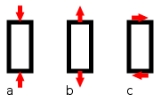
  • Compressive stress
    Compressive stress

    Compressive stress is the stress applied to materials resulting in their compaction . When a material is subjected to compressive stress, then this material is under physical compression....
     (or compression
    Physical compression

    Physical compression is the result of the subjection of a material to compressive stress, resulting in reduction of volume. The opposite of compression is tension ....
    ) is the stress state caused by an applied load that acts to reduce the length of the material (compression member
    Compression member

    A compression member is a general class of structural elements of which a column is the most common specific example....
    ) in the axis of the applied load, in other words the stress state caused by squeezing the material. A simple case of compression is the uniaxial compression induced by the action of opposite, pushing forces. Compressive strength for materials is generally higher than that of tensile stress. However, structures loaded in compression are subject to additional failure modes dependent on geometry, such as Euler buckling
    Buckling

    In engineering, buckling is a structural failure characterized by a sudden failure of a structural member subjected to high compressive stresses, where the actual compressive stress at the point of failure is less than the ultimate compressive stresses that the material is capable of withstanding....
    .


  • Tensile stress is the stress state caused by an applied load that tends to elongate the material in the axis of the applied load, in other words the stress caused by pulling the material. The strength of structures of equal cross sectional area loaded in tension is independent of cross section geometry. Materials loaded in tension are susceptible to stress concentrations such as material defects or abrupt changes in geometry. However, materials exhibiting ductile behavior(metals for example) can tolerate some defects while brittle materials (such as ceramics) can fail well below their ultimate stress.


  • Shear stress
    Shear stress

    File:Shear stress.JPGA shear stress, denoted , is defined as a stress which is applied parallel or tangent to a face of a material, as opposed to a normal stress which is applied perpendicularly....
     is the stress state caused by a opposing forces acting along parallel lines of action through the material, in other words the stress caused by sliding faces of the material relative to one another. An example is cutting paper with scissors.


Strength terms

  • Yield strength
    Yield (engineering)

    The yield strength or yield point of a material is defined in engineering and materials science as the Stress at which a material begins to Plasticity ....
     is the lowest stress that gives permanent deformation in a material. In some materials, like aluminium alloy
    Aluminium alloy

    Aluminium alloys are alloys of aluminium, often with copper, zinc, manganese, silicon, or magnesum. They are much lighter and more corrosion resistant than plain carbon steel, but not as corrosion resistant as pure aluminium....
    s, the point of yielding is hard to define, thus it is usually given as the stress required to cause 0.2% plastic strain.


  • Compressive strength
    Compressive strength

    Compressive strength is the capacity of a material to withstand axially directed pushing forces. When the limit of compressive strength is reached, materials are crushed....
     is a limit state of compressive stress
    Compressive stress

    Compressive stress is the stress applied to materials resulting in their compaction . When a material is subjected to compressive stress, then this material is under physical compression....
     that leads to compressive failure in the manner of ductile failure (infinite theoretical yield) or in the manner of brittle failure (rupture as the result of crack propagation, or sliding along a weak plane - see shear strength
    Shear strength

    Shear strength in engineering is a term used to describe the strength of a material or component against the type of Yield or structural failure where the material or component fails in Shearing ....
    ).


  • Tensile strength
    Tensile strength

    Tensile strength , or is the Stress at which a material breaks or permanently deforms. Tensile strength is an Intensive and extensive properties and, consequently, does not depend on the size of the test specimen....
     or ultimate tensile strength is a limit state of tensile stress thats leads to tensile failure in the manner of ductile failure (yield as the first stage of failure, some hardening in the second stage and break after a possible "neck" formation) or in the manner of brittle failure (sudden breaking in two or more pieces with a low stress state). Tensile strength can be given as either true stress or engineering stress.


  • Fatigue strength
    Fatigue (material)

    In materials science, 'fatigue' is the progressive and localized structural damage that occurs when a material is subjected to cyclic loading....
     is a measure of the strength of a material or a component under cyclic loading, and is usually more difficult to assess than the static strength measures. Fatigue strength is given as stress amplitude or stress range , usually at zero mean stress, along with the number of cycles to failure.


  • Impact strength, it is the capability of the material in withstanding by the suddenly applied loads in terms of energy. Often measured with the Izod impact strength test
    Izod impact strength test

    Izod impact strength testing is an ASTM standard method of determining impact strength. A notched sample is generally used to determine impact strength....
     or Charpy impact test
    Charpy impact test

    The Charpy impact test, also known as the Charpy v-notch test, is a Wiktionary:standardized high strain -rate test which determines the amount of energy absorbed by a material during fracture....
    , both of which measure the impact energy required to fracture a sample.


Strain (deformation) terms

  • Deformation
    Deformation

    In materials science, deformation is a change in the shape or size of an object due to an applied force . This can be a result of tensile strength forces, compressive strength forces, Simple shear, bending or torsion ....
     of the material is the change in geometry when stress is applied (in the form of force loading, gravitational field, acceleration, thermal expansion, etc.). Deformation is expressed by the displacement field of the material.


  • Strain
    Strain (materials science)

    In continuum mechanics, the infinitesimal strain theory, sometimes called small deformation theory, small displacement theory, or small displacement-gradient theory, deals with infinitesimal Deformation s of a Continuum mechanics....
     or reduced deformation is a mathematical term to express the trend of the deformation change among the material field. For uniaxial loading - displacements of a specimen (for example a bar element) it is expressed as the quotient of the displacement and the length of the specimen. For 3D displacement fields it is expressed as derivatives of displacement functions in terms of a second order tensor
    Tensor

    A tensor is an object which extends the notion of Scalar , Vector , and Matrix . The term has slightly different meanings in mathematics and physics....
     (with 6 independent elements).


  • Deflection
    Deflection

    Deflection or deflexion may refer to:*Deflection *Deflection *Deflection *Electrostatic deflection*Deflection ...
     is a term to describe the magnitude to which a structural element bends under a load.


Stress-strain relations

  • Elasticity
    Deformation

    In materials science, deformation is a change in the shape or size of an object due to an applied force . This can be a result of tensile strength forces, compressive strength forces, Simple shear, bending or torsion ....
     is the ability of a material to return to its previous shape after stress is released. In many materials, the relation between applied stress and the resulting strain is directly proportional (up to a certain limit), and a graph representing those two quantities is a straight line.
The slope of this line is known as Young's Modulus
Young's modulus

In solid mechanics, Young's modulus is a measure of the stiffness of an isotropic elastic material. It is also known as the Young modulus, modulus of elasticity, elastic modulus or tensile modulus....
, or the "Modulus of Elasticity." The Modulus of Elasticity can be used to determine stress-strain relationships in the linear-elastic portion of the stress-strain curve. The linear-elastic region is taken to be between 0 and 0.2% strain, and is defined as the region of strain in which no yielding (permanent deformation) occurs.

  • Plasticity
    Plasticity (physics)

    In physics and materials science, plasticity describes the deformation of a material undergoing non-reversible changes of shape in response to applied forces....
     or plastic deformation is the opposite of elastic deformation and is accepted as unrecoverable strain. Plastic deformation is retained even after the relaxation of the applied stress. Most materials in the linear-elastic category are usually capable of plastic deformation. Brittle materials, like ceramics, do not experience any plastic deformation and will fracture under relatively low stress. Materials such as metals usually experience a small amount of plastic deformation before failure while soft or ductile polymers will plasticly deform much more.


Consider the difference between a carrot and chewed bubble gum. The carrot will stretch very little before breaking, but nevertheless will still stretch. The chewed bubble gum, on the other hand, will plasticly deform enormously before finally breaking.

Design terms


Ultimate strength is an attribute directly related to a material, rather than just specific specimen of the material, and as such is quoted force per unit of cross section area (N/m²). For example, the ultimate tensile strength (UTS) of AISI 1018 Steel is 440 MN/m². In general, the SI unit of stress is the pascal
Pascal (unit)

The pascal is the SI derived unit of pressure, stress , Young's modulus and tensile strength. It is a measure of force per unit area i.e. equivalent to one newton per square meter or one joule per cubic meter....
, where 1 Pa = 1 N/m². In Imperial units, the unit of stress is given as lbf/in² or pounds-force per square inch. This unit is often abbreviated as psi. One thousand psi is abbreviated ksi.

Factor of safety
Factor of safety

Factor of safety can mean either the fraction of structural capability over that required, or a multiplier applied to the maximum expected load to which a component or assembly will be subjected....
 is a design constraint that an engineered component or structure must achieve. , where FS: the Factor of Safety, R: The applied stress, and UTS: the Ultimate force (or stress).

Margin of Safety is also sometimes used to as design constraint. It is defined MS=Factor of safety - 1

For example to achieve a factor of safety of 4, the allowable stress in an AISI 1018 steel component can be worked out as = 440/4 = 110 MPa, or = 110×106 N/m².

Suggested reading

  • Mechanics of Materials , E.J. Hearn
  • Alfirevic, Ivo. Strength of Materials I. Tehnicka knjiga, 1995. ISBN 953-172-010-X.
  • Alfirevic, Ivo. Strength of Materials II. Tehnicka knjiga, 1999. ISBN 953-6168-85-5.
  • Ashby, M.F. Materials Selection in Design. Pergamon, 1992.
  • Beer, F.P., E.R. Johnston, et al. Mechanics of Materials, 3rd edition. McGraw-Hill, 2001. ISBN 0-07-248673-2
  • Cottrell, A.H. Mechanical Properties of Matter. Wiley, New York, 1964.
  • Den Hartog, Jacob P. Strength of Materials. Dover Publications, Inc., 1961, ISBN 0-486-60755-0.
  • Drucker, D.C. Introduction to Mechanics of Deformable Solids. McGraw-Hill, 1967.
  • Gordon, J.E. The New Science of Strong Materials. Princeton, 1984.
  • Groover, Mikell P. Fundamentals of Modern Manufacturing, 2nd edition. John Wiley & Sons,Inc., 2002. ISBN 0-471-40051-3.
  • Hashemi, Javad and William F. Smith. Foundations of Materials Science and Engineering, 4th edition. McGraw-Hill, 2006. ISBN 007-125690-3.
  • Hibbeler, R.C. Statics and Mechanics of Materials, SI Edition. Prentice-Hall, 2004. ISBN 013-129-011-8.
  • Lebedev, Leonid P. and Michael J. Cloud. Approximating Perfection: A Mathematician's Journey into the World of Mechanics. Princeton University Press, 2004. ISBN 0-691-11726-8.
  • Mott, Robert L. Applied Strength of Materials, 4th edition. Prentice-Hall, 2002. ISBN 0-13-088578-9.
  • Popov, Egor P. Engineering Mechanics of Solids. Prentice Hall, Englewood Cliffs, N. J., 1990. ISBN 0-13-279258-3.
  • Ramamrutham, S. Strength of Materials.
  • Shames, I.H. and F.A. Cozzarelli. Elastic and inelastic stress analysis. Prentice-Hall, 1991. ISBN 1-56032-686-7.
  • Timoshenko S.
    Stephen Timoshenko

    Stephen P. Timoshenko , is reputed to be the father of modern engineering mechanics. He wrote many of the seminal works in the areas of engineering mechanics, Elasticity and strength of materials, many of which are still widely used today....
     Strength of Materials, 3rd edition. Krieger Publishing Company, 1976, ISBN 0-88275-420-3.
  • Timoshenko, S.P. and D.H. Young. Elements of Strength of Materials, 5th edition. (MKS System)


See also


External links

  • online lectures, problems, tests/solutions, links, software