
All Topics  
Friction


   Email Print
   Bookmark   Link


Friction


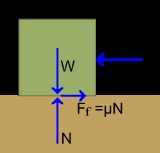
for block on ground. Arrows are vectors indicating directions and magnitudes of forces. W is the force of weight
Weight

In the physical sciences, weight is a measurement of the gravitational force acting on an object. Near the surface of the Earth, the Earth's gravity is approximately constant; this means that an object's weight is roughly proportional to its mass....
, N is the normal force
Normal force

In physics, the normal force is the component, perpendicular to the surface of contact, of the contact force exerted by, for example, the surface of a floor or wall, on an object, preventing the object from entering the floor or wall....
, F is an applied force of unidentified type, and Ff is the force of kinetic friction which is equal to the coefficient of kinetic friction times the normal force. Since the magnitude of the applied force is greater than the magnitude of the force of kinetic friction opposing it, the block is moving to the left.]]

Friction is the force
Force

In physics, a force is that which can cause an object with mass to change its velocity. Force has both Euclidean_vector#Length of a vector and Direction , making it a Vector quantity....
 resisting the relative lateral (tangential) motion of solid surfaces, fluid layers, or material elements in contact.


Discussion
Ask a question about 'Friction'
Start a new discussion about 'Friction'
Answer questions from other users
Full Discussion Forum


Recent Posts


Encyclopedia


for block on ground. Arrows are vectors indicating directions and magnitudes of forces. W is the force of weight
Weight

In the physical sciences, weight is a measurement of the gravitational force acting on an object. Near the surface of the Earth, the Earth's gravity is approximately constant; this means that an object's weight is roughly proportional to its mass....
, N is the normal force
Normal force

In physics, the normal force is the component, perpendicular to the surface of contact, of the contact force exerted by, for example, the surface of a floor or wall, on an object, preventing the object from entering the floor or wall....
, F is an applied force of unidentified type, and Ff is the force of kinetic friction which is equal to the coefficient of kinetic friction times the normal force. Since the magnitude of the applied force is greater than the magnitude of the force of kinetic friction opposing it, the block is moving to the left.]]

Friction is the force
Force

In physics, a force is that which can cause an object with mass to change its velocity. Force has both Euclidean_vector#Length of a vector and Direction , making it a Vector quantity....
 resisting the relative lateral (tangential) motion of solid surfaces, fluid layers, or material elements in contact. It is usually subdivided into several varieties:

  • Dry friction resists relative lateral motion of two solid surface
    Surface

    In mathematics, specifically in topology, a surface is a two-dimensional topological manifold. The most familiar examples are those that arise as the boundaries of solid objects in ordinary three-dimensional Euclidean space E3....
    s in contact. Dry friction is also subdivided into static friction between non-moving surfaces, and kinetic friction (sometimes called sliding friction or dynamic friction) between moving surfaces.


  • Lubricated friction or fluid friction resists relative lateral motion of two solid surfaces separated by a layer of gas or liquid.


  • Fluid friction is also used to describe the friction between layers within a fluid that are moving relative to each other.


  • Skin friction
    Parasitic drag

    Parasitic drag is Drag caused by moving a solid object through a fluid. Parasitic drag is made up of many components, the most prominent being form drag....
     is a component of drag
    Drag (physics)

    The term drag is widely used in Physics and Engineering and is central to the field of fluid dynamics. "Drag" refers to forces that oppose the motion of a solid object through a fluid ....
    , the force resisting the motion of a solid body through a fluid.


  • Internal friction is the force resisting motion between the elements making up a solid material while it undergoes deformation
    Deformation (mechanics)

    In continuum mechanics, deformation is the change in shape and/or size of a Continuum mechanics body after it undergoes a Continuum mechanics#Kinematics: deformation and motion between an initial or undeformed Continuum mechanics , at time , and a current or deformed configuration , at the current time ....
    .


Friction is not a fundamental force, as it is derived from electromagnetic force
Electromagnetic force

In physics, the electromagnetic force is the force that the electromagnetic field exerts on electrically charged particles. It is the electromagnetic force that holds electrons and protons together in atoms, and which hold atoms together to make molecules....
 between charged particles, including electrons, protons, atoms, and molecules, and so cannot be calculated from first principles, but instead must be found empirical
Empirical

The word empirical denotes information gained by means of observation, experience, or experiment, as opposed to theory. A central concept in science and the scientific method is that all evidence must be empirical, or empirically based, that is, dependent on evidence or Logical consequence that are observable by the senses....
ly. When contacting surfaces move relative to each other, the friction between the two surfaces converts kinetic energy
Kinetic energy

The kinetic energy of an object is the extra energy which it possesses due to its motion. It is defined as the mechanical work needed to accelerate a body of a given mass from rest to its current velocity....
 into thermal energy
Thermal energy

Thermal energy is a form of energy that manifests itself as an increase of temperature. It is also the sum of sensible heat and latent heat....
, or heat
Heat

In physics and thermodynamics, heat is any transfer of energy from one body or thermodynamic system to another due to a difference in temperature....
. Contrary to earlier explanations, kinetic friction is now understood not to be caused by surface roughness but by chemical bonding between the surfaces. Surface roughness and contact area, however, do affect kinetic friction for micro- and nano-scale objects where surface area forces dominate inertial forces.

Friction is distinct from traction
Traction (engineering)

Traction is defined by dictionaries as adhesive friction, another name for Friction#Static_friction . Traction is never properly used to mean Friction#Kinetic_friction ....
. Surface area does not affect friction significantly because as contact area increases, force per unit area decreases. In traction, however, surface area is important.

History

Several famous scientists and engineers contributed to our understanding of friction. They include Leonardo da Vinci
Leonardo da Vinci

Leonardo di ser Piero da Vinci was an Italy polymath, being a scientist, mathematician, engineer, inventor, anatomist, Painting, sculptor, architect, botanist, musician and writer....
, Guillaume Amontons
Guillaume Amontons

Guillaume Amontons was a France scientific instrument inventor and physicist. He was one of the pioneers in tribology, apart from Leonardo da Vinci, John Theophilius Desanguliers, Leonard Euler and Charles-Augustin de Coulomb....
, John Theophilus Desaguliers
John Theophilus Desaguliers

John Theophilus Desaguliers was a natural philosopher born in France. He was a member of the Royal Society of London beginning 29 July 1714. He was presented with the Royal Society's highest honour, the Copley Medal, in 1734, 1736 and 1741, the 1741 award being for his "discovery of the properties of Electricity"....
, Leonard Euler, and Charles-Augustin de Coulomb. Their findings are codified into these laws:

  1. The force of friction is directly proportional to the applied load. (Amontons 1st Law)
  2. The force of friction is independent of the apparent area of contact. (Amontons 2nd Law)
  3. Kinetic friction is independent of the sliding velocity. (Coulomb's Law)


Coulomb friction

Coulomb friction, named after Charles-Augustin de Coulomb, is a model used to calculate the force of dry friction. It is governed by the equation:

where
  • is either the force exerted by friction, or, in the case of equality, the maximum possible magnitude of this force.
  • is the coefficient of friction, which is an empirical property of the contacting materials,
  • is the normal force
    Normal force

    In physics, the normal force is the component, perpendicular to the surface of contact, of the contact force exerted by, for example, the surface of a floor or wall, on an object, preventing the object from entering the floor or wall....
     exerted between the surfaces.


For surfaces at rest relative to each other , where is the coefficient of static friction. This is usually larger than its kinetic counterpart. The Coulomb friction may take any value from zero up to , and the direction of the frictional force against a surface is opposite to the motion that surface would experience in the absence of friction. Thus, in the static case, the frictional force is exactly what it must be in order to prevent motion between the surfaces; it balances the net force tending to cause such motion. In this case, rather than providing an estimate of the actual frictional force, the Coulomb approximation provides a threshold value for this force, above which motion would commence.

For surfaces in relative motion , where is the coefficient of kinetic friction. The Coulomb friction is equal to , and the frictional force on each surface is exerted in the direction opposite to its motion relative to the other surface.

This approximation mathematically follows from the assumptions that surfaces are in atomically close contact only over a small fraction of their overall area, that this contact area
Contact area

When two Physical body touch, a certain portion of their surface areas will be in contact with each other. Contact area refers to the fraction of this area that consists of the atoms of one object being in contact with the atoms of the other object....
 is proportional to the normal force (until saturation
Saturation

Saturation or saturated may mean:* Dew point, which is a temperature that occurs when atmospheric humidity reaches 100% and the air is saturated with moisture...
, which takes place when all area is in atomic contact), and that frictional force is proportional to the applied normal force, independently of the contact area (you can see the experiments on friction from Leonardo Da Vinci). Such reasoning aside, however, the approximation is fundamentally an empirical construction. It is a rule of thumb describing the approximate outcome of an extremely complicated physical interaction. The strength of the approximation is its simplicity and versatility – though in general the relationship between normal force and frictional force is not exactly linear (and so the frictional force is not entirely independent of the contact area of the surfaces), the Coulomb approximation is an adequate representation of friction for the analysis of many physical systems.

Coefficient of friction

The coefficient of friction (COF), also known as a frictional coefficient or friction coefficient, symbolized by the Greek letter µ, is a dimensionless
Dimensionless quantity

In dimensional analysis, a dimensionless quantity is a quantity without any physical units and thus a pure number. Such a number is typically defined as a product or ratio of quantity which do have units, in such a way that all the units cancel out....
 scalar
Scalar (physics)

In physics, a scalar is a simple physical quantity that is not changed by coordinate system rotations or translations , or by Lorentz transformations or space-time translations ....
 value which describes the ratio of the force of friction between two bodies and the force pressing them together. The coefficient of friction depends on the materials used; for example, ice on steel has a low coefficient of friction, while rubber on pavement has a high coefficient of friction. Coefficients of friction range from near zero to greater than one – under good conditions, a tire on concrete may have a coefficient of friction of 1.7.

When the surfaces are conjoined, Coulomb friction becomes a very poor approximation (for example, adhesive tape
Adhesive tape

Adhesive tape can be one of many varieties of backing materials coated with an adhesive.Several types of adhesives can be used:...
 resists sliding even when there is no normal force, or a negative normal force). In this case, the frictional force may depend strongly on the area of contact. Some drag racing
Drag racing

Drag racing is a competition in which vehicles compete to be the first to cross a set finish line, usually from a dead stop, and in a straight line....
 tires are adhesive in this way. However, despite the complexity of the fundamental physics behind friction, the relationships are accurate enough to be useful in many applications.

The force of friction is always exerted in a direction that opposes movement (for kinetic friction) or potential movement (for static friction) between the two surfaces. For example, a curling
Curling

Curling is a team sport with similarities to bowls and shuffleboard, played by two teams of four players each on a rectangular sheet of carefully prepared ice....
 stone sliding along the ice experiences a kinetic force slowing it down. For an example of potential movement, the drive wheels of an accelerating car experience a frictional force pointing forward; if they did not, the wheels would spin, and the rubber would slide backwards along the pavement. Note that it is not the direction of movement of the vehicle they oppose, it is the direction of (potential) sliding between tire and road.

The coefficient of friction is an empirical
Empirical

The word empirical denotes information gained by means of observation, experience, or experiment, as opposed to theory. A central concept in science and the scientific method is that all evidence must be empirical, or empirically based, that is, dependent on evidence or Logical consequence that are observable by the senses....
 measurement
Measurement

Measurement is the process of assigning a number to an attribute according to a rule or set of rules. The term can also be used to refer to the result obtained after performing the process....
 – it has to be measured experiment
Experiment

In scientific inquiry, an experiment is a method of investigating causal relationships among variables. An experiment is a cornerstone of the empiricism approach to acquiring data about the world and is used in both natural sciences and social sciences....
ally, and cannot be found through calculations. Rougher surfaces tend to have higher effective values. Most dry materials in combination have friction coefficient values between 0.3 and 0.6. Values outside this range are rarer, but teflon
Polytetrafluoroethylene

In chemistry, poly or poly is a synthetic fluoropolymer which finds numerous applications. PTFE is most well known by the DuPont brand name Teflon....
, for example, can have a coefficient as low as 0.04. A value of zero would mean no friction at all, an elusive property – even magnetic levitation
Magnetic levitation

Magnetic levitation, maglev, or magnetic suspension is a method by which an object is levitation with no support other than magnetic fields....
 vehicles
Maglev train

MAGLEV, or magnetic levitation, is a system of transportation that suspends, guides and propels vehicles, predominantly trains, using levitation from a very large number of magnets for lift and propulsion....
 have drag
Drag (physics)

The term drag is widely used in Physics and Engineering and is central to the field of fluid dynamics. "Drag" refers to forces that oppose the motion of a solid object through a fluid ....
. Rubber in contact with other surfaces can yield friction coefficients from 1 to 2. Occasionally it is maintained that µ is always < 1, but this is not true. While in most relevant applications µ < 1, a value above 1 merely implies that the force required to slide an object along the surface is greater than the normal force of the surface on the object. For example, silicone rubber
Silicone rubber

Silicone rubber is a polymer that has a "backbone" of silicon-oxygen linkages, the same bond that is found in quartz, glass and sand. Normally, heat is required to Vulcanization the silicone rubber; this is normally carried out in a two stage process at the point of manufacture into the desired shape, and then in a prolonged post-cure proces...
 or acrylic rubber
Acrylic rubber

Acrylic rubber, known by the chemical name alkyl acrylate copolymer or the tradename Hytemp, is a type of rubber that has outstanding resistance to hot oil and oxidation....
-coated surfaces have a coefficient of friction that can be substantially larger than 1.

Both static and kinetic coefficients of friction depend on the pair of surfaces in contact; their values are usually approximately determined experimentally. For a given pair of surfaces, the coefficient of static friction is usually larger than that of kinetic friction; in some sets the two coefficients are equal, such as teflon-on-teflon.

In the case of kinetic friction, the direction of the friction force may or may not match the direction of motion: a block sliding atop a table with rectilinear motion is subject to friction directed along the line of motion; an automobile making a turn is subject to friction acting perpendicular to the line of motion (in which case it is said to be 'normal' to it). The direction of the static friction force can be visualized as directly opposed to the force that would otherwise cause motion, were it not for the static friction preventing motion. In this case, the friction force exactly cancels the applied force, so the net force given by the vector sum, equals zero. It is important to note that in all cases, Newton's first law of motion holds.

While it is often stated that the COF is a "material property," it is better categorized as a "system property." Unlike true material properties (such as conductivity, dielectric constant, yield strength), the COF for any two materials depends on system variables like temperature
Temperature

In physics, temperature is a physical property of a Physical system that underlies the common notions of hot and cold; something that feels hotter generally has the greater temperature....
, velocity
Velocity

In physics, velocity is defined as the Derivative of Position vector. It is a vector physical quantity; both speed and direction are required to define it....
, atmosphere
Atmosphere

An atmosphere is a layer of gases that may surround a material body of sufficient mass, by the gravity of the body, and are retained for a longer duration if gravity is high and the atmosphere's temperature is low....
 and also what are now popularly described as aging and deaging times; as well as on geometric properties of the interface between the materials. For example, a copper
Copper

Copper is a chemical element with the symbol Cu and atomic number 29.It is a ductile metal with very high thermal and electrical conductivity....
 pin sliding against a thick copper plate can have a COF that varies from 0.6 at low speeds (metal sliding against metal) to below 0.2 at high speeds when the copper surface begins to melt due to frictional heating. The latter speed, of course, does not determine the COF uniquely; if the pin diameter is increased so that the frictional heating is removed rapidly, the temperature drops, the pin remains solid and the COF rises to that of a 'low speed' test.

The normal force

The normal force is defined as the net force compressing two parallel surfaces together; and its direction is perpendicular to the surfaces. In the simple case of a mass resting on a horizontal surface, the only component of the normal force is the force due to gravity, where . In this case, the magnitude of the friction force is the product of the mass of the object, the acceleration due to gravity, and the coefficient of friction. However, the coefficient of friction is not a function of mass or volume; it depends only on the material. For instance, a large aluminum block has the same coefficient of friction as a small aluminum block. However, the magnitude of the friction force itself depends on the normal force, and hence the mass of the block.

If an object is on a level surface and the force tending to cause it to slide is horizontal, the normal force between the object and the surface is just its weight, which is equal to its mass
Mass

In physical science, mass refers to the degree of acceleration a body acquires when subject to a force: bodies with greater mass are accelerated less by the same force....
 multiplied by the acceleration
Acceleration

File:Acceleration.JPGFile:Acceleration components.JPGIn physics, and more specifically kinematics, acceleration is the change in velocity over time....
 due to earth's gravity, g
Standard gravity

Standard gravity, usually denoted by g0 or gn, is the nominal acceleration due to Earth's gravity at the Earth's surface at sea level....
. If the object is on a tilted surface such as an inclined plane, the normal force is less, because less of the force of gravity is perpendicular to the face of the plane. Therefore, the normal force, and ultimately the frictional force, is determined using vector analysis, usually via a free body diagram
Free body diagram

A free body diagram is a pictorial representation often used by physicists and engineers to analyze the forces acting on a free body. A free body diagram shows all contact force and non-contact force forces acting on the body....
. Depending on the situation, the calculation of the normal force may include forces other than gravity.

Approximate coefficients of friction
Materials Static friction,
Dry & clean Lubricated
Aluminum Steel 0.61 
Copper Steel 0.53 
Brass Steel 0.51 
Cast iron Copper 1.05 
Cast iron Zinc 0.85 
Concrete (wet) Rubber 0.30 
Concrete (dry) Rubber 1.0 
Copper Glass 0.68 
Glass Glass 0.94 
Polythene Steel 0.2 0.2
Steel Steel 0.80 0.16
Steel Teflon 0.04 0.04
Teflon Teflon 0.04 0.04


The slipperiest solid known, discovered in 1999, dubbed BAM
BAM (material)

BAM is a ceramic alloy created from an alloy of boron, aluminium and magnesium and titanium boride . It is the third-hardest known material, after diamond and cubic boron nitride....
 (for the elements boron, aluminum, and magnesium), has an approximate coefficient of friction of 0.02, about half that of Teflon.

Static friction

Static friction is friction between two solid objects that are not moving relative to each other. For example, static friction can prevent an object from sliding down a sloped surface. The coefficient of static friction, typically denoted as µs, is usually higher than the coefficient of kinetic friction.

The static friction force must be overcome by an applied force before an object can move. The maximum possible friction force between two surfaces before sliding begins is the product of the coefficient of static friction and the normal force: . When there is no sliding occurring, the friction force can have any value from zero up to . Any force smaller than attempting to slide one surface over the other is opposed by a frictional force of equal magnitude and opposite direction. Any force larger than overcomes the force of static friction and causes sliding to occur. The instant sliding occurs, static friction is no longer applicable and kinetic friction becomes applicable.

An example of static friction is the force that prevents a car wheel from slipping as it rolls on the ground. Even though the wheel is in motion, the patch of the tire in contact with the ground is stationary relative to the ground, so it is static rather than kinetic friction.

The maximum value of static friction, when motion is impending, is sometimes referred to as limiting friction, although this term is not used universally.

Kinetic friction

Kinetic (or dynamic) friction occurs when two objects are moving relative to each other and rub together (like a sled on the ground). The coefficient of kinetic friction is typically denoted as µk, and is usually less than the coefficient of static friction for the same materials.

Examples of kinetic friction:

  • Kinetic friction is when two objects are rubbing against each other. Putting a book flat on a desk and moving it around is an example of kinetic friction.


  • Fluid friction is the interaction between a solid object and a fluid
    Fluid

    A fluid is defined as a substance that continually deforms under an applied shear stress. All liquids and all gases are fluids. Fluids are a subset of the Phase and include liquids, gas, Plasma physics and, to some extent, plasticity ....
     (liquid or gas), as the object moves through the fluid. The skin friction
    Drag (physics)

    The term drag is widely used in Physics and Engineering and is central to the field of fluid dynamics. "Drag" refers to forces that oppose the motion of a solid object through a fluid ....
     of air on an airplane or of water on a swimmer are two examples of fluid friction. This kind of friction is not only due to rubbing, which generates a force tangent to the surface of the object (such as sliding friction). It is also due to forces that are orthogonal to the surface of the object. These orthogonal forces significantly (and mainly, if relative velocity is high enough) contribute to fluid friction. Fluid friction is the classic name of this force. This name is no longer used in modern fluid dynamics
    Fluid dynamics

    In physics, fluid dynamics is the sub-discipline of fluid mechanics dealing with fluid flow — the natural science of fluids in motion....
    . Since rubbing is not its only cause, in modern fluid dynamics the same force is typically referred to as drag or fluid resistance, while the force component due to rubbing is called skin friction. Notice that a fluid can in some cases exert, together with drag, a force orthogonal to the direction of the relative motion of the object (lift
    Lift (force)

    In the context of a fluid flow relative to a body, the lift force is the Vector #Vector components of the aerodynamic force that is perpendicular to the oncoming flow direction....
    ). The net force exerted by a fluid (drag + lift) is called fluidodynamic force (aerodynamic if the fluid is a gas, or hydrodynamic if the fluid is a liquid).


Angle of friction


For certain applications it is more useful to define static friction in terms of the maximum angle before which one of the items will begin sliding. This is called the angle of friction or friction angle. It is defined as:

where is the angle from horizontal and is the static coefficient of friction between the objects.

Other types of friction


Rolling resistance

Rolling resistance is the force that resists the rolling of a wheel or other circular object along a surface caused by deformations in the object and/or surface. Generally the force of rolling resistance is less than that associated with kinetic friction. Typical values for the coefficient of rolling resistance are 0.001. One of the most common examples of rolling resistance is the movement of motor vehicle
Motor vehicle

A motor vehicle is a machine which incorporates a wikt:motor , and which is used for transportation. The internal combustion engine is the most common motor choice, although electric motors or other types are sometimes used....
 tire
Tire

Tires, or tyres , are ring-shaped parts, either pneumatic or solid , that fit around wheels to protect them and enhance their function....
s on a road
Road

A road is an identifiable Road number, way or Trail between Location . Roads are typically smoothed, Pavement , or otherwise prepared to allow easy travel; though they need not be, and historically many roads were simply recognizable routes without any formal construction or Maintenance, repair and operations....
, a process which generates heat and sound
Roadway noise

Roadway noise is the collective sound energy emanating from motor vehicles. In the USA it contributes more to environmental noise exposure than any other noise source, and is constituted chiefly of engine, tire, aerodynamic and braking elements....
 as by-products.

Triboelectric effect

Rubbing dissimilar materials against one another can cause a build-up of electrostatic charge, which can be hazardous if flammable gases or vapours are present. When the static build-up discharges, explosion
Explosion

An explosion is a sudden increase in volume and release of energy in an extreme manner, usually with the generation of high temperatures and the release of gases....
s can be caused by ignition of the flammable mixture.

Reducing friction


Devices

Devices such as wheels, ball bearing
Ball bearing

A ball bearing is an engineering term referring to a type of rolling-element bearing which uses balls to maintain the separation between the moving parts of the bearing....
s, air cushion or roller bearing can change sliding friction into a much smaller type of rolling friction. Many thermoplastic
Thermoplastic

A thermoplastic is a polymer that turns to a liquid when heated and freezes to a very glassy state when cooled sufficiently. Most thermoplastics are high-molecular mass polymers whose Chain s associate through weak Van der Waals forces ; stronger dipole interactions and hydrogen bonding ; or even stacking of aromatic rings ....
 materials such as nylon
Nylon

Nylon is a generic designation for a family of synthetic polymers known generically as polyamides and first produced on February 28, 1935 by Wallace Carothers at DuPont....
, HDPE and PTFE are commonly used for low friction bearings. They are especially useful because the coefficient of friction falls with increasing imposed load.

Lubricants

A common way to reduce friction is by using a lubricant
Lubricant

A lubricant is a substance introduced between two moving surfaces to reduce the friction between them, improving efficiency and reducing wear....
, such as oil, water, or grease, which is placed between the two surfaces, often dramatically lessening the coefficient of friction. The science of friction and lubrication is called tribology
Tribology

Tribology is the science and technology of interacting surfaces in relative Motion . It includes the study and application of the principles of friction, lubrication and wear....
. Lubricant technology is when lubricants are mixed with the application of science, especially to industrial or commercial objectives.

Superlubricity
Superlubricity

Superlubricity is a regime of motion in which friction vanishes or very nearly vanishes.Superlubricity may occur when two crystalline surfaces slide over each other in dry commensurability contact....
, a recently-discovered effect, has been observed in graphite
Graphite

The mineral graphite is one of the allotropes of carbon. It was named by Abraham Gottlob Werner in 1789 from the Greek language ??afe?? : "to draw/write", for its use in pencils, where it is commonly called lead, as distinguished from the actual metallic element lead....
: it is the substantial decrease of friction between two sliding objects, approaching zero levels. A very small amount of frictional energy would still be dissipated.

Lubricants to overcome friction need not always be thin, turbulent fluids or powdery solids such as graphite and talc
Talc

Talc is a mineral composed of hydrated magnesium silicate with the chemical formula Hydrogen2Magnesium34 or Magnesium3Silicon4Oxygen102....
; acoustic lubrication
Acoustic lubrication

Acoustic or sonic lubrication occurs when sound permits vibration to introduce separation between the sliding faces. This could happen between two plates or between a series of particles....
 actually uses sound as a lubricant.

Another way to reduce friction between two parts is to superimpose micro-scale vibration to one of the parts. This can be sinusoidal vibration as used in ultrasound-assisted cutting or vibration noise, known as dither.

Energy of friction

According to the law of conservation of energy
Conservation of energy

The law of conservation of energy states that the total amount of energy in an isolated system remains constant. A consequence of this law is that energy cannot be created or destroyed....
, no energy is destroyed due to friction, though it may be lost to the system of concern. Energy is transformed from other forms into heat. A sliding hockey puck comes to rest because friction converts its kinetic energy into heat. Since heat quickly dissipates, many early philosophers, including Aristotle
Aristotle

Aristotle was a Greeks philosopher, a student of Plato and teacher of Alexander the Great. He wrote on many subjects, including physics, metaphysics, Poetics , theater, music, logic, rhetoric, politics, government, ethics, biology and zoology....
, wrongly concluded that moving objects lose energy without a driving force.

When an object is pushed along a surface, the energy converted to heat is given by: where
Fn is the normal force,
µk is the coefficient of kinetic friction,
x is the coordinate along which the object transverses.

Work of friction

In the reference frame of the interface between two surfaces, static friction does no work
Mechanical work

In physics, mechanical work is the amount of energy transferred by a force acting through a distance. Like energy, it is a scalar quantity, with SI of joules....
, because there is never displacement between the surfaces. In the same reference frame, kinetic friction is always in the direction opposite the motion, and does negative work. However, friction can do positive work in certain frames of reference. One can see this by placing a heavy box on a rug, then pulling on the rug quickly. In this case, the box slides backwards relative to the rug, but moves forward relative to the frame of reference in which the floor is stationary. Thus, the kinetic friction between the box and rug accelerates the box in the same direction that the box moves, doing positive work.

The work done by friction can translate into deformation, wear
Wear

In materials science, wear is the erosion of material from a solid surface by the action of another substance. The study of the processes of wear is part of the discipline of tribology....
, and heat that can affect the contact surface properties (even the coefficient of friction between the surfaces). This can be beneficial as in polishing
Polishing

Polishing is the process of creating a smooth and shiny surface by rubbing it or using a chemical action, leaving a surface with significant specular reflection and minimal diffuse reflection....
. The work of friction is used to mix and join materials such as in the process of friction welding
Friction welding

Friction welding is a class of solid-state welding processes that generates heat through mechanical friction between a moving workpiece and a stationary component, with the addition of a lateral force called "upset" to plastically displace and fuse the materials....
. Excessive erosion or wear of mating surfaces occur when work due frictional forces rise to unacceptable levels. Harder corrosion particles caught between mating surfaces (fretting
Fretting

Fretting refers to wear and sometimes corrosion damage at the asperities of contact surfaces. This damage is induced under load and in the presence of repeated relative surface motion, as induced for example by vibration....
) exacerbates wear of frictional forces. Bearing seizure or failure may result from excessive wear due to work of friction. As surfaces are worn by work due to friction, fit
Tolerance (engineering)

Engineering tolerance is the permissible limit of variation in# a physical dimension,# a measured value or physical property of a material, manufacturing object, system, or service,...
 and surface finish
Roughness

Roughness is a measure of the texture of a surface. It is quantified by the vertical deviations of a real surface from its ideal form. If these deviations are large, the surface is rough; if they are small the surface is smooth....
 of an object may degrade until it no longer functions properly.

See also

  • Angle of repose
    Angle of repose

    The angle of repose is an engineering property of granular materials. The angle of repose is the maximum angle of a stable slope determined by friction, cohesion and the shapes of the particles....
  • Drag (physics)
    Drag (physics)

    The term drag is widely used in Physics and Engineering and is central to the field of fluid dynamics. "Drag" refers to forces that oppose the motion of a solid object through a fluid ....
  • Factor of adhesion
    Factor of adhesion

    In railroad engineering, the factor of adhesion of a locomotive is the weight on the driving wheels divided by the starting tractive effort. This is an important statistic, because obviously extra power is pointless if there's not enough traction to put it to useful work....
  • Pin on disc tester Equipment used to measure kinetic friction of surfaces
  • Rolling resistance
    Rolling resistance

    Rolling resistance, sometimes called rolling friction or rolling drag, is the Friction that occurs when a round object such as a ball or tire rolls on a flat surface....
  • Tire
    Tire

    Tires, or tyres , are ring-shaped parts, either pneumatic or solid , that fit around wheels to protect them and enhance their function....
  • Traction (engineering)
    Traction (engineering)

    Traction is defined by dictionaries as adhesive friction, another name for Friction#Static_friction . Traction is never properly used to mean Friction#Kinetic_friction ....
  • Triboelectric effect
    Triboelectric effect

    The triboelectric effect is a type of contact electrification in which certain materials become electric charge after they come into contact with another different material and are then separated ....
  • Tribology
    Tribology

    Tribology is the science and technology of interacting surfaces in relative Motion . It includes the study and application of the principles of friction, lubrication and wear....
  • Wear
    Wear

    In materials science, wear is the erosion of material from a solid surface by the action of another substance. The study of the processes of wear is part of the discipline of tribology....


External links

  • - tables of coefficients, plus many links
  • from the University of New South Wales