
All Topics  
Viscoelasticity


   Email Print
   Bookmark   Link


Viscoelasticity


Viscoelasticity is the property of materials that exhibit both viscous
Viscosity

Viscosity is a measure of the Drag of a fluid which is being deformed by either shear stress or extensional stress. In everyday terms , viscosity is "thickness"....
 and elastic
Elasticity (physics)

In physics, elasticity is the physical property of a material when it deforms under stress , but returns to its original shape when the stress is removed....
 characteristics when undergoing deformation
Deformation

In materials science, deformation is a change in the shape or size of an object due to an applied force . This can be a result of tensile strength forces, compressive strength forces, Simple shear, bending or torsion ....
. Viscous materials, like honey, resist shear flow
Shear flow

Shear flow is:-DimensionsIn solid mechanics, shear flow is given in dimensions of force per length. This corresponds to units of newtons per metre in the SI system and pound-force per foot ...
 and strain
Strain (materials science)

In continuum mechanics, the infinitesimal strain theory, sometimes called small deformation theory, small displacement theory, or small displacement-gradient theory, deals with infinitesimal Deformation s of a Continuum mechanics....
 linearly with time when a stress
Stress (physics)

In continuum mechanics, stress is a measure of the average amount of force exerted per unit area. It is a measure of the intensity of the total internal forces acting within a body across imaginary internal surfaces, as a reaction to external applied forces and body forces....
 is applied. Elastic materials strain instantaneously when stretched and just as quickly return to their original state once the stress is removed. Viscoelastic materials have elements of both of these properties and, as such, exhibit time dependent strain.


Discussion
Ask a question about 'Viscoelasticity'
Start a new discussion about 'Viscoelasticity'
Answer questions from other users
Full Discussion Forum


Encyclopedia


Viscoelasticity is the property of materials that exhibit both viscous
Viscosity

Viscosity is a measure of the Drag of a fluid which is being deformed by either shear stress or extensional stress. In everyday terms , viscosity is "thickness"....
 and elastic
Elasticity (physics)

In physics, elasticity is the physical property of a material when it deforms under stress , but returns to its original shape when the stress is removed....
 characteristics when undergoing deformation
Deformation

In materials science, deformation is a change in the shape or size of an object due to an applied force . This can be a result of tensile strength forces, compressive strength forces, Simple shear, bending or torsion ....
. Viscous materials, like honey, resist shear flow
Shear flow

Shear flow is:-DimensionsIn solid mechanics, shear flow is given in dimensions of force per length. This corresponds to units of newtons per metre in the SI system and pound-force per foot ...
 and strain
Strain (materials science)

In continuum mechanics, the infinitesimal strain theory, sometimes called small deformation theory, small displacement theory, or small displacement-gradient theory, deals with infinitesimal Deformation s of a Continuum mechanics....
 linearly with time when a stress
Stress (physics)

In continuum mechanics, stress is a measure of the average amount of force exerted per unit area. It is a measure of the intensity of the total internal forces acting within a body across imaginary internal surfaces, as a reaction to external applied forces and body forces....
 is applied. Elastic materials strain instantaneously when stretched and just as quickly return to their original state once the stress is removed. Viscoelastic materials have elements of both of these properties and, as such, exhibit time dependent strain. Whereas elasticity is usually the result of bond stretching along crystallographic planes in an ordered solid, viscoelasticity is the result of the diffusion of atoms or molecules inside of an amorphous material .

Background


In the nineteenth century, physicists such as Maxwell
James Clerk Maxwell

James Clerk Maxwell was a Scotland Mathematical physics. His most significant achievement was the development of the classical electromagnetic theory, synthesizing all previous unrelated observations, experiments and equations of electricity, magnetism and even optics into a consistent theory....
, Boltzmann
Ludwig Boltzmann

Ludwig Eduard Boltzmann was an Austrian physicist famous for his founding contributions in the fields of statistical mechanics and statistical thermodynamics....
, and Kelvin
William Thomson, 1st Baron Kelvin

William Thomson, 1st Baron Kelvin , Order of Merit , Royal Victorian Order, Privy Council of the United Kingdom, Presidents of the Royal Society, Royal Society of Edinburgh, was an Ireland-born United Kingdom of Great Britain and Ireland Mathematical physics and engineer....
 researched and experimented with creep
Creep (deformation)

Creep is the tendency of a solid material to slowly move or deform permanently under the influence of stress es. It occurs as a result of long term exposure to levels of stress that are below the yield strength of the material....
 and recovery of glass
Glass

Glass generally refers to a Hardness, brittle, transparency amorphous solid, such as that used for windows, many Glass Bottles, or eyewear, including, but not limited to, soda-lime glass, borosilicate glass, acrylic glass, sugar glass, Muscovite , or aluminium oxynitride....
es, metal
Metal

In chemistry, a metal is a chemical element whose atoms readily lose electrons to form positive ions , and form metallic bonds between other metal atoms and ionic bonds between nonmetal atoms....
s, and rubber
Rubber

Natural rubber is an elastomer?an Elasticity_ hydrocarbon polymer?that was originally derived from a milky colloidal suspension, or latex , found in the sap of some plants....
s . Viscoelasticity was further examined in the late twentieth century when synthetic polymer
Synthetic polymer

Synthetic polymers are often referred to as "plastics", such as the well-known polyethylene and nylon. However, most of them can be classified in at least three main categories: thermoplastics, thermosets and elastomers....
s were engineered and used in a variety of applications . Viscoelasticity calculations depend heavily on the viscosity
Viscosity

Viscosity is a measure of the Drag of a fluid which is being deformed by either shear stress or extensional stress. In everyday terms , viscosity is "thickness"....
 variable, ?. The inverse of ? is also known as fluidity, f. The value of either can be derived as a function of temperature
Temperature dependence of liquid viscosity

The temperature dependence of liquid viscosity is the phenomenon by which liquid viscosity tends to decrease as its temperature increases. This can be observed, for example, by watching how cooking oil appears to move more fluidly upon a frying pan after being heated by a stove....
 or as a given value (ie for a dashpot
Dashpot

A dashpot is a mechanical device, a damper which resists motion via viscous friction. The resulting force is proportional to the velocity, but acts in the opposite direction, slowing the motion and absorbing energy....
) .
Non Newtonian Fluid
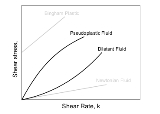
Depending on the change of strain rate versus stress inside a material the viscosity can be categorized as having a linear, non-linear, or plastic response. When a material exhibits a linear response it is categorized as a Newtonian material
Newtonian material

With regards to materials science, a material is said to be "Newtonian" if it exhibits a linear relationship between Stress and strain rate....
 . In this case the stress is linearly proportional to the strain rate. If the material exhibits a non-linear response to the strain rate, it is categorized as Non-Newtonian fluid
Non-Newtonian fluid

A non-Newtonian fluid is a fluid whose flow properties are not described by a single constant value of viscosity. Many polymer solutions and molten polymers are non-Newtonian fluids, as are many commonly found substances such as ketchup, starch suspensions, paint, blood and shampoo....
. There is also an interesting case where the viscosity decreases as the shear/strain rate remains constant. A material which exhibits this type of behavior is known as thixotropic
Thixotropy

Thixotropy is the property of some Non-Newtonian fluid Power-law fluid fluids to show a time-dependent change in viscosity; the longer the fluid undergoes shear stress, the lower is its viscosity....
 . In addition, when the stress is independent of this strain rate, the material exhibits plastic deformation . Many viscoelastic materials exhibit rubber
Rubber

Natural rubber is an elastomer?an Elasticity_ hydrocarbon polymer?that was originally derived from a milky colloidal suspension, or latex , found in the sap of some plants....
 like behavior explained by the thermodynamic theory of polymer elasticity. In reality all materials deviate from Hooke's law in various ways, for example by exhibiting viscous-like as well as elastic characteristics. Viscoelastic materials are those for which the relationship between stress and strain depends on time. Anelastic solids represent a subset of viscoelastic materials: they have a unique equilibrium configuration and ultimately recover fully after removal of a transient load.

Some phenomena in viscoelastic materials are: (i) if the stress is held constant, the strain increases with time (creep); (ii) if the strain is held constant, the stress decreases with time (relaxation); (iii) the effective stiffness depends on the rate of application of the load; (iv) if cyclic loading is applied, hysteresis (a phase lag) occurs, leading to a dissipation of mechanical energy; (v) acoustic waves experience attenuation; (vi) rebound of an object following an impact is less than 100%; (vii) during rolling, frictional resistance occurs.

All materials exhibit some viscoelastic response. In common metals such as steel or aluminum, as well as in quartz, at room temperature and at small strain, the behavior does not deviate much from linear elasticity. Synthetic polymers, wood, and human tissue as well as metals at high temperature display significant viscoelastic effects. In some applications, even a small viscoelastic response can be significant. To be complete, an analysis or design involving such materials must incorporate their viscoelastic behavior. Knowledge of the viscoelastic response of a material is based on measurement

Some examples of viscoelastic materials include amorphous polymers, semicrystalline polymers, biopolymers, metals at very high temperatures, and bitumen materials. Cracking occurs when the strain is applied quickly and outside of the elastic limit.

A viscoelastic material has the following properties:
  • hysteresis
    Hysteresis

    A system with hysteresis can be summarized as a system that may be in any number of states, independent of the inputs to the system. To be exact, a system with hysteresis exhibits path-dependence, or "rate-independent memory"....
     is seen in the stress-strain curve
    Stress-strain curve

    File:Metal yield.svgDuring testing of a material sample, the stress?strain curve is a graphical representation of the relationship between Stress , derived from measuring the load applied on the sample, and Strain , derived from measuring the deformation of the sample, i.e....
    .
  • stress relaxation
    Stress relaxation

    Stress relaxation describes how polymers relieve Stress under constant strain. Because they are viscoelastic, polymers behave in a nonlinear system, Hooke's law fashion....
     occurs: step constant strain causes decreasing stress
  • creep
    Creep (deformation)

    Creep is the tendency of a solid material to slowly move or deform permanently under the influence of stress es. It occurs as a result of long term exposure to levels of stress that are below the yield strength of the material....
     occurs: step constant stress causes increasing strain


Elastic behavior versus viscoelastic behavior


Unlike purely elastic substances, a viscoelastic substance has an elastic component and a viscous component. The viscosity
Viscosity

Viscosity is a measure of the Drag of a fluid which is being deformed by either shear stress or extensional stress. In everyday terms , viscosity is "thickness"....
 of a viscoelastic substance gives the substance a strain rate dependent on time. Purely elastic materials do not dissipate energy (heat) when a load is applied, then removed. However, a viscoelastic substance loses energy when a load is applied, then removed. Hysteresis
Hysteresis

A system with hysteresis can be summarized as a system that may be in any number of states, independent of the inputs to the system. To be exact, a system with hysteresis exhibits path-dependence, or "rate-independent memory"....
 is observed in the stress-strain curve, with the area of the loop being equal to the energy lost during the loading cycle. Since viscosity is the resistance to thermally activated plastic deformation, a viscous material will lose energy through a loading cycle. Plastic deformation results in lost energy, which is uncharacteristic of a purely elastic material's reaction to a loading cycle.

Specifically, viscoelasticity is a molecular rearrangement. When a stress is applied to a viscoelastic material such as a polymer
Polymer

A polymer is a large molecule composed of repeating structural units typically connected by covalent chemical bonds. While polymer in popular usage suggests plastic, the term actually refers to a large class of natural and synthetic materials with a variety of properties....
, parts of the long polymer chain change position. This movement or rearrangement is called Creep
Creep (deformation)

Creep is the tendency of a solid material to slowly move or deform permanently under the influence of stress es. It occurs as a result of long term exposure to levels of stress that are below the yield strength of the material....
. Polymers remain a solid material even when these parts of their chains are rearranging in order to accompany the stress, and as this occurs, it creates a back stress in the material. When the back stress is the same magnitude as the applied stress, the material no longer creeps. When the original stress is taken away, the accumulated back stresses will cause the polymer to return to its original form. The material creeps, which gives the prefix visco-, and the material fully recovers, which gives the suffix -elasticity.

Types of viscoelasticity


Linear viscoelasticity is when the function is separable in both creep response and load. All linear viscoelastic models can be represented by a Volterra equation
Integral equation

In mathematics, an integral equation is an equation in which an unknown function appears under an integral sign. There is a close connection between differential equation and integral equations, and some problems may be formulated either way....
 connecting stress
Stress (physics)

In continuum mechanics, stress is a measure of the average amount of force exerted per unit area. It is a measure of the intensity of the total internal forces acting within a body across imaginary internal surfaces, as a reaction to external applied forces and body forces....
 and strain
Strain (materials science)

In continuum mechanics, the infinitesimal strain theory, sometimes called small deformation theory, small displacement theory, or small displacement-gradient theory, deals with infinitesimal Deformation s of a Continuum mechanics....
: or where
  • t is time
    Time

    Time is a component of the measurement used to sequence events, to compare the durations of events and the intervals between them, and to quantify the motions of objects....
  • ' is stress
    Stress (physics)

    In continuum mechanics, stress is a measure of the average amount of force exerted per unit area. It is a measure of the intensity of the total internal forces acting within a body across imaginary internal surfaces, as a reaction to external applied forces and body forces....
  • ' is strain
  • ' and ' are instantaneous elastic moduli
    Young's modulus

    In solid mechanics, Young's modulus is a measure of the stiffness of an isotropic elastic material. It is also known as the Young modulus, modulus of elasticity, elastic modulus or tensile modulus....
     for creep and relaxation
  • K(t) is the creep
    Creep (deformation)

    Creep is the tendency of a solid material to slowly move or deform permanently under the influence of stress es. It occurs as a result of long term exposure to levels of stress that are below the yield strength of the material....
     function
  • F(t) is the relaxation function


Linear viscoelasticity is usually applicable only for small deformation
Deformation

In materials science, deformation is a change in the shape or size of an object due to an applied force . This can be a result of tensile strength forces, compressive strength forces, Simple shear, bending or torsion ....
s.

Nonlinear viscoelasticity is when the function is not separable. It is usually happens when the deformation
Deformation

In materials science, deformation is a change in the shape or size of an object due to an applied force . This can be a result of tensile strength forces, compressive strength forces, Simple shear, bending or torsion ....
s are large or if the material changes its properties under deformations.

An anelastic material is a special case of a viscoelastic material: an anelastic material will fully recover to its original state on the removal of load.

Dynamic modulus


Viscoelasticity is studied using dynamic mechanical analysis
Dynamic mechanical analysis

Dynamic Mechanical Analysis , dynamic mechanical thermal analysis or dynamic thermomechanical analysis is a technique used to study and characterize materials....
. When we apply a small oscillatory strain and measure the resulting stress.
  • Purely elastic materials have stress and strain in phase, so that the response of one caused by the other is immediate.
  • In purely viscous materials, strain lags stress by a 90 degree phase lag.
  • Viscoelastic materials exhibit behavior somewhere in the middle of these two types of material, exhibiting some lag in strain.


Complex Dynamic modulus
Dynamic modulus

Dynamic modulus is the ratio of stress to strain under vibratory conditions . It is a property of viscoelastic materials....
 G can be used to represent the relations between the oscillating stress and strain: where ; is the storage modulus and is the loss modulus: where and are the amplitudes of stress and strain and is the phase shift between them.

Constitutive models of linear viscoelasticity


Viscoelastic materials, such as amorphous polymers, semicrystalline polymers, and biopolymers, can be modeled in order to determine their stress or strain interactions as well as their temporal dependencies. These models, which include the Maxwell model
Maxwell material

A Maxwell material is a viscoelastic material having the properties both of Elasticity and viscosity. It is named for James Clerk Maxwell who proposed the model in 1867....
, the Kelvin-Voigt model
Kelvin-Voigt material

A Kelvin-Voigt material, also called a Voigt material, is a viscoelastic material having the properties both of elasticity and viscosity....
, and the Standard Linear Solid Model
Standard Linear Solid model

The Standard Linear Solid model also known as the zener model, is a method of modeling the behavior of a Viscoelasticity material using a linear combination of springs and dashpots to represent elastic and viscous components, respectively....
, are used to predict a material's response under different loading conditions. Viscoelastic behavior is comprised of elastic and viscous components modeled as linear combinations of springs
Spring (device)

A spring is an Elasticity object used to store mechanical energy. Springs are usually made out of hardened steel. Small springs can be wound from pre-hardened stock, while larger ones are made from annealing steel and hardened after fabrication....
 and dashpots, respectively. Each model differs in the arrangement of these elements, and all of these viscoelastic models can be equivalently modeled as electrical circuits. In an equivalent electrical circuit, stress is represented by voltage, and the derivative of strain (velocity) by current. The elastic modulus of a spring is analogous to a circuit's capacitance (it stores energy) and the viscosity of a dashpot to a circuit's resistance (it dissipates energy).

The elastic components, as previously mentioned, can be modeled as springs
Spring (device)

A spring is an Elasticity object used to store mechanical energy. Springs are usually made out of hardened steel. Small springs can be wound from pre-hardened stock, while larger ones are made from annealing steel and hardened after fabrication....
 of elastic constant E, given the formula: where s is the stress, E is the elastic modulus of the material, and e is the strain that occurs under the given stress, similar to Hooke's Law
Hooke's law

In mechanics, and physics, Hooke's law of theory of elasticity is an approximation that states that the extension of a spring is in direct proportion with the load added to it as long as this load does not exceed the elastic limit....
.

The viscous components can be modeled as dashpots such that the stress-strain rate relationship can be given as, where s is the stress, ? is the viscosity of the material, and de/dt is the time derivative of strain.

The relationship between stress and strain can be simplified for specific stress rates. For high stress states/short time periods, the time derivative components of the stress-strain relationship dominate. A dashpots resists changes in length, and in a high stress state it can be approximated as a rigid rod. Since a rigid rod cannot be stretched past its original length, no strain is added to the system

Conversely, for low stress states/longer time periods, the time derivative components are negligible and the dashpot can be effectively removed from the system - an "open" circuit. As a result, only the spring connected in parallel to the dashpot will contribute to the total strain in the system

Maxwell model


The Maxwell model can be represented by a purely viscous damper and a purely elastic spring connected in series, as shown in the diagram. The model can be represented by the following equation:

.

Under this model, if the material is put under a constant strain, the stresses gradually relax
Relaxation time

Relaxation time is a general concept in physics for the characteristic time in which a system changes to an equilibrium condition from a non-equilibrium condition....
, When a material is put under a constant stress, the strain has two components. First, an elastic component occurs instantaneously, corresponding to the spring, and relaxes immediately upon release of the stress. The second is a viscous component that grows with time as long as the stress is applied. The Maxwell model predicts that stress decays exponentially with time, which is accurate for most polymers. One limitation of this model is that it does not predict creep accurately. The Maxwell model for creep or constant-stress conditions postulates that strain will increase linearly with time. However, polymers for the most part show the strain rate to be decreasing with time.

Application to soft solids:thermoplastic polymers in the vicinity of their melting temperature, fresh concrete ( neglecting its ageing), numerous metals at a temperature close to their melting point.

Kelvin-Voigt model


The Kelvin-Voigt model, also known as the Voigt model, consists of a Newtonian damper and Hookean elastic spring connected in parallel, as shown in the picture. It is used to explain the stress relaxation behaviors of polymers.

The constitutive relation is expressed as a linear first-order differential equation:

This model represents a solid undergoing reversible, viscoelastic strain. Upon application of a constant stress, the material deforms at a decreasing rate, asymptotically approaching the steady-state strain. When the stress is released, the material gradually relaxes to its undeformed state. At constant stress (creep), the Model is quite realistic as it predicts strain to tend to s/E as time continues to infinity. Similar to the Maxwell model, the Kelvin-Voigt Model also has limitations. The model is extremely good with modelling creep in materials, but with regards to relaxation the model is much less accurate.

Applications : organic polymers, rubber, wood when the load is not too high.

Standard Linear Solid Model


The Standard Linear Solid Model effectively combines the Maxwell Model and a Hookean spring in parallel. A viscous material is modeled as a spring and a dashpot in series with each other, both of which are in parallel with a lone spring. For this model, the governing constitutive relation is: Under a constant stress, the modeled material will instantaneously deform to some strain, which is the elastic portion of the strain, and after that it will continue to deform and asymptotically approach a steady-state strain. This last portion is the viscous part of the strain. Although the Standard Linear Solid Model is more accurate than the Maxwell and Kelvin-Voigt models in predicting material responses, mathematically it returns inaccurate results for strain under specific loading conditions and is rather difficult to calculate.

Generalized Maxwell Model

The Generalized Maxwell also known as the Maxwell-Weichert model (after James Clerk Maxwell
James Clerk Maxwell

James Clerk Maxwell was a Scotland Mathematical physics. His most significant achievement was the development of the classical electromagnetic theory, synthesizing all previous unrelated observations, experiments and equations of electricity, magnetism and even optics into a consistent theory....
 and Dieter Weichert
Dieter Weichert

Dieter Weichert is a Germany mechanical engineer specialising in solid mechanics and polymer rheology. Since 1995 he is the Director of the Institute for General Mechanics of RWTH Aachen....
) is the most general form of the models described above. It takes into account that relaxation does not occur at a single time, but at a distribution of times. Due to molecular segments of different lengths with shorter ones contributing less than longer ones, there is a varying time distribution. The Weichert model shows this by having as many spring-dashpot Maxwell elements as are necessary to accurately represent the distribution. The Figure on the right represents a possible Weichert model . Applications : metals and alloys at temperatures lower than one quarter of their absolute melting temperature (expressed in K).

Effect of temperature on viscoelastic behavior


The secondary bonds of a polymer constantly break and reform due to thermal motion. Application of a stress favors some conformations over others, so the molecules of the polymer will gradually "flow" into the favored conformations over time . Because thermal motion is one factor contributing to the deformation of polymers, viscoelastic properties change with increasing or decreasing temperature. In most cases, the creep modulus, defined as the ratio of applied stress to the time-dependent strain, decreases with increasing temperature. Generally speaking, an increase in temperature correlates to a logarithmic decrease in the time required to impart equal strain under a constant stress. In other words, it takes less work to stretch a viscoelastic material an equal distance at a higher temperature than it does at a lower temperature.

Viscoelastic creep


When subjected to a step constant stress, viscoelastic materials experience a time-dependent increase in strain. This phenomenon is known as viscoelastic creep.

At a time , a viscoelastic material is loaded with a constant stress that is maintained for a sufficiently long time period. The material responds to the stress with a strain that increases until the material ultimately fails. When the stress is maintained for a shorter time period, the material undergoes an initial strain until a time , after which the strain immediately decreases (discontinuity) then gradually decreases at times to a residual strain.

Viscoelastic creep data can be presented by plotting the creep modulus (constant applied stress divided by total strain at a particular time) as a function of time . Below its critical stress, the viscoelastic creep modulus is independent of stress applied. A family of curves describing strain versus time response to various applied stress may be represented by a single viscoelastic creep modulus versus time curve if the applied stresses are below the material's critical stress value.

Viscoelastic creep is important when considering long-term structural design. Given loading and temperature conditions, designers can choose materials that best suit component lifetimes.

Measuring viscoelasticity


Though there are many instruments that test the mechanical and viscoelastic response of materials, broadband viscoelastic spectroscopy (BVS) and resonant ultrasound specstroscopy (RUS) are more commonly used to test viscoelastic behavior because they can be used above and below ambient temperatures and are more specific to testing viscoelasticity. These two instruments employ a damping mechanism at various frequencies and time ranges with no appeal to time-temperature superposition . Using BVS and RUS to study the mechanical properties of materials is important to understanding how a material exhibiting viscoelasticity will perform .

See also

  • Viscoplasticity
    Viscoplasticity

    Viscoplasticity is a model for rate-dependent plasticity. Rate dependent plasticity is important for transient plasticity calculations. It should be used, however, in combination with a plasticity law....
  • Bingham plastic
    Bingham plastic

    A Bingham plastic is a viscoplastic material that behaves as a rigid body at low stresses but flows as a viscosity fluid at high stress. It is named after Eugene C....
  • Polymer
    Polymer

    A polymer is a large molecule composed of repeating structural units typically connected by covalent chemical bonds. While polymer in popular usage suggests plastic, the term actually refers to a large class of natural and synthetic materials with a variety of properties....
  • Creep
    Creep (deformation)

    Creep is the tendency of a solid material to slowly move or deform permanently under the influence of stress es. It occurs as a result of long term exposure to levels of stress that are below the yield strength of the material....
  • Stress relaxation
    Stress relaxation

    Stress relaxation describes how polymers relieve Stress under constant strain. Because they are viscoelastic, polymers behave in a nonlinear system, Hooke's law fashion....
  • Hysteresis
    Hysteresis

    A system with hysteresis can be summarized as a system that may be in any number of states, independent of the inputs to the system. To be exact, a system with hysteresis exhibits path-dependence, or "rate-independent memory"....
  • Biomaterial
    Biomaterial

    The development of biomaterials is not a new area of science, having existed for around half a century. The study of biomaterials is called biomaterial science....
  • Biomechanics
    Biomechanics

    Biomechanics is the application of mechanical principles to living organisms. This includes bioengineering, the research and analysis of the mechanics of living organisms and the application of engineering principles to and from biological systems....
  • Rubber Elasticity
    Rubber Elasticity

    Rubber elasticity, also known as Hyperelastic material, describes the mechanical behavior of many polymers, especially those with crosslinking. Invoking the theory of rubber elasticity, one considers a polymer chain in a crosslinked network as an entropic spring....
  • Fractional calculus
    Fractional calculus

    Fractional calculus is a branch of mathematical analysis that studies the possibility of taking real number powers, or even complex number powers, of the differential operator...
  • Rheology
    Rheology

    Rheology is the study of the flow of matter: mainly liquids but also soft solids or solids under conditions in which they flow rather than deform elastically....