

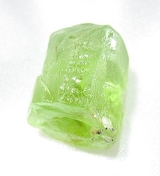
Olivine

Encyclopedia
The mineral
olivine (when gem-quality also called peridot
) is a magnesium
iron
silicate
with the formula (Mg
,Fe
)2Si
O
4. It is a common mineral in the Earth's subsurface but weathers quickly on the surface.
The ratio of magnesium and iron varies between the two endmember
s of the solid solution
series: forsterite
(Mg-endmember) and fayalite
(Fe-endmember). Compositions of olivine are commonly expressed as molar percentages of forsterite (Fo) and fayalite (Fa) (e.g., Fo70Fa30). Forsterite has an unusually high melting temperature at atmospheric pressure, almost 1900 °C, but the melting temperature of fayalite is much lower (about 1200 °C). The melting temperature varies smoothly between the two endmembers, as do other properties. Olivine incorporates only minor amounts of elements other than oxygen
, silicon
, magnesium
and iron
. Manganese
and nickel
commonly are the additional elements present in highest concentrations.
Olivine gives its name to the group of minerals with a related structure (the olivine group) which includes tephroite
(Mn
2SiO4), monticellite
(Ca
MgSiO4) and kirschsteinite (CaFeSiO4).

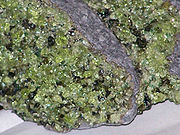 Olivine is named for its typically olive-green color (thought to be a result of traces of nickel
), though it may alter to a reddish color from the oxidation of iron.
Translucent olivine is sometimes used as a gemstone
called peridot
, the French
word for olivine. It is also called chrysolite, from the Greek
words for gold
and stone. Some of the finest gem-quality olivine has been obtained from a body of mantle
rocks on Zabargad island in the Red Sea
.
Olivine/peridot occurs in both mafic
and ultramafic igneous rock
s and as a primary mineral in certain metamorphic rock
s. Mg-rich olivine crystallizes from magma
that is rich in magnesium and low in silica. That magma crystallizes to mafic
rocks such as gabbro
and basalt
. Ultramafic rocks such as peridotite
and dunite
can be residues left after extraction of magmas, and typically they are more enriched in olivine after extraction of partial melts. Olivine and high pressure structural variants constitute over 50% of the Earth's upper mantle, and olivine is one of the Earth's most common minerals by volume. The metamorphism
of impure dolomite
or other sedimentary rock
s with high magnesium and low silica content also produces Mg-rich olivine, or forsterite
.
Fe-rich olivine is relatively much less common, but it occurs in igneous rock
s in small amounts in rare granite
s and rhyolite
s, and extremely Fe-rich olivine can exist stably with quartz
and tridymite
. In contrast, Mg-rich olivine does not occur stably with silica minerals, as it would react with them to form orthopyroxene ((Mg,Fe)2Si2O6).
Mg-rich olivine is stable to pressures equivalent to a depth of about 410 km within Earth. Because it is thought to be the most abundant mineral in Earth’s mantle at shallower depths, the properties of olivine have a dominant influence upon the rheology
of that part of Earth and hence upon the solid flow that drives plate tectonics
. Experiments have documented that olivine at high pressures (e.g., 12 GPa, the pressure at depths of about 360 kilometers) can contain at least as much as about 8900 parts per million (weight) of water, and that such water contents drastically reduce the resistance of olivine to solid flow; moreover, because olivine is so abundant, more water may be dissolved in olivine of the mantle than contained in Earth's oceans.
Mg-rich olivine has also been discovered in meteorite
s, on Mars and on the Moon
. Such meteorites include chondrite
s, collections of debris from the early solar system, and pallasite
s, mixes of iron-nickel and olivine. The spectral signature of olivine has been seen in the dust disks around young stars. The tails of comets (which formed from the dust disk around the young Sun
) often have the spectral signature of olivine, and the presence of olivine has recently been verified in samples of a comet from the Stardust spacecraft.
s, the Moon
, Mars
, in the dust of comet Wild 2, within the core of comet Tempel 1, falling into infant stars, as well as on asteroid 25143 Itokawa
.
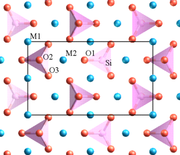 Minerals in the olivine group crystallize in the orthorhombic system (space group
Pbnm) with isolated silicate tetrahedra, meaning that olivine is a nesosilicate
. In an alternative view, the atomic structure can be described as a hexagonal, close-packed array of oxygen ion
s with half of the octahedral sites occupied with magnesium or iron ions and one-eighth of the tetrahedral sites occupied by silicon ions.
There are three distinct oxygen sites (marked O1, O2 and O3 in figure 1), two distinct metal sites (M1 and M2) and only one distinct silicon site. O1, O2, M2 and Si all lie on mirror planes, while M1 exists on an inversion center. O3 lies in a general position.
to the sorosilicate
, wadsleyite
and, at about 520 km (323.1 mi) depth, wadsleyite transforms into ringwoodite
, which has the spinel
structure. These phase transitions lead to a discontinuous increase in the density of the Earth's mantle
that can be observed by seismic methods.
The pressure at which these phase transitions occur depends on temperature and iron content. At 800 °C (1,073.2 K; 1,472 °F), the pure magnesium end member, forsterite, transforms to wadsleyite at 11.8 gigapascals (116,456.9 atm) and to ringwoodite at pressures above 14 GPa (138,169.3 atm). Increasing the iron content decreases the pressure of the phase transition and narrows the wadsleyite
stability field. At about 0.8 mole fraction fayalite, olivine transforms directly to ringwoodite over the pressure range 10 to-. Fayalite transforms to spinel at pressures below 5 GPa (49,346.2 atm). Increasing the temperature increases the pressure of these phase transitions.
. It weathers to iddingsite
(a combination of clay minerals, iron oxides and ferrihydrite
s) readily in the presence of water. The presence of iddingsite
on Mars would suggest that liquid water once existed there, and might enable scientists to determine when there was last liquid water on the planet.
The aluminium foundry industry uses olivine sand to cast objects in aluminium. Olivine sand requires less water than silicon based sand while providing the necessary strength to hold the mold together during handling and pouring of the metal. Less water means less gas (steam) to vent from the mold as metal is poured into the mold.
Mineral
A mineral is a naturally occurring solid chemical substance formed through biogeochemical processes, having characteristic chemical composition, highly ordered atomic structure, and specific physical properties. By comparison, a rock is an aggregate of minerals and/or mineraloids and does not...
olivine (when gem-quality also called peridot
Peridot
-Chemistry:The chemical composition of peridot is 2SiO4, with Mg in greater quantities than Fe.-Etymology:The origin of the name "peridot" is uncertain...
) is a magnesium
Magnesium
Magnesium is a chemical element with the symbol Mg, atomic number 12, and common oxidation number +2. It is an alkaline earth metal and the eighth most abundant element in the Earth's crust and ninth in the known universe as a whole...
iron
Iron
Iron is a chemical element with the symbol Fe and atomic number 26. It is a metal in the first transition series. It is the most common element forming the planet Earth as a whole, forming much of Earth's outer and inner core. It is the fourth most common element in the Earth's crust...
silicate
Silicate minerals
The silicate minerals make up the largest and most important class of rock-forming minerals, constituting approximately 90 percent of the crust of the Earth. They are classified based on the structure of their silicate group...
with the formula (Mg
Magnesium
Magnesium is a chemical element with the symbol Mg, atomic number 12, and common oxidation number +2. It is an alkaline earth metal and the eighth most abundant element in the Earth's crust and ninth in the known universe as a whole...
,Fe
Iron
Iron is a chemical element with the symbol Fe and atomic number 26. It is a metal in the first transition series. It is the most common element forming the planet Earth as a whole, forming much of Earth's outer and inner core. It is the fourth most common element in the Earth's crust...
)2Si
Silicon
Silicon is a chemical element with the symbol Si and atomic number 14. A tetravalent metalloid, it is less reactive than its chemical analog carbon, the nonmetal directly above it in the periodic table, but more reactive than germanium, the metalloid directly below it in the table...
O
Oxygen
Oxygen is the element with atomic number 8 and represented by the symbol O. Its name derives from the Greek roots ὀξύς and -γενής , because at the time of naming, it was mistakenly thought that all acids required oxygen in their composition...
4. It is a common mineral in the Earth's subsurface but weathers quickly on the surface.
The ratio of magnesium and iron varies between the two endmember
Endmember (mineralogy)
An endmember in mineralogy is a mineral that is at the extreme end of a mineral series in terms of purity. Minerals often can be described as solid solutions with varying compositions of some chemical elements, rather than as substances with an exact chemical formula...
s of the solid solution
Solid solution
A solid solution is a solid-state solution of one or more solutes in a solvent. Such a mixture is considered a solution rather than a compound when the crystal structure of the solvent remains unchanged by addition of the solutes, and when the mixture remains in a single homogeneous phase...
series: forsterite
Forsterite
Forsterite is the magnesium rich end-member of the olivine solid solution series. Forsterite crystallizes in the orthorhombic system with cell parameters a 4.75 Å , b 10.20 Å and c 5.98 Å .Forsterite is associated with igneous and metamorphic rocks and has also been found in meteorites...
(Mg-endmember) and fayalite
Fayalite
Fayalite is the iron-rich end-member of the olivine solid-solution series. In common with all minerals in the olivine group, fayalite crystallizes in the orthorhombic system with cell parameters a 4.82 Å, b 10.48 Å and c Å 6.09.Iron rich olivine is a relatively common constituent of acidic and...
(Fe-endmember). Compositions of olivine are commonly expressed as molar percentages of forsterite (Fo) and fayalite (Fa) (e.g., Fo70Fa30). Forsterite has an unusually high melting temperature at atmospheric pressure, almost 1900 °C, but the melting temperature of fayalite is much lower (about 1200 °C). The melting temperature varies smoothly between the two endmembers, as do other properties. Olivine incorporates only minor amounts of elements other than oxygen
Oxygen
Oxygen is the element with atomic number 8 and represented by the symbol O. Its name derives from the Greek roots ὀξύς and -γενής , because at the time of naming, it was mistakenly thought that all acids required oxygen in their composition...
, silicon
Silicon
Silicon is a chemical element with the symbol Si and atomic number 14. A tetravalent metalloid, it is less reactive than its chemical analog carbon, the nonmetal directly above it in the periodic table, but more reactive than germanium, the metalloid directly below it in the table...
, magnesium
Magnesium
Magnesium is a chemical element with the symbol Mg, atomic number 12, and common oxidation number +2. It is an alkaline earth metal and the eighth most abundant element in the Earth's crust and ninth in the known universe as a whole...
and iron
Iron
Iron is a chemical element with the symbol Fe and atomic number 26. It is a metal in the first transition series. It is the most common element forming the planet Earth as a whole, forming much of Earth's outer and inner core. It is the fourth most common element in the Earth's crust...
. Manganese
Manganese
Manganese is a chemical element, designated by the symbol Mn. It has the atomic number 25. It is found as a free element in nature , and in many minerals...
and nickel
Nickel
Nickel is a chemical element with the chemical symbol Ni and atomic number 28. It is a silvery-white lustrous metal with a slight golden tinge. Nickel belongs to the transition metals and is hard and ductile...
commonly are the additional elements present in highest concentrations.
Olivine gives its name to the group of minerals with a related structure (the olivine group) which includes tephroite
Tephroite
Tephroite is a non-metallic manganese silicate mineral with the formula, Mn2SiO4.It was first described for an occurrence at the Sterling Hill Mine and Franklin, New Jersey, USA. It occurs in iron-manganese ore deposits and their related skarns. It also occurs in metamorphosed manganese-rich...
(Mn
Manganese
Manganese is a chemical element, designated by the symbol Mn. It has the atomic number 25. It is found as a free element in nature , and in many minerals...
2SiO4), monticellite
Monticellite
Monticellite and kirschsteinite are gray silicate minerals of the olivine group with compositions CaMgSiO4 and CaFeSiO4, respectively. Most monticellites have the pure magnesium end-member composition but rare ferroan monticellites and magnesio-kirschsteinite are found with between 30 and 75 mol.%...
(Ca
Calcium
Calcium is the chemical element with the symbol Ca and atomic number 20. It has an atomic mass of 40.078 amu. Calcium is a soft gray alkaline earth metal, and is the fifth-most-abundant element by mass in the Earth's crust...
MgSiO4) and kirschsteinite (CaFeSiO4).
Identification and paragenesis
Nickel
Nickel is a chemical element with the chemical symbol Ni and atomic number 28. It is a silvery-white lustrous metal with a slight golden tinge. Nickel belongs to the transition metals and is hard and ductile...
), though it may alter to a reddish color from the oxidation of iron.
Translucent olivine is sometimes used as a gemstone
Gemstone
A gemstone or gem is a piece of mineral, which, in cut and polished form, is used to make jewelry or other adornments...
called peridot
Peridot
-Chemistry:The chemical composition of peridot is 2SiO4, with Mg in greater quantities than Fe.-Etymology:The origin of the name "peridot" is uncertain...
, the French
French language
French is a Romance language spoken as a first language in France, the Romandy region in Switzerland, Wallonia and Brussels in Belgium, Monaco, the regions of Quebec and Acadia in Canada, and by various communities elsewhere. Second-language speakers of French are distributed throughout many parts...
word for olivine. It is also called chrysolite, from the Greek
Greek language
Greek is an independent branch of the Indo-European family of languages. Native to the southern Balkans, it has the longest documented history of any Indo-European language, spanning 34 centuries of written records. Its writing system has been the Greek alphabet for the majority of its history;...
words for gold
Gold
Gold is a chemical element with the symbol Au and an atomic number of 79. Gold is a dense, soft, shiny, malleable and ductile metal. Pure gold has a bright yellow color and luster traditionally considered attractive, which it maintains without oxidizing in air or water. Chemically, gold is a...
and stone. Some of the finest gem-quality olivine has been obtained from a body of mantle
Mantle (geology)
The mantle is a part of a terrestrial planet or other rocky body large enough to have differentiation by density. The interior of the Earth, similar to the other terrestrial planets, is chemically divided into layers. The mantle is a highly viscous layer between the crust and the outer core....
rocks on Zabargad island in the Red Sea
Red Sea
The Red Sea is a seawater inlet of the Indian Ocean, lying between Africa and Asia. The connection to the ocean is in the south through the Bab el Mandeb strait and the Gulf of Aden. In the north, there is the Sinai Peninsula, the Gulf of Aqaba, and the Gulf of Suez...
.
Olivine/peridot occurs in both mafic
Mafic
Mafic is an adjective describing a silicate mineral or rock that is rich in magnesium and iron; the term is a portmanteau of the words "magnesium" and "ferric". Most mafic minerals are dark in color and the relative density is greater than 3. Common rock-forming mafic minerals include olivine,...
and ultramafic igneous rock
Igneous rock
Igneous rock is one of the three main rock types, the others being sedimentary and metamorphic rock. Igneous rock is formed through the cooling and solidification of magma or lava...
s and as a primary mineral in certain metamorphic rock
Metamorphic rock
Metamorphic rock is the transformation of an existing rock type, the protolith, in a process called metamorphism, which means "change in form". The protolith is subjected to heat and pressure causing profound physical and/or chemical change...
s. Mg-rich olivine crystallizes from magma
Magma
Magma is a mixture of molten rock, volatiles and solids that is found beneath the surface of the Earth, and is expected to exist on other terrestrial planets. Besides molten rock, magma may also contain suspended crystals and dissolved gas and sometimes also gas bubbles. Magma often collects in...
that is rich in magnesium and low in silica. That magma crystallizes to mafic
Mafic
Mafic is an adjective describing a silicate mineral or rock that is rich in magnesium and iron; the term is a portmanteau of the words "magnesium" and "ferric". Most mafic minerals are dark in color and the relative density is greater than 3. Common rock-forming mafic minerals include olivine,...
rocks such as gabbro
Gabbro
Gabbro refers to a large group of dark, coarse-grained, intrusive mafic igneous rocks chemically equivalent to basalt. The rocks are plutonic, formed when molten magma is trapped beneath the Earth's surface and cools into a crystalline mass....
and basalt
Basalt
Basalt is a common extrusive volcanic rock. It is usually grey to black and fine-grained due to rapid cooling of lava at the surface of a planet. It may be porphyritic containing larger crystals in a fine matrix, or vesicular, or frothy scoria. Unweathered basalt is black or grey...
. Ultramafic rocks such as peridotite
Peridotite
A peridotite is a dense, coarse-grained igneous rock, consisting mostly of the minerals olivine and pyroxene. Peridotite is ultramafic, as the rock contains less than 45% silica. It is high in magnesium, reflecting the high proportions of magnesium-rich olivine, with appreciable iron...
and dunite
Dunite
Dunite is an igneous, plutonic rock, of ultramafic composition, with coarse-grained or phaneritic texture. The mineral assemblage is greater than 90% olivine, with minor amounts of other minerals such as pyroxene, chromite and pyrope. Dunite is the olivine-rich end-member of the peridotite group...
can be residues left after extraction of magmas, and typically they are more enriched in olivine after extraction of partial melts. Olivine and high pressure structural variants constitute over 50% of the Earth's upper mantle, and olivine is one of the Earth's most common minerals by volume. The metamorphism
Metamorphism
Metamorphism is the solid-state recrystallization of pre-existing rocks due to changes in physical and chemical conditions, primarily heat, pressure, and the introduction of chemically active fluids. Mineralogical, chemical and crystallographic changes can occur during this process...
of impure dolomite
Dolomite
Dolomite is a carbonate mineral composed of calcium magnesium carbonate CaMg2. The term is also used to describe the sedimentary carbonate rock dolostone....
or other sedimentary rock
Sedimentary rock
Sedimentary rock are types of rock that are formed by the deposition of material at the Earth's surface and within bodies of water. Sedimentation is the collective name for processes that cause mineral and/or organic particles to settle and accumulate or minerals to precipitate from a solution....
s with high magnesium and low silica content also produces Mg-rich olivine, or forsterite
Forsterite
Forsterite is the magnesium rich end-member of the olivine solid solution series. Forsterite crystallizes in the orthorhombic system with cell parameters a 4.75 Å , b 10.20 Å and c 5.98 Å .Forsterite is associated with igneous and metamorphic rocks and has also been found in meteorites...
.
Fe-rich olivine is relatively much less common, but it occurs in igneous rock
Igneous rock
Igneous rock is one of the three main rock types, the others being sedimentary and metamorphic rock. Igneous rock is formed through the cooling and solidification of magma or lava...
s in small amounts in rare granite
Granite
Granite is a common and widely occurring type of intrusive, felsic, igneous rock. Granite usually has a medium- to coarse-grained texture. Occasionally some individual crystals are larger than the groundmass, in which case the texture is known as porphyritic. A granitic rock with a porphyritic...
s and rhyolite
Rhyolite
This page is about a volcanic rock. For the ghost town see Rhyolite, Nevada, and for the satellite system, see Rhyolite/Aquacade.Rhyolite is an igneous, volcanic rock, of felsic composition . It may have any texture from glassy to aphanitic to porphyritic...
s, and extremely Fe-rich olivine can exist stably with quartz
Quartz
Quartz is the second-most-abundant mineral in the Earth's continental crust, after feldspar. It is made up of a continuous framework of SiO4 silicon–oxygen tetrahedra, with each oxygen being shared between two tetrahedra, giving an overall formula SiO2. There are many different varieties of quartz,...
and tridymite
Tridymite
Tridymite is a high-temperature polymorph of quartz and usually occurs as minute tabular white or colorless pseudo-hexagonal triclinic crystals, or scales, in cavities in acidic volcanic rocks. Its chemical formula is SiO2. Tridymite was first described in 1868 and the type location is in Hidalgo,...
. In contrast, Mg-rich olivine does not occur stably with silica minerals, as it would react with them to form orthopyroxene ((Mg,Fe)2Si2O6).
Mg-rich olivine is stable to pressures equivalent to a depth of about 410 km within Earth. Because it is thought to be the most abundant mineral in Earth’s mantle at shallower depths, the properties of olivine have a dominant influence upon the rheology
Rheology
Rheology is the study of the flow of matter, primarily in the liquid state, but also as 'soft solids' or solids under conditions in which they respond with plastic flow rather than deforming elastically in response to an applied force....
of that part of Earth and hence upon the solid flow that drives plate tectonics
Plate tectonics
Plate tectonics is a scientific theory that describes the large scale motions of Earth's lithosphere...
. Experiments have documented that olivine at high pressures (e.g., 12 GPa, the pressure at depths of about 360 kilometers) can contain at least as much as about 8900 parts per million (weight) of water, and that such water contents drastically reduce the resistance of olivine to solid flow; moreover, because olivine is so abundant, more water may be dissolved in olivine of the mantle than contained in Earth's oceans.
Mg-rich olivine has also been discovered in meteorite
Meteorite
A meteorite is a natural object originating in outer space that survives impact with the Earth's surface. Meteorites can be big or small. Most meteorites derive from small astronomical objects called meteoroids, but they are also sometimes produced by impacts of asteroids...
s, on Mars and on the Moon
Moon
The Moon is Earth's only known natural satellite,There are a number of near-Earth asteroids including 3753 Cruithne that are co-orbital with Earth: their orbits bring them close to Earth for periods of time but then alter in the long term . These are quasi-satellites and not true moons. For more...
. Such meteorites include chondrite
Chondrite
Chondrites are stony meteorites that have not been modified due to melting or differentiation of the parent body. They formed when various types of dust and small grains that were present in the early solar system accreted to form primitive asteroids...
s, collections of debris from the early solar system, and pallasite
Pallasite
A pallasite is a type of stony–iron meteorite.-Structure and composition:It consists of cm-sized olivine crystals of peridot quality in an iron-nickel matrix. Coarser metal areas develop Widmanstätten patterns upon etching...
s, mixes of iron-nickel and olivine. The spectral signature of olivine has been seen in the dust disks around young stars. The tails of comets (which formed from the dust disk around the young Sun
Sun
The Sun is the star at the center of the Solar System. It is almost perfectly spherical and consists of hot plasma interwoven with magnetic fields...
) often have the spectral signature of olivine, and the presence of olivine has recently been verified in samples of a comet from the Stardust spacecraft.
Extraterrestrial occurrences
Olivine has also been identified in meteoriteMeteorite
A meteorite is a natural object originating in outer space that survives impact with the Earth's surface. Meteorites can be big or small. Most meteorites derive from small astronomical objects called meteoroids, but they are also sometimes produced by impacts of asteroids...
s, the Moon
Moon
The Moon is Earth's only known natural satellite,There are a number of near-Earth asteroids including 3753 Cruithne that are co-orbital with Earth: their orbits bring them close to Earth for periods of time but then alter in the long term . These are quasi-satellites and not true moons. For more...
, Mars
Mars
Mars is the fourth planet from the Sun in the Solar System. The planet is named after the Roman god of war, Mars. It is often described as the "Red Planet", as the iron oxide prevalent on its surface gives it a reddish appearance...
, in the dust of comet Wild 2, within the core of comet Tempel 1, falling into infant stars, as well as on asteroid 25143 Itokawa
25143 Itokawa
25143 Itokawa is an Apollo and Mars-crosser asteroid. It was the first asteroid to be the target of a sample return mission, the Japanese space probe Hayabusa.-Discovery and naming:...
.
Crystal structure
Space group
In mathematics and geometry, a space group is a symmetry group, usually for three dimensions, that divides space into discrete repeatable domains.In three dimensions, there are 219 unique types, or counted as 230 if chiral copies are considered distinct...
Pbnm) with isolated silicate tetrahedra, meaning that olivine is a nesosilicate
Silicate minerals
The silicate minerals make up the largest and most important class of rock-forming minerals, constituting approximately 90 percent of the crust of the Earth. They are classified based on the structure of their silicate group...
. In an alternative view, the atomic structure can be described as a hexagonal, close-packed array of oxygen ion
Ion
An ion is an atom or molecule in which the total number of electrons is not equal to the total number of protons, giving it a net positive or negative electrical charge. The name was given by physicist Michael Faraday for the substances that allow a current to pass between electrodes in a...
s with half of the octahedral sites occupied with magnesium or iron ions and one-eighth of the tetrahedral sites occupied by silicon ions.
There are three distinct oxygen sites (marked O1, O2 and O3 in figure 1), two distinct metal sites (M1 and M2) and only one distinct silicon site. O1, O2, M2 and Si all lie on mirror planes, while M1 exists on an inversion center. O3 lies in a general position.
High pressure polymorphs
At the high temperatures and pressures found at depth within the Earth the olivine structure is no longer stable. Below depths of about 410 km (254.8 mi) olivine undergoes a phase transitionPhase transition
A phase transition is the transformation of a thermodynamic system from one phase or state of matter to another.A phase of a thermodynamic system and the states of matter have uniform physical properties....
to the sorosilicate
Silicate minerals
The silicate minerals make up the largest and most important class of rock-forming minerals, constituting approximately 90 percent of the crust of the Earth. They are classified based on the structure of their silicate group...
, wadsleyite
Wadsleyite
Wadsleyite is a high-pressure polymorph of olivine, an orthorhombic mineral found in the Peace River meteorite in Alberta, Canada. In the phase transformations from Mg2SiO4-Fe2SiO4 , olivine is transformed to wadsleyite β-Mg2SiO4 and then to a spinel-structured γ-Mg2SiO4 with increasing pressure...
and, at about 520 km (323.1 mi) depth, wadsleyite transforms into ringwoodite
Ringwoodite
Ringwoodite is a high-pressure polymorph of olivine, and it is stable at high temperatures and pressures like those in the Earth's mantle near 600 km depth. This mineral was first identified in the Tenham Meteorites in 1969, and it is inferred to be present in large quantity in the earth’s...
, which has the spinel
Spinel
Spinel is the magnesium aluminium member of the larger spinel group of minerals. It has the formula MgAl2O4. Balas ruby is an old name for a rose-tinted variety.-Spinel group:...
structure. These phase transitions lead to a discontinuous increase in the density of the Earth's mantle
Mantle (geology)
The mantle is a part of a terrestrial planet or other rocky body large enough to have differentiation by density. The interior of the Earth, similar to the other terrestrial planets, is chemically divided into layers. The mantle is a highly viscous layer between the crust and the outer core....
that can be observed by seismic methods.
The pressure at which these phase transitions occur depends on temperature and iron content. At 800 °C (1,073.2 K; 1,472 °F), the pure magnesium end member, forsterite, transforms to wadsleyite at 11.8 gigapascals (116,456.9 atm) and to ringwoodite at pressures above 14 GPa (138,169.3 atm). Increasing the iron content decreases the pressure of the phase transition and narrows the wadsleyite
Wadsleyite
Wadsleyite is a high-pressure polymorph of olivine, an orthorhombic mineral found in the Peace River meteorite in Alberta, Canada. In the phase transformations from Mg2SiO4-Fe2SiO4 , olivine is transformed to wadsleyite β-Mg2SiO4 and then to a spinel-structured γ-Mg2SiO4 with increasing pressure...
stability field. At about 0.8 mole fraction fayalite, olivine transforms directly to ringwoodite over the pressure range 10 to-. Fayalite transforms to spinel at pressures below 5 GPa (49,346.2 atm). Increasing the temperature increases the pressure of these phase transitions.
Weathering
Olivine is one of the weaker common minerals on the surface according to the Goldich dissolution seriesGoldich dissolution series
The Goldich dissolution series is a way of predicting the relative stability or weathering rate of various minerals on the Earth's surface. S. S. Goldich came up with the series in 1938 after studying soil profiles...
. It weathers to iddingsite
Iddingsite
Iddingsite is an alteration of olivine that consists of a mixture of clay minerals, iron oxides and ferrihydrites. It is absent from deep-seated rocks and is found on meteorites...
(a combination of clay minerals, iron oxides and ferrihydrite
Ferrihydrite
Ferrihydrite is a widespread hydrous ferric oxyhydroxide mineral at the Earth's surface, and a likely constituent in extraterrestrial materials. It forms in several types of environments, from freshwater to marine systems, aquifers to hydrothermal hot springs and scales, soils, and areas affected...
s) readily in the presence of water. The presence of iddingsite
Iddingsite
Iddingsite is an alteration of olivine that consists of a mixture of clay minerals, iron oxides and ferrihydrites. It is absent from deep-seated rocks and is found on meteorites...
on Mars would suggest that liquid water once existed there, and might enable scientists to determine when there was last liquid water on the planet.
Uses
A worldwide search is on for cheap processes to sequester CO2 by mineral reactions. Removal by reactions with olivine is an attractive option, because it is widely available and reacts easily with the (acid) CO2 from the atmosphere. When olivine is crushed, it weathers completely within a few years, depending on the grain size. All the CO2 that is produced by burning 1 liter of oil can be sequestered by less than 1 liter of olivine. The reaction is exothermic but slow. In order to recover the heat produced by the reaction to produce electricity, a large volume of olivine must be thermally well isolated. The end-products of the reaction are silicon dioxide, magnesium carbonate and small amounts of iron oxide.The aluminium foundry industry uses olivine sand to cast objects in aluminium. Olivine sand requires less water than silicon based sand while providing the necessary strength to hold the mold together during handling and pouring of the metal. Less water means less gas (steam) to vent from the mold as metal is poured into the mold.
External links
- Pretty Green Mineral – Pretty Dry Mars? by Linda M.V. Martel, Planetary Science Research Discoveries, Hawai'i Institute of Geophysics and Planetology
- Olivine Page Farlang library: Historic sources + modern articles on Olivine and Peridot
- Geological information and several microscopic images University of North Dakota