
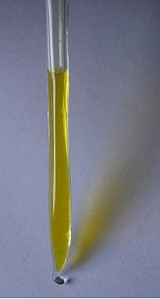
Chlorine is the
chemical elementA chemical element is a pure chemical substance consisting of one type of atom distinguished by its atomic number, which is the number of protons in its nucleus. Familiar examples of elements include carbon, oxygen, aluminum, iron, copper, gold, mercury, and lead.As of November 2011, 118 elements...
with
atomic numberIn chemistry and physics, the atomic number is the number of protons found in the nucleus of an atom and therefore identical to the charge number of the nucleus. It is conventionally represented by the symbol Z. The atomic number uniquely identifies a chemical element...
17 and symbol
Cl. It is the second lightest
halogenThe halogens or halogen elements are a series of nonmetal elements from Group 17 IUPAC Style of the periodic table, comprising fluorine , chlorine , bromine , iodine , and astatine...
, found in the
periodic tableThe periodic table of the chemical elements is a tabular display of the 118 known chemical elements organized by selected properties of their atomic structures. Elements are presented by increasing atomic number, the number of protons in an atom's atomic nucleus...
in group 17. The element forms diatomic molecules under standard conditions, called dichlorine. It has the highest
electron affinityThe Electron affinity of an atom or molecule is defined as the amount of energy released when an electron is added to a neutral atom or molecule to form a negative ion....
and the third highest
electronegativityElectronegativity, symbol χ , is a chemical property that describes the tendency of an atom or a functional group to attract electrons towards itself. An atom's electronegativity is affected by both its atomic number and the distance that its valence electrons reside from the charged nucleus...
of all the elements; for this reason, chlorine is a strong
oxidizing agentAn oxidizing agent can be defined as a substance that removes electrons from another reactant in a redox chemical reaction...
.
The most common compound of chlorine, sodium chloride, has been known since ancient times; however, around 1630, chlorine gas was obtained by the Belgian chemist and physician Jan Baptist van Helmont. The synthesis and characterization of elemental chlorine occurred in 1774 by Swedish chemist Carl Wilhelm Scheele, who called it "dephlogisticated muriatic acid air," having thought he synthesized the oxide obtained from the hydrochloric acid. Because acids were thought at the time to necessarily contain oxygen, a number of chemists, including Claude Berthollet, suggested that Scheele's dephlogisticated muriatic acid air must be a combination of oxygen and the yet undiscovered element, and Scheele named the supposed new element within this oxide as
muriaticum. The suggestion that this newly discovered gas was a simple element was made in 1809 by Joseph Louis Gay-Lussac and Louis-Jacques. This was confirmed by Sir Humphry Davy in 1810, who named it chlorine, from the Greek word χλωρος (chlōros), meaning "green-yellow."
Chlorine is a component of various compounds, including table salt. It is the
second most abundant halogen and 21st most abundant chemical elementThe table shows the abundance of elements in Earth's crust. Numbers show percentage or parts per million in mass; 10,000 ppm = 1%.Note that numbers are estimates, and they will vary depending on source and method of estimation. Order of magnitude of data can roughly be relied upon.The table shows...
in Earth's crust. The great oxidizing potential of chlorine led it to its bleaching and disinfectant uses, as well as uses of an essential reagent in the chemical industry. As a common disinfectant, chlorine compounds are used in
swimming poolA swimming pool, swimming bath, wading pool, or simply a pool, is a container filled with water intended for swimming or water-based recreation. There are many standard sizes; the largest is the Olympic-size swimming pool...
s to keep them clean and
sanitarySwimming pool sanitation refers to methods for ensuring healthy conditions in swimming pools, lap pools, hot tubs, plunge pools, and similar recreational water venues...
. In the upper atmosphere, chlorine-containing molecules such as chlorofluorocarbons have been implicated in
ozone depletionOzone depletion describes two distinct but related phenomena observed since the late 1970s: a steady decline of about 4% per decade in the total volume of ozone in Earth's stratosphere , and a much larger springtime decrease in stratospheric ozone over Earth's polar regions. The latter phenomenon...
. Elemental chlorine is extremely dangerous and poisonous for all lifeforms; however, chlorine is necessary to most forms of life, including
humanHumans are the only living species in the Homo genus...
s, in form of
chlorideThe chloride ion is formed when the element chlorine, a halogen, picks up one electron to form an anion Cl−. The salts of hydrochloric acid HCl contain chloride ions and can also be called chlorides. The chloride ion, and its salts such as sodium chloride, are very soluble in water...
ions.
Physical characteristics
At standard temperature and pressure, two chlorine atoms form the diatomic molecule Cl
2. This is a yellow-green gas that has its distinctive strong smell, the smell of bleach. The bonding between the two atoms is relatively weak (only 242.580 ± 0.004 kJ/mol), which makes the Cl
2 molecule highly reactive. The boiling point at regular atmosphere is around −34 ˚C, but it can be liquefied at room temperature with pressures above 8 atmospheres.
Chemical characteristics
Along with
fluorineFluorine is the chemical element with atomic number 9, represented by the symbol F. It is the lightest element of the halogen column of the periodic table and has a single stable isotope, fluorine-19. At standard pressure and temperature, fluorine is a pale yellow gas composed of diatomic...
,
bromineBromine ") is a chemical element with the symbol Br, an atomic number of 35, and an atomic mass of 79.904. It is in the halogen element group. The element was isolated independently by two chemists, Carl Jacob Löwig and Antoine Jerome Balard, in 1825–1826...
,
iodineIodine is a chemical element with the symbol I and atomic number 53. The name is pronounced , , or . The name is from the , meaning violet or purple, due to the color of elemental iodine vapor....
, and
astatineAstatine is a radioactive chemical element with the symbol At and atomic number 85. It occurs on the Earth only as the result of decay of heavier elements, and decays away rapidly, so much less is known about this element than its upper neighbors in the periodic table...
, chlorine is a member of the
halogenThe halogens or halogen elements are a series of nonmetal elements from Group 17 IUPAC Style of the periodic table, comprising fluorine , chlorine , bromine , iodine , and astatine...
series that forms the group 17 (formerly VII, VIIA, or VIIB) of the periodic table. Chlorine forms compounds with almost all of the elements to give compounds that are usually called chlorides. Chlorine gas reacts with most organic compounds, and will even sluggishly support the combustion of
hydrocarbonIn organic chemistry, a hydrocarbon is an organic compound consisting entirely of hydrogen and carbon. Hydrocarbons from which one hydrogen atom has been removed are functional groups, called hydrocarbyls....
s.
Hydrolysis
At 25 °C and atmospheric pressure, one
literpic|200px|right|thumb|One litre is equivalent to this cubeEach side is 10 cm1 litre water = 1 kilogram water The litre is a metric system unit of volume equal to 1 cubic decimetre , to 1,000 cubic centimetres , and to 1/1,000 cubic metre...
of
waterWater is a chemical substance with the chemical formula H2O. A water molecule contains one oxygen and two hydrogen atoms connected by covalent bonds. Water is a liquid at ambient conditions, but it often co-exists on Earth with its solid state, ice, and gaseous state . Water also exists in a...
dissolves 3.26 g or 1.02 L of gaseous chlorine. Solutions of chlorine in water contain chlorine (Cl
2), hydrochloric acid, and hypochlorous acid:
- Cl2 + H2O HCl + HClO
This conversion to the right is called
disproportionationDisproportionation, also known as dismutation is used to describe a specific type of redox reaction in which a species is simultaneously reduced and oxidized so as to form two different products....
, because the ingredient chlorine both increases and decreases in formal oxidation state. The solubility of chlorine in water is increased if the water contains dissolved alkali hydroxide, and in this way, chlorine bleach is produced.
- Cl2 + 2 OH– → ClO– + Cl– + H2O
Chlorine gas only exists in a neutral or acidic solution.
Compounds
Chlorine exists in all odd numbered oxidation states from −1 to +7, as well as the elemental state of zero and four in chlorine dioxide (see table below, and also structures in
chloriteThe chlorite ion is ClO2−. A chlorite is a compound that contains this group,with chlorine in oxidation state +3. Chlorites are also known as salts of chlorous acid.-Oxidation states:...
). Progressing through the states, hydrochloric acid can be oxidized using manganese dioxide, or
hydrogen chlorideThe compound hydrogen chloride has the formula HCl. At room temperature, it is a colorless gas, which forms white fumes of hydrochloric acid upon contact with atmospheric humidity. Hydrogen chloride gas and hydrochloric acid are important in technology and industry...
gas oxidized catalytically by air to form elemental chlorine gas.
Oxidation state | Name | Formula | Characteristic compounds |
| −1 |
chlorides |
Cl− |
ionic chlorides, organic chlorides, hydrochloric acid |
| 0 |
chlorine |
Cl2 |
elemental chlorine |
| +1 |
hypochlorites |
ClO− |
sodium hypochlorite, calcium hypochlorite Calcium hypochlorite is a chemical compound with formula 2. It is widely used for water treatment and as a bleaching agent...
|
| +3 |
chlorite The chlorite ion is ClO2−. A chlorite is a compound that contains this group,with chlorine in oxidation state +3. Chlorites are also known as salts of chlorous acid.-Oxidation states:... s |
|
sodium chlorite Sodium chlorite is a chemical compound used in the manufacture of paper.-Use:The main application of sodium chlorite is the generation of chlorine dioxide for bleaching and stripping of textiles, pulp, and paper. It is also used for disinfection of a few municipal water treatment plants after...
|
| +4 |
chlorine(IV) |
|
chlorine dioxideChlorine dioxide is a chemical compound with the formula ClO2. This yellowish-green gas crystallizes as bright orange crystals at −59 °C. As one of several oxides of chlorine, it is a potent and useful oxidizing agent used in water treatment and in bleaching....
|
| +5 |
chlorate The chlorate anion has the formula ClO. In this case, the chlorine atom is in the +5 oxidation state. "Chlorate" can also refer to chemical compounds containing this anion; chlorates are the salts of chloric acid. "Chlorate", when followed by a roman numeral in parentheses, e.g... s |
|
sodium chlorate Sodium chlorate is a chemical compound with the chemical formula . When pure, it is a white crystalline powder that is readily soluble in water. It is hygroscopic. It decomposes above 250 °C to release oxygen and leave sodium chloride... , potassium chloratePotassium chlorate is a compound containing potassium, chlorine and oxygen atoms, with the molecular formula KClO3. In its pure form, it is a white crystalline substance. It is the most common chlorate in industrial use... , chloric acidChloric acid, HClO3, is an oxoacid of chlorine, and the formal precursor of chlorate salts. It is a strong acid and oxidizing agent....
|
| +7 |
perchlorate Perchlorates are the salts derived from perchloric acid . They occur both naturally and through manufacturing. They have been used as a medicine for more than 50 years to treat thyroid gland disorders. They are used extensively within the pyrotechnics industry, and ammonium perchlorate is also a... s |
|
perchloric acid Perchloric acid is the inorganic compound with the formula HClO4. Usually encountered as an aqueous solution, this colourless compound is a strong acid comparable in strength to sulfuric and nitric acids. It is a powerful oxidizer, but its aqueous solutions up to appr. 70% are remarkably inert,... , perchlorate salts such as magnesium perchlorateMagnesium perchlorate is a powerful oxidizing agent, with the formula Mg2.Magnesium perchlorate decomposes at 250 °C. The heat of formation is -568.90 kJ mol-1.... , dichlorine heptoxideDichlorine heptoxide is the chemical compound with the formula Cl2O7. This chlorine oxide is the anhydride of perchloric acid. It is produced by the careful distillation of perchloric acid in the presence of the dehydrating agent phosphorus pentoxide:...
|
Chlorine oxides
Chlorine forms a variety of oxides, as seen above:
chlorine dioxideChlorine dioxide is a chemical compound with the formula ClO2. This yellowish-green gas crystallizes as bright orange crystals at −59 °C. As one of several oxides of chlorine, it is a potent and useful oxidizing agent used in water treatment and in bleaching....
(ClO
2),
dichlorine monoxideDichlorine monoxide, Cl2O, also known as, oxygen dichloride, dichlorine oxide or chlorine oxide is a chlorine oxide. It is a brownish yellow gas at room temperature which can explode in high concentrations when heated or sparked....
(Cl
2O),
dichlorine hexoxideDichlorine hexoxide is the chemical compound with the formula . This chlorine oxide is the mixed anhydride of chloric and perchloric acids. It is produced by reaction between chlorine dioxide and excess ozone:...
(Cl
2O
6),
dichlorine heptoxideDichlorine heptoxide is the chemical compound with the formula Cl2O7. This chlorine oxide is the anhydride of perchloric acid. It is produced by the careful distillation of perchloric acid in the presence of the dehydrating agent phosphorus pentoxide:...
(Cl
2O
7). The anionic derivatives of these same oxides are also well known including
chlorateThe chlorate anion has the formula ClO. In this case, the chlorine atom is in the +5 oxidation state. "Chlorate" can also refer to chemical compounds containing this anion; chlorates are the salts of chloric acid. "Chlorate", when followed by a roman numeral in parentheses, e.g...
,
chloriteThe chlorite ion is ClO2−. A chlorite is a compound that contains this group,with chlorine in oxidation state +3. Chlorites are also known as salts of chlorous acid.-Oxidation states:...
,
hypochloriteThe hypochlorite ion, also known as chlorate anion is ClO−. A hypochlorite compound is a chemical compound containing this group, with chlorine in oxidation state +1.Hypochlorites are the salts of hypochlorous acid...
(ClO
−), and
perchloratePerchlorates are the salts derived from perchloric acid . They occur both naturally and through manufacturing. They have been used as a medicine for more than 50 years to treat thyroid gland disorders. They are used extensively within the pyrotechnics industry, and ammonium perchlorate is also a...
. The acid derivatives of these anions are
hypochlorous acidHypochlorous acid is a weak acid with the chemical formula HClO. It forms when chlorine dissolves in water. It cannot be isolated in pure form due to rapid equilibration with its precursor...
(HOCl),
chloric acidChloric acid, HClO3, is an oxoacid of chlorine, and the formal precursor of chlorate salts. It is a strong acid and oxidizing agent....
(HClO
3) and
perchloric acidPerchloric acid is the inorganic compound with the formula HClO4. Usually encountered as an aqueous solution, this colourless compound is a strong acid comparable in strength to sulfuric and nitric acids. It is a powerful oxidizer, but its aqueous solutions up to appr. 70% are remarkably inert,...
(HClO
4). The chloroxy cation
chlorylIn chemistry, chloryl refers to the red-colored cation having the chemical formula . It is polyatomic ion, structurally identical to chlorite and having the same chemical formula but with chlorine in the +5 oxidation state rather than +3...
(ClO
2+) is known and has the same structure as
chloriteThe chlorite ion is ClO2−. A chlorite is a compound that contains this group,with chlorine in oxidation state +3. Chlorites are also known as salts of chlorous acid.-Oxidation states:...
but with a positive charge and chlorine in the +5 oxidation state. The compound "chlorine trioxide", rather than being the expected +6 oxidation state, is instead a mixture of +5 and +7 states, occurring as the ionic compound chloryl perchlorate, commonly called
dichlorine hexoxideDichlorine hexoxide is the chemical compound with the formula . This chlorine oxide is the mixed anhydride of chloric and perchloric acids. It is produced by reaction between chlorine dioxide and excess ozone:...
.
In hot concentrated alkali solution
hypochloriteThe hypochlorite ion, also known as chlorate anion is ClO−. A hypochlorite compound is a chemical compound containing this group, with chlorine in oxidation state +1.Hypochlorites are the salts of hypochlorous acid...
disproportionates:
- 2 ClO− → Cl− +
- ClO− + → Cl− +
Sodium chlorateSodium chlorate is a chemical compound with the chemical formula . When pure, it is a white crystalline powder that is readily soluble in water. It is hygroscopic. It decomposes above 250 °C to release oxygen and leave sodium chloride...
and
potassium chloratePotassium chlorate is a compound containing potassium, chlorine and oxygen atoms, with the molecular formula KClO3. In its pure form, it is a white crystalline substance. It is the most common chlorate in industrial use...
can be crystallized from solutions formed by the above reactions. If their crystals are heated, they undergo a further, final disproportionation:
- 4 → Cl− + 3
This same progression from chloride to perchlorate can be accomplished by electrolysis. The anode reaction progression is:
| Reaction | Electrode potential |
| Cl− + 2 OH− → ClO− + H2O + 2 e− |
+0.89 volts |
| ClO− + 2 OH− → + H2O + 2 e− |
+0.67 volts |
| + 2 OH− → + H2O + 2 e− |
+0.33 volts |
| + 2 OH− → + H2O + 2 e− |
+0.35 volts |
Each step is accompanied at the cathode by
- 2 H2O + 2 e− → 2 OH− + H2 (−0.83 volts)
Interhalogen compounds
Chlorine oxidizes bromide and iodide salts to bromine and iodine, respectively. However, it cannot oxidize fluoride salts to fluorine. It makes a variety of interhalogen compounds such as the chlorine fluorides,
chlorine monofluorideChlorine monofluoride is a volatile interhalogen compound with the chemical formula ClF. It is a colourless gas at room temperature and is stable even at high temperatures. When cooled to −100 °C, ClF condenses as a pale yellow liquid...
(ClF),
chlorine trifluorideChlorine trifluoride is an interhalogen compound with the formula ClF3. This colourless, poisonous, corrosive and very reactive gas condenses to a pale-greenish yellow liquid, the form in which it is most often sold...
(ClF
3),
chlorine pentafluorideChlorine pentafluoride is an interhalogen compound with formula ClF5. It was first synthesized in 1963.Its square pyramidal structure with C4v symmetry was confirmed by its high resolution19F NMR spectrum.-Preparation:...
(ClF
5). Chlorides of bromine and iodine are also known.
Organochlorine compounds
Chlorine is used extensively in
organic chemistryOrganic chemistry is a subdiscipline within chemistry involving the scientific study of the structure, properties, composition, reactions, and preparation of carbon-based compounds, hydrocarbons, and their derivatives...
in substitution and
addition reactionAn addition reaction, in organic chemistry, is in its simplest terms an organic reaction where two or more molecules combine to form a larger one....
s. Chlorine often imparts many desired properties to an
organic compoundAn organic compound is any member of a large class of gaseous, liquid, or solid chemical compounds whose molecules contain carbon. For historical reasons discussed below, a few types of carbon-containing compounds such as carbides, carbonates, simple oxides of carbon, and cyanides, as well as the...
, in part owing to its electronegativity. Some organochlorine compounds are also serious pollutants, either as side products of industrial processes or as persistent pesticides.
Many important industrial products are produced via organochlorine intermediates. Examples include
polycarbonatePolycarbonatePhysical PropertiesDensity 1.20–1.22 g/cm3Abbe number 34.0Refractive index 1.584–1.586FlammabilityV0-V2Limiting oxygen index25–27%Water absorption – Equilibrium0.16–0.35%Water absorption – over 24 hours0.1%...
s,
polyurethaneA polyurethane is any polymer composed of a chain of organic units joined by carbamate links. Polyurethane polymers are formed through step-growth polymerization, by reacting a monomer with another monomer in the presence of a catalyst.Polyurethanes are...
s,
siliconeSilicones are inert, synthetic compounds with a variety of forms and uses. Typically heat-resistant and rubber-like, they are used in sealants, adhesives, lubricants, medical applications , cookware, and insulation....
s,
polytetrafluoroethylenePolytetrafluoroethylene is a synthetic fluoropolymer of tetrafluoroethylene that finds numerous applications. PTFE is most well known by the DuPont brand name Teflon....
,
carboxymethyl celluloseCarboxymethyl cellulose or cellulose gum is a cellulose derivative with carboxymethyl groups bound to some of the hydroxyl groups of the glucopyranose monomers that make up the cellulose backbone...
, and
propylene oxidePropylene oxide is an organic compound with the molecular formula CH3CHCH2O. This colourless volatile liquid is produced on a large scale industrially, its major application being its use for the production of polyether polyols for use in making polyurethane plastics...
. Like the other halogens, chlorine participates in free-radical substitution reactions with hydrogen-containing organic compounds. When applied to organic substrates, reaction is often—but not invariably—non-regioselective, and, hence, may result in a mixture of isomeric products. It is often difficult to control the degree of substitution as well, so multiple substitutions are common. If the different reaction products are easily separated, e.g., by distillation, substitutive free-radical chlorination (in some cases accompanied by concurrent thermal dehydrochlorination) may be a useful synthetic route. Industrial examples of this are the production of methyl chloride, methylene chloride,
chloroformChloroform is an organic compound with formula CHCl3. It is one of the four chloromethanes. The colorless, sweet-smelling, dense liquid is a trihalomethane, and is considered somewhat hazardous...
, and
carbon tetrachlorideCarbon tetrachloride, also known by many other names is the organic compound with the formula CCl4. It was formerly widely used in fire extinguishers, as a precursor to refrigerants, and as a cleaning agent...
from methane,
allyl chlorideAllyl chloride is the organic compound with the formula CH2=CHCH2Cl. This colorless liquid is insoluble in water but soluble in common organic solvents. It is mainly converted to epichlorohydrin, used in the production of plastics. It is a chlorinated derivative of propylene.-Production:Allyl...
from propylene, and
trichloroethyleneThe chemical compound trichloroethylene is a chlorinated hydrocarbon commonly used as an industrial solvent. It is a clear non-flammable liquid with a sweet smell. It should not be confused with the similar 1,1,1-trichloroethane, which is commonly known as chlorothene.The IUPAC name is...
, and
tetrachloroethyleneTetrachloroethylene, also known under its systematic name tetrachloroethene and many other names, is a chlorocarbon with the formula Cl2C=CCl2. It is a colourless liquid widely used for dry cleaning of fabrics, hence it is sometimes called "dry-cleaning fluid." It has a sweet odor detectable by...
from 1,2-dichloroethane.
Like the other halides, chlorine undergoes
electrophilic additionIn organic chemistry, an electrophilic addition reaction is an addition reaction where, in a chemical compound, a π bond is broken and two new σ bonds are formed...
reactions, the most notable one being the chlorination of alkenes and aromatic compounds with a
Lewis acid]The term Lewis acid refers to a definition of acid published by Gilbert N. Lewis in 1923, specifically: An acid substance is one which can employ a lone pair from another molecule in completing the stable group of one of its own atoms. Thus, H+ is a Lewis acid, since it can accept a lone pair,...
catalyst. Organic chlorine compounds tend to be less reactive in
nucleophilic substitutionIn organic and inorganic chemistry, nucleophilic substitution is a fundamental class of reactions in which an electron nucleophile selectively bonds with or attacks the positive or partially positive charge of an atom or a group of atoms called the leaving group; the positive or partially positive...
reactions than the corresponding bromine or iodine derivatives, but they tend to be cheaper. They may be activated for reaction by substituting with a tosylate group, or by the use of a catalytic amount of
sodium iodideSodium iodide is a white, crystalline salt with chemical formula NaI used in radiation detection, treatment of iodine deficiency, and as a reactant in the Finkelstein reaction.-Uses:Sodium iodide is commonly used to treat and prevent iodine deficiency....
.
Chlorides
Chlorine combines with almost all elements to give chlorides. Compounds with
oxygenOxygen is the element with atomic number 8 and represented by the symbol O. Its name derives from the Greek roots ὀξύς and -γενής , because at the time of naming, it was mistakenly thought that all acids required oxygen in their composition...
,
nitrogenNitrogen is a chemical element that has the symbol N, atomic number of 7 and atomic mass 14.00674 u. Elemental nitrogen is a colorless, odorless, tasteless, and mostly inert diatomic gas at standard conditions, constituting 78.08% by volume of Earth's atmosphere...
,
xenonXenon is a chemical element with the symbol Xe and atomic number 54. The element name is pronounced or . A colorless, heavy, odorless noble gas, xenon occurs in the Earth's atmosphere in trace amounts...
, and
kryptonKrypton is a chemical element with the symbol Kr and atomic number 36. It is a member of Group 18 and Period 4 elements. A colorless, odorless, tasteless noble gas, krypton occurs in trace amounts in the atmosphere, is isolated by fractionally distilling liquified air, and is often used with other...
are known, but do not form by direct reaction of the elements. Chloride is one of the most common anions in nature.
Hydrogen chlorideThe compound hydrogen chloride has the formula HCl. At room temperature, it is a colorless gas, which forms white fumes of hydrochloric acid upon contact with atmospheric humidity. Hydrogen chloride gas and hydrochloric acid are important in technology and industry...
and its aqueous solution,
hydrochloric acidHydrochloric acid is a solution of hydrogen chloride in water, that is a highly corrosive, strong mineral acid with many industrial uses. It is found naturally in gastric acid....
, are produced on megaton scale annually both as valued intermediates but sometimes as undesirable pollutants.
Occurrence
In nature, chlorine is found primarily as the chloride ion, a component of the salt that is deposited in the earth or dissolved in the
oceanAn ocean is a major body of saline water, and a principal component of the hydrosphere. Approximately 71% of the Earth's surface is covered by ocean, a continuous body of water that is customarily divided into several principal oceans and smaller seas.More than half of this area is over 3,000...
s — about 1.9% of the mass of seawater is chloride ions. Even higher concentrations of chloride are found in the
Dead SeaThe Dead Sea , also called the Salt Sea, is a salt lake bordering Jordan to the east and Israel and the West Bank to the west. Its surface and shores are below sea level, the lowest elevation on the Earth's surface. The Dead Sea is deep, the deepest hypersaline lake in the world...
and in underground
brineBrine is water, saturated or nearly saturated with salt .Brine is used to preserve vegetables, fruit, fish, and meat, in a process known as brining . Brine is also commonly used to age Halloumi and Feta cheeses, or for pickling foodstuffs, as a means of preserving them...
deposits. Most chloride salts are soluble in water, thus, chloride-containing minerals are usually only found in abundance in dry climates or deep underground. In the Earth's crust, chlorine is present at average concentrations of about 126 parts per million, predominantly in such minerals as
haliteHalite , commonly known as rock salt, is the mineral form of sodium chloride . Halite forms isometric crystals. The mineral is typically colorless or white, but may also be light blue, dark blue, purple, pink, red, orange, yellow or gray depending on the amount and type of impurities...
(
sodium chlorideSodium chloride, also known as salt, common salt, table salt or halite, is an inorganic compound with the formula NaCl. Sodium chloride is the salt most responsible for the salinity of the ocean and of the extracellular fluid of many multicellular organisms...
),
sylviteSylvite is potassium chloride in natural mineral form. It forms crystals in the isometric system very similar to normal rock salt, halite . The two are, in fact, isomorphous. Sylvite is colorless to white with shades of yellow and red due to inclusions. It has a Mohs hardness of 2.5 and a specific...
(
potassium chlorideThe chemical compound potassium chloride is a metal halide salt composed of potassium and chlorine. In its pure state, it is odorless and has a white or colorless vitreous crystal appearance, with a crystal structure that cleaves easily in three directions. Potassium chloride crystals are...
), and
carnalliteCarnallite is an evaporite mineral, a hydrated potassium magnesium chloride with formula: KMgCl3·6. It is variably colored yellow to white, reddish, and sometimes colorless or blue. It is usually massive to fibrous with rare pseudohexagonal orthorhombic crystals...
(potassium magnesium chloride hexahydrate). Over 2000 naturally occurring organic chlorine compounds are known.
In the interstellar medium, chlorine is produced in
supernovaA supernova is a stellar explosion that is more energetic than a nova. It is pronounced with the plural supernovae or supernovas. Supernovae are extremely luminous and cause a burst of radiation that often briefly outshines an entire galaxy, before fading from view over several weeks or months...
e via the
r-processThe r-process is a nucleosynthesis process, likely occurring in core-collapse supernovae responsible for the creation of approximately half of the neutron-rich atomic nuclei that are heavier than iron. The process entails a succession of rapid neutron captures on seed nuclei, typically Ni-56,...
.
Isotopes
Chlorine has a wide range of
isotopesChlorine has 24 isotopes with mass numbers ranging from 28Cl to 51Cl and 2 isomers . There are two principal stable isotopes, 35Cl and 37Cl , found in the relative proportions of 37.89:12.11, not 3:1, respectively, giving chlorine a standard atomic mass of 35.453, not 35.5...
. The two stable
isotopeIsotopes are variants of atoms of a particular chemical element, which have differing numbers of neutrons. Atoms of a particular element by definition must contain the same number of protons but may have a distinct number of neutrons which differs from atom to atom, without changing the designation...
s are
35Cl (75.77%) and
37Cl (24.23%). Together they give chlorine an
atomic weightAtomic weight is a dimensionless physical quantity, the ratio of the average mass of atoms of an element to 1/12 of the mass of an atom of carbon-12...
of 35.4527 g/mol. The
half-integerIn mathematics, a half-integer is a number of the formn + 1/2,where n is an integer. For example,are all half-integers. Note that a half of an integer is not always a half-integer: half of an even integer is an integer but not a half-integer...
value for chlorine's weight caused some confusion in the early days of chemistry, when it had been postulated that atoms were composed of even units of hydrogen (see Proust's law), and the existence of chemical
isotopeIsotopes are variants of atoms of a particular chemical element, which have differing numbers of neutrons. Atoms of a particular element by definition must contain the same number of protons but may have a distinct number of neutrons which differs from atom to atom, without changing the designation...
s was unsuspected.
Trace amounts of radioactive
36ClChlorine-36 is an isotope of chlorine. Chlorine has two stable isotopes and one radioactive environmental isotope: the cosmogenic isotope 36Cl. The ratio of 36Cl to stable 37Cl in the environment is ~700 × 10−15. Its half-life is 301,000 ± 4,000 years. The long half-life of 36Cl makes it...
exist in the environment, in a ratio of about 7x10
−13 to 1 with stable isotopes.
36Cl is produced in the atmosphere by
spallationIn general, spallation is a process in which fragments of material are ejected from a body due to impact or stress. In the context of impact mechanics it describes ejection or vaporization of material from a target during impact by a projectile...
of
36ArArgon is a chemical element represented by the symbol Ar. Argon has atomic number 18 and is the third element in group 18 of the periodic table . Argon is the third most common gas in the Earth's atmosphere, at 0.93%, making it more common than carbon dioxide...
by interactions with
cosmic rayCosmic rays are energetic charged subatomic particles, originating from outer space. They may produce secondary particles that penetrate the Earth's atmosphere and surface. The term ray is historical as cosmic rays were thought to be electromagnetic radiation...
protonThe proton is a subatomic particle with the symbol or and a positive electric charge of 1 elementary charge. One or more protons are present in the nucleus of each atom, along with neutrons. The number of protons in each atom is its atomic number....
s. In the subsurface environment,
36Cl is generated primarily as a result of
neutron captureNeutron capture is a kind of nuclear reaction in which an atomic nucleus collides with one or more neutrons and they merge to form a heavier nucleus. Since neutrons have no electric charge they can enter a nucleus more easily than positively charged protons, which are repelled...
by
35Cl or
muon captureMuon capture is the capture of a negative muon by a proton, usually resulting in production of a neutron and a neutrino, and sometimes a gamma photon....
by
40CaCalcium is the chemical element with the symbol Ca and atomic number 20. It has an atomic mass of 40.078 amu. Calcium is a soft gray alkaline earth metal, and is the fifth-most-abundant element by mass in the Earth's crust...
.
36Cl decays to
36SSulfur or sulphur is the chemical element with atomic number 16. In the periodic table it is represented by the symbol S. It is an abundant, multivalent non-metal. Under normal conditions, sulfur atoms form cyclic octatomic molecules with chemical formula S8. Elemental sulfur is a bright yellow...
and to
36ArArgon is a chemical element represented by the symbol Ar. Argon has atomic number 18 and is the third element in group 18 of the periodic table . Argon is the third most common gas in the Earth's atmosphere, at 0.93%, making it more common than carbon dioxide...
, with a combined
half-lifeHalf-life, abbreviated t½, is the period of time it takes for the amount of a substance undergoing decay to decrease by half. The name was originally used to describe a characteristic of unstable atoms , but it may apply to any quantity which follows a set-rate decay.The original term, dating to...
of 308,000 years. The half-life of this hydrophilic nonreactive isotope makes it suitable for geologic dating in the range of 60,000 to 1 million years. Additionally, large amounts of
36Cl were produced by irradiation of
seawaterSeawater is water from a sea or ocean. On average, seawater in the world's oceans has a salinity of about 3.5% . This means that every kilogram of seawater has approximately of dissolved salts . The average density of seawater at the ocean surface is 1.025 g/ml...
during atmospheric detonations of
nuclear weaponA nuclear weapon is an explosive device that derives its destructive force from nuclear reactions, either fission or a combination of fission and fusion. Both reactions release vast quantities of energy from relatively small amounts of matter. The first fission bomb test released the same amount...
s between 1952 and 1958. The residence time of
36Cl in the atmosphere is about 1 week. Thus, as an event marker of 1950s water in
soilSoil is a natural body consisting of layers of mineral constituents of variable thicknesses, which differ from the parent materials in their morphological, physical, chemical, and mineralogical characteristics...
and ground water,
36Cl is also useful for dating waters less than 50 years before the present.
36Cl has seen use in other areas of the geological sciences, including dating ice and sediments.
History
The most common compound of chlorine, sodium chloride, has been known since ancient times; archaeologists have found evidence that rock salt was used as early as 3000 BC and brine as early as 6000 BC. Around 1630, chlorine was recognized as a gas by the Belgian chemist and physician
Jan Baptist van HelmontJan Baptist van Helmont was an early modern period Flemish chemist, physiologist, and physician. He worked during the years just after Paracelsus and iatrochemistry, and is sometimes considered to be "the founder of pneumatic chemistry"...
.
Elemental chlorine was first prepared and studied in 1774 by Swedish chemist
Carl Wilhelm ScheeleCarl Wilhelm Scheele was a German-Swedish pharmaceutical chemist. Isaac Asimov called him "hard-luck Scheele" because he made a number of chemical discoveries before others who are generally given the credit...
, and, therefore, he is credited for its discovery. He called it "
dephlogisticated muriatic acid air" since it is a gas (then called "airs") and it came from
hydrochloric acidHydrochloric acid is a solution of hydrogen chloride in water, that is a highly corrosive, strong mineral acid with many industrial uses. It is found naturally in gastric acid....
(then known as "muriatic acid"). However, he failed to establish chlorine as an element, mistakenly thinking that it was the
oxideAn oxide is a chemical compound that contains at least one oxygen atom in its chemical formula. Metal oxides typically contain an anion of oxygen in the oxidation state of −2....
obtained from the hydrochloric acid (see
phlogiston theoryThe phlogiston theory , first stated in 1667 by Johann Joachim Becher, is an obsolete scientific theory that postulated the existence of a fire-like element called "phlogiston", which was contained within combustible bodies and released during combustion...
).
He named the new element within this oxide as
muriaticum. Regardless of what he thought, Scheele did isolate chlorine by reacting MnO
2 (as the mineral
pyrolusitePyrolusite is a mineral consisting essentially of manganese dioxide and is important as an ore of manganese. It is a black, amorphous appearing mineral, often with a granular, fibrous or columnar structure, sometimes forming reniform crusts. It has a metallic luster, a black or bluish-black...
) with HCl:
- 4 HCl + MnO2 → MnCl2 + 2 H2O + Cl2
Scheele observed several of the properties of chlorine: the bleaching effect on
litmusLitmus is a water-soluble mixture of different dyes extracted from lichens, especially Roccella tinctoria. It is often absorbed onto filter paper to produce one of the oldest forms of pH indicator, used to test materials for acidity. Blue litmus paper turns red under acidic conditions and red...
, the deadly effect on insects, the yellow green color, and the smell similar to
aqua regiaAqua regia or aqua regis is a highly corrosive mixture of acids, fuming yellow or red solution, also called nitro-hydrochloric acid. The mixture is formed by freshly mixing concentrated nitric acid and hydrochloric acid, usually in a volume ratio of 1:3, respectively...
.
At the time, common chemical theory was: any acid is a compound that contains oxygen (still sounding in the German and Dutch names of
oxygenOxygen is the element with atomic number 8 and represented by the symbol O. Its name derives from the Greek roots ὀξύς and -γενής , because at the time of naming, it was mistakenly thought that all acids required oxygen in their composition...
:
sauerstoff or
zuurstof, both translating into English as
acid stuff), so a number of chemists, including Claude Berthollet, suggested that Scheele's
dephlogisticated muriatic acid air must be a combination of oxygen and the yet undiscovered element,
muriaticum.
In 1809,
Joseph Louis Gay-Lussac- External links :* from the American Chemical Society* from the Encyclopædia Britannica, 10th Edition * , Paris...
and Louis-Jacques Thénard tried to decompose
dephlogisticated muriatic acid air by reacting it with charcoal to release the free element
muriaticum (and carbon dioxide). They did not succeed and published a report in which they considered the possibility that
dephlogisticated muriatic acid air is an element, but were not convinced.
In 1810, Sir Humphry Davy tried the same experiment again, and concluded that it is an element, and not a compound. He named this new element as chlorine, from the Greek word χλωρος (
chlōros), meaning green-yellow. The name halogen, meaning salt producer, was originally defined for chlorine (in 1811 by
Johann Salomo Christoph SchweiggerJohann Salomo Christoph Schweigger was a German chemist, physicist, and professor of mathematics. In 1811, he proposed the name "Chlorine" for the substance discovered in 1774 by Carl Wilhelm Scheele and properly identified by Humphry Davy as an element in 1810. In 1820 he built the first...
), and later in 1842, at a suggestion by
Jöns Jakob BerzeliusJöns Jacob Berzelius was a Swedish chemist. He worked out the modern technique of chemical formula notation, and is together with John Dalton, Antoine Lavoisier, and Robert Boyle considered a father of modern chemistry...
, this term was applied to the rest of the elements in this family. In 1823,
Michael FaradayMichael Faraday, FRS was an English chemist and physicist who contributed to the fields of electromagnetism and electrochemistry....
liquefied chlorine for the first time, and demonstrated that what was then known as "solid chlorine" had a structure of chlorine hydrate (Cl
2·H
2O).
Chlorine was first used by Claude Berthollet to bleach textiles in 1785. In 1826,
silver chlorideSilver chloride is a chemical compound with the chemical formula AgCl. This white crystalline solid is well known for its low solubility in water . Upon illumination or heating, silver chloride converts to silver , which is signalled by greyish or purplish coloration to some samples...
was used to produce photographic images for the first time. Chloroform was first used as an anesthetic in 1847. An elemental chlorine solution in water (which was expensive), then the less expensive chlorine gas dissolved in lime-water (calcium
hypochloriteThe hypochlorite ion, also known as chlorate anion is ClO−. A hypochlorite compound is a chemical compound containing this group, with chlorine in oxidation state +1.Hypochlorites are the salts of hypochlorous acid...
) was first used as an antiseptic to prevent the spread of
puerperal feverPuerperal fever or childbed fever, is a bacterial infection contracted by women during childbirth or miscarriage. It can develop into puerperal sepsis, which is a serious form of septicaemia. If untreated, it is often fatal....
in the maternity wards of
Vienna General HospitalThe Vienna General Hospital is the University medical center of the city of Vienna, Austria. The AKH is the largest hospital of Austria and Europe, the second largest hospital in the world, and at 85-m high is one of the tallest hospital buildings in the world...
in Austria in 1847,. In 1850, chlorine in lime-water was used by
John SnowJohn Snow was an English physician and a leader in the adoption of anaesthesia and medical hygiene. He is considered to be one of the fathers of epidemiology, because of his work in tracing the source of a cholera outbreak in Soho, England, in 1854.-Early life and education:Snow was born 15 March...
to purify the water supply in London after an outbreak of
choleraCholera is an infection of the small intestine that is caused by the bacterium Vibrio cholerae. The main symptoms are profuse watery diarrhea and vomiting. Transmission occurs primarily by drinking or eating water or food that has been contaminated by the diarrhea of an infected person or the feces...
. (Both uses preceded the germ theory of disease, and were based on destruction of odors and "putrid matter").
The US Department of Treasury called for all water to be disinfected with chlorine by 1918.
Polyvinyl chloridePolyvinyl chloride, commonly abbreviated PVC, is a thermoplastic polymer. It is a vinyl polymer constructed of repeating vinyl groups having one hydrogen replaced by chloride. Polyvinyl chloride is the third most widely produced plastic, after polyethylene and polypropylene. PVC is widely used in...
(PVC) was invented in 1912, initially without a purpose. Chlorine gas was first introduced as a weapon on April 22, 1915, at
YpresYpres is a Belgian municipality located in the Flemish province of West Flanders. The municipality comprises the city of Ypres and the villages of Boezinge, Brielen, Dikkebus, Elverdinge, Hollebeke, Sint-Jan, Vlamertinge, Voormezele, Zillebeke, and Zuidschote...
by the
German ArmyThe German Army is the land component of the armed forces of the Federal Republic of Germany. Following the disbanding of the Wehrmacht after World War II, it was re-established in 1955 as the Bundesheer, part of the newly formed West German Bundeswehr along with the Navy and the Air Force...
, and the results of this weapon were disastrous because
gas maskA gas mask is a mask put on over the face to protect the wearer from inhaling airborne pollutants and toxic gases. The mask forms a sealed cover over the nose and mouth, but may also cover the eyes and other vulnerable soft tissues of the face. Some gas masks are also respirators, though the word...
s had not yet been invented.
Production
In industry, elemental chlorine is usually produced by the electrolysis of sodium chloride dissolved in water. Along with chlorine, this
chloralkali processThe chloralkali process is an industrial process for the electrolysis of sodium chloride solution . Depending on the method several products beside hydrogen can be produced. If the products are separated, chlorine and sodium hydroxide are the products; by mixing, sodium hypochlorite or sodium...
yields
hydrogenHydrogen is the chemical element with atomic number 1. It is represented by the symbol H. With an average atomic weight of , hydrogen is the lightest and most abundant chemical element, constituting roughly 75% of the Universe's chemical elemental mass. Stars in the main sequence are mainly...
gas and
sodium hydroxide, according to the following
chemical equationA chemical equation is the symbolic representation of a chemical reaction where the reactant entities are given on the left hand side and the product entities on the right hand side. The coefficients next to the symbols and formulae of entities are the absolute values of the stoichiometric numbers...
:
- 2 NaCl + 2 H2O → Cl2 + H2 + 2 NaOH
The electrolysis of chloride solutions all proceed according to the following equations:
- Cathode: 2 H+ (aq) + 2 e− → H2 (g)
- Anode: 2 Cl− (aq) → Cl2 (g) + 2 e−
Overall process: 2 NaCl (or KCl) + 2 H
2O → Cl
2 + H
2 + 2 NaOH (or KOH)
In diaphragm cell electrolysis, an
asbestosAsbestos is a set of six naturally occurring silicate minerals used commercially for their desirable physical properties. They all have in common their eponymous, asbestiform habit: long, thin fibrous crystals...
(or polymer-fiber) diaphragm separates a cathode and an
anodeAn anode is an electrode through which electric current flows into a polarized electrical device. Mnemonic: ACID ....
, preventing the chlorine forming at the anode from re-mixing with the sodium hydroxide and the hydrogen formed at the cathode. The salt solution (brine) is continuously fed to the anode compartment and flows through the diaphragm to the cathode compartment, where the caustic
alkaliIn chemistry, an alkali is a basic, ionic salt of an alkali metal or alkaline earth metal element. Some authors also define an alkali as a base that dissolves in water. A solution of a soluble base has a pH greater than 7. The adjective alkaline is commonly used in English as a synonym for base,...
is produced and the brine is partially depleted. Diaphragm methods produce dilute and slightly impure alkali but they are not burdened with the problem of preventing mercury discharge into the environment and they are more energy efficient. Membrane cell electrolysis employ
permeable membraneA semipermeable membrane, also termed a selectively permeable membrane, a partially permeable membrane or a differentially permeable membrane, is a membrane that will allow certain molecules or ions to pass through it by diffusion and occasionally specialized "facilitated diffusion".The rate of...
as an
ion exchangeIon exchange is an exchange of ions between two electrolytes or between an electrolyte solution and a complex. In most cases the term is used to denote the processes of purification, separation, and decontamination of aqueous and other ion-containing solutions with solid polymeric or mineralic 'ion...
r. Saturated sodium (or potassium) chloride solution is passed through the anode compartment, leaving at a lower
concentrationIn chemistry, concentration is defined as the abundance of a constituent divided by the total volume of a mixture. Four types can be distinguished: mass concentration, molar concentration, number concentration, and volume concentration...
. This method is more efficient than the diaphragm cell and produces very pure sodium (or potassium) hydroxide at about 32% concentration, but requires very pure brine.
Laboratory methods
Small amounts of chlorine gas can be made in the laboratory by combining hydrochloric acid and manganese dioxide. Alternatively a strong acid such as sulfuric acid or hydrochloric acid reacts with
sodium hypochlorite solution to release chlorine gas but reacts with
sodium chlorateSodium chlorate is a chemical compound with the chemical formula . When pure, it is a white crystalline powder that is readily soluble in water. It is hygroscopic. It decomposes above 250 °C to release oxygen and leave sodium chloride...
to produce chlorine gas and
chlorine dioxideChlorine dioxide is a chemical compound with the formula ClO2. This yellowish-green gas crystallizes as bright orange crystals at −59 °C. As one of several oxides of chlorine, it is a potent and useful oxidizing agent used in water treatment and in bleaching....
gas as well. In the home, accidents occur when hypochlorite bleach solutions are combined with certain acidic drain-cleaners.
Production of industrial and consumer products
Principal applications of chlorine are in the production of a wide range of industrial and consumer products. For example, it is used in making plastics, solvents for dry cleaning and metal degreasing, textiles, agrochemicals and pharmaceuticals, insecticides, dyestuffs, household cleaning products, etc. Quantitavely, about 63% and 18% of all chlorine are used in the manufacture of organic and inorganic chlorine compounds, respectively, and about 15,000 chlorine compounds are being used commercially. The remaining 19% is used for bleaches and disinfection products. The most significant of organic compounds in terms of production volume are
1,2-dichloroethaneThe chemical compound 1,2-dichloroethane, commonly known by its old name of ethylene dichloride , is a chlorinated hydrocarbon, mainly used to produce vinyl chloride monomer , the major precursor for PVC production. It is a colourless liquid with a chloroform-like odour...
and
vinyl chlorideVinyl chloride is the organochloride with the formula H2C:CHCl. It is also called vinyl chloride monomer, VCM or chloroethene. This colorless compound is an important industrial chemical chiefly used to produce the polymer polyvinyl chloride . At ambient pressure and temperature, vinyl chloride...
, intermediates in the production of
PVCPolyvinyl chloride, commonly abbreviated PVC, is a thermoplastic polymer. It is a vinyl polymer constructed of repeating vinyl groups having one hydrogen replaced by chloride. Polyvinyl chloride is the third most widely produced plastic, after polyethylene and polypropylene. PVC is widely used in...
. Other particularly important organochlorines are methyl chloride, methylene chloride,
chloroformChloroform is an organic compound with formula CHCl3. It is one of the four chloromethanes. The colorless, sweet-smelling, dense liquid is a trihalomethane, and is considered somewhat hazardous...
, vinylidene chloride,
trichloroethyleneThe chemical compound trichloroethylene is a chlorinated hydrocarbon commonly used as an industrial solvent. It is a clear non-flammable liquid with a sweet smell. It should not be confused with the similar 1,1,1-trichloroethane, which is commonly known as chlorothene.The IUPAC name is...
, perchloroethylene,
allyl chlorideAllyl chloride is the organic compound with the formula CH2=CHCH2Cl. This colorless liquid is insoluble in water but soluble in common organic solvents. It is mainly converted to epichlorohydrin, used in the production of plastics. It is a chlorinated derivative of propylene.-Production:Allyl...
,
epichlorohydrinEpichlorohydrin is an organochlorine compound and an epoxide. This is a colorless liquid with a pungent, garlic-like odor, moderately soluble in water, but miscible with most polar organic solvents. Epichlorohydrin is a highly reactive compound and is used in the production of glycerol, plastics,...
,
chlorobenzeneChlorobenzene is an aromatic organic compound with the chemical formula C6H5Cl. This colorless, flammable liquid is a common solvent and a widely used intermediate in the manufacture of other chemicals.-Uses:...
, dichlorobenzenes, and
trichlorobenzeneTrichlorobenzene may refer to any of three isomeric chlorinated derivatives of benzene with the molecular formula C6H3Cl3:* 1,2,3-Trichlorobenzene* 1,2,4-Trichlorobenzene* 1,3,5-Trichlorobenzene...
s. The major inorganic compounds include HCl, Cl
2O, HOCl, NaClO
3, chlorinated isocyanurates, AlCl
3, SiCl
4, SnCl
4, PCl
3, PCl
5, POCl
3, AsCl
3, SbCl
3, SbCl
5, BiCl
3, S
2Cl
2, SCl
2, SOCI
2, CIF
3, ICl, ICl
3, TiCl
3, TiCl
4, MoCl
5, FeCl
3, ZnCl
2, etc.
Purification and disinfection
Chlorine is an important chemical for
water purificationWater purification is the process of removing undesirable chemicals, materials, and biological contaminants from contaminated water. The goal is to produce water fit for a specific purpose...
(such as water treatment plants), in disinfectants, and in
bleachBleach refers to a number of chemicals that remove color, whiten, or disinfect, often via oxidation. Common chemical bleaches include household chlorine bleach , lye, oxygen bleach , and bleaching powder...
. Chlorine in water is more than three times as effective as a disinfectant against
Escherichia coliEscherichia coli is a Gram-negative, rod-shaped bacterium that is commonly found in the lower intestine of warm-blooded organisms . Most E. coli strains are harmless, but some serotypes can cause serious food poisoning in humans, and are occasionally responsible for product recalls...
than an equivalent concentration of
bromineBromine ") is a chemical element with the symbol Br, an atomic number of 35, and an atomic mass of 79.904. It is in the halogen element group. The element was isolated independently by two chemists, Carl Jacob Löwig and Antoine Jerome Balard, in 1825–1826...
, and is more than six times more effective than an equivalent concentration of
iodineIodine is a chemical element with the symbol I and atomic number 53. The name is pronounced , , or . The name is from the , meaning violet or purple, due to the color of elemental iodine vapor....
.
Chlorine is usually used (in the form of
hypochlorous acidHypochlorous acid is a weak acid with the chemical formula HClO. It forms when chlorine dissolves in water. It cannot be isolated in pure form due to rapid equilibration with its precursor...
) to kill
bacteriaBacteria are a large domain of prokaryotic microorganisms. Typically a few micrometres in length, bacteria have a wide range of shapes, ranging from spheres to rods and spirals...
and other microbes in
drinking waterDrinking water or potable water is water pure enough to be consumed or used with low risk of immediate or long term harm. In most developed countries, the water supplied to households, commerce and industry is all of drinking water standard, even though only a very small proportion is actually...
supplies and public swimming pools. In most private swimming pools, chlorine itself is not used, but rather
sodium hypochlorite, formed from chlorine and
sodium hydroxide, or solid tablets of chlorinated isocyanurates. The drawback of using chlorine in swimming pools is that the chlorine reacts with a human's hair and skin because hair and skin are made from protein.
(Reaction with protein amino groups)Hypochlorous acid is a weak acid with the chemical formula HClO. It forms when chlorine dissolves in water. It cannot be isolated in pure form due to rapid equilibration with its precursor...
Even small water supplies are now routinely chlorinated.
It is often impractical to store and use poisonous chlorine gas for water treatment, so alternative methods of adding chlorine are used. These include
hypochloriteThe hypochlorite ion, also known as chlorate anion is ClO−. A hypochlorite compound is a chemical compound containing this group, with chlorine in oxidation state +1.Hypochlorites are the salts of hypochlorous acid...
solutions, which gradually release chlorine into the water, and compounds like sodium dichloro-s-triazinetrione (dihydrate or anhydrous), sometimes referred to as "dichlor", and trichloro-s-triazinetrione, sometimes referred to as "trichlor". These compounds are stable while solid and may be used in powdered, granular, or tablet form. When added in small amounts to pool water or industrial water systems, the chlorine atoms hydrolyze from the rest of the molecule forming hypochlorous acid (HOCl), which acts as a general biocide, killing germs, micro-organisms, algae, and so on.
World War I
Chlorine gas, also known as
bertholite, was first
used as a weaponChemical warfare involves using the toxic properties of chemical substances as weapons. This type of warfare is distinct from Nuclear warfare and Biological warfare, which together make up NBC, the military acronym for Nuclear, Biological, and Chemical...
in
World War IWorld War I , which was predominantly called the World War or the Great War from its occurrence until 1939, and the First World War or World War I thereafter, was a major war centred in Europe that began on 28 July 1914 and lasted until 11 November 1918...
by Germany on April 22, 1915 in the
Second Battle of YpresThe Second Battle of Ypres was the first time Germany used poison gas on a large scale on the Western Front in the First World War and the first time a former colonial force pushed back a major European power on European soil, which occurred in the battle of St...
. As described by the soldiers it had a distinctive smell of a mixture between pepper and pineapple. It also tasted metallic and stung the back of the throat and chest. Chlorine can react with water in the mucosa of the lungs to form
hydrochloric acidHydrochloric acid is a solution of hydrogen chloride in water, that is a highly corrosive, strong mineral acid with many industrial uses. It is found naturally in gastric acid....
, an irritant that can be lethal. The damage done by chlorine gas can be prevented by a gas mask, or other filtration method, which makes the overall chance of death by chlorine gas much lower than those of other chemical weapons. It was pioneered by a German scientist later to be a Nobel laureate,
Fritz HaberFritz Haber was a German chemist, who received the Nobel Prize in Chemistry in 1918 for his development for synthesizing ammonia, important for fertilizers and explosives. Haber, along with Max Born, proposed the Born–Haber cycle as a method for evaluating the lattice energy of an ionic solid...
of the Kaiser Wilhelm Institute in Berlin, in collaboration with the German chemical conglomerate
IG FarbenI.G. Farbenindustrie AG was a German chemical industry conglomerate. Its name is taken from Interessen-Gemeinschaft Farbenindustrie AG . The company was formed in 1925 from a number of major companies that had been working together closely since World War I...
, who developed methods for discharging chlorine gas against an
entrenchedA trench is a type of excavation or depression in the ground. Trenches are generally defined by being deeper than they are wide , and by being narrow compared to their length ....
enemy. It is alleged that Haber's role in the use of chlorine as a deadly weapon drove his wife,
Clara ImmerwahrClara Immerwahr was a Jewish-German chemist and the wife of fellow chemist Fritz Haber.-Education:Immerwahr studied at the University of Breslau, attaining her degree and a Ph.D. in chemistry. She was the first woman Ph.D. at the University of Breslau.-Marriage and work:Immerwahr married Haber in...
, to suicide. After its first use, chlorine was utilized by both sides as a chemical weapon, but it was soon replaced by the more deadly
phosgenePhosgene is the chemical compound with the formula COCl2. This colorless gas gained infamy as a chemical weapon during World War I. It is also a valued industrial reagent and building block in synthesis of pharmaceuticals and other organic compounds. In low concentrations, its odor resembles...
and mustard gas.
Iraq War
Chlorine gas has also been used by insurgents against the local population and coalition forces in the
Iraq War in the form of
chlorine bombA chlorine bomb is a small-scale explosive device using the pressure of chemically produced chlorine gas to produce an explosion. It is made with an airtight container part-filled with rubbing alcohol or similar solvent...
s. On March 17, 2007, for example, three chlorine filled trucks were detonated in the Anbar province killing two and sickening over 350. Other chlorine bomb attacks resulted in higher death tolls, with more than 30 deaths on two separate occasions. Most of the deaths were caused by the force of the explosions rather than the effects of chlorine, since the toxic gas is readily dispersed and diluted in the atmosphere by the blast. The Iraqi authorities have tightened up security for chlorine, which is essential for providing safe drinking water for the population.
Chlorine cracking
The element is widely used for purifying water owing to its powerful oxidizing properties, especially potable water supplies and water used in swimming pools. Several catastrophic collapses of swimming pool ceilings have occurred owing to
stress corrosion crackingStress corrosion cracking is the unexpected sudden failure of normally ductile metals subjected to a tensile stress in a corrosive environment, especially at elevated temperature in the case of metals. SCC is highly chemically specific in that certain alloys are likely to undergo SCC only when...
of
stainless steelIn metallurgy, stainless steel, also known as inox steel or inox from French "inoxydable", is defined as a steel alloy with a minimum of 10.5 or 11% chromium content by mass....
rods used to suspend them. Some
polymerA polymer is a large molecule composed of repeating structural units. These subunits are typically connected by covalent chemical bonds...
s are also sensitive to attack, including acetal resin and
polybutenePolybutene and polyisobutylene are liquid oligomers widely used as plasticizers for high-molecular weight polymers, such as polyethylene. They are not to be confused with the high molecular weight polymer polybutene-1.-Properties:...
. Both materials were used in hot and cold water domestic supplies, and
stress corrosion crackingStress corrosion cracking is the unexpected sudden failure of normally ductile metals subjected to a tensile stress in a corrosive environment, especially at elevated temperature in the case of metals. SCC is highly chemically specific in that certain alloys are likely to undergo SCC only when...
caused widespread failures in the USA in the 1980s and 1990s. One example shows an acetal joint in a water supply system, which, when it fractured, caused substantial physical damage to computers in the labs below the supply. The cracks started at
injection moldingInjection molding is a manufacturing process for producing parts from both thermoplastic and thermosetting plastic materials. Material is fed into a heated barrel, mixed, and forced into a mold cavity where it cools and hardens to the configuration of the cavity...
defects in the joint and grew slowly until finally triggered. The fracture surface shows iron and calcium salts that were deposited in the leaking joint from the water supply before failure.
Health effects
NFPA 704NFPA 704 is a standard maintained by the U.S.-based National Fire Protection Association. It defines the colloquial "fire diamond" used by emergency personnel to quickly and easily identify the risks posed by nearby hazardous materials...
|
|
Chlorine is a toxic gas that irritates the respiratory system. Because it is heavier than air, it tends to accumulate at the bottom of poorly ventilated spaces. Chlorine gas is a strong oxidizer, which may react with flammable materials.
Chlorine is detectable with measuring devices in concentrations of as low as 0.2 parts per million (ppm), and by smell at 3 ppm. Coughing and vomiting may occur at 30 ppm and lung damage at 60 ppm. About 1000 ppm can be fatal after a few deep breaths of the gas. Breathing lower concentrations can aggravate the respiratory system, and exposure to the gas can irritate the eyes.
The toxicity of chlorine comes from its oxidizing power. When chlorine is inhaled at concentrations above 30 ppm, it begins to react with water and cells, which change it into hydrochloric acid (HCl) and
hypochlorous acidHypochlorous acid is a weak acid with the chemical formula HClO. It forms when chlorine dissolves in water. It cannot be isolated in pure form due to rapid equilibration with its precursor...
(HClO).
When used at specified levels for water disinfection, the reaction of chlorine with water is not a major concern for human health. However, other materials present in the water may generate disinfection by-products that can damage human health.
See also
- Chloride
The chloride ion is formed when the element chlorine, a halogen, picks up one electron to form an anion Cl−. The salts of hydrochloric acid HCl contain chloride ions and can also be called chlorides. The chloride ion, and its salts such as sodium chloride, are very soluble in water...
- Polymer degradation
Polymer degradation is a change in the properties—tensile strength, colour, shape, etc.—of a polymer or polymer-based product under the influence of one or more environmental factors such as heat, light or chemicals such as acids, alkalis and some salts...
External links