

Isthmus of Corinth

Encyclopedia
Peloponnese
The Peloponnese, Peloponnesos or Peloponnesus , is a large peninsula , located in a region of southern Greece, forming the part of the country south of the Gulf of Corinth...
peninsula with the rest of the mainland of Greece
Greece
Greece , officially the Hellenic Republic , and historically Hellas or the Republic of Greece in English, is a country in southeastern Europe....
, near the city of Corinth
Corinth
Corinth is a city and former municipality in Corinthia, Peloponnese, Greece. Since the 2011 local government reform it is part of the municipality Corinth, of which it is the seat and a municipal unit...
. The word "isthmus" comes from the Ancient Greek
Ancient Greece
Ancient Greece is a civilization belonging to a period of Greek history that lasted from the Archaic period of the 8th to 6th centuries BC to the end of antiquity. Immediately following this period was the beginning of the Early Middle Ages and the Byzantine era. Included in Ancient Greece is the...
word for "neck" and refers to the narrowness of the land. The Isthmus was known in the ancient world as the landmark separating Peloponnese from mainland of Greece. Theseus
Theseus
For other uses, see Theseus Theseus was the mythical founder-king of Athens, son of Aethra, and fathered by Aegeus and Poseidon, both of whom Aethra had slept with in one night. Theseus was a founder-hero, like Perseus, Cadmus, or Heracles, all of whom battled and overcame foes that were...
, on his way to Athens
Athens
Athens , is the capital and largest city of Greece. Athens dominates the Attica region and is one of the world's oldest cities, as its recorded history spans around 3,400 years. Classical Athens was a powerful city-state...
erected a pillar
Column
A column or pillar in architecture and structural engineering is a vertical structural element that transmits, through compression, the weight of the structure above to other structural elements below. For the purpose of wind or earthquake engineering, columns may be designed to resist lateral forces...
on the Isthmus of Corinth, which bears two inscriptions. One towards the East, i.e. towards Attica
Attica
Attica is a historical region of Greece, containing Athens, the current capital of Greece. The historical region is centered on the Attic peninsula, which projects into the Aegean Sea...
reading: "Here is not Peloponnesus, but Ionia
Ionia
Ionia is an ancient region of central coastal Anatolia in present-day Turkey, the region nearest İzmir, which was historically Smyrna. It consisted of the northernmost territories of the Ionian League of Greek settlements...
" () and the one towards the West, i.e. towards the Peloponnese: "Here is Peloponnesus, not Ionia" ().
To the west of the Isthmus is the Gulf of Corinth
Gulf of Corinth
The Gulf of Corinth or the Corinthian Gulf is a deep inlet of the Ionian Sea separating the Peloponnese from western mainland Greece...
, to the east the Saronic Gulf
Saronic Gulf
The Saronic Gulf or Gulf of Aegina in Greece forms part of the Aegean Sea and defines the eastern side of the isthmus of Corinth. It is the eastern terminus of the Corinth Canal, which cuts across the isthmus.-Geography:The gulf includes the islands of; Aegina, Salamis, and Poros along with...
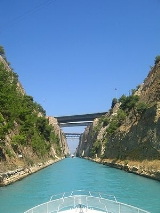
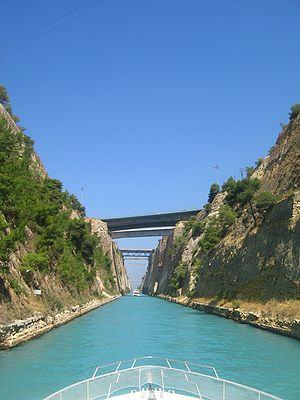
. Since 1893 the Corinth Canal
Corinth Canal
The Corinth Canal is a canal that connects the Gulf of Corinth with the Saronic Gulf in the Aegean Sea. It cuts through the narrow Isthmus of Corinth and separates the Peloponnesian peninsula from the Greek mainland, thus effectively making the former an island. The builders dug the canal through...
has run through the 6.3 km wide isthmus, effectively making the Peloponnese an island. Today, two road bridges, two railway bridges and two submersible bridge
Submersible bridge
A submersible bridge is a type of movable bridge that lowers the bridge deck below the water level to permit waterborne traffic to use the waterway. This differs from a lift bridge or table bridge, which operate by raising the roadway. Two submersible bridges exist across the Corinth Canal, one at...
s at both ends of the canal connect the mainland side of the isthmus with the Peloponnese side. Also a military emergency bridge is located at the west end of the canal.
History of the canal
The idea for a shortcut to save boats sailing all round the Peloponnese was long considered by the Ancient GreeksAncient Greece
Ancient Greece is a civilization belonging to a period of Greek history that lasted from the Archaic period of the 8th to 6th centuries BC to the end of antiquity. Immediately following this period was the beginning of the Early Middle Ages and the Byzantine era. Included in Ancient Greece is the...
. The first attempt to build a canal there was carried out by the tyrant Periander
Periander
Periander was the second tyrant of Corinth, Greece in the 7th century BC. He was the son of the first tyrant, Cypselus. Periander succeeded his father in 627 BC. He died in 585 BC....
in the 7th century BC. He abandoned the project owing to technical difficulties, and instead constructed a simpler and less costly overland stone ramp, named Diolkos
Diolkos
The Diolkos was a paved trackway near Corinth in Ancient Greece which enabled boats to be moved overland across the Isthmus of Corinth. The shortcut allowed ancient vessels to avoid the dangerous circumnavigation of the Peloponnese peninsula...
, as a portage road
Portage Road
Portage Road is an otherwise unremarkable road in the Auckland, New Zealand suburb of Otahuhu. What makes this road special is described in a plaque that is embedded in a concrete plinth at the intersection of Portage Road and Great South Road....
. Remnants of Diolkos still exist today next to the modern canal.
When the Roman republic
Roman Republic
The Roman Republic was the period of the ancient Roman civilization where the government operated as a republic. It began with the overthrow of the Roman monarchy, traditionally dated around 508 BC, and its replacement by a government headed by two consuls, elected annually by the citizens and...
(later to be the Roman Empire) took control of Greece, a number of different solutions were tried. Julius Caesar
Julius Caesar
Gaius Julius Caesar was a Roman general and statesman and a distinguished writer of Latin prose. He played a critical role in the gradual transformation of the Roman Republic into the Roman Empire....
foresaw the advantages of a link for his newly built Colonia Laus Iulia Corinthiensis. By the reign of Tiberius
Tiberius
Tiberius , was Roman Emperor from 14 AD to 37 AD. Tiberius was by birth a Claudian, son of Tiberius Claudius Nero and Livia Drusilla. His mother divorced Nero and married Augustus in 39 BC, making him a step-son of Octavian...
, engineers tried to dig a canal
Canal
Canals are man-made channels for water. There are two types of canal:#Waterways: navigable transportation canals used for carrying ships and boats shipping goods and conveying people, further subdivided into two kinds:...
, but were defeated by lack of modern equipment. Instead they built an Ancient Egypt
Ancient Egypt
Ancient Egypt was an ancient civilization of Northeastern Africa, concentrated along the lower reaches of the Nile River in what is now the modern country of Egypt. Egyptian civilization coalesced around 3150 BC with the political unification of Upper and Lower Egypt under the first pharaoh...
ian device: boats were rolled across the isthmus on logs, as the Egyptians had rolled blocks of granite
Granite
Granite is a common and widely occurring type of intrusive, felsic, igneous rock. Granite usually has a medium- to coarse-grained texture. Occasionally some individual crystals are larger than the groundmass, in which case the texture is known as porphyritic. A granitic rock with a porphyritic...
to make their pyramids
Egyptian pyramids
The Egyptian pyramids are ancient pyramid-shaped masonry structures located in Egypt.There are 138 pyramids discovered in Egypt as of 2008. Most were built as tombs for the country's Pharaohs and their consorts during the Old and Middle Kingdom periods.The earliest known Egyptian pyramids are found...
. This was in use by AD 32. In AD 67, the philhellene Roman emperor Nero
Nero
Nero , was Roman Emperor from 54 to 68, and the last in the Julio-Claudian dynasty. Nero was adopted by his great-uncle Claudius to become his heir and successor, and succeeded to the throne in 54 following Claudius' death....
ordered 6,000 slaves to dig a canal with spade
Spade
A spade is a tool designed primarily for the purpose of digging or removing earth. Early spades were made of riven wood. After the art of metalworking was discovered, spades were made with sharper tips of metal. Before the advent of metal spades manual labor was less efficient at moving earth,...
s. According to Pliny the Elder
Pliny the Elder
Gaius Plinius Secundus , better known as Pliny the Elder, was a Roman author, naturalist, and natural philosopher, as well as naval and army commander of the early Roman Empire, and personal friend of the emperor Vespasian...
, the work advanced four stadia
Stadion (unit of length)
The stadion, Latinized as stadium and anglicized as stade, is an ancient Greek unit of length. According to Herodotus, one stade is equal to 600 feet. However, there were several different lengths of “feet”, depending on the country of origin....
(about 5/8 kilometers). The following year Nero died, and his successor Galba
Galba
Galba , was Roman Emperor for seven months from 68 to 69. Galba was the governor of Hispania Tarraconensis, and made a bid for the throne during the rebellion of Julius Vindex...
abandoned the project as being too expensive.
Preservation efforts
Near the canal runs an ancient stone trackway, the DiolkosDiolkos
The Diolkos was a paved trackway near Corinth in Ancient Greece which enabled boats to be moved overland across the Isthmus of Corinth. The shortcut allowed ancient vessels to avoid the dangerous circumnavigation of the Peloponnese peninsula...
, once used for dragging ships overland. There are major concerns about preservation of this path. Greek campaigners are calling for greater effort by the Greek government to protect this archaeological site.