

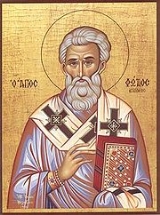
Patriarch Photios I of Constantinople

Encyclopedia
Photios I also spelled Photius or Fotios, was the Ecumenical Patriarch of Constantinople from 858 to 867 and from 877 to 886. He is recognized in the Eastern Orthodox churches as St. Photios the Great.
Photios is widely regarded as the most powerful and influential Patriarch of Constantinople since John Chrysostom
, and as the most important intellectual of his time, "the leading light of the ninth-century renaissance". He was a central figure in both the conversion of the Slavs to Christianity
and the Photian schism
.
Photios was a well-educated man from a noble Constantinopolitan family. Photius's great uncle was the previous Patriarch of Constantinople, Tarasius
. He intended to be a monk, but chose to be a scholar and statesman instead. In 858, Emperor Michael III
(r. 842–867) deposed Patriarch Ignatius of Constantinople, and Photios, still a layman, was appointed in his place. Amid power struggles between the pope and the Byzantine emperor, Ignatius was reinstated. Photios resumed the position when Ignatius died (877), by order of the Byzantine emperor. The new pope, John VIII
, approved Photios's reinstatement. Catholics regard a Fourth Council of Constantinople (Roman Catholic) as anathematizing Photios as legitimate. Eastern Orthodox regard a second council named the Fourth Council of Constantinople (Eastern Orthodox), reversing the first, as legitimate. The contested Ecumenical Councils mark the end of unity represented by the first seven Ecumenical Councils
.
(r. 802–811). During the second Iconoclasm
, his family suffered persecution since his father, Sergios, was a prominent iconophile. Sergios's family returned to favor only after the restoration of the icons in 842. Certain scholars assert that Photios was, at least in part, of Armenian
descent while other scholars merely refer to him as a "Greek Byzantine
". Byzantine writers also report that Emperor Michael III
(r. 842–867) once angrily called Photios "Khazar-faced", but whether this was a generic insult or a reference to his ethnicity is unclear.
Although Photios had an excellent education, we have no information about how he received this education. The famous library he possessed attests to his enormous erudition (theology
, philosophy
, grammar
, law
, the natural sciences, and medicine
). Most scholars believe that he never taught at Magnaura
or at any other university; Vasileios N. Tatakes asserts that, even while he was patriarch, Photios taught "young students passionately eager for knowledge" at his home, which "was a center of learning".
Photios says that, when he was young, he had an inclination for the monastic life, but instead he started a secular career. The way to public life was probably opened for him by (according to one account) the marriage of his brother Sergios to Irene, a sister of the Empress Theodora
, who upon the death of her husband Emperor Theophilos (r. 829–842) in 842, had assumed the regency of the Byzantine Empire. Photios became a captain of the guard (prōtospatharios
) and subsequently chief imperial secretary (protasēkrētis
). At an uncertain date, Photios participated in an embassy to the Abbasids of Baghdad
.
and his nephew, the youthful Emperor Michael, put an end to the administration of the regent Theodora and the logothete of the drome Theoktistos
in 856. In 858, Bardas found himself opposed by the then Patriarch Ignatios, who refused to admit him into Hagia Sophia
, since it was believed that he was having an affair with his widowed daughter-in-law, Eudoxia Ingerina. In response, Bardas and Michael engineered Ignatios's deposition and confinement on the charge of treason, thus leaving the patriarchal throne empty. The throne was soon filled with a kinsman of Bardas, Photios himself; he was tonsured on December 20, 858, and on the four following days he was successively ordained lector, sub-deacon, deacon and priest. He was consecrated as Patriarch of Constantinople on Christmas.
The deposition of Ignatios and the sudden promotion of Photios caused scandal and ecclesiastical division on an oecumenical scale as the Pope
and the rest of the western bishops took up the cause of Ignatios. The latter's deposition without a formal ecclesiastical trial meant that Photios's election was uncanonical, and eventually Pope Nicholas I
, as senior patriarch, sought to involve himself in determining the legitimacy of the succession. His legates were dispatched to Constantinople with instructions to investigate, but finding Photios well ensconced, they acquiesced in the confirmation of his election at a synod in 861. On their return to Rome, they discovered that this was not at all what Nicholas had intended, and in 863 at a synod in Rome the pope deposed Photios, and reappointed Ignatius as the rightful patriarch. Four years later, Photios was to respond on his own part by calling a Council and excommunicating
the pope on grounds of heresy – over the question of the double procession of the Holy Spirit
. The situation was additionally complicated by the question of papal authority over the entire Church and by disputed jurisdiction over newly-converted Bulgaria
. As Photius had been targeted by Pope Nicholas to be removed from his position and to be subjected to vitriol attacks with charges of ambition for power.
This state of affairs changed with the murder of Photios's patron Bardas
in 866 and of Emperor Michael III in 867, by his colleague Basil the Macedonian, who now usurped the throne. Photios was deposed as patriarch, not so much because he was a protégé of Bardas and Michael, but because Basil I was seeking an alliance with the Pope and the western emperor. Photios was removed from his office and banished about the end of September 867, and Ignatios was reinstated on November 23. Photios was condemned by the Council of 869–870. During his second patriarchate, Ignatios followed a policy not very different from that of Photios.
Not long after his condemnation, Photios had reingratiated himself with Basil, and became tutor to the Byzantine emperor's children. From surviving letters of Photios written during his exile at the Skepi monastery, it appears that the ex-patriarch brought pressure to bear on the Byzantine emperor to restore him. Ignatios's biographer argues that Photios forged a document relating to the genealogy and rule of Basil's family, and had it placed in the imperial library where a friend of his was a librarian. According to this document, the Byzantine emperor's ancestors were not mere peasants as everyone believed but descendants of the Arsacid Dynasty of Armenia
. True or not, this story does reveal Basil's dependence on Photios for literary and ideological matters. Following Photios's recall, Ignatios and the ex-patriarch met, and publicly expressed their reconciliation. When Ignatios died on October 23, 877, it was a matter of course that his old opponent replaced him on the patriarchal throne three days later. Shaun Tougher asserts that from this point on Basil no longer simply depended on Photios, but in fact he was dominated by him.
Photios now obtained the formal recognition of the Christian world in a council convened at Constantinople in November 879. The legates of Pope John VIII
attended, prepared to acknowledge Photios as legitimate patriarch, a concession for which the pope was much censured by Latin opinion. The patriarch stood firm on the main points contested between the Eastern and Western Churches, the demanded apology to the Pope, the ecclesiastical jurisdiction over Bulgaria
, and the introduction of the filioque clause
into the Nicene creed
. Eventually, Photios refused to apologize or accept the filioque, and the papal legates made do with his return of Bulgaria to Rome. This concession, however, was purely nominal, as Bulgaria's return to the Byzantine rite
in 870 had already secured for it an autocephalous church. Without the consent of Boris I of Bulgaria
(r. 852–889), the papacy was unable to enforce its claims.
During the altercations between Emperor Basil I and his heir Leo VI
, Photios took the side of the Byzantine emperor. In 883, Basil accused Leo of conspiracy and confined the prince to the palace; he would have even blinded him had he not been dissuaded by Photios and Stylianos Zaoutzes
, the father of Zoe Zaoutzaina
, Leo's mistress. In 886, Basil discovered and punished a conspiracy by the domestic of the Hikanatoi
John Kourkouas
and many other officials. In this conspiracy, Leo was not implicated, but Photios was possibly one of the conspirators against Basil's authority.
Basil died in 886 injured while hunting, according to the official story. Warren T. Treadgold believes that this time the evidence points to a plot on behalf of Leo VI, who became an emperor, and dismissed Photios, although the latter had been his tutor. Photios was replaced by the Byzantine emperor's brother Stephen, and sent into exile to the monastery of Bordi in Armenia
. It is confirmed from letters to and from Pope Stephen
that Leo extracted a resignation from Photios. In 887, Leo was put on trial for treason, but no conviction against the ex-patriarch had been secured; the main witness, Theodore Santabarenos, refused to testify that Photios was behind Leo's removal from power in 883, and after the trial faced the Byzantine emperor's wrath. As a persona non grata, Photios probably returned to his enforced monastic retirement. Yet it appears that he did not remain reviled for the remainder of his life.
Photios continued his career as a writer during the reign of Emperor Leo VI who probably rehabilitated his reputation within the next few years; in his Epitaphios on his brothers, a text probably written in 888, the Byzantine emperor presents Photios favorably, portraying him as the legitimate archbishop, and the instrument of ultimate unity, an image that jars with his attitude to the patriarch in 886–887. Confirmation that Photios was rehabilitated comes upon his death: according to some chronicles, his body was permitted to be buried in Constantinople. In addition, according to the anti-Photian biographer of Ignatius, partisans of the ex-patriarch after his death endeavored to claim for him the "honor of sainthood". Furthermore, a leading member of Leo's court, Leo Choirospaktes, wrote poems commemorating the memory of several prominent contemporary figures, such as Leo the Mathematician
and the Patriarch Stephen, and he also wrote one on Photios. Shaun Tougher notes, however, that "yet Photios's passing does seem rather muted for a great figure of Byzantine history [...] Leo [...] certainly did not allow him back into the sphere of politics, and it is surely his absence from this arena that accounts for his quiet passing."
The Eastern Orthodox Church venerates Photios as a saint; his feast day is February 6.
regards him as "the most wonderful man of all the Middle Ages", and stresses that "had not given his name to the great schism, he would always be remembered as the greatest scholar of his time".
or Myriobiblon, a collection of extracts and abridgements of 280 volumes of classical authors (usually cited as Codices), the originals of which are now to a great extent lost. The work is especially rich in extracts from historical writers.
There have been discussions on whether the Bibliotheca was in fact compiled in Baghdad
at the time of Photius's embassy to the Abbasid
court
in Samarra
in June 845, since many of the mentioned works - the majority by secular authors - seems to have been virtually nonexistent in both contemporary and later Byzantium. The Abbasids showed great interest in classical Greek works and Photius might have studied them during his years in exile
in Baghdad. Yet, scholars such as Paul Lemerle
find that Photius could not have compiled his Bibliotheca in Baghdad due to factors such as lack of time.
To Photios, we are indebted for almost all we possess of Ctesias
, Memnon of Heraclea
, Conon
, the lost books of Diodorus Siculus
, and the lost writings of Arrian
. Theology and ecclesiastical history are also very fully represented, but poetry and ancient philosophy are almost entirely ignored. It seems that he did not think it necessary to deal with those authors with whom every well-educated man would naturally be familiar. The literary criticisms, generally distinguished by keen and independent judgment, and the excerpts vary considerably in length. The numerous biographical notes are probably taken from the work of Hesychius of Miletus
.
The Lexicon, published later than the Bibliotheca, was probably in the main the work of some of his pupils. It was intended as a book of reference to facilitate the reading of old classical and sacred authors, whose language and vocabulary were out of date. The only manuscript of the Lexicon is the Codex Galeanus, which passed into the library of Trinity College, Cambridge
.
His most important theological work is the Amphilochia, a collection of some 300 questions and answers on difficult points in Scripture, addressed to Amphilochius, archbishop of Cyzicus. Other similar works are his treatise in four books against the Manichaeans and Paulicians, and his controversy with the Latins on the Procession of the Holy Spirit
. Photios also addressed a long letter of theological advice to the newly-converted Boris I of Bulgaria. Numerous other Epistles also survive.
Photios is also the writer of two "mirrors of princes", addressed to Boris-Michael of Bulgaria (Epistula 1, ed. Terzaghi) and to Leo VI the Wise (Admonitory Chapters of Basil I).
The chief contemporary authority for the life of Photios is his bitter enemy, Nicetas the Paphlagonian, the biographer of his rival Ignatios.
The first English translation, by Holy Transfiguration Monastery, of the "Mystagogy of the Holy Spirit" by Photios was published in 1983. Another translation was published in 1987 with a preface by Archimandrite
(now Archbishop
) Chrysostomos of Etna.
Apolytikion, Pl.4th “Let Us Worship the Word”
As a radiant beacon of Wisdom hid in God, * And a Defender of Orthodoxy revealed from on High,* O Great Photios, Blest adornment of The Patriarchs, *Thou didst refute the Innovations of Boastful (western) Heresy, O Light of the Holy Churches, * Which do thou keep from all error, O luminary of the Dayspring on High.
Photios is widely regarded as the most powerful and influential Patriarch of Constantinople since John Chrysostom
John Chrysostom
John Chrysostom , Archbishop of Constantinople, was an important Early Church Father. He is known for his eloquence in preaching and public speaking, his denunciation of abuse of authority by both ecclesiastical and political leaders, the Divine Liturgy of St. John Chrysostom, and his ascetic...
, and as the most important intellectual of his time, "the leading light of the ninth-century renaissance". He was a central figure in both the conversion of the Slavs to Christianity
Christianity
Christianity is a monotheistic religion based on the life and teachings of Jesus as presented in canonical gospels and other New Testament writings...
and the Photian schism
Photian schism
The Photian schism is a term for a controversy lasting from 863-867 between Eastern and Western Christianity....
.
Photios was a well-educated man from a noble Constantinopolitan family. Photius's great uncle was the previous Patriarch of Constantinople, Tarasius
Patriarch Tarasios of Constantinople
Saint Tarasios was Ecumenical Patriarch of Constantinople from December 25, 784 until his death in 806.-Background:...
. He intended to be a monk, but chose to be a scholar and statesman instead. In 858, Emperor Michael III
Michael III
Michael III , , Byzantine Emperor from 842 to 867. Michael III was the third and traditionally last member of the Amorian-Phrygian Dynasty...
(r. 842–867) deposed Patriarch Ignatius of Constantinople, and Photios, still a layman, was appointed in his place. Amid power struggles between the pope and the Byzantine emperor, Ignatius was reinstated. Photios resumed the position when Ignatius died (877), by order of the Byzantine emperor. The new pope, John VIII
Pope John VIII
Pope John VIII was pope from December 13, 872 to December 16, 882. He is often considered one of the ablest pontiffs of the ninth century and the last bright spot on the papacy until Leo IX two centuries later....
, approved Photios's reinstatement. Catholics regard a Fourth Council of Constantinople (Roman Catholic) as anathematizing Photios as legitimate. Eastern Orthodox regard a second council named the Fourth Council of Constantinople (Eastern Orthodox), reversing the first, as legitimate. The contested Ecumenical Councils mark the end of unity represented by the first seven Ecumenical Councils
First seven Ecumenical Councils
In the history of Christianity, the first seven Ecumenical Councils, from the First Council of Nicaea to the Second Council of Nicaea , represent an attempt to reach an orthodox consensus and to establish a unified Christendom as the State church of the Roman Empire...
.
Secular life
Most of the primary sources treating Photios's life are written by persons hostile to him. Modern scholars are thus cautious when assessing the accuracy of the information these sources provide. Little is known of Photios's origin and early years. It is known that he was born into a notable family and that his uncle Tarasios had been the Patriarch of Constantinople from 784–806 under both Empress Irene (r. 797–802) and Emperor Nikephoros INikephoros I
Nikephoros I or Nicephorus I, Logothetes or Genikos was Byzantine emperor from 802 to 811, when he was killed in the Battle of Pliska....
(r. 802–811). During the second Iconoclasm
Iconoclasm (Byzantine)
The Byzantine Iconoclasm encompasses two periods in the history of the Byzantine Empire when Emperors, backed by imperially-appointed leaders and councils of the Orthodox Church imposed a ban on religious images or icons. The "First Iconoclasm", as it is sometimes called, lasted between about 730...
, his family suffered persecution since his father, Sergios, was a prominent iconophile. Sergios's family returned to favor only after the restoration of the icons in 842. Certain scholars assert that Photios was, at least in part, of Armenian
Armenians
Armenian people or Armenians are a nation and ethnic group native to the Armenian Highland.The largest concentration is in Armenia having a nearly-homogeneous population with 97.9% or 3,145,354 being ethnic Armenian....
descent while other scholars merely refer to him as a "Greek Byzantine
Byzantine Greeks
Byzantine Greeks or Byzantines is a conventional term used by modern historians to refer to the medieval Greek or Hellenised citizens of the Byzantine Empire, centered mainly in Constantinople, the southern Balkans, the Greek islands, Asia Minor , Cyprus and the large urban centres of the Near East...
". Byzantine writers also report that Emperor Michael III
Michael III
Michael III , , Byzantine Emperor from 842 to 867. Michael III was the third and traditionally last member of the Amorian-Phrygian Dynasty...
(r. 842–867) once angrily called Photios "Khazar-faced", but whether this was a generic insult or a reference to his ethnicity is unclear.
Although Photios had an excellent education, we have no information about how he received this education. The famous library he possessed attests to his enormous erudition (theology
Theology
Theology is the systematic and rational study of religion and its influences and of the nature of religious truths, or the learned profession acquired by completing specialized training in religious studies, usually at a university or school of divinity or seminary.-Definition:Augustine of Hippo...
, philosophy
Philosophy
Philosophy is the study of general and fundamental problems, such as those connected with existence, knowledge, values, reason, mind, and language. Philosophy is distinguished from other ways of addressing such problems by its critical, generally systematic approach and its reliance on rational...
, grammar
Grammar
In linguistics, grammar is the set of structural rules that govern the composition of clauses, phrases, and words in any given natural language. The term refers also to the study of such rules, and this field includes morphology, syntax, and phonology, often complemented by phonetics, semantics,...
, law
Law
Law is a system of rules and guidelines which are enforced through social institutions to govern behavior, wherever possible. It shapes politics, economics and society in numerous ways and serves as a social mediator of relations between people. Contract law regulates everything from buying a bus...
, the natural sciences, and medicine
Medicine
Medicine is the science and art of healing. It encompasses a variety of health care practices evolved to maintain and restore health by the prevention and treatment of illness....
). Most scholars believe that he never taught at Magnaura
University of Constantinople
The University of Constantinople, sometimes known as the University of the palace hall of Magnaura in the Roman-Byzantine Empire was founded in 425 under the name of Pandidakterion...
or at any other university; Vasileios N. Tatakes asserts that, even while he was patriarch, Photios taught "young students passionately eager for knowledge" at his home, which "was a center of learning".
Photios says that, when he was young, he had an inclination for the monastic life, but instead he started a secular career. The way to public life was probably opened for him by (according to one account) the marriage of his brother Sergios to Irene, a sister of the Empress Theodora
Theodora (9th century)
Theodora was a Byzantine Empress as the spouse of the Byzantine emperor Theophilos, and regent of her son, Michael III, from Theophilos' death in 842 to 855...
, who upon the death of her husband Emperor Theophilos (r. 829–842) in 842, had assumed the regency of the Byzantine Empire. Photios became a captain of the guard (prōtospatharios
Protospatharios
Prōtospatharios was one of the highest court dignities of the middle Byzantine period , awarded to senior generals and provincial governors, as well as to foreign princes.-History:...
) and subsequently chief imperial secretary (protasēkrētis
Protasekretis
The prōtasēkrētis , also found as prōtoasēkrētis and latinized as protasecretis or protoasecretis, was a senior official in the Byzantine bureaucracy. The title means "first asēkrētis", illustrating his position as the head of the order of the asēkrētai, the senior class of imperial notaries.The...
). At an uncertain date, Photios participated in an embassy to the Abbasids of Baghdad
Baghdad
Baghdad is the capital of Iraq, as well as the coterminous Baghdad Governorate. The population of Baghdad in 2011 is approximately 7,216,040...
.
Patriarch of Constantinople
Photios's ecclesiastical career took off spectacularly after Caesar BardasBardas
Bardas was a Byzantine noble and high-ranking minister. As the brother of Empress Theodora, he rose to high office under Theophilos . Although sidelined after Theophilos' death by Theodora and Theoktistos, in 856 he engineered Theoktistos' fall and became the regent for his nephew, Michael III...
and his nephew, the youthful Emperor Michael, put an end to the administration of the regent Theodora and the logothete of the drome Theoktistos
Theoktistos
Theoktistos was an influential senior Byzantine official during the reigns of Michael II and his son Theophilos, and regent for the underage Michael III...
in 856. In 858, Bardas found himself opposed by the then Patriarch Ignatios, who refused to admit him into Hagia Sophia
Hagia Sophia
Hagia Sophia is a former Orthodox patriarchal basilica, later a mosque, and now a museum in Istanbul, Turkey...
, since it was believed that he was having an affair with his widowed daughter-in-law, Eudoxia Ingerina. In response, Bardas and Michael engineered Ignatios's deposition and confinement on the charge of treason, thus leaving the patriarchal throne empty. The throne was soon filled with a kinsman of Bardas, Photios himself; he was tonsured on December 20, 858, and on the four following days he was successively ordained lector, sub-deacon, deacon and priest. He was consecrated as Patriarch of Constantinople on Christmas.
The deposition of Ignatios and the sudden promotion of Photios caused scandal and ecclesiastical division on an oecumenical scale as the Pope
Pope
The Pope is the Bishop of Rome, a position that makes him the leader of the worldwide Catholic Church . In the Catholic Church, the Pope is regarded as the successor of Saint Peter, the Apostle...
and the rest of the western bishops took up the cause of Ignatios. The latter's deposition without a formal ecclesiastical trial meant that Photios's election was uncanonical, and eventually Pope Nicholas I
Pope Nicholas I
Pope Nicholas I, , or Saint Nicholas the Great, reigned from April 24, 858 until his death. He is remembered as a consolidator of papal authority and power, exerting decisive influence upon the historical development of the papacy and its position among the Christian nations of Western Europe.He...
, as senior patriarch, sought to involve himself in determining the legitimacy of the succession. His legates were dispatched to Constantinople with instructions to investigate, but finding Photios well ensconced, they acquiesced in the confirmation of his election at a synod in 861. On their return to Rome, they discovered that this was not at all what Nicholas had intended, and in 863 at a synod in Rome the pope deposed Photios, and reappointed Ignatius as the rightful patriarch. Four years later, Photios was to respond on his own part by calling a Council and excommunicating
Excommunication
Excommunication is a religious censure used to deprive, suspend or limit membership in a religious community. The word means putting [someone] out of communion. In some religions, excommunication includes spiritual condemnation of the member or group...
the pope on grounds of heresy – over the question of the double procession of the Holy Spirit
Holy Spirit
Holy Spirit is a term introduced in English translations of the Hebrew Bible, but understood differently in the main Abrahamic religions.While the general concept of a "Spirit" that permeates the cosmos has been used in various religions Holy Spirit is a term introduced in English translations of...
. The situation was additionally complicated by the question of papal authority over the entire Church and by disputed jurisdiction over newly-converted Bulgaria
Bulgaria
Bulgaria , officially the Republic of Bulgaria , is a parliamentary democracy within a unitary constitutional republic in Southeast Europe. The country borders Romania to the north, Serbia and Macedonia to the west, Greece and Turkey to the south, as well as the Black Sea to the east...
. As Photius had been targeted by Pope Nicholas to be removed from his position and to be subjected to vitriol attacks with charges of ambition for power.
This state of affairs changed with the murder of Photios's patron Bardas
Bardas
Bardas was a Byzantine noble and high-ranking minister. As the brother of Empress Theodora, he rose to high office under Theophilos . Although sidelined after Theophilos' death by Theodora and Theoktistos, in 856 he engineered Theoktistos' fall and became the regent for his nephew, Michael III...
in 866 and of Emperor Michael III in 867, by his colleague Basil the Macedonian, who now usurped the throne. Photios was deposed as patriarch, not so much because he was a protégé of Bardas and Michael, but because Basil I was seeking an alliance with the Pope and the western emperor. Photios was removed from his office and banished about the end of September 867, and Ignatios was reinstated on November 23. Photios was condemned by the Council of 869–870. During his second patriarchate, Ignatios followed a policy not very different from that of Photios.
Not long after his condemnation, Photios had reingratiated himself with Basil, and became tutor to the Byzantine emperor's children. From surviving letters of Photios written during his exile at the Skepi monastery, it appears that the ex-patriarch brought pressure to bear on the Byzantine emperor to restore him. Ignatios's biographer argues that Photios forged a document relating to the genealogy and rule of Basil's family, and had it placed in the imperial library where a friend of his was a librarian. According to this document, the Byzantine emperor's ancestors were not mere peasants as everyone believed but descendants of the Arsacid Dynasty of Armenia
Arsacid Dynasty of Armenia
The Arsacid dynasty or Arshakuni dynasty ruled the Kingdom of Armenia from 54 AD to 428 AD. Formerly a branch of the Iranian Parthian Arsacids, they became a distinctly Armenian dynasty. Arsacid Kings reigned intermittently throughout the chaotic years following the fall of the Artaxiad Dynasty...
. True or not, this story does reveal Basil's dependence on Photios for literary and ideological matters. Following Photios's recall, Ignatios and the ex-patriarch met, and publicly expressed their reconciliation. When Ignatios died on October 23, 877, it was a matter of course that his old opponent replaced him on the patriarchal throne three days later. Shaun Tougher asserts that from this point on Basil no longer simply depended on Photios, but in fact he was dominated by him.
Photios now obtained the formal recognition of the Christian world in a council convened at Constantinople in November 879. The legates of Pope John VIII
Pope John VIII
Pope John VIII was pope from December 13, 872 to December 16, 882. He is often considered one of the ablest pontiffs of the ninth century and the last bright spot on the papacy until Leo IX two centuries later....
attended, prepared to acknowledge Photios as legitimate patriarch, a concession for which the pope was much censured by Latin opinion. The patriarch stood firm on the main points contested between the Eastern and Western Churches, the demanded apology to the Pope, the ecclesiastical jurisdiction over Bulgaria
Bulgaria
Bulgaria , officially the Republic of Bulgaria , is a parliamentary democracy within a unitary constitutional republic in Southeast Europe. The country borders Romania to the north, Serbia and Macedonia to the west, Greece and Turkey to the south, as well as the Black Sea to the east...
, and the introduction of the filioque clause
Filioque clause
Filioque , Latin for "and the Son", is a phrase found in the form of Nicene Creed in use in the Latin Church. It is not present in the Greek text of the Nicene Creed as originally formulated at the First Council of Constantinople, which says only that the Holy Spirit proceeds "from the Father":The...
into the Nicene creed
Nicene Creed
The Nicene Creed is the creed or profession of faith that is most widely used in Christian liturgy. It is called Nicene because, in its original form, it was adopted in the city of Nicaea by the first ecumenical council, which met there in the year 325.The Nicene Creed has been normative to the...
. Eventually, Photios refused to apologize or accept the filioque, and the papal legates made do with his return of Bulgaria to Rome. This concession, however, was purely nominal, as Bulgaria's return to the Byzantine rite
Byzantine Rite
The Byzantine Rite, sometimes called the Rite of Constantinople or Constantinopolitan Rite is the liturgical rite used currently by all the Eastern Orthodox Churches, by the Greek Catholic Churches , and by the Protestant Ukrainian Lutheran Church...
in 870 had already secured for it an autocephalous church. Without the consent of Boris I of Bulgaria
Boris I of Bulgaria
Boris I, also known as Boris-Mihail and Bogoris was the Knyaz of First Bulgarian Empire in 852–889. At the time of his baptism in 864, Boris was named Michael after his godfather, Emperor Michael III...
(r. 852–889), the papacy was unable to enforce its claims.
During the altercations between Emperor Basil I and his heir Leo VI
Leo VI the Wise
Leo VI, surnamed the Wise or the Philosopher , was Byzantine emperor from 886 to 912. The second ruler of the Macedonian dynasty , he was very well-read, leading to his surname...
, Photios took the side of the Byzantine emperor. In 883, Basil accused Leo of conspiracy and confined the prince to the palace; he would have even blinded him had he not been dissuaded by Photios and Stylianos Zaoutzes
Stylianos Zaoutzes
Stylianos Zaoutzes was a high Byzantine official of Armenian origin. Rising to high rank under Byzantine emperor Basil I , he then rose further to prominence under Basil's successor Emperor Leo VI the Wise , who had a close friendship and possible an affair with Stylianos's daughter Zoe Zaoutzaina...
, the father of Zoe Zaoutzaina
Zoe Zaoutzaina
Zoe Zaoutzaina was the second wife of the Byzantine emperor Leo VI the Wise. She was the daughter of Stylianos Zaoutzes, a high-ranking bureaucrat during the reign of her husband.-Royal mistress:...
, Leo's mistress. In 886, Basil discovered and punished a conspiracy by the domestic of the Hikanatoi
Hikanatoi
The Hikanatoi , sometimes Latinized as Hicanati, were one of the Byzantine tagmata, the elite guard units based near the imperial capital of Constantinople...
John Kourkouas
John Kourkouas
John Kourkouas , also transliterated as Kurkuas or Curcuas, was one of the most important generals of the Byzantine Empire. His successes in battle against the Muslim states in the East definitively reversed the course of the centuries-long Byzantine–Arab Wars and began Byzantium's 10th-century...
and many other officials. In this conspiracy, Leo was not implicated, but Photios was possibly one of the conspirators against Basil's authority.
Basil died in 886 injured while hunting, according to the official story. Warren T. Treadgold believes that this time the evidence points to a plot on behalf of Leo VI, who became an emperor, and dismissed Photios, although the latter had been his tutor. Photios was replaced by the Byzantine emperor's brother Stephen, and sent into exile to the monastery of Bordi in Armenia
Armenia
Armenia , officially the Republic of Armenia , is a landlocked mountainous country in the Caucasus region of Eurasia...
. It is confirmed from letters to and from Pope Stephen
Pope Stephen V
Pope Stephen V was pope from 885 to 891. He succeeded Pope Adrian III, and was in turn succeeded by Pope Formosus. In his dealings with Constantinople in the matter of Photius, as also in his relations with the young Slavonic church, he pursued the policy of Pope Nicholas I.His father, Hadrian, who...
that Leo extracted a resignation from Photios. In 887, Leo was put on trial for treason, but no conviction against the ex-patriarch had been secured; the main witness, Theodore Santabarenos, refused to testify that Photios was behind Leo's removal from power in 883, and after the trial faced the Byzantine emperor's wrath. As a persona non grata, Photios probably returned to his enforced monastic retirement. Yet it appears that he did not remain reviled for the remainder of his life.
Photios continued his career as a writer during the reign of Emperor Leo VI who probably rehabilitated his reputation within the next few years; in his Epitaphios on his brothers, a text probably written in 888, the Byzantine emperor presents Photios favorably, portraying him as the legitimate archbishop, and the instrument of ultimate unity, an image that jars with his attitude to the patriarch in 886–887. Confirmation that Photios was rehabilitated comes upon his death: according to some chronicles, his body was permitted to be buried in Constantinople. In addition, according to the anti-Photian biographer of Ignatius, partisans of the ex-patriarch after his death endeavored to claim for him the "honor of sainthood". Furthermore, a leading member of Leo's court, Leo Choirospaktes, wrote poems commemorating the memory of several prominent contemporary figures, such as Leo the Mathematician
Leo the Mathematician
Leo the Mathematician or the Philosopher was a Byzantine philosopher and logician associated with the Macedonian Renaissance and the end of Iconoclasm. His only preserved writings are some notes contained in manuscripts of Plato's dialogues. He has been called a "true Renaissance man" and "the...
and the Patriarch Stephen, and he also wrote one on Photios. Shaun Tougher notes, however, that "yet Photios's passing does seem rather muted for a great figure of Byzantine history [...] Leo [...] certainly did not allow him back into the sphere of politics, and it is surely his absence from this arena that accounts for his quiet passing."
The Eastern Orthodox Church venerates Photios as a saint; his feast day is February 6.
Assessments
Photios is one of the most famous figures not only of 9th-century Byzantium but of the entire history of the Byzantine Empire. One of the most learned men of his age, he has earned his fame due to his part in ecclesiastical conflicts, and also for his intellect and literary works Analyzing his intellectual work, Tatakes regards Photios as "mind turned more to practice than to theory". He believes that, thanks to Photios, humanism was added to Orthodoxy as a basic element of the national consciousness of the Byzantines. Tatakes also argues that, having understood this national consciousness, Photios emerged as a defender of the Greek nation and its spiritual independence in his debates with the Western Church. Adrian FortescueAdrian Fortescue (priest)
Adrian Fortescue was a Roman Catholic priest and Englishman who was an influential liturgist, artist, calligrapher, composer, polyglot, amateur photographer, Byzantine scholar, and adventurer.-Early life and education:...
regards him as "the most wonderful man of all the Middle Ages", and stresses that "had not given his name to the great schism, he would always be remembered as the greatest scholar of his time".
Writings
The most important of the works of Photios is his renowned BibliothecaBibliotheca (Photius)
The Bibliotheca or Myriobiblon was a 9th century work of Byzantine Patriarch Photius, dedicated to his brother and composed of 279 reviews of books which he had read. It was not meant to be used as a reference work, but was widely used as such in the 9th century, and is generally seen as the first...
or Myriobiblon, a collection of extracts and abridgements of 280 volumes of classical authors (usually cited as Codices), the originals of which are now to a great extent lost. The work is especially rich in extracts from historical writers.
There have been discussions on whether the Bibliotheca was in fact compiled in Baghdad
Baghdad
Baghdad is the capital of Iraq, as well as the coterminous Baghdad Governorate. The population of Baghdad in 2011 is approximately 7,216,040...
at the time of Photius's embassy to the Abbasid
Abbasid
The Abbasid Caliphate or, more simply, the Abbasids , was the third of the Islamic caliphates. It was ruled by the Abbasid dynasty of caliphs, who built their capital in Baghdad after overthrowing the Umayyad caliphate from all but the al-Andalus region....
court
Court
A court is a form of tribunal, often a governmental institution, with the authority to adjudicate legal disputes between parties and carry out the administration of justice in civil, criminal, and administrative matters in accordance with the rule of law...
in Samarra
Samarra
Sāmarrā is a city in Iraq. It stands on the east bank of the Tigris in the Salah ad-Din Governorate, north of Baghdad and, in 2003, had an estimated population of 348,700....
in June 845, since many of the mentioned works - the majority by secular authors - seems to have been virtually nonexistent in both contemporary and later Byzantium. The Abbasids showed great interest in classical Greek works and Photius might have studied them during his years in exile
Exile
Exile means to be away from one's home , while either being explicitly refused permission to return and/or being threatened with imprisonment or death upon return...
in Baghdad. Yet, scholars such as Paul Lemerle
Paul Lemerle
Paul Lemerle was a French Byzantinist.Lemerle taught at the École française d’Athènes , at the Faculté des Lettres of the University of Burgundy at Dijon , at the École Pratique des Hautes Études , at the Sorbonne and at the Collège de France...
find that Photius could not have compiled his Bibliotheca in Baghdad due to factors such as lack of time.
To Photios, we are indebted for almost all we possess of Ctesias
Ctesias
Ctesias of Cnidus was a Greek physician and historian from Cnidus in Caria. Ctesias, who lived in the 5th century BC, was physician to Artaxerxes Mnemon, whom he accompanied in 401 BC on his expedition against his brother Cyrus the Younger....
, Memnon of Heraclea
Memnon of Heraclea
Memnon of Heraclea was a Greek historical writer, probably a native of Heraclea Pontica. He described the history of that city in a large work, known only through the Excerpta of Photius , and describing especially the various tyrants who had at times ruled Heraclea.Memnon's history encompassed...
, Conon
Conon
Conon was an Athenian general at the end of the Peloponnesian War, who presided over the crucial Athenian naval defeat at Battle of Aegospotami; later he contributed significantly to the restoration of the political and military power.-Defeat at Aegospotami:Conon had been sent out following the...
, the lost books of Diodorus Siculus
Diodorus Siculus
Diodorus Siculus was a Greek historian who flourished between 60 and 30 BC. According to Diodorus' own work, he was born at Agyrium in Sicily . With one exception, antiquity affords no further information about Diodorus' life and doings beyond what is to be found in his own work, Bibliotheca...
, and the lost writings of Arrian
Arrian
Lucius Flavius Arrianus 'Xenophon , known in English as Arrian , and Arrian of Nicomedia, was a Roman historian, public servant, a military commander and a philosopher of the 2nd-century Roman period...
. Theology and ecclesiastical history are also very fully represented, but poetry and ancient philosophy are almost entirely ignored. It seems that he did not think it necessary to deal with those authors with whom every well-educated man would naturally be familiar. The literary criticisms, generally distinguished by keen and independent judgment, and the excerpts vary considerably in length. The numerous biographical notes are probably taken from the work of Hesychius of Miletus
Hesychius of Miletus
Hesychius of Miletus, Greek chronicler and biographer, surnamed Illustrius, son of an advocate, flourished at Constantinople in the 6th century AD during the reign of Justinian.According to Photius he was the author of three important works:...
.
The Lexicon, published later than the Bibliotheca, was probably in the main the work of some of his pupils. It was intended as a book of reference to facilitate the reading of old classical and sacred authors, whose language and vocabulary were out of date. The only manuscript of the Lexicon is the Codex Galeanus, which passed into the library of Trinity College, Cambridge
Trinity College, Cambridge
Trinity College is a constituent college of the University of Cambridge. Trinity has more members than any other college in Cambridge or Oxford, with around 700 undergraduates, 430 graduates, and over 170 Fellows...
.
His most important theological work is the Amphilochia, a collection of some 300 questions and answers on difficult points in Scripture, addressed to Amphilochius, archbishop of Cyzicus. Other similar works are his treatise in four books against the Manichaeans and Paulicians, and his controversy with the Latins on the Procession of the Holy Spirit
Holy Spirit
Holy Spirit is a term introduced in English translations of the Hebrew Bible, but understood differently in the main Abrahamic religions.While the general concept of a "Spirit" that permeates the cosmos has been used in various religions Holy Spirit is a term introduced in English translations of...
. Photios also addressed a long letter of theological advice to the newly-converted Boris I of Bulgaria. Numerous other Epistles also survive.
Photios is also the writer of two "mirrors of princes", addressed to Boris-Michael of Bulgaria (Epistula 1, ed. Terzaghi) and to Leo VI the Wise (Admonitory Chapters of Basil I).
The chief contemporary authority for the life of Photios is his bitter enemy, Nicetas the Paphlagonian, the biographer of his rival Ignatios.
The first English translation, by Holy Transfiguration Monastery, of the "Mystagogy of the Holy Spirit" by Photios was published in 1983. Another translation was published in 1987 with a preface by Archimandrite
Archimandrite
The title Archimandrite , primarily used in the Eastern Orthodox and the Eastern Catholic churches, originally referred to a superior abbot whom a bishop appointed to supervise...
(now Archbishop
Archbishop
An archbishop is a bishop of higher rank, but not of higher sacramental order above that of the three orders of deacon, priest , and bishop...
) Chrysostomos of Etna.
Hymns
Troparion (Tone 4)- Follower of the Apostles' way
- And teacher of mankind:
- Intercede, O Photius, with the Lord of all,
- To grant peace to the world
- And to our souls great mercy!
Apolytikion, Pl.4th “Let Us Worship the Word”
As a radiant beacon of Wisdom hid in God, * And a Defender of Orthodoxy revealed from on High,* O Great Photios, Blest adornment of The Patriarchs, *Thou didst refute the Innovations of Boastful (western) Heresy, O Light of the Holy Churches, * Which do thou keep from all error, O luminary of the Dayspring on High.
American Shrine
The Saint Photios Greek Orthodox National Shrine is located in the city of St Augustine, Florida. It is known as the "Jewel of St. George Street". The Shrine commemorates the first members of the Greek Orthodox Church in North America, a group of men, women and children who were brought over to work on a plantation during Florida's English occupation. The workers were treated like slaves and eventually revolted against their masters and traveled many miles over the harsh Florida scrub to ask the English governor for their freedom. Although the Greeks were allowed to settle in St. Augustine as free persons, many had already died and two of their leaders were hanged by the English as an example to other indentured servants and slaves. The Shrine consists of a chapel and an historical exhibit about the Greek immigrants and their uprising.External links
- Saint Photius the Great Orthodox Icon and Synaxarion (February 6)
- Patriarch Photios of Constantinople Life and translations of his works
- The Excerpta of Photius Photius's summary of Books 9-16 of Memnon of Heraclea's history of Heraclea Pontica
- The Myrobiblion at Tertullian.Org
- Catholic Encyclopedia - Photius
- Greek Opera Omnia by Migne Patrologia Graeca with analytical indexes
- Saint Photius the Great, Mystagogy of the Holy Spirit (English translation)