


Rakia

Encyclopedia
Rakia is an alcoholic beverage
that is produced by distillation
of fermented
fruit; it is a popular beverage throughout the Balkans
. Its alcohol content is normally 40% ABV
, but home-produced rakia can be stronger (typically 50% to 60%). Prepečenica is double-distilled rakia which has an alcohol content that may exceed 60%. Rakı
is also the name of a Turkish anise-flavored drink.
Rakia originally appeared in Bulgaria in the 14th century. Rakia is considered to be а national drink in a number of countries, including Albania
, Bulgaria
, Bosnia and Herzegovina
, Croatia
, Macedonia
, Montenegro
, Serbia
and Turkey
. Common flavours are slivovica, produced from plum
s, Kajsijevaca, produced from apricot
s and lozovaca, made from grape
s. Fruits less commonly used are peach
es, apple
s, pear
s, cherry
, fig
s, blackberries
, and quince
. Similar spirits are produced in Russia
and the Caucasus
. A popular home-made variant in Bosnia and Herzegovina, Bulgaria, Macedonia, and Serbia is rakia produced from mixed fruits. In the Istria
n and Dalmatia
n regions of Croatia
, rakia tends to be home-made exclusively from grape
s, where the drink is also known locally as trapa or grappa (the latter name also being used in Italy). In Albania, rakia can be made out of grapes (mostly in mild climate regions) or out of plum (and sometimes out of mulberry
or walnuts) in colder climate areas. Plum and grape rakia are sometimes mixed with other ingredients, such as herbs, honey, sour cherries and walnuts, after distillation.
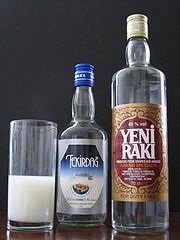

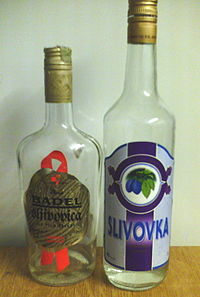 Normally, rakia is colourless, unless herb
s or other ingredients are added. Some types of rakia are kept in wooden barrels (oak
or mulberry) for extra aroma and a golden colour.
It is supposed to be drunk from special small glasses which hold from 0.03 to 0.05 L
.
A popular myth is that one can tell the strength of rakia by the size of the ring of bubbles (venac) which forms when the bottle is well shaken. This is also mistakenly used as a measure of the quality of the liquor.
In Serbia
it is the most popular alcoholic drink. It is usually served before lunch and dinner and is drunk along with appetizers. Serbian rakija usually consists of greater quality than other forms due to the quality of fruits used from Serbian farmers in Vojvodina and southern Serbia. Slivovica, a plum rakija, is the most popular of all in Serbia and the Balkans. It has originated in Serbia. Serbia also won rights to the name "Rakija" from the International Court.
In Montenegro
, rakia is one of the most popular alcoholic drinks. Although Montenegrin plum rakia isn't high quality, Montenegrins excel at making grape
rakia, called lozovaca, due to good Mediterranean grapes quality. Rakia also served to Montenegrins from 16th to 19th century as opiate when healing serious injuries,in order to not feel pain when being healed.
In Bulgaria
and Macedonia
, rakia is generally served with shopska salad
, milk salad
, pickled vegetables (turshiya
) or other salads, which form the first course of the meal. Muskatova rakiya is made from Muscat
grapes, while the preparation method of dzhibrova rakiya is the same as for Italian Grappa
.
In Croatia, travarica (herbal rakia) is usually served at the beginning of the meal, together with dried figs. The Croatian Adriatic coast is known for a great variety of herbal grappas, some typical for only one island or group of islands. The island Hvar is famous for grappa with the addition of myrrh
(mrtina — bitter and dark brown). Southern islands, such as Korčula, and the city of Dubrovnik are famous for grappa with anise
(aniseta), and in central Dalmatia the most popular rakia is grappa with nuts (orahovica). It's usually homemade, and served with dry cookies or dried figs. In the summer, it's very typical to see huge glass jars of grappa with nuts steeping in the liquid on every balcony, because the process requires the exposure of orahovica to the sun. In the northern Adriatic — mainly Istria — rakia is typically made of honey
(medica) or mistletoe
(biska). Biska, which is yellow-brown and sweet, is a typical liquor of Istria.
Another popular way of serving is "cooked" (Croatian: kuhana, Serbian: kuvana or grejana, Bulgarian: греяна (grejana), Macedonian: греена or топла) rakia (also called Šumadija
tea in Serbia), which is heated and sweetened with honey or sugar, with added spice
s. Heated in large kettles, it is often offered to visitors to various open-air festivities, especially in winter. It is similar to mulled wine
, as weaker brands of rakia are used (or stronger ones diluted with water).
* Kom or džibra is the fruity grape mash that remains after winemaking. It contains up to 5.5 litres of pure alcohol per 100 kg, and at least 40% dry matter.
** Not to be confused with mead
, which is made solely of honey.
, until the 19th century, meyhane
s would mainly serve wine
along with meze
, due to religious restrictions imposed by various Sultan
s. Although there were many Muslim
s among meyhane attendants, sharia
authorities could, at times, prosecute them. With the relatively liberal atmosphere of the Tanzimat
Period (1839–1876), meyhane attendance among Muslims rose considerably, and Raki became a favourite among meyhane
-goers. By the end of the century, Raki took its current standard form and its consumption surpassed that of wine
.
The Albanian raki is made from fermented
and distilled fruit
, particularly grape
s and plum
s. Albanian raki contains no aniseed and its taste varies according to the fruit used to make it. The process of making raki is exceptionally difficult, requiring much labor to mash the fruit, ferment it under the proper conditions, ensure the correct amount of fire under the distillery barrel
and finally to infuse
the final product with leaves from the apple
tree. The slightest mistake turns a potentially perfect batch of raki into what is known as 'soft raki', which is considered by many to not be worth drinking. Also worth noticed is that in Albania rakia is not mixed with water like in Turkey or other countries. It is drank in small cups called Teke (which means one single shot) or dopio (which mean a double shot in one glass)
In Albania rakia is a very popular alcoholic beverage. There are a lot of different brands. Moreover there are lots of families who still produce their own Rakia.
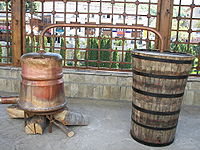
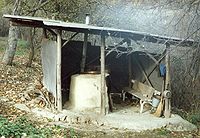 Although wine
is the essential part of the Eucharist
rite in the Eastern Orthodox and Roman Catholic churches in the region, rakia has found uses in certain religious and related rituals across the Balkans.
At the end of the Orthodox Christian burial
service, at the exit from the cemetery, visitors are offered a piece of soda bread
(pogača) and a glass of rakia. When drinking "for the soul" of the deceased, one spills some rakia on the ground, saying "For peaceful rest of the soul", before drinking the rest.
During wedding
ceremonies, the groom's father goes around all tables and offers a glass of rakia to all guests, sharing a toast
for the happiness of the newlyweds. In general, in the Balkans, rakia is offered to guests in one's home as a welcoming gesture.
Alcoholic beverage
An alcoholic beverage is a drink containing ethanol, commonly known as alcohol. Alcoholic beverages are divided into three general classes: beers, wines, and spirits. They are legally consumed in most countries, and over 100 countries have laws regulating their production, sale, and consumption...
that is produced by distillation
Distillation
Distillation is a method of separating mixtures based on differences in volatilities of components in a boiling liquid mixture. Distillation is a unit operation, or a physical separation process, and not a chemical reaction....
of fermented
Fermentation (food)
Fermentation in food processing typically is the conversion of carbohydrates to alcohols and carbon dioxide or organic acids using yeasts, bacteria, or a combination thereof, under anaerobic conditions. Fermentation in simple terms is the chemical conversion of sugars into ethanol...
fruit; it is a popular beverage throughout the Balkans
Balkans
The Balkans is a geopolitical and cultural region of southeastern Europe...
. Its alcohol content is normally 40% ABV
ABV
ABV is a three-letter acronym that may refer to:* Alcohol by volume, a measure of the alcohol content of alcoholic drinks* Nnamdi Azikiwe International Airport, Abuja, Nigeria, from its IATA airport code...
, but home-produced rakia can be stronger (typically 50% to 60%). Prepečenica is double-distilled rakia which has an alcohol content that may exceed 60%. Rakı
Raki
-Alcoholic beverages:*Rakı, an anise-flavored spirit popular in Turkey*Any anise-flavored drink.-Fictional characters:*Raki, a character in the manga/anime series Claymore*Raki, a character in the game Ar tonelico II: Melody of Metafalica...
is also the name of a Turkish anise-flavored drink.
Rakia originally appeared in Bulgaria in the 14th century. Rakia is considered to be а national drink in a number of countries, including Albania
Albania
Albania , officially known as the Republic of Albania , is a country in Southeastern Europe, in the Balkans region. It is bordered by Montenegro to the northwest, Kosovo to the northeast, the Republic of Macedonia to the east and Greece to the south and southeast. It has a coast on the Adriatic Sea...
, Bulgaria
Bulgaria
Bulgaria , officially the Republic of Bulgaria , is a parliamentary democracy within a unitary constitutional republic in Southeast Europe. The country borders Romania to the north, Serbia and Macedonia to the west, Greece and Turkey to the south, as well as the Black Sea to the east...
, Bosnia and Herzegovina
Bosnia and Herzegovina
Bosnia and Herzegovina , sometimes called Bosnia-Herzegovina or simply Bosnia, is a country in Southern Europe, on the Balkan Peninsula. Bordered by Croatia to the north, west and south, Serbia to the east, and Montenegro to the southeast, Bosnia and Herzegovina is almost landlocked, except for the...
, Croatia
Croatia
Croatia , officially the Republic of Croatia , is a unitary democratic parliamentary republic in Europe at the crossroads of the Mitteleuropa, the Balkans, and the Mediterranean. Its capital and largest city is Zagreb. The country is divided into 20 counties and the city of Zagreb. Croatia covers ...
, Macedonia
Republic of Macedonia
Macedonia , officially the Republic of Macedonia , is a country located in the central Balkan peninsula in Southeast Europe. It is one of the successor states of the former Yugoslavia, from which it declared independence in 1991...
, Montenegro
Montenegro
Montenegro Montenegrin: Crna Gora Црна Гора , meaning "Black Mountain") is a country located in Southeastern Europe. It has a coast on the Adriatic Sea to the south-west and is bordered by Croatia to the west, Bosnia and Herzegovina to the northwest, Serbia to the northeast and Albania to the...
, Serbia
Serbia
Serbia , officially the Republic of Serbia , is a landlocked country located at the crossroads of Central and Southeast Europe, covering the southern part of the Carpathian basin and the central part of the Balkans...
and Turkey
Turkey
Turkey , known officially as the Republic of Turkey , is a Eurasian country located in Western Asia and in East Thrace in Southeastern Europe...
. Common flavours are slivovica, produced from plum
Plum
A plum or gage is a stone fruit tree in the genus Prunus, subgenus Prunus. The subgenus is distinguished from other subgenera in the shoots having a terminal bud and solitary side buds , the flowers in groups of one to five together on short stems, and the fruit having a groove running down one...
s, Kajsijevaca, produced from apricot
Apricot
The apricot, Prunus armeniaca, is a species of Prunus, classified with the plum in the subgenus Prunus. The native range is somewhat uncertain due to its extensive prehistoric cultivation.- Description :...
s and lozovaca, made from grape
Grape
A grape is a non-climacteric fruit, specifically a berry, that grows on the perennial and deciduous woody vines of the genus Vitis. Grapes can be eaten raw or they can be used for making jam, juice, jelly, vinegar, wine, grape seed extracts, raisins, molasses and grape seed oil. Grapes are also...
s. Fruits less commonly used are peach
Peach
The peach tree is a deciduous tree growing to tall and 6 in. in diameter, belonging to the subfamily Prunoideae of the family Rosaceae. It bears an edible juicy fruit called a peach...
es, apple
Apple
The apple is the pomaceous fruit of the apple tree, species Malus domestica in the rose family . It is one of the most widely cultivated tree fruits, and the most widely known of the many members of genus Malus that are used by humans. Apple grow on small, deciduous trees that blossom in the spring...
s, pear
Pear
The pear is any of several tree species of genus Pyrus and also the name of the pomaceous fruit of these trees. Several species of pear are valued by humans for their edible fruit, but the fruit of other species is small, hard, and astringent....
s, cherry
Cherry
The cherry is the fruit of many plants of the genus Prunus, and is a fleshy stone fruit. The cherry fruits of commerce are usually obtained from a limited number of species, including especially cultivars of the wild cherry, Prunus avium....
, fig
Ficus
Ficus is a genus of about 850 species of woody trees, shrubs, vines, epiphytes, and hemiepiphyte in the family Moraceae. Collectively known as fig trees or figs, they are native throughout the tropics with a few species extending into the semi-warm temperate zone. The Common Fig Ficus is a genus of...
s, blackberries
Blackberry
The blackberry is an edible fruit produced by any of several species in the Rubus genus of the Rosaceae family. The fruit is not a true berry; botanically it is termed an aggregate fruit, composed of small drupelets. The plants typically have biennial canes and perennial roots. Blackberries and...
, and quince
Quince
The quince , or Cydonia oblonga, is the sole member of the genus Cydonia and native to warm-temperate southwest Asia in the Caucasus region...
. Similar spirits are produced in Russia
Russia
Russia or , officially known as both Russia and the Russian Federation , is a country in northern Eurasia. It is a federal semi-presidential republic, comprising 83 federal subjects...
and the Caucasus
Caucasus
The Caucasus, also Caucas or Caucasia , is a geopolitical region at the border of Europe and Asia, and situated between the Black and the Caspian sea...
. A popular home-made variant in Bosnia and Herzegovina, Bulgaria, Macedonia, and Serbia is rakia produced from mixed fruits. In the Istria
Istria
Istria , formerly Histria , is the largest peninsula in the Adriatic Sea. The peninsula is located at the head of the Adriatic between the Gulf of Trieste and the Bay of Kvarner...
n and Dalmatia
Dalmatia
Dalmatia is a historical region on the eastern coast of the Adriatic Sea. It stretches from the island of Rab in the northwest to the Bay of Kotor in the southeast. The hinterland, the Dalmatian Zagora, ranges from fifty kilometers in width in the north to just a few kilometers in the south....
n regions of Croatia
Croatia
Croatia , officially the Republic of Croatia , is a unitary democratic parliamentary republic in Europe at the crossroads of the Mitteleuropa, the Balkans, and the Mediterranean. Its capital and largest city is Zagreb. The country is divided into 20 counties and the city of Zagreb. Croatia covers ...
, rakia tends to be home-made exclusively from grape
Grape
A grape is a non-climacteric fruit, specifically a berry, that grows on the perennial and deciduous woody vines of the genus Vitis. Grapes can be eaten raw or they can be used for making jam, juice, jelly, vinegar, wine, grape seed extracts, raisins, molasses and grape seed oil. Grapes are also...
s, where the drink is also known locally as trapa or grappa (the latter name also being used in Italy). In Albania, rakia can be made out of grapes (mostly in mild climate regions) or out of plum (and sometimes out of mulberry
Mulberry
Morus is a genus of flowering plants in the family Moraceae. The 10–16 species of deciduous trees it contains are commonly known as Mulberries....
or walnuts) in colder climate areas. Plum and grape rakia are sometimes mixed with other ingredients, such as herbs, honey, sour cherries and walnuts, after distillation.
Similar drinks
Many countries produce similar fruit brandies which are listed here by their local names:- AlbaniaAlbaniaAlbania , officially known as the Republic of Albania , is a country in Southeastern Europe, in the Balkans region. It is bordered by Montenegro to the northwest, Kosovo to the northeast, the Republic of Macedonia to the east and Greece to the south and southeast. It has a coast on the Adriatic Sea...
: raki(a) - Bosnia and HerzegovinaBosnia and HerzegovinaBosnia and Herzegovina , sometimes called Bosnia-Herzegovina or simply Bosnia, is a country in Southern Europe, on the Balkan Peninsula. Bordered by Croatia to the north, west and south, Serbia to the east, and Montenegro to the southeast, Bosnia and Herzegovina is almost landlocked, except for the...
: rakija - BulgariaBulgariaBulgaria , officially the Republic of Bulgaria , is a parliamentary democracy within a unitary constitutional republic in Southeast Europe. The country borders Romania to the north, Serbia and Macedonia to the west, Greece and Turkey to the south, as well as the Black Sea to the east...
: ракия - CroatiaCroatiaCroatia , officially the Republic of Croatia , is a unitary democratic parliamentary republic in Europe at the crossroads of the Mitteleuropa, the Balkans, and the Mediterranean. Its capital and largest city is Zagreb. The country is divided into 20 counties and the city of Zagreb. Croatia covers ...
: rakija - Czech RepublicCzech RepublicThe Czech Republic is a landlocked country in Central Europe. The country is bordered by Poland to the northeast, Slovakia to the east, Austria to the south, and Germany to the west and northwest....
: pálenkaPalenkaPálenka denotes any kind of distillate, but especially fruit distillate, in Hungary. It is also often used as a generic word for all kinds of liquors, including vodka, gin, borovička, etc... - HungaryHungaryHungary , officially the Republic of Hungary , is a landlocked country in Central Europe. It is situated in the Carpathian Basin and is bordered by Slovakia to the north, Ukraine and Romania to the east, Serbia and Croatia to the south, Slovenia to the southwest and Austria to the west. The...
: pálinkaPalinkaPálinka or Palincă is a traditional fruit brandy made in regions of the Carpathian Basin. Modern commercial production occurs in Hungary, Romania and parts of Austria. It is commonly made from the fermentation of plums, but other fruits used include apricots, apples, pears, peaches and cherries... - MacedoniaRepublic of MacedoniaMacedonia , officially the Republic of Macedonia , is a country located in the central Balkan peninsula in Southeast Europe. It is one of the successor states of the former Yugoslavia, from which it declared independence in 1991...
: ракија - MontenegroMontenegroMontenegro Montenegrin: Crna Gora Црна Гора , meaning "Black Mountain") is a country located in Southeastern Europe. It has a coast on the Adriatic Sea to the south-west and is bordered by Croatia to the west, Bosnia and Herzegovina to the northwest, Serbia to the northeast and Albania to the...
: ракија/rakija - RomaniaRomaniaRomania is a country located at the crossroads of Central and Southeastern Europe, on the Lower Danube, within and outside the Carpathian arch, bordering on the Black Sea...
n: rachiu/răchie, ţuicăTuicaŢuică is a traditional Romanian spirit of somewhere in between 45%-60% alcohol by volume. It is usually made from plums.Ţuică is the official name for the drink when it is prepared only from plums...
, palincă - SerbiaSerbiaSerbia , officially the Republic of Serbia , is a landlocked country located at the crossroads of Central and Southeast Europe, covering the southern part of the Carpathian basin and the central part of the Balkans...
: ракија/rakija - SlovakiaSlovakiaThe Slovak Republic is a landlocked state in Central Europe. It has a population of over five million and an area of about . Slovakia is bordered by the Czech Republic and Austria to the west, Poland to the north, Ukraine to the east and Hungary to the south...
: pálenkaPalenkaPálenka denotes any kind of distillate, but especially fruit distillate, in Hungary. It is also often used as a generic word for all kinds of liquors, including vodka, gin, borovička, etc... - SloveniaSloveniaSlovenia , officially the Republic of Slovenia , is a country in Central and Southeastern Europe touching the Alps and bordering the Mediterranean. Slovenia borders Italy to the west, Croatia to the south and east, Hungary to the northeast, and Austria to the north, and also has a small portion of...
: žganje - TurkeyTurkeyTurkey , known officially as the Republic of Turkey , is a Eurasian country located in Western Asia and in East Thrace in Southeastern Europe...
: rakıRaki-Alcoholic beverages:*Rakı, an anise-flavored spirit popular in Turkey*Any anise-flavored drink.-Fictional characters:*Raki, a character in the manga/anime series Claymore*Raki, a character in the game Ar tonelico II: Melody of Metafalica...
General
Herb
Except in botanical usage, an herb is "any plant with leaves, seeds, or flowers used for flavoring, food, medicine, or perfume" or "a part of such a plant as used in cooking"...
s or other ingredients are added. Some types of rakia are kept in wooden barrels (oak
Oak
An oak is a tree or shrub in the genus Quercus , of which about 600 species exist. "Oak" may also appear in the names of species in related genera, notably Lithocarpus...
or mulberry) for extra aroma and a golden colour.
It is supposed to be drunk from special small glasses which hold from 0.03 to 0.05 L
Litre
pic|200px|right|thumb|One litre is equivalent to this cubeEach side is 10 cm1 litre water = 1 kilogram water The litre is a metric system unit of volume equal to 1 cubic decimetre , to 1,000 cubic centimetres , and to 1/1,000 cubic metre...
.
A popular myth is that one can tell the strength of rakia by the size of the ring of bubbles (venac) which forms when the bottle is well shaken. This is also mistakenly used as a measure of the quality of the liquor.
In Serbia
Serbia
Serbia , officially the Republic of Serbia , is a landlocked country located at the crossroads of Central and Southeast Europe, covering the southern part of the Carpathian basin and the central part of the Balkans...
it is the most popular alcoholic drink. It is usually served before lunch and dinner and is drunk along with appetizers. Serbian rakija usually consists of greater quality than other forms due to the quality of fruits used from Serbian farmers in Vojvodina and southern Serbia. Slivovica, a plum rakija, is the most popular of all in Serbia and the Balkans. It has originated in Serbia. Serbia also won rights to the name "Rakija" from the International Court.
In Montenegro
Montenegro
Montenegro Montenegrin: Crna Gora Црна Гора , meaning "Black Mountain") is a country located in Southeastern Europe. It has a coast on the Adriatic Sea to the south-west and is bordered by Croatia to the west, Bosnia and Herzegovina to the northwest, Serbia to the northeast and Albania to the...
, rakia is one of the most popular alcoholic drinks. Although Montenegrin plum rakia isn't high quality, Montenegrins excel at making grape
Grape
A grape is a non-climacteric fruit, specifically a berry, that grows on the perennial and deciduous woody vines of the genus Vitis. Grapes can be eaten raw or they can be used for making jam, juice, jelly, vinegar, wine, grape seed extracts, raisins, molasses and grape seed oil. Grapes are also...
rakia, called lozovaca, due to good Mediterranean grapes quality. Rakia also served to Montenegrins from 16th to 19th century as opiate when healing serious injuries,in order to not feel pain when being healed.
In Bulgaria
Bulgaria
Bulgaria , officially the Republic of Bulgaria , is a parliamentary democracy within a unitary constitutional republic in Southeast Europe. The country borders Romania to the north, Serbia and Macedonia to the west, Greece and Turkey to the south, as well as the Black Sea to the east...
and Macedonia
Republic of Macedonia
Macedonia , officially the Republic of Macedonia , is a country located in the central Balkan peninsula in Southeast Europe. It is one of the successor states of the former Yugoslavia, from which it declared independence in 1991...
, rakia is generally served with shopska salad
Shopska salad
Shopska salad is a traditional Bulgarian cold salad popular throughout the Balkans and Central Europe.It is made from tomatoes, cucumbers, onion, raw or roasted peppers , sirene Shopska salad (Bulgarian, Macedonian, Serbian: Шопска салата; Croatian: Šopska salata; Romanian: Salata bulgărească;...
, milk salad
Milk salad
Snezhanka Salad , sometimes called "Mlechna salad" , is a traditional Bulgarian salad, which is made of strained Bulgarian yoghurt, cucumber, garlic, salt, usually cooking oil, dill, sometimes roasted peppers, walnuts and parsley."Snezhanka salad" was popularized in the former Eastern block during...
, pickled vegetables (turshiya
Turshiya
Torshi refers to pickled vegetables in the cuisine of many Balkan and Middle East countries...
) or other salads, which form the first course of the meal. Muskatova rakiya is made from Muscat
Muscat (grape and wine)
The Muscat variety of grapes of the species Vitis vinifera is widely grown for wine, raisins and table grapes. Their color ranges from white to near black. Muscat almost always has a pronounced sweet floral aroma. Muscat grapes are grown around the world...
grapes, while the preparation method of dzhibrova rakiya is the same as for Italian Grappa
Grappa
Grappa is an alcoholic beverage, a fragrant, grape-based pomace brandy of Italian origin that contains 35%–60% alcohol by volume...
.
In Croatia, travarica (herbal rakia) is usually served at the beginning of the meal, together with dried figs. The Croatian Adriatic coast is known for a great variety of herbal grappas, some typical for only one island or group of islands. The island Hvar is famous for grappa with the addition of myrrh
Myrrh
Myrrh is the aromatic oleoresin of a number of small, thorny tree species of the genus Commiphora, which grow in dry, stony soil. An oleoresin is a natural blend of an essential oil and a resin. Myrrh resin is a natural gum....
(mrtina — bitter and dark brown). Southern islands, such as Korčula, and the city of Dubrovnik are famous for grappa with anise
Anise
Anise , Pimpinella anisum, also called aniseed, is a flowering plant in the family Apiaceae native to the eastern Mediterranean region and Southwest Asia. Its flavor resembles that of liquorice, fennel, and tarragon.- Biology :...
(aniseta), and in central Dalmatia the most popular rakia is grappa with nuts (orahovica). It's usually homemade, and served with dry cookies or dried figs. In the summer, it's very typical to see huge glass jars of grappa with nuts steeping in the liquid on every balcony, because the process requires the exposure of orahovica to the sun. In the northern Adriatic — mainly Istria — rakia is typically made of honey
Honey
Honey is a sweet food made by bees using nectar from flowers. The variety produced by honey bees is the one most commonly referred to and is the type of honey collected by beekeepers and consumed by humans...
(medica) or mistletoe
Mistletoe
Mistletoe is the common name for obligate hemi-parasitic plants in several families in the order Santalales. The plants in question grow attached to and within the branches of a tree or shrub.-Mistletoe in the genus Viscum:...
(biska). Biska, which is yellow-brown and sweet, is a typical liquor of Istria.
Another popular way of serving is "cooked" (Croatian: kuhana, Serbian: kuvana or grejana, Bulgarian: греяна (grejana), Macedonian: греена or топла) rakia (also called Šumadija
Šumadija
Šumadija is a geographical region in Serbia. The area is heavily covered with forests, hence the name...
tea in Serbia), which is heated and sweetened with honey or sugar, with added spice
Spice
A spice is a dried seed, fruit, root, bark, or vegetative substance used in nutritionally insignificant quantities as a food additive for flavor, color, or as a preservative that kills harmful bacteria or prevents their growth. It may be used to flavour a dish or to hide other flavours...
s. Heated in large kettles, it is often offered to visitors to various open-air festivities, especially in winter. It is similar to mulled wine
Mulled wine
Mulled wine, variations of which are popular in Europe, is wine, usually red, combined with spices and typically served warm. It is a traditional drink during winter, especially around Christmas and Halloween.-Glühwein:...
, as weaker brands of rakia are used (or stronger ones diluted with water).
Types of rakia
There are many kinds of rakia, depending on the fruit it is produced from:| Fruits | in Bosnia, Croatia, Montenegro and Serbia | in Macedonia | in Bulgaria |
|---|---|---|---|
| Basic types | |||
| plum Plum A plum or gage is a stone fruit tree in the genus Prunus, subgenus Prunus. The subgenus is distinguished from other subgenera in the shoots having a terminal bud and solitary side buds , the flowers in groups of one to five together on short stems, and the fruit having a groove running down one... (slivovitz Slivovitz Slivovitz or Slivovitsais a distilled beverage made from Damson plums. It is frequently called plum brandy, and in the Balkans is part of the category of drinks called rakia... ) |
šljivovica, шљивовица | сливова ракија (slivova rakija) | сливова (slivova) сливовица (slivovitsa) |
| grapes | lozovača/loza, лозова ракија/лозовача/лоза | лозова ракија (lozova rakija) | гроздова (grozdova) гроздовица (grozdovitsa) мускатова (muskatova) |
| grape pomace Pomace Pomace , or marc , is the solid remains of grapes, olives, or other fruit after pressing for juice or oil. It contains the skins, pulp, seeds, and stems of the fruit.... (kom) * |
komovica, комова ракија/комовица | комова ракија (komova rakija) | джиброва (dzhibrova) джибровица (dzhibrovitsa) шльокавица (shlyokavitsa) |
| apricot Apricot The apricot, Prunus armeniaca, is a species of Prunus, classified with the plum in the subgenus Prunus. The native range is somewhat uncertain due to its extensive prehistoric cultivation.- Description :... |
mareličarka, kajsijevača, кајсијевача | ракија од кајсии (rakija od kajsii) | кайсиева (kaysieva) |
| peach Peach The peach tree is a deciduous tree growing to tall and 6 in. in diameter, belonging to the subfamily Prunoideae of the family Rosaceae. It bears an edible juicy fruit called a peach... |
rakija od breskve ракија од брескве | ракија од праски (rakija od praski) | праскова (praskova) |
| pear Pear The pear is any of several tree species of genus Pyrus and also the name of the pomaceous fruit of these trees. Several species of pear are valued by humans for their edible fruit, but the fruit of other species is small, hard, and astringent.... |
kruškovača/vilijamovka, крушковача/виљамовка,крушка | ракија од круши (rakija od kruši) | крушoва (krushova) |
| apple Apple The apple is the pomaceous fruit of the apple tree, species Malus domestica in the rose family . It is one of the most widely cultivated tree fruits, and the most widely known of the many members of genus Malus that are used by humans. Apple grow on small, deciduous trees that blossom in the spring... |
jabukovača, јабуковача | јаболкова ракија (jabolkova rakija) | ябълкова (yabalkova) |
| mulberry Mulberry Morus is a genus of flowering plants in the family Moraceae. The 10–16 species of deciduous trees it contains are commonly known as Mulberries.... |
dudova rakija/dudovača/dudara, дудова ракија/дудовача/дудара | ракија од црница (rakija od crnica) | черничева (chernicheva) |
| quince Quince The quince , or Cydonia oblonga, is the sole member of the genus Cydonia and native to warm-temperate southwest Asia in the Caucasus region... |
dunjevača, дуњевача | ракија од дуња (rakija od dunja) | дюлева (dyuleva) |
| fig Ficus Ficus is a genus of about 850 species of woody trees, shrubs, vines, epiphytes, and hemiepiphyte in the family Moraceae. Collectively known as fig trees or figs, they are native throughout the tropics with a few species extending into the semi-warm temperate zone. The Common Fig Ficus is a genus of... |
smokvovača, смоквача | ракија од смоква (rakija od smokva) | смокинова (smokinova) |
| cherry Cherry The cherry is the fruit of many plants of the genus Prunus, and is a fleshy stone fruit. The cherry fruits of commerce are usually obtained from a limited number of species, including especially cultivars of the wild cherry, Prunus avium.... |
višnjevača | црешова ракија (crešova rakija) | черешова (chereshova) |
| mixed fruits | - | плодова (plodova) | |
| With additions | |||
| with rose Rose A rose is a woody perennial of the genus Rosa, within the family Rosaceae. There are over 100 species. They form a group of erect shrubs, and climbing or trailing plants, with stems that are often armed with sharp prickles. Flowers are large and showy, in colours ranging from white through yellows... s |
- | гюлова (gyulova) | |
| with herbs | travarica, траварица/trava | билна ракија (bilna rakija) | билкова (bilkova) |
| with juniper Juniper Junipers are coniferous plants in the genus Juniperus of the cypress family Cupressaceae. Depending on taxonomic viewpoint, there are between 50-67 species of juniper, widely distributed throughout the northern hemisphere, from the Arctic, south to tropical Africa in the Old World, and to the... |
klekovača, клековача | ||
| with walnut Walnut Juglans is a plant genus of the family Juglandaceae, the seeds of which are known as walnuts. They are deciduous trees, 10–40 meters tall , with pinnate leaves 200–900 millimetres long , with 5–25 leaflets; the shoots have chambered pith, a character shared with the wingnuts , but not the hickories... s |
orahovača, ораховача/orahovica | ракија од орев (rakija od orev) | орехова (orehova) |
| with honey Honey Honey is a sweet food made by bees using nectar from flowers. The variety produced by honey bees is the one most commonly referred to and is the type of honey collected by beekeepers and consumed by humans... ** |
medenica, medovača, medica, zamedljana (very popular in Istria Istria Istria , formerly Histria , is the largest peninsula in the Adriatic Sea. The peninsula is located at the head of the Adriatic between the Gulf of Trieste and the Bay of Kvarner... - a region in Croatia Croatia Croatia , officially the Republic of Croatia , is a unitary democratic parliamentary republic in Europe at the crossroads of the Mitteleuropa, the Balkans, and the Mediterranean. Its capital and largest city is Zagreb. The country is divided into 20 counties and the city of Zagreb. Croatia covers ... ), медовача/medovača, |
ракија со мед (rakija so med) | медена (medena) |
| with sour cherries Sour Cherry Prunus cerasus, or the sour cherry, is a species of Prunus in the subgenus Cerasus , native to much of Europe and southwest Asia. It is closely related to the wild cherry Prunus cerasus, or the sour cherry, is a species of Prunus in the subgenus Cerasus (cherries), native to much of Europe and... |
višnjevac/višnjevača, вишњевача | ракија од вишни (rakija od višni) | вишновка (vishnovka) |
| with anise Anise Anise , Pimpinella anisum, also called aniseed, is a flowering plant in the family Apiaceae native to the eastern Mediterranean region and Southwest Asia. Its flavor resembles that of liquorice, fennel, and tarragon.- Biology :... |
анасонка (anasonka) | анасонлийка (anasonliyka) | |
* Kom or džibra is the fruity grape mash that remains after winemaking. It contains up to 5.5 litres of pure alcohol per 100 kg, and at least 40% dry matter.
** Not to be confused with mead
Mead
Mead , also called honey wine, is an alcoholic beverage that is produced by fermenting a solution of honey and water. It may also be produced by fermenting a solution of water and honey with grain mash, which is strained immediately after fermentation...
, which is made solely of honey.
Albanian rakia
The Albanian rakia is a type of rakia found only in Albania. In the Ottoman EmpireOttoman Empire
The Ottoman EmpireIt was usually referred to as the "Ottoman Empire", the "Turkish Empire", the "Ottoman Caliphate" or more commonly "Turkey" by its contemporaries...
, until the 19th century, meyhane
Meyhane
A meyhane is a traditional restaurant or bar in historical Iran, Turkey and Balkans region. The word of meyhane comes from persian and the meaning is the place where people drink wine. "Meyhane" is composed of two Persian words: mey and hane .- History :History of meyhane starts from Byzantine...
s would mainly serve wine
Wine
Wine is an alcoholic beverage, made of fermented fruit juice, usually from grapes. The natural chemical balance of grapes lets them ferment without the addition of sugars, acids, enzymes, or other nutrients. Grape wine is produced by fermenting crushed grapes using various types of yeast. Yeast...
along with meze
Meze
Meze or mezze is a selection of small dishes served in the Mediterranean and Middle East as dinner or lunch, with or without drinks. In Levantine cuisines and in the Caucasus region, meze is served at the beginning of all large-scale meals....
, due to religious restrictions imposed by various Sultan
Sultan
Sultan is a title with several historical meanings. Originally, it was an Arabic language abstract noun meaning "strength", "authority", "rulership", and "dictatorship", derived from the masdar سلطة , meaning "authority" or "power". Later, it came to be used as the title of certain rulers who...
s. Although there were many Muslim
Muslim
A Muslim, also spelled Moslem, is an adherent of Islam, a monotheistic, Abrahamic religion based on the Quran, which Muslims consider the verbatim word of God as revealed to prophet Muhammad. "Muslim" is the Arabic term for "submitter" .Muslims believe that God is one and incomparable...
s among meyhane attendants, sharia
Sharia
Sharia law, is the moral code and religious law of Islam. Sharia is derived from two primary sources of Islamic law: the precepts set forth in the Quran, and the example set by the Islamic prophet Muhammad in the Sunnah. Fiqh jurisprudence interprets and extends the application of sharia to...
authorities could, at times, prosecute them. With the relatively liberal atmosphere of the Tanzimat
Tanzimat
The Tanzimât , meaning reorganization of the Ottoman Empire, was a period of reformation that began in 1839 and ended with the First Constitutional Era in 1876. The Tanzimât reform era was characterized by various attempts to modernize the Ottoman Empire, to secure its territorial integrity against...
Period (1839–1876), meyhane attendance among Muslims rose considerably, and Raki became a favourite among meyhane
Meyhane
A meyhane is a traditional restaurant or bar in historical Iran, Turkey and Balkans region. The word of meyhane comes from persian and the meaning is the place where people drink wine. "Meyhane" is composed of two Persian words: mey and hane .- History :History of meyhane starts from Byzantine...
-goers. By the end of the century, Raki took its current standard form and its consumption surpassed that of wine
Wine
Wine is an alcoholic beverage, made of fermented fruit juice, usually from grapes. The natural chemical balance of grapes lets them ferment without the addition of sugars, acids, enzymes, or other nutrients. Grape wine is produced by fermenting crushed grapes using various types of yeast. Yeast...
.
The Albanian raki is made from fermented
Fermentation (food)
Fermentation in food processing typically is the conversion of carbohydrates to alcohols and carbon dioxide or organic acids using yeasts, bacteria, or a combination thereof, under anaerobic conditions. Fermentation in simple terms is the chemical conversion of sugars into ethanol...
and distilled fruit
Fruit
In broad terms, a fruit is a structure of a plant that contains its seeds.The term has different meanings dependent on context. In non-technical usage, such as food preparation, fruit normally means the fleshy seed-associated structures of certain plants that are sweet and edible in the raw state,...
, particularly grape
Grape
A grape is a non-climacteric fruit, specifically a berry, that grows on the perennial and deciduous woody vines of the genus Vitis. Grapes can be eaten raw or they can be used for making jam, juice, jelly, vinegar, wine, grape seed extracts, raisins, molasses and grape seed oil. Grapes are also...
s and plum
Plum
A plum or gage is a stone fruit tree in the genus Prunus, subgenus Prunus. The subgenus is distinguished from other subgenera in the shoots having a terminal bud and solitary side buds , the flowers in groups of one to five together on short stems, and the fruit having a groove running down one...
s. Albanian raki contains no aniseed and its taste varies according to the fruit used to make it. The process of making raki is exceptionally difficult, requiring much labor to mash the fruit, ferment it under the proper conditions, ensure the correct amount of fire under the distillery barrel
Distillation
Distillation is a method of separating mixtures based on differences in volatilities of components in a boiling liquid mixture. Distillation is a unit operation, or a physical separation process, and not a chemical reaction....
and finally to infuse
Infusion
An infusion is the outcome of steeping plants with desired chemical compounds or flavors in water or oil.-History:The first recorded use of essential oils was in the 10th or 11th century by the Persian polymath Avicenna, possibly in The Canon of Medicine.-Preparation techniques:An infusion is very...
the final product with leaves from the apple
Apple
The apple is the pomaceous fruit of the apple tree, species Malus domestica in the rose family . It is one of the most widely cultivated tree fruits, and the most widely known of the many members of genus Malus that are used by humans. Apple grow on small, deciduous trees that blossom in the spring...
tree. The slightest mistake turns a potentially perfect batch of raki into what is known as 'soft raki', which is considered by many to not be worth drinking. Also worth noticed is that in Albania rakia is not mixed with water like in Turkey or other countries. It is drank in small cups called Teke (which means one single shot) or dopio (which mean a double shot in one glass)
In Albania rakia is a very popular alcoholic beverage. There are a lot of different brands. Moreover there are lots of families who still produce their own Rakia.
Ritual use
Wine
Wine is an alcoholic beverage, made of fermented fruit juice, usually from grapes. The natural chemical balance of grapes lets them ferment without the addition of sugars, acids, enzymes, or other nutrients. Grape wine is produced by fermenting crushed grapes using various types of yeast. Yeast...
is the essential part of the Eucharist
Eucharist
The Eucharist , also called Holy Communion, the Sacrament of the Altar, the Blessed Sacrament, the Lord's Supper, and other names, is a Christian sacrament or ordinance...
rite in the Eastern Orthodox and Roman Catholic churches in the region, rakia has found uses in certain religious and related rituals across the Balkans.
At the end of the Orthodox Christian burial
Burial
Burial is the act of placing a person or object into the ground. This is accomplished by excavating a pit or trench, placing an object in it, and covering it over.-History:...
service, at the exit from the cemetery, visitors are offered a piece of soda bread
Soda bread
Soda bread is a variety of quick bread traditionally made in a variety of cuisines in which sodium bicarbonate is used as a raising agent rather than the more common yeast. The ingredients of traditional soda bread are flour, bread soda, salt, and buttermilk...
(pogača) and a glass of rakia. When drinking "for the soul" of the deceased, one spills some rakia on the ground, saying "For peaceful rest of the soul", before drinking the rest.
During wedding
Wedding
A wedding is the ceremony in which two people are united in marriage or a similar institution. Wedding traditions and customs vary greatly between cultures, ethnic groups, religions, countries, and social classes...
ceremonies, the groom's father goes around all tables and offers a glass of rakia to all guests, sharing a toast
Toast (honor)
A toast is a ritual in which a drink is taken as an expression of honor or goodwill. The term may be applied to the person or thing so honored, the drink taken, or the verbal expression accompanying the drink. Thus, a person could be "the toast of the evening," for whom someone "proposes a toast"...
for the happiness of the newlyweds. In general, in the Balkans, rakia is offered to guests in one's home as a welcoming gesture.