

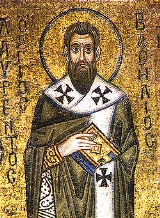
Basil of Caesarea

Encyclopedia
Basil of Caesarea, also called Saint Basil the Great, (330 – January 1, 379) was the bishop
of Caesarea Mazaca in Cappadocia
, Asia Minor
(modern-day Turkey
). He was an influential 4th century Christian
theologian. Theologically, Basil was a supporter of the Nicene
faction of the church, in opposition to Arianism
on one side and the followers of Apollinaris of Laodicea
on the other. His ability to balance his theological convictions with his political connections made Basil a powerful advocate for the Nicene position.
In addition to his work as a theologian, Basil was known for his care of the poor and underprivileged. Basil established guidelines for monastic life which focus on community life, liturgical prayer, and manual labor. Together with Pachomius
he is remembered as a father of communal monasticism in Eastern Christianity. He is considered a saint
by the traditions of both Eastern
and Western Christianity
.
Basil, Gregory of Nazianzus
, and Gregory of Nyssa
are collectively referred to as the Cappadocian Fathers
. The Eastern Orthodox Church
and Eastern Catholic Churches have given him, together with Gregory of Nazianzus and John Chrysostom
, the title of Great Hierarch
. The Eastern Orthodox Church
and the Roman Catholic Church
have also named him a Doctor of the Church
. He is also referred to as "the revealer of heavenly mysteries" (Ouranophantor).
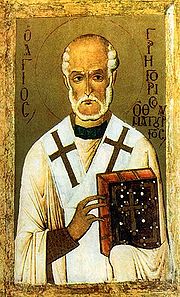 St. Basil was born into the wealthy family of Basil the Elder
, a famous rhetor, and Emmelia of Caesarea around 330 in Caesarea Mazaca in Cappadocia
(now known as Kayseri
, Turkey
). It was a large household, consisting of ten children, the parents, and Basil's grandmother, Macrina the Elder. His parents were known for their piety, and his maternal grandfather was a Christian martyr
, executed in the years prior to Constantine I
's conversion. Four of Basil's siblings are known by name, and considered to be saints by various Christian traditions. His older sister Macrina the Younger was a well-known nun
. His younger brother Peter
served as bishop of Sebaste
in Armenia, and wrote a few well-known theological treatises. His brother Naucratius
was an anchorite
, and inspired much of Basil's theological work. Perhaps the most influential of Basil's siblings was his younger brother Gregory
. Gregory was appointed by Basil to be the bishop of Nyssa
, and he produced a number of writings defending Nicene theology and describing the life of early Christian monastics.
Shortly after Basil's birth, the family moved to the estate of his grandmother Macrina, in the region of Pontus
. There, Basil was educated in the home by his father and grandmother. He was greatly influenced by the elder Macrina, who herself was a student of Gregory Thaumaturgus
. Following the death of his father during his teenage years, Basil returned to Caesarea in Cappadocia around 350-51 to begin his formal education. There he met Gregory of Nazianzus
, who would become a lifetime friend. Together, Basil and Gregory went on to study in Constantinople
, where they would have listened to the lectures of Libanius
. Finally, the two spent almost six years in Athens
starting around 349, where they met a fellow student who would become the emperor Julian the Apostate
. It was at Athens that he began to first think about living a life focused on Christian principles.
Returning from Athens around 355, Basil briefly practiced law and taught rhetoric in Caesarea. A year later, Basil's life would change radically after he encountered Eustathius of Sebaste
, a charismatic bishop and ascetic.
Basil soon abandoned his legal and teaching professions in order to devote his life to God. Describing his spiritual awakening in a letter, Basil said:
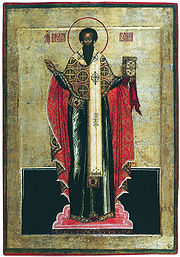 After receiving the sacrament of baptism, Basil traveled in 357 to Palestine, Egypt, Syria and Mesopotamia to study ascetics and monasticism. While impressed by the piety of the ascetics, the ideal of solitary life held little appeal to him. Rather, he turned his attention toward communal religious life. After dividing his fortunes among the poor he went briefly into solitude near Neocaesaria on the Iris. Basil soon ventured out of this solitude, and by 358 he was gathering around him a group of like-minded disciples
, including his brother Peter. Together they founded a monastic settlement on his family estate at Arnesi in Pontus. Joining him there were his mother Emmelia, then widowed, his sister Macrina and several other women, gave themselves to a pious life of prayer and charitable works. Eustathius of Sebaste
had already labored in Pontus in behalf of the anchoretic life, and Basil revered him on that account, although they differed over dogma
tic points, which gradually separated the two.
It was here that Basil wrote his works regarding monastic communal life, which are accounted as being pivotal in the development of the monastic tradition of the Eastern Church and have led to his being called the "father of Eastern communal monasticism". In 358 he wrote to his friend, Gregory of Nazianzus, asking Gregory to join him in Arnesi. Gregory eventually agreed to come; together, they collaborated on the production of the Philocalia
, an anthology drawn from Origen
. Gregory then decided to return to his family in Nazianzus.
Basil attended the Council of Constantinople
in 360. It was here that he first sided with the Homoiousian
s, a semi-Arian faction who taught that the Son was of like substance with the Father, neither the same (one substance) nor different from him. Its members included Eustathius, Basil's mentor in asceticism. The Homoiousians opposed the Arianism of Eunomius but refused to join with the supporters of the Nicene Creed
, who professed that the members of the Trinity were of one substance ("homoousios"). This stance put him at odds with his bishop, Dianius of Caesarea, who had subscribed only to the earlier Nicene form of agreement. Some years later Basil abandoned the Homoiousians, emerging instead as a supporter of the Nicene Creed.
 In 362 Basil was ordained a deacon
by Bishop Meletius of Antioch
. He was summoned by Eusebius to his city, and was ordained presbyter
of the Church there in 365. His ordination was probably the result of the entreaties of his ecclesiastical superiors, who wished to use his talents against the Arians, who were numerous in that part of the country and were favored by the Arian emperor, Valens
, who then reigned in Constantinople
.
Basil and Gregory Nazianzus spent the next few years combating the Arian heresy
, which threatened to divide the region of Cappadocia. The two friends then entered a period of close fraternal cooperation as they participated in a great rhetorical contest of the Caesarean church precipitated by the arrival of accomplished Arian theologians and rhetors. In the subsequent public debates, presided over by agents of Valens
, Gregory and Basil emerged triumphant. This success confirmed for both Gregory and Basil that their futures lay in administration of the church. Basil next took on functional administration of the Diocese
of Caesarea. Eusebius is reported as becoming jealous of the reputation and influence which Basil quickly developed, and allowed Basil to return to his earlier solitude. Later, however, Gregory persuaded Basil to return. Basil did so, and became the effective manager of the diocese for several years, while giving all the credit to Eusebius.
In 370, Eusebius died, and Basil was chosen to succeed him, and was consecrated bishop on June 14, 370. His new post as bishop of Caesarea also gave him the powers of exarch
of Pontus and metropolitan
of five suffragan bishop
s, many of whom had opposed him in the election for Eusebius's successor. It was then that his great powers were called into action. Hot-blooded and somewhat imperious, Basil was also generous and sympathetic. He personally organized a soup kitchen
and distributed food to the poor during a famine following a drought. He gave away his personal family inheritance to benefit the poor of his diocese.
His letters show that he actively worked to reform thieves and prostitutes. They also show him encouraging his clergy not to be tempted by wealth or the comparatively easy life of a priest, and that he personally took care in selecting worthy candidates for holy orders
. He also had the courage to criticize public officials who failed in their duty of administering justice. At the same time, he preached every morning and evening in his own church to large congregations. In addition to all the above, he built a large complex just outside Caesarea, called the Basiliad, which included a poorhouse, hospice, and hospital, and was regarded at the time as one of the wonders of the world.
His zeal for orthodoxy
did not blind him to what was good in an opponent; and for the sake of peace and charity he was content to waive the use of orthodox terminology when it could be surrendered without a sacrifice of truth. The Emperor Valens
, who was an adherent of the Arian philosophy, sent his prefect
Modestus to at least agree to a compromise with the Arian faction. Basil's adamant negative response prompted Modestus to say that no one had ever spoken to him in that way before. Basil replied, "Perhaps you have never yet had to deal with a bishop." Modestus reported back to Valens that he believed nothing short of violence would avail against Basil. Valens was apparently unwilling to engage in violence. He did however issue orders banishing Basil repeatedly, none of which succeeded. Valens came himself to attend when Basil celebrated the Divine Liturgy
on the Feast of the Theophany
(Epiphany), and at that time was so impressed by Basil that he donated to him some land for the building of the Basiliad. This interaction helped to define the limits of governmental power over the church.
Basil then had to face the growing spread of Arianism
. This belief system, which denied that Christ was consubstantial
with the Father, was quickly gaining adherents and was seen by many, particularly those in Alexandria most familiar with it, as posing a threat to the unity of the church. Basil entered into connections with the West, and with the help of Athanasius, he tried to overcome its distrustful attitude toward the Homoiousians. The difficulties had been enhanced by bringing in the question as to the essence of the Holy Spirit
. Although Basil advocated objectively the consubstantiality
of the Holy Spirit
with the Father
and the Son
, he belonged to those, who, faithful to Eastern tradition, would not allow the predicate homoousios to the former; for this he was reproached as early as 371 by the Orthodox zealots among the monks, and Athanasius defended him. He maintained a relationship with Eustathius
despite dogmatic differences. On the other hand, Basil was grievously offended by the extreme adherents of Homoousian
ism, who seemed to him to be reviving the Sabellian
heresy.
Basil corresponded with Pope Damasus in the hope of having the Roman bishop condemn heresy
wherever found, both East
and West
. The Pope
's apparent indifference upset Basil's zeal and he turned around in distress and sadness. It is still a point of controversy over how much he believed the Roman See
could do for the Churches in the East, as many Roman Catholic theologians claim the primacy of the Roman bishopric over the rest of the Churches, both in doctrine and in authoritative strength.
He did not live to see the end of the factional disturbances and the complete success of his continued exertions in behalf of the Church. He suffered from liver illness and his excessive asceticism seems to have hastened him to an early death. A lasting monument of his episcopal care for the poor was the great institute before the gates of Caesarea, which was used as poorhouse, hospital, and hospice.
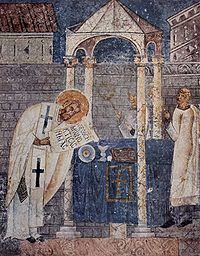 The principal theological writings of Basil are his On the Holy Spirit, a lucid and edifying appeal to Scripture and early Christian tradition (to prove the divinity of the Holy Spirit), and his Refutation of the Apology of the Impious Eunomius, written in 363 or 364, three books against Eunomius of Cyzicus
, the chief exponent of Anomoian Arianism. The first three books of the Refutation are his work; the fourth and fifth books that are usually included do not belong to Basil, or to Apollinaris of Laodicea
, but probably to Didymus "the Blind" of Alexandria
.
He was a famous preacher, and many of his homilies, including a series of Lenten
lectures on the Hexaëmeron
(the Six Days of Creation), and an exposition of the psalter
, have been preserved. Some, like that against usury and that on the famine in 368, are valuable for the history of morals; others illustrate the honor paid to martyrs and relic
s; the address to young men on the study
of classical literature shows that Basil was lastingly influenced by his own education, which taught him to appreciate the propaedeutic
importance of the classics.
In his exegesis
Basil was a great admirer of Origen
and the need for the spiritual interpretation of Scripture, as his co-editorship of the Philokalia
with Gregory of Nazianzen testifies. In his work on the Holy Spirit
, he asserts that "to take the literal sense and stop there, is to have the heart covered by the veil of Jewish literalism. Lamps are useless when the sun is shining." He frequently stresses the need for Reserve in doctrinal and sacramental matters. At the same time he was against the wild allegories of some contemporaries. Concerning this, he wrote:
His ascetic tendencies are exhibited in the Moralia and Asketika (sometimes mistranslated as Rules of St. Basil), ethical manuals for use in the world and the cloister, respectively. Of the two works known as the Greater Asketikon and the Lesser Asketikon, the shorter is the one most probably his work.
It is in the ethical manuals and moral sermons that the practical aspects of his theoretical theology are illustrated. So, for example, it is in his Sermon to the Lazicans that we find St. Basil explaining how it is our common nature that obliges us to treat our neighbor's natural needs (e.g., hunger, thirst) as our own, even though he is a separate individual. Later theologians explicitly explain this as an example of how the saints become an image of the one common nature of the persons of the Trinity.
His three hundred letters reveal a rich and observant nature, which, despite the troubles of ill-health and ecclesiastical unrest, remained optimistic, tender and even playful. His principal efforts as a reformer were directed towards the improvement of the liturgy, and the reformation of the monastic institutions of the East.
Most of his extant works, and a few spuriously attributed to him, are available in the Patrologia Graeca
, which includes Latin translations of varying quality. Several of St. Basil's works have appeared in the late twentieth century in the Sources Chrétiennes
collection.
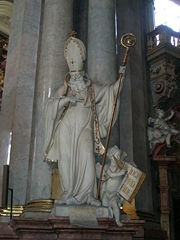
, coming as he did at the end of the age of persecution
. Basil's liturgical influence is well attested in early sources. Though it is difficult at this time to know exactly which parts of the Divine Liturgies which bear his name are actually his work, a vast corpus of prayers attributed to him has survived in the various Eastern Christian churches. Tradition also credits Basil with the elevation of the iconostasis
to its present height.
Most of the liturgies
bearing the name of Basil are not entirely his work in their present form, but they nevertheless preserve a recollection of Basil's activity in this field in formularizing liturgical prayers and promoting church-song. Patristics scholars conclude that the Liturgy of Saint Basil "bears, unmistakably, the personal hand, pen, mind and heart of St. Basil the Great."
One liturgy that can be attributed to him is The Divine Liturgy of Saint Basil the Great, a liturgy that is somewhat longer than the more commonly used Divine Liturgy of St. John Chrysostom
. The difference between the two is primarily in the silent prayers said by the priest, and in the use of the hymn to the Theotokos
, All of Creation, instead of the Axion Estin
of Saint John Chrysostom's Liturgy. Chrysostom's Liturgy has come to replace Saint Basil's on most days in the Eastern Orthodox and Byzantine Catholic liturgical traditions. However, they still use Saint Basil's Liturgy on certain feast days: the first five Sundays of Great Lent
; the Eve
s of Nativity
and Theophany
; and on Great and Holy Thursday and Holy Saturday
; and the Feast of Saint Basil, January 1 (for those churches which follow the Julian Calendar
, their January 1 falls on January 14 of the Gregorian Calendar
).
The Eastern Churches preserve numerous other prayers attributed to Saint Basil, including three Prayers of Exorcism
, several Morning and Evening Prayers, the "Prayer of the Hours" which is read at each service of the Daily Office, and the "Kneeling Prayers" which are recited by the priest at Vespers
on Pentecost
in the Byzantine Rite
.
Basil is remembered as one of the most influential figures in the development of Christian monasticism. Not only is Basil recognised as the father of Eastern monasticism; historians recognize that his legacy extends also to the Western church, largely due to his influence on Saint Benedict. Patristic scholars such as Meredith assert that Benedict himself recognized this when he wrote in the epilogue to his Rule that his monks, in addition to the Bible, should read "the confessions of the Fathers and their institutes and their lives and the Rule of our Holy Father, Basil.
Basil's teachings on monasticism, as encoded in works such as his Small Asketikon, was transmitted to the west via Rufinus
during the last 4th century.
As a result of his influence, numerous religious orders in Eastern Christianity bear his name. In the Roman Catholic Church, the Basilian Fathers, also known as The Congregation of St. Basil, an international order of priests and students studying for the priesthood, is named after him.
for his contributions to the debate initiated by the Arian controversy regarding the nature of the Trinity, and especially the question of the divinity of the Holy Spirit
. Basil was responsible for defining the terms "ousia
" (essence/substance) and "hypostasis
" (person/reality), and for defining the classic formulation of three Persons in one Nature. His single greatest contribution was his insistence on the divinity and consubstantiality of the Holy Spirit with the Father and the Son.
In Greek
tradition, his name was given to Father Christmas
and he is supposed to visit children and give presents every January 1 (St Basil's Day) — unlike other traditions where Saint Nicholas
arrives either on December 6 (Saint Nicholas Day) or on Christmas Eve
(December 24). It is traditional on St Basil's Day to serve "Vasilopita
", a rich bread baked with a coin inside. It is customary on his feast day to visit the homes of friends and relatives, to sing New Year carols, and to set an extra place at the table for Saint Basil. In Greek tradition and according to historical records, St Basil, of Greek heritage, is the original "Father Christmas
", who being born into a wealthy family, gave away all his possessions to the poor and those in need, the underprivileged and children. A similar story exists for another Greek bishop, St. Nicholas of Myra. Over the centuries the two have been merged but the Western "Santa Claus" is St. Nicholas and the Eastern "Santa Claus" is St. Basil.
Saint Basil died on January 1, and the Eastern Orthodox Church
celebrates his feast day together with that of the Feast of the Circumcision on that day. This was also the day on which the Roman Catholic calendar of saints
celebrated it at first; but in the 13th century it was moved to June 14, a date believed to be that of his ordination
as Bishop
, and it remained on that date until the 1969 revision of the calendar, which moved it to January 2, rather than January 1, because the latter date is occuped by the Solemnity of Mary, Mother of God. On January 2 Saint Basil is celebrated together with Saint Gregory Nazianzen. Some traditionalist Catholics continue to observe pre-1970 calendars.
The Anglican Church celebrates Saint Basil's feast on January 2, but the Episcopal Church
celebrates it on June 14.
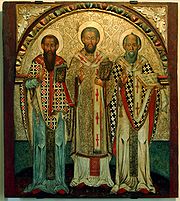
In the Byzantine Rite
, January 30 is the Synaxis
of the Three Holy Hierarchs
, in honor of Saint Basil, Saint Gregory the Theologian and Saint John Chrysostom
.
The Coptic Orthodox Church of Alexandria
celebrates the feast day of Saint Basil on the 6th of Tobi
(6th of Terr on the Ethiopian calendar
of the Ethiopian Orthodox Tewahedo Church
). At present, this corresponds to January 14, January 15 during leap year
.
There are numerous relic
s of Saint Basil throughout the world. One of the most important is his head, which is preserved to this day at the monastery of the Great Lavra
on Mount Athos
in Greece
. The mythical sword Durandal is said to contain some of Basil's blood.
Bishop
A bishop is an ordained or consecrated member of the Christian clergy who is generally entrusted with a position of authority and oversight. Within the Catholic Church, Eastern Orthodox, Oriental Orthodox Churches, in the Assyrian Church of the East, in the Independent Catholic Churches, and in the...
of Caesarea Mazaca in Cappadocia
Cappadocia
Cappadocia is a historical region in Central Anatolia, largely in Nevşehir Province.In the time of Herodotus, the Cappadocians were reported as occupying the whole region from Mount Taurus to the vicinity of the Euxine...
, Asia Minor
Asia Minor
Asia Minor is a geographical location at the westernmost protrusion of Asia, also called Anatolia, and corresponds to the western two thirds of the Asian part of Turkey...
(modern-day Turkey
Turkey
Turkey , known officially as the Republic of Turkey , is a Eurasian country located in Western Asia and in East Thrace in Southeastern Europe...
). He was an influential 4th century Christian
Christian
A Christian is a person who adheres to Christianity, an Abrahamic, monotheistic religion based on the life and teachings of Jesus of Nazareth as recorded in the Canonical gospels and the letters of the New Testament...
theologian. Theologically, Basil was a supporter of the Nicene
First Council of Nicaea
The First Council of Nicaea was a council of Christian bishops convened in Nicaea in Bithynia by the Roman Emperor Constantine I in AD 325...
faction of the church, in opposition to Arianism
Arianism
Arianism is the theological teaching attributed to Arius , a Christian presbyter from Alexandria, Egypt, concerning the relationship of the entities of the Trinity and the precise nature of the Son of God as being a subordinate entity to God the Father...
on one side and the followers of Apollinaris of Laodicea
Apollinaris of Laodicea
Apollinaris "the Younger" was a bishop of Laodicea in Syria. He collaborated with his father Apollinaris the Elder in reproducing the Old Testament in the form of Homeric and Pindaric poetry, and the New Testament after the fashion of Platonic dialogues, when the emperor Julian had forbidden...
on the other. His ability to balance his theological convictions with his political connections made Basil a powerful advocate for the Nicene position.
In addition to his work as a theologian, Basil was known for his care of the poor and underprivileged. Basil established guidelines for monastic life which focus on community life, liturgical prayer, and manual labor. Together with Pachomius
Pachomius
Saint Pakhom , also known as Pachome and Pakhomius , is generally recognized as the founder of Christian cenobitic monasticism. In the Coptic churches his feast day is celebrated on May 9...
he is remembered as a father of communal monasticism in Eastern Christianity. He is considered a saint
Saint
A saint is a holy person. In various religions, saints are people who are believed to have exceptional holiness.In Christian usage, "saint" refers to any believer who is "in Christ", and in whom Christ dwells, whether in heaven or in earth...
by the traditions of both Eastern
Eastern Christianity
Eastern Christianity comprises the Christian traditions and churches that developed in the Balkans, Eastern Europe, Asia Minor, the Middle East, Northeastern Africa, India and parts of the Far East over several centuries of religious antiquity. The term is generally used in Western Christianity to...
and Western Christianity
Western Christianity
Western Christianity is a term used to include the Latin Rite of the Catholic Church and groups historically derivative thereof, including the churches of the Anglican and Protestant traditions, which share common attributes that can be traced back to their medieval heritage...
.
Basil, Gregory of Nazianzus
Gregory of Nazianzus
Gregory of Nazianzus was a 4th-century Archbishop of Constantinople. He is widely considered the most accomplished rhetorical stylist of the patristic age...
, and Gregory of Nyssa
Gregory of Nyssa
St. Gregory of Nyssa was a Christian bishop and saint. He was a younger brother of Basil the Great and a good friend of Gregory of Nazianzus. His significance has long been recognized in the Eastern Orthodox, Oriental Orthodox, Eastern Catholic and Roman Catholic branches of Christianity...
are collectively referred to as the Cappadocian Fathers
Cappadocian Fathers
The Cappadocian Fathers are Basil the Great , who was bishop of Caesarea; Basil's brother Gregory of Nyssa , who was bishop of Nyssa; and a close friend, Gregory of Nazianzus , who became Patriarch of Constantinople...
. The Eastern Orthodox Church
Eastern Orthodox Church
The Orthodox Church, officially called the Orthodox Catholic Church and commonly referred to as the Eastern Orthodox Church, is the second largest Christian denomination in the world, with an estimated 300 million adherents mainly in the countries of Belarus, Bulgaria, Cyprus, Georgia, Greece,...
and Eastern Catholic Churches have given him, together with Gregory of Nazianzus and John Chrysostom
John Chrysostom
John Chrysostom , Archbishop of Constantinople, was an important Early Church Father. He is known for his eloquence in preaching and public speaking, his denunciation of abuse of authority by both ecclesiastical and political leaders, the Divine Liturgy of St. John Chrysostom, and his ascetic...
, the title of Great Hierarch
Three Holy Hierarchs
The Three Holy Hierarchs of Eastern Christianity refers to Basil the Great , Gregory the Theologian and John Chrysostom. They were highly influential bishops of the early church who played pivotal roles in shaping Christian theology...
. The Eastern Orthodox Church
Eastern Orthodox Church
The Orthodox Church, officially called the Orthodox Catholic Church and commonly referred to as the Eastern Orthodox Church, is the second largest Christian denomination in the world, with an estimated 300 million adherents mainly in the countries of Belarus, Bulgaria, Cyprus, Georgia, Greece,...
and the Roman Catholic Church
Roman Catholic Church
The Catholic Church, also known as the Roman Catholic Church, is the world's largest Christian church, with over a billion members. Led by the Pope, it defines its mission as spreading the gospel of Jesus Christ, administering the sacraments and exercising charity...
have also named him a Doctor of the Church
Doctor of the Church
Doctor of the Church is a title given by a variety of Christian churches to individuals whom they recognize as having been of particular importance, particularly regarding their contribution to theology or doctrine.-Catholic Church:In the Catholic Church, this name is given to a saint from whose...
. He is also referred to as "the revealer of heavenly mysteries" (Ouranophantor).
Early life and education
Basil the Elder
Saint Basil the Elder raised in Neocaesarea in Pontus. The son of Macrina the Elder, Basil is said to have moved with the family to the shores of the Black Sea during the persecution of Christians under Galerius. He married into the wealthy family of his wife Emmelia, and settled in Caesarea...
, a famous rhetor, and Emmelia of Caesarea around 330 in Caesarea Mazaca in Cappadocia
Cappadocia
Cappadocia is a historical region in Central Anatolia, largely in Nevşehir Province.In the time of Herodotus, the Cappadocians were reported as occupying the whole region from Mount Taurus to the vicinity of the Euxine...
(now known as Kayseri
Kayseri
Kayseri is a large and industrialized city in Central Anatolia, Turkey. It is the seat of Kayseri Province. The city of Kayseri, as defined by the boundaries of Kayseri Metropolitan Municipality, is structurally composed of five metropolitan districts, the two core districts of Kocasinan and...
, Turkey
Turkey
Turkey , known officially as the Republic of Turkey , is a Eurasian country located in Western Asia and in East Thrace in Southeastern Europe...
). It was a large household, consisting of ten children, the parents, and Basil's grandmother, Macrina the Elder. His parents were known for their piety, and his maternal grandfather was a Christian martyr
Martyr
A martyr is somebody who suffers persecution and death for refusing to renounce, or accept, a belief or cause, usually religious.-Meaning:...
, executed in the years prior to Constantine I
Constantine I
Constantine the Great , also known as Constantine I or Saint Constantine, was Roman Emperor from 306 to 337. Well known for being the first Roman emperor to convert to Christianity, Constantine and co-Emperor Licinius issued the Edict of Milan in 313, which proclaimed religious tolerance of all...
's conversion. Four of Basil's siblings are known by name, and considered to be saints by various Christian traditions. His older sister Macrina the Younger was a well-known nun
Nun
A nun is a woman who has taken vows committing her to live a spiritual life. She may be an ascetic who voluntarily chooses to leave mainstream society and live her life in prayer and contemplation in a monastery or convent...
. His younger brother Peter
Peter of Sebaste
Peter of Sebaste was a bishop, taking his usual name from the city of his bishopry, Sebaste in Armenia.Also known as Peter of Sebasteia....
served as bishop of Sebaste
Sebaste
Sebaste was a common placename in classical Antiquity. Sebaste was the Greek equivalent of the Latin Augusta. Ancient towns by the name sought to honor Augustus or a later Roman emperor.- Places :* Elaiussa Sebaste in Mersin Province, Turkey...
in Armenia, and wrote a few well-known theological treatises. His brother Naucratius
Naucratius
Saint Naucratius was the son of Basil the Elder and Emmelia of Caesarea. He had distinguished himself both in scholarship and Christian devotion, as an active hermit, a living example for his famous brothers, Basil and Gregory of Nyssa.-Life:...
was an anchorite
Anchorite
Anchorite denotes someone who, for religious reasons, withdraws from secular society so as to be able to lead an intensely prayer-oriented, ascetic, and—circumstances permitting—Eucharist-focused life...
, and inspired much of Basil's theological work. Perhaps the most influential of Basil's siblings was his younger brother Gregory
Gregory of Nyssa
St. Gregory of Nyssa was a Christian bishop and saint. He was a younger brother of Basil the Great and a good friend of Gregory of Nazianzus. His significance has long been recognized in the Eastern Orthodox, Oriental Orthodox, Eastern Catholic and Roman Catholic branches of Christianity...
. Gregory was appointed by Basil to be the bishop of Nyssa
Nyssa
Nyssa may refer to:* the genus name for the tupelo tree* Nyssa , a female name** Nyssa , a companion of the Fourth and Fifth Doctors in the long-running British science fiction series Doctor Who...
, and he produced a number of writings defending Nicene theology and describing the life of early Christian monastics.
Shortly after Basil's birth, the family moved to the estate of his grandmother Macrina, in the region of Pontus
Pontus
Pontus or Pontos is a historical Greek designation for a region on the southern coast of the Black Sea, located in modern-day northeastern Turkey. The name was applied to the coastal region in antiquity by the Greeks who colonized the area, and derived from the Greek name of the Black Sea: Πόντος...
. There, Basil was educated in the home by his father and grandmother. He was greatly influenced by the elder Macrina, who herself was a student of Gregory Thaumaturgus
Gregory Thaumaturgus
Gregory Thaumaturgus, also known as Gregory of Neocaesarea or Gregory the Wonderworker, was a Christian bishop of the 3rd century.-Biography:Gregory was born at Neo-Caesarea around 213 A.D...
. Following the death of his father during his teenage years, Basil returned to Caesarea in Cappadocia around 350-51 to begin his formal education. There he met Gregory of Nazianzus
Gregory of Nazianzus
Gregory of Nazianzus was a 4th-century Archbishop of Constantinople. He is widely considered the most accomplished rhetorical stylist of the patristic age...
, who would become a lifetime friend. Together, Basil and Gregory went on to study in Constantinople
Constantinople
Constantinople was the capital of the Roman, Eastern Roman, Byzantine, Latin, and Ottoman Empires. Throughout most of the Middle Ages, Constantinople was Europe's largest and wealthiest city.-Names:...
, where they would have listened to the lectures of Libanius
Libanius
Libanius was a Greek-speaking teacher of rhetoric of the Sophist school. During the rise of Christian hegemony in the later Roman Empire, he remained unconverted and regarded himself as a Hellene in religious matters.-Life:...
. Finally, the two spent almost six years in Athens
Athens
Athens , is the capital and largest city of Greece. Athens dominates the Attica region and is one of the world's oldest cities, as its recorded history spans around 3,400 years. Classical Athens was a powerful city-state...
starting around 349, where they met a fellow student who would become the emperor Julian the Apostate
Julian the Apostate
Julian "the Apostate" , commonly known as Julian, or also Julian the Philosopher, was Roman Emperor from 361 to 363 and a noted philosopher and Greek writer....
. It was at Athens that he began to first think about living a life focused on Christian principles.
Returning from Athens around 355, Basil briefly practiced law and taught rhetoric in Caesarea. A year later, Basil's life would change radically after he encountered Eustathius of Sebaste
Eustathius of Sebaste
Eustathius, was bishop of Sebastia in Armenia. Together with Basil of Ancyra, he was the author of the sect of the Macedonians....
, a charismatic bishop and ascetic.
Basil soon abandoned his legal and teaching professions in order to devote his life to God. Describing his spiritual awakening in a letter, Basil said:
Arnesi
Disciple (Christianity)
In Christianity, the disciples were the students of Jesus during his ministry. While Jesus attracted a large following, the term disciple is commonly used to refer specifically to "the Twelve", an inner circle of men whose number perhaps represented the twelve tribes of Israel...
, including his brother Peter. Together they founded a monastic settlement on his family estate at Arnesi in Pontus. Joining him there were his mother Emmelia, then widowed, his sister Macrina and several other women, gave themselves to a pious life of prayer and charitable works. Eustathius of Sebaste
Eustathius of Sebaste
Eustathius, was bishop of Sebastia in Armenia. Together with Basil of Ancyra, he was the author of the sect of the Macedonians....
had already labored in Pontus in behalf of the anchoretic life, and Basil revered him on that account, although they differed over dogma
Dogma
Dogma is the established belief or doctrine held by a religion, or a particular group or organization. It is authoritative and not to be disputed, doubted, or diverged from, by the practitioners or believers...
tic points, which gradually separated the two.
It was here that Basil wrote his works regarding monastic communal life, which are accounted as being pivotal in the development of the monastic tradition of the Eastern Church and have led to his being called the "father of Eastern communal monasticism". In 358 he wrote to his friend, Gregory of Nazianzus, asking Gregory to join him in Arnesi. Gregory eventually agreed to come; together, they collaborated on the production of the Philocalia
Philocalia
The Philocalia may mean:* Origen's Philocalia compiled by Basil the Great and Gregory Nazianzen.* The Philokalia, a medieval compilation of sayings of the Fathers of the Church....
, an anthology drawn from Origen
Origen
Origen , or Origen Adamantius, 184/5–253/4, was an early Christian Alexandrian scholar and theologian, and one of the most distinguished writers of the early Church. As early as the fourth century, his orthodoxy was suspect, in part because he believed in the pre-existence of souls...
. Gregory then decided to return to his family in Nazianzus.
Basil attended the Council of Constantinople
First Council of Constantinople (360)
In 359, the Roman Emperor Constantius II requested a church council, at Constantinople, of both the eastern and western bishops, to resolve the split at the Council of Seleucia...
in 360. It was here that he first sided with the Homoiousian
Homoiousian
Homoiousianism was a 4th century AD movement which arose in the early period of the Christian religion out of a wing of Arianism...
s, a semi-Arian faction who taught that the Son was of like substance with the Father, neither the same (one substance) nor different from him. Its members included Eustathius, Basil's mentor in asceticism. The Homoiousians opposed the Arianism of Eunomius but refused to join with the supporters of the Nicene Creed
Nicene Creed
The Nicene Creed is the creed or profession of faith that is most widely used in Christian liturgy. It is called Nicene because, in its original form, it was adopted in the city of Nicaea by the first ecumenical council, which met there in the year 325.The Nicene Creed has been normative to the...
, who professed that the members of the Trinity were of one substance ("homoousios"). This stance put him at odds with his bishop, Dianius of Caesarea, who had subscribed only to the earlier Nicene form of agreement. Some years later Basil abandoned the Homoiousians, emerging instead as a supporter of the Nicene Creed.
Caesarea
Deacon
Deacon is a ministry in the Christian Church that is generally associated with service of some kind, but which varies among theological and denominational traditions...
by Bishop Meletius of Antioch
Meletius of Antioch
Saint Meletius of Antioch was a Christian bishop, or Patriarch of Antioch, from 360 until his death. There were contrasting view about his theological position: on the one hand, he was exiled three times under Arian emperors; on the other, he was strongly opposed by those faithful to the memory...
. He was summoned by Eusebius to his city, and was ordained presbyter
Presbyter
Presbyter in the New Testament refers to a leader in local Christian congregations, then a synonym of episkopos...
of the Church there in 365. His ordination was probably the result of the entreaties of his ecclesiastical superiors, who wished to use his talents against the Arians, who were numerous in that part of the country and were favored by the Arian emperor, Valens
Valens
Valens was the Eastern Roman Emperor from 364 to 378. He was given the eastern half of the empire by his brother Valentinian I after the latter's accession to the throne...
, who then reigned in Constantinople
Constantinople
Constantinople was the capital of the Roman, Eastern Roman, Byzantine, Latin, and Ottoman Empires. Throughout most of the Middle Ages, Constantinople was Europe's largest and wealthiest city.-Names:...
.
Basil and Gregory Nazianzus spent the next few years combating the Arian heresy
Arianism
Arianism is the theological teaching attributed to Arius , a Christian presbyter from Alexandria, Egypt, concerning the relationship of the entities of the Trinity and the precise nature of the Son of God as being a subordinate entity to God the Father...
, which threatened to divide the region of Cappadocia. The two friends then entered a period of close fraternal cooperation as they participated in a great rhetorical contest of the Caesarean church precipitated by the arrival of accomplished Arian theologians and rhetors. In the subsequent public debates, presided over by agents of Valens
Valens
Valens was the Eastern Roman Emperor from 364 to 378. He was given the eastern half of the empire by his brother Valentinian I after the latter's accession to the throne...
, Gregory and Basil emerged triumphant. This success confirmed for both Gregory and Basil that their futures lay in administration of the church. Basil next took on functional administration of the Diocese
Diocese
A diocese is the district or see under the supervision of a bishop. It is divided into parishes.An archdiocese is more significant than a diocese. An archdiocese is presided over by an archbishop whose see may have or had importance due to size or historical significance...
of Caesarea. Eusebius is reported as becoming jealous of the reputation and influence which Basil quickly developed, and allowed Basil to return to his earlier solitude. Later, however, Gregory persuaded Basil to return. Basil did so, and became the effective manager of the diocese for several years, while giving all the credit to Eusebius.
In 370, Eusebius died, and Basil was chosen to succeed him, and was consecrated bishop on June 14, 370. His new post as bishop of Caesarea also gave him the powers of exarch
Exarch
In the Byzantine Empire, an exarch was governor with extended authority of a province at some remove from the capital Constantinople. The prevailing situation frequently involved him in military operations....
of Pontus and metropolitan
Metropolitan bishop
In Christian churches with episcopal polity, the rank of metropolitan bishop, or simply metropolitan, pertains to the diocesan bishop or archbishop of a metropolis; that is, the chief city of a historical Roman province, ecclesiastical province, or regional capital.Before the establishment of...
of five suffragan bishop
Suffragan bishop
A suffragan bishop is a bishop subordinate to a metropolitan bishop or diocesan bishop. He or she may be assigned to an area which does not have a cathedral of its own.-Anglican Communion:...
s, many of whom had opposed him in the election for Eusebius's successor. It was then that his great powers were called into action. Hot-blooded and somewhat imperious, Basil was also generous and sympathetic. He personally organized a soup kitchen
Soup kitchen
A soup kitchen, a bread line, or a meal center is a place where food is offered to the hungry for free or at a reasonably low price. Frequently located in lower-income neighborhoods, they are often staffed by volunteer organizations, such as church groups or community groups...
and distributed food to the poor during a famine following a drought. He gave away his personal family inheritance to benefit the poor of his diocese.
His letters show that he actively worked to reform thieves and prostitutes. They also show him encouraging his clergy not to be tempted by wealth or the comparatively easy life of a priest, and that he personally took care in selecting worthy candidates for holy orders
Holy Orders
The term Holy Orders is used by many Christian churches to refer to ordination or to those individuals ordained for a special role or ministry....
. He also had the courage to criticize public officials who failed in their duty of administering justice. At the same time, he preached every morning and evening in his own church to large congregations. In addition to all the above, he built a large complex just outside Caesarea, called the Basiliad, which included a poorhouse, hospice, and hospital, and was regarded at the time as one of the wonders of the world.
His zeal for orthodoxy
Orthodoxy
The word orthodox, from Greek orthos + doxa , is generally used to mean the adherence to accepted norms, more specifically to creeds, especially in religion...
did not blind him to what was good in an opponent; and for the sake of peace and charity he was content to waive the use of orthodox terminology when it could be surrendered without a sacrifice of truth. The Emperor Valens
Valens
Valens was the Eastern Roman Emperor from 364 to 378. He was given the eastern half of the empire by his brother Valentinian I after the latter's accession to the throne...
, who was an adherent of the Arian philosophy, sent his prefect
Prefect
Prefect is a magisterial title of varying definition....
Modestus to at least agree to a compromise with the Arian faction. Basil's adamant negative response prompted Modestus to say that no one had ever spoken to him in that way before. Basil replied, "Perhaps you have never yet had to deal with a bishop." Modestus reported back to Valens that he believed nothing short of violence would avail against Basil. Valens was apparently unwilling to engage in violence. He did however issue orders banishing Basil repeatedly, none of which succeeded. Valens came himself to attend when Basil celebrated the Divine Liturgy
Divine Liturgy
Divine Liturgy is the common term for the Eucharistic service of the Byzantine tradition of Christian liturgy. As such, it is used in the Eastern Orthodox and Eastern Catholic Churches. Armenian Christians, both of the Armenian Apostolic Church and of the Armenian Catholic Church, use the same term...
on the Feast of the Theophany
Epiphany (Christian)
Epiphany, or Theophany, meaning "vision of God",...
(Epiphany), and at that time was so impressed by Basil that he donated to him some land for the building of the Basiliad. This interaction helped to define the limits of governmental power over the church.
Basil then had to face the growing spread of Arianism
Arianism
Arianism is the theological teaching attributed to Arius , a Christian presbyter from Alexandria, Egypt, concerning the relationship of the entities of the Trinity and the precise nature of the Son of God as being a subordinate entity to God the Father...
. This belief system, which denied that Christ was consubstantial
Consubstantiality
Consubstantial is an adjective used in Latin Christian christology, coined by Tertullian in Against Hermogenes 44, used to translate the Greek term homoousios...
with the Father, was quickly gaining adherents and was seen by many, particularly those in Alexandria most familiar with it, as posing a threat to the unity of the church. Basil entered into connections with the West, and with the help of Athanasius, he tried to overcome its distrustful attitude toward the Homoiousians. The difficulties had been enhanced by bringing in the question as to the essence of the Holy Spirit
Holy Spirit
Holy Spirit is a term introduced in English translations of the Hebrew Bible, but understood differently in the main Abrahamic religions.While the general concept of a "Spirit" that permeates the cosmos has been used in various religions Holy Spirit is a term introduced in English translations of...
. Although Basil advocated objectively the consubstantiality
Consubstantiality
Consubstantial is an adjective used in Latin Christian christology, coined by Tertullian in Against Hermogenes 44, used to translate the Greek term homoousios...
of the Holy Spirit
Holy Spirit
Holy Spirit is a term introduced in English translations of the Hebrew Bible, but understood differently in the main Abrahamic religions.While the general concept of a "Spirit" that permeates the cosmos has been used in various religions Holy Spirit is a term introduced in English translations of...
with the Father
God the Father
God the Father is a gendered title given to God in many monotheistic religions, particularly patriarchal, Abrahamic ones. In Judaism, God is called Father because he is the creator, life-giver, law-giver, and protector...
and the Son
God the Son
God the Son is the second person of the Trinity in Christian theology. The doctrine of the Trinity identifies Jesus of Nazareth as God the Son, united in essence but distinct in person with regard to God the Father and God the Holy Spirit...
, he belonged to those, who, faithful to Eastern tradition, would not allow the predicate homoousios to the former; for this he was reproached as early as 371 by the Orthodox zealots among the monks, and Athanasius defended him. He maintained a relationship with Eustathius
Eustathius
Eustathius or Eustathios may refer to:* Eustathius of Antioch, Patriarch of Antioch * Eustathius of Sebaste * Eustathius of Cappadocia Neoplatonist, orator, and diplomat...
despite dogmatic differences. On the other hand, Basil was grievously offended by the extreme adherents of Homoousian
Homoousian
Homoousian is a technical theological term used in discussion of the Christian understanding of God as Trinity. The Nicene Creed describes Jesus as being homooúsios with God the Father — that is, they are of the "same substance" and are equally God...
ism, who seemed to him to be reviving the Sabellian
Sabellianism
In Christianity, Sabellianism, is the nontrinitarian belief that the Heavenly Father, Resurrected Son and Holy Spirit are different modes or aspects of one God, as perceived by the believer, rather than three distinct persons in God Himself.The term Sabellianism comes from...
heresy.
Basil corresponded with Pope Damasus in the hope of having the Roman bishop condemn heresy
Heresy
Heresy is a controversial or novel change to a system of beliefs, especially a religion, that conflicts with established dogma. It is distinct from apostasy, which is the formal denunciation of one's religion, principles or cause, and blasphemy, which is irreverence toward religion...
wherever found, both East
East
East is a noun, adjective, or adverb indicating direction or geography.East is one of the four cardinal directions or compass points. It is the opposite of west and is perpendicular to north and south.By convention, the right side of a map is east....
and West
West
West is a noun, adjective, or adverb indicating direction or geography.West is one of the four cardinal directions or compass points. It is the opposite of east and is perpendicular to north and south.By convention, the left side of a map is west....
. The Pope
Pope
The Pope is the Bishop of Rome, a position that makes him the leader of the worldwide Catholic Church . In the Catholic Church, the Pope is regarded as the successor of Saint Peter, the Apostle...
's apparent indifference upset Basil's zeal and he turned around in distress and sadness. It is still a point of controversy over how much he believed the Roman See
Holy See
The Holy See is the episcopal jurisdiction of the Catholic Church in Rome, in which its Bishop is commonly known as the Pope. It is the preeminent episcopal see of the Catholic Church, forming the central government of the Church. As such, diplomatically, and in other spheres the Holy See acts and...
could do for the Churches in the East, as many Roman Catholic theologians claim the primacy of the Roman bishopric over the rest of the Churches, both in doctrine and in authoritative strength.
He did not live to see the end of the factional disturbances and the complete success of his continued exertions in behalf of the Church. He suffered from liver illness and his excessive asceticism seems to have hastened him to an early death. A lasting monument of his episcopal care for the poor was the great institute before the gates of Caesarea, which was used as poorhouse, hospital, and hospice.
Writings
Eunomius of Cyzicus
Eunomius , one of the leaders of the extreme or "anomoean" Arians, who are sometimes accordingly called Eunomians, was born at Dacora in Cappadocia early in the 4th century....
, the chief exponent of Anomoian Arianism. The first three books of the Refutation are his work; the fourth and fifth books that are usually included do not belong to Basil, or to Apollinaris of Laodicea
Apollinaris of Laodicea
Apollinaris "the Younger" was a bishop of Laodicea in Syria. He collaborated with his father Apollinaris the Elder in reproducing the Old Testament in the form of Homeric and Pindaric poetry, and the New Testament after the fashion of Platonic dialogues, when the emperor Julian had forbidden...
, but probably to Didymus "the Blind" of Alexandria
Didymus the Blind
Didymus the Blind was a Coptic Church theologian of Alexandria, whose famous Catechetical School he led for about half a century. He became blind at a very young age, and therefore ignorant of the rudiments of learning...
.
He was a famous preacher, and many of his homilies, including a series of Lenten
Great Lent
Great Lent, or the Great Fast, is the most important fasting season in the church year in Eastern Christianity, which prepares Christians for the greatest feast of the church year, Pascha . In many ways Great Lent is similar to Lent in Western Christianity...
lectures on the Hexaëmeron
Hexameron
The term Hexameron refers either to the genre of theological treatise that describes God's work on the six days of creation or to the six days of creation themselves. Most often these theological works take the form of commentaries on Genesis 1...
(the Six Days of Creation), and an exposition of the psalter
Psalter
A psalter is a volume containing the Book of Psalms, often with other devotional material bound in as well, such as a liturgical calendar and litany of the Saints. Until the later medieval emergence of the book of hours, psalters were the books most widely owned by wealthy lay persons and were...
, have been preserved. Some, like that against usury and that on the famine in 368, are valuable for the history of morals; others illustrate the honor paid to martyrs and relic
Relic
In religion, a relic is a part of the body of a saint or a venerated person, or else another type of ancient religious object, carefully preserved for purposes of veneration or as a tangible memorial...
s; the address to young men on the study
Address to Young Men on Greek Literature
Address to Young Men on Greek Literature is a text by Basil of Caesarea...
of classical literature shows that Basil was lastingly influenced by his own education, which taught him to appreciate the propaedeutic
Propaedeutics
Propaedeutics or propedeutics is a historical term for an introductory course into a discipline: art, science, etc. Etymology: pro- + Greek: paideutikós, "pertaining to teaching"....
importance of the classics.
In his exegesis
Exegesis
Exegesis is a critical explanation or interpretation of a text, especially a religious text. Traditionally the term was used primarily for exegesis of the Bible; however, in contemporary usage it has broadened to mean a critical explanation of any text, and the term "Biblical exegesis" is used...
Basil was a great admirer of Origen
Origen
Origen , or Origen Adamantius, 184/5–253/4, was an early Christian Alexandrian scholar and theologian, and one of the most distinguished writers of the early Church. As early as the fourth century, his orthodoxy was suspect, in part because he believed in the pre-existence of souls...
and the need for the spiritual interpretation of Scripture, as his co-editorship of the Philokalia
Philokalia
The Philokalia is a collection of texts written between the 4th and 15th centuries by spiritual masters of the Eastern Orthodox hesychast tradition. They were originally written for the guidance and instruction of monks in "the practise of the contemplative life". The collection was compiled in...
with Gregory of Nazianzen testifies. In his work on the Holy Spirit
Holy Spirit
Holy Spirit is a term introduced in English translations of the Hebrew Bible, but understood differently in the main Abrahamic religions.While the general concept of a "Spirit" that permeates the cosmos has been used in various religions Holy Spirit is a term introduced in English translations of...
, he asserts that "to take the literal sense and stop there, is to have the heart covered by the veil of Jewish literalism. Lamps are useless when the sun is shining." He frequently stresses the need for Reserve in doctrinal and sacramental matters. At the same time he was against the wild allegories of some contemporaries. Concerning this, he wrote:
"I know the laws of allegory, though less by myself than from the works of others. There are those, truly, who do not admit the common sense of the Scriptures, for whom water is not water, but some other nature, who see in a plant, in a fish, what their fancy wishes, who change the nature of reptiles and of wild beasts to suit their allegories, like the interpreters of dreams who explain visions in sleep to make them serve their own end."
His ascetic tendencies are exhibited in the Moralia and Asketika (sometimes mistranslated as Rules of St. Basil), ethical manuals for use in the world and the cloister, respectively. Of the two works known as the Greater Asketikon and the Lesser Asketikon, the shorter is the one most probably his work.
It is in the ethical manuals and moral sermons that the practical aspects of his theoretical theology are illustrated. So, for example, it is in his Sermon to the Lazicans that we find St. Basil explaining how it is our common nature that obliges us to treat our neighbor's natural needs (e.g., hunger, thirst) as our own, even though he is a separate individual. Later theologians explicitly explain this as an example of how the saints become an image of the one common nature of the persons of the Trinity.
His three hundred letters reveal a rich and observant nature, which, despite the troubles of ill-health and ecclesiastical unrest, remained optimistic, tender and even playful. His principal efforts as a reformer were directed towards the improvement of the liturgy, and the reformation of the monastic institutions of the East.
Most of his extant works, and a few spuriously attributed to him, are available in the Patrologia Graeca
Patrologia Graeca
The Patrologia Graeca is an edited collection of writings by the Christian Church Fathers and various secular writers, in the ancient Koine or medieval variants of the Greek language. It consists of 161 volumes produced in 1857–1866 by J. P. Migne's Imprimerie Catholique...
, which includes Latin translations of varying quality. Several of St. Basil's works have appeared in the late twentieth century in the Sources Chrétiennes
Sources chretiennes
Sources Chrétiennes is a bilingual collection of patristic texts founded in Lyon in 1942 by the Jesuits Jean Daniélou, Claude Mondésert, and Henri de Lubac....
collection.
Legacy
Liturgical contributions
St Basil of Caesarea holds a very important place in the history of Christian liturgyChristian liturgy
A liturgy is a set form of ceremony or pattern of worship. Christian liturgy is a pattern for worship used by a Christian congregation or denomination on a regular basis....
, coming as he did at the end of the age of persecution
Persecution
Persecution is the systematic mistreatment of an individual or group by another group. The most common forms are religious persecution, ethnic persecution, and political persecution, though there is naturally some overlap between these terms. The inflicting of suffering, harassment, isolation,...
. Basil's liturgical influence is well attested in early sources. Though it is difficult at this time to know exactly which parts of the Divine Liturgies which bear his name are actually his work, a vast corpus of prayers attributed to him has survived in the various Eastern Christian churches. Tradition also credits Basil with the elevation of the iconostasis
Iconostasis
In Eastern Christianity an iconostasis is a wall of icons and religious paintings, separating the nave from the sanctuary in a church. Iconostasis also refers to a portable icon stand that can be placed anywhere within a church...
to its present height.
Most of the liturgies
Liturgy
Liturgy is either the customary public worship done by a specific religious group, according to its particular traditions or a more precise term that distinguishes between those religious groups who believe their ritual requires the "people" to do the "work" of responding to the priest, and those...
bearing the name of Basil are not entirely his work in their present form, but they nevertheless preserve a recollection of Basil's activity in this field in formularizing liturgical prayers and promoting church-song. Patristics scholars conclude that the Liturgy of Saint Basil "bears, unmistakably, the personal hand, pen, mind and heart of St. Basil the Great."
One liturgy that can be attributed to him is The Divine Liturgy of Saint Basil the Great, a liturgy that is somewhat longer than the more commonly used Divine Liturgy of St. John Chrysostom
Divine Liturgy of St. John Chrysostom
The Divine Liturgy of Saint John Chrysostom is the most celebrated Divine Liturgy in the Byzantine Rite. It is named after the anaphora with the same name which is its core part and it is attributed to Saint John Chrysostom, Archbishop of Constantinople in the 5th century.It reflects the work of...
. The difference between the two is primarily in the silent prayers said by the priest, and in the use of the hymn to the Theotokos
Theotokos
Theotokos is the Greek title of Mary, the mother of Jesus used especially in the Eastern Orthodox, Oriental Orthodox, and Eastern Catholic Churches. Its literal English translations include God-bearer and the one who gives birth to God. Less literal translations include Mother of God...
, All of Creation, instead of the Axion Estin
Axion Estin
Axion estin , or It is Truly Meet, is a theotokion, i.e. a Hymn to Mary , which is chanted in the Divine Services of the Eastern Orthodox and Eastern Catholic Churches...
of Saint John Chrysostom's Liturgy. Chrysostom's Liturgy has come to replace Saint Basil's on most days in the Eastern Orthodox and Byzantine Catholic liturgical traditions. However, they still use Saint Basil's Liturgy on certain feast days: the first five Sundays of Great Lent
Great Lent
Great Lent, or the Great Fast, is the most important fasting season in the church year in Eastern Christianity, which prepares Christians for the greatest feast of the church year, Pascha . In many ways Great Lent is similar to Lent in Western Christianity...
; the Eve
Eve
Eve is the first woman created by God in the Book of Genesis.Eve may also refer to:-People:*Eve , a common given name and surname*Eve , American recording artist and actress-Places:...
s of Nativity
Christmas
Christmas or Christmas Day is an annual holiday generally celebrated on December 25 by billions of people around the world. It is a Christian feast that commemorates the birth of Jesus Christ, liturgically closing the Advent season and initiating the season of Christmastide, which lasts twelve days...
and Theophany
Theophany
Theophany, from the Ancient Greek , meaning "appearance of God"), refers to the appearance of a deity to a human or other being, or to a divine disclosure....
; and on Great and Holy Thursday and Holy Saturday
Holy Saturday
Holy Saturday , sometimes known as Easter Eve or Black Saturday, is the day after Good Friday. It is the day before Easter and the last day of Holy Week in which Christians prepare for Easter...
; and the Feast of Saint Basil, January 1 (for those churches which follow the Julian Calendar
Julian calendar
The Julian calendar began in 45 BC as a reform of the Roman calendar by Julius Caesar. It was chosen after consultation with the astronomer Sosigenes of Alexandria and was probably designed to approximate the tropical year .The Julian calendar has a regular year of 365 days divided into 12 months...
, their January 1 falls on January 14 of the Gregorian Calendar
Gregorian calendar
The Gregorian calendar, also known as the Western calendar, or Christian calendar, is the internationally accepted civil calendar. It was introduced by Pope Gregory XIII, after whom the calendar was named, by a decree signed on 24 February 1582, a papal bull known by its opening words Inter...
).
The Eastern Churches preserve numerous other prayers attributed to Saint Basil, including three Prayers of Exorcism
Exorcism
Exorcism is the religious practice of evicting demons or other spiritual entities from a person or place which they are believed to have possessed...
, several Morning and Evening Prayers, the "Prayer of the Hours" which is read at each service of the Daily Office, and the "Kneeling Prayers" which are recited by the priest at Vespers
Vespers
Vespers is the evening prayer service in the Western Catholic, Eastern Catholic, and Eastern Orthodox, Anglican, and Lutheran liturgies of the canonical hours...
on Pentecost
Pentecost
Pentecost is a prominent feast in the calendar of Ancient Israel celebrating the giving of the Law on Sinai, and also later in the Christian liturgical year commemorating the descent of the Holy Spirit upon the disciples of Christ after the Resurrection of Jesus...
in the Byzantine Rite
Byzantine Rite
The Byzantine Rite, sometimes called the Rite of Constantinople or Constantinopolitan Rite is the liturgical rite used currently by all the Eastern Orthodox Churches, by the Greek Catholic Churches , and by the Protestant Ukrainian Lutheran Church...
.
Influence on monasticism
Through his examples and teachings Basil effected a noteworthy moderation in the austere practices which were previously characteristic of monastic life. He is also credited with coordinating the duties of work and prayer to ensure a proper balance between the two.Basil is remembered as one of the most influential figures in the development of Christian monasticism. Not only is Basil recognised as the father of Eastern monasticism; historians recognize that his legacy extends also to the Western church, largely due to his influence on Saint Benedict. Patristic scholars such as Meredith assert that Benedict himself recognized this when he wrote in the epilogue to his Rule that his monks, in addition to the Bible, should read "the confessions of the Fathers and their institutes and their lives and the Rule of our Holy Father, Basil.
Basil's teachings on monasticism, as encoded in works such as his Small Asketikon, was transmitted to the west via Rufinus
Tyrannius Rufinus
Tyrannius Rufinus or Rufinus of Aquileia was a monk, historian, and theologian. He is most known as a translator of Greek patristic material into Latin—especially the work of Origen.-Life:...
during the last 4th century.
As a result of his influence, numerous religious orders in Eastern Christianity bear his name. In the Roman Catholic Church, the Basilian Fathers, also known as The Congregation of St. Basil, an international order of priests and students studying for the priesthood, is named after him.
Commemorations of Basil
St Basil was given the title Doctor of the ChurchDoctor of the Church
Doctor of the Church is a title given by a variety of Christian churches to individuals whom they recognize as having been of particular importance, particularly regarding their contribution to theology or doctrine.-Catholic Church:In the Catholic Church, this name is given to a saint from whose...
for his contributions to the debate initiated by the Arian controversy regarding the nature of the Trinity, and especially the question of the divinity of the Holy Spirit
Holy Spirit
Holy Spirit is a term introduced in English translations of the Hebrew Bible, but understood differently in the main Abrahamic religions.While the general concept of a "Spirit" that permeates the cosmos has been used in various religions Holy Spirit is a term introduced in English translations of...
. Basil was responsible for defining the terms "ousia
Ousia
Ousia is the Ancient Greek noun formed on the feminine present participle of ; it is analogous to the English participle being, and the modern philosophy adjectival ontic...
" (essence/substance) and "hypostasis
Hypostasis
Hypostasis may refer to:* Hypostatic abstraction * Hypostasis , personification of entities* Hypostatic gene* Hypostasis , an Australian-based not-for-profit organization...
" (person/reality), and for defining the classic formulation of three Persons in one Nature. His single greatest contribution was his insistence on the divinity and consubstantiality of the Holy Spirit with the Father and the Son.
In Greek
Greeks
The Greeks, also known as the Hellenes , are a nation and ethnic group native to Greece, Cyprus and neighboring regions. They also form a significant diaspora, with Greek communities established around the world....
tradition, his name was given to Father Christmas
Father Christmas
Father Christmas is the name used in many English-speaking countries for a figure associated with Christmas. A similar figure with the same name exists in several other countries, including France , Spain , Brazil , Portugal , Italy , Armenia , India...
and he is supposed to visit children and give presents every January 1 (St Basil's Day) — unlike other traditions where Saint Nicholas
Saint Nicholas
Saint Nicholas , also called Nikolaos of Myra, was a historic 4th-century saint and Greek Bishop of Myra . Because of the many miracles attributed to his intercession, he is also known as Nikolaos the Wonderworker...
arrives either on December 6 (Saint Nicholas Day) or on Christmas Eve
Christmas Eve
Christmas Eve refers to the evening or entire day preceding Christmas Day, a widely celebrated festival commemorating the birth of Jesus of Nazareth that takes place on December 25...
(December 24). It is traditional on St Basil's Day to serve "Vasilopita
Vasilopita
Vasilopita is a New Year's Day bread or cake in Greece and many other areas in eastern Europe and the Balkans which contains a hidden coin or trinket which gives good luck to the receiver...
", a rich bread baked with a coin inside. It is customary on his feast day to visit the homes of friends and relatives, to sing New Year carols, and to set an extra place at the table for Saint Basil. In Greek tradition and according to historical records, St Basil, of Greek heritage, is the original "Father Christmas
Father Christmas
Father Christmas is the name used in many English-speaking countries for a figure associated with Christmas. A similar figure with the same name exists in several other countries, including France , Spain , Brazil , Portugal , Italy , Armenia , India...
", who being born into a wealthy family, gave away all his possessions to the poor and those in need, the underprivileged and children. A similar story exists for another Greek bishop, St. Nicholas of Myra. Over the centuries the two have been merged but the Western "Santa Claus" is St. Nicholas and the Eastern "Santa Claus" is St. Basil.
Saint Basil died on January 1, and the Eastern Orthodox Church
Eastern Orthodox Church
The Orthodox Church, officially called the Orthodox Catholic Church and commonly referred to as the Eastern Orthodox Church, is the second largest Christian denomination in the world, with an estimated 300 million adherents mainly in the countries of Belarus, Bulgaria, Cyprus, Georgia, Greece,...
celebrates his feast day together with that of the Feast of the Circumcision on that day. This was also the day on which the Roman Catholic calendar of saints
Roman Catholic calendar of saints
The General Roman Calendar indicates the days of the year to which are assigned the liturgical celebrations of saints and of the mysteries of the Lord that are to be observed wherever the Roman Rite is used...
celebrated it at first; but in the 13th century it was moved to June 14, a date believed to be that of his ordination
Ordination
In general religious use, ordination is the process by which individuals are consecrated, that is, set apart as clergy to perform various religious rites and ceremonies. The process and ceremonies of ordination itself varies by religion and denomination. One who is in preparation for, or who is...
as Bishop
Bishop
A bishop is an ordained or consecrated member of the Christian clergy who is generally entrusted with a position of authority and oversight. Within the Catholic Church, Eastern Orthodox, Oriental Orthodox Churches, in the Assyrian Church of the East, in the Independent Catholic Churches, and in the...
, and it remained on that date until the 1969 revision of the calendar, which moved it to January 2, rather than January 1, because the latter date is occuped by the Solemnity of Mary, Mother of God. On January 2 Saint Basil is celebrated together with Saint Gregory Nazianzen. Some traditionalist Catholics continue to observe pre-1970 calendars.
The Anglican Church celebrates Saint Basil's feast on January 2, but the Episcopal Church
Episcopal Church (United States)
The Episcopal Church is a mainline Anglican Christian church found mainly in the United States , but also in Honduras, Taiwan, Colombia, Ecuador, Haiti, the Dominican Republic, Venezuela, the British Virgin Islands and parts of Europe...
celebrates it on June 14.
In the Byzantine Rite
Byzantine Rite
The Byzantine Rite, sometimes called the Rite of Constantinople or Constantinopolitan Rite is the liturgical rite used currently by all the Eastern Orthodox Churches, by the Greek Catholic Churches , and by the Protestant Ukrainian Lutheran Church...
, January 30 is the Synaxis
Synaxis
In Eastern Christianity , a Synaxis is an assembly for liturgical purposes, generally through the celebration of Vespers, Matins, Little Hours, and the Divine Liturgy....
of the Three Holy Hierarchs
Three Holy Hierarchs
The Three Holy Hierarchs of Eastern Christianity refers to Basil the Great , Gregory the Theologian and John Chrysostom. They were highly influential bishops of the early church who played pivotal roles in shaping Christian theology...
, in honor of Saint Basil, Saint Gregory the Theologian and Saint John Chrysostom
John Chrysostom
John Chrysostom , Archbishop of Constantinople, was an important Early Church Father. He is known for his eloquence in preaching and public speaking, his denunciation of abuse of authority by both ecclesiastical and political leaders, the Divine Liturgy of St. John Chrysostom, and his ascetic...
.
The Coptic Orthodox Church of Alexandria
Alexandria
Alexandria is the second-largest city of Egypt, with a population of 4.1 million, extending about along the coast of the Mediterranean Sea in the north central part of the country; it is also the largest city lying directly on the Mediterranean coast. It is Egypt's largest seaport, serving...
celebrates the feast day of Saint Basil on the 6th of Tobi
Month of Tobi
Tobi , also known as Touba, is the fifth month of the Coptic calendar. It lies between January 9 and February 7 of the Gregorian calendar...
(6th of Terr on the Ethiopian calendar
Ethiopian calendar
The Ethiopian calendar , also called the Ge'ez calendar, is the principal calendar used in Ethiopia and also serves as the liturgical calendar for Christians in Eritrea belonging to the Eritrean Orthodox Church, Eastern Catholic Church and Lutheran Evangelical Church of Eritrea...
of the Ethiopian Orthodox Tewahedo Church
Ethiopian Orthodox Tewahedo Church
The Ethiopian Orthodox Tewahedo Church is the predominant Oriental Orthodox Christian church in Ethiopia. The Ethiopian Church was administratively part of the Coptic Orthodox Church until 1959, when it was granted its own Patriarch by Coptic Orthodox Pope of Alexandria and Patriarch of All...
). At present, this corresponds to January 14, January 15 during leap year
Leap year
A leap year is a year containing one extra day in order to keep the calendar year synchronized with the astronomical or seasonal year...
.
There are numerous relic
Relic
In religion, a relic is a part of the body of a saint or a venerated person, or else another type of ancient religious object, carefully preserved for purposes of veneration or as a tangible memorial...
s of Saint Basil throughout the world. One of the most important is his head, which is preserved to this day at the monastery of the Great Lavra
Great Lavra
This is the monastery on Mount Athos. For the monastery associated with Saint Sabbas, see Mar Saba.The Monastery of Great Lavra is the first monastery built on Mount Athos. It is located on the southeastern foot of the Mount at an elevation of 160 metres...
on Mount Athos
Mount Athos
Mount Athos is a mountain and peninsula in Macedonia, Greece. A World Heritage Site, it is home to 20 Eastern Orthodox monasteries and forms a self-governed monastic state within the sovereignty of the Hellenic Republic. Spiritually, Mount Athos comes under the direct jurisdiction of the...
in Greece
Greece
Greece , officially the Hellenic Republic , and historically Hellas or the Republic of Greece in English, is a country in southeastern Europe....
. The mythical sword Durandal is said to contain some of Basil's blood.
See also
- Cappadocian FathersCappadocian FathersThe Cappadocian Fathers are Basil the Great , who was bishop of Caesarea; Basil's brother Gregory of Nyssa , who was bishop of Nyssa; and a close friend, Gregory of Nazianzus , who became Patriarch of Constantinople...
- Gregory of NyssaGregory of NyssaSt. Gregory of Nyssa was a Christian bishop and saint. He was a younger brother of Basil the Great and a good friend of Gregory of Nazianzus. His significance has long been recognized in the Eastern Orthodox, Oriental Orthodox, Eastern Catholic and Roman Catholic branches of Christianity...
- Gregory Nazianzus
- John ChrysostomJohn ChrysostomJohn Chrysostom , Archbishop of Constantinople, was an important Early Church Father. He is known for his eloquence in preaching and public speaking, his denunciation of abuse of authority by both ecclesiastical and political leaders, the Divine Liturgy of St. John Chrysostom, and his ascetic...
- Basilian monkBasilian monkBasilian monks are monks who follow the "Rule" of Saint Basil the Great, bishop of Caesarea. The chief importance of the monastic rules and institutes of St. Basil lies in the fact that to this day his reconstruction of the monastic life is the basis of most of the monasticism practiced in the...
- BasilopitaTsourekiTsoureki , çörek , panarët , choreg , or çörək is a sweet bread in the cuisines of the Balkans, Turkey, Azerbaijan, and Armenia. It is formed of braided strands of dough...
- Christian mystics
External links
- The Life of St. Basil the Great, Bishop of Caesarea & Doctor of the Catholic Church
- Christian Classics Ethereal Library, Early Church Fathers, Series II, Vol. VIII contains the treatise On the Holy Spirit, the Hexaemeron, some of the homilies and the letters
- St. Basil the Great in English and Greek, Select Resources
- Basil the Great article from Orthodox Wikipedia has a slightly longer article on St. Basil
- The Heritage of the Holy Fathers has a more complete collection of his homilies (and some other works, but only a few of his letters)—in Russian
- Excerpts from Basil the Great
- Catholic Online: St. Basil the Great
- American Catholic: St. Basil the Great
- Basil of Caesarea and His Influence on Monastic Mission benedictines.org.uk
- Preface to the Asketikon English translation by Oxford University PressOxford University PressOxford University Press is the largest university press in the world. It is a department of the University of Oxford and is governed by a group of 15 academics appointed by the Vice-Chancellor known as the Delegates of the Press. They are headed by the Secretary to the Delegates, who serves as...
- St. Basil the Great the Archbishop of Caesarea, in Cappadocia Orthodox iconIconAn icon is a religious work of art, most commonly a painting, from Eastern Christianity and in certain Eastern Catholic churches...
and synaxarion - St. Basil's Sermons About Fasting, translated by Kent Berghuis
- Gregory of Nyssa, A Eulogy for Basil the Great