


Proscenium

Encyclopedia
Theatre
Theatre is a collaborative form of fine art that uses live performers to present the experience of a real or imagined event before a live audience in a specific place. The performers may communicate this experience to the audience through combinations of gesture, speech, song, music or dance...
space whose primary feature is a large frame or arch
Arch
An arch is a structure that spans a space and supports a load. Arches appeared as early as the 2nd millennium BC in Mesopotamian brick architecture and their systematic use started with the Ancient Romans who were the first to apply the technique to a wide range of structures.-Technical aspects:The...
(called the proscenium arch even though it is frequently not a rounded archway at all), which is located at or near the front of the stage
Stage (theatre)
In theatre or performance arts, the stage is a designated space for the performance productions. The stage serves as a space for actors or performers and a focal point for the members of the audience...
. The use of the term "proscenium arch" is explained by the fact that in Latin, the stage is known as the "proscenium", meaning "in front of the scenery."
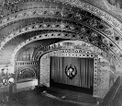
In a proscenium theatre, the audience directly faces the stage, which is typically raised several feet above front row audience level, and views the performance through the proscenium "arch". The space that holds the audience is called the "house". The main stage is the space behind the proscenium arch; it is often delimited by a front curtain
Front curtain
The front curtain, also known as the house curtain, act curtain, grand drape, main drape or main rag is a stage curtain at the very front of a stage....
that can be lowered or drawn closed. The space in front of the curtain is called the "apron
Apron stage
The apron is any part of the stage that extends past the proscenium arch and into the audience or seating area. The Elizabethan stage, which was a raised platform with the audience on three sides, is the outstanding example....
". The stage-level areas obscured by the proscenium arch and any curtains serving the same purpose (often called legs or tormentors) are called the wings, while the space above the stage that is concealed by the top of the proscenium arch is called the flyspace. Any space not viewable to the audiences is collectively referred to as offstage. Proscenium stages range in size from small enclosures to several stories
Floor
A floor is the walking surface of a room or vehicle. Floors vary from simple dirt in a cave to many-layered surfaces using modern technology...
tall.
In general practice, a theatre space is referred to as a "proscenium" any time the audience directly faces the stage, with no audience on any other side, even if there is not a formal proscenium arch over the stage. Because it seems somewhat incongruous to refer to a proscenium theatre when no proscenium arch is present, these theatres are sometimes referred to as "end-on" or "end-stage" theatre spaces.
Origin
In ancient Rome, the stage area in front of the scaenae frons
Scaenae frons
The scaenae frons is the elaborately decorated background of a Roman theatre stage. This area usually has several entrances to the stage including a grand central entrance. The scaenae frons is two or sometime three stories in height and was central to the theatre's visual impact for this was what...
was known as the "proscenium", meaning "in front of the scenery". In the Roman theater, no proscenium arch existed, in the modern sense. However, Roman theaters
Roman theatre (structure)
The characteristics of Roman to those of the earlier Greek theatres due in large part to its influence on the Roman triumvir Gnaeus Pompeius Magnus. Much of the architectural influence on the Romans came from the Greeks, and theatre structural design was no different from other buildings...
were similar to modern proscenium theaters in the sense that the entire audience had a restricted range of views on the stage--all of which were from the front, rather than the sides or back.
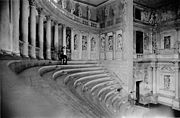
The oldest surviving indoor theater of the modern era, the Teatro Olimpico
Teatro Olimpico
The Teatro Olimpico is a theatre in Vicenza, northern Italy: constructed in 1580-1585, it is the oldest surviving enclosed theatre in the world. The theatre was the final design by the Italian Renaissance architect Andrea Palladio, Renaissance, and was not completed until after his death...
in Vicenza
Vicenza
Vicenza , a city in north-eastern Italy, is the capital of the eponymous province in the Veneto region, at the northern base of the Monte Berico, straddling the Bacchiglione...
(1585), is sometimes incorrectly proposed as the first example of a proscenium theatre. The Teatro Olimpico was an academic reconstruction of an outdoor Roman theater. This emulation of the Roman model extended to referring to the stage area as the "proscenium", and some writers have incorrectly referred to the theater's scaenae frons as a proscenium, and have even suggested that the central archway in the middle of the scaenae frons was the inspiration for the later development of the full-size proscenium arch. There is no evidence at all for this assumption (indeed, contemporary illustrations of performances at the Teatro Olimpico clearly show that the action took place in front of the scaenae frons, and that the actors were rarely framed by the central archway).
The confusion is probably the result of the fact that the Italian word for a scaenae frons is "proscenio." One modern translator explains the wording problem: "[In this translation from Italian,] we retain the Italian proscenio in the text; it cannot be rendered proscenium for obvious reasons; and there is no English equivalent....It would also be possible to retain the classical frons scaenae. The Italian "arco scenico" has been translated as "proscenium arch."
In practice however, the stage in the Teatro Olimpico runs from one edge of the seating area to the other, and only a very limited framing effect is created by the coffered ceiling over the stage and by the partition walls at the corners of the stage where the seating area abuts the floorboards. The result is that in this theater "the architectural spaces for the audience and the action . . . are distinct in treatment yet united by their juxtaposition; no proscenium arch separates them."
However, the Teatro Olimpico's exact replication of the open and accessible Roman stage was the exception rather than the rule in sixteenth-century theatre design. Engravings suggest that the proscenium arch was already in use as early as 1560 at a production in Siena
Siena
Siena is a city in Tuscany, Italy. It is the capital of the province of Siena.The historic centre of Siena has been declared by UNESCO a World Heritage Site. It is one of the nation's most visited tourist attractions, with over 163,000 international arrivals in 2008...
. The most likely candidate for the first true proscenium arch in a permanent theatre is the Teatro Farnese
Teatro Farnese
Teatro Farnese is a Baroque-style theatre in Parma, Italy. It was built in 1618 by Giovanni Battista Aleotti. The theatre was almost destroyed by an Allied air raid during World War II...
in Parma
Parma
Parma is a city in the Italian region of Emilia-Romagna famous for its ham, its cheese, its architecture and the fine countryside around it. This is the home of the University of Parma, one of the oldest universities in the world....
(1618). A clearly defined "arco scenico"--more like a picture frame than an arch, but serving the same purpose--outlines the stage and separates the audience from the action onstage.
Function
The proscenium arch creates a "window" around the scenery and performers. The advantages are that it gives everyone in the audience a good view because the performers need only focus on one direction rather than continually moving around the stage to give a good view from all sides. A proscenium theatre layout also simplifies the hiding and obscuring of objects from the audience's view (sets, performers not currently performing, and theatre technology). Anything that is not meant to be seen is simply placed outside the "window" created by the proscenium arch, either in the wings or in the flyspace above the stage.The side of the stage that faces the audience is referred to as the "fourth wall
Fourth wall
The fourth wall is the imaginary "wall" at the front of the stage in a traditional three-walled box set in a proscenium theatre, through which the audience sees the action in the world of the play...
". The phrase "breaking the proscenium" refers to when a performer addresses the audience directly as part of the dramatic production (is also known as breaking the fourth wall
Fourth wall
The fourth wall is the imaginary "wall" at the front of the stage in a traditional three-walled box set in a proscenium theatre, through which the audience sees the action in the world of the play...
). The phrase can also refer to when a member of the cast or crew walks onto the stage or into the house when there is an audience inside, also breaking the fourth wall.
Proscenium theatres have fallen out of favor in some theatre circles because they perpetuate the fourth wall
Fourth wall
The fourth wall is the imaginary "wall" at the front of the stage in a traditional three-walled box set in a proscenium theatre, through which the audience sees the action in the world of the play...
concept. The staging in proscenium theatres often implies that the characters performing on stage are doing so in a four-walled environment, with the "wall" facing the audience being invisible. Many modern theatres attempt to do away with the fourth wall concept and so are instead designed with a thrust stage
Thrust stage
In theatre, a thrust stage is one that extends into the audience on three sides and is connected to the backstage area by its up stage end. A thrust has the benefit of greater intimacy between performers and the audience than a proscenium, while retaining the utility of a backstage area...
that projects out of the proscenium arch and "reaches" into the audience (technically, this can still be referred to as a proscenium theatre because it still contains a proscenium arch, however the term thrust stage is more specific and more widely used).
Other forms of theatre staging
- Alley theatre: The stage is surrounded on two sides by the audience.
- ThrustThrust stageIn theatre, a thrust stage is one that extends into the audience on three sides and is connected to the backstage area by its up stage end. A thrust has the benefit of greater intimacy between performers and the audience than a proscenium, while retaining the utility of a backstage area...
: The stage is surrounded on three sides (or 270˚) by audience. Can be a modification of a proscenium stage. Sometimes known as "three quarter round". - Theatre in the roundTheatre in the roundTheatre-in-the-round or arena theatre is any theatre space in which the audience surrounds the stage area...
: The stage is surrounded by audience on all sides. - Site-specific theatre (a.k.a. environmental theatre): The stage and audience either blend together, or are in numerous or oddly shaped sections. Includes any form of staging that is not easily classifiable under the above categories.
- Black box theatre: The black box theatre is a relatively recent innovation consisting of a large rectangular room with black walls and a flat floor. The seating is typically composed of loose chairs on platforms, which can be easily moved or removed to allow the entire space to be adapted to the artistic elements of a production.
- Studio theatre layout: Not technically a form of staging, rather a theatre that can be reconfigured to accommodate many forms of staging.
- Reverse in the round: A variant of theatre in the round however the audience sits in a central room and the action happens around them. This variant is usually used in promenade theatre
- Plato: The smallest curtains located above the stage.
External links
- Scenography - The Theatre Design Website Diagram and images of proscenium stage