

Agate

Encyclopedia
Agate is a microcrystalline
variety of silica, chiefly chalcedony
, characterised by its fineness of grain and brightness of color. Although agates may be found in various kinds of rock, they are classically associated with volcanic rocks and can be common in certain metamorphic rocks.
, a Greek philosopher and naturalist, who discovered the stone along the shore line of the river Achates sometime between the 4th and 3rd centuries BC. Colorful agates and other chalcedonies
were obtained over 3,000 years ago from the Achates River, now called Dirillo
, in Sicily
.
, and has been recovered at a number of ancient sites, indicating its widespread use in the ancient world; for example, archaeological recovery at the Knossos
site on Crete
illustrates its role in Bronze Age
Minoan
culture.
in volcanic rocks or ancient lava
s where they represent cavities originally produced by the disengagement of volatiles
in the molten mass which were then filled, wholly or partially, by siliceous matter deposited in regular layers upon the walls. Such agates, when cut transversely, exhibit a succession of parallel lines, often of extreme tenuity, giving a banded appearance to the section. Such stones are known as banded agate, riband agate and striped agate.
In the formation of an ordinary agate, it is probable that waters containing silica in solution—derived, perhaps, from the decomposition of some of the silicates in the lava itself—percolated through the rock and deposited a siliceous coating on the interior of the vapour-vesicles. Variations in the character of the solution or in the conditions of deposition may cause a corresponding variation in the successive layers, so that bands of chalcedony often alternate with layers of crystalline quartz
. Several vapour-vesicles may unite while the rock is still viscous
, and thus form a large cavity which may become the home of an agate of exceptional size; thus a Brazil
ian geode
lined with amethyst
and weighing 35 tons was exhibited at the Düsseldorf Exhibition of 1902. Perhaps the most comprehensive review of agate chemistry is a recent text by Moxon cited below.
The first deposit on the wall of a cavity, forming the "skin" of the agate, is generally a dark greenish mineral substance, like celadonite
, delessite
or "green earth", which are rich in iron
probably derived from the decomposition of the augite
in the enclosing volcanic rock. This green silicate may give rise by alteration to a brown iron oxide
(limonite
), producing a rusty appearance on the outside of the agate-nodule. The outer surface
of an agate, freed from its matrix, is often pitted and rough, apparently in consequence of the removal of the original coating. The first layer spread over the wall of the cavity has been called the "priming", and upon this base zeolitic minerals may be deposited.
Many agates are hollow, since deposition has not proceeded far enough to fill the cavity, and in such cases the last deposit commonly consists of quartz, often amethyst, having the apices of the crystal
s directed towards the free space so as to form a crystal-lined cavity, or geode.
On the disintegration of the matrix in which the agates are embedded, they are set free. The agates are extremely resistant to weathering and remain as nodules in the soil
or are deposited as gravel
in streams and shorelines.
. Dendritic agates have fern like patterns in them formed due to the presence of manganese and iron oxides. Other types of included matter deposited during agate-building include sagenitic growths (radial mineral crystals) and chunks of entrapped detritus (such as sand, ash, or mud). Occasionally agate fills a void left by decomposed vegetative material such as a tree limb or root and is called limb cast agate due to its appearance.
Turritella agate is formed from silicified fossil
Elimia tenera
(erroneously considered Turritella
) shells. E. tenera are spiral marine gastropods having elongated, spiral shells composed of many whorls. Similarly, coral
, petrified wood
and other organic remains or porous rocks can also become agatized. Agatized coral is often referred to as Petoskey stone
or agate.
Greek agate is a name given to pale white to tan colored agate found in Sicily back to 400 B.C. The Greeks used it for making jewelry and beads. Even though the stone had been around centuries and was known to both the Sumerians and the Egyptians, both who used the gem for decoration and for playing important parts in their religious ceremonies, any agate of this color from Sicily, once an ancient Greek colony, is called Greek agate.
Another type of agate is Brazilian agate, which is found as sizable geodes of layered nodules. These occur in brownish tones interlayered with white and gray. Quartz forms within these nodules, creating a striking specimen when cut opposite the layered growth axis. It is often dyed in various colors for ornamental purposes.
Certain stones, when examined in thin section
s by transmitted light, show a diffraction spectrum due to the extreme delicacy of the successive bands, whence they are termed rainbow agates. Often agate coexists with layers or masses of opal, jasper or crystalline quartz due to ambient variations during the formation process.
Other forms of agate include Lake Superior agate
, carnelian agate (usually exhibiting reddish hues), Botswana agate, Ellensburg blue agate, blue lace agate, plume agates, tube agate (with visible flow channels), fortification agate (which exhibit little or no layered structure), fire agate (which seems to glow internally like an opal) and Mexican crazy-lace agate (which exhibits an often brightly colored, complex banded pattern) also called Rodeo Agate and Rosetta Stone depending on who owned the mine at the time.
was one of the centers which made use of agate on an industrial scale. Where in the beginning locally found agates were used to make all types of objects for the European market, this became a globalized business around the turn of the 20th century: Idar-Oberstein imported large quantities of agate from Brazil, as ship's ballast. Making use of a variety of proprietary chemical processes, they produced colored beads that were sold around the globe. Agates have long been used in arts and crafts. The sanctuary of a Presbyterian church in Yachats, Oregon
, has six windows with panes made of agates collected from the local beaches.
Microcrystalline
A microcrystalline material is a crystallized substance or rock that contains small crystals visible only through microscopic examination.-See also:* Macrocrystalline* Microcrystalline silicon* Protocrystalline* Rock microstructure...
variety of silica, chiefly chalcedony
Chalcedony
Chalcedony is a cryptocrystalline form of silica, composed of very fine intergrowths of the minerals quartz and moganite. These are both silica minerals, but they differ in that quartz has a trigonal crystal structure, while moganite is monoclinic...
, characterised by its fineness of grain and brightness of color. Although agates may be found in various kinds of rock, they are classically associated with volcanic rocks and can be common in certain metamorphic rocks.
Etymology and history
The stone was given its name by TheophrastusTheophrastus
Theophrastus , a Greek native of Eresos in Lesbos, was the successor to Aristotle in the Peripatetic school. He came to Athens at a young age, and initially studied in Plato's school. After Plato's death he attached himself to Aristotle. Aristotle bequeathed to Theophrastus his writings, and...
, a Greek philosopher and naturalist, who discovered the stone along the shore line of the river Achates sometime between the 4th and 3rd centuries BC. Colorful agates and other chalcedonies
Chalcedony
Chalcedony is a cryptocrystalline form of silica, composed of very fine intergrowths of the minerals quartz and moganite. These are both silica minerals, but they differ in that quartz has a trigonal crystal structure, while moganite is monoclinic...
were obtained over 3,000 years ago from the Achates River, now called Dirillo
Dirillo
The Dirillo, or Acate, is a river in Sicily which springs from the Hyblaean Mountains and flows through the areas of Vizzini, Licodia Eubea, Mazzarrone, Chiaramonte Gulfi, Acate, Vittoria, Gela. It enters the Strait of Sicily south-east of the town of Gela...
, in Sicily
Sicily
Sicily is a region of Italy, and is the largest island in the Mediterranean Sea. Along with the surrounding minor islands, it constitutes an autonomous region of Italy, the Regione Autonoma Siciliana Sicily has a rich and unique culture, especially with regard to the arts, music, literature,...
.
Ancient use
Agate is one of the most common materials used in the art of hardstone carvingHardstone carving
Hardstone carving is a general term in art history and archaeology for the carving for artistic purposes of semi-precious stones, also known as gemstones, such as jade, rock crystal , agate, onyx, jasper, serpentine or carnelian, and for an object made in this way. Normally the objects are small,...
, and has been recovered at a number of ancient sites, indicating its widespread use in the ancient world; for example, archaeological recovery at the Knossos
Knossos
Knossos , also known as Labyrinth, or Knossos Palace, is the largest Bronze Age archaeological site on Crete and probably the ceremonial and political centre of the Minoan civilization and culture. The palace appears as a maze of workrooms, living spaces, and store rooms close to a central square...
site on Crete
Crete
Crete is the largest and most populous of the Greek islands, the fifth largest island in the Mediterranean Sea, and one of the thirteen administrative regions of Greece. It forms a significant part of the economy and cultural heritage of Greece while retaining its own local cultural traits...
illustrates its role in Bronze Age
Bronze Age
The Bronze Age is a period characterized by the use of copper and its alloy bronze as the chief hard materials in the manufacture of some implements and weapons. Chronologically, it stands between the Stone Age and Iron Age...
Minoan
Minoan civilization
The Minoan civilization was a Bronze Age civilization that arose on the island of Crete and flourished from approximately the 27th century BC to the 15th century BC. It was rediscovered at the beginning of the 20th century through the work of the British archaeologist Arthur Evans...
culture.
Formation and characteristics
Most agates occur as nodulesNodule (geology)
A nodule in petrology or mineralogy is a secondary structure, generally spherical or irregularly rounded in shape. Nodules are typically solid replacement bodies of chert or iron oxides formed during diagenesis of a sedimentary rock...
in volcanic rocks or ancient lava
Lava
Lava refers both to molten rock expelled by a volcano during an eruption and the resulting rock after solidification and cooling. This molten rock is formed in the interior of some planets, including Earth, and some of their satellites. When first erupted from a volcanic vent, lava is a liquid at...
s where they represent cavities originally produced by the disengagement of volatiles
Volatiles
In planetary science, volatiles are that group of chemical elements and chemical compounds with low boiling points that are associated with a planet's or moon's crust and/or atmosphere. Examples include nitrogen, water, carbon dioxide, ammonia, hydrogen, and methane, all compounds of C, H, O...
in the molten mass which were then filled, wholly or partially, by siliceous matter deposited in regular layers upon the walls. Such agates, when cut transversely, exhibit a succession of parallel lines, often of extreme tenuity, giving a banded appearance to the section. Such stones are known as banded agate, riband agate and striped agate.
In the formation of an ordinary agate, it is probable that waters containing silica in solution—derived, perhaps, from the decomposition of some of the silicates in the lava itself—percolated through the rock and deposited a siliceous coating on the interior of the vapour-vesicles. Variations in the character of the solution or in the conditions of deposition may cause a corresponding variation in the successive layers, so that bands of chalcedony often alternate with layers of crystalline quartz
Quartz
Quartz is the second-most-abundant mineral in the Earth's continental crust, after feldspar. It is made up of a continuous framework of SiO4 silicon–oxygen tetrahedra, with each oxygen being shared between two tetrahedra, giving an overall formula SiO2. There are many different varieties of quartz,...
. Several vapour-vesicles may unite while the rock is still viscous
Viscosity
Viscosity is a measure of the resistance of a fluid which is being deformed by either shear or tensile stress. In everyday terms , viscosity is "thickness" or "internal friction". Thus, water is "thin", having a lower viscosity, while honey is "thick", having a higher viscosity...
, and thus form a large cavity which may become the home of an agate of exceptional size; thus a Brazil
Brazil
Brazil , officially the Federative Republic of Brazil , is the largest country in South America. It is the world's fifth largest country, both by geographical area and by population with over 192 million people...
ian geode
Geode
Geodes are geological secondary sedimentary structures which occur in sedimentary and certain volcanic rocks. Geodes are essentially spherical masses of mineral matter that were deposited sygenetically within the rock formations they are found in. Geodes have a Chalcedony shell containing...
lined with amethyst
Amethyst
Amethyst is a violet variety of quartz often used in jewelry. The name comes from the Ancient Greek ἀ a- and μέθυστος methustos , a reference to the belief that the stone protected its owner from drunkenness; the ancient Greeks and Romans wore amethyst and made drinking vessels of it in the belief...
and weighing 35 tons was exhibited at the Düsseldorf Exhibition of 1902. Perhaps the most comprehensive review of agate chemistry is a recent text by Moxon cited below.
The first deposit on the wall of a cavity, forming the "skin" of the agate, is generally a dark greenish mineral substance, like celadonite
Celadonite
Celadonite is a mica group mineral, a phyllosilicate of potassium, iron in both oxidation states, aluminium and hydroxide with formula: K[Si4O10]2....
, delessite
Delessite
Delessite is a mineral variety, a magnesium rich form of chamosite which is a member of the chlorite group. Delessite has the formula: 4O108....
or "green earth", which are rich in iron
Iron
Iron is a chemical element with the symbol Fe and atomic number 26. It is a metal in the first transition series. It is the most common element forming the planet Earth as a whole, forming much of Earth's outer and inner core. It is the fourth most common element in the Earth's crust...
probably derived from the decomposition of the augite
Augite
Augite is a single chain inosilicate mineral, 2O6. The crystals are monoclinic and prismatic. Augite has two prominent cleavages, meeting at angles near 90 degrees.-Characteristics:Augite is a solid solution in the pyroxene group...
in the enclosing volcanic rock. This green silicate may give rise by alteration to a brown iron oxide
Iron oxide
Iron oxides are chemical compounds composed of iron and oxygen. All together, there are sixteen known iron oxides and oxyhydroxides.Iron oxides and oxide-hydroxides are widespread in nature, play an important role in many geological and biological processes, and are widely utilized by humans, e.g.,...
(limonite
Limonite
Limonite is an ore consisting in a mixture of hydrated iron oxide-hydroxide of varying composition. The generic formula is frequently written as FeO·nH2O, although this is not entirely accurate as limonite often contains a varying amount of oxide compared to hydroxide.Together with hematite, it has...
), producing a rusty appearance on the outside of the agate-nodule. The outer surface
Surface
In mathematics, specifically in topology, a surface is a two-dimensional topological manifold. The most familiar examples are those that arise as the boundaries of solid objects in ordinary three-dimensional Euclidean space R3 — for example, the surface of a ball...
of an agate, freed from its matrix, is often pitted and rough, apparently in consequence of the removal of the original coating. The first layer spread over the wall of the cavity has been called the "priming", and upon this base zeolitic minerals may be deposited.
Many agates are hollow, since deposition has not proceeded far enough to fill the cavity, and in such cases the last deposit commonly consists of quartz, often amethyst, having the apices of the crystal
Crystal
A crystal or crystalline solid is a solid material whose constituent atoms, molecules, or ions are arranged in an orderly repeating pattern extending in all three spatial dimensions. The scientific study of crystals and crystal formation is known as crystallography...
s directed towards the free space so as to form a crystal-lined cavity, or geode.
On the disintegration of the matrix in which the agates are embedded, they are set free. The agates are extremely resistant to weathering and remain as nodules in the soil
Soil
Soil is a natural body consisting of layers of mineral constituents of variable thicknesses, which differ from the parent materials in their morphological, physical, chemical, and mineralogical characteristics...
or are deposited as gravel
Gravel
Gravel is composed of unconsolidated rock fragments that have a general particle size range and include size classes from granule- to boulder-sized fragments. Gravel can be sub-categorized into granule and cobble...
in streams and shorelines.
Types of agate
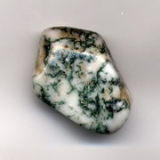
A Mexican agate, showing only a single eye, has received the name of cyclops agate. Included matter of a green, golden, red, black or other color or combinations embedded in the chalcedony and disposed in filaments and other forms suggestive of vegetable growth, gives rise to dendritic or moss agateMoss agate
thumb|Moss agate pebble, 1 inch long.Moss agate is a semi-precious gemstone formed from silicon dioxide. This mineral is commonly found in limestone and granite. It is a form of agate which includes minerals of a green colour embedded in the chalcedony, forming filaments and other patterns...
. Dendritic agates have fern like patterns in them formed due to the presence of manganese and iron oxides. Other types of included matter deposited during agate-building include sagenitic growths (radial mineral crystals) and chunks of entrapped detritus (such as sand, ash, or mud). Occasionally agate fills a void left by decomposed vegetative material such as a tree limb or root and is called limb cast agate due to its appearance.
Turritella agate is formed from silicified fossil
Fossil
Fossils are the preserved remains or traces of animals , plants, and other organisms from the remote past...
Elimia tenera
Elimia tenera
Elimia tenera, formerly known as Goniobasis tenera, is an extinct species of freshwater snails with an operculum, in the aquatic gastropod mollusk family Pleuroceridae...
(erroneously considered Turritella
Turritella
Turritella is a genus of medium-sized sea snails with an operculum, marine gastropod mollusks in the family Turritellidae. They have tightly coiled shells, whose overall shape is basically that of an elongated cone....
) shells. E. tenera are spiral marine gastropods having elongated, spiral shells composed of many whorls. Similarly, coral
Coral
Corals are marine animals in class Anthozoa of phylum Cnidaria typically living in compact colonies of many identical individual "polyps". The group includes the important reef builders that inhabit tropical oceans and secrete calcium carbonate to form a hard skeleton.A coral "head" is a colony of...
, petrified wood
Petrified wood
Petrified wood is the name given to a special type of fossilized remains of terrestrial vegetation. It is the result of a tree having turned completely into stone by the process of permineralization...
and other organic remains or porous rocks can also become agatized. Agatized coral is often referred to as Petoskey stone
Petoskey stone
A Petoskey stone is a rock and a fossil, often pebble-shaped, that is composed of a fossilized coral, Hexagonaria percarinata. The stones were formed as a result of glaciation, in which sheets of ice plucked stones from the bedrock, grinding off their rough edges and depositing them in Michigan's...
or agate.
Greek agate is a name given to pale white to tan colored agate found in Sicily back to 400 B.C. The Greeks used it for making jewelry and beads. Even though the stone had been around centuries and was known to both the Sumerians and the Egyptians, both who used the gem for decoration and for playing important parts in their religious ceremonies, any agate of this color from Sicily, once an ancient Greek colony, is called Greek agate.
Another type of agate is Brazilian agate, which is found as sizable geodes of layered nodules. These occur in brownish tones interlayered with white and gray. Quartz forms within these nodules, creating a striking specimen when cut opposite the layered growth axis. It is often dyed in various colors for ornamental purposes.
Certain stones, when examined in thin section
Thin section
In optical mineralogy and petrography, a thin section is a laboratory preparation of a rock, mineral, soil, pottery, bones, or even metal sample for use with a polarizing petrographic microscope, electron microscope and electron microprobe. A thin sliver of rock is cut from the sample with a...
s by transmitted light, show a diffraction spectrum due to the extreme delicacy of the successive bands, whence they are termed rainbow agates. Often agate coexists with layers or masses of opal, jasper or crystalline quartz due to ambient variations during the formation process.
Other forms of agate include Lake Superior agate
Lake Superior agate
The Lake Superior agate is a type of agate stained by iron and found on the shores of Lake Superior. Its wide distribution and iron-rich bands of color reflect the gemstone's geologic history in Minnesota...
, carnelian agate (usually exhibiting reddish hues), Botswana agate, Ellensburg blue agate, blue lace agate, plume agates, tube agate (with visible flow channels), fortification agate (which exhibit little or no layered structure), fire agate (which seems to glow internally like an opal) and Mexican crazy-lace agate (which exhibits an often brightly colored, complex banded pattern) also called Rodeo Agate and Rosetta Stone depending on who owned the mine at the time.
Uses in industry and art
Industry uses agates chiefly to make ornaments such as pins, brooches, paper knives, inkstands, marbles and seals. Because of its hardness and ability to resist acids, agate is used to make mortars and pestles to crush and mix chemicals. Because of the high polish possible with agate it has been used for centuries for leather burnishing tools. Idar-ObersteinIdar-Oberstein
Idar-Oberstein is a town in the Birkenfeld district in Rhineland-Palatinate, Germany. As a Große kreisangehörige Stadt , it assumes some of the responsibilities that for smaller municipalities in the district are assumed by the district administration...
was one of the centers which made use of agate on an industrial scale. Where in the beginning locally found agates were used to make all types of objects for the European market, this became a globalized business around the turn of the 20th century: Idar-Oberstein imported large quantities of agate from Brazil, as ship's ballast. Making use of a variety of proprietary chemical processes, they produced colored beads that were sold around the globe. Agates have long been used in arts and crafts. The sanctuary of a Presbyterian church in Yachats, Oregon
Yachats, Oregon
Yachats is a small coastal city in Lincoln County, Oregon, United States. According to Oregon Geographic Names, the name comes from the Siletz language, and means "dark water at the foot of the mountain". There is a range of differing etymologies, however. William Bright says the name comes from...
, has six windows with panes made of agates collected from the local beaches.