
All Topics  
Architecture of Ancient Greece

 
Architecture of Ancient Greece

   Email Print
   Bookmark   Link


Architecture of Ancient Greece


Architecture
Architecture

The term architecture can refer to a process, a profession or documentation.As a process, architecture is the activity of designing and construction buildings and other physical structures by a person or a computer, primarily to provide shelter....
 was extinct in Greece
Greece

Greece , officially the Hellenic Republic , is a country in southeastern Europe, situated on the southern end of the Balkans. It has borders with Albania, Bulgaria and the former Yugoslav Republic of Macedonia to the north, and Turkey to the east....
 from the end of the Mycenaean
Helladic period

Helladic is a modern archaeological term meant to identify a sequence of periods characterizing the culture of mainland ancient Greece during the Bronze Age....
 period (about 1200 BC) to the 7th century BC, when plebian life and prosperity recovered to a point where public building could be undertaken. But since many Greek buildings in the colonization period (8th
8th century BC

The 8th century BC started the first day of 800 BC and ended the last day of 701 BC....
 - 6th century BC), were made of wood
Wood

Wood is an organic material; in the strict sense wood is produced as secondary xylem in the stems of woody plants, notably trees but also shrubs, etc....
 or mud-brick or clay
Clay

Clay is a naturally occurring material composed primarily of fine-grained minerals, which show plasticity through a variable range of water content, and which can be hardened when dried and/or fired....
, nothing remains of them except for a few ground-plans, and almost no written sources on early architecture or descriptions of these embryonic buildings exist.

Common materials of Greek architecture were wood
Wood

Wood is an organic material; in the strict sense wood is produced as secondary xylem in the stems of woody plants, notably trees but also shrubs, etc....
, used for supports and roof beams; plaster, used for sinks and bathtubs; unbaked brick, used for walls, especially for private homes; limestone
Limestone

File:Limestone Formation In Waitomo.jpgLimestone is a sedimentary rock composed largely of the mineral calcite . The deposition of limestone strata is often a by-product and indicator of biological activity in the geology record....
 and marble
Marble

Marble is a nonfoliated metamorphic rock resulting from the metamorphism of limestone, composed mostly of calcite . It is extensively used for Marble sculpture, as a architecture material, and in many other applications....
, used for columns, walls, and upper portions of temples and public buildings; terracotta, used for roof tiles and ornaments; and metals, especially bronze
Bronze

Bronze is a metal alloy consisting primarily of copper, usually with tin as the main additive, but sometimes with other chemical element such as phosphorus, manganese, aluminium, or silicon....
, used for decorative details.


Discussion
Ask a question about 'Architecture of Ancient Greece'
Start a new discussion about 'Architecture of Ancient Greece'
Answer questions from other users
Full Discussion Forum


Recent Posts


Encyclopedia


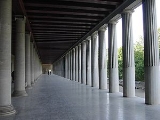
Stoa in Athens
Architecture
Architecture

The term architecture can refer to a process, a profession or documentation.As a process, architecture is the activity of designing and construction buildings and other physical structures by a person or a computer, primarily to provide shelter....
 was extinct in Greece
Greece

Greece , officially the Hellenic Republic , is a country in southeastern Europe, situated on the southern end of the Balkans. It has borders with Albania, Bulgaria and the former Yugoslav Republic of Macedonia to the north, and Turkey to the east....
 from the end of the Mycenaean
Helladic period

Helladic is a modern archaeological term meant to identify a sequence of periods characterizing the culture of mainland ancient Greece during the Bronze Age....
 period (about 1200 BC) to the 7th century BC, when plebian life and prosperity recovered to a point where public building could be undertaken. But since many Greek buildings in the colonization period (8th
8th century BC

The 8th century BC started the first day of 800 BC and ended the last day of 701 BC....
 - 6th century BC), were made of wood
Wood

Wood is an organic material; in the strict sense wood is produced as secondary xylem in the stems of woody plants, notably trees but also shrubs, etc....
 or mud-brick or clay
Clay

Clay is a naturally occurring material composed primarily of fine-grained minerals, which show plasticity through a variable range of water content, and which can be hardened when dried and/or fired....
, nothing remains of them except for a few ground-plans, and almost no written sources on early architecture or descriptions of these embryonic buildings exist.

Common materials of Greek architecture were wood
Wood

Wood is an organic material; in the strict sense wood is produced as secondary xylem in the stems of woody plants, notably trees but also shrubs, etc....
, used for supports and roof beams; plaster, used for sinks and bathtubs; unbaked brick, used for walls, especially for private homes; limestone
Limestone

File:Limestone Formation In Waitomo.jpgLimestone is a sedimentary rock composed largely of the mineral calcite . The deposition of limestone strata is often a by-product and indicator of biological activity in the geology record....
 and marble
Marble

Marble is a nonfoliated metamorphic rock resulting from the metamorphism of limestone, composed mostly of calcite . It is extensively used for Marble sculpture, as a architecture material, and in many other applications....
, used for columns, walls, and upper portions of temples and public buildings; terracotta, used for roof tiles and ornaments; and metals, especially bronze
Bronze

Bronze is a metal alloy consisting primarily of copper, usually with tin as the main additive, but sometimes with other chemical element such as phosphorus, manganese, aluminium, or silicon....
, used for decorative details. Architects of the Archaic and Classical periods used these building materials to construct five simple types of buildings: religious, civic, domestic, funerary, or recreational.

History


Around 600 BC, the wooden column
Column

File:National Capitol Columns - Washington, D.C..jpgA column in structural engineering is a vertical structural element that transmits, through physical compression, the weight of the structure above to other structural elements below....
s of the old Temple of Hera
Temple of Hera (Olympia)

The Temple of Hera is an ancient Doric order Greek temple at Olympia, Greece, Greece. The Temple of Hera was destroyed by an earthquake in the early 4th century AD, and never rebuilt....
 at Olympia
Olympia, Greece

Olympia , a sanctuary of ancient Greece in Elis, is known for having been the site of the Olympic Games in classical times, comparable in importance to the Pythian Games held in Delphi....
 underwent a material transformation, known as "petrification", in which they were replaced by stone
Rock (geology)

In geology, rock is a naturally occurring solid aggregate of minerals and/or mineraloids.The Earth's outer solid layer, the lithosphere, is made of rock....
 columns. By degrees, other parts of the temple were "petrified".

Most of our knowledge of Greek architecture comes from the late archaic period (550 - 500 BC), the Periclean age (450 - 430 BC), and the early to pure classical
Classical architecture

Classical architecture is the set of building styles and techniques of Classical Greece, as used in ancient Greece, the Hellenistic period, and the Roman empire....
 period (430 - 400 BC). Greek examples are considered alongside Hellenistic and Roman
Ancient Rome

Ancient Rome was a civilization that grew out of a small agricultural community founded on the Italian Peninsula as early as the 10th century BC....
 periods (since Roman architecture
Roman architecture

The Architecture of Ancient Rome adopted the external Greek Architecture for their own purposes, which were so different from Greek buildings as to create a new architecture style....
 heavily copied Greek), and late written sources such as Vitruvius
Vitruvius

File:Vitruvius.jpgMarcus Vitruvius Pollio was a Ancient Rome writer, architect and engineer , active in the 1st century BC. By his own description Vitruvius served as a Ballista , the third class of arms in the military offices....
 (1st century). This results in a strong bias towards temple
Temple

A temple is a structure reserved for religious or spiritual activities, such as prayer and sacrifice, or analogous rites. A ??templum?? constituted a sacred precinct as defined by a priest, or augur....
s, the only buildings which survive in large numbers!

Like Greek painting
Painting

Painting is the practice of applying paint, pigment, color or other medium to a surface . In art, the term describes both the act and the result, which is called a painting....
 and sculpture
Sculpture

Sculpture is Three-dimensional space artwork created by shaping or combining hard and or plastic material, sound, and or text and or light, commonly Stone sculpture , metal, glass, or wood....
, Greek Architecture
Architecture

The term architecture can refer to a process, a profession or documentation.As a process, architecture is the activity of designing and construction buildings and other physical structures by a person or a computer, primarily to provide shelter....
 in the first half of classical antiquity
Classical antiquity

Classical antiquity is a broad term for a long period of cultural history centered on the Mediterranean Sea, comprising the interlocking civilizations of Ancient Greece and Ancient Rome....
 was not "art for art's sake
Art for art's sake

"Art for art's sake" is the usual English language rendition of a French language slogan, from the early 19th century, l'art pour l'art, and expresses a philosophy that the intrinsic value of art, and the only "true" art, is divorced from any didactic, moral or utilitarian function....
" in the modern sense. The architect was a craftsman
Artisan

An artisan is a skilled manual labor worker who crafts items that may be functional or strictly decorative, including furniture, clothing, jewelry, household items, and tools....
 employed by the state or a wealthy private client. No distinction was made between the architect and the building contractor. The architect designed the building, hired the laborers and craftsmen who built it, and was responsible for both its budget and its timely completion. He did not enjoy any of the lofty status accorded to modern architects of public buildings. Even the names of architects are not known before the 5th century. An architect like Iktinos
Iktinos

Iktinos was an architect active in the mid 5th century BC. Ancient sources identify Iktinos and Kallikrates as co-architects of the Parthenon....
, who designed the Parthenon
Parthenon

The Parthenon is a Greek temple of the Greek gods Athena, built in the 5th century BC on the Acropolis of Athens. It is the most important surviving building of Classical Greece, generally considered to be the culmination of the development of the Doric order....
, who would today be seen as a genius, was treated in his lifetime as no more than a very valuable master tradesman.

Greek public architecture


The temple
Greek temple

Greek temples were structures built to house deity statues within Greek sanctuaries in Greek paganism. The temples themselves did usually not directly serve a cult purpose, since the sacrifices and rituals dedicated to the respective deity took place outside them....
 was the most common and best-known form of Greek public architecture. The temple did not serve the same function as a modern church, since the altar stood under the open sky in the temenos
Temenos

Temenos is a piece of land cut off and assigned as an official domain, especially to basileus and anax, or a piece of land marked off from common uses and dedicated to a god, a sanctuary, holy grove or holy precinct: The Pythian Games race-course is called a temenos, the sacred valley of the Nile is the ?e????? p??? t??e??? ?????da, the...
 or sacred fane, often directly before the temple. Temples served as storage places for the treasury associated with the cult of the god in question, as the location of a cult image
Cult image

In the practice of religion, a cult image is a man-made object that is venerated for the deity, spirit or daemon that it embodies or represents....
, and as a place for devotees of the god to leave their votive offering
Votive offering

A votive deposit or votive offering is an object left in a sacred place for ritual purposes. Such items are a feature of modern and ancient societies and are generally made in order to gain favor with supernatural forces....
s, such as statues, helmets and weapons. The inner room of the temple, the cella
Cella

A cella or naos , is the inner chamber of a temple in classical architecture, or a shop facing the street in domestic Roman architecture ....
, served mainly as a strongroom and storeroom. It was usually lined by another row of columns. Some Greek temples were oriented astronomically.

Other architectural forms used by the Greeks were the tholos
Tholos

As a generic term tholos tomb is an alternative name for a Beehive tomb from the late Bronze Age.It is also the name given to several Ancient Greece structures and buildings:...
 or circular temple, of which the best example is the Tholos of Theodorus at Delphi
Delphi

Delphi is an archaeology site and a modern town in Greece on the south-western spur of Mount Parnassus in the valley of Phocis. Delphi was the site of the Pythia, the most important oracle in the classical Greek world, when it was a major site for the worship of the god Apollo after he slew the Python , a deity who lived there and protecte...
 dedicated to the worship of Athena
Athena

In Greek mythology, Athena is the shrewd companion of Hero and the goddess of Hero endeavour. She is the virgin patron of Athens, which built the Parthenon to worship her....
 Pronaia; the propylon or porch, forming the entrance to temple sanctuaries (the best-surviving example is the Propylaea
Propylaea

A Propylaea, Propylea or Propylaia is any monumental gateway based on the original Propylaea that serves as the entrance to the Acropolis in Athens....
 on the Acropolis of Athens
Acropolis of Athens

The Acropolis of Athens is the best known acropolis in the world. Although there are many other acropolises in Greece, the significance of the Acropolis of Athens is such that it is commonly known as The Acropolis without qualification....
); the fountain house, a building where women filled their vases with water from a public fountain; and the stoa
Stoa

Stoa in Architecture of Ancient Greece; covered walkways or porticos, commonly for public usage. Early stoae were open at the entrance with columns lining the side of the building, creating an enveloping, protective atmosphere and were usually of Doric order....
, a long narrow hall with an open colonnade
Colonnade

In classical architecture, a colonnade denotes a long sequence of columns joined by their entablature, often free-standing, as in the famous elliptically curving colonnades that Bernini added to the fa?ade of The apostel Peter's Basilica in Rome, which embrace and define the Piazza....
 on one side, which was used to house rows of shops in the agora
Agora

The Agora was an open "place of assembly" in ancient Ancient Greece city-states. Early in Greek history , free-born male land-owners who were citizens would gather in the agora for military duty or to hear statements of the ruling king or council....
s (commercial centers) of Greek towns. A completely restored stoa, the Stoa of Attalus, can be seen in Athens
Athens

Athens , the Capital and largest city of Greece, dominates the Attica periphery; as one of the List of cities by time of continuous habitation, its recorded history spans around 3,400 years....
. Greek towns of substantial size also had a palaestra
Palaestra

The palaestra was the History of Ancient Greece wrestling school. The events that did not require a lot of space, such as boxing and Amateur wrestling, were practiced there....
 or a gymnasium
Gymnasium (ancient Greece)

The gymnasium in ancient Greece functioned as a training facility for competitors in public games. It was also a place for socializing and engaging in intellectual pursuits....
, the social centre for male citizens. These peripterally enclosed space open to the sky were used for athletic contests and exercise. Greek towns also needed at least one bouleuterion
Bouleuterion

A bouleuterion was a building which housed the council of citizens in Ancient Greece. There are several extant remains of Bouleuterions around Greece and former Greek territories of ancient times....
 or council chamber, a large public building which served as a court house and as a meeting place for the town council (boule
Boule

The term Boule may refer to:* Boule , plural boulai, assembly forming part of city governments in Ancient Greece* Boule , block of synthetically-produced crystal material...
). Because the Greeks did not use arches or domes, they could not construct buildings with large interior spaces. The bouleuterion thus had rows of internal columns to hold the roof up (hypostyle
Hypostyle

In architecture, a hypostyle hall has a flat ceiling which is supported by columns, as in the Great Hypostyle Hall, Karnak at Karnak. In this case the columns flanking the central avenue are of greater height than those of the side aisles, and this allows openings in the wall above the smaller columns, through which light is admitted over th...
). No examples of these buildings survive.

Finally, every Greek town had a theatre
Theatre

Theatre is the branch of the performing arts defined by Bernard Beckerman as what "occurs when one or more actor, isolated in time and/or Theater , present themselves to Audience." By this broad definition, theatre has existed since the dawn of man, as a result of human tendency for story telling....
. These were used for both public meetings as well as dramatic performances. The theatre was usually set in a hillside outside the town, and had rows of tiered seating set in a semi-circle around the central performance area, the orchestra. Behind the orchestra was a low building called the skene
Skene

In classical drama, the skene was the background building which connected the platform stage, in which costumes were stored and to which the periaktoi were connected....
, which served as a store-room, a dressing-room, and also as a backdrop to the action taking place in the orchestra. A number of Greek theatres survive almost intact, the best known being at Epidaurus
Epidaurus

Epidaurus was a small city in ancient Greece, at the Saronic Gulf. The modern town Epidavros , part of the prefecture of Argolis, was built near the ancient site....
.

Orders of Greek architecture


There were two main styles (or "orders") of early Greek architecture, the Doric
Doric order

The Doric order was one of the Classical order of Architecture of Ancient Greece or classical architecture; the other two canonical orders were the Ionic order and the Corinthian order....
 and the Ionic
Ionic order

The Ionic order column forms one of the Classical order of classical architecture, the other two canonic orders being the Doric order and the Corinthian order....
. These names were used by the Greeks themselves, and reflected their belief that the styles descended from the Dorian and Ionian Greeks of the Dark Ages, but this is unlikely to be true. The Doric style was used in mainland Greece and spread from there to the Greek colonies in Italy
Italy

Italy , officially the Italian Republic , is a country located on the Italian Peninsula in Southern Europe and on the two largest islands in the Mediterranean Sea, Sicily and Sardinia....
. The Ionic style was used in the cities of Ionia (now the west coast of Turkey
Turkey

Turkey , known officially as the Republic of Turkey , is a Eurasian country that stretches across the Anatolian peninsula in southwest Asia and Thrace in the Balkans region of Southern Europe....
) and some of the Aegean
Aegean Sea

The Aegean Sea is an elongated embayment of the Mediterranean Sea located between the southern Balkans and Anatolian peninsulas, i.e., between the mainlands of Greece and Turkey respectively....
 islands. The Doric style was more formal and austere, the Ionic was more relaxed and decorative. The more ornate Corinthian
Corinthian order

The Corinthian order is one of the Classical orders of Greece and Rome architecture, characterized by a slender Fluting column and an ornate capital decorated with acanthus leaves and scrolls....
 style was a later development of the Ionic. These styles are best known through the three orders of column capitals, but there are differences in most points of design and decoration between the orders.

Most surviving Greek buildings, such as the Parthenon
Parthenon

The Parthenon is a Greek temple of the Greek gods Athena, built in the 5th century BC on the Acropolis of Athens. It is the most important surviving building of Classical Greece, generally considered to be the culmination of the development of the Doric order....
 and the Temple of Hephaestus
Temple of Hephaestus

The Temple of Hephaestus and Athena Ergane , also known as the Hephaisteion or Theseion , is the best preserved ancient Greek temple....
 in Athens, are Doric. The Erechtheum
Erechtheum

The Erechtheum is an ancient Greek temple on the north side of the Acropolis, Athens of Athens in Greece....
 and the small temple of Athena
Athena

In Greek mythology, Athena is the shrewd companion of Hero and the goddess of Hero endeavour. She is the virgin patron of Athens, which built the Parthenon to worship her....
 Nike on the Acropolis are Ionic however. The Ionic order became dominant in the Hellenistic period
Hellenistic period

The Hellenistic period describes the era which followed the conquests of Alexander the Great. During this time, Greek cultural influence and power was at its zenith in Europe and Asia....
, since its more decorative style suited the aesthetic of the period better than the more restrained Doric. Records show that the evolution of the Ionic order was resisted by many Greek States, as they claimed it represented the dominance of Athens
Athens

Athens , the Capital and largest city of Greece, dominates the Attica periphery; as one of the List of cities by time of continuous habitation, its recorded history spans around 3,400 years....
. Some of the best surviving Hellenistic buildings, such as the Library of Celsus, can be seen in Turkey
Turkey

Turkey , known officially as the Republic of Turkey , is a Eurasian country that stretches across the Anatolian peninsula in southwest Asia and Thrace in the Balkans region of Southern Europe....
, at cities such as Ephesus
Ephesus

Ephesus was an ancient Greek city on the west coast of Anatolia, in the region known as Ionia during the period known as Classical Greece. It was one of the twelve cities of the Ionian League....
 and Pergamum. But in the greatest of Hellenistic cities, Alexandria
Alexandria

Alexandria , with a population of 4.1 million, is the second-largest city in Egypt, and is the country's largest seaport, serving about 80% of Egypt's imports and exports....
 in Egypt
Egypt

Egypt is a country mainly in North Africa, with the Sinai Peninsula forming a land bridge in Western Asia. Covering an area of about , Egypt borders the Mediterranean Sea to the north, the Gaza Strip and Israel to the northeast, the Red Sea to the east, Sudan to the south and Libya to the west....
, almost nothing survives.

Roof tiles

The earliest finds of roof tiles in archaic Greece
Archaic period in Greece

The archaic period in Greece is a period of Ancient Greece history. The term originated in the 18th century and has been standard since. This term arose from the study of Greek art, where it refers to styles mainly of Decorative art and Plastic arts, falling in time between Geometric Art and the art of Classical Greece....
 are documented from a very restricted area around Corinth
Corinth

Corinth, or Korinth Corinth is now the capital of the Prefectures of Greece of Corinthia. The city is surrounded by the coastal townlets of Lechaio, Isthmia, Kechries, and the inland townlets of Examilia and the archaeological site....
 (Greece
Greece

Greece , officially the Hellenic Republic , is a country in southeastern Europe, situated on the southern end of the Balkans. It has borders with Albania, Bulgaria and the former Yugoslav Republic of Macedonia to the north, and Turkey to the east....
), where fired tiles began to replace thatched roofs at two temples of Apollo
Apollo

In Greek mythology and Roman mythology, Apollo , is one of the most important and many-sided of the Twelve Olympians. The ideal of the kouros , Apollo has been variously recognized as a god of light and the sun; truth and prophecy; archery; medicine and healing; music, poetry, and the arts; and more....
 and Poseidon
Poseidon

In Greek mythology, Poseidon was the god of the sea and, as "Earth-Shaker," of earthquakes. The name of the god Nethuns in Etruscan mythology was adopted in Latin for Neptune in Roman mythology: both were sea gods analogous to Poseidon....
 between 700-650 BC. Spreading rapidly, roof tiles were within fifty years in evidence for a large number of sites around the Eastern Mediterranean
Mediterranean Sea

The Mediterranean Sea is a sea or Ocean off the Atlantic Ocean surrounded by the Mediterranean region and almost completely enclosed by land: on the north by Europe, on the south by Africa, and on the east by Asia....
, including Mainland Greece
Greece

Greece , officially the Hellenic Republic , is a country in southeastern Europe, situated on the southern end of the Balkans. It has borders with Albania, Bulgaria and the former Yugoslav Republic of Macedonia to the north, and Turkey to the east....
, Western Asia Minor, Southern and Central Italy
Italy

Italy , officially the Italian Republic , is a country located on the Italian Peninsula in Southern Europe and on the two largest islands in the Mediterranean Sea, Sicily and Sardinia....
. Early roof tiles showed an S-shape, with the pan and cover tile forming one piece. They were rather bulky, weighing around 30 kg apiece. Being more expensive and labour-intensive to produce than thatchet, their introduction has been explained with their greatly enhanced fire resistance which gave desired protection to the costly temples.

The spread of the roof tile technique has to be viewed in connection with the simultaneous rise of monumental architecture in Archaic Greece. Only stone walls, which were replacing the earlier mudbrick
Mudbrick

A mudbrick is a firefree brick made of clay, or mud mixed with a binding material such as rice husks or straw.In warm regions with very little timber available to fuel a kiln, bricks were generally sun dried....
 and wood walls, were strong enough to support the weight of a tiled roof. As a side-effect, it has been assumed that the new stone and tile construction also ushered in the end of 'Chinese roof' (Knickdach) construction in Greek architecture, as they made the need for an extended roof as rain protection for the mudbrick walls obsolete.

See also

  • Greek temple
    Greek temple

    Greek temples were structures built to house deity statues within Greek sanctuaries in Greek paganism. The temples themselves did usually not directly serve a cult purpose, since the sacrifices and rituals dedicated to the respective deity took place outside them....
  • Byzantine Architecture
    Byzantine architecture

    Byzantine architecture is the architecture of the Byzantine Empire. The empire gradually emerged as a distinct artistic and cultural entity from what is today referred to as the Roman Empire after AD 330, when the Roman Emperor Constantine I moved the capital of the Roman Empire east from Rome to Byzantium....
  • Greek technology
  • Greek culture


Footnotes